ESP Seat Alhambra 2011 Manual PDF
[x] Cancel search | Manufacturer: SEAT, Model Year: 2011, Model line: Alhambra, Model: Seat Alhambra 2011Pages: 385, PDF Size: 7.92 MB
Page 241 of 385
239
Trailer towing
● The trailer must have a fixed drawbar.
● Tr
ailers with brakes must be equipped with a mechanical inertia brake. WARNING
Do not let the extra safety afforded by the stabilisation system tempt you
into t ak
ing any risks when driving.
● Adjust your speed and driving style to visibility, road, traffic and
weather c
onditions.
● If the road surface is slippery, take care when accelerating.
● When a system is operating, lift your foot off the accelerator. WARNING
It is possible that the combination stabilisation system does not correct-
ly r ec
ognised all driving situations.
● It is possible that the stabilisation system does not detect snaking of
a light trai
ler and thus does not intervene.
● When driving on slippery ground, the trailer could jack-knife
despite
the stabilisation system.
● Trailers with a high centre of gravity may even tip over before they
star
t to rock sideways.
● If a trailer is not used at the trailer socket is connected (for example,
inst
allation of a bicycle carrier with lights), repeated automatic braking
may occur in extreme driving conditions. Retrofitting a tow hitch
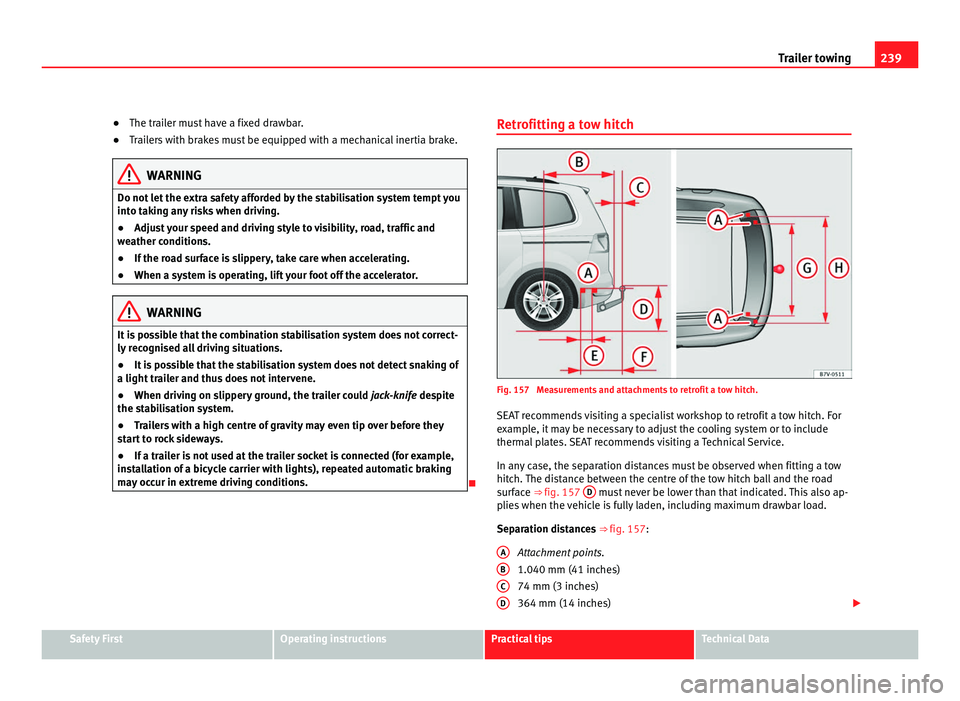
Fig. 157 Measurements and attachments to retrofit a tow hitch.
SEA T r
ecommends visiting a specialist workshop to retrofit a tow hitch. For
example, it may be necessary to adjust the cooling system or to include
thermal plates. SEAT recommends visiting a Technical Service.
In any case, the separation distances must be observed when fitting a tow
hitch. The distance between the centre of the tow hitch ball and the road
surface ⇒ fig. 157 D must never be lower than that indicated. This also ap-
plie s
when the vehicle is fully laden, including maximum drawbar load.
Separation distances ⇒ fig. 157:
Attachment points.
1.040 mm (41 inches)
74 mm (3 inches)
364 mm (14 inches)
A B
C
D
Safety First Operating instructions Practical tips Technical Data
Page 244 of 385
242
Vehicle maintenance and cleaning
Vehicle maintenance and cleaning
Care and cleaning the vehicle exterior
Introduction Regular maintenance and washing help to maint
ain the value of the vehicle.
This may also be one of the requirements for acknowledging warranty
claims in the event of bodywork corrosion or paint defects.
Products suitable for the care of your vehicle are available at any Technical
Service.
Additional information and warnings:
● Care and cleaning of the vehicle interior ⇒ page 249
● W
orking in the engine compartment ⇒ page 275
● A
ccessories, parts replacement, repairs and modifications ⇒ page 257WARNING
Car care products may be toxic and hazardous. If car care products are
not s uit
able or are used inappropriately, this could result in accident, se-
rious injury, burns or intoxication.
● Car care products must always be stored in the original container
which shoul
d be kept closed.
● Observe information provided by the manufacturer.
● To prevent confusion, never store car care products in empty food
cans, bottl
es or other containers.
● Keep all care products out of reach of children. WARNING (Continued)
● Harmf ul vapours may be produced when using car care products.
Ther ef
ore, care products should only be used in well-ventilated spaces or
in the open air.
● Never use fuel, turpentine, engine oil, acetone or any other volatile
liquid to w
ash, clean or care for the vehicle. These are toxic and highly
flammable. WARNING
Inappropriate care and cleaning of vehicle components may effect the ve-
hicl e s
afety equipment, increasing the risk of severe injury.
● Vehicle components should only be cleaned and maintained in ac-
cord
ance with the manufacturer's instructions.
● Only use approved or recommended care products. CAUTION
Cleaning products which contain solvents will damage the material. For the sake of the environment
● Only wash the vehicle in areas allocated for this purpose, to prevent
dir ty
water which may be contaminated by oil, grease or fuel, from entering
the drains. In some districts, washing vehicles outside wash bays is prohibi-
ted.
● Where possible, always use products which respect the environment.
● The remains of car care products should not be disposed of with ordina-
ry hou
sehold waste. Observe information provided by the manufacturer.
Page 248 of 385
246
Vehicle maintenance and cleaning
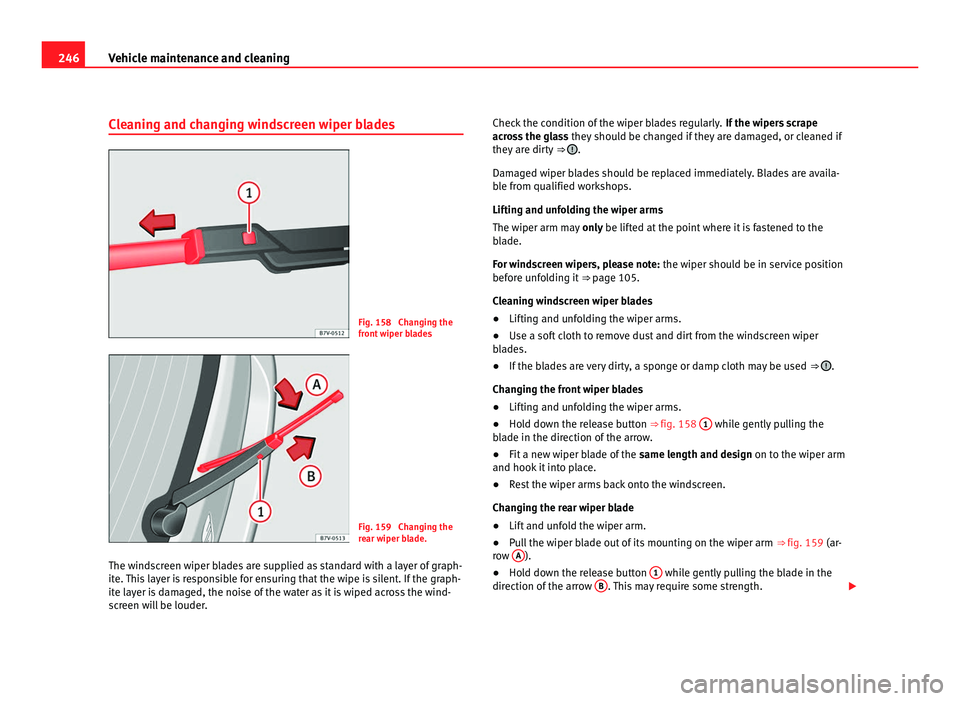
Cleaning and changing windscreen wiper blades Fig. 158 Changing the
front
w
iper blades Fig. 159 Changing the
re
ar w
iper blade.
The windscreen wiper blades are supplied as standard with a layer of graph-
ite. Thi
s layer is responsible for ensuring that the wipe is silent. If the graph-
ite layer is damaged, the noise of the water as it is wiped across the wind-
screen will be louder. Check the condition of the wiper blades regularly.
If the wiper
s scrape
across the glass they should be changed if they are damaged, or cleaned if
they are dirty ⇒ .
Damag ed w
iper blades should be replaced immediately. Blades are availa-
ble from qualified workshops.
Lifting and unfolding the wiper arms
The wiper arm may only be lifted at the point where it is fastened to the
blade.
For windscreen wipers, please note: the wiper should be in service position
before unfolding it ⇒ page 105.
Cleaning windscreen wiper blades
● Lifting and unfolding the wiper arms.
● Use a soft cloth to remove dust and dirt from the windscreen wiper
bla
des.
● If the blades are very dirty, a sponge or damp cloth may be used ⇒ .
Chan gin
g the front wiper blades
● Lifting and unfolding the wiper arms.
● Hold down the release button ⇒ fig. 158 1 while gently pulling the
bl a
de in the direction of the arrow.
● Fit a new wiper blade of the same len
gth and design on to the wiper arm
and hook it into place.
● Rest the wiper arms back onto the windscreen.
Changin
g the rear wiper blade
● Lift and unfold the wiper arm.
● Pull the wiper blade out of its mounting on the wiper arm ⇒ fig. 159 (ar-
ro
w A ).
● Hold down the release button 1 while gently pulling the blade in the
direction of the arr
ow B . This may require some strength.
Page 251 of 385
249
Vehicle maintenance and cleaning WARNING
Additional underseal or anti-corrosion products could catch fire due to
the high temper at
ures reached by the exhaust gas system and other en-
gine components.
● Do not apply additional underseal or anti-corrosion products to the
exhau
st pipes, catalytic converters, heat shields or other parts of the ve-
hicle which reach high temperatures.
Cleaning the engine compartment The engine compartment of any motor vehicle is a potentially hazardous
are
a
⇒ page 275.
The engine compartment should only be cleaned by qualified personnel. If
it is not correctly cleaned, the anti-corrosion coating and consequently elec-
trical components may be damaged. Moreover, water may filter directly into
the vehicle interior through the water chamber ⇒ .
If the en gine c
ompartment is very dirty, always take the vehicle to a Techni-
cal Service for professional cleaning. SEAT recommends visiting a Technical
Service.
Water box
The water box is in the engine compartment, between the windscreen and
the engine, and beneath a perforated cover. Air is taken in through the wa-
ter box from outside to the vehicle interior via the heating and air condition-
ing system.
Leaves and other loose objects should be regularly cleaned away from the
water box either by hand or with a vacuum. WARNING
When working on the engine or in the engine compartment, there is a
risk of
injury, burns, accident or fire.
● Before starting work, please ensure you are familiar with the required
procedur
e and the safety precautions ⇒ page 275.
● SEAT recommends you have this work performed by a qualified deal-
ership. CAUTION
If water is manually poured into the water box (for example, using a high
pre s
sure cleaning appliance), this could cause significant damage to the ve-
hicle. For the sake of the environment
Only wash the engine compartment in areas allocated for this purpose, to
prev ent
dirty water which may be contaminated by oil, grease or fuel, from
entering the drains. In some districts, the engine compartment may not be
washed outside the wash bays provided for this purpose.
Caring for and cleaning the vehicle interior Introduction The dye from many items of modern clothing (e.g. dark jeans) is not always
solid enough.
Se
at upholstery (material and leather), especially when light-
coloured, may visibly discolour if the dye comes out of clothing (even when
used correctly). This is not an upholstery defect but indicates that the dye in
the item of clothing is not solid enough. Safety First Operating instructions Practical tips Technical Data
Page 253 of 385
251
Vehicle maintenance and cleaning CAUTION
Failure to observe the instructions in the check list for caring for your up-
hol s
tery could result in damage or discolouration of the upholstery and cov-
ers.
● Always follow the check list and perform the necessary operations. Note
SEAT recommends you take the vehicle to a Technical Service to treat any
stain
s on the upholstery caused by the discolouration of clothing.
Cleaning upholstery, textile covers and Alcantara ®
mat eri
alNormal cleaning
●
Before applying cleaning products, please read the instructions for han-
dling and the w arnin
gs shown on the container.
● The upholstery, textile covers, Alcantara ®
materi
al and mats should be
regularly vacuumed (with vacuum brush).
● We recommend that you use a soft sponge or lint-free, micro-fibre cloth
for normal
cleaning ⇒ .
● Clean Alcantara ®
sur f
aces with a damp lint-free cotton, wool or micro-
fibre cloth used for normal cleaning ⇒ .
General s
uperficial dirt on upholstery and textile covers can be cleaned with
a normal foam cleaning product.
If the upholstery and the material trims are very dirty, we recommend you
have them cleaned by a specialist cleaning form.
Cleaning stains
It may be necessary to clean the whole surface and not only the stain itself.
Especially if the surface has been dirtied through normal use. Otherwise, the stained area may become lighter than the rest of the surface after treat-
ment. Type of stain Cleaning the vehicle
Water-based stains
,
e.g. c off
ee or fruit
juice.
Use a sponge and wipe with a solution of water
and w oo
l wash.
Dry the area gently with a soft dry cloth. Persistent stains
,
e.g. c hoc
olate or
make-up.
Apply cleaning paste a)
dir ectly to the stain and
treat.
Next, rinse with clean water using a sponge or
damp cloth to remove the cleaning product deposits.
Carefully dry the area with an absorbent dry cloth. Grease-based
st
ain
s, e.g. oil or lip-
stick.
Apply a neutral soap or cleaning paste a)
and tr e at
the stain.
Apply absorbent material to loose colorants or par-
ticles of grease.
Then rinse the area with clean water. Take care not
to soak the upholstery. a)
Bile soap can be used as a cleaning paste. CAUTION
● Brushes should only be used to clean the mats and floor mat! Other sur-
f ac
es may be damaged if a brush is used.
● Do not use steam cleaning equipment, as the dirt becomes more incrus-
ted in the mat
erial when steam is applied.
● Alcantara ®
uphols
teries should never be soaked.
● Do not use leather cleaning products, solvents, wax polish, shoe cream,
spot r
emovers or similar products on Alcantara ®
.
● Never use brushes for cleaning damp material as they could damage the
surf
ace.
● Do not use steam cleaning equipment, as the dirt becomes more incrus-
ted in the mat
erial when steam is applied. Safety First Operating instructions Practical tips Technical Data
Page 257 of 385
255
Vehicle maintenance and cleaning
Notes for the user Labels and p
latesSome parts in the engine compartment come from the factory with certifi-
cat
e
s of safety, labels or plates containing important information regarding
the operation of the vehicle, for example, on the petrol cap, on the passeng-
er's sun visor, on the driver's door strut, or on the floor of the luggage com-
partment.
● Never remove these certificates of safety, labels or plates, and ensure
they are k
ept in good condition and are legible.
● If a vehicle part, bearing a certificate of safety, label or plate, is re-
plac
ed, the qualified workshop should attach the information back in the
same place.
Certificate of safety
A certificate of safety on the door strut states that all the safety standards
and regulations established by the national traffic authorities responsible
for road safety were met at the time of manufacture. It may also give the
month and year of manufacture, together with the chassis number.
Warning of high voltage label*
There is a label close to the bonnet lock which warns of high voltage in the
vehicle electrical installation. The vehicle ignition system complies with sev-
eral standards, including the Canadian standard, ICES-002.
Using your vehicle in other countries and continents The vehicle is manufactured at the factory for use in a particular country in
acc
or
dance with the national legislation in force at the time of manufacture. If the vehicle is sold in another country or used in another country for an ex-
tended period of time, the ap
plicable legislation of that country should be
observed.
It may be necessary to fit or remove certain pieces of equipment or to deac-
tivate certain functions. Service work may also be affected. This is particu-
larly true if the vehicle is used in a different climate for an extended period
of time.
As there are different types of frequency bands around the world, you may
find that the radio or navigation system supplied at the factory does not
work in another country. CAUTION
● SEAT does not accept liability for any damage to the vehicle due to the
u se of
a lower quality fuel, an inadequate service or the non-availability of
genuine spare parts.
● SEAT does not accept liability if the vehicle does not comply in part or in
ful
l with the legal requirements of other countries or continents.
Radio reception and the aerial The aerial of radio and navigation systems fitted at the factory may be
mount
ed in diff
erent parts of the vehicle:
● On the inside of the rear window, next to the rear window heating,
● on the inside of the rear side windows,
● on the inside of the windscreen,
● on the roof of the car.
Aerials
mounted on the inside of a window can be recognised by the fine
wires. Safety First Operating instructions Practical tips Technical Data
Page 260 of 385
258
Accessories, parts replacement and modifications
Fluids and consumables All vehicle fluids and consumables
, such a s notched belts, tyres, coolant
fluids, engine oils, spark plugs and batteries are continually being devel-
oped. Therefore all fluids and consumables should be changed at a Techni-
cal Service. Qualified workshops are permanently informed of any modifica-
tions. WARNING
The incorrect use or handling of fluids or consumables may result in acci-
dent, serious injur
y, burns or intoxication.
● Therefore, fluids must always be stored closed in their original con-
tainer.
● Nev
er store fluids in empty food containers or bottles as other people
may
accidentally drink the fluid.
● Keep all fluids and consumables out of reach of children.
● Read and observe the information and warnings given on the fluid
container
s.
● Only work in the open air or in well-ventilated zones, when using
products
which give off harmful vapours.
● Never use fuel, turpentine, engine oil, acetone or any other volatile
liquid in the maint
enance of the vehicle. These are toxic and highly flam-
mable. They could lead to fire or explosions! CAUTION
● Only use appropriate fluids. Never mix the fluids. Failure to observe this
point w
ill result in serious malfunctions and engine damage!
● Accessories and other components mounted in front of the air inlet re-
duce the coo
ling effect of the coolant. If the engine is running under great
strain in high outside temperatures, it could overheat. For the sake of the environment
Leaking fluids could pollute the environment. Collect any spilt fluids in suit-
abl e c
ontainers and dispose of in accordance with legislation and with re-
spect for the environment.
Repairs and technical changes When performing repairs and technical modifications, SEAT's directives
mus
t
be observed! ⇒ Unauthorised modifications to the electronic components or software in the
vehic
l
e may cause malfunctions. Due to the way the electronic components
are linked together in networks, other indirect systems may be affected by
the faults. This may significantly affect the vehicle's performance, increase
component wear and could mean that the vehicle registration documents
are no longer valid.
Your Technical Service cannot be held liable for any damage caused by tech-
nical modifications or repairs performed incorrectly.
The Technical Service does not accept liability for damage resulting from
technical modifications or repairs performed incorrectly; neither is the SEAT
warranty valid in these cases.
SEAT recommends you have any technical modifications or repairs per-
formed at a SEAT authorised service and that you use genuine SEAT spare
parts ®
.
Vehicles with special accessories and equipment
The manufacturers of additional equipment guarantee that the equipment
complies with applicable laws and regulations with respect to the environ-
ment, in particular Directives 2000/53/CE and 2003/11/CE. The first direc-
tive governs the disposal of end-of-life vehicles while the second refers to
the restrictions on the marketing and use of certain dangerous substances
and preparations.
Page 261 of 385
259
Accessories, parts replacement and modifications
The vehicle owner should keep the documentation for the additional equip-
ment s af
ely and hand it over to the scrap yard at the end of the vehicle's
service life. This ensures that any additional equipment mounted in end-of-
life vehicles is correctly disposed of with respect for the environment. WARNING
Repairs or modifications which are not performed correctly may result in
dam ag
e or errors in the vehicle operation, affecting the efficiency of the
driver assist systems. This could result in serious accident.
● All repairs and modifications to the vehicle should only be performed
by a
Technical Service.
Repair and faults in the airbag system When performing repairs and technical modifications, SEAT's directives
mus
t
be observed! ⇒ Modifications and repairs to the front bumper, doors, front seats, and re-
pair
s
to the roof or chassis should only be carried out in a Technical Service.
These components may contain parts or sensors belonging to the airbag
system.
If work is carried out on the airbag system or remove and fit parts of the sys-
tem when performing other repair work, parts of the airbag system may be
damaged. The consequence may be that, in the event of an accident, the
airbag inflates incorrectly or does not inflate at all.
So that the effectiveness of the airbag is not reduced and that removed
parts do not cause any injuries or environmental pollution, regulations must
be observed. These requirements are known to qualified dealerships.
Modifications to the vehicle suspension may affect the operation of the air-
bag system in the event of collision. For example, if wheel and tyre combi-
nations not approved by SEAT are used, or if the vehicle height is lowered, the suspension is stiffened or the suspension springs, telescopic arms,
dampers, et
c., are modified, the results received by the airbag sensors and
sent to the control unit may not be accurate. For example, some modifica-
tions to the suspension could increase the force measured by the sensors
and result in the triggering of the airbag systems in collisions. Under normal
conditions, the measured values would be lower and the airbag would not
have been triggered. Other modifications may reduce the forces measured
by the sensors and therefore the airbags are not triggered in situations
when they should have triggered. WARNING
Repairs or modifications which are not performed correctly may result in
dam ag
e or errors in the vehicle operation, affecting the efficiency of the
airbag systems. This could result in serious or fatal accident.
● All repairs and modifications to the vehicle should only be performed
by a
Technical Service.
● Airbag modules must never be repaired: if damaged, they must be re-
plac
ed.
● Never fit recycled or reused airbag components in your vehicle. WARNING
Modifications to the vehicle suspension, including the use of unauthor-
ised wheel and ty
re combinations, may affect the performance of the air-
bags and increase the risk of serious or fatal injury in the event of acci-
dent.
● Never fit suspension components which are not identical to the origi-
nal
parts mounted in the vehicle.
● Never use wheel and tyre combinations not approved by SEAT.
Safety First Operating instructions Practical tips Technical Data
Page 268 of 385
266
Checking and refilling levels WARNING
Driving with insufficient fuel reserve could result in the vehicle breaking
down in tr affic
and a serious accident.
● If the fuel level is too low then the fuel supply to the engine can be-
come irre
gular especially on slopes.
● If the engine “is choked” or stalls due to lack of or irregularity of the
fuel s
upply, the power steering as well as all of the driver assistance sys-
tems including braking assistance will stop working.
● Always refuel when there is only one quarter of the fuel tank left to
avoid runnin
g out of fuel. CAUTION
● Always pay attention to any lit lamps and to the corresponding descrip-
tion s
and instructions to avoid damage to the vehicle.
● Never run the tank completely dry. An irregular fuel supply may lead to
ignition faults
and unburnt fuel could enter the exhaust system. This could
damage the catalytic converter filter or the diesel particulate filter! Note
The arrow next to the fuel pump symbol on the instrument panel ⇒ fig. 162
indic
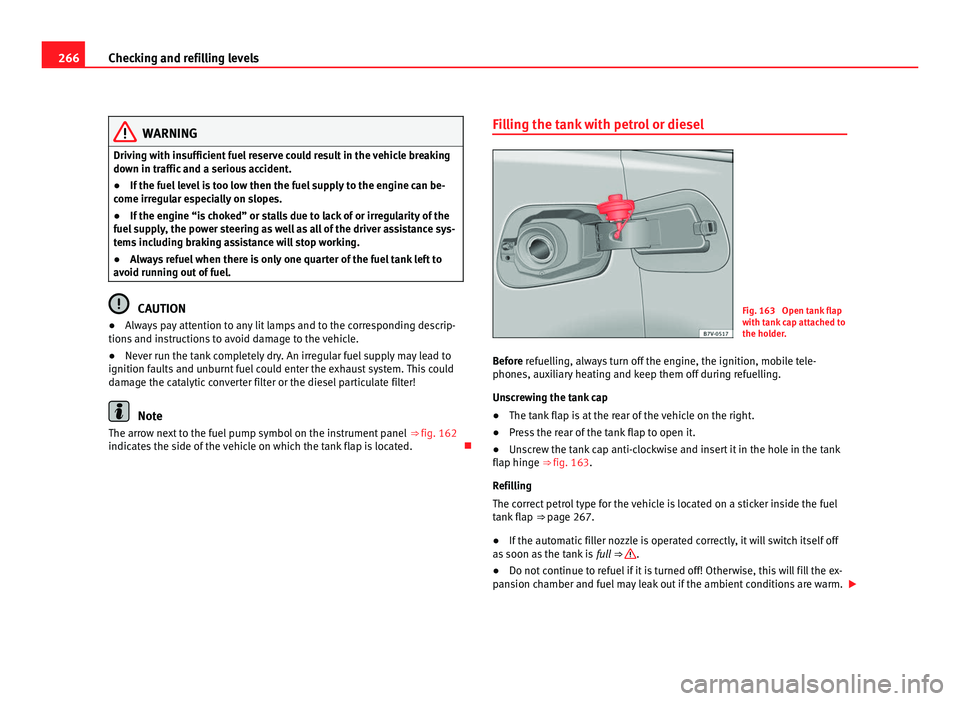
ates the side of the vehicle on which the tank flap is located. Filling the tank with petrol or diesel Fig. 163 Open tank flap
with t
ank
cap attached to
the holder.
Before refuelling, always turn off the engine, the ignition, mobile tele- phones, aux
iliary heating and keep them off during refuelling.
Unscrewing the tank cap
● The tank flap is at the rear of the vehicle on the right.
● Press the rear of the tank flap to open it.
● Unscrew the tank cap anti-clockwise and insert it in the hole in the tank
flap hing
e ⇒ fig. 163.
Refilling
The correct petrol type for the vehicle is located on a sticker inside the fuel
tank flap ⇒ page 267.
● If the automatic filler nozzle is operated correctly, it will switch itself off
as soon a
s the tank is full ⇒ .
● Do not continue to refuel if it is turned off! Otherwise, this will fill the ex-
pan s
ion chamber and fuel may leak out if the ambient conditions are warm.
Page 269 of 385
267
Checking and refilling levels
Closing the tank cap
● Screw on the tank cap clockwise until it you hear it click into position.
● Press the tank flap until you hear it click into place. The tank flap must
be flush w ith the body
contour. WARNING
Do not continue refilling once the fuel nozzle has switched itself off. The
fuel t
ank may be filled too much. As a result, fuel may spurt out and spill.
This could lead to a fire, explosion and severe injuries. CAUTION
● Always remove any fuel spilled on the vehicle paintwork immediately to
av oid d
amage to the wheel housing, the tyre and vehicle paintwork. For the sake of the environment
Spilt fuel can contaminate the environment.
Refilling precautions Information on bulb replacement
⇒ pag
e 326.
Checklist
Never work on the engine or in the engine compartment if you are not famil-
iar with the operations to be carried out, the applicable safety standards
and especially if you do not have the instruments, liquids and tools neces-
sary ⇒ page 275, Working in the engine compartment! Have the work car-
ried out by a Technical Service if you are uncertain. Check the following reg-
ularly, preferably when you refuel:
● Windscreen washer fluid level ⇒ pag
e 105
● Engine oil level ⇒ pag
e 279 ●
Engine coolant level ⇒ p
age 283
● Brake fluid level ⇒ pag
e 183
● Tyre pressure ⇒ pag
e 293
● Vehicle lighting required to guarantee road safety:
Indicator
s
Side lights, dipped headlights and full beam headlights
Rear lights
Brake lights
Rear fog light ⇒ page 97 WARNING
Not following the checklist prepared for your own safety could lead to ac-
cident s
and severe injuries.
● Always follow the check list and perform the necessary operations.
Fuel Introduction You will find a factory-fitted sticker containing information on the type of
fuel
f
or your vehicle on the inside of the fuel tank flap.
Additional information and warnings:
● ⇒ Bookl et Maintenance Programme
● R
efuelling ⇒ pag e 264
● En
gine and exhaust system management ⇒ page 228
–
–
–
–
–
Safety First Operating instructions Practical tips Technical Data