seats Seat Alhambra 2011 Manual PDF
[x] Cancel search | Manufacturer: SEAT, Model Year: 2011, Model line: Alhambra, Model: Seat Alhambra 2011Pages: 385, PDF Size: 7.92 MB
Page 156 of 385
154
Seats and storage compartments LED on the socket
⇒ fig. 120Steady green light: The child safety device is unlocked. The
sock
et
can now be used. Flashing red light: There is some kind of fault (e.g. discon-
nection due to e
x
cess current or tempera-
ture). Heat protection
The 230 V
o
lt Euro power connector converter switches off automatically
when a certain temperature is exceeded. This disconnect prevents overheat-
ing in the event of an increase in power consumption of the connected ap-
pliance and where the atmospheric temperature is too high. The converter
will switch on again automatically after it has cooled down. Appliances that
are switched on and connected to the socket will start up again. Therefore,
switch off all electrical appliances connected to the socket when the current
converter switches off due to overheating. WARNING
High voltage in the electrical installation!
● Liquids must not be spilt over the socket.
● Do not plug adapters or extension cords into the 230 Volt Euro power
connect or
. Otherwise, the built-in child safety device will switch off and
the connector will become live.
● Do not plug current conductors such as a knitting needle into the 230
Volt
Euro power connector. CAUTION
● Always follow the operating instructions for the appliances to be con-
nect ed!
● Nev
er exceed the maximum power rating as this could damage the vehi-
cle's
general electrical system. ●
12 volt socket:
– Only
use accessories with approved electromagnetic compatibility ac-
cordin
g to current regulations.
– Never power the socket.
● 230 Volt Euro socket:
– Do not hang appliances or plugs that are too heavy (e.g. a transform-
er) from the sock
et.
– Do not connect lamps which contain a neon tube.
– Only plug appliances with a voltage that matches the socket voltage
into the sock
et.
– In the event of consumers with a high start-up current, surge protec-
tion prevents
them from switching on. In this case, unplug the consumer
and try plugging it back in after around 10 seconds. Note
● Some app li
ances may not work properly in the 230 Volt Euro power con-
nector due to a lack of power (Watts).
● The 230 Watt Euro power connector can be modified for 115 Watt appli-
ances
and vice versa. Consult a specialist shop for advice on accessories to
adapt the connector. SEAT recommends visiting a Technical Service.
Page 160 of 385
158
Heating, Ventilation and Air conditioning
Some Climatronic controls may also be on the climate control system con-
tro l
panel located in the rear centre console. These controls are used to
make the appropriate settings for the rear seats. Control
butt on Additional information. Climatic
⇒ fig. 121; Climatr
onic
⇒ fig. 122. 1
Tem-
perat ur
e
... Climatic: rotate the control to adjust the temperature accord-
in
gly
.
Climatronic: the settings for the left hand side, the right-hand
side and the rear seats are made separately. Rotate the con-
trol to adjust the temperature accordingly. The temperature is
indicated on the outside ring. 2
Fan
... Climatic: setting 0, f
an and C
limatic switched off;
setting 4, fan set to maximum.
Climatronic: the Fan speed is automatically adjusted depend-
ing on the vehicle speed to avoid annoying noises. The fan
can also be adjusted manually. 3
Air dis-
tribution Climatic: rotate the continuous control to direct the airflow to
the de
s
ired area.
Climatronic: manually adjustable using the controls. Climatic: defro
s
t function. The airflow is directed at the wind-
screen. In this position, air recirculation is automatically
switched off or is not switched on. Climatronic: defro
s
t function. The air drawn in from outside
the vehicle is directed at the windscreen and air recirculation
is automatically switched off. To defrost the windscreen more
quickly, the air is dehumidified at temperatures over approxi-
mately +1.5°C (+35°F) and the fan runs at maximum output. The air is directed at the chest of driver and passengers by the
da
shbo
ard air vents. – Air distribution towards the footwell.
Air distribution towards the windscreen and the footwell.
AC Climatic, Climatronic: Pre
s
s the button to turn off/on cooling. Control
butt on Additional information. Climatic
⇒ fig. 121; Climatr
onic
⇒ fig. 122. Heated rear window: this only works when the engine is run-
ning and sw
it
ches off automatically after a maximum of 10 mi-
nutes. Air recirculation mode ⇒ pag
e 161. Climatronic: Autom
atic
air recirculation ⇒ page 161. Windscreen heating: only works when the engine is running
and swit
c
hes off automatically after a few minutes. Instant auxiliary heating on/off button
⇒ page 163. Switching
off
OFF Climatic: turn the fan switch to setting 0.
C
lim
atronic: press the OFF button or set the fan manually to
0. When the sy s
tem switches off, the OFF button will light up.
REAR Climatronic: pre
s
s the REAR button to adjust the climate con-
tro l
for the rear seats from the front. The REAR button will light
up when the fu nction i
s switched on. The settings for the rear
seats will be displayed. Press the button again to switch the
function off or do not touch any other button for around 10
seconds. REST Climatronic: pre
s
s the button REST to use residual heat. When
the engine i s
still warm but the ignition switched off, the heat
given off by the engine can be used to keep the passenger
compartment warm. The REST button will light up when the
fu nction i
s switched on. The function will switch off after
around 30 minutes and if the battery level is low.
Page 161 of 385
159
Heating, Ventilation and Air conditioning Control
butt on Additional information. Climatic
⇒ fig. 121; Climatr onic
⇒ fig. 122. Climatronic: tran
sf
erring the driver's seat temperature set-
tings to the other seats. If the button is not lit up, the set
temper at
ure in the driver's seat will also apply to the other
seats.
Press the button or the temperature control for the front pas-
senger's seat or the rear seats to set them to a different tem-
perature. The button lights with an indicator.
Vehicles with auxiliary heating: observe the description of the AUTO button.
AUTO Automatic temperature, fan, and air distribution control.
WARNING
Never turn off the air fan for a long time or the air in the passenger com-
par tment
will not be refreshed.
● Stuffy or used air will increase fatigue and reduce driver and passen-
ger conc
entration possibly resulting in a serious accident. Note
● Not all Climatronic buttons are operational in REAR mode.
● The REAR button is locked in defrost mode.
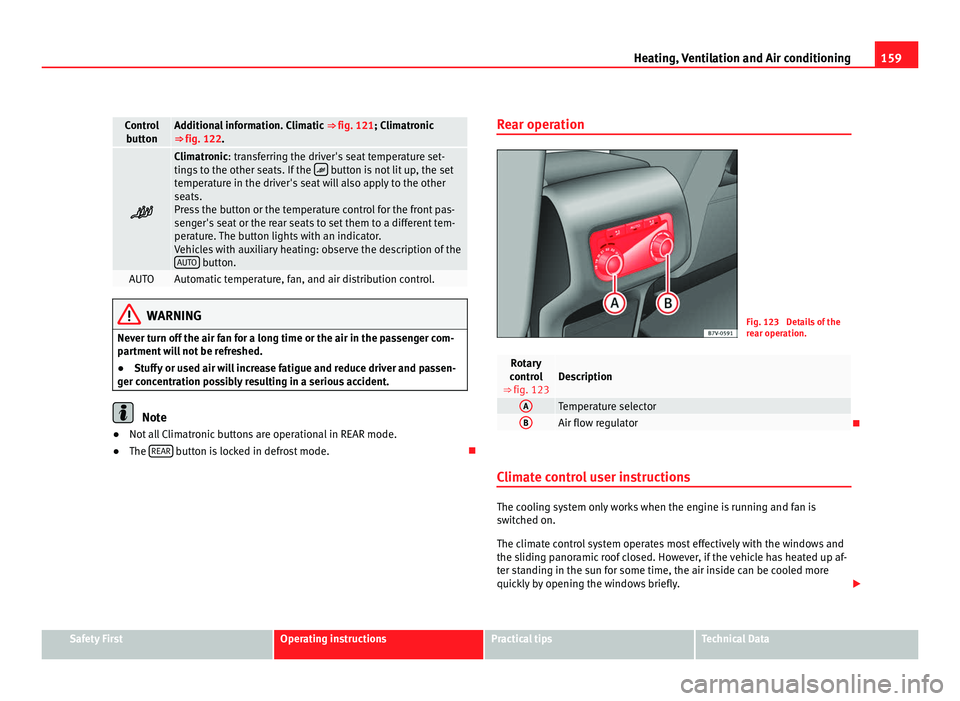
Rear operation Fig. 123 Details of the
re
ar oper
ation. Rotary
contr o
l
⇒ fig. 123 Description
A
Temperature selector
B
Air flow regulator
Climate control user instructions The cooling system only works when the engine is running and fan is
swit
c
hed on.
The climate control system operates most effectively with the windows and
the sliding panoramic roof closed. However, if the vehicle has heated up af-
ter standing in the sun for some time, the air inside can be cooled more
quickly by opening the windows briefly. Safety First Operating instructions Practical tips Technical Data
Page 228 of 385
226
Driving and the environment
Economic driving style Changing gear early
General
in
structions: The highest gear is always the most economical gear.
As a guideline, for the majority of vehicles: At a speed of 30 km/h, drive in
third gear, at 40 km/h in fourth gear and at 50 km/h in fifth gear.
In addition, skipping gears when shifting up helps to save fuel, weather and
traffic conditions permitting.
Do not wait until the last moment before changing gear. Only use first gear
when you move off and change to second gear quickly. Avoid the kick-down
function in vehicles with automatic gearbox.
Vehicles with a gear display help to achieve an economical driving style as
the display indicates the best moment to change gear.
Let the vehicle roll
If you take your foot off the accelerator, the fuel supply is stopped and con-
sumption is reduced.
Allow the vehicle to roll without accelerating, for example when approach-
ing a red traffic light. However, if the vehicle is rolling too slowly or the dis-
tance is too long, the clutch pedal should be pressed to declutch. The en-
gine will then operate at idle speed.
If the vehicle is going to be at a standstill for a period of time, switch off the
engine; for example, while waiting at a level crossing. In vehicles which
have the Start-Stop function on, the engine switches off automatically when
the vehicle is not moving.
Think ahead and “flow” with the traffic
Frequent acceleration and braking considerably increase fuel consumption.
If you think ahead as you drive and keep a safe distance from the vehicle in
front, it is possible to slow down by simply lifting your foot off the accelera-
tor. This eliminates the need for constant braking and acceleration. Calm and steady driving
Cons
tancy is more important than speed: The more you drive at a constant
speed, the lower the fuel consumption.
When driving on the motorway, it is more efficient to drive at a constant and
more moderate speed than to be continuously accelerating and braking. As
a general rule, you will reach your destination just as quickly when you drive
at a constant speed.
The cruise control function helps you to achieve a constant style of driving.
Moderate use of additional electrical appliances
It is important to travel in comfort, but convenience systems should be used
in an ecological manner.
Some equipment, when connected, increase fuel consumption considera-
bly, for example:
● Air conditioning cooling system: If the air conditioning system is re-
quired to c
ool to significantly lower temperatures than the true outside tem-
perature, it will require a large quantity of energy from the engine. There-
fore, we recommend that the selected temperature for the vehicle is not too
different to the outside temperature. It is a good idea to open all the win-
dows of the car before starting your journey, and to drive a short distance
with all the windows open to allow the vehicle to cool down slightly. Only
then should you close all the windows and switch on the air conditioning.
Keep windows closed when travelling at high speeds. Driving with the win-
dows open increases fuel consumption.
● Switch off the seat heating when the seats have warmed up.
● Switch off the heated rear window and the windscreen heating when the
window
s have demisted and are free of ice.
● Do not leave the auxiliary heater switched on when the vehicle is mov-
ing ⇒ p
age 163.
Page 261 of 385
259
Accessories, parts replacement and modifications
The vehicle owner should keep the documentation for the additional equip-
ment s af
ely and hand it over to the scrap yard at the end of the vehicle's
service life. This ensures that any additional equipment mounted in end-of-
life vehicles is correctly disposed of with respect for the environment. WARNING
Repairs or modifications which are not performed correctly may result in
dam ag
e or errors in the vehicle operation, affecting the efficiency of the
driver assist systems. This could result in serious accident.
● All repairs and modifications to the vehicle should only be performed
by a
Technical Service.
Repair and faults in the airbag system When performing repairs and technical modifications, SEAT's directives
mus
t
be observed! ⇒ Modifications and repairs to the front bumper, doors, front seats, and re-
pair
s
to the roof or chassis should only be carried out in a Technical Service.
These components may contain parts or sensors belonging to the airbag
system.
If work is carried out on the airbag system or remove and fit parts of the sys-
tem when performing other repair work, parts of the airbag system may be
damaged. The consequence may be that, in the event of an accident, the
airbag inflates incorrectly or does not inflate at all.
So that the effectiveness of the airbag is not reduced and that removed
parts do not cause any injuries or environmental pollution, regulations must
be observed. These requirements are known to qualified dealerships.
Modifications to the vehicle suspension may affect the operation of the air-
bag system in the event of collision. For example, if wheel and tyre combi-
nations not approved by SEAT are used, or if the vehicle height is lowered, the suspension is stiffened or the suspension springs, telescopic arms,
dampers, et
c., are modified, the results received by the airbag sensors and
sent to the control unit may not be accurate. For example, some modifica-
tions to the suspension could increase the force measured by the sensors
and result in the triggering of the airbag systems in collisions. Under normal
conditions, the measured values would be lower and the airbag would not
have been triggered. Other modifications may reduce the forces measured
by the sensors and therefore the airbags are not triggered in situations
when they should have triggered. WARNING
Repairs or modifications which are not performed correctly may result in
dam ag
e or errors in the vehicle operation, affecting the efficiency of the
airbag systems. This could result in serious or fatal accident.
● All repairs and modifications to the vehicle should only be performed
by a
Technical Service.
● Airbag modules must never be repaired: if damaged, they must be re-
plac
ed.
● Never fit recycled or reused airbag components in your vehicle. WARNING
Modifications to the vehicle suspension, including the use of unauthor-
ised wheel and ty
re combinations, may affect the performance of the air-
bags and increase the risk of serious or fatal injury in the event of acci-
dent.
● Never fit suspension components which are not identical to the origi-
nal
parts mounted in the vehicle.
● Never use wheel and tyre combinations not approved by SEAT.
Safety First Operating instructions Practical tips Technical Data
Page 351 of 385
349
Technical Data
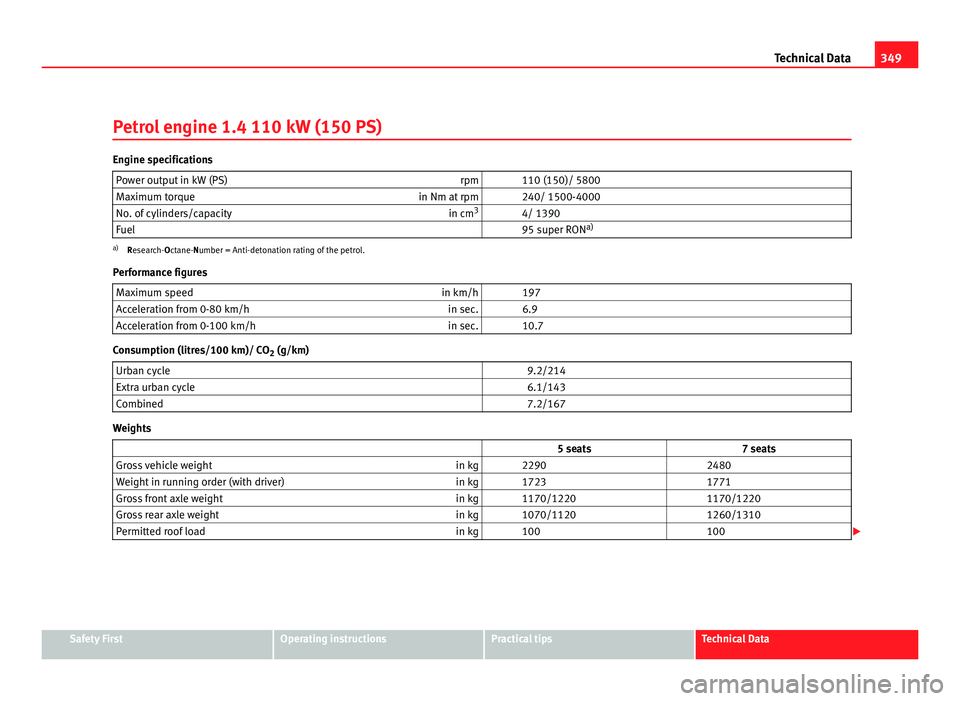
Petrol engine 1.4 110 kW (150 PS) Engine specifications
Power output in kW (PS) rpm 110 (150)/ 5800
Maximum torque in Nm at rpm 240/ 1500-4000
No. of cylinders/capacity in cm3
4/ 1390
Fuel 95 super RON a)a)
Research-Octane-Number = Anti-detonation rating of the petrol.
P er
formance figures
Maximum speed in km/h 197
Acceleration from 0-80 km/h in sec. 6.9
Acceleration from 0-100 km/h in sec. 10.7Consumption (litres/100 km)/ CO
2 (g/km)
Urban cycle 9.2/214
Extra urban cycle 6.1/143
Combined 7.2/167Weights
5 seats 7 seats
Gross vehicle weight in kg 2290 2480
Weight in running order (with driver) in kg 1723 1771
Gross front axle weight in kg 1170/1220 1170/1220
Gross rear axle weight in kg 1070/1120 1260/1310
Permitted roof load in kg 100 100Safety First Operating instructions Practical tips Technical Data
Page 353 of 385
351
Technical Data
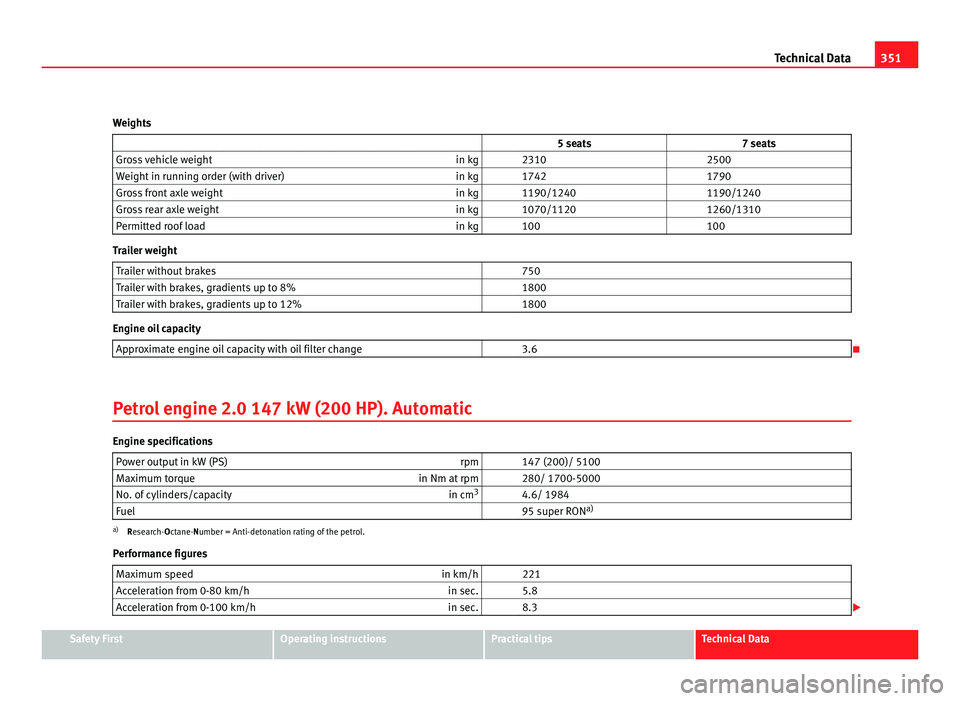
Weights 5 seats 7 seats
Gross vehicle weight in kg 2310 2500
Weight in running order (with driver) in kg 1742 1790
Gross front axle weight in kg 1190/1240 1190/1240
Gross rear axle weight in kg 1070/1120 1260/1310
Permitted roof load in kg 100 100Trailer weight
Trailer without brakes 750
Trailer with brakes, gradients up to 8% 1800
Trailer with brakes, gradients up to 12% 1800Engine oil capacity
Approximate engine oil capacity with oil filter change 3.6
Petrol engine 2.0 147 kW (200 HP). Automatic Engine specifications
Power output in kW (PS) rpm 147 (200)/ 5100
Maximum torque in Nm at rpm 280/ 1700-5000
No. of cylinders/capacity in cm3
4.6/ 1984
Fuel 95 super RON a)a)
Research-Octane-Number = Anti-detonation rating of the petrol.
P er
formance figures
Maximum speed in km/h 221
Acceleration from 0-80 km/h in sec. 5.8
Acceleration from 0-100 km/h in sec. 8.3 Safety First Operating instructions Practical tips Technical Data
Page 354 of 385
352
Technical Data
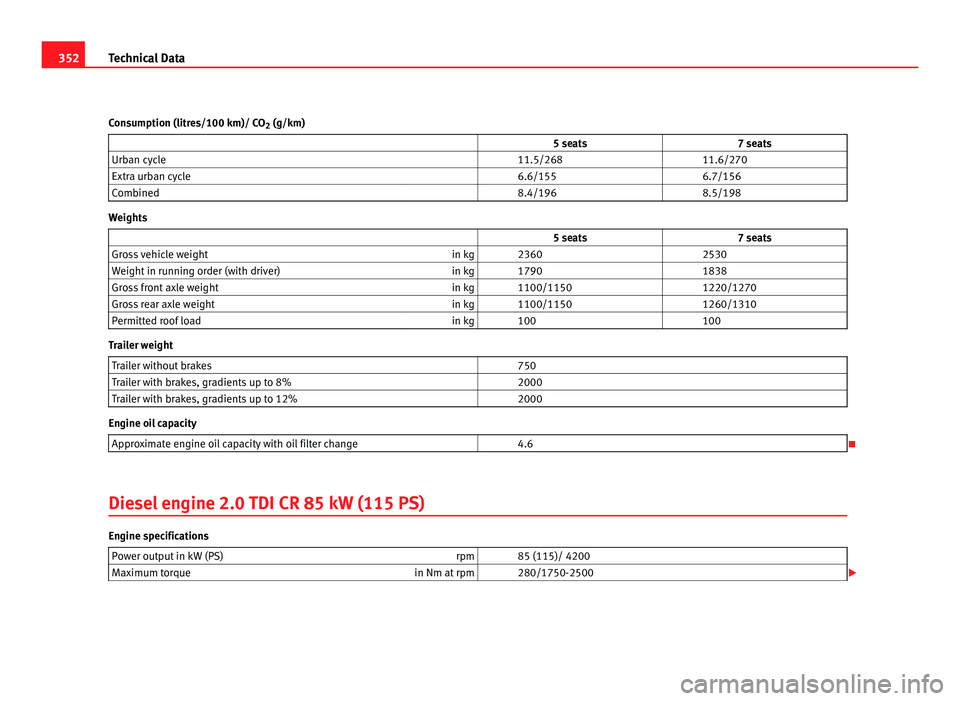
Consumption (litres/100 km)/ CO 2 (g/km)
5 seats 7 seats
Urban cycle 11.5/268 11.6/270
Extra urban cycle 6.6/155 6.7/156
Combined 8.4/196 8.5/198Weights
5 seats 7 seats
Gross vehicle weight in kg 2360 2530
Weight in running order (with driver) in kg 1790 1838
Gross front axle weight in kg 1100/1150 1220/1270
Gross rear axle weight in kg 1100/1150 1260/1310
Permitted roof load in kg 100 100Trailer weight
Trailer without brakes 750
Trailer with brakes, gradients up to 8% 2000
Trailer with brakes, gradients up to 12% 2000Engine oil capacity
Approximate engine oil capacity with oil filter change 4.6
Diesel engine 2.0 TDI CR 85 kW (115 PS) Engine specifications
Power output in kW (PS) rpm 85 (115)/ 4200
Maximum torque in Nm at rpm 280/1750-2500
Page 355 of 385
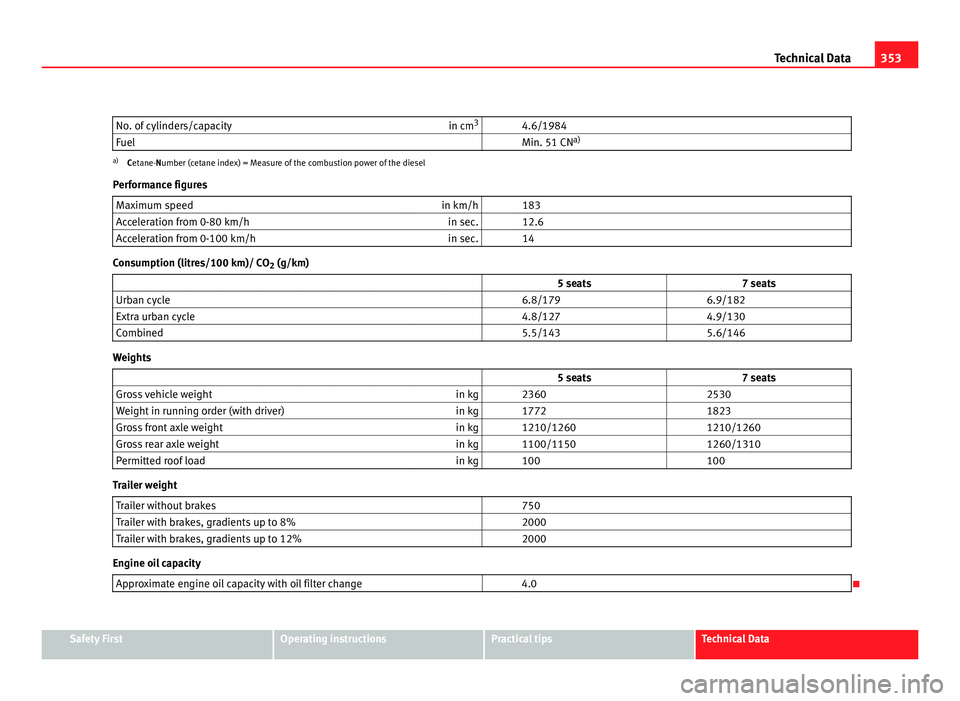
353
Technical Data
No. of cylinders/capacity in cm3
4.6/1984
Fuel Min. 51 CN a)a)
Cetane-Number (cetane index) = Measure of the combustion power of the diesel
P er
formance figures
Maximum speed in km/h 183
Acceleration from 0-80 km/h in sec. 12.6
Acceleration from 0-100 km/h in sec. 14Consumption (litres/100 km)/ CO
2 (g/km)
5 seats 7 seats
Urban cycle 6.8/179 6.9/182
Extra urban cycle 4.8/127 4.9/130
Combined 5.5/143 5.6/146Weights
5 seats 7 seats
Gross vehicle weight in kg 2360 2530
Weight in running order (with driver) in kg 1772 1823
Gross front axle weight in kg 1210/1260 1210/1260
Gross rear axle weight in kg 1100/1150 1260/1310
Permitted roof load in kg 100 100Trailer weight
Trailer without brakes 750
Trailer with brakes, gradients up to 8% 2000
Trailer with brakes, gradients up to 12% 2000Engine oil capacity
Approximate engine oil capacity with oil filter change 4.0
Safety First Operating instructions Practical tips Technical Data
Page 356 of 385
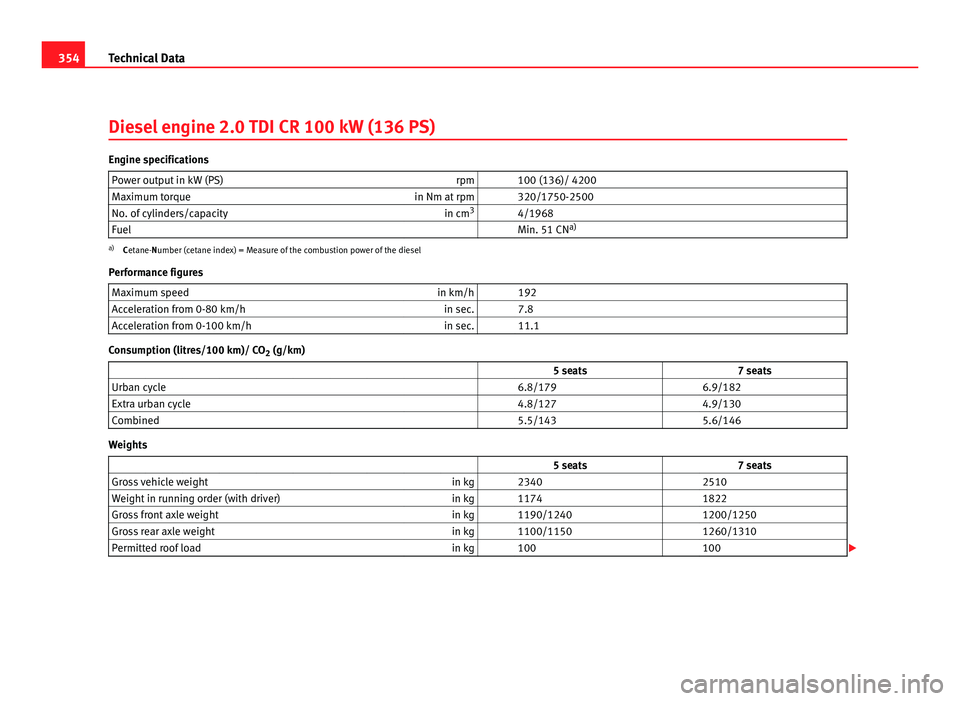
354
Technical Data
Diesel engine 2.0 TDI CR 100 kW (136 PS) Engine specifications
Power output in kW (PS) rpm 100 (136)/ 4200
Maximum torque in Nm at rpm 320/1750-2500
No. of cylinders/capacity in cm3
4/1968
Fuel Min. 51 CN a)a)
Cetane-Number (cetane index) = Measure of the combustion power of the diesel
P er
formance figures
Maximum speed in km/h 192
Acceleration from 0-80 km/h in sec. 7.8
Acceleration from 0-100 km/h in sec. 11.1Consumption (litres/100 km)/ CO
2 (g/km)
5 seats 7 seats
Urban cycle 6.8/179 6.9/182
Extra urban cycle 4.8/127 4.9/130
Combined 5.5/143 5.6/146Weights
5 seats 7 seats
Gross vehicle weight in kg 2340 2510
Weight in running order (with driver) in kg 1174 1822
Gross front axle weight in kg 1190/1240 1200/1250
Gross rear axle weight in kg 1100/1150 1260/1310
Permitted roof load in kg 100 100