Light Seat Alhambra 2012 Owner's Manual
[x] Cancel search | Manufacturer: SEAT, Model Year: 2012, Model line: Alhambra, Model: Seat Alhambra 2012Pages: 388, PDF Size: 6.72 MB
Page 257 of 388
255
Vehicle maintenance and cleaning
CAUTION
If you ignore this checklist, which is important for maintaining your seat up-
holstery, the fabric may be damaged or stained.
● Consult the checklist and carry out the operations it describes.
Note
SEAT recommends you take the vehicle to a specialised workshop to treat
any stains on the upholstery caused by the discolouration of clothing.
How to clean the upholstery, trim fabrics and Alcantara ®
Cleaning the fabric on heated seats and electrically adjustable seats or
seats with airbag components
It is possible that there are important airbag components and electrical con-
nections inside the driver seat, passenger seat and possibly the outer rear
seats. If these seats and backrests are damaged, or are cleaned and are
treated incorrectly, or if they get wet, the vehicle electric system may be de-
stroyed and the airbag system damaged
⇒
.
Electric and heated seats contain components and electrical connections
that may be damaged if the seats are cleaned or incorrectly treated ⇒
.
Similarly, damage might be caused at other points in the vehicle's electric
system.
For this reason, bear the following indications in mind for cleaning:
● Do not use high-pressure or steam cleaning equipment or cold aerosols.
● Do not use cream detergents or detergent-based solutions for delicate
garments.
● Prevent the fabric from getting wet at all times.
● Only use cleaning products approved by SEAT.
● If in doubt, take the vehicle to a professional cleaning company. Cleaning the fabric on unheated seats, non-electrically adjustable seats
and seats without airbag components
●
Before using any cleaning products, consult and keep in mind the in-
structions of use, indications and warnings on the container.
● Use a vacuum cleaner (with the brush attachment) on the trim and seat
fabrics, the Alcantara ®
upholstery of the seats and the carpet.
● Do not use high-pressure or steam cleaning equipment or cold aerosols.
● For general cleaning, use a soft sponge or an ordinary lint-free microfi-
bre cloth ⇒
.
● Clean Alcantara ®
surfaces with a slightly damp cotton or woollen cloth,
or a standard lint-free microfibre cloth ⇒
.
If the dirt on the trim and upholstery fabrics is only superficial, you can use
a standard foam cleaner.
If the upholstery and trim are very dirty, before cleaning them we recom-
mend you find out about the most suitable cleaning options from a profes-
sional cleaning company. If necessary, the cleaning should be carried out
by a specialised company.
Stain removal
When removing stains, it may be necessary to clean the whole surface and
not just the stain itself. Especially if the surface has been dirtied through
normal use. If you only clean the stained area, that part may then look light-
er than the rest. If in doubt, take the vehicle to a professional cleaning com-
pany.
WARNING
If there is a fault in the airbag system, it is likely that the airbag will not
deploy correctly, not deploy at all, or do so unexpectedly, which could
cause serious or fatal injuries.
● Have the system checked immediately by a specialised workshop.
Safety FirstOperating instructionsPractical tipsTechnical Specifications
Page 258 of 388
256Vehicle maintenance and cleaning
CAUTION
If the upholstery on electrically operated seats or seats with airbag compo-
nents gets soaked, the vehicle's electric system and certain other compo-
nents may be damaged.
● If the seat gets soaked, take the vehicle immediately to a specialised
workshop to be dried and for the system components to be inspected.
● Do not use steam cleaning equipment as the dirt becomes more encrus-
ted and fixed in the material.
● High-pressure cleaning equipment and cold aerosols may damage the
upholstery.
CAUTION
● Brushes should only be used to clean the carpet and floor mats! Other
fabrics may be damaged if cleaned with a brush.
● If cream detergents or detergents for delicate garments are applied with
a damp cloth or sponge, they may, for example, leave rings when dry be-
cause of the tensioactive components they contain. Generally, such rings
are very difficult or almost impossible to remove.
CAUTION
● Do not let water soak into Alcantara ®
under any circumstances.
● Do not use leather cleaning products, solvents, wax polish, shoe cream,
stain removers or similar products on Alcantara ®
.
● Never use brushes for cleaning damp material as they could damage the
surface.
Cleaning and maintenance of natural leather upholstery
Consult a professional cleaning workshop if you have any doubts on clean-
ing and maintaining the leather equipment in your car. Maintenance and treatment
Nappa natural leather is delicate because it has no additional protective
layer.
●
After cleaning, regularly apply a conditioner with sun-screen and im-
pregnating action. These products nourish the leather, soften it and make it
more breathable, as well as re-hydrating it. They also provide it with a pro-
tective film.
● Clean the leather every two or three months and remove stains as they
appear.
● Treat the leather regularly (about twice a year) with a suitable mainte-
nance product.
● Apply as few cleaning and maintenance products as possible, always
using a dry, lint-free cotton or woollen cloth. Do not apply cleaning and
maintenance products directly to the leather.
● Remove recent ball-point pen and ink stains, lipstick, shoe cream and
similar stains as soon as possible.
● Maintain the colour of the leather. To do this, use a special cream espe-
cially coloured for leather to achieve the same overall colour, if necessary.
● Afterwards, go over it with a soft cloth.
Cleaning the vehicle
SEAT recommends using a slightly damp cotton or woollen cloth for general
cleaning purposes.
Generally, the leather should never be soaked at any point, nor should wa-
ter penetrate the seams.
Before cleaning the leather upholstery, bear in mind the following recom-
mendations ⇒ page 255, Cleaning the fabric on heated seats and electrical-
ly adjustable seats or seats with airbag components.
Page 259 of 388
257
Vehicle maintenance and cleaning
CAUTION
● On no account use solvents, wax polish, shoe cream, stain removers or
similar materials on leather.
● If the stain remains on the leather for long, it will soak in and be impos-
sible to remove.
● In the event of spilt liquids, dry immediately with an absorbent cloth to
prevent the liquid penetrating through the leather or seams.
● If the car is left standing in the sun for long periods, the leather should
be protected against direct sunlight to prevent it from fading.
Note
The leather will usually change colour slightly with use.
Cleaning synthetic leather upholstery
Before cleaning the synthetic leather upholstery, bear in mind the following
recommendations ⇒ page 255, Cleaning the fabric on heated seats and
electrically adjustable seats or seats with airbag components
Only use water and neutral cleaning products to clean synthetic leather up-
holstery.
CAUTION
Do not use solvents, floor wax, shoe cream, stain removers or similar prod-
ucts on synthetic leather. These will stiffen the material, causing it to crack
prematurely. Cleaning storage compartments, drinks holders and
ashtray
Cleaning storage compartments and drinks holders
Some storage compartments and drinks holders have a removable rubber
mat.
●
Use a clean, damp, lint-free cloth to clean parts.
● If this does not provide satisfactory results, we recommend using a spe-
cial solvent-free plastic cleaning product.
Cleaning the ashtray
● Extract the ashtray and empty it.
● Clean the ashtray with a dishcloth.
Use a toothpick or similar to remove ash from the area where cigarettes are
stubbed out.
Care and cleaning of plastic parts, wooden trim and the
instrument panel
● Use a clean, damp, lint-free cloth to clean parts.
● Clean plastic parts (inside and outside the vehicle) and the instrument
panel with a special solvent-free product for the care and cleaning of plas-
tic, approved by SEAT ⇒
.
● Wash wooden trims with a mild soap and water solution.
Safety FirstOperating instructionsPractical tipsTechnical Specifications
Page 266 of 388
264Accessories, parts replacement and modifications
Retro-fitting of two-way radios
An exterior aerial is required for the use of two-way radios in the vehicle.
The retro-fitting of electrical or electronic appliances in the vehicle is sub-
ject to their approval for use in your vehicle. Under certain circumstances,
this could mean that your vehicle registration documents are no longer val-
id.
SEAT has approved your vehicle for use with two-way radios providing the
following conditions are observed:
●The exterior aerial must be mounted professionally.
● The maximum transmitting power is 10 watts.
An only external aerial is needed to give the equipment its optimal reach.
Check first with a qualified dealer if you wish to use a two-way radio with a
transmitting power of over 10 watts. The qualified workshops are familiar
with the technical options for installation. SEAT recommends visiting a Tech-
nical Service.
All legal requirements, together with the instructions for the use of two-way
radios must be observed.
WARNING
If the two-way radio is not securely fastened in position, it could be sent
flying around the vehicle in the event of sharp braking, sudden manoeu-
vres or accident, causing injury.
● While driving, two-way radios must be securely fastened in position,
outside the radius of action of the airbags, or safely stowed away.
WARNING
When using a two-way radio without a connection to an exterior aerial,
the maximum permitted levels of electromagnetic radiation may be ex-
ceeded. This is also the case if the aerial has not been correctly installed.
● You should only use a two-way radio inside the vehicle if it has first
been correctly connected to an exterior aerial.
Information stored by the control units
Your vehicle is fitted at the factory with a series of electronic control units
responsible for the engine and gearbox management. In addition, the con-
trol units supervise the performance of the exhaust gas system and the air-
bag systems.
Therefore, while the vehicle is being driven, these electronic control units
are continuously analysing the vehicle data. In the event of faults or devia-
tions from the theoretical values, only this data is stored. Normally, the
warning lamps on the instrument panel light up in the event of faults.
This data can only be read and analysed using special equipment.
The storing of the data allows specialised workshops to detect and repair
faults. Stored data may include:
● Data relating to the engine or the gearbox
● Speed
● Direction of travel
● Braking force
● Detection of seat belt
The vehicle control units never record conversations held by passengers in
the vehicle.
Page 271 of 388
269
Checking and refilling levels
WARNING (Continued)
– If you are using a metal fuel canister, the nozzle must always touch
the canister while it is being filled to avoid static electricity.
– Follow the legal requirements for the use, storage and transport of
spare fuel canisters.
– Insure that the fuel container complies with manufacturing stand-
ards, for example, ANSI or ASTM F852-86.
CAUTION
● Always remove any fuel spilled on the vehicle paintwork immediately to
avoid damage to the wheel housing, the tyre and vehicle paintwork.
● Refuelling a petrol engine with diesel or a diesel engine with petrol can
cause serious engine and fuel system damage; the resulting malfunctions
are not covered by the SEAT warranty. If you refuel with the wrong type of
fuel, never start the engine. This applies to even the smallest amount of the
wrong fuel. You should obtain professional assistance. With the engine run-
ning, the composition of the wrong fuel could significantly damage the fuel
system and the engine itself.
● In vehicles with a diesel engine, under no circumstances should you re-
fuel or drive with petrol, kerosene, heating oil or any other type of different
fuel. Other types of fuels could cause serious damage to the engine and to
the fuel supply system and the resulting problems are not covered by the
SEAT warranty.
For the sake of the environment
Fuels can contaminate the environment. Collect any spilt service fluids and
allow a professional to dispose of them.
Note
There is no emergency mechanism for the manual release of the tank flap. If
necessary, request assistance from specialised personnel. Control lamps and fuel gauge
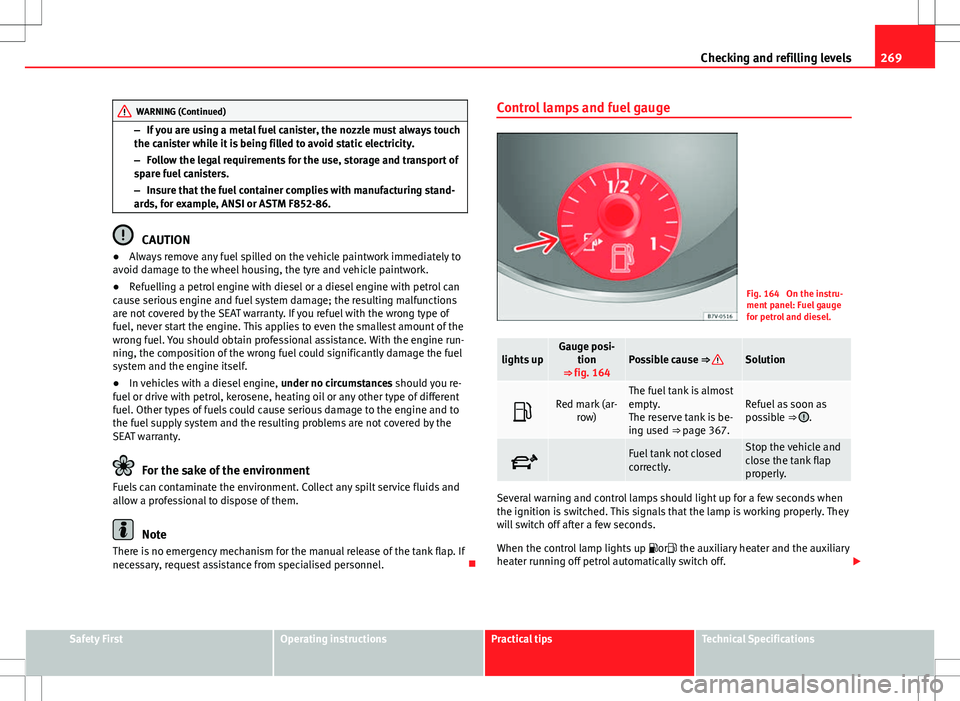
Fig. 164 On the instru-
ment panel: Fuel gauge
for petrol and diesel.
lights upGauge posi-
tion
⇒ fig. 164Possible cause ⇒ Solution
Red mark (ar- row)The fuel tank is almost
empty.
The reserve tank is be-
ing used ⇒ page 367.Refuel as soon as
possible ⇒ .
Fuel tank not closed
correctly.Stop the vehicle and
close the tank flap
properly.
Several warning and control lamps should light up for a few seconds when
the ignition is switched. This signals that the lamp is working properly. They
will switch off after a few seconds.
When the control lamp lights up or the auxiliary heater and the auxiliary
heater running off petrol automatically switch off.
Safety FirstOperating instructionsPractical tipsTechnical Specifications
Page 273 of 388
271
Checking and refilling levels
Closing the tank cap
● Screw on the tank cap clockwise until it you hear it click into position.
● Press the tank flap until you hear it click into place. The tank flap must
be flush with the body contour.
WARNING
Do not continue refilling once the fuel nozzle has switched itself off. The
fuel tank may be filled too much. As a result, fuel may spurt out and spill.
This could lead to a fire, explosion and severe injuries.
CAUTION
● Always remove any fuel spilled on the vehicle paintwork immediately to
avoid damage to the wheel housing, the tyre and vehicle paintwork.
For the sake of the environment
Spilt fuel can contaminate the environment.
Refilling precautions
Information on bulb replacement ⇒ page 330.
Checklist
Never work on the engine or in the engine compartment if you are not famil-
iar with the operations to be carried out, the applicable safety standards
and especially if you do not have the instruments, liquids and tools neces-
sary ⇒ page 279, Working in the engine compartment! Have the work car-
ried out by a specialised workshop if you are uncertain. Check the following
regularly, preferably when you refuel:
● Windscreen washer fluid level ⇒ page 105
● Engine oil level ⇒ page 283 ●
Engine coolant level ⇒ page 287
● Brake fluid level ⇒ page 185
● Tyre pressure ⇒ page 297
● Vehicle lighting required to guarantee road safety:
Turn signals
Side lights, dipped headlights and full beam headlights
Rear lights
Brake lights
Rear fog light ⇒ page 97
WARNING
Not following the checklist prepared for your own safety could lead to ac-
cidents and severe injuries.
● Always follow the check list and perform the necessary operations.
Fuel Introduction
You will find a factory-fitted sticker containing information on the type of
fuel for your vehicle on the inside of the fuel tank flap.
Additional information and warnings:
● ⇒ Booklet Maintenance Programme
● Refuelling ⇒ page 268
● Engine and exhaust system management ⇒ page 232
–
–
–
–
–
Safety FirstOperating instructionsPractical tipsTechnical Specifications
Page 275 of 388
273
Checking and refilling levels
● If, in exceptional circumstances, petrol with a lower octane rating to that
recommended is used, only use moderate engine speeds and a light throt-
tle. Avoid using full throttle and overloading the engine. Otherwise you may
damage the engine. Fill up with fuel of a suitable octane rating as soon as
possible.
● Do not refuel if the filler indicates that the fuel contains metal. LRP (lead
replacement petrol) fuels also contain high concentrations of metal addi-
tives. This could damage the engine!
● Just one full tank of leaded fuel would seriously impair the efficiency of
the catalytic converter and could damage it.
Diesel
Diesel fuel
Diesel fuel must correspond to European standard EN 590 (In Germany,
EN 590 or DIN 51628).
The use of diesel fuel with a high sulphur percentage requires shorter serv-
ice intervals ⇒ Booklet Maintenance Programme ⇒
. Your Technical Serv-
ice will be able to tell you which countries have diesel with a high sulphur
content.
Do not mix fuel additives (thinners, or similar additives) with diesel fuel.
Winter-grade diesel
When using “summer-grade diesel fuel”, difficulties may be experienced at
temperatures below 0 °C (+32 °F) because the fuel thickens due to wax sep-
aration. For this reason, “winter-grade diesel fuel” is available in Germany,
for example, during the cold months. It can be used at temperatures as low
as -20 °C (-4 °F).
In countries with different climatic conditions, other types of diesel fuel are
available that are suitable to local temperatures. Technical Services and fill-
ing stations in the country concerned will inform you on the type of diesel
fuels available. A cold diesel engine makes more noise during winter temperatures than
summer temperatures. Furthermore, the exhaust fumes may turn slightly
bluish while the engine is heating. The quantity of exhaust gases will de-
pend on the outside temperature.
Filter pre-heater
Vehicles with a diesel engine are fitted with a fuel filter pre-heater. This en-
sures that the fuel system remains operational to approx. -24 °C (-11.2 °F),
provided you use winter-grade diesel which is safe to -15 °C (+5 °F).
However, if the fuel has waxed to such an extent that the engine will not
start at temperatures of under -24 °C (-11,2 °F), simply place the vehicle in a
warm garage or workshop for a while to heat up.
Auxiliary heater
Vehicles with a diesel engine may be fitted with an auxiliary heater. The
heater runs off the fuel from the fuel tank. On doing so, smells and steam
may be noticed outside the vehicle for a short period. This is normal and it
is not an indication of a fault in the vehicle.
Whenever there is little fuel in the tank (reserve), the auxiliary heater auto-
matically switches off.
WARNING
Never use start boosters. An aerosol start booster could explode or cause
a sudden rise in engine speed leading to engine damage and serious in-
jury.
Safety FirstOperating instructionsPractical tipsTechnical Specifications
Page 276 of 388
274Checking and refilling levels
CAUTION
● The vehicle is not prepared for the use of biodiesel. Never, under any
circumstances refuel with biodiesel. It could damage the fuel system and
subsequently lead to engine faults!
● The addition of biodiesel to diesel by the diesel producer according to
Standard EN 590 or other equivalent (DIN 51628 in Germany, for example)
is authorised and causes no type of damage to the engine or the fuel
system.
● The diesel engine has been designed for to use diesel fuel exclusively.
Therefore, never use petrol, fuel oil or other unsuitable fuels. The composi-
tion of these fuels may significantly damage the fuel system and the en-
gine.
● The use of diesel fuels with a high sulphur percentage could considera-
bly reduce the service life of the diesel particulate filter. Your Technical Serv-
ice will be able to tell you which countries have diesel with a high sulphur
content.
Information on fuel consumption
The consumption and emission values indicated do not refer to one specific
vehicle. They are only to be used to compare the values of the different ve-
hicle versions. The fuel consumption and CO 2 emissions of a vehicle not on-
ly depend on the effective use of fuel. They also depend on your driving
style and other non-technical factors.
Calculation of fuel consumption
Fuel consumption and emission values are determined according to the cur-
rent version of the 715/2007/EC or 80/1268/EEC regulation and are valid
for the vehicle kerb weight. The specifications do not refer to an individual
vehicle. Two measuring cycles are carried out on a rolling road test bed. The
test criteria are as follows:
Urban cycleMeasurement of the urban cycle starts with an engine cold
start. City driving is then simulated at between 0 and 50 km/
h.
Road cycleIn the road cycle simulation, the car undergoes frequent ac-
celeration and braking in all gears, as in normal everyday
driving. The road speed ranges from 0 to 120 km/h.
CombinedThe average combined consumption is calculated with a
weighting of around 37 % for the urban cycle and 63 % for
the road cycle.
CO 2 emis-
sions of the
combinationThe exhaust gases are collected during both driving cycles
to calculate carbon dioxide emissions (urban and road). The
gas composition is then analysed to evaluate the CO 2 con-
tent and other emissions.
Note
● The kerb weight may vary according to the vehicle equipment. This
could raise consumption and the CO 2 emissions slightly.
● In practice, consumption values could be different to the values calcula-
ted based on the 715/2007/EC or 80/1268/EEC regulations.
Page 277 of 388
275
Checking and refilling levels
Selective Catalytic Reduction* (AdBlue)
Introduction
The AdBlue fill level must be checked when the vehicle is being serviced
⇒ Booklet Maintenance Programme.
Additional information and warnings:
● Luggage compartment ⇒ page 126
● Fuel ⇒ page 271
● Wheels and tyres ⇒ page 297
● Accessories, parts replacement, repairs and modifications ⇒ page 261
WARNING
If the AdBlue fill level is too low, the vehicle may not restart after switch-
ing the ignition off. The emergency start or jump start will not be possi-
ble either!
● Top up with AdBlue at the latest 1000 km or 600 miles before it runs
out.
● Do not allow the AdBlue to run too low.
WARNING
AdBlue is an irritant, corrosive liquid that can cause injuries if it touches
the skin, eyes or respiratory organs.
● If AdBlue get in contact with eyes and skin, rinse for at least 15 mi-
nutes with plenty of water and seek medical help.
● If the AdBlue is swallowed, wash the mouth with plenty of water for at
least 15 minutes. Do not try to provoke vomiting unless recommended by
a Doctor. Seek medical advice immediately.
CAUTION
AdBlue damages surfaces such as painted vehicle parts, plastic, items of
clothing and carpets. Spilt AdBlue should be removed as quickly as possi-
ble using a damp cloth and plenty of cold water.
● If the AdBlue has crystallised, remove with warm water and a sponge.
Control and warning lamps
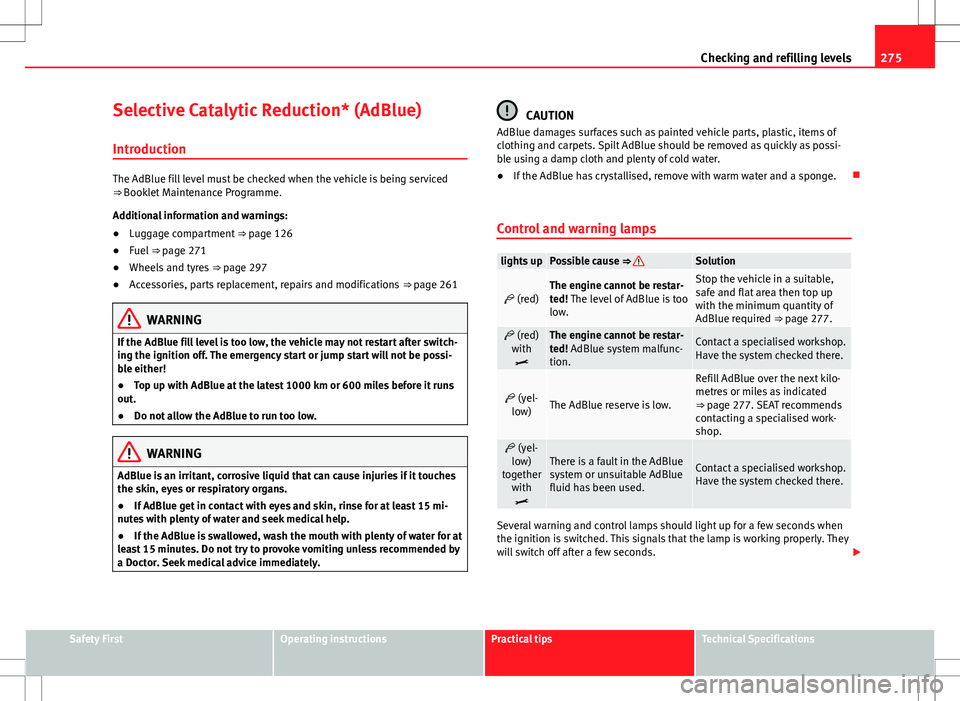
lights upPossible cause ⇒ Solution
(red)The engine cannot be restar-
ted! The level of AdBlue is too
low.Stop the vehicle in a suitable,
safe and flat area then top up
with the minimum quantity of
AdBlue required ⇒ page 277.
(red) withThe engine cannot be restar-
ted! AdBlue system malfunc-
tion.Contact a specialised workshop.
Have the system checked there.
(yel-
low)The AdBlue reserve is low.
Refill AdBlue over the next kilo-
metres or miles as indicated
⇒ page 277. SEAT recommends
contacting a specialised work-
shop.
(yel-
low)
together withThere is a fault in the AdBlue
system or unsuitable AdBlue
fluid has been used.Contact a specialised workshop.
Have the system checked there.
Several warning and control lamps should light up for a few seconds when
the ignition is switched. This signals that the lamp is working properly. They
will switch off after a few seconds.
Safety FirstOperating instructionsPractical tipsTechnical Specifications
Page 278 of 388
276Checking and refilling levels
WARNING
If the warning lamps and messages are ignored, the vehicle may stall in
traffic, or may cause accidents and severe injuries.
● Never ignore the warning lamps or text messages.
● Stop the vehicle safely as soon as possible.
CAUTION
Failure to heed the warning lamps and text messages when they appear
may result in faults in the vehicle.
Information on AdBlue
In vehicles with Selective Catalytic Reduction, a special urea solution (AdBl-
ue) is injected into the exhaust gas system in front of the catalytic converter
to reduce nitrogen oxide emissions.
The consumption of AdBlue depends on individual driving style, the tem-
perature at which the system operates and the outside temperature where
the vehicle is driven. AdBlue is kept in an independent tank in the vehicle and should be refilled
at an official supplier. The AdBlue tank holds about 17 litres.
A message will be displayed on the instrument panel around 2400 km be-
fore the next service to indicate that AdBlue must be refilled
⇒ page 277. If
you ignore this message and do not refill, you will be unable to start the en-
gine afterwards ⇒ page 275.
SEAT recommends contacting a specialised workshop. If you are unable to
visit a qualified specialised workshop, you should temporarily refill with a
minimum of 10.0 litres of AdBlue. Only refill using AdBlue expressly ap-
proved by SEAT.
When the indicators and light simultaneously, there is a fault. SEAT
recommends visiting the closest qualified workshop.
AdBlue ®
is a registered trademark in the US, Germany, the European Union
and other countries belonging to the German automobile industry ("Ver-
band der Automobilindustrie e. V.", VDA).