clock Seat Alhambra 2012 User Guide
[x] Cancel search | Manufacturer: SEAT, Model Year: 2012, Model line: Alhambra, Model: Seat Alhambra 2012Pages: 388, PDF Size: 6.72 MB
Page 282 of 388
280Checking and refilling levels
WARNING (Continued)
● Once the engine has cooled, follow the instructions below before
opening the bonnet:
–Turn on the electronic parking brake and place the gear selector
lever in P or the gear stick in neutral.
– Remove the key from the ignition.
– Keep children away from the engine compartment and never leave
them unsupervised.
● When the engine is warm or hot, the cooling system is pressurised.
Do not unscrew the cap on the expansion tank when the engine is hot.
Otherwise, coolant may spray out under pressure causing burns and seri-
ous injury.
–Carefully and slowly unscrew the cap anticlockwise, gently press-
ing down on it.
– Always protect your face, hands and arms from hot coolant and
steam using a large, thick cloth.
● When refilling liquids, avoid spilling them on parts of the engine and
the exhaust system. Spilled liquids could cause a fire.
WARNING
The high voltages of the electrical system can give electric shocks as well
as causing burns and serious injury and possibly even death!
● Never cause short circuits in the electrical system. The battery could
explode.
● To minimise the risk of electric shock and serious consequences
while the engine is running or starting the engine, note the following:
–Never touch the electrical wiring of the ignition system.
– Never touch electric cables or the gas discharge lamps.
WARNING
In the engine compartment, there are rotating parts that could cause se-
rious injury.
● Never place your hands on or near the radiator fan. Touching the rotor
blades could seriously harm you. The ventilator works according to the
engine temperature and could start suddenly even when the ignition is
turned off and the key is removed.
● If any work has to be performed when the engine is started or with
the engine running, there is an additional, potentially fatal, safety risk
from the rotating parts, such as the drive belts, alternator, radiator fan
etc as well as from the high-voltage ignition system. Always work with
the utmost caution.
–Always make sure that no parts of your body, jewellery, ties, loose
clothing and long hair can be trapped by the rotating parts of the en-
gine. Before any work, remove ties and jewellery ( necklaces, etc), tie
longhair back and tie all items of loose clothing to your body to make
sure that they cannot be trapped by engine components.
– Take extreme caution when operating the accelerator and remain
attentive. The vehicle could move, even with the electronic parking
brake activated.
● Always make sure you have not left any objects, such as cloths or
tools, in the engine compartment. If any object is left in the engine com-
partment, this could cause malfunctions, engine faults and even a fire.
WARNING
Refill liquids and certain materials can catch fire easily in the engine
compartment, causing a fire and serious injury!
● Never smoke.
● Never work close to places exposed to flames or sparks.
Page 293 of 388
291
Checking and refilling levels
WARNING
Hot vapours and coolant can cause serious burns.
● Never open the coolant expansion tank if steam or coolant is coming
from the engine compartment. Wait until you cannot see or hear any
steam or coolant escaping.
● Always wait until the engine has completely cooled before very care-
fully opening the expansion tank cap. Contact with hot elements of the
engine can cause skin burns.
● Once the engine has cooled, follow the instructions below before
opening the bonnet:
–Turn on the electronic parking brake and place the gear selector
lever in P or the gear stick in neutral.
– Remove the key from the ignition.
– Keep children away from the engine compartment and never leave
them unsupervised.
● When the engine is warm or hot, the cooling system is pressurised.
Do not unscrew the cap on the expansion tank when the engine is hot.
Otherwise, coolant may spray out under pressure causing burns and seri-
ous injury.
–Carefully and slowly unscrew the cap anticlockwise, gently press-
ing down on it.
– Always protect your face, hands and arms from hot coolant and
steam using a large, thick cloth.
● When refilling liquids, avoid spilling them on parts of the engine and
the exhaust system. Spilled liquids could cause a fire. Under specific cir-
cumstances, the ethylene glycol can catch fire.CAUTION
● Top up with distilled water only. Any other type of water may lead to con-
siderable rusting in the engine due to its chemical components. This could
consequently damage the engine. If you have not used distilled water but
another type of water to top up the coolant, a specialised workshop must
immediately replace all of the fluid in the engine cooling system.
● Only top up coolant to the top level of the marked area ⇒ fig. 173. Other-
wise the excess coolant will be forced out of the cooling system when the
engine is hot, causing damage.
● If a lot of liquid coolant has been lost, wait for the engine to cool down
completely before adding coolant. Extensive coolant loss is an indication of
leaks in the engine cooling system. Have the engine cooling system inspec-
ted immediately by a Technical Service. Otherwise you may damage the en-
gine.
● When refilling or changing service liquids, ensure that you put the liq-
uids into the right tank. Making a mistake when refilling could cause seri-
ous malfunctions and damage the engine!
Safety FirstOperating instructionsPractical tipsTechnical Specifications
Page 313 of 388

311
Wheels and tyres
Wheel bolts
Fig. 183 Changing the
wheel: Slacken the wheel
bolts.
Fig. 184 Changing the
wheel: Tyre valve 1 and
position of anti-theft
wheel locking bolt 2
or
3.
Only use the tool supplied with the vehicle to loosen the wheel bolts.
Loosen the wheel bolts only about one turn before raising the vehicle with
the jack. If the wheel bolt is very tight, you may be able to loosen it by pushing down
on the end of the wheel brace carefully with your foot. Hold on to the car for
support and take care not to slip.
Loosening wheel bolts
●
Fit the wheel brace as far as it will go over the wheel bolt ⇒ fig. 183.
● Hold the wheel brace at the end and rotate the bolt approximately one
turn anticlockwise ⇒
.
Loosening anti-theft wheel bolts
For wheels with full hubcap, the anti-theft wheel lock must be threaded into
position ⇒ fig. 184 2
or 3 before mounting the hubcap. Otherwise it will
not be possible to mount the full hubcap.
● Take the adapter for anti-theft wheel bolts out of the vehicle tool kit.
● Insert the adapter onto the wheel bolt.
● Fit the wheel brace onto the adapter as far as possible.
● Hold the wheel brace at the end and rotate the bolt approximately one
turn anticlockwise ⇒
.
Important information about wheel bolts
The wheel rims and bolts have been designed to be fitted to factory op-
tions. If different rims are fitted, the correct wheel bolts with the right length
and correctly shaped bolt heads must be used. This ensures that wheels are
fitted securely and that the brake system functions correctly.
In some circumstances, wheel bolts from the same model vehicle should
not be used.
Wheel bolt tightening torque
The prescribed tightening torque for wheel bolts for steel and alloy wheels
is 140 Nm. Have the tightening torque of the wheel bolts checked as soon
as possible with a reliable torque wrench.
If wheel bolts are rusty and it is difficult to tighten them, the threads should
be replaced and cleaned before checking the torque.
Safety FirstOperating instructionsPractical tipsTechnical Specifications
Page 317 of 388

315
Wheels and tyres
Changing a wheel
Fig. 187 Changing the
wheel: loosen wheel
bolts with the socket at
the end of the wheel
brace.
Removing the wheel
● Please observe the check list ⇒ page 310.
● Loosen the wheel bolts ⇒ page 311.
● Jacking up the vehicle ⇒ page 313.
● Using the hexagonal socket in the wheel brace ⇒ fig. 187, unscrew the
slackened wheel bolts and place them on a clean surface.
● Take off the wheel.
Putting on the spare wheel
Check the direction of rotation of the tyre ⇒ page 299.
● Fit the wheel.
● Screw on the anti-theft locking bolt with the adapter in position
⇒ fig. 184 2
or 3 clockwise and tighten gently.
● Replace the other wheel bolts and tighten slightly using the hexagonal
socket on the end of the wheel brace.
● Lower the car with the jack. ●
Tighten all of the wheel bolts clockwise ⇒
. Tighten the bolts in diago-
nal pairs (not in a circle).
● Put the caps, trim or full hubcap back on ⇒ page 308.
WARNING
If the wheel bolts are not treated suitably or not tightened to the correct
torque then this could lead to loss of vehicle control and to a serious ac-
cident.
● All the wheel bolts and hub threads should be clean and free of oil
and grease. The wheel bolts should be easily tightened to the correct tor-
que.
● The hexagonal socket in the wheel brace should be used for turning
wheel bolts only. Do not use it to loosen or tighten the wheel bolts.
After changing the wheel
● Clean the wheel brace, if necessary and put it away in the luggage com-
partment ⇒ page 324.
● Have the tightening torque of the wheel bolts checked as soon as possi-
ble with a torque wrench ⇒ page 311.
Note
If the vehicle is fitted with a tyre monitoring system, this should be “reprog-
rammed” if necessary whenever a tyre is changed ⇒ page 227.
Safety FirstOperating instructionsPractical tipsTechnical Specifications
Page 348 of 388
346If and when
Note
The vehicle can only be towed if the electronic parking brake and steering
lock are deactivated. If the vehicle has no power supply or there is an elec-
tric system fault, the engine must be started using jump leads to deactivate
the electronic parking brake and electronic steering lock.
Fitting the front tow ring
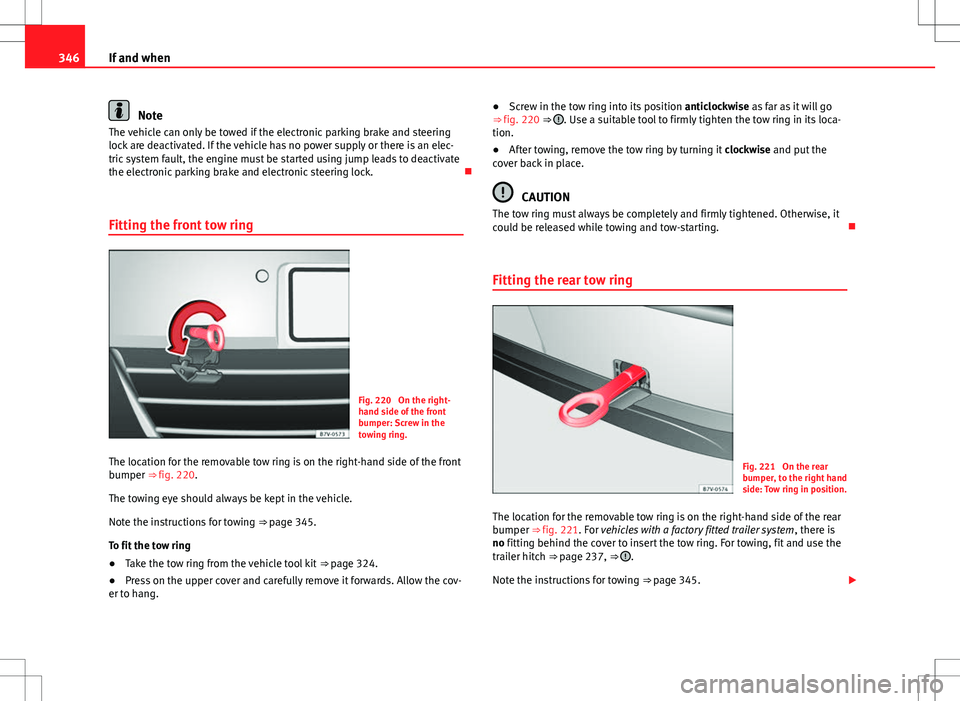
Fig. 220 On the right-
hand side of the front
bumper: Screw in the
towing ring.
The location for the removable tow ring is on the right-hand side of the front
bumper ⇒ fig. 220. The towing eye should always be kept in the vehicle.
Note the instructions for towing ⇒ page 345.
To fit the tow ring
● Take the tow ring from the vehicle tool kit ⇒ page 324.
● Press on the upper cover and carefully remove it forwards. Allow the cov-
er to hang. ●
Screw in the tow ring into its position anticlockwise as far as it will go
⇒ fig. 220 ⇒
. Use a suitable tool to firmly tighten the tow ring in its loca-
tion.
● After towing, remove the tow ring by turning it clockwise and put the
cover back in place.
CAUTION
The tow ring must always be completely and firmly tightened. Otherwise, it
could be released while towing and tow-starting.
Fitting the rear tow ring
Fig. 221 On the rear
bumper, to the right hand
side: Tow ring in position.
The location for the removable tow ring is on the right-hand side of the rear
bumper ⇒ fig. 221. For vehicles with a factory fitted trailer system , there is
no fitting behind the cover to insert the tow ring. For towing, fit and use the
trailer hitch ⇒ page 237, ⇒
.
Note the instructions for towing ⇒ page 345.
Page 349 of 388
347
If and when
Fitting the tow ring to the rear for vehicles without factory fitted tow hitch
● Take the tow ring from the on-board tools ⇒ page 324.
● Press on the upper cover and carefully remove it back. This may require
some strength. Allow the cover to hang.
● Screw in the tow ring into its position anticlockwise as far as it will go
⇒
. Use a suitable tool to firmly tighten the tow ring in its location.
● After towing, remove the tow ring by turning it clockwise and put the
cover back in place.
CAUTION
● The tow ring must always be completely and firmly tightened. Other-
wise, it could be released while towing and tow-starting.
● Vehicles with a factory fitted towing device, can only be used for towing
with a tow-bar, specially designed to fit on a tow hitch ball. Otherwise, the
tow hitch ball and the vehicle may be damaged. Otherwise, a tow rope
should be used.
Towing advice
Towing requires some experience, especially when using a tow-rope. Both
drivers should be familiar with the technique required for towing. For this
reason, inexperienced drivers should abstain.
While driving, avoid excessive traction forces and jerking. When towing on
an unpaved road, there is always a risk of overloading and damaging the
anchorage points.
If the vehicle is towed, with the hazard warning lights on and the ignition
switched on, the turn signal may be used to indicate changes of direction.
Simply operate the turn indicator lever as usual. Meanwhile, the hazard
warning lights will go off. When the turn signal lever is returned to the rest
position, the hazard warning lights will be turned on automatically. Notes for the driver of the towed vehicle
●
Leave the ignition on to avoid locking the steering wheel, to release the
electronic parking brake and to activate the turn signal indicators, the horn
as well as the window wipers and window washers.
● As the power assisted steering does not work if the engine is not run-
ning, you will need more strength to steer than normally.
● The brake must be depressed must harder as the brake servo does not
operate. Avoid hitting the towing vehicle.
● Note the instructions and information contained in the instruction man-
ual for the vehicle to be towed.
Notes for the driver of the towing vehicle
● Accelerate gently and carefully. Avoid sudden manoeuvres.
● Brake well in advance than usual and brake gently.
● Note the instructions and information contained in the instruction man-
ual for the vehicle to be towed.
Safety FirstOperating instructionsPractical tipsTechnical Specifications
Page 375 of 388
Tyre monitoring systems . . . . . . . . . . . . . . 226
Windscreen wiper fluid level . . . . . . . . . . . 105
Controlling function Electric exterior mirrors . . . . . . . . . . . . . . . 113
Control of function Rain sensor . . . . . . . . . . . . . . . . . . . . . . . . . 108
Control units . . . . . . . . . . . . . . . . . . . . . . . . . . . 264 Reprogramming . . . . . . . . . . . . . . . . . . . . . 265
Convenience closing Electric windows . . . . . . . . . . . . . . . . . . . . . . 90
Panorama sliding sunroof . . . . . . . . . . . . . . 94
Convenience functions Reprogramming . . . . . . . . . . . . . . . . . . . . . 265
Convenience opening Electric windows . . . . . . . . . . . . . . . . . . . . . . 90
Panorama sliding sunroof . . . . . . . . . . . . . . 94
Convenient entry function for the third row of seats . . . . . . . . . . . . . . . . . . . . . . . . . . . . . . . 120
Coolant Control lamp . . . . . . . . . . . . . . . . . . . . . . . . 288
See engine coolant . . . . . . . . . . . . . . . . . . 287
Temperature gauge . . . . . . . . . . . . . . . . . . 288
Warning lamp . . . . . . . . . . . . . . . . . . . . . . . 288
Counter steering assistance system . . . . . . . . 170
Crossing a river Salt water . . . . . . . . . . . . . . . . . . . . . . . . . . . . 9
Cruise control . . . . . . . . . . . . . . . . . . . . . . . . . . 214 Control lamp . . . . . . . . . . . . . . . . . . . . . . . . 214
Operations . . . . . . . . . . . . . . . . . . . . . . . . . 215
Warning lamp . . . . . . . . . . . . . . . . . . . . . . . 214
Cruise control system . . . . . . . . . . . . . . . . . . . . 214
Cup holder . . . . . . . . . . . . . . . . . . . . . . . . . . . . 151 Cup holders . . . . . . . . . . . . . . . . . . . . . . . 150, 151
Curb weight . . . . . . . . . . . . . . . . . . . . . . . . . . . . 15
Curtain airbags
See "Airbag system" . . . . . . . . . . . . . . . . . . 37
D Damaged tyres . . . . . . . . . . . . . . . . . . . . . . . . . 303
Dangers of not using the seat belt . . . . . . . . . . 20
Dash panel . . . . . . . . . . . . . . . . . . . . . . . . . . . . . 53 Airbag system . . . . . . . . . . . . . . . . . . . . . . . . 31
Data link connector (DLC) . . . . . . . . . . . . . . . . 265
Data plate . . . . . . . . . . . . . . . . . . . . . . . . . . . . . 349 Model identification . . . . . . . . . . . . . . . . . . 349
Technical specifications . . . . . . . . . . . . . . . 349
Vehicle chassis number . . . . . . . . . . . . . . . 349
Data registry . . . . . . . . . . . . . . . . . . . . . . . . . . . 264
Data storage during the journey . . . . . . . . . . . 264
Data stored by the control units . . . . . . . . . . . 264
Daytime driving light . . . . . . . . . . . . . . . . . . . . . 98
De-icing the door lock cylinder . . . . . . . . . . . . 252
De-icing the locks . . . . . . . . . . . . . . . . . . . . . . . 252
Details Driving with a trailer . . . . . . . . . . . . . . . . . . 241
Diagnostics connection . . . . . . . . . . . . . . . . . . 265
Diesel . . . . . . . . . . . . . . . . . . . . . . . . . . . . . . . . 273 Auxiliary heater . . . . . . . . . . . . . . . . . . . . . 273
Biodiesel . . . . . . . . . . . . . . . . . . . . . . . . . . . 274
Filling the tank . . . . . . . . . . . . . . . . . . . . . . 270
Filter pre-heater . . . . . . . . . . . . . . . . . . . . . 273
Fuel gauge . . . . . . . . . . . . . . . . . . . . . . . . . 269
Winter-grade diesel . . . . . . . . . . . . . . . . . . 273 Diesel particle filter
Malfunction . . . . . . . . . . . . . . . . . . . . . . . . 233
Diesel particulate filter . . . . . . . . . . . . . . . . . . 233 Recommended gear . . . . . . . . . . . . . . . . . . 184
Things to note . . . . . . . . . . . . . . . . . . . . . . . 274
Warning lamp . . . . . . . . . . . . . . . . . . . . . . . 232
Differential lock See "Brake assist systems" . . . . . . . . . . . . 192
Digital clock . . . . . . . . . . . . . . . . . . . . . . . . . . . . 57
Dipped beam headlight . . . . . . . . . . . . . . . . . . . 97
Dipstick . . . . . . . . . . . . . . . . . . . . . . . . . . . . . . . 285
Display . . . . . . . . . . . . . . . . . . . . . . . . . . . . . 57, 58
Disposal Airbag system . . . . . . . . . . . . . . . . . . . . . . . 260
Belt tension device . . . . . . . . . . . . . . . . . . . . 27
End-of-life vehicle . . . . . . . . . . . . . . . . . . . 260
Door release lever . . . . . . . . . . . . . . . . . . . . . . . 53
Doors . . . . . . . . . . . . . . . . . . . . . . . . . . . . . . . . . . 80 Child safety lock . . . . . . . . . . . . . . . . . . . . . . 83
Emergency locking and unlocking . . . . . . 319
Warning indicator . . . . . . . . . . . . . . . . . . . . . 80
Drawbar load . . . . . . . . . . . . . . . . . . . . . . . . . . 235 Loading the trailer . . . . . . . . . . . . . . . . . . . 240
Drawers . . . . . . . . . . . . . . . . . . . . . . . . . . . . . . . 147
Driving Automatic gearbox . . . . . . . . . . . . . . . . . . . 182
Check list . . . . . . . . . . . . . . . . . . . . . . . . . . . . 8
Cross country . . . . . . . . . . . . . . . . . . . . . . . . . 7
Data storage . . . . . . . . . . . . . . . . . . . . . . . . 264
Driving abroad . . . . . . . . . . . . . . . . . . . . . . . . 8
Driving through water . . . . . . . . . . . . . . . . . . 9
Ecological . . . . . . . . . . . . . . . . . . . . . . . . . . 229
373
Index