warning Seat Alhambra 2012 Owner's Manual
[x] Cancel search | Manufacturer: SEAT, Model Year: 2012, Model line: Alhambra, Model: Seat Alhambra 2012Pages: 388, PDF Size: 6.72 MB
Page 332 of 388
330If and when
Changing bulbs
Introduction
Changing bulbs requires a certain amount of manual skill. If you are unsure,
SEAT recommends that you consult an Technical Service or request assis-
tance from a specialist. In general, a specialist is required if other vehicle
components must be removed or if the discharge lamps must be replaced.
You should store spare light bulbs in the vehicle for safety-relevant lights.
Spare bulbs may be obtained from the Technical Services. In some coun-
tries, it is a legal requirement to carry spare bulbs in the vehicle.
Driving with faults and blown bulbs on the vehicle exterior lighting is
against the law.
Additional bulb specifications
The specifications of some headlamp bulbs and bulbs for the tail lamps fit-
ted at the factory may be different to those of conventional bulbs. Bulb in-
formation is displayed on the bulb socket or on the bulb itself.
Additional information and warnings:
● Lights and visibility ⇒ page 95
● Working in the engine compartment ⇒ page 279
● Vehicle tools ⇒ page 324
● Fuses ⇒ page 326
WARNING
If the road is not well-lit and the vehicle is not clearly visible to other
drivers, there is a risk of accident.
WARNING
Failure to replace bulbs correctly may cause serious accidents.
● Before carrying out any work in the engine compartment please read
and observe the warnings ⇒ page 279. In any vehicle, the engine com-
partment is a hazardous area and could cause severe injury.
● Discharge lamps work with high-voltage and can cause serious or fa-
tal injury if handled incorrectly.
● H7 and discharge lamps are highly pressurised and could explode
when being changed.
● Only replace the bulbs concerned when they have cooled.
● Never replace bulbs alone if you are not familiar with the operations
necessary. If you are not sure about procedures then visit a Technical
Service to carry out the necessary work.
● Never touch the bulb glass directly. Fingerprints will be evaporated by
the heat of the operating bulb thus “fogging” up the reflector.
● The headlamp frameworks in the engine compartment and the tail
lamps contain sharp elements. Always protect your hands when chang-
ing bulbs.
CAUTION
After changing a bulb, if the rubber covers and plastic caps are not replaced
correctly on the headlamp framework, the electrical installation may be
damaged, especially if water is allowed to enter.
Indicator
lights upPossible causeSolution
A vehicle exterior lighting
bulb is not working.Replace the faulty bulb.
Page 333 of 388

331
If and when
Several warning and control lamps should light up for a few seconds when
the ignition is switched. This signals that the lamp is working properly. They
will switch off after a few seconds.
Checking the bulbs of a trailer
For vehicles with the factory fitted trailer system, certain trailer lights are al-
so controlled if the socket is correctly connected.
A fault on a trailer turn indicator is indicated on the instrument panel by the
indicator blinking twice as fast ( or ) ⇒ page 95.
● General fault of all indicators on one side.
● Fault in one tail light (on some models, also the registration light).
● Fault in two brake lights.
WARNING
If the warning lamps and messages are ignored, the vehicle may stall in
traffic, or may cause accidents and severe injuries.
● Never ignore the warning lamps or text messages.
● Stop the vehicle safely as soon as possible.
CAUTION
Failure to heed the warning lamps and text messages when they appear
may result in faults in the vehicle.
Note
A fault in the LED on the tail lights will not be indicated. However, if the fault
affects all the LEDs then this will be indicated by the indicator . Information for replacing bulbs
Checklist
To replace a bulb, carry out the following operations always in the order giv-
en ⇒
:
Park the vehicle a safe distance from traffic and on suitable ground.
Connect the electronic parking brake ⇒ page 185.
Turn the light switch to position 0 ⇒ page 95.
Move the gear lever into the neutral position ⇒ page 95.
Automatic gearbox: Move selector lever to position P ⇒ page 176.
Stop the engine and remove the key from the ignition ⇒ page 172.
Manual gearbox: Select a gear ⇒ page 176.
Wait until all of the passenger compartment lights are turned off
⇒ page 95.
Allow the corresponding bulb to cool. Visually inspect fuses to see if any are blown ⇒ page 326.
Replace the bulb according to the instructions ⇒
. Bulbs should only
be replaced by new identical models. Bulb information is displayed on
the bulb socket or on the bulb itself.
In general, never touch the bulb glass directly. The heat of the bulb
would cause the fingerprint to evaporate and condense on the reflector.
This will impair the brightness of the headlight.
Check if the new bulb is working. If the bulb is not working, it may not
have been correctly fitted, it could be damaged or the connector may
not be correctly connected.
Every time a bulb for the headlights is replaced, visit a specialised
workshop to check the headlights.
1.
2.
3.
4.
5.
6.
7.
8.
9.
10.
11.
12.
13.
14.
Safety FirstOperating instructionsPractical tipsTechnical Specifications
Page 334 of 388
332If and when
WARNING
Failure to follow the checklist prepared for your own safety could lead to
accidents and severe injuries.
● Always complete the operations given in the checklist and observe
the general rules of safety.CAUTION
Always remove and fit headlights carefully to avoid damage to the paint-
work and other vehicle parts.
To replace halogen headlight bulbs
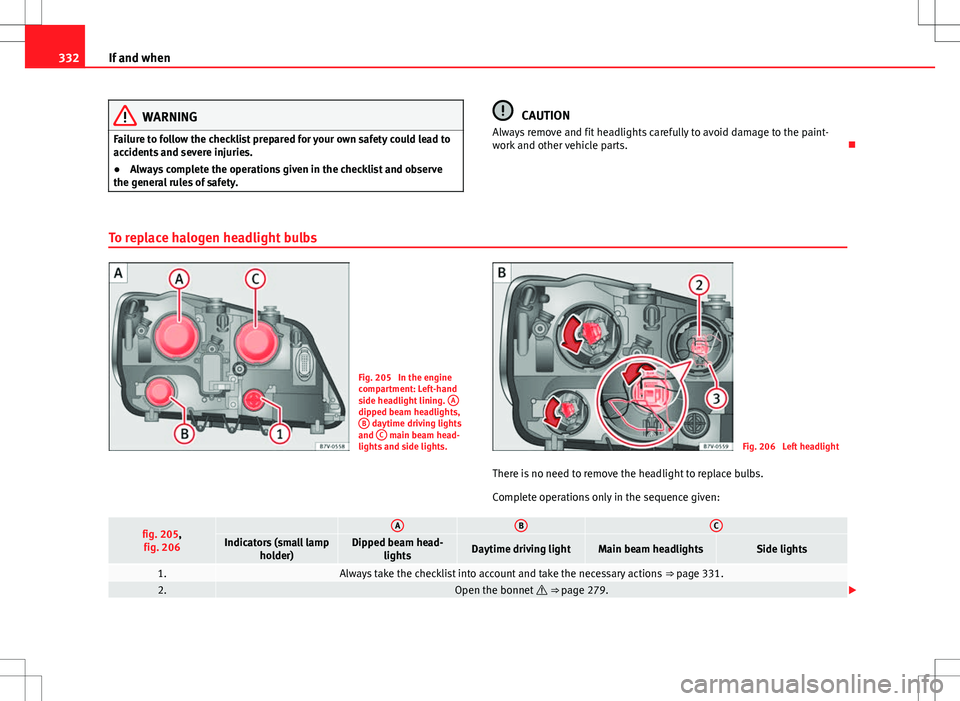
Fig. 205 In the engine
compartment: Left-hand
side headlight lining. A
dipped beam headlights,
B daytime driving lights
and C main beam head-
lights and side lights.Fig. 206 Left headlight
There is no need to remove the headlight to replace bulbs.
Complete operations only in the sequence given:
fig. 205, fig. 206 ABCIndicators (small lamp holder)Dipped beam head-lightsDaytime driving lightMain beam headlightsSide lights
1.Always take the checklist into account and take the necessary actions ⇒ page 331.2.Open the bonnet ⇒ page 279.
Page 343 of 388
341
If and when
Starting assistance
Introduction
If the engine fails to start because of a discharged battery, the battery of an-
other vehicle can be used to start the engine. Before starting, check the
magic eye on the battery ⇒ page 292.
For starting assistance, jump lead cables conforming to the standard
DIN 72553 are required (see the cable manufacturer instructions). The jump
lead cable must be at least 25 mm 2
in section (0.038 inches 2
) for petrol en-
gines, and 35 mm 2
(0.054 inches 2
) for diesel engines.
For vehicles whose battery is not in the engine compartment, the jump
leads should only be connected to the starting assistance connection
points in the engine compartment.
Additional information and warnings:
● Starter assist systems (Start-Stop function) ⇒ page 196
● Working in the engine compartment ⇒ page 279
● Selective Catalytic Reduction (AdBlue) ⇒ page 275
● Vehicle battery ⇒ page 292
WARNING
Incorrect use of jump leads and incorrectly jump starting could cause the
battery to explode resulting in serious injury. Please observe the follow-
ing rules to minimise the risk of a battery explosion:
● All work involving the vehicle battery and electrical system can cause
corrosion, fire and serious electric shocks. Always read and take into ac-
count the safety warnings and standards before beginning work on the
battery ⇒ page 292, Vehicle battery.
WARNING (Continued)
● The battery providing current must have the same voltage (12V) and
approximately the same capacity (see markings on battery) as the flat
battery.
● Never charge a frozen or recently thawed battery. A flat battery can al-
so freeze at temperatures close to 0 °C (+32 °F).
● If a battery is frozen and/or has been frozen then it must be replaced.
● A highly explosive mixture of gases is released when the battery is
being charged. Always keep lit cigarettes, open flames, sparks and fire
far from the battery. Never use a mobile telephone when connecting and
removing the jump leads.
● Charge the battery only in well ventilated areas given that when the
battery is charged by outside assistance, it creates a mix of highly explo-
sive gases.
● Jump leads should never enter into contact with moving parts in the
engine compartment.
● Never switch the positive and negative poles or connect the jump
leads incorrectly.
● Note the instructions provided by the manufacturer of the jump leads.
CAUTION
To avoid considerable damage to the vehicle electrical system, note the fol-
lowing carefully:
● If the jump leads are incorrectly connected, this could result in a short
circuit.
● The vehicles must not touch each other, otherwise electricity could flow
as soon as the positive terminals are connected.
Safety FirstOperating instructionsPractical tipsTechnical Specifications
Page 345 of 388
343
If and when
The vehicles should not touch. Otherwise, current may be allowed to flow
when the positive poles are connected.
Connect the clamps so they have good metal-to-metal contact with the ter-
minals.
If the engine fails to start straight-away, switch off the starter after about 10
seconds and try again after about a minute.
Complete operations only in the sequence given.
Jump lead terminal connections
● Switch off the ignition of both vehicles ⇒ page 172.
● Likewise, open the battery cover in the engine compartment
⇒ page 292, or remove the positive pole cap from one side 1)
, in the direc-
tion of the arrow ⇒ fig. 217.
● Connect one end of the red jump lead to the positive terminal
⇒ fig. 218 +
or ⇒
fig. 217 + of the vehicle with the flat battery A ⇒ .
● Connect the other end of the red jump lead to the positive terminal + in
the vehicle providing assistance B.
● For vehicles without Start-Stop system: Connect one end of the black
jump lead to the negative terminal -
in the vehicle providing assistance
B ⇒ fig. 218.
● For vehicles with Start-Stop system: Connect one end of the black X
jump lead to a suitable ground connection, a solid piece of metal in the en-
gine block, or to the engine block
⇒ fig. 219.
● Connect the other end of the black jump lead X
to a solid metal compo-
nent connected to the engine block, or onto the engine block itself of the
vehicle with the flat battery however, connect it as far away as possible from
the battery A
⇒ .
● Place the leads so that they cannot be caught by any moving parts in the
engine compartment. Switching on
●
Start the engine of the vehicle supplying current and let it run at idling
speed.
● Start the engine of the car with the flat battery and wait two or three mi-
nutes until the engine is “running smoothly”.
Removing the jump leads
● Before you remove the jump leads, switch off the headlights (if they are
switched on).
● Turn on the heating and rear window heater in the vehicle with the flat
battery. This helps minimise voltage peaks which are generated when the
leads are disconnected.
● With the engines running, disconnect the leads in reverse order to con-
nection.
● Close the battery cover, or replace the positive pole cap 1)
.
WARNING
Incorrectly jump starting could cause the battery to explode resulting in
serious injury. Please observe the following rules to minimise the risk of
a battery explosion:
● All work involving the vehicle battery and electrical system can cause
corrosion, fire and serious electric shocks. Always read and take into ac-
count the safety warnings and standards before beginning work on the
battery ⇒ page 292, Vehicle battery.
● Always protect your eyes with suitable working goggles and never
lean over the vehicle battery.
● The jump leads must be connected in the correct order: first the posi-
tive cable, then the negative cable.
1)
Vehicles whose battery is not located in the engine compartment ⇒ page 342.
Safety FirstOperating instructionsPractical tipsTechnical Specifications
Page 346 of 388
344If and when
WARNING (Continued)
● Do not attach the negative cable to parts of the fuel system or to the
brake hose/pipe.
● The non-insulated parts of the battery clamps must not be allowed to
touch. Also, the cable connected to the positive pole of the battery
should never enter into contact with electrically conductive parts of the
vehicle.
● Check the magic eye on the battery; use a lamp if necessary. If it is
clear yellow or clear, do not start the vehicle: seek specialised technical
assistance.
● Avoid static electricity discharges in the area around the battery. In
the event of sparks, explosive gases coming from the battery could ig-
nite.
● Never use starting assistance if the vehicle battery is damaged, fro-
zen or has been frozen.
Towing and tow starting Introduction
When towing, always respect legal requirements.
For technical reasons, it is not possible to tow a vehicle if the battery is flat.
Additional information and warnings:
● Electronic power control and exhaust gases purification system
⇒ page 232
WARNING
A vehicle with a flat battery should never be towed.
● Never remove the key from the ignition lock. The electronic steering
lock could engage. Then the vehicle will be uncontrollable. You may lose
control of the vehicle and there is a risk of serious accident.
WARNING
When towing the vehicle, the handling and braking efficiency change
considerably. Please observe the following instructions to minimise the
risk of serious accidents and injury:
● As the driver of the vehicle being towed:
– The brake must be depressed must harder as the brake servo does
not operate. Always remain aware to avoid collision with the towing
vehicle.
– More strength is required at the steering wheel as the power steer-
ing does not operate when the engine is switched off.
● As the driver of the towing vehicle:
– Accelerate gently and carefully.
– Avoid sudden braking and manoeuvres.
– Brake well in advance than usual and brake gently.
CAUTION
● Carefully fit and remove the towing ring and its cover to avoid damage to
the vehicle (for example, paintwork).
● When towing, fuel could enter the catalytic converter and cause dam-
age!
Page 347 of 388
345
If and when
Instructions for tow starting
In general, the vehicle should not be started by towing. Jump-starting is
much more preferable ⇒ page 341.
For technical reasons, the following vehicles can not be tow started:
● Vehicles with an automatic gearbox.
● Vehicles with an electronic parking brake, given that it is possible that
the brake will not be disengaged.
● If the vehicle battery is flat, it is possible that the engine control units do
not operate correctly.
However, if your vehicle must absolutely be tow-started (manual gearbox):
● Engage the 2nd or 3rd gear.
● Keep the clutch pressed down.
● Switch on the ignition and the hazard warning lights.
● Release the clutch when both vehicles are moving.
● As soon as the engine starts, press the clutch and move the gear lever
into neutral. This helps to prevent a collision with the towing vehicle.
CAUTION
When tow-starting, fuel could enter the catalytic converter and damage it.
Towing instructions
Tow-rope or tow-bar
When towing, the tow bar is the safest and vehicle friendly way. You should
only use a tow-rope if you do not have a tow-bar. A tow-rope should be slightly elastic to avoid damage to both vehicles. It is
advisable to use a tow-rope made of synthetic fibre or similarly elastic mate-
rial.
Only secure the tow rope or tow bar to the tow ring or specially designed
fitting.
Vehicles with a
factory fitted towing device , can only be used for towing
with a tow-bar, specially designed to fit on a tow hitch ball ⇒ page 237.
Towing vehicles with an automatic gearbox
Note the following for a towed vehicle:
● Make sure the gear selector lever is in the N position.
● Do not drive faster than 50 km/h (30 mph) when towing a vehicle.
● Do not tow further than 50 km (30 miles).
● If a breakdown truck is used, the vehicle must be towed with the front
wheels raised. Note the following instructions for towing four wheel drive
vehicles.
Instructions for towing four-wheel-drive vehicles
Four wheel drive vehicles can be towed using a toolbar or tow rope. If the
vehicle is towed with the front or rear axle raised, the engine must be turned
off to avoid transmission damage.
For vehicles with a double clutched DSG ®
(direct shift gearbox) the instruc-
tions for towing vehicles with an automatic gearbox apply ⇒ page 345.
Situations in which the vehicle should not be towed
In the following cases, the vehicle should not be towed but transported on a
trailer or special vehicle:
● If the vehicle gearbox does not contain lubricant due to a fault.
● If the vehicle battery is flat and, as a result, the electronic steering lock
and electronic parking brake cannot be disengaged if applied.
● If the vehicle to be towed has an automatic gearbox and the distance to
be covered is greater than 50 km (30 miles).
Safety FirstOperating instructionsPractical tipsTechnical Specifications
Page 349 of 388
347
If and when
Fitting the tow ring to the rear for vehicles without factory fitted tow hitch
● Take the tow ring from the on-board tools ⇒ page 324.
● Press on the upper cover and carefully remove it back. This may require
some strength. Allow the cover to hang.
● Screw in the tow ring into its position anticlockwise as far as it will go
⇒
. Use a suitable tool to firmly tighten the tow ring in its location.
● After towing, remove the tow ring by turning it clockwise and put the
cover back in place.
CAUTION
● The tow ring must always be completely and firmly tightened. Other-
wise, it could be released while towing and tow-starting.
● Vehicles with a factory fitted towing device, can only be used for towing
with a tow-bar, specially designed to fit on a tow hitch ball. Otherwise, the
tow hitch ball and the vehicle may be damaged. Otherwise, a tow rope
should be used.
Towing advice
Towing requires some experience, especially when using a tow-rope. Both
drivers should be familiar with the technique required for towing. For this
reason, inexperienced drivers should abstain.
While driving, avoid excessive traction forces and jerking. When towing on
an unpaved road, there is always a risk of overloading and damaging the
anchorage points.
If the vehicle is towed, with the hazard warning lights on and the ignition
switched on, the turn signal may be used to indicate changes of direction.
Simply operate the turn indicator lever as usual. Meanwhile, the hazard
warning lights will go off. When the turn signal lever is returned to the rest
position, the hazard warning lights will be turned on automatically. Notes for the driver of the towed vehicle
●
Leave the ignition on to avoid locking the steering wheel, to release the
electronic parking brake and to activate the turn signal indicators, the horn
as well as the window wipers and window washers.
● As the power assisted steering does not work if the engine is not run-
ning, you will need more strength to steer than normally.
● The brake must be depressed must harder as the brake servo does not
operate. Avoid hitting the towing vehicle.
● Note the instructions and information contained in the instruction man-
ual for the vehicle to be towed.
Notes for the driver of the towing vehicle
● Accelerate gently and carefully. Avoid sudden manoeuvres.
● Brake well in advance than usual and brake gently.
● Note the instructions and information contained in the instruction man-
ual for the vehicle to be towed.
Safety FirstOperating instructionsPractical tipsTechnical Specifications
Page 350 of 388
348Description of specifications
Technical Specifications
Description of specifications
Important information
Important
The information in the vehicle documentation always has
precedence. All technical specifications provided in this manual are valid for the stand-
ard model in Spain. The vehicle data card included in the Inspection and
Maintenance Plan in the vehicle documents shows which engine is installed
in the vehicle.
The figures may be different depending on if additional equipment is fitted,
for different models, for special vehicles and for other countries.
Additional information and warnings:
● Transporting ⇒ page 13
● Ecological driving ⇒ page 229
● Fuel ⇒ page 271
● Engine oil ⇒ page 283
● Engine coolant ⇒ page 287
● Wheels and tyres ⇒ page 297
● Notes for the user ⇒ page 259 Abbreviations used in the Technical Specifications section
Abbrevia-
tionMeaning
kWKilowatt, engine power measurement.
PSPferdestärke (horsepower), formerly used to denote engine
power.
rpmRevolutions per minute - engine speed.NmNewton metres, unit of engine torque.l/100 kmFuel consumption in litres per 100 km.g/kmCarbon dioxide emissions in grams per km travelled.CO2Carbon dioxideCNCetane number, indication of the diesel combustion power.
RONResearch octane number, indication of the knock resistance
of petrol.
WARNING
Failure to observe requirements for weight, loads, dimensions and maxi-
mum speed may lead to severe accident.
Page 352 of 388
350Description of specifications
Information on fuel consumption
Fuel consumption
The consumption and emission details shown on the vehicle
data sticker differ from one vehicle to another.
The fuel consumption, CO 2 emissions and actual kerb weight of the vehicle
are noted on the vehicle data sticker.
The fuel consumption and emissions figures given are based on the vehicle
weight category, which is determined according to the engine/gearbox
combination and the equipment fitted.
The consumption and emission figures are calculated in accordance with
the EC test requirements 1999/100/EC. These test requirements specify a
realistic test method based on normal everyday driving.
The following test conditions are applied:
Urban cycleThe urban cycle starts with an engine cold start. City driving
is then simulated.
Extra urban
cycleIn the extra urban cycle simulation the vehicle frequently ac-
celerates and brakes in all gears, as in normal everyday driv-
ing. The road speed ranges from 0 to 120 km/h.
Total con-
sumptionThe average total consumption is calculated with a weight-
ing of around 37% for the urban cycle and 63% for the extra
urban cycle.
CO 2 emis-
sionsThe exhaust gases are collected during both driving cycles
to calculate carbon dioxide emissions. The gas composition
is then analysed to evaluate the CO 2 content and other
emissions.
Note
● Actual consumption may vary from quoted test values, depending on
personal driving style, road and traffic conditions, the weather and the vehi-
cle condition.
Weights
Kerb weight refers to the basic model with a fuel tank filled to 90% capacity
and without optional extras. The figure quoted includes 75 kg to allow for
the weight of the driver.
For special versions and optional equipment fittings or for the addition of
accessories, the weight of the vehicle will increase ⇒
.
WARNING
● Please note that the centre of gravity may shift when transporting
heavy objects; this may affect the vehicle's handling and lead to an acci-
dent. Always adjust your speed and driving style to suit road conditions
and requirements.
● Never exceed the gross axle weight rating or the gross vehicle weight
rating. If the allowed axle load or the allowed total weight is exceeded,
the driving characteristics of the vehicle may change, leading to acci-
dents, injuries and damage to the vehicle.