airbag Seat Alhambra 2012 Owner's Guide
[x] Cancel search | Manufacturer: SEAT, Model Year: 2012, Model line: Alhambra, Model: Seat Alhambra 2012Pages: 388, PDF Size: 6.72 MB
Page 39 of 388

37
Airbag system
Curtain airbags
Fig. 22 On the left side of the vehicle: location and de-
ployment area of the curtain airbag.
Fig. 23 Deployed curtain
airbags
The curtain airbags are located on the driver and front passenger side
above the doors ⇒ fig. 22. Airbags are identified by the word “AIRBAG”. The area framed red ⇒ fig. 22 is covered by the curtain airbag when it is de-
ployed (deployment area). Therefore, objects should never be placed or
mounted in these areas.
In a side collision, the curtain airbag on the side affected will be deployed.
The airbag covers the windows and pillars.
In a side collision, the curtain airbags for the front and outer rear seats re-
duce the risk of injury to the areas of the body facing the impact.
WARNING
The airbag is deployed at high speed in fractions of a second.
● Always keep the deployment areas of the curtain airbags free.
● Do not fix objects to the cover or in the deployment area of the cur-
tain airbag.
Safety FirstOperating instructionsPractical tipsTechnical Specifications
Page 40 of 388
38Airbag system
WARNING (Continued)
● Occupants of the front and outer rear seats must never carry any oth-
er people, pets or objects in the deployment space between them and
the airbags.
● The built-in coat hooks should be used only for lightweight clothing.
Do not leave any heavy or sharp-edged objects in the pockets.
● Do not mount accessories on the doors.
● Do not fit curtains to the windows other than those expressly ap-
proved for use in the vehicle.
● Only turn the sun blinds towards the windows if there is no object,
e.g. pens or garage remote controls, secured to the sun blind.
Knee airbag
Fig. 24 On the driver
side: location of the knee
airbag.
Fig. 25 On the driver
side: Radius of action of
the knee airbag.
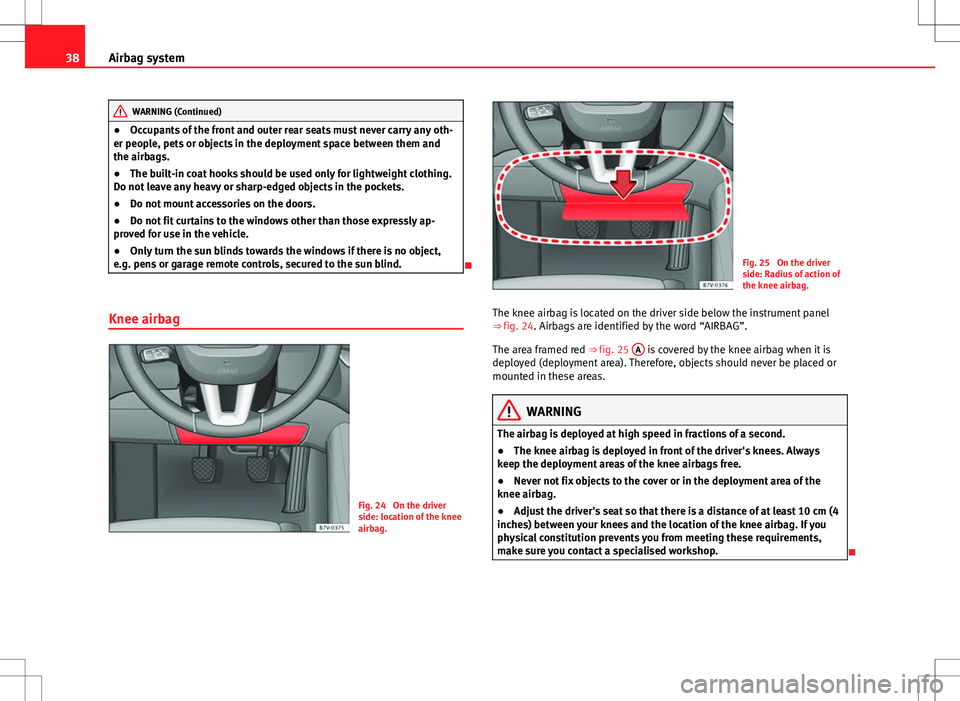
The knee airbag is located on the driver side below the instrument panel
⇒ fig. 24. Airbags are identified by the word “AIRBAG”.
The area framed red ⇒ fig. 25 A
is covered by the knee airbag when it is
deployed (deployment area). Therefore, objects should never be placed or
mounted in these areas.
WARNING
The airbag is deployed at high speed in fractions of a second.
● The knee airbag is deployed in front of the driver's knees. Always
keep the deployment areas of the knee airbags free.
● Never not fix objects to the cover or in the deployment area of the
knee airbag.
● Adjust the driver's seat so that there is a distance of at least 10 cm (4
inches) between your knees and the location of the knee airbag. If you
physical constitution prevents you from meeting these requirements,
make sure you contact a specialised workshop.
Page 41 of 388

39
Child safety
Child safety
Child seats (accessories) Introduction
Please read the information regarding the airbag system fully before trans-
porting babies and children in a child seat or other child restraint system
installed on the front passenger seat.
This information is extremely important for driver and passenger safety, par-
ticularly that of babies and children.
SEAT recommends the use of child seats from the SEAT accessory pro-
gramme. These child seats have been designed and tested for use in SEAT
vehicles. You can purchase child seats with different mountings from a
Technical Service.
Using child restraint systems with a base or foot
Some child retention systems are secured to the seat using a base or foot.
For certain equipment the use of an additional accessory will be necessary
(for example, the accessory for the floor compartment) to fit the child reten-
tion system correctly and securely.
Additional information and warnings:
● Airbag system ⇒ page 31
● Integrated child seats ⇒ page 45
WARNING
Make sure children are properly belted in and correctly secured to avoid
severe or fatal injuries while the vehicle is in motion.
● Never use a rear-facing child seat in the front passenger seat if the
front passenger airbag is enabled.
● Children up to 12 years old should always travel on the rear seat.
● Children must always be protected with an approved child restraint
system suited to their height and weight.
● Children must assume the proper sitting position and be properly bel-
ted in while travelling.
● Ensure the backrest of a seat is upright when a child seat is being
used on it.
● Do not allow the child's head or other part of his or her body to fall
into the deployment area of the side airbags.
● Make sure the belt webbing is correctly positioned.
● Never hold children or babies on your lap or in your arms.
● Only one child may occupy a child seat.
● If you are using a child seat with a base or foot, always install this
base or foot correctly and safely.
● If the vehicle has a storage compartment in the foot well in front of
the last row of seats, this compartment cannot be used as designed; on
the contrary: It must be filled using the specially designed accessory so
that the base or foot is correctly supported by the closed compartment
and the child seat is secured properly. If this compartment is not suitably
secured when using a child seat with a base or foot then the compart-
ment cover could rupture in an accident and the child will be ejected and
suffer serious injury.
● Please read and observe the child seat manufacturer's handling in-
structions.
Safety FirstOperating instructionsPractical tipsTechnical Specifications
Page 44 of 388
42Child safety
Always secure child seats properly and safely in the vehicle according to the
child seat manufacturer's installation instructions.
Mounted child seats must rest correctly on the vehicle's seat and must not
move or rock more than 2.5 cm (1 inch).
Child seats equipped for a Top Tether strap must also be secured using the
Top Tether retaining strap in the vehicle ⇒ page 45. Only secure the re-
taining belt to the rings fitted for this purpose and identified as Top Tether.
Not all rings can be used with the Top Tether system. Always tighten the Top
Tether retaining strap so that the child seat fits snugly against the corre-
sponding seat in the vehicle.
Specific mounting systems for each country
Europe: ISOFIX retaining rings and upper retaining strap ⇒ page 44
and ⇒ page 45.
Three-point seat belt and upper retaining strap ⇒ page 44.
The systems include the child restraint system mounting with an upper re-
taining strap (Top Tether) and lower anchoring points on the seat.
Use of the child seat on the front passenger seat
Transporting children on the front passenger seat is not permitted in all
countries. Furthermore, not all child seats are approved for use on the front
passenger seat. Your Technical Service has an updated list of all approved
child seats. Only used child seats that are approved for each vehicle.
The frontal airbag on the front passenger side is highly dangerous for a
child. The front passenger seat is life-threatening to a child if he or she is
transported in a rear-facing child seat.
If a rear-facing child seat is secured to the front passenger seat, an inflating
airbag can strike it with such great force that severe or fatal injuries may re-
sult ⇒
. Therefore, rear-facing child seats must never be used on the front
passenger seat when the front passenger airbag is enabled. A
B
Only use a rear-facing child seat on the front passenger seat if the front pas-
senger airbag is disabled. When it is disabled, the yellow
PASSENGER
AIR BAG control lamp on the instrument panel will be lit ⇒ page 31. If
you cannot disable the front passenger airbag and it remains enabled, it is
forbidden to transport children on the front passenger seat ⇒
.
Things to note if using a child seat on the front passenger seat:
● The front passenger airbag must be disabled if using a rear-facing
child seat ⇒ page 35.
● The backrest of the front passenger seat must be upright.
● The front passenger seat must be moved as far back as possible.
● The backrest of the front passenger seat must be upright.
● The seat belt height adjustment must be as high as possible.
Suitable child seats
The child seat must be authorised by the manufacturer especially for use on
a front passenger seat with a frontal or side airbag.
If the front passenger seat is equipped with retaining rings, the child seat
can be secured using the approved retaining system provided it is approved
for this type of vehicle in accordance with current regulations in the country
in question.
Universal seats for children in groups 0, 0+, 1, 2 or 3 according to the ECE-
R 44 regulation.
WARNING
If a child seat is mounted on the front passenger seat, the risk of the
child sustaining severe or fatal injuries in the event of an accident increa-
ses. Rear-facing child seats must never be mounted on the front passen-
ger seat when the front passenger airbag is enabled. This is life-threaten-
ing to the child should the frontal airbag deploy, as the child seat would
be struck by the inflated airbag and thrown against the backrest.
Page 45 of 388
43
Child safety
WARNING
If, in exceptional circumstances, a child must be transported in a rear-fac-
ing child seat on the front passenger seat, strictly observe the following:
● Always disable the front passenger airbag and leave it disabled.
● The child seat must be approved by the manufacturer for use on a
front passenger seat with frontal and side airbag.
● Follow the installation instructions of the child seat manufacturer and
observe the warnings.
● Move the front passenger seat as far back as possible and adjust it to
its highest position to keep as far away as possible from the frontal air-
bag.
● Move the backrest to the upright position.
● The seat belt height adjustment must be as high as possible.
● Children must always be protected with an approved child restraint
system suited to their height and weight.
Use of the child seat on the rear seat
If a child seat is mounted on the rear seat, adapt the position of the front
passenger seat so that the child has enough space. Therefore, adapt the
front passenger seat to the size of the child seat and the height of the child.
Ensure the passenger is in the correct position ⇒ page 10.
Move the second and third row of seats fully back and lock them. Place the
seat backs in a vertical position and fold the armrests down.
ISOFIX child seats approved for rear seats
The rear seats are suitable for child seats with the ISOFIX system specially
designed for this type of vehicle in accordance with regulation ECE-R 44.
ISOFIX child seats are divided into “specific categories for the vehicle”,
“limited” or “semi-universal”. Child seat manufacturers supply a list of vehicles with each ISOFIX seat,
which includes the models for which the ISOFIX child seat in question is ap-
proved. If the vehicle is included in the manufacturer's list and the ISOFIX
child seat belongs to a seat category included in the list, then it can be
used in your vehicle. If necessary, contact the child seat manufacturer for an
updated list of vehicles.
Group (weight
category)ISOFIX child seat cate- gorySeat position on the rear seats
Group 0: chil-
dren up to 10 kgEIUF a)
Group 0+: chil-
dren up to 13 kgEIUF a)DIUFa)CIUFa)
Group 1: 9 to 18
kg
DIUFa)CIUFa)BIUFa)B1IUFa)AIUFa)a)
IUF: suitable for “universal” ISOFIX child seats authorised for use in this group.
WARNING
If child seats are fitted to all the seats in the second row then it is possi-
ble that the seats of this row cannot be folded down from the third row of
seats in case of an accident. In case of an emergency, passengers in the
third row of seats will not be able to leave the vehicle or to help them-
selves.
● Child seats should not occupy all the seats of the second row if other
passengers are to occupy the third row of seats.
Safety FirstOperating instructionsPractical tipsTechnical Specifications
Page 48 of 388
46Child safety
WARNING
Child travelling without their seat belt fastened or not secured using a
suitable restraint system may sustain fatal injuries if the airbag is de-
ployed.
● Children up to 12 years old should always travel on the rear seat.
● Always disable the front passenger airbag if, in exceptional cases,
you have no alternative but to transport a child in a rear-facing child safe-
ty seat on the front passenger seat.
● Children must always be protected with a child restraint system suit-
ed to their height and weight.
● Always fasten children's seat belts correctly.
WARNING
Children must travel in a child seat appropriate to their weight and
height while the vehicle is in motion.
● Children must always be protected with a child restraint system suit-
ed to their height and weight.
● Children must assume the proper sitting position and be properly bel-
ted in while travelling.
● The shoulder part of the seat belt must lie approximately on the cen-
tre of the shoulder, never across the neck or the arm.
● The seat belt must lie close to the upper part of the body.
WARNING (Continued)
● The lap belt part must lie across the pelvis, not across the stomach,
and always fit closely.
● Allow the belt to retract until it fits tightly over the child's seat.
● Never hold children or babies on your lap.
● Always use a child seat and the seat belt for children who are less
than 1.5 metres tall. The normal seat belt could cause injuries to the ab-
dominal and neck areas.
● Only one child may occupy a child seat.
● Read and follow the information and warnings provided by the child
seat manufacturer.
● Never leave an unsupervised child alone on a child seat or in the vehi-
cle.
● All modifications to the integrated child seat must be carried out by a
specialised workshop.
● Replace the child seat or any seat components damaged or involved
in an accident.
WARNING
Loose objects could fly uncontrollably around the vehicle interior and
cause injuries in the event of an accident or sudden braking.
● Do not leave toys or other hard, loose objects on the child seat or on
the seat while the vehicle is in motion.
Page 55 of 388
53
Cockpit
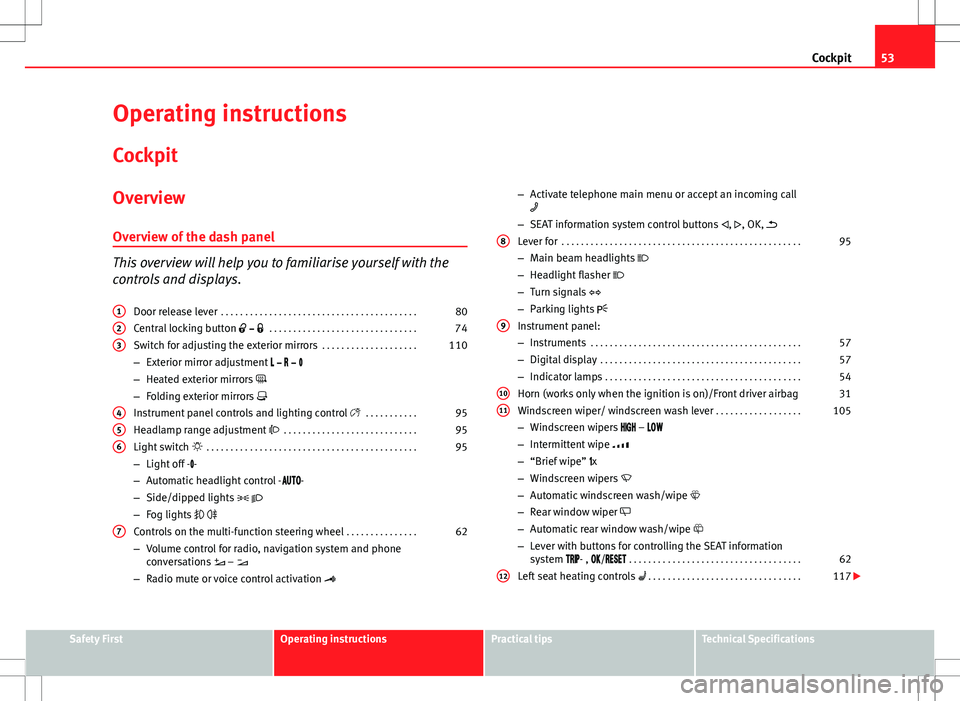
Operating instructions Cockpit
Overview Overview of the dash panel
This overview will help you to familiarise yourself with the
controls and displays. Door release lever . . . . . . . . . . . . . . . . . . . . . . . . . . . . . . . . . . . . . . . . . 80
Central locking button . . . . . . . . . . . . . . . . . . . . . . . . . . . . . . . 74
Switch for adjusting the exterior mirrors . . . . . . . . . . . . . . . . . . . .110
– Exterior mirror adjustment
– Heated exterior mirrors
– Folding exterior mirrors
Instrument panel controls and lighting control . . . . . . . . . . .95
Headlamp range adjustment . . . . . . . . . . . . . . . . . . . . . . . . . . . . 95
Light switch . . . . . . . . . . . . . . . . . . . . . . . . . . . . . . . . . . . . . . . . . . . . 95
– Light off - -
– Automatic headlight control - -
– Side/dipped lights
– Fog lights
Controls on the multi-function steering wheel . . . . . . . . . . . . . . .62
– Volume control for radio, navigation system and phone
conversations –
– Radio mute or voice control activation
1
23
456
7
–
Activate telephone main menu or accept an incoming call
– SEAT information system control buttons , , OK,
Lever for . . . . . . . . . . . . . . . . . . . . . . . . . . . . . . . . . . . . . . . . . . . . . . . . . . 95
– Main beam headlights
– Headlight flasher
– Turn signals
– Parking lights
Instrument panel:
– Instruments . . . . . . . . . . . . . . . . . . . . . . . . . . . . . . . . . . . . . . . . . . . . 57
– Digital display . . . . . . . . . . . . . . . . . . . . . . . . . . . . . . . . . . . . . . . . . . 57
– Indicator lamps . . . . . . . . . . . . . . . . . . . . . . . . . . . . . . . . . . . . . . . . . 54
Horn (works only when the ignition is on)/Front driver airbag 31
Windscreen wiper/ windscreen wash lever . . . . . . . . . . . . . . . . . .105
– Windscreen wipers –
– Intermittent wipe
– “Brief wipe” x
– Windscreen wipers
– Automatic windscreen wash/wipe
– Rear window wiper
– Automatic rear window wash/wipe
– Lever with buttons for controlling the SEAT information
system - , / . . . . . . . . . . . . . . . . . . . . . . . . . . . . . . . . . . . . 62
Left seat heating controls . . . . . . . . . . . . . . . . . . . . . . . . . . . . . . . . 117
8
9
1011
12
Safety FirstOperating instructionsPractical tipsTechnical Specifications
Page 56 of 388
54Cockpit
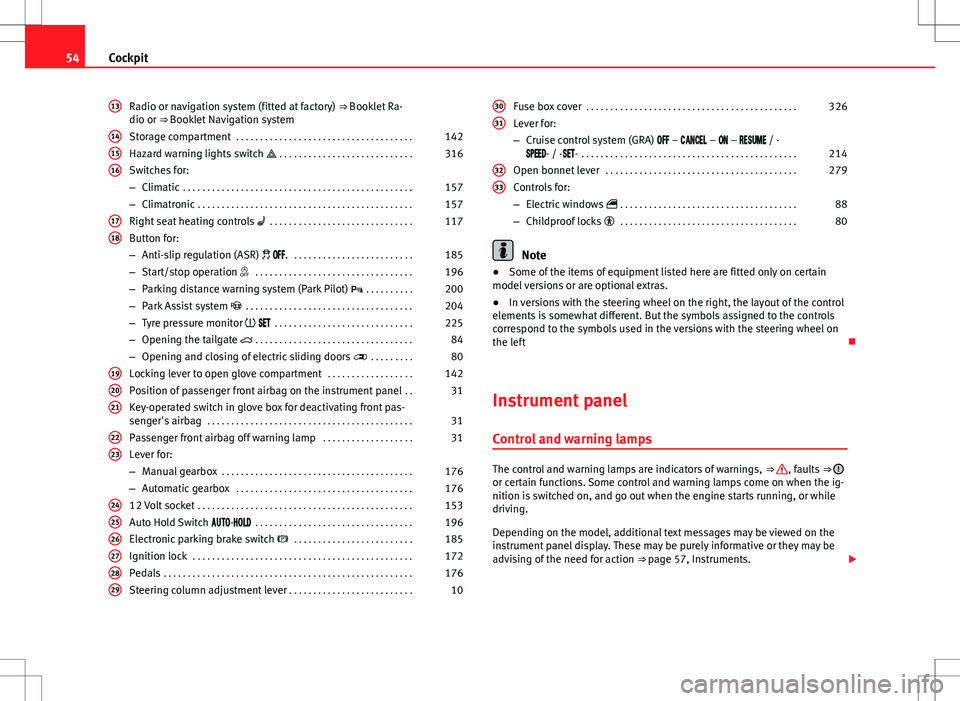
Radio or navigation system (fitted at factory) ⇒ Booklet Ra-
dio or ⇒ Booklet Navigation system
Storage compartment . . . . . . . . . . . . . . . . . . . . . . . . . . . . . . . . . . . . . 142
Hazard warning lights switch . . . . . . . . . . . . . . . . . . . . . . . . . . . . 316
Switches for:
– Climatic . . . . . . . . . . . . . . . . . . . . . . . . . . . . . . . . . . . . . . . . . . . . . . . . 157
– Climatronic . . . . . . . . . . . . . . . . . . . . . . . . . . . . . . . . . . . . . . . . . . . . . 157
Right seat heating controls . . . . . . . . . . . . . . . . . . . . . . . . . . . . . . 117
Button for:
– Anti-slip regulation (ASR) . . . . . . . . . . . . . . . . . . . . . . . . . . 185
– Start/stop operation . . . . . . . . . . . . . . . . . . . . . . . . . . . . . . . . . 196
– Parking distance warning system (Park Pilot) . . . . . . . . . . 200
– Park Assist system . . . . . . . . . . . . . . . . . . . . . . . . . . . . . . . . . . . 204
– Tyre pressure monitor . . . . . . . . . . . . . . . . . . . . . . . . . . . . . 225
– Opening the tailgate . . . . . . . . . . . . . . . . . . . . . . . . . . . . . . . . . 84
– Opening and closing of electric sliding doors . . . . . . . . . 80
Locking lever to open glove compartment . . . . . . . . . . . . . . . . . .142
Position of passenger front airbag on the instrument panel . .31
Key-operated switch in glove box for deactivating front pas-
senger's airbag . . . . . . . . . . . . . . . . . . . . . . . . . . . . . . . . . . . . . . . . . . . 31
Passenger front airbag off warning lamp . . . . . . . . . . . . . . . . . . .31
Lever for:
– Manual gearbox . . . . . . . . . . . . . . . . . . . . . . . . . . . . . . . . . . . . . . . . 176
– Automatic gearbox . . . . . . . . . . . . . . . . . . . . . . . . . . . . . . . . . . . . . 176
12 Volt socket . . . . . . . . . . . . . . . . . . . . . . . . . . . . . . . . . . . . . . . . . . . . . 153
Auto Hold Switch - . . . . . . . . . . . . . . . . . . . . . . . . . . . . . . . . . 196
Electronic parking brake switch . . . . . . . . . . . . . . . . . . . . . . . . . 185
Ignition lock . . . . . . . . . . . . . . . . . . . . . . . . . . . . . . . . . . . . . . . . . . . . . . 172
Pedals . . . . . . . . . . . . . . . . . . . . . . . . . . . . . . . . . . . . . . . . . . . . . . . . . . . . 176
Steering column adjustment lever . . . . . . . . . . . . . . . . . . . . . . . . . . 10
13
141516
1718
192021
2223
242526272829
Fuse box cover
. . . . . . . . . . . . . . . . . . . . . . . . . . . . . . . . . . . . . . . . . . . . 326
Lever for:
– Cruise control system (GRA) – – – / -
- / -- . . . . . . . . . . . . . . . . . . . . . . . . . . . . . . . . . . . . . . . . . . . . . 214
Open bonnet lever . . . . . . . . . . . . . . . . . . . . . . . . . . . . . . . . . . . . . . . . 279
Controls for:
– Electric windows . . . . . . . . . . . . . . . . . . . . . . . . . . . . . . . . . . . . . 88
– Childproof locks . . . . . . . . . . . . . . . . . . . . . . . . . . . . . . . . . . . . . 80
Note
● Some of the items of equipment listed here are fitted only on certain
model versions or are optional extras.
● In versions with the steering wheel on the right, the layout of the control
elements is somewhat different. But the symbols assigned to the controls
correspond to the symbols used in the versions with the steering wheel on
the left
Instrument panel Control and warning lamps
The control and warning lamps are indicators of warnings, ⇒ , faults ⇒ or certain functions. Some control and warning lamps come on when the ig-
nition is switched on, and go out when the engine starts running, or while
driving.
Depending on the model, additional text messages may be viewed on the
instrument panel display. These may be purely informative or they may be
advising of the need for action ⇒ page 57, Instruments.
30
31
3233
Page 58 of 388
56Cockpit
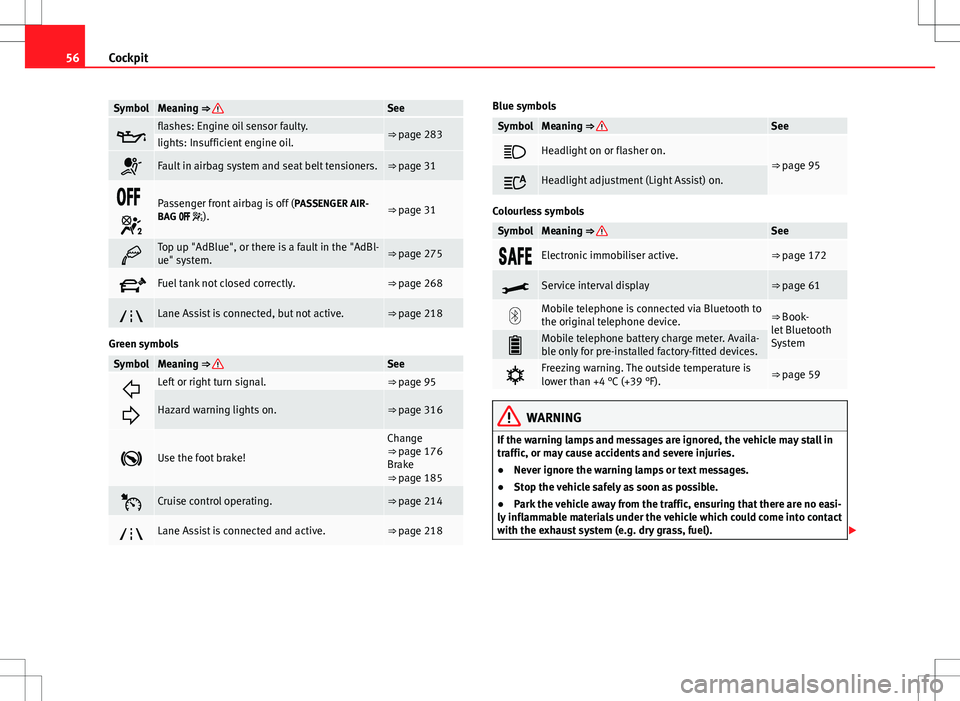
SymbolMeaning ⇒ See
flashes: Engine oil sensor faulty.⇒ page 283lights: Insufficient engine oil.
Fault in airbag system and seat belt tensioners.⇒ page 31
Passenger front airbag is off ( PASSENGER AIR-
BAG ).⇒ page 31
Top up "AdBlue", or there is a fault in the "AdBl-
ue" system.⇒ page 275
Fuel tank not closed correctly.⇒ page 268
Lane Assist is connected, but not active.⇒ page 218
Green symbols
SymbolMeaning ⇒ See
Left or right turn signal.⇒ page 95
Hazard warning lights on.⇒ page 316
Use the foot brake!
Change
⇒ page 176
Brake
⇒ page 185
Cruise control operating.⇒ page 214
Lane Assist is connected and active.⇒ page 218
Blue symbols
SymbolMeaning ⇒ See
Headlight on or flasher on.⇒ page 95
Headlight adjustment (Light Assist) on.
Colourless symbols
SymbolMeaning ⇒ See
Electronic immobiliser active.⇒ page 172
Service interval display⇒ page 61
Mobile telephone is connected via Bluetooth to
the original telephone device.⇒ Book-
let Bluetooth
System
Mobile telephone battery charge meter. Availa-
ble only for pre-installed factory-fitted devices.
Freezing warning. The outside temperature is
lower than +4 °C (+39 °F).⇒ page 59
WARNING
If the warning lamps and messages are ignored, the vehicle may stall in
traffic, or may cause accidents and severe injuries.
● Never ignore the warning lamps or text messages.
● Stop the vehicle safely as soon as possible.
● Park the vehicle away from the traffic, ensuring that there are no easi-
ly inflammable materials under the vehicle which could come into contact
with the exhaust system (e.g. dry grass, fuel).
Page 77 of 388

75
Unlocking and locking
● Electric windows ⇒ page 88
● Panorama sliding sunroof ⇒ page 92
● Towing mode ⇒ page 237
● Emergency locking and unlocking ⇒ page 318
WARNING
The incorrect use of the central locking system may cause serious inju-
ries.
● The central locking system will lock all doors. A vehicle locked from
the inside can prevent any non-authorised individual from opening the
doors and accessing the vehicle. Nevertheless, in case of emergency or
accident, locked doors will complicate access to the passenger compart-
ment to help the passengers.
● Never leave children or disabled people alone in the vehicle. The cen-
tral locking button can be used to lock all the doors from within. There-
fore, passengers will be locked inside the vehicle. Individuals locked in
the vehicle can be exposed to very high or very low temperatures.
● Depending on the time of the year, temperatures inside a locked and
closed vehicle can be extremely high or extremely low resulting in seri-
ous injuries and illness or even death, particularly for young children.
● Never leave individuals locked in a closed and locked vehicle. In case
of emergency, they may not be able to exit the vehicle by themselves or
get help.
Description of the central locking system
The central locking system allows all doors and the tailgate to be locked
and unlocked centrally.
● From outside, using the vehicle key.
● From inside, by pushing the central locking button ⇒ page 77. In the submenu Convenience in the Configuration menu, or by visiting a spe-
cialized workshop, special functions of the central locking system can be
switched on or off ⇒ page 62.
In case of a vehicle key fault or central locking system fault, all doors can be
locked or unlocked manually.
Locking the vehicle after the airbags have been deployed
If the airbags are deployed due to an accident, the vehicle will be automati-
cally and completely unlocked. Depending on the amount of damage, the
vehicle can be locked following an accident in the following ways:
FunctionNecessary operationsLocking the vehicle
from within:– Turn off the ignition and turn it on again.
– Push the central locking button .Locking the vehicle
from the outside:– Turn off the ignition and turn it on again.
OR: – Remove the key from the ignition.
– Open any door just once.
– Lock the vehicle with the key.
Safety FirstOperating instructionsPractical tipsTechnical Specifications