oil Seat Alhambra 2012 Owner's Guide
[x] Cancel search | Manufacturer: SEAT, Model Year: 2012, Model line: Alhambra, Model: Seat Alhambra 2012Pages: 388, PDF Size: 6.72 MB
Page 285 of 388
283
Checking and refilling levels
CAUTION
● To avoid damage to the bonnet and to the windscreen wiper arms, only
open the bonnet when the windscreen wipers are in place against the wind-
screen.
● Before driving, always lower the wiper arms.
Engine oil Introduction
Additional information and warnings:
● ⇒ Booklet Maintenance Programme
● Working in the engine compartment ⇒ page 279
● Accessories, parts replacement, repairs and modifications ⇒ page 261
WARNING
Incorrectly handling engine oil can cause injury and serious burns.
● Always protect your eyes when handling engine oil.
● Oil is toxic and must be kept out of the reach of children.
● Engine oil must only be kept closed in its original container. The same
applies to use oil until it has been disposed of.
● Never store engine oil in empty food containers or bottles as other
people may accidentally drink it.
● Regular contact with engine oil can be bad for the skin. If you come
into contact with engine oil, wash your skin with soap and water.
● With the engine running, the engine oil gets extremely hot and can
cause severe skin burns. Always wait until the engine has fully cooled.
For the sake of the environment
Similar to the other service liquids, spilled engine oil can be bad for the en-
vironment. Collect any spilt fluids in suitable containers and dispose of in
accordance with legislation and with the utmost respect for the environ-
ment.
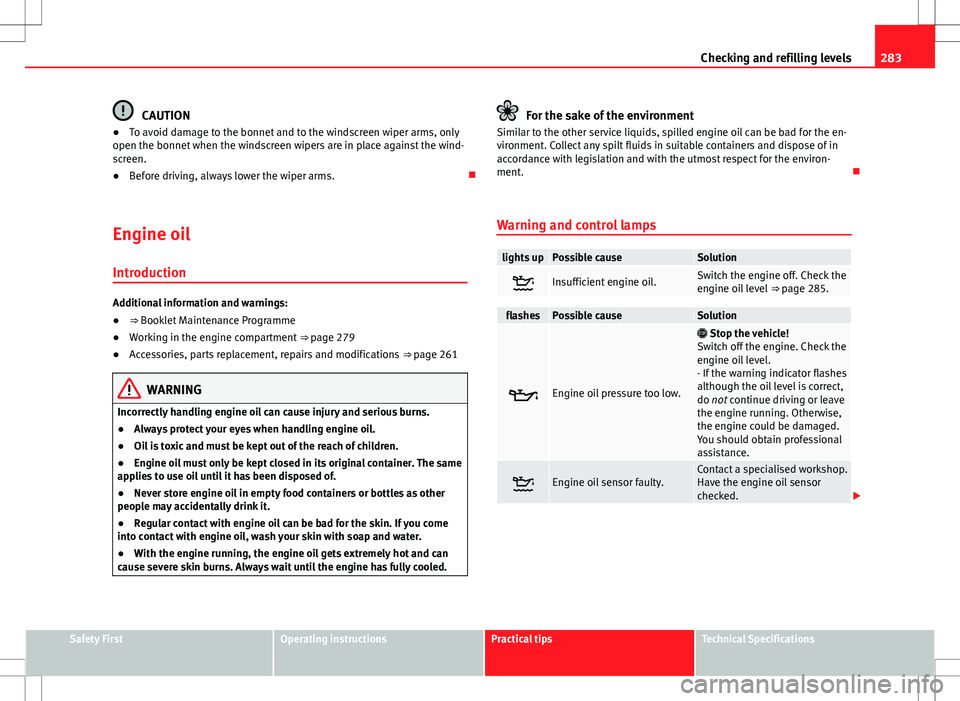
Warning and control lamps
lights upPossible causeSolution
Insufficient engine oil.Switch the engine off. Check the
engine oil level ⇒ page 285.
flashesPossible causeSolution
Engine oil pressure too low.
Stop the vehicle!
Switch off the engine. Check the
engine oil level.
- If the warning indicator flashes
although the oil level is correct,
do not continue driving or leave
the engine running. Otherwise,
the engine could be damaged.
You should obtain professional
assistance.
Engine oil sensor faulty.Contact a specialised workshop.
Have the engine oil sensor
checked.
Safety FirstOperating instructionsPractical tipsTechnical Specifications
Page 286 of 388
284Checking and refilling levels
WARNING
If the warning lamps and messages are ignored, the vehicle may stall in
traffic, or may cause accidents and severe injuries.
● Never ignore the warning lamps or text messages.
● Stop the vehicle safely as soon as possible.
CAUTION
Failure to heed the warning lamps and text messages when they appear
may result in faults in the vehicle.
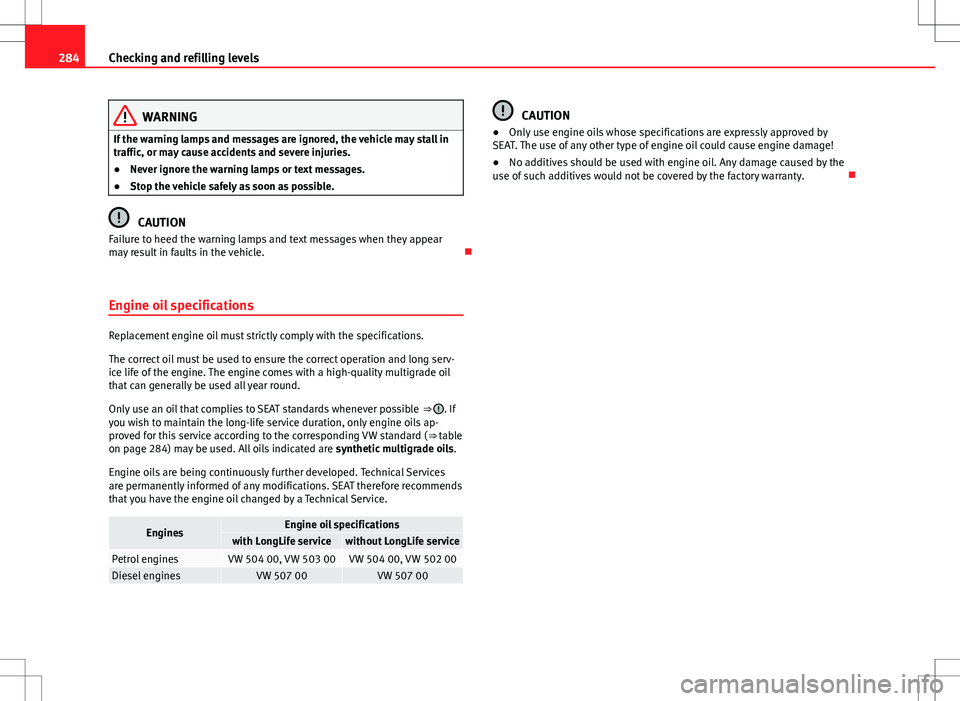
Engine oil specifications
Replacement engine oil must strictly comply with the specifications.
The correct oil must be used to ensure the correct operation and long serv-
ice life of the engine. The engine comes with a high-quality multigrade oil
that can generally be used all year round.
Only use an oil that complies to SEAT standards whenever possible ⇒
. If
you wish to maintain the long-life service duration, only engine oils ap-
proved for this service according to the corresponding VW standard ( ⇒ table
on page 284) may be used. All oils indicated are synthetic multigrade oils.
Engine oils are being continuously further developed. Technical Services
are permanently informed of any modifications. SEAT therefore recommends
that you have the engine oil changed by a Technical Service.
EnginesEngine oil specificationswith LongLife servicewithout LongLife servicePetrol enginesVW 504 00, VW 503 00VW 504 00, VW 502 00Diesel enginesVW 507 00VW 507 00
CAUTION
● Only use engine oils whose specifications are expressly approved by
SEAT. The use of any other type of engine oil could cause engine damage!
● No additives should be used with engine oil. Any damage caused by the
use of such additives would not be covered by the factory warranty.
Page 287 of 388
285
Checking and refilling levels
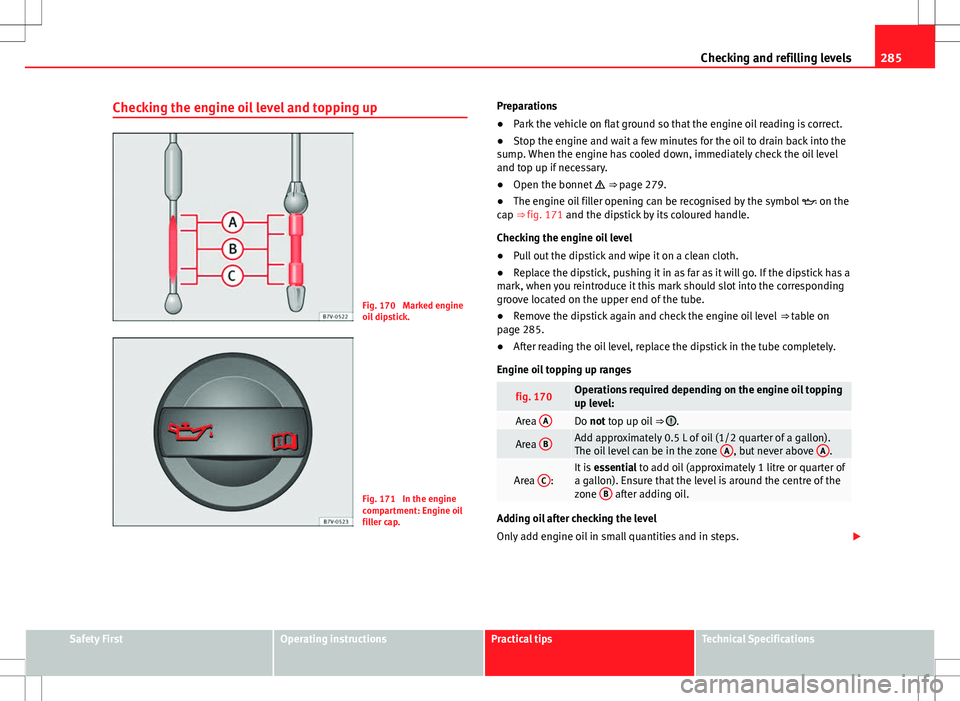
Checking the engine oil level and topping up
Fig. 170 Marked engine
oil dipstick.
Fig. 171 In the engine
compartment: Engine oil
filler cap. Preparations
●
Park the vehicle on flat ground so that the engine oil reading is correct.
● Stop the engine and wait a few minutes for the oil to drain back into the
sump. When the engine has cooled down, immediately check the oil level
and top up if necessary.
● Open the bonnet ⇒ page 279.
● The engine oil filler opening can be recognised by the symbol on the
cap ⇒ fig. 171 and the dipstick by its coloured handle.
Checking the engine oil level
● Pull out the dipstick and wipe it on a clean cloth.
● Replace the dipstick, pushing it in as far as it will go. If the dipstick has a
mark, when you reintroduce it this mark should slot into the corresponding
groove located on the upper end of the tube.
● Remove the dipstick again and check the engine oil level ⇒ table on
page 285.
● After reading the oil level, replace the dipstick in the tube completely.
Engine oil topping up ranges
fig. 170Operations required depending on the engine oil topping
up level:
Area ADo not top up oil
⇒ .
Area BAdd approximately 0.5 L of oil (1/2 quarter of a gallon).
The oil level can be in the zone A, but never above A.
Area C:It is
essential to add oil (approximately 1 litre or quarter of
a gallon). Ensure that the level is around the centre of the
zone B
after adding oil.
Adding oil after checking the level
Only add engine oil in small quantities and in steps.
Safety FirstOperating instructionsPractical tipsTechnical Specifications
Page 288 of 388
286Checking and refilling levels
● Unscrew the cap from engine oil filler opening on the cylinder head
⇒ fig. 171. If you are not sure where the cap is, request help from a special-
ist.
● Only refill using engine oil expressly approved by SEAT and in small
quantities (not more than 0.5 l or 1/2 a quarter of a gallon at a time)
⇒ page 284.
● To avoid adding too much oil, each time you add a quantity, wait until
the oil has flowed into the crankcase so that it can be measured with the
dipstick.
● Check the oil level before adding any more oil. Do not top up with too
much engine oil ⇒
.
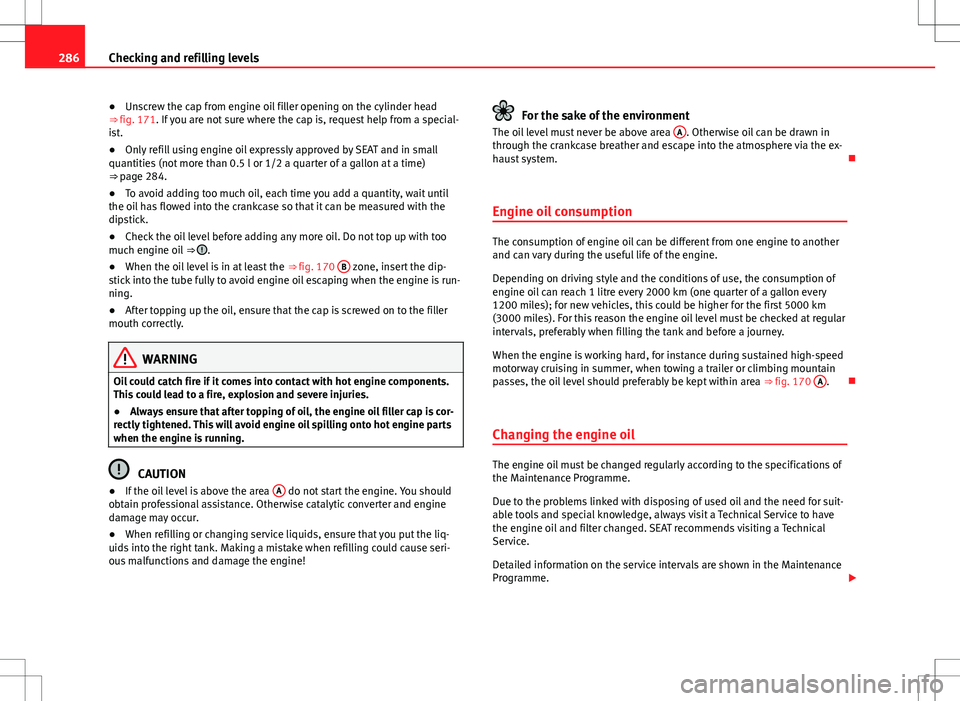
● When the oil level is in at least the ⇒ fig. 170 B zone, insert the dip-
stick into the tube fully to avoid engine oil escaping when the engine is run-
ning.
● After topping up the oil, ensure that the cap is screwed on to the filler
mouth correctly.
WARNING
Oil could catch fire if it comes into contact with hot engine components.
This could lead to a fire, explosion and severe injuries.
● Always ensure that after topping of oil, the engine oil filler cap is cor-
rectly tightened. This will avoid engine oil spilling onto hot engine parts
when the engine is running.
CAUTION
● If the oil level is above the area A do not start the engine. You should
obtain professional assistance. Otherwise catalytic converter and engine
damage may occur.
● When refilling or changing service liquids, ensure that you put the liq-
uids into the right tank. Making a mistake when refilling could cause seri-
ous malfunctions and damage the engine!
For the sake of the environment
The oil level must never be above area A. Otherwise oil can be drawn in
through the crankcase breather and escape into the atmosphere via the ex-
haust system.
Engine oil consumption
The consumption of engine oil can be different from one engine to another
and can vary during the useful life of the engine.
Depending on driving style and the conditions of use, the consumption of
engine oil can reach 1 litre every 2000 km (one quarter of a gallon every
1200 miles); for new vehicles, this could be higher for the first 5000 km
(3000 miles). For this reason the engine oil level must be checked at regular
intervals, preferably when filling the tank and before a journey.
When the engine is working hard, for instance during sustained high-speed
motorway cruising in summer, when towing a trailer or climbing mountain
passes, the oil level should preferably be kept within area ⇒ fig. 170 A
.
Changing the engine oil
The engine oil must be changed regularly according to the specifications of
the Maintenance Programme.
Due to the problems linked with disposing of used oil and the need for suit-
able tools and special knowledge, always visit a Technical Service to have
the engine oil and filter changed. SEAT recommends visiting a Technical
Service.
Detailed information on the service intervals are shown in the Maintenance
Programme.
Page 289 of 388
287
Checking and refilling levels
Engine oil additives make new oil darker after the engine has been running
for a short period. This is normal and does not mean more frequent oil
changes are required.
WARNING
If, in exceptional circumstances, you must change the engine oil yourself,
please note the following:
● Wear eye protection.
● Always wait until the engine has completely cooled to avoid being
burned.
● Always keep your arms horizontal when unscrewing the oil drainage
bolt so that the oil does not run down your arms when it begins to drain.
● Use a suitable and large enough container to collect all of the used oil
in the engine.
● Never collect engine oil in empty food containers, cans, bottles and
other containers as not all people are able to identify engine oil.
● Oil is toxic and must be kept out of the reach of children.
For the sake of the environment
Before changing the engine oil, find a suitable location or service for proper
disposal.
For the sake of the environment
Always dispose of engine oil with the utmost respect for the environment.
Never dispose of used engine oil in places such as a garden, woods, drains,
roads, paths, rivers and drainage systems. Engine coolant
Introduction
Never work on the engine cooling system or if you are not familiar with the
operations to be carried out, the applicable safety standards and especially
if you do not have the instruments, liquids and tools necessary ⇒
! Have
the work carried out by a specialised workshop if you are uncertain. SEAT
recommends visiting a Technical Service.
Negligent work can cause serious injury.
Additional information and warnings:
● Towing mode ⇒ page 237
● Working in the engine compartment ⇒ page 279
● Accessories, parts replacement, repairs and modifications ⇒ page 261
WARNING
Engine coolant is toxic!
● Only keep engine coolant in its original container, tightly shut and in
a safe place.
● Never store engine coolant in empty food containers or bottles as
other people may accidentally drink it.
● Always keep engine coolant out of reach of children.
● Ensure that the proportion of engine coolant additive corresponds to
the lowest outside temperature to which the vehicle will be exposed.
● If the outside temperature is extremely low, the engine coolant could
freeze causing the vehicle to stop. As this would also cause the heating
to stop working, passengers without sufficient clothing could freeze.
Safety FirstOperating instructionsPractical tipsTechnical Specifications
Page 291 of 388
289
Checking and refilling levels
WARNING
If the warning lamps and messages are ignored, the vehicle may stall in
traffic, or may cause accidents and severe injuries.
● Always observe any lit warning lamps and text messages.
● Never ignore the warning lamps or text messages.
● Stop the vehicle safely as soon as possible.
CAUTION
Failure to heed the warning lamps and text messages when they appear
may result in faults in the vehicle.
Engine coolant specifications
The engine cooling system comes with a special mixture of water and at
least 40% G 12 plus-plus (TL-VW 774 G) or G 12 plus (TL-VW 774 F) engine
coolant additive. Both are easily recognisable because they are purple in
colour.
This mixture gives the necessary frost protection down to -25 °C (-13 °F) and
protects the alloy parts of the cooling system against corrosion. It also pre-
vents scaling and raises the boiling point of the coolant.
To protect the engine cooling system, the proportion of additive must al-
ways be at least 40%, even if frost protection is not required in countries
with a warm climate.
If greater frost protection is required in very cold climates, the proportion of
additive can be increased. However, the percentage of additive should not
exceed 60 %, as this would reduce the frost protection and, in turn, de-
crease the cooling capacity. When adding coolant, a mixture of
distilled water and at least 40 % of the
additive G 12 plus-plus must be use to ensure optimum rust protection
⇒
.
WARNING
In the event of insufficient antifreeze protection in the engine cooling
system, the engine could be damaged and severe injuries caused.
● Ensure that the proportion of engine coolant additive corresponds to
the lowest outside temperature to which the vehicle will be exposed.
● If the outside temperature is extremely low, the engine coolant could
freeze causing the vehicle to stop. As this would also cause the heating
to stop working, passengers without sufficient clothing could freeze.
CAUTION
Never mix genuine additives with other additives that are not approved by
SEAT. Otherwise, you run the risk of causing severe damage to the engine
and the engine cooling system.
● The engine coolant G 12 plus-plus can be mixed with G 12 plus and
G 11.
● If the fluid in the expansion reservoir is not purple but, for example,
brown, this means that you have mixed G 12 plus-plus or G 12 plus with an-
other coolant. The coolant must be changed as soon as possible if this is
the case! Using the wrong fluids could cause serious malfunctions and en-
gine damage!
For the sake of the environment
Coolants and additives can contaminate the environment. Collect any spilt
fluids in suitable containers and dispose of in accordance with legislation
and with the utmost respect for the environment.
Safety FirstOperating instructionsPractical tipsTechnical Specifications
Page 301 of 388

299
Wheels and tyres
● Replace damaged or worn tyres as soon as possible ⇒ page 303.
● Regularly check tyres for non-visible damage ⇒ page 303.
● Never exceed the maximum permitted speed or loads specified for the
type of tyre fitted on your vehicle ⇒ page 306.
● Do not allow tyres to come into contact with aggressive substances,
grease, oil, fuel or brake fluid ⇒
.
● Lost valve caps should be replaced immediately.
Tyres with directional tread pattern
Tyres with directional tread pattern have been designed to operate best
when rotating in only one direction. An arrow on the tyre sidewall indicates
the direction of rotation on tyres with directional tread ⇒ page 306. Always
observe the direction of rotation indicated when mounting the wheel. This
guarantees optimum grip and helps to avoid aquaplaning, excessive noise
and wear.
If the tyre is mounted in the opposite direction of rotation, drive with ex-
treme caution, as the tyre is no longer being used correctly. This is of partic-
ular importance when the road surface is wet. Change the tyre as soon as
possible or remount it with the correct direction of rotation.
Interchanging tyres
To ensure that the wear is equal on all tyres the wheels should be changed
round from time to time according to the system ⇒ fig. 177. All the tyres will
then last for about the same time.
SEAT recommends you take the vehicle to a Technical Service to have the
tyres changed.
Tyres that are over 6 years old
Tyres are subject to an ageing process as a result of physical and chemical
processes. This may affect their performance. Tyres which are stored for
long periods of time without being used, harden and become more fragile
than tyres which are in constant use.
SEAT recommends that tyres over six years old are replaced with new tyres.
This also applies to tyres which appear to be in perfect condition on the out- side and which have a tread depth within the values stipulated by the Law
⇒
.
The date of manufacture, part of the tyre identification number (TIN), indi-
cates the age of the tyre ⇒ page 306.
Storing tyres
Mark tyres when you remove them to indicate the direction of rotation (left,
right, forwards, backwards). This ensures you will be able to mount them
correctly when you replace them. When removed, the wheels and/or tyres
should be stored in a cool, dry and preferably dark location. Do not place
tyres mounted on the wheel in a vertical position.
Protect tyres not mounted on wheels from dirt by storing them in suitable
bags and standing them on the ground on their tread.
WARNING
Aggressive fluids or substances could result in visible or invisible dam-
age with the consequent risks.
● Always ensure that tyres do not come into contact with chemical
products, oil, grease, fuel, brake fluid or other aggressive substances.
WARNING
Old tyres, even if they have never been used, may lose air or burst unex-
pectedly while driving, resulting in serious accident or damage.
● If tyres are over six years old, they should only be used in an emer-
gency and with extreme caution.
For the sake of the environment
Old tyres must be disposed of by qualified personnel according to the laws
in the country concerned.
Safety FirstOperating instructionsPractical tipsTechnical Specifications
Page 314 of 388
312Wheels and tyres
Never grease or lubricate wheel bolts or the wheel hub threads. Although
they have been tightened to the prescribed torque, they could come loose
while driving.
WARNING
If the wheel bolts are not fitted correctly they could be released while
driving leading to loss of vehicle control and serious damage.
● Only use wheel bolts which correspond to the wheel rims in question.
● Never use different wheel bolts.
● The bolts and threads should be clean, free of oil and grease and easy
to thread.
WARNING (Continued)
● To loosen and tighten the wheel bolts, always use the wheel brace
supplied with the vehicle.
● Loosen the wheel bolts only about one turn before raising the vehicle
with the jack.
● Never grease or lubricate wheel bolts or the wheel hub threads. Al-
though they have been tightened to the prescribed torque, they could
come loose while driving.
● Never loosen the bolted joints of wheel rims with bolted ring trims.
● If the wheel bolts are not tightened to the correct torque, they may
come loose while driving, and the bolts and rims may come out. If the
tightening torque is too high, the wheel bolts and threads can be dam-
aged.
Page 317 of 388

315
Wheels and tyres
Changing a wheel
Fig. 187 Changing the
wheel: loosen wheel
bolts with the socket at
the end of the wheel
brace.
Removing the wheel
● Please observe the check list ⇒ page 310.
● Loosen the wheel bolts ⇒ page 311.
● Jacking up the vehicle ⇒ page 313.
● Using the hexagonal socket in the wheel brace ⇒ fig. 187, unscrew the
slackened wheel bolts and place them on a clean surface.
● Take off the wheel.
Putting on the spare wheel
Check the direction of rotation of the tyre ⇒ page 299.
● Fit the wheel.
● Screw on the anti-theft locking bolt with the adapter in position
⇒ fig. 184 2
or 3 clockwise and tighten gently.
● Replace the other wheel bolts and tighten slightly using the hexagonal
socket on the end of the wheel brace.
● Lower the car with the jack. ●
Tighten all of the wheel bolts clockwise ⇒
. Tighten the bolts in diago-
nal pairs (not in a circle).
● Put the caps, trim or full hubcap back on ⇒ page 308.
WARNING
If the wheel bolts are not treated suitably or not tightened to the correct
torque then this could lead to loss of vehicle control and to a serious ac-
cident.
● All the wheel bolts and hub threads should be clean and free of oil
and grease. The wheel bolts should be easily tightened to the correct tor-
que.
● The hexagonal socket in the wheel brace should be used for turning
wheel bolts only. Do not use it to loosen or tighten the wheel bolts.
After changing the wheel
● Clean the wheel brace, if necessary and put it away in the luggage com-
partment ⇒ page 324.
● Have the tightening torque of the wheel bolts checked as soon as possi-
ble with a torque wrench ⇒ page 311.
Note
If the vehicle is fitted with a tyre monitoring system, this should be “reprog-
rammed” if necessary whenever a tyre is changed ⇒ page 227.
Safety FirstOperating instructionsPractical tipsTechnical Specifications
Page 350 of 388
348Description of specifications
Technical Specifications
Description of specifications
Important information
Important
The information in the vehicle documentation always has
precedence. All technical specifications provided in this manual are valid for the stand-
ard model in Spain. The vehicle data card included in the Inspection and
Maintenance Plan in the vehicle documents shows which engine is installed
in the vehicle.
The figures may be different depending on if additional equipment is fitted,
for different models, for special vehicles and for other countries.
Additional information and warnings:
● Transporting ⇒ page 13
● Ecological driving ⇒ page 229
● Fuel ⇒ page 271
● Engine oil ⇒ page 283
● Engine coolant ⇒ page 287
● Wheels and tyres ⇒ page 297
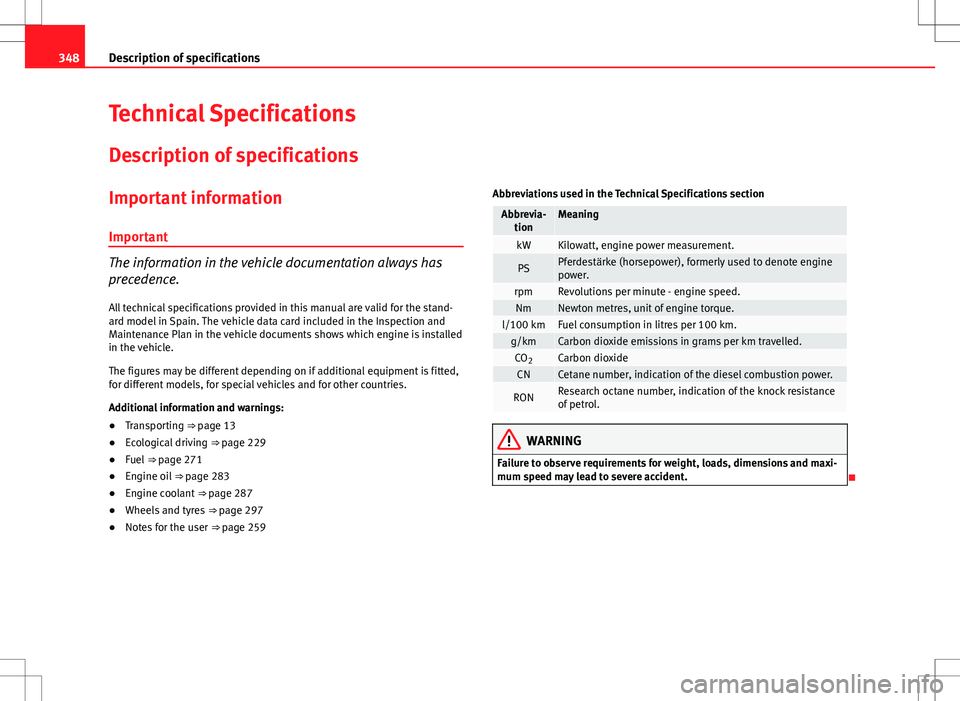
● Notes for the user ⇒ page 259 Abbreviations used in the Technical Specifications section
Abbrevia-
tionMeaning
kWKilowatt, engine power measurement.
PSPferdestärke (horsepower), formerly used to denote engine
power.
rpmRevolutions per minute - engine speed.NmNewton metres, unit of engine torque.l/100 kmFuel consumption in litres per 100 km.g/kmCarbon dioxide emissions in grams per km travelled.CO2Carbon dioxideCNCetane number, indication of the diesel combustion power.
RONResearch octane number, indication of the knock resistance
of petrol.
WARNING
Failure to observe requirements for weight, loads, dimensions and maxi-
mum speed may lead to severe accident.