coolant reservoir Seat Alhambra 2012 Owner's Manual
[x] Cancel search | Manufacturer: SEAT, Model Year: 2012, Model line: Alhambra, Model: Seat Alhambra 2012Pages: 388, PDF Size: 6.72 MB
Page 291 of 388
289
Checking and refilling levels
WARNING
If the warning lamps and messages are ignored, the vehicle may stall in
traffic, or may cause accidents and severe injuries.
● Always observe any lit warning lamps and text messages.
● Never ignore the warning lamps or text messages.
● Stop the vehicle safely as soon as possible.
CAUTION
Failure to heed the warning lamps and text messages when they appear
may result in faults in the vehicle.
Engine coolant specifications
The engine cooling system comes with a special mixture of water and at
least 40% G 12 plus-plus (TL-VW 774 G) or G 12 plus (TL-VW 774 F) engine
coolant additive. Both are easily recognisable because they are purple in
colour.
This mixture gives the necessary frost protection down to -25 °C (-13 °F) and
protects the alloy parts of the cooling system against corrosion. It also pre-
vents scaling and raises the boiling point of the coolant.
To protect the engine cooling system, the proportion of additive must al-
ways be at least 40%, even if frost protection is not required in countries
with a warm climate.
If greater frost protection is required in very cold climates, the proportion of
additive can be increased. However, the percentage of additive should not
exceed 60 %, as this would reduce the frost protection and, in turn, de-
crease the cooling capacity. When adding coolant, a mixture of
distilled water and at least 40 % of the
additive G 12 plus-plus must be use to ensure optimum rust protection
⇒
.
WARNING
In the event of insufficient antifreeze protection in the engine cooling
system, the engine could be damaged and severe injuries caused.
● Ensure that the proportion of engine coolant additive corresponds to
the lowest outside temperature to which the vehicle will be exposed.
● If the outside temperature is extremely low, the engine coolant could
freeze causing the vehicle to stop. As this would also cause the heating
to stop working, passengers without sufficient clothing could freeze.
CAUTION
Never mix genuine additives with other additives that are not approved by
SEAT. Otherwise, you run the risk of causing severe damage to the engine
and the engine cooling system.
● The engine coolant G 12 plus-plus can be mixed with G 12 plus and
G 11.
● If the fluid in the expansion reservoir is not purple but, for example,
brown, this means that you have mixed G 12 plus-plus or G 12 plus with an-
other coolant. The coolant must be changed as soon as possible if this is
the case! Using the wrong fluids could cause serious malfunctions and en-
gine damage!
For the sake of the environment
Coolants and additives can contaminate the environment. Collect any spilt
fluids in suitable containers and dispose of in accordance with legislation
and with the utmost respect for the environment.
Safety FirstOperating instructionsPractical tipsTechnical Specifications
Page 292 of 388
290Checking and refilling levels
Checking the engine coolant level and refilling
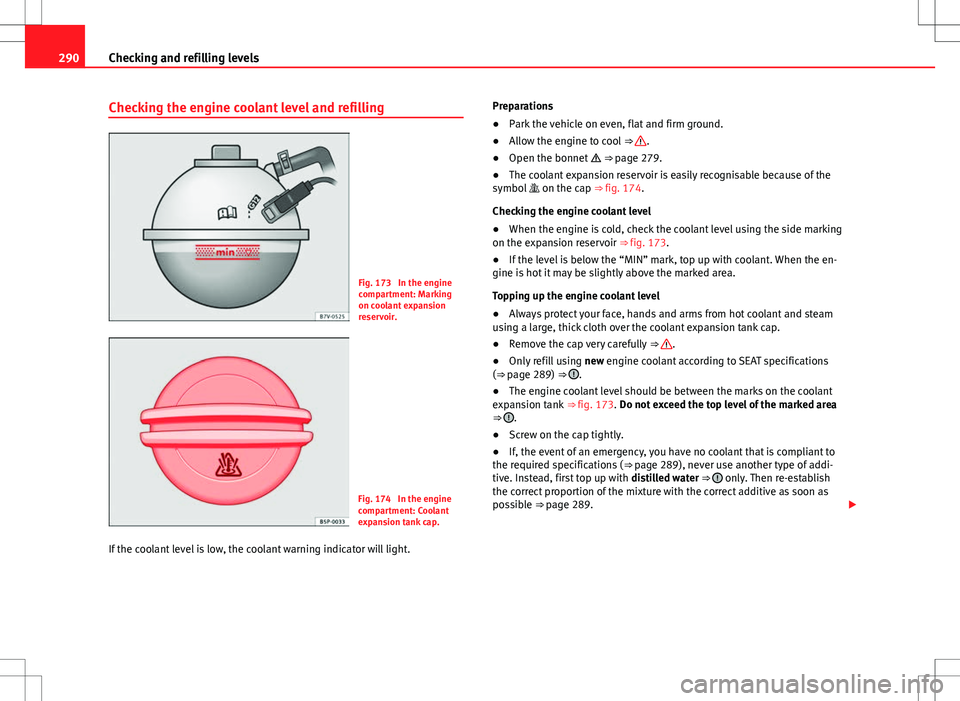
Fig. 173 In the engine
compartment: Marking
on coolant expansion
reservoir.
Fig. 174 In the engine
compartment: Coolant
expansion tank cap.
If the coolant level is low, the coolant warning indicator will light. Preparations
●
Park the vehicle on even, flat and firm ground.
● Allow the engine to cool ⇒
.
● Open the bonnet ⇒ page 279.
● The coolant expansion reservoir is easily recognisable because of the
symbol on the cap ⇒ fig. 174.
Checking the engine coolant level
● When the engine is cold, check the coolant level using the side marking
on the expansion reservoir ⇒ fig. 173.
● If the level is below the “MIN” mark, top up with coolant. When the en-
gine is hot it may be slightly above the marked area.
Topping up the engine coolant level
● Always protect your face, hands and arms from hot coolant and steam
using a large, thick cloth over the coolant expansion tank cap.
● Remove the cap very carefully ⇒
.
● Only refill using new engine coolant according to SEAT specifications
(⇒ page 289) ⇒
.
● The engine coolant level should be between the marks on the coolant
expansion tank ⇒ fig. 173. Do not exceed the top level of the marked area
⇒
.
● Screw on the cap tightly.
● If, the event of an emergency, you have no coolant that is compliant to
the required specifications ( ⇒ page 289), never use another type of addi-
tive. Instead, first top up with distilled water ⇒
only. Then re-establish
the correct proportion of the mixture with the correct additive as soon as
possible ⇒ page 289.
Page 354 of 388

352Technical specifications
Technical specifications
Checking fluid levels
From time to time, the levels of the different fluids in the ve-
hicle must be checked. Never fill with incorrect fluids, other-
wise serious damage to the engine may be caused.
Fig. 223 Diagram for the location of the various elements Coolant fluid deposit
Engine oil dipstick
Oil filler neck
Brake fluid reservoir
Vehicle battery (underneath a cover)
Windscreen washer fluid reservoir
The checking and refilling of service fluids are carried out on the compo-
nents mentioned above. These operations are described in ⇒ page 279.
Overview
Further explanations, instructions and restrictions on the technical data are
contained as of ⇒ page 348
1
23456