service interval Seat Alhambra 2013 User Guide
[x] Cancel search | Manufacturer: SEAT, Model Year: 2013, Model line: Alhambra, Model: Seat Alhambra 2013Pages: 387, PDF Size: 6.13 MB
Page 239 of 387
237
Trailer towing
CAUTION
● If the rear lights of the trailer are not correctly connected, the vehicle
electronics may be damaged.
● If the trailer absorbs excessive electric current, the vehicle electronics
may be damaged.
● Never connect the trailer's electric system to the electrical connections
of the rear lights or any other power sources. Only use suitable connections
for providing electric current to the trailer.
Note
● Towing a trailer places additional demands on the vehicle. At SEAT, we
recommend additional services between the normal inspection intervals if
the vehicle is used frequently for towing a trailer.
● In some countries, an additional fire extinguisher is required if the trailer
weight is more than 2500 kg
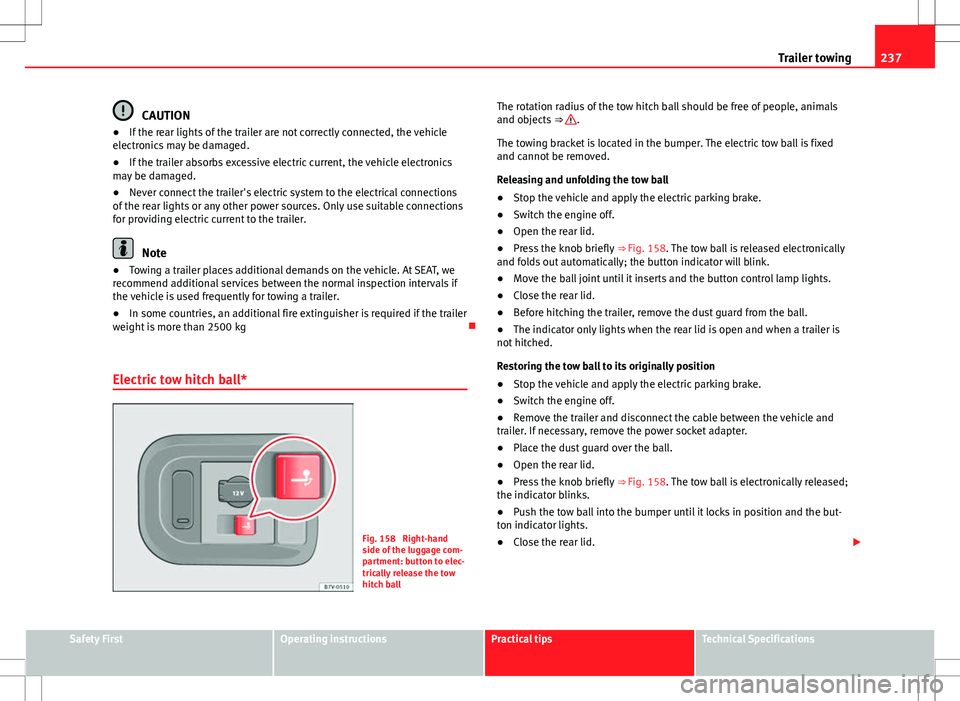
Electric tow hitch ball*
Fig. 158 Right-hand
side of the luggage com-
partment: button to elec-
trically release the tow
hitch ball The rotation radius of the tow hitch ball should be free of people, animals
and objects
⇒
.
The towing bracket is located in the bumper. The electric tow ball is fixed
and cannot be removed.
Releasing and unfolding the tow ball
● Stop the vehicle and apply the electric parking brake.
● Switch the engine off.
● Open the rear lid.
● Press the knob briefly ⇒ Fig. 158. The tow ball is released electronically
and folds out automatically; the button indicator will blink.
● Move the ball joint until it inserts and the button control lamp lights.
● Close the rear lid.
● Before hitching the trailer, remove the dust guard from the ball.
● The indicator only lights when the rear lid is open and when a trailer is
not hitched.
Restoring the tow ball to its originally position
● Stop the vehicle and apply the electric parking brake.
● Switch the engine off.
● Remove the trailer and disconnect the cable between the vehicle and
trailer. If necessary, remove the power socket adapter.
● Place the dust guard over the ball.
● Open the rear lid.
● Press the knob briefly ⇒ Fig. 158. The tow ball is electronically released;
the indicator blinks.
● Push the tow ball into the bumper until it locks in position and the but-
ton indicator lights.
● Close the rear lid.
Safety FirstOperating instructionsPractical tipsTechnical Specifications
Page 274 of 387
272Checking and refilling levels
● If, in exceptional circumstances, petrol with a lower octane rating to that
recommended is used, only use moderate engine speeds and a light throt-
tle. Avoid using full throttle and overloading the engine. Otherwise you may
damage the engine. Fill up with fuel of a suitable octane rating as soon as
possible.
● Do not refuel if the filler indicates that the fuel contains metal. LRP (lead
replacement petrol) fuels also contain high concentrations of metal addi-
tives. This could damage the engine!
● Just one full tank of leaded fuel would seriously impair the efficiency of
the catalytic converter and could damage it.
Diesel
Diesel fuel
Diesel fuel must correspond to European standard EN 590 (In Germany,
EN 590 or DIN 51628).
The use of diesel fuel with a high sulphur percentage requires shorter serv-
ice intervals ⇒ Booklet Maintenance Programme ⇒
. Your Technical Serv-
ice will be able to tell you which countries have diesel with a high sulphur
content.
Do not mix fuel additives (thinners, or similar additives) with diesel fuel.
Winter-grade diesel
When using “summer-grade diesel fuel”, difficulties may be experienced at
temperatures below 0 °C (+32 °F) because the fuel thickens due to wax sep-
aration. For this reason, “winter-grade diesel fuel” is available in Germany,
for example, during the cold months. It can be used at temperatures as low
as -20 °C (-4 °F).
In countries with different climatic conditions, other types of diesel fuel are
available that are suitable to local temperatures. Technical Services and fill-
ing stations in the country concerned will inform you on the type of diesel
fuels available. A cold diesel engine makes more noise during winter temperatures than
summer temperatures. Furthermore, the exhaust gases may turn slightly
bluish while the engine is heating. The quantity of exhaust gases will de-
pend on the outside temperature.
Filter pre-heater
Vehicles with a diesel engine are fitted with a fuel filter pre-heating system.
This ensures that the fuel system remains operational to approx. -24 °C
(-11.2 °F), provided you use winter-grade diesel which is safe to -15 °C
(+5 °F).
However, if the fuel has waxed to such an extent that the engine will not
start at temperatures of under -24 °C (-11.2 °F), simply place the vehicle in a
warm garage or workshop for a while to heat up.
Auxiliary heater
Vehicles with a diesel engine may be fitted with an auxiliary heater. The
heater runs off the fuel from the fuel tank. On doing so, smells and steam
may be noticed outside the vehicle for a short period. This is normal and it
is not an indication of a fault in the vehicle.
Whenever there is little fuel in the tank (reserve), the auxiliary heater auto-
matically switches off.
WARNING
Never use start boosters. An aerosol start booster could explode or cause
a sudden rise in engine speed leading to engine damage and serious in-
jury.
Page 287 of 387
285
Checking and refilling levels
● Unscrew the cap from engine oil filler neck on the cylinder head
⇒ Fig. 171. If you are not sure where the cap is, request help from a special-
ist.
● Only refill using engine oil expressly approved by SEAT and in small
quantities (not more than 0.5 l or 1/2 a quarter of a gallon at a time)
⇒ page 283.
● To avoid adding too much oil, each time you add a quantity, wait until
the oil has flowed into the crankcase so that it can be measured with the
dipstick.
● Check the oil level before adding any more oil. Do not top up with too
much engine oil ⇒
.
● When the oil level is in at least the ⇒ Fig. 170 B zone, insert the dip-
stick into the tube fully to avoid engine oil escaping when the engine is run-
ning.
● After topping up the oil, ensure that the cap is screwed on to the filler
neck correctly.
WARNING
Oil could catch fire if it comes into contact with hot engine components.
This could lead to a fire, explosion and severe injuries.
● Always ensure that after topping of oil, the engine oil filler cap is cor-
rectly tightened. This will avoid engine oil spilling onto hot engine parts
when the engine is running.
CAUTION
● If the engine oil level is above the area A do not start the engine. You
should obtain professional assistance. Otherwise catalytic converter and
engine damage may occur.
● When refilling or changing service liquids, ensure that you put the liq-
uids into the right tank. Making a mistake when refilling could cause seri-
ous malfunctions and damage the engine!
For the sake of the environment
The oil level must never be above area A. Otherwise oil can be drawn in
through the crankcase breather and escape into the atmosphere via the ex-
haust system.
Engine oil consumption
The consumption of engine oil can be different from one engine to another
and can vary during the useful life of the engine.
Depending on driving style and the conditions of use, the consumption of
engine oil can reach 1 litre every 2000 km (one quarter of a gallon every
1200 miles); for new vehicles, this could be higher for the first 5000 km
(3000 miles). For this reason the engine oil level must be checked at regular
intervals, preferably when filling the tank and before a journey.
When the engine is working hard, for instance during sustained high-speed
motorway cruising in summer, when towing a trailer or climbing mountain
passes, the oil level should preferably be kept within area ⇒ Fig. 170 A
.
Changing the engine oil
The engine oil must be changed regularly according to the specifications of
the Maintenance Programme.
Due to the problems linked with disposing of used oil and the need for suit-
able tools and special knowledge, always visit a specialised workshop to
have the engine oil and filter changed. SEAT recommends visiting a Techni-
cal Service.
Detailed information on the service intervals are shown in the Maintenance
Programme.
Safety FirstOperating instructionsPractical tipsTechnical Specifications
Page 296 of 387
294Checking and refilling levels
WARNING (Continued)
● Battery acid is very corrosive and caustic. It can burn skin and cause
blindness. When handling the battery, protect yourself from splashes of
acids, above all your hands, arms and face.
● Never tilt the vehicle battery. Battery acid could spill out of the open-
ings to release gases and cause corrosion damage.
● Never open the vehicle battery.
● If battery acid splashes on you, immediately rinse your eyes and skin
abundantly with water for several minutes. Then seek medical care imme-
diately.
● If acid is swallowed by mistake, consult a doctor immediately.
Charging, replacing and connecting or disconnecting the
battery
Charging the battery
The vehicle battery should be charged by a specialised workshop only, as
batteries using special technology have been installed and they must be
charged in a controlled environment ⇒
. SEAT recommends visiting a
Technical Service.
Replacing a vehicle battery
The battery has been developed to suit the conditions of its location and
has special safety features. If the battery must be replaced, consult a Tech-
nical Service for information on electromagnetic compatibility, the size and
maintenance, performance and safety requirements of the new battery in
your vehicle before you purchase one. SEAT recommends you have the bat-
tery replaced by a Technical Service.
Use only maintenance-free genuine batteries conforming to TL 825 06 and
VW 7 50 73 Standards. These standards must be dated April 2008 or later. Start-Stop systems (
⇒ page 197) are equipped with a special battery. There-
fore, it must only be replaced with a battery of the same specifications.
Disconnecting the vehicle's battery
If you must disconnect the battery from the electrical system, please note
the following:
● Switch off the ignition and all electrical equipment.
● The vehicle must be unlocked before disconnecting the battery, other-
wise the alarm will be triggered.
● First disconnect the negative cable and then the positive ⇒
.
Connecting the vehicle's battery
● Before reconnecting the battery, switch off the engine, the ignition and
electric devices.
● First reconnect the positive cable and then the negative ⇒
.
Different control lamps may light up after connecting the battery and switch-
ing the ignition on. They will be turned off after a short trip at a speed of
between 15 - 20 km/h (10 - 12 mph). If the warning indicators remain lit,
please visit a specialised workshop to have the vehicle checked.
If the battery has been disconnected for a long time, it is possible that the
next service date is not displayed or calculated correctly ⇒ page 57. Respect
the maximum service intervals permitted ⇒ Booklet Maintenance Pro-
gramme.
Automatic consumer disconnection
The intelligent vehicle electrical system automatically implements a range
of measures to prevent the battery from discharging when high demands
are made on it:
Page 376 of 387
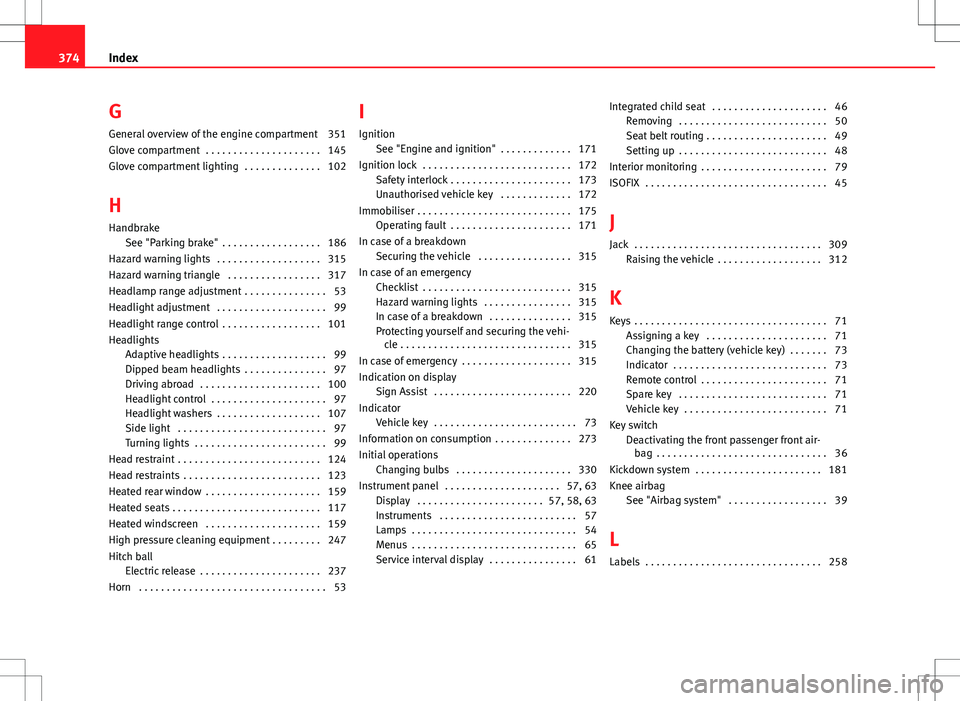
GGeneral overview of the engine compartment 351
Glove compartment . . . . . . . . . . . . . . . . . . . . . 145
Glove compartment lighting . . . . . . . . . . . . . . 102
H Handbrake See "Parking brake" . . . . . . . . . . . . . . . . . . 186
Hazard warning lights . . . . . . . . . . . . . . . . . . . 315
Hazard warning triangle . . . . . . . . . . . . . . . . . 317
Headlamp range adjustment . . . . . . . . . . . . . . . 53
Headlight adjustment . . . . . . . . . . . . . . . . . . . . 99
Headlight range control . . . . . . . . . . . . . . . . . . 101
Headlights Adaptive headlights . . . . . . . . . . . . . . . . . . . 99
Dipped beam headlights . . . . . . . . . . . . . . . 97
Driving abroad . . . . . . . . . . . . . . . . . . . . . . 100
Headlight control . . . . . . . . . . . . . . . . . . . . . 97
Headlight washers . . . . . . . . . . . . . . . . . . . 107
Side light . . . . . . . . . . . . . . . . . . . . . . . . . . . 97
Turning lights . . . . . . . . . . . . . . . . . . . . . . . . 99
Head restraint . . . . . . . . . . . . . . . . . . . . . . . . . . 124
Head restraints . . . . . . . . . . . . . . . . . . . . . . . . . 123
Heated rear window . . . . . . . . . . . . . . . . . . . . . 159
Heated seats . . . . . . . . . . . . . . . . . . . . . . . . . . . 117
Heated windscreen . . . . . . . . . . . . . . . . . . . . . 159
High pressure cleaning equipment . . . . . . . . . 247
Hitch ball Electric release . . . . . . . . . . . . . . . . . . . . . . 237
Horn . . . . . . . . . . . . . . . . . . . . . . . . . . . . . . . . . . 53 I
Ignition See "Engine and ignition" . . . . . . . . . . . . . 171
Ignition lock . . . . . . . . . . . . . . . . . . . . . . . . . . . 172 Safety interlock . . . . . . . . . . . . . . . . . . . . . . 173
Unauthorised vehicle key . . . . . . . . . . . . . 172
Immobiliser . . . . . . . . . . . . . . . . . . . . . . . . . . . . 175 Operating fault . . . . . . . . . . . . . . . . . . . . . . 171
In case of a breakdown Securing the vehicle . . . . . . . . . . . . . . . . . 315
In case of an emergency Checklist . . . . . . . . . . . . . . . . . . . . . . . . . . . 315
Hazard warning lights . . . . . . . . . . . . . . . . 315
In case of a breakdown . . . . . . . . . . . . . . . 315
Protecting yourself and securing the vehi-cle . . . . . . . . . . . . . . . . . . . . . . . . . . . . . . . 315
In case of emergency . . . . . . . . . . . . . . . . . . . . 315
Indication on display Sign Assist . . . . . . . . . . . . . . . . . . . . . . . . . 220
Indicator Vehicle key . . . . . . . . . . . . . . . . . . . . . . . . . . 73
Information on consumption . . . . . . . . . . . . . . 273
Initial operations Changing bulbs . . . . . . . . . . . . . . . . . . . . . 330
Instrument panel . . . . . . . . . . . . . . . . . . . . . 57, 63 Display . . . . . . . . . . . . . . . . . . . . . . . 57, 58, 63
Instruments . . . . . . . . . . . . . . . . . . . . . . . . . 57
Lamps . . . . . . . . . . . . . . . . . . . . . . . . . . . . . . 54
Menus . . . . . . . . . . . . . . . . . . . . . . . . . . . . . . 65
Service interval display . . . . . . . . . . . . . . . . 61 Integrated child seat . . . . . . . . . . . . . . . . . . . . . 46
Removing . . . . . . . . . . . . . . . . . . . . . . . . . . . 50
Seat belt routing . . . . . . . . . . . . . . . . . . . . . . 49
Setting up . . . . . . . . . . . . . . . . . . . . . . . . . . . 48
Interior monitoring . . . . . . . . . . . . . . . . . . . . . . . 79
ISOFIX . . . . . . . . . . . . . . . . . . . . . . . . . . . . . . . . . 45
J Jack . . . . . . . . . . . . . . . . . . . . . . . . . . . . . . . . . . 309 Raising the vehicle . . . . . . . . . . . . . . . . . . . 312
K
Keys . . . . . . . . . . . . . . . . . . . . . . . . . . . . . . . . . . . 71 Assigning a key . . . . . . . . . . . . . . . . . . . . . . 71
Changing the battery (vehicle key) . . . . . . . 73
Indicator . . . . . . . . . . . . . . . . . . . . . . . . . . . . 73
Remote control . . . . . . . . . . . . . . . . . . . . . . . 71
Spare key . . . . . . . . . . . . . . . . . . . . . . . . . . . 71
Vehicle key . . . . . . . . . . . . . . . . . . . . . . . . . . 71
Key switch Deactivating the front passenger front air-bag . . . . . . . . . . . . . . . . . . . . . . . . . . . . . . . 36
Kickdown system . . . . . . . . . . . . . . . . . . . . . . . 181
Knee airbag See "Airbag system" . . . . . . . . . . . . . . . . . . 39
L
Labels . . . . . . . . . . . . . . . . . . . . . . . . . . . . . . . . 258
374 Index
Page 380 of 387
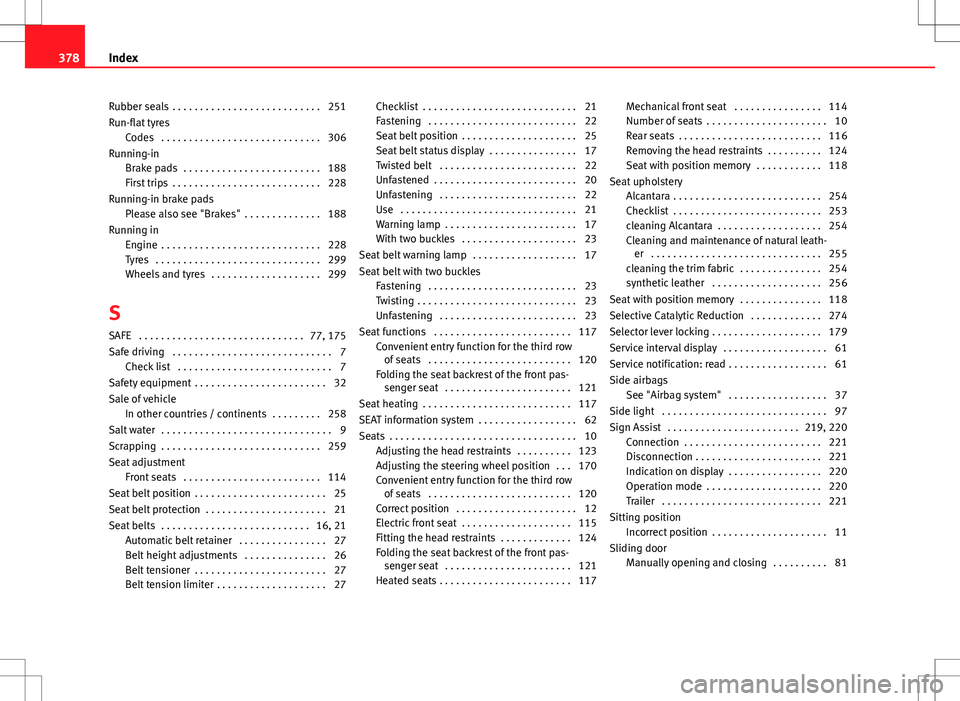
Rubber seals . . . . . . . . . . . . . . . . . . . . . . . . . . . 251
Run-flat tyresCodes . . . . . . . . . . . . . . . . . . . . . . . . . . . . . 306
Running-in Brake pads . . . . . . . . . . . . . . . . . . . . . . . . . 188
First trips . . . . . . . . . . . . . . . . . . . . . . . . . . . 228
Running-in brake pads Please also see "Brakes" . . . . . . . . . . . . . . 188
Running in Engine . . . . . . . . . . . . . . . . . . . . . . . . . . . . . 228
Tyres . . . . . . . . . . . . . . . . . . . . . . . . . . . . . . 299
Wheels and tyres . . . . . . . . . . . . . . . . . . . . 299
S SAFE . . . . . . . . . . . . . . . . . . . . . . . . . . . . . . 77, 175
Safe driving . . . . . . . . . . . . . . . . . . . . . . . . . . . . . 7 Check list . . . . . . . . . . . . . . . . . . . . . . . . . . . . 7
Safety equipment . . . . . . . . . . . . . . . . . . . . . . . . 32
Sale of vehicle In other countries / continents . . . . . . . . . 258
Salt water . . . . . . . . . . . . . . . . . . . . . . . . . . . . . . . 9
Scrapping . . . . . . . . . . . . . . . . . . . . . . . . . . . . . 259
Seat adjustment Front seats . . . . . . . . . . . . . . . . . . . . . . . . . 114
Seat belt position . . . . . . . . . . . . . . . . . . . . . . . . 25
Seat belt protection . . . . . . . . . . . . . . . . . . . . . . 21
Seat belts . . . . . . . . . . . . . . . . . . . . . . . . . . . 16, 21 Automatic belt retainer . . . . . . . . . . . . . . . . 27
Belt height adjustments . . . . . . . . . . . . . . . 26
Belt tensioner . . . . . . . . . . . . . . . . . . . . . . . . 27
Belt tension limiter . . . . . . . . . . . . . . . . . . . . 27 Checklist . . . . . . . . . . . . . . . . . . . . . . . . . . . . 21
Fastening . . . . . . . . . . . . . . . . . . . . . . . . . . . 22
Seat belt position . . . . . . . . . . . . . . . . . . . . . 25
Seat belt status display . . . . . . . . . . . . . . . . 17
Twisted belt . . . . . . . . . . . . . . . . . . . . . . . . . 22
Unfastened . . . . . . . . . . . . . . . . . . . . . . . . . . 20
Unfastening . . . . . . . . . . . . . . . . . . . . . . . . . 22
Use . . . . . . . . . . . . . . . . . . . . . . . . . . . . . . . . 21
Warning lamp . . . . . . . . . . . . . . . . . . . . . . . . 17
With two buckles . . . . . . . . . . . . . . . . . . . . . 23
Seat belt warning lamp . . . . . . . . . . . . . . . . . . . 17
Seat belt with two buckles Fastening . . . . . . . . . . . . . . . . . . . . . . . . . . . 23
Twisting . . . . . . . . . . . . . . . . . . . . . . . . . . . . . 23
Unfastening . . . . . . . . . . . . . . . . . . . . . . . . . 23
Seat functions . . . . . . . . . . . . . . . . . . . . . . . . . 117 Convenient entry function for the third rowof seats . . . . . . . . . . . . . . . . . . . . . . . . . . 120
Folding the seat backrest of the front pas- senger seat . . . . . . . . . . . . . . . . . . . . . . . 121
Seat heating . . . . . . . . . . . . . . . . . . . . . . . . . . . 117
SEAT information system . . . . . . . . . . . . . . . . . . 62
Seats . . . . . . . . . . . . . . . . . . . . . . . . . . . . . . . . . . 10 Adjusting the head restraints . . . . . . . . . . 123
Adjusting the steering wheel position . . . 170
Convenient entry function for the third rowof seats . . . . . . . . . . . . . . . . . . . . . . . . . . 120
Correct position . . . . . . . . . . . . . . . . . . . . . . 12
Electric front seat . . . . . . . . . . . . . . . . . . . . 115
Fitting the head restraints . . . . . . . . . . . . . 124
Folding the seat backrest of the front pas- senger seat . . . . . . . . . . . . . . . . . . . . . . . 121
Heated seats . . . . . . . . . . . . . . . . . . . . . . . . 117 Mechanical front seat . . . . . . . . . . . . . . . . 114
Number of seats . . . . . . . . . . . . . . . . . . . . . . 10
Rear seats . . . . . . . . . . . . . . . . . . . . . . . . . . 116
Removing the head restraints . . . . . . . . . . 124
Seat with position memory . . . . . . . . . . . . 118
Seat upholstery Alcantara . . . . . . . . . . . . . . . . . . . . . . . . . . . 254
Checklist . . . . . . . . . . . . . . . . . . . . . . . . . . . 253
cleaning Alcantara . . . . . . . . . . . . . . . . . . . 254
Cleaning and maintenance of natural leath-er . . . . . . . . . . . . . . . . . . . . . . . . . . . . . . . 255
cleaning the trim fabric . . . . . . . . . . . . . . . 254
synthetic leather . . . . . . . . . . . . . . . . . . . . 256
Seat with position memory . . . . . . . . . . . . . . . 118
Selective Catalytic Reduction . . . . . . . . . . . . . 274
Selector lever locking . . . . . . . . . . . . . . . . . . . . 179
Service interval display . . . . . . . . . . . . . . . . . . . 61
Service notification: read . . . . . . . . . . . . . . . . . . 61
Side airbags See "Airbag system" . . . . . . . . . . . . . . . . . . 37
Side light . . . . . . . . . . . . . . . . . . . . . . . . . . . . . . 97
Sign Assist . . . . . . . . . . . . . . . . . . . . . . . . 219, 220 Connection . . . . . . . . . . . . . . . . . . . . . . . . . 221
Disconnection . . . . . . . . . . . . . . . . . . . . . . . 221
Indication on display . . . . . . . . . . . . . . . . . 220
Operation mode . . . . . . . . . . . . . . . . . . . . . 220
Trailer . . . . . . . . . . . . . . . . . . . . . . . . . . . . . 221
Sitting position Incorrect position . . . . . . . . . . . . . . . . . . . . . 11
Sliding door Manually opening and closing . . . . . . . . . . 81
378 Index