ECO mode Seat Alhambra 2013 Owner's Guide
[x] Cancel search | Manufacturer: SEAT, Model Year: 2013, Model line: Alhambra, Model: Seat Alhambra 2013Pages: 387, PDF Size: 6.13 MB
Page 243 of 387
241
Trailer towing
● The vehicle centre of gravity and handling change because of the trailer
load and because of the increased combined mass of the vehicle and trail-
er.
● If the towing vehicle is empty and the trailer loaded then the load distri-
bution is incorrect. If you must travel in these conditions, drive carefully and
reduce your speed accordingly.
Hill starts with a trailer
Depending on the hill and the gross combined weight, it is possible that the
combined vehicle and trailer move backwards slightly when starting.
For a hill start with a trailer, proceed as follows:
● Press and hold the brake pedal.
● Press the button
once to turn off the electric parking brake
⇒ page 184.
● Press and hold the button
to hold the vehicle and trailer combination
using the parking brake.
● With a manual gearbox: press the clutch pedal to the floor.
● Engage first gear or the gear range D ⇒ page 175, Changing gear.
● Release the brake pedal.
● Move off slowly. To do this, gently release the clutch pedal (for manual
gearbox).
● Release the button
only when the engine provides sufficient power
to move the vehicle and trailer combination.
WARNING
Jerking the trailer in an unsuitable manner could cause loss of vehicle
control with the subsequent serious consequences.
● Driving with a trailer and transporting heavy or a large objects will
change the vehicle handling and braking distances.
WARNING (Continued)
● Anticipate traffic and be extremely cautious. Brake early.
● Adjust your speed and driving style to visibility, road, traffic and
weather conditions. Reduce your speed, especially on steep hills.
● Accelerate gently and carefully. Avoid brusque manoeuvres and sud-
den braking.
● Always take the following precautions seriously. Reduce your speed
immediately if you observe the trailer rocking from side to side.
● Never try to stop the “snaking” by increasing speed.
● Always take the speed limits for vehicles with and without trailers in
each country into account.
Stabilising the vehicle and trailer combination
Stabilisation of the vehicle and trailer combination is an extension of the
electronic stability control (ESC) and helps, with the assistance of the trajec-
tory control, to reduce trailer “snaking”.
Stabilisation of the vehicle and trailer combination is active when the ESC
indicator on the dash panel remains lit for about two seconds more than the
ABS indicator.
Requirements for stabilising the vehicle/trailer combination
● An original tow hitch is fitted by the manufacturer or a compatible model
is retrofitted.
● The ECS is switched on. The warning lamp on the instrument panel is
not lit.
● The trailer is connected to the vehicle using the power socket.
● The vehicle is driven faster than 60 km/h (40 mph).
● The maximum drawbar load is used.
Safety FirstOperating instructionsPractical tipsTechnical Specifications
Page 254 of 387
252Vehicle maintenance and cleaning
WARNING
Additional underseal or anti-corrosion products could catch fire due to
the high temperatures reached by the exhaust gas system and other en-
gine components.
● Do not apply additional underseal or anti-corrosion products to the
exhaust pipes, catalytic converters, heat shields or other parts of the ve-
hicle which reach high temperatures.
Cleaning the engine compartment
The engine compartment of any motor vehicle is a potentially hazardous
area ⇒ page 278. The engine compartment should only be cleaned by qualified personnel. If
it is not correctly cleaned, the anti-corrosion coating and consequently elec-
trical components may be damaged. Moreover, water may filter directly into
the vehicle interior through the water chamber ⇒
.
If the engine compartment is very dirty, always take the vehicle to a special-
ised workshop for professional cleaning. SEAT recommends visiting a Tech-
nical Service.
Water box
The water box is in the engine compartment, between the windscreen and
the engine, and beneath a perforated cover. Air is taken in through the wa-
ter box from outside to the vehicle interior via the heating and air condition-
er.
Leaves and other loose objects should be regularly cleaned away from the
water box either by hand or with a vacuum.
WARNING
When working on the engine or in the engine compartment, there is a
risk of injury, burns, accident or fire.
● Before starting work, please ensure you are familiar with the required
procedure and the safety precautions ⇒ page 278.
● SEAT recommends you have this work performed by a specialised
workshop.
CAUTION
If water is manually poured into the water box (for example, using a high
pressure cleaning appliance), this could cause significant damage to the ve-
hicle.
For the sake of the environment
Only wash the engine compartment in areas allocated for this purpose, to
prevent dirty water which may be contaminated by oil, grease or fuel, from
entering the drains. In some districts, the engine compartment may not be
washed outside the wash bays provided for this purpose.
Caring for and cleaning the vehicle interior Introduction
The dye used in many modern garments, for example dark jeans, is not al-
ways sufficiently colour-fast. Seat upholstery (material and leather), espe-
cially when light-coloured, may visibly discolour if the dye comes out of
clothing (even when used correctly). This is not an upholstery defect but in-
dicates that the dye in the item of clothing is not sufficiently colour-fast.
Page 274 of 387
272Checking and refilling levels
● If, in exceptional circumstances, petrol with a lower octane rating to that
recommended is used, only use moderate engine speeds and a light throt-
tle. Avoid using full throttle and overloading the engine. Otherwise you may
damage the engine. Fill up with fuel of a suitable octane rating as soon as
possible.
● Do not refuel if the filler indicates that the fuel contains metal. LRP (lead
replacement petrol) fuels also contain high concentrations of metal addi-
tives. This could damage the engine!
● Just one full tank of leaded fuel would seriously impair the efficiency of
the catalytic converter and could damage it.
Diesel
Diesel fuel
Diesel fuel must correspond to European standard EN 590 (In Germany,
EN 590 or DIN 51628).
The use of diesel fuel with a high sulphur percentage requires shorter serv-
ice intervals ⇒ Booklet Maintenance Programme ⇒
. Your Technical Serv-
ice will be able to tell you which countries have diesel with a high sulphur
content.
Do not mix fuel additives (thinners, or similar additives) with diesel fuel.
Winter-grade diesel
When using “summer-grade diesel fuel”, difficulties may be experienced at
temperatures below 0 °C (+32 °F) because the fuel thickens due to wax sep-
aration. For this reason, “winter-grade diesel fuel” is available in Germany,
for example, during the cold months. It can be used at temperatures as low
as -20 °C (-4 °F).
In countries with different climatic conditions, other types of diesel fuel are
available that are suitable to local temperatures. Technical Services and fill-
ing stations in the country concerned will inform you on the type of diesel
fuels available. A cold diesel engine makes more noise during winter temperatures than
summer temperatures. Furthermore, the exhaust gases may turn slightly
bluish while the engine is heating. The quantity of exhaust gases will de-
pend on the outside temperature.
Filter pre-heater
Vehicles with a diesel engine are fitted with a fuel filter pre-heating system.
This ensures that the fuel system remains operational to approx. -24 °C
(-11.2 °F), provided you use winter-grade diesel which is safe to -15 °C
(+5 °F).
However, if the fuel has waxed to such an extent that the engine will not
start at temperatures of under -24 °C (-11.2 °F), simply place the vehicle in a
warm garage or workshop for a while to heat up.
Auxiliary heater
Vehicles with a diesel engine may be fitted with an auxiliary heater. The
heater runs off the fuel from the fuel tank. On doing so, smells and steam
may be noticed outside the vehicle for a short period. This is normal and it
is not an indication of a fault in the vehicle.
Whenever there is little fuel in the tank (reserve), the auxiliary heater auto-
matically switches off.
WARNING
Never use start boosters. An aerosol start booster could explode or cause
a sudden rise in engine speed leading to engine damage and serious in-
jury.
Page 288 of 387
286Checking and refilling levels
Engine oil additives make new oil darker after the engine has been running
for a short period. This is normal and does not mean more frequent oil
changes are required.
WARNING
If, in exceptional circumstances, you must change the engine oil yourself,
please note the following:
● Wear eye protection.
● Always wait until the engine has completely cooled to avoid being
burned.
● Always keep your arms horizontal when unscrewing the oil drainage
bolt so that the oil does not run down your arms when it begins to drain.
● Use a suitable and large enough container to collect all of the used oil
in the engine.
● Never collect engine oil in empty food containers, cans, bottles and
other containers as not all people are able to identify engine oil.
● Oil is toxic and must be kept out of the reach of children.
For the sake of the environment
Before changing the engine oil, find a suitable location or service for proper
disposal.
For the sake of the environment
Always dispose of engine oil with the utmost respect for the environment.
Never dispose of used engine oil in places such as a garden, woods, drains,
roads, paths, rivers and drainage systems. Engine coolant
Introduction
Never work on the engine cooling system or if you are not familiar with the
operations to be carried out, the applicable safety standards and especially
if you do not have the instruments, liquids and tools necessary ⇒
! Have
the work carried out by a specialised workshop if you are uncertain. SEAT
recommends visiting a Technical Service.
Negligent work can cause serious injury.
Additional information and warnings:
● Towing mode ⇒ page 236
● Working in the engine compartment ⇒ page 278
● Accessories, parts replacement, repairs and modifications ⇒ page 260
WARNING
Engine coolant is toxic!
● Only keep engine coolant in its original container, tightly shut and in
a safe place.
● Never store engine coolant in empty food containers or bottles as
other people may accidentally drink it.
● Always keep engine coolant out of reach of children.
● Ensure that the proportion of engine coolant additive corresponds to
the lowest outside temperature to which the vehicle will be exposed.
● If the outside temperature is extremely low, the engine coolant could
freeze causing the vehicle to stop. As this would also cause the heating
to stop working, passengers without sufficient clothing could freeze.
Page 298 of 387
296Wheels and tyres
Wheels and tyres
Wheels
Introduction
The SEAT Alhambra is equipped as standard with anti-puncture technology
tyres (Conti-Seal). In the event of a puncture or air leak of up to 5 mm, the
tyre seals the hole with a protective layer inside the tread.
The inclusion of such technology means that there is no type of spare
wheel, nor puncture repair kit included in the vehicle's inventory.
SEAT recommend that all work on tyres and wheels is carried out by a speci-
alised workshop. They have the necessary special tools and replacement
parts, trained personnel and facilities for disposing of the old tyres. SEAT
recommends visiting a Technical Service.
Additional information and warnings:
● Transporting ⇒ page 13
● Towing mode ⇒ page 236
● Braking, stopping and parking ⇒ page 184
● Park assist system ⇒ page 203
● Tyre control systems ⇒ page 224
● Caring for and cleaning the vehicle exterior ⇒ page 245
● Wheel trims ⇒ page 307
● Change wheel ⇒ page 309
● Notes for the user ⇒ page 258
WARNING
The vehicle cannot be totally controlled or braked if the tyres (new or
used) are worn or damaged.
● Incorrect use of wheels and tyres could make driving more dangerous
and result in serious accidents and damage.
● All four wheels must be fitted with radial tyres of the same type, size
(rolling circumference) and the same tread pattern.
● New tyres do not give maximum grip and will not have reached their
maximum braking capacity to start with, and therefore need running in.
To prevent accidents and major damage, extreme caution should be tak-
en for the first 600 km (370 miles).
● Check tyre pressures regularly and ensure they are maintained at the
pressures indicated. If the tyre pressure is too low, the tyres could over-
heat, resulting in tread detachment or even burst tyres.
● Never drive on damaged (punctured, cut, cracked or dented) or worn
tyres. Driving on damaged or worn tyres could result in burst tyres, seri-
ous accidents or damage. Worn or damaged tyres must be replaced im-
mediately.
● Never exceed the maximum permitted speed or loads specified for the
type of tyre fitted on your vehicle.
● The effectiveness of driver and brake assist systems also depends on
the grip of the tyres.
● If you notice unusual vibration or if the vehicle pulls to one side when
driving, stop the car immediately and check the tyres and wheels for
damage.
● To minimise the risk of losing control of the vehicle or causing a seri-
ous accident, never undo the bolted joints of beadlock wheels.
Page 301 of 387
299
Wheels and tyres
Wheel rims
The design of wheel bolts is matched to the rims. If different rims are fitted,
the correct wheel bolts with the right length and correctly shaped bolt
heads must be used. This ensures that wheels are fitted securely and that
the brake system functions correctly ⇒ page 309.
For technical reasons, it is not generally possible to use the wheels from
other vehicles. In some cases, this may also be true for the same model of
wheel.
The tyres and rims approved by SEAT are specially matched to the character-
istics of the vehicle and are critical to good road holding and safe handling.
Wheel bolts
Wheel bolts must be tightened to the correct torque ⇒ page 309.
Beadlock wheel rims
Beadlock wheel rims have various components. These are joined together
by special bolts using a special procedure. This ensures good performance,
a better seal, improved safety and wheel run out. Therefore, worn rims
should always be replaced and must only be repaired in a specialised work-
shop. SEAT recommends visiting a Technical Service ⇒
.
Wheel rims with bolted trims
Wheel rims may be fitted with interchangeable trim parts which are attach-
ed to the rim using self-locking bolts. Worn trims should only be replaced at
a specialised workshop. SEAT recommends visiting a Technical Service
⇒
.
WARNING
The use of worn or damaged wheel rims could make driving more danger-
ous and result in serious accidents and damage.
● Only wheel rims which have been approved for use with your vehicle
should be used.
● Inspect wheel rims regularly for damage and replace as required.
WARNING
If the bolted joints of wheel rims with bolted ring trims are not correctly
tightened or loosened, this could result in serious accident.
● Never loosen the bolted joints of wheel rims with bolted ring trims.
● Any work relating to wheel rims with bolted rims should be carried
out at specialised workshop. SEAT recommends visiting a Technical Serv-
ice.
Replacement of new tyres and wheel rims
New tyres
● When tyres are new, drive with extreme caution for the first 500 km
(310 miles), as all tyres need to be run-in. Tyres which have not been run-in
do not have such good grip ⇒
or braking capacity ⇒ .
● All four wheels must be fitted with radial tyres of the same type, size
(rolling circumference) and the same tread pattern.
● The tread depth of new tyres may vary, according to the type and make
of tyre and the tread pattern.
Safety FirstOperating instructionsPractical tipsTechnical Specifications
Page 332 of 387
330If and when
Several warning and control lamps should light up for a few seconds when
the ignition is switched on, signalling that the function is being verified.
They will switch off after a few seconds.
Checking the bulbs of a trailer
For vehicles with the factory fitted towing bracket, certain trailer lights are
also controlled if the power socket is correctly connected.
A fault on a trailer turn signal is indicated on the instrument panel by the
turn signal blinking twice as fast ( or ) ⇒ page 95.
● General fault of all turn signals on one side.
● Fault in one tail light (on some models, also the registration light).
● Fault in two brake lights.
WARNING
If the warning lamps and messages are ignored, the vehicle may stall in
traffic, or may cause accidents and severe injuries.
● Never ignore the warning lamps or text messages.
● Stop the vehicle safely as soon as possible.
CAUTION
Failure to heed the control lamps and text messages when they appear may
result in faults in the vehicle.
Note
A fault in the LED on the tail lights will not be indicated. However, if the fault
affects all the LEDs then this will be indicated by the control lamp . Information for replacing bulbs
Checklist
To replace a bulb, carry out the following operations always in the order giv-
en ⇒
:
Park the vehicle a safe distance from traffic and on suitable ground.
Connect the electronic parking brake ⇒ page 184.
Turn the light switch to position 0 ⇒ page 95.
Move the gear lever into the neutral position ⇒ page 95.
Automatic gearbox: move the selector lever to position P ⇒ page 175.
Stop the engine and remove the key from the ignition ⇒ page 171.
Manual gearbox: Select a gear ⇒ page 175.
Wait until all of the vehicle interior lights are turned off ⇒ page 95.
Allow the corresponding bulb to cool. Visually inspect fuses to see if any are blown ⇒ page 325.
Replace the bulb according to the instructions ⇒
. Bulbs should only
be replaced by new identical models. Bulb information is displayed on
the bulb socket or on the bulb itself.
In general, never touch the bulb glass directly. The heat of the bulb
would cause the fingerprint to evaporate and condense on the reflector.
This will impair the brightness of the headlight.
Check if the new bulb is working. If the bulb is not working, it may not
have been correctly fitted, it could be damaged or the connector may
not be correctly connected.
Every time a bulb for the headlights is replaced, visit a specialised
workshop to check the headlights.
1.
2.
3.
4.
5.
6.
7.
8.
9.
10.
11.
12.
13.
14.
Page 349 of 387
347
Description of specifications
Technical Specifications
Description of specifications Important information
Important
The information in your vehicle's official documents always
take precedence over the information in the current instruc-
tion manual. All technical specifications provided in this documentation are valid for the
standard model in Spain. The vehicle data card included in the Inspection
and Maintenance Plan in the vehicle documentation shows which engine is
installed in the vehicle.
The figures may be different depending whether additional equipment is fit-
ted, for different models, for special vehicles and for other countries.
Additional information and warnings:
● Transporting ⇒ page 13
● Ecological driving ⇒ page 228
● Fuel ⇒ page 270
● Engine oil ⇒ page 282
● Engine coolant ⇒ page 286
● Wheels and tyres ⇒ page 296
● Notes for the user ⇒ page 258 Abbreviations used in the Technical Specifications section
Abbrevia-
tionMeaning
kWKilowatt, engine power measurement.
PSPferdestärke (horsepower), formerly used to denote engine
power.
rpmRevolutions per minute - engine speed.NmNewton metres, unit of engine torque.l/100 km(mpg)Fuel consumption in litres per 100 km.
g/kmCarbon dioxide emissions in grams per km travelled.CO 2Carbon dioxideCNCetane number, indication of the diesel combustion power.
RONResearch octane number, indication of the knock resistance
of petrol.
WARNING
Failure to observe requirements for weight, loads, dimensions and maxi-
mum speed may lead to severe accident.
Safety FirstOperating instructionsPractical tipsTechnical Specifications
Page 373 of 387
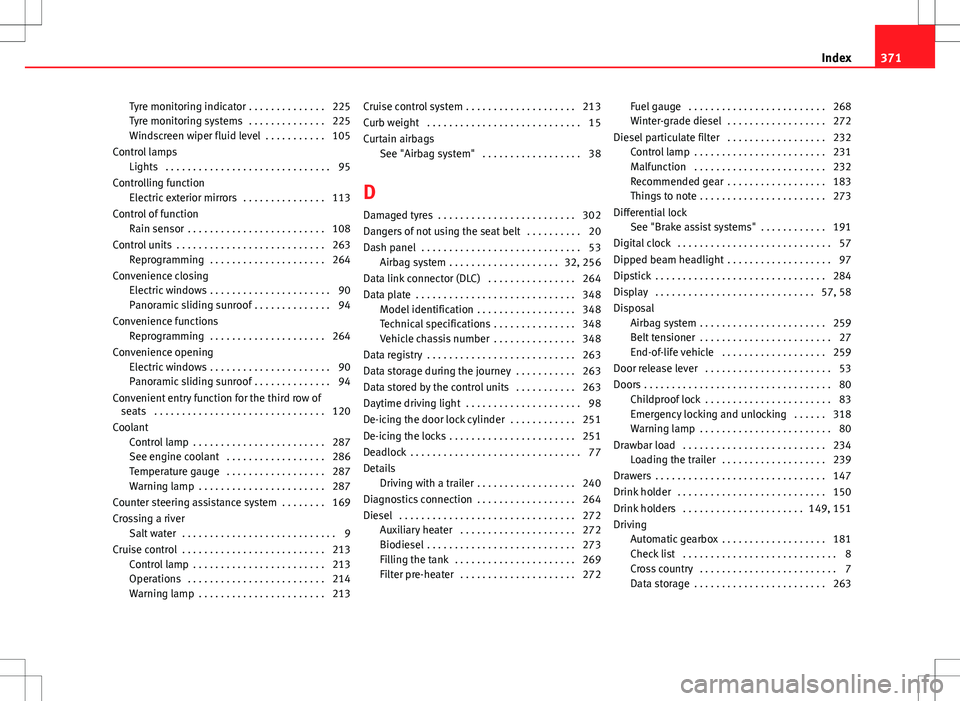
Tyre monitoring indicator . . . . . . . . . . . . . . 225
Tyre monitoring systems . . . . . . . . . . . . . . 225
Windscreen wiper fluid level . . . . . . . . . . . 105
Control lamps Lights . . . . . . . . . . . . . . . . . . . . . . . . . . . . . . 95
Controlling function Electric exterior mirrors . . . . . . . . . . . . . . . 113
Control of function Rain sensor . . . . . . . . . . . . . . . . . . . . . . . . . 108
Control units . . . . . . . . . . . . . . . . . . . . . . . . . . . 263 Reprogramming . . . . . . . . . . . . . . . . . . . . . 264
Convenience closing Electric windows . . . . . . . . . . . . . . . . . . . . . . 90
Panoramic sliding sunroof . . . . . . . . . . . . . . 94
Convenience functions Reprogramming . . . . . . . . . . . . . . . . . . . . . 264
Convenience opening Electric windows . . . . . . . . . . . . . . . . . . . . . . 90
Panoramic sliding sunroof . . . . . . . . . . . . . . 94
Convenient entry function for the third row of seats . . . . . . . . . . . . . . . . . . . . . . . . . . . . . . . 120
Coolant Control lamp . . . . . . . . . . . . . . . . . . . . . . . . 287
See engine coolant . . . . . . . . . . . . . . . . . . 286
Temperature gauge . . . . . . . . . . . . . . . . . . 287
Warning lamp . . . . . . . . . . . . . . . . . . . . . . . 287
Counter steering assistance system . . . . . . . . 169
Crossing a river Salt water . . . . . . . . . . . . . . . . . . . . . . . . . . . . 9
Cruise control . . . . . . . . . . . . . . . . . . . . . . . . . . 213 Control lamp . . . . . . . . . . . . . . . . . . . . . . . . 213
Operations . . . . . . . . . . . . . . . . . . . . . . . . . 214
Warning lamp . . . . . . . . . . . . . . . . . . . . . . . 213 Cruise control system . . . . . . . . . . . . . . . . . . . . 213
Curb weight . . . . . . . . . . . . . . . . . . . . . . . . . . . . 15
Curtain airbags
See "Airbag system" . . . . . . . . . . . . . . . . . . 38
D Damaged tyres . . . . . . . . . . . . . . . . . . . . . . . . . 302
Dangers of not using the seat belt . . . . . . . . . . 20
Dash panel . . . . . . . . . . . . . . . . . . . . . . . . . . . . . 53 Airbag system . . . . . . . . . . . . . . . . . . . . 32, 256
Data link connector (DLC) . . . . . . . . . . . . . . . . 264
Data plate . . . . . . . . . . . . . . . . . . . . . . . . . . . . . 348 Model identification . . . . . . . . . . . . . . . . . . 348
Technical specifications . . . . . . . . . . . . . . . 348
Vehicle chassis number . . . . . . . . . . . . . . . 348
Data registry . . . . . . . . . . . . . . . . . . . . . . . . . . . 263
Data storage during the journey . . . . . . . . . . . 263
Data stored by the control units . . . . . . . . . . . 263
Daytime driving light . . . . . . . . . . . . . . . . . . . . . 98
De-icing the door lock cylinder . . . . . . . . . . . . 251
De-icing the locks . . . . . . . . . . . . . . . . . . . . . . . 251
Deadlock . . . . . . . . . . . . . . . . . . . . . . . . . . . . . . . 77
Details Driving with a trailer . . . . . . . . . . . . . . . . . . 240
Diagnostics connection . . . . . . . . . . . . . . . . . . 264
Diesel . . . . . . . . . . . . . . . . . . . . . . . . . . . . . . . . 272 Auxiliary heater . . . . . . . . . . . . . . . . . . . . . 272
Biodiesel . . . . . . . . . . . . . . . . . . . . . . . . . . . 273
Filling the tank . . . . . . . . . . . . . . . . . . . . . . 269
Filter pre-heater . . . . . . . . . . . . . . . . . . . . . 272 Fuel gauge . . . . . . . . . . . . . . . . . . . . . . . . . 268
Winter-grade diesel . . . . . . . . . . . . . . . . . . 272
Diesel particulate filter . . . . . . . . . . . . . . . . . . 232 Control lamp . . . . . . . . . . . . . . . . . . . . . . . . 231
Malfunction . . . . . . . . . . . . . . . . . . . . . . . . 232
Recommended gear . . . . . . . . . . . . . . . . . . 183
Things to note . . . . . . . . . . . . . . . . . . . . . . . 273
Differential lock See "Brake assist systems" . . . . . . . . . . . . 191
Digital clock . . . . . . . . . . . . . . . . . . . . . . . . . . . . 57
Dipped beam headlight . . . . . . . . . . . . . . . . . . . 97
Dipstick . . . . . . . . . . . . . . . . . . . . . . . . . . . . . . . 284
Display . . . . . . . . . . . . . . . . . . . . . . . . . . . . . 57, 58
Disposal Airbag system . . . . . . . . . . . . . . . . . . . . . . . 259
Belt tensioner . . . . . . . . . . . . . . . . . . . . . . . . 27
End-of-life vehicle . . . . . . . . . . . . . . . . . . . 259
Door release lever . . . . . . . . . . . . . . . . . . . . . . . 53
Doors . . . . . . . . . . . . . . . . . . . . . . . . . . . . . . . . . . 80 Childproof lock . . . . . . . . . . . . . . . . . . . . . . . 83
Emergency locking and unlocking . . . . . . 318
Warning lamp . . . . . . . . . . . . . . . . . . . . . . . . 80
Drawbar load . . . . . . . . . . . . . . . . . . . . . . . . . . 234 Loading the trailer . . . . . . . . . . . . . . . . . . . 239
Drawers . . . . . . . . . . . . . . . . . . . . . . . . . . . . . . . 147
Drink holder . . . . . . . . . . . . . . . . . . . . . . . . . . . 150
Drink holders . . . . . . . . . . . . . . . . . . . . . . 149, 151
Driving Automatic gearbox . . . . . . . . . . . . . . . . . . . 181
Check list . . . . . . . . . . . . . . . . . . . . . . . . . . . . 8
Cross country . . . . . . . . . . . . . . . . . . . . . . . . . 7
Data storage . . . . . . . . . . . . . . . . . . . . . . . . 263
371
Index
Page 379 of 387
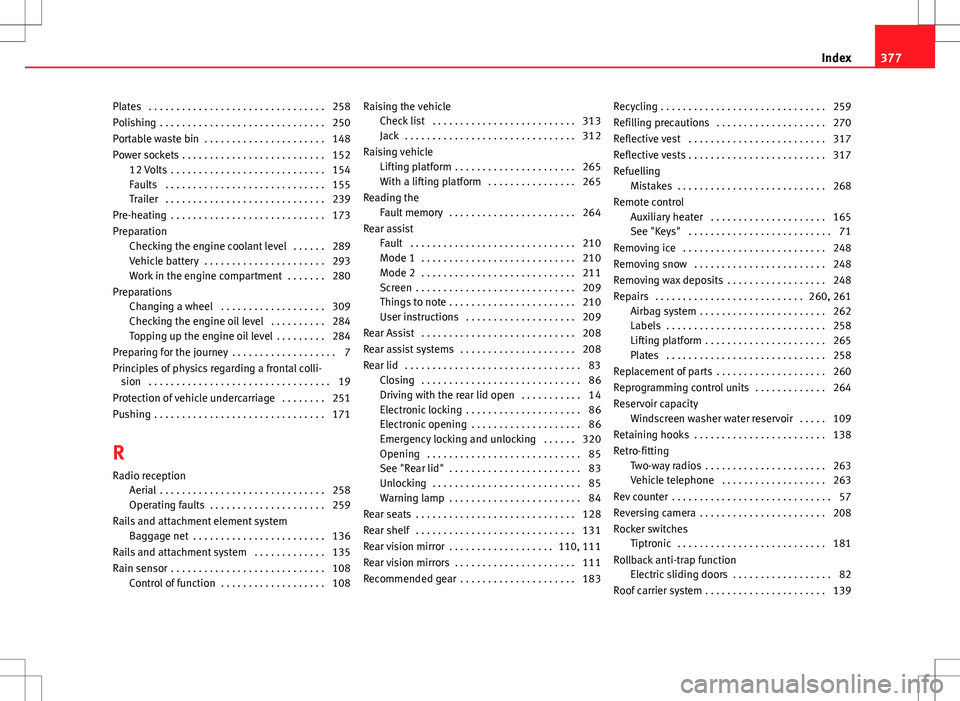
Plates . . . . . . . . . . . . . . . . . . . . . . . . . . . . . . . . 258
Polishing . . . . . . . . . . . . . . . . . . . . . . . . . . . . . . 250
Portable waste bin . . . . . . . . . . . . . . . . . . . . . . 148
Power sockets . . . . . . . . . . . . . . . . . . . . . . . . . . 15212 Volts . . . . . . . . . . . . . . . . . . . . . . . . . . . . 154
Faults . . . . . . . . . . . . . . . . . . . . . . . . . . . . . 155
Trailer . . . . . . . . . . . . . . . . . . . . . . . . . . . . . 239
Pre-heating . . . . . . . . . . . . . . . . . . . . . . . . . . . . 173
Preparation Checking the engine coolant level . . . . . . 289
Vehicle battery . . . . . . . . . . . . . . . . . . . . . . 293
Work in the engine compartment . . . . . . . 280
Preparations Changing a wheel . . . . . . . . . . . . . . . . . . . 309
Checking the engine oil level . . . . . . . . . . 284
Topping up the engine oil level . . . . . . . . . 284
Preparing for the journey . . . . . . . . . . . . . . . . . . . 7
Principles of physics regarding a frontal colli- sion . . . . . . . . . . . . . . . . . . . . . . . . . . . . . . . . . 19
Protection of vehicle undercarriage . . . . . . . . 251
Pushing . . . . . . . . . . . . . . . . . . . . . . . . . . . . . . . 171
R Radio reception Aerial . . . . . . . . . . . . . . . . . . . . . . . . . . . . . . 258
Operating faults . . . . . . . . . . . . . . . . . . . . . 259
Rails and attachment element system Baggage net . . . . . . . . . . . . . . . . . . . . . . . . 136
Rails and attachment system . . . . . . . . . . . . . 135
Rain sensor . . . . . . . . . . . . . . . . . . . . . . . . . . . . 108 Control of function . . . . . . . . . . . . . . . . . . . 108 Raising the vehicle
Check list . . . . . . . . . . . . . . . . . . . . . . . . . . 313
Jack . . . . . . . . . . . . . . . . . . . . . . . . . . . . . . . 312
Raising vehicle Lifting platform . . . . . . . . . . . . . . . . . . . . . . 265
With a lifting platform . . . . . . . . . . . . . . . . 265
Reading the Fault memory . . . . . . . . . . . . . . . . . . . . . . . 264
Rear assist Fault . . . . . . . . . . . . . . . . . . . . . . . . . . . . . . 210
Mode 1 . . . . . . . . . . . . . . . . . . . . . . . . . . . . 210
Mode 2 . . . . . . . . . . . . . . . . . . . . . . . . . . . . 211
Screen . . . . . . . . . . . . . . . . . . . . . . . . . . . . . 209
Things to note . . . . . . . . . . . . . . . . . . . . . . . 210
User instructions . . . . . . . . . . . . . . . . . . . . 209
Rear Assist . . . . . . . . . . . . . . . . . . . . . . . . . . . . 208
Rear assist systems . . . . . . . . . . . . . . . . . . . . . 208
Rear lid . . . . . . . . . . . . . . . . . . . . . . . . . . . . . . . . 83 Closing . . . . . . . . . . . . . . . . . . . . . . . . . . . . . 86
Driving with the rear lid open . . . . . . . . . . . 14
Electronic locking . . . . . . . . . . . . . . . . . . . . . 86
Electronic opening . . . . . . . . . . . . . . . . . . . . 86
Emergency locking and unlocking . . . . . . 320
Opening . . . . . . . . . . . . . . . . . . . . . . . . . . . . 85
See "Rear lid" . . . . . . . . . . . . . . . . . . . . . . . . 83
Unlocking . . . . . . . . . . . . . . . . . . . . . . . . . . . 85
Warning lamp . . . . . . . . . . . . . . . . . . . . . . . . 84
Rear seats . . . . . . . . . . . . . . . . . . . . . . . . . . . . . 128
Rear shelf . . . . . . . . . . . . . . . . . . . . . . . . . . . . . 131
Rear vision mirror . . . . . . . . . . . . . . . . . . . 110, 111
Rear vision mirrors . . . . . . . . . . . . . . . . . . . . . . 111
Recommended gear . . . . . . . . . . . . . . . . . . . . . 183 Recycling . . . . . . . . . . . . . . . . . . . . . . . . . . . . . . 259
Refilling precautions . . . . . . . . . . . . . . . . . . . . 270
Reflective vest . . . . . . . . . . . . . . . . . . . . . . . . . 317
Reflective vests . . . . . . . . . . . . . . . . . . . . . . . . . 317
Refuelling
Mistakes . . . . . . . . . . . . . . . . . . . . . . . . . . . 268
Remote control Auxiliary heater . . . . . . . . . . . . . . . . . . . . . 165
See "Keys" . . . . . . . . . . . . . . . . . . . . . . . . . . 71
Removing ice . . . . . . . . . . . . . . . . . . . . . . . . . . 248
Removing snow . . . . . . . . . . . . . . . . . . . . . . . . 248
Removing wax deposits . . . . . . . . . . . . . . . . . . 248
Repairs . . . . . . . . . . . . . . . . . . . . . . . . . . . 260, 261 Airbag system . . . . . . . . . . . . . . . . . . . . . . . 262
Labels . . . . . . . . . . . . . . . . . . . . . . . . . . . . . 258
Lifting platform . . . . . . . . . . . . . . . . . . . . . . 265
Plates . . . . . . . . . . . . . . . . . . . . . . . . . . . . . 258
Replacement of parts . . . . . . . . . . . . . . . . . . . . 260
Reprogramming control units . . . . . . . . . . . . . 264
Reservoir capacity Windscreen washer water reservoir . . . . . 109
Retaining hooks . . . . . . . . . . . . . . . . . . . . . . . . 138
Retro-fitting Two-way radios . . . . . . . . . . . . . . . . . . . . . . 263
Vehicle telephone . . . . . . . . . . . . . . . . . . . 263
Rev counter . . . . . . . . . . . . . . . . . . . . . . . . . . . . . 57
Reversing camera . . . . . . . . . . . . . . . . . . . . . . . 208
Rocker switches Tiptronic . . . . . . . . . . . . . . . . . . . . . . . . . . . 181
Rollback anti-trap function Electric sliding doors . . . . . . . . . . . . . . . . . . 82
Roof carrier system . . . . . . . . . . . . . . . . . . . . . . 139
377
Index