service Seat Alhambra 2013 Repair Manual
[x] Cancel search | Manufacturer: SEAT, Model Year: 2013, Model line: Alhambra, Model: Seat Alhambra 2013Pages: 387, PDF Size: 6.13 MB
Page 287 of 387
285
Checking and refilling levels
● Unscrew the cap from engine oil filler neck on the cylinder head
⇒ Fig. 171. If you are not sure where the cap is, request help from a special-
ist.
● Only refill using engine oil expressly approved by SEAT and in small
quantities (not more than 0.5 l or 1/2 a quarter of a gallon at a time)
⇒ page 283.
● To avoid adding too much oil, each time you add a quantity, wait until
the oil has flowed into the crankcase so that it can be measured with the
dipstick.
● Check the oil level before adding any more oil. Do not top up with too
much engine oil ⇒
.
● When the oil level is in at least the ⇒ Fig. 170 B zone, insert the dip-
stick into the tube fully to avoid engine oil escaping when the engine is run-
ning.
● After topping up the oil, ensure that the cap is screwed on to the filler
neck correctly.
WARNING
Oil could catch fire if it comes into contact with hot engine components.
This could lead to a fire, explosion and severe injuries.
● Always ensure that after topping of oil, the engine oil filler cap is cor-
rectly tightened. This will avoid engine oil spilling onto hot engine parts
when the engine is running.
CAUTION
● If the engine oil level is above the area A do not start the engine. You
should obtain professional assistance. Otherwise catalytic converter and
engine damage may occur.
● When refilling or changing service liquids, ensure that you put the liq-
uids into the right tank. Making a mistake when refilling could cause seri-
ous malfunctions and damage the engine!
For the sake of the environment
The oil level must never be above area A. Otherwise oil can be drawn in
through the crankcase breather and escape into the atmosphere via the ex-
haust system.
Engine oil consumption
The consumption of engine oil can be different from one engine to another
and can vary during the useful life of the engine.
Depending on driving style and the conditions of use, the consumption of
engine oil can reach 1 litre every 2000 km (one quarter of a gallon every
1200 miles); for new vehicles, this could be higher for the first 5000 km
(3000 miles). For this reason the engine oil level must be checked at regular
intervals, preferably when filling the tank and before a journey.
When the engine is working hard, for instance during sustained high-speed
motorway cruising in summer, when towing a trailer or climbing mountain
passes, the oil level should preferably be kept within area ⇒ Fig. 170 A
.
Changing the engine oil
The engine oil must be changed regularly according to the specifications of
the Maintenance Programme.
Due to the problems linked with disposing of used oil and the need for suit-
able tools and special knowledge, always visit a specialised workshop to
have the engine oil and filter changed. SEAT recommends visiting a Techni-
cal Service.
Detailed information on the service intervals are shown in the Maintenance
Programme.
Safety FirstOperating instructionsPractical tipsTechnical Specifications
Page 288 of 387
286Checking and refilling levels
Engine oil additives make new oil darker after the engine has been running
for a short period. This is normal and does not mean more frequent oil
changes are required.
WARNING
If, in exceptional circumstances, you must change the engine oil yourself,
please note the following:
● Wear eye protection.
● Always wait until the engine has completely cooled to avoid being
burned.
● Always keep your arms horizontal when unscrewing the oil drainage
bolt so that the oil does not run down your arms when it begins to drain.
● Use a suitable and large enough container to collect all of the used oil
in the engine.
● Never collect engine oil in empty food containers, cans, bottles and
other containers as not all people are able to identify engine oil.
● Oil is toxic and must be kept out of the reach of children.
For the sake of the environment
Before changing the engine oil, find a suitable location or service for proper
disposal.
For the sake of the environment
Always dispose of engine oil with the utmost respect for the environment.
Never dispose of used engine oil in places such as a garden, woods, drains,
roads, paths, rivers and drainage systems. Engine coolant
Introduction
Never work on the engine cooling system or if you are not familiar with the
operations to be carried out, the applicable safety standards and especially
if you do not have the instruments, liquids and tools necessary ⇒
! Have
the work carried out by a specialised workshop if you are uncertain. SEAT
recommends visiting a Technical Service.
Negligent work can cause serious injury.
Additional information and warnings:
● Towing mode ⇒ page 236
● Working in the engine compartment ⇒ page 278
● Accessories, parts replacement, repairs and modifications ⇒ page 260
WARNING
Engine coolant is toxic!
● Only keep engine coolant in its original container, tightly shut and in
a safe place.
● Never store engine coolant in empty food containers or bottles as
other people may accidentally drink it.
● Always keep engine coolant out of reach of children.
● Ensure that the proportion of engine coolant additive corresponds to
the lowest outside temperature to which the vehicle will be exposed.
● If the outside temperature is extremely low, the engine coolant could
freeze causing the vehicle to stop. As this would also cause the heating
to stop working, passengers without sufficient clothing could freeze.
Page 289 of 387
287
Checking and refilling levels
For the sake of the environment
Coolants and additives can contaminate the environment. Collect any spilt
fluids in suitable containers and dispose of in accordance with legislation
and with the utmost respect for the environment.
Coolant temperature warning lamp and gauge
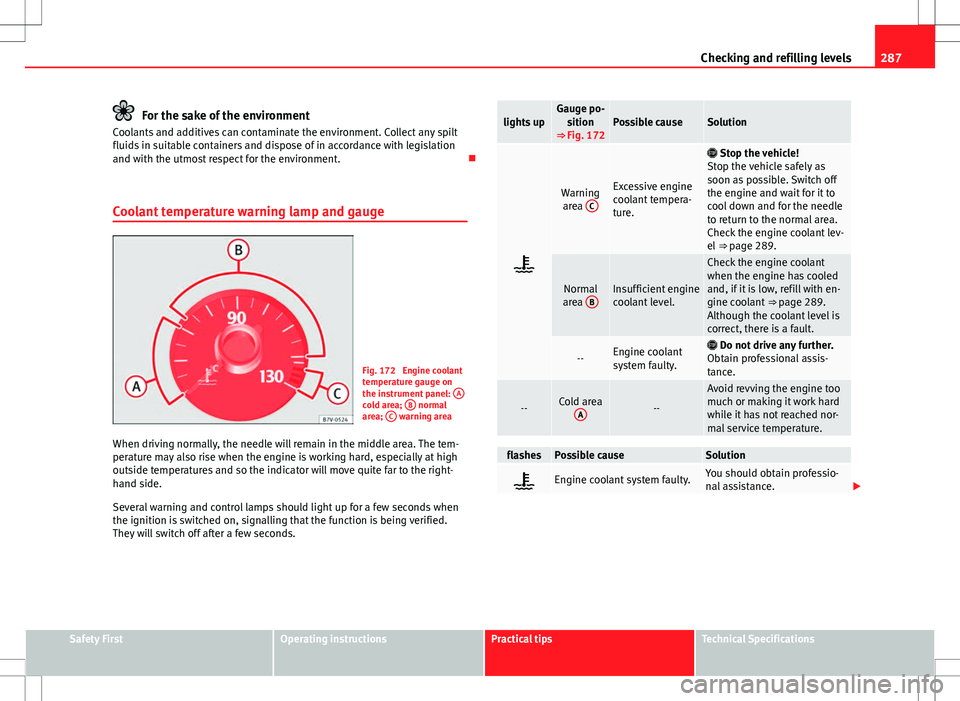
Fig. 172 Engine coolant
temperature gauge on
the instrument panel: A
cold area; B normal
area; C warning area
When driving normally, the needle will remain in the middle area. The tem-
perature may also rise when the engine is working hard, especially at high
outside temperatures and so the indicator will move quite far to the right-
hand side.
Several warning and control lamps should light up for a few seconds when
the ignition is switched on, signalling that the function is being verified.
They will switch off after a few seconds.
lights upGauge po- sition
⇒ Fig. 172Possible causeSolution
Warning area CExcessive engine
coolant tempera-
ture.
Stop the vehicle!
Stop the vehicle safely as
soon as possible. Switch off
the engine and wait for it to
cool down and for the needle
to return to the normal area.
Check the engine coolant lev-
el ⇒ page 289.
Normal
area BInsufficient engine
coolant level.
Check the engine coolant
when the engine has cooled
and, if it is low, refill with en-
gine coolant
⇒ page 289.
Although the coolant level is
correct, there is a fault.
--Engine coolant
system faulty. Do not drive any further.
Obtain professional assis-
tance.
--Cold area A--
Avoid revving the engine too
much or making it work hard
while it has not reached nor-
mal service temperature.
flashesPossible causeSolution
Engine coolant system faulty.You should obtain professio-
nal assistance.
Safety FirstOperating instructionsPractical tipsTechnical Specifications
Page 292 of 387
290Checking and refilling levels
WARNING
Hot vapours and coolant can cause serious burns.
● Never open the coolant expansion tank if steam or coolant is coming
from the engine compartment. Wait until you cannot see or hear any
steam or coolant escaping.
● Always wait until the engine has completely cooled before very care-
fully opening the expansion tank cap. Contact with hot elements of the
engine can cause skin burns.
● Once the engine has cooled, follow the instructions below before
opening the bonnet:
–Turn on the electronic parking brake and place the gear selector
lever in P or the gearbox lever in neutral.
– Remove the key from the ignition.
– Keep children away from the engine compartment and never leave
them unsupervised.
● When the engine is warm or hot, the cooling system is pressurised.
Do not unscrew the cap on the expansion tank when the engine is hot.
Otherwise, coolant may spray out under pressure causing burns and seri-
ous injury.
–Carefully and slowly unscrew the cap anticlockwise, gently press-
ing down on it.
– Always protect your face, hands and arms from hot coolant and
steam using a large, thick cloth.
● When refilling liquids, avoid spilling them on parts of the engine and
the exhaust system. Spilled liquids could cause a fire. Under specific cir-
cumstances, the ethylene glycol can catch fire.CAUTION
● Top up with distilled water only. Any other type of water may lead to con-
siderable rusting in the engine due to its chemical components. This could
consequently damage the engine. If you have not used distilled water but
another type of water to top up the coolant, a specialised workshop must
immediately replace all of the fluid in the engine cooling system.
● Only top up coolant to the top level of the marked area ⇒ Fig. 173. Oth-
erwise the excess coolant will be forced out of the cooling system when the
engine is hot, causing damage.
● If a lot of liquid coolant has been lost, wait for the engine to cool down
completely before adding coolant. Extensive coolant loss is an indication of
leaks in the engine cooling system. Have the engine cooling system inspec-
ted immediately by a specialised workshop. Otherwise you may damage the
engine.
● When refilling or changing service liquids, ensure that you put the liq-
uids into the right tank. Making a mistake when refilling could cause seri-
ous malfunctions and damage the engine!
Page 293 of 387
291
Checking and refilling levels
Vehicle battery
Introduction
The battery is a component of the vehicle's electrical system.
Never work on the electrical system without fully understanding the opera-
tions required, the applicable safety standards and without the correct tools
⇒
! Have the work carried out by a specialised workshop if you are uncer-
tain. SEAT recommends visiting a Technical Service. Negligent work can
cause serious injury.
Location and number of batteries in the vehicle
The battery is located in the engine compartment.
Explanation of the warning indications on the vehicle's battery
SymbolMeaning
Wear eye protection!
Battery acid is very corrosive and caustic. Always wear
protective gloves and eye protection!
Fires, sparks, open flames and smoking are prohibited.
A highly explosive mixture of gases is released when
the battery is under charge.
Keep children away from acid and batteries!
Additional information and warnings:
● ⇒ Booklet Maintenance Programme
● Starter assist systems (Start-Stop function) ⇒ page 195
● Working in the engine compartment ⇒ page 278
● Accessories, parts replacement, repairs and modifications ⇒ page 260
WARNING
Working on the vehicle battery and the electrical system can cause corro-
sion, fire and electric shocks. Always read and take into account the fol-
lowing warnings and safety standards before carrying out any work:
● Before working on the battery, switch off the engine, the ignition and
all electrical devices then disconnect the negative connection on the bat-
tery.
● Keep children away from acid and the battery itself!
● Wear eye protection.
● Battery acid is very corrosive and caustic. It can burn skin and cause
blindness. When handling the battery, protect yourself from splashes of
acids, above all your hands, arms and face.
● Do not smoke and never work close to places exposed to flames or
sparks.
● Avoid sparks and electrostatic discharges when working with cables
and electrical devices.
● Never short the battery terminals.
● Never use a damaged battery. It can explode. Replace a damaged bat-
tery immediately.
● Replaced damaged or frozen batteries as soon as possible. A flat bat-
tery can also freeze at temperatures close to 0 °C (+32 °F).
● For vehicles with the battery in the luggage compartment: Check that
the battery gas ventilation hose is securely attached.
Safety FirstOperating instructionsPractical tipsTechnical Specifications
Page 296 of 387
294Checking and refilling levels
WARNING (Continued)
● Battery acid is very corrosive and caustic. It can burn skin and cause
blindness. When handling the battery, protect yourself from splashes of
acids, above all your hands, arms and face.
● Never tilt the vehicle battery. Battery acid could spill out of the open-
ings to release gases and cause corrosion damage.
● Never open the vehicle battery.
● If battery acid splashes on you, immediately rinse your eyes and skin
abundantly with water for several minutes. Then seek medical care imme-
diately.
● If acid is swallowed by mistake, consult a doctor immediately.
Charging, replacing and connecting or disconnecting the
battery
Charging the battery
The vehicle battery should be charged by a specialised workshop only, as
batteries using special technology have been installed and they must be
charged in a controlled environment ⇒
. SEAT recommends visiting a
Technical Service.
Replacing a vehicle battery
The battery has been developed to suit the conditions of its location and
has special safety features. If the battery must be replaced, consult a Tech-
nical Service for information on electromagnetic compatibility, the size and
maintenance, performance and safety requirements of the new battery in
your vehicle before you purchase one. SEAT recommends you have the bat-
tery replaced by a Technical Service.
Use only maintenance-free genuine batteries conforming to TL 825 06 and
VW 7 50 73 Standards. These standards must be dated April 2008 or later. Start-Stop systems (
⇒ page 197) are equipped with a special battery. There-
fore, it must only be replaced with a battery of the same specifications.
Disconnecting the vehicle's battery
If you must disconnect the battery from the electrical system, please note
the following:
● Switch off the ignition and all electrical equipment.
● The vehicle must be unlocked before disconnecting the battery, other-
wise the alarm will be triggered.
● First disconnect the negative cable and then the positive ⇒
.
Connecting the vehicle's battery
● Before reconnecting the battery, switch off the engine, the ignition and
electric devices.
● First reconnect the positive cable and then the negative ⇒
.
Different control lamps may light up after connecting the battery and switch-
ing the ignition on. They will be turned off after a short trip at a speed of
between 15 - 20 km/h (10 - 12 mph). If the warning indicators remain lit,
please visit a specialised workshop to have the vehicle checked.
If the battery has been disconnected for a long time, it is possible that the
next service date is not displayed or calculated correctly ⇒ page 57. Respect
the maximum service intervals permitted ⇒ Booklet Maintenance Pro-
gramme.
Automatic consumer disconnection
The intelligent vehicle electrical system automatically implements a range
of measures to prevent the battery from discharging when high demands
are made on it:
Page 297 of 387
295
Checking and refilling levels
● the idling speed is increased so that the alternator provides more elec-
tricity.
● where necessary, the power of the most powerful consumers is reduced
or even completely disconnected.
● On starting the engine, the power supply from the 12-volt power sockets
and the cigarette lighter may be interrupted for a short time.
The on-board management program cannot always prevent the battery from
running flat. For example, if the ignition is left on for a long period with the
engine off or if the side lights or parking lights are left on while the vehicle
is stationary.
Why does the battery run flat?
● When stationary for a long time without starting the engine, particularly
if the ignition is switched on.
● Use of electrical consumers with the engine switched off.
● If the auxiliary heater is running ⇒ page 164.
WARNING
Incorrectly securing the battery or using the wrong battery can cause
short-circuits, fire and serious injuries.
● Always use only maintenance free batteries that do not run flat alone
and whose properties, specifications and size correspond to the stand-
ard battery. The specifications are indicated on the battery case.
WARNING
A highly explosive mixture of gases is released when the battery is under
charge.
● The batteries should be charged in a well-ventilated room only.
● Never charge a frozen or recently thawed battery. A flat battery can al-
so freeze at temperatures close to 0 °C (+32 °F).
WARNING (Continued)
● Always replace a battery which has frozen.
● Battery cables not correctly connected may cause a short circuit. Re-
connect first the positive cable and then the negative cable.
CAUTION
● Never disconnect the battery if the ignition is switched on or if the en-
gine is running. This could damage the electrical system or electronic com-
ponents.
● Never plug accessories supply current, such as solar panels or a battery
charger, to the 12-volt power sockets or the cigarette lighter. This could
damage the vehicle's electrical system.
For the sake of the environment
● Dispose of the battery in an environment-friendly manner. Batteries con-
tain toxic substances such as sulphuric acid and lead.
● Battery acid can contaminate the environment. Collect any spilt service
fluids and allow a dispose of them correctly.
Safety FirstOperating instructionsPractical tipsTechnical Specifications
Page 298 of 387
296Wheels and tyres
Wheels and tyres
Wheels
Introduction
The SEAT Alhambra is equipped as standard with anti-puncture technology
tyres (Conti-Seal). In the event of a puncture or air leak of up to 5 mm, the
tyre seals the hole with a protective layer inside the tread.
The inclusion of such technology means that there is no type of spare
wheel, nor puncture repair kit included in the vehicle's inventory.
SEAT recommend that all work on tyres and wheels is carried out by a speci-
alised workshop. They have the necessary special tools and replacement
parts, trained personnel and facilities for disposing of the old tyres. SEAT
recommends visiting a Technical Service.
Additional information and warnings:
● Transporting ⇒ page 13
● Towing mode ⇒ page 236
● Braking, stopping and parking ⇒ page 184
● Park assist system ⇒ page 203
● Tyre control systems ⇒ page 224
● Caring for and cleaning the vehicle exterior ⇒ page 245
● Wheel trims ⇒ page 307
● Change wheel ⇒ page 309
● Notes for the user ⇒ page 258
WARNING
The vehicle cannot be totally controlled or braked if the tyres (new or
used) are worn or damaged.
● Incorrect use of wheels and tyres could make driving more dangerous
and result in serious accidents and damage.
● All four wheels must be fitted with radial tyres of the same type, size
(rolling circumference) and the same tread pattern.
● New tyres do not give maximum grip and will not have reached their
maximum braking capacity to start with, and therefore need running in.
To prevent accidents and major damage, extreme caution should be tak-
en for the first 600 km (370 miles).
● Check tyre pressures regularly and ensure they are maintained at the
pressures indicated. If the tyre pressure is too low, the tyres could over-
heat, resulting in tread detachment or even burst tyres.
● Never drive on damaged (punctured, cut, cracked or dented) or worn
tyres. Driving on damaged or worn tyres could result in burst tyres, seri-
ous accidents or damage. Worn or damaged tyres must be replaced im-
mediately.
● Never exceed the maximum permitted speed or loads specified for the
type of tyre fitted on your vehicle.
● The effectiveness of driver and brake assist systems also depends on
the grip of the tyres.
● If you notice unusual vibration or if the vehicle pulls to one side when
driving, stop the car immediately and check the tyres and wheels for
damage.
● To minimise the risk of losing control of the vehicle or causing a seri-
ous accident, never undo the bolted joints of beadlock wheels.
Page 299 of 387
297
Wheels and tyres
WARNING (Continued)
● Never mount used tyres or wheels if you are not sure of their previous
history. They may be damaged, although the damage is not immediately
visible.
● Old tyres, even if they have never been used, may lose air or burst un-
expectedly while driving, resulting in serious accident or damage. If tyres
are over six years old, they should only be used in an emergency and
with extreme caution.
Note
● For technical reasons, it is not generally possible to use the wheels from
other vehicles. In some cases, this may also be true for the same model of
wheel. Please refer to the vehicle documentation or ask at a Technical Serv-
ice.
● If you decide to fit your vehicle with conventional tyres, remember that
you must carry a puncture repair kit, not available in the tools that come
with the vehicle. About your tyres and wheels
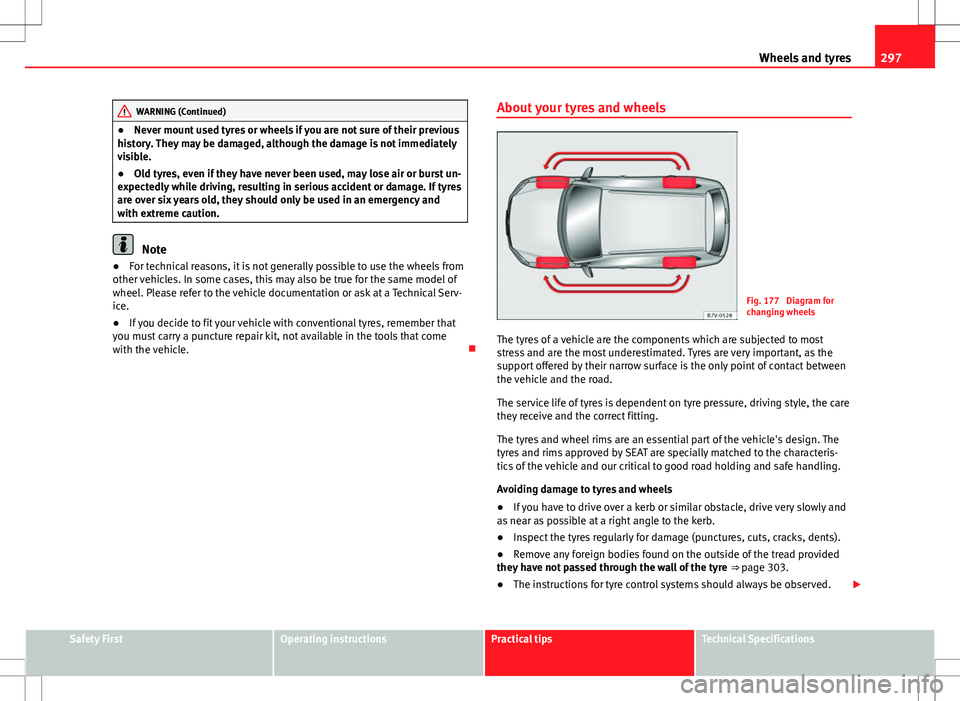
Fig. 177 Diagram for
changing wheels
The tyres of a vehicle are the components which are subjected to most
stress and are the most underestimated. Tyres are very important, as the
support offered by their narrow surface is the only point of contact between
the vehicle and the road.
The service life of tyres is dependent on tyre pressure, driving style, the care
they receive and the correct fitting.
The tyres and wheel rims are an essential part of the vehicle's design. The
tyres and rims approved by SEAT are specially matched to the characteris-
tics of the vehicle and our critical to good road holding and safe handling.
Avoiding damage to tyres and wheels
● If you have to drive over a kerb or similar obstacle, drive very slowly and
as near as possible at a right angle to the kerb.
● Inspect the tyres regularly for damage (punctures, cuts, cracks, dents).
● Remove any foreign bodies found on the outside of the tread provided
they have not passed through the wall of the tyre ⇒ page 303.
● The instructions for tyre control systems should always be observed.
Safety FirstOperating instructionsPractical tipsTechnical Specifications
Page 301 of 387
299
Wheels and tyres
Wheel rims
The design of wheel bolts is matched to the rims. If different rims are fitted,
the correct wheel bolts with the right length and correctly shaped bolt
heads must be used. This ensures that wheels are fitted securely and that
the brake system functions correctly ⇒ page 309.
For technical reasons, it is not generally possible to use the wheels from
other vehicles. In some cases, this may also be true for the same model of
wheel.
The tyres and rims approved by SEAT are specially matched to the character-
istics of the vehicle and are critical to good road holding and safe handling.
Wheel bolts
Wheel bolts must be tightened to the correct torque ⇒ page 309.
Beadlock wheel rims
Beadlock wheel rims have various components. These are joined together
by special bolts using a special procedure. This ensures good performance,
a better seal, improved safety and wheel run out. Therefore, worn rims
should always be replaced and must only be repaired in a specialised work-
shop. SEAT recommends visiting a Technical Service ⇒
.
Wheel rims with bolted trims
Wheel rims may be fitted with interchangeable trim parts which are attach-
ed to the rim using self-locking bolts. Worn trims should only be replaced at
a specialised workshop. SEAT recommends visiting a Technical Service
⇒
.
WARNING
The use of worn or damaged wheel rims could make driving more danger-
ous and result in serious accidents and damage.
● Only wheel rims which have been approved for use with your vehicle
should be used.
● Inspect wheel rims regularly for damage and replace as required.
WARNING
If the bolted joints of wheel rims with bolted ring trims are not correctly
tightened or loosened, this could result in serious accident.
● Never loosen the bolted joints of wheel rims with bolted ring trims.
● Any work relating to wheel rims with bolted rims should be carried
out at specialised workshop. SEAT recommends visiting a Technical Serv-
ice.
Replacement of new tyres and wheel rims
New tyres
● When tyres are new, drive with extreme caution for the first 500 km
(310 miles), as all tyres need to be run-in. Tyres which have not been run-in
do not have such good grip ⇒
or braking capacity ⇒ .
● All four wheels must be fitted with radial tyres of the same type, size
(rolling circumference) and the same tread pattern.
● The tread depth of new tyres may vary, according to the type and make
of tyre and the tread pattern.
Safety FirstOperating instructionsPractical tipsTechnical Specifications