service Seat Alhambra 2013 Workshop Manual
[x] Cancel search | Manufacturer: SEAT, Model Year: 2013, Model line: Alhambra, Model: Seat Alhambra 2013Pages: 387, PDF Size: 6.13 MB
Page 270 of 387
268Checking and refilling levels
WARNING (Continued)
– If you are using a metal fuel canister, the nozzle must always touch
the canister while it is being filled to avoid static electricity.
– Follow the legal requirements for the use, storage and transport of
spare fuel canisters.
– Insure that the fuel container complies with manufacturing stand-
ards, for example, ANSI or ASTM F852-86.
CAUTION
● Always remove any fuel spilled on the vehicle paintwork immediately to
avoid damage to the wheel housing, the tyre and vehicle paintwork.
● Refuelling a petrol engine with diesel or a diesel engine with petrol can
cause serious engine and fuel system damage; the resulting malfunctions
are not covered by the SEAT warranty. If you refuel with the wrong type of
fuel, never start the engine. This applies to even the smallest amount of the
wrong fuel. You should obtain professional assistance. With the engine run-
ning, the composition of the wrong fuel could significantly damage the fuel
system and the engine itself.
● In vehicles with a diesel engine, under no circumstances should you re-
fuel or drive with petrol, kerosene, heating oil or any other type of different
fuel. Other types of fuels could cause serious damage to the engine and to
the fuel supply system and the resulting problems are not covered by the
SEAT warranty.
For the sake of the environment
Fuels can contaminate the environment. Collect any spilt service fluids and
allow a professional to dispose of them.
Note
There is no emergency mechanism for the manual release of the tank flap. If
necessary, request assistance from specialised personnel. Control lamps and fuel gauge
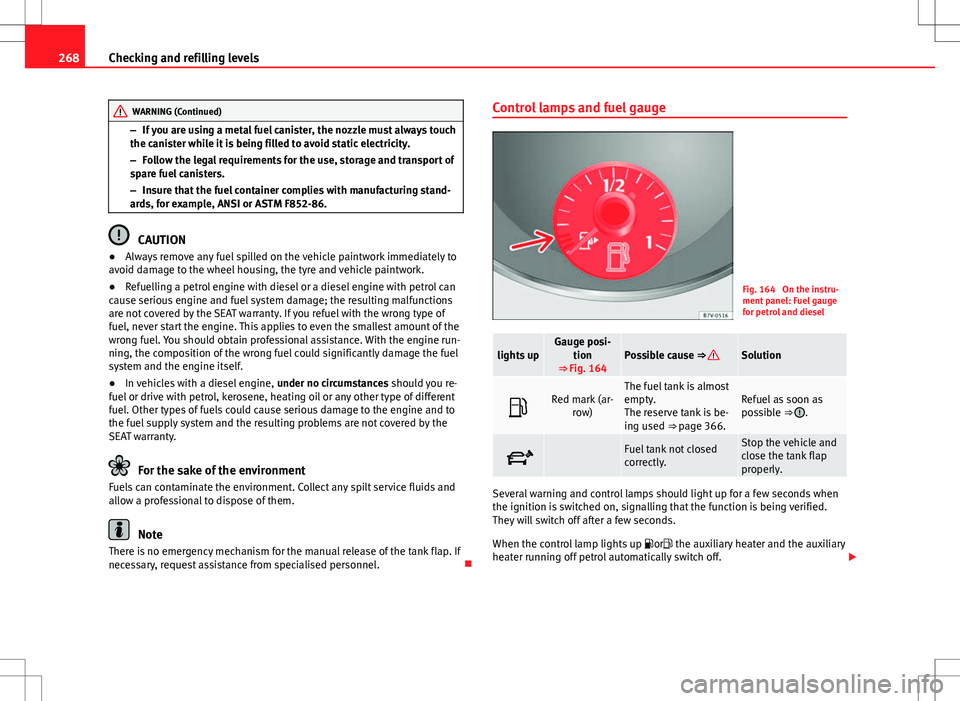
Fig. 164 On the instru-
ment panel: Fuel gauge
for petrol and diesel
lights upGauge posi-
tion
⇒ Fig. 164Possible cause ⇒ Solution
Red mark (ar- row)The fuel tank is almost
empty.
The reserve tank is be-
ing used ⇒ page 366.Refuel as soon as
possible ⇒ .
Fuel tank not closed
correctly.Stop the vehicle and
close the tank flap
properly.
Several warning and control lamps should light up for a few seconds when
the ignition is switched on, signalling that the function is being verified.
They will switch off after a few seconds.
When the control lamp lights up or the auxiliary heater and the auxiliary
heater running off petrol automatically switch off.
Page 273 of 387
271
Checking and refilling levels
WARNING
Refuelling or handling fuel carelessly can cause an explosion or fire re-
sulting in serious burns and injuries.
● Fuel is a highly explosive, easily flammable substance.
● Observe current safety instructions and local regulations concerning
the handling of fuel.
Types of fuel
The type of fuel to use when refilling will depend on the vehicle's engine.
You will find a factory-fitted sticker containing information on the type of
fuel for your vehicle on the inside of the fuel tank flap.
SEAT recommends the use of sulphur-free or low sulphur fuel to reduce con-
sumption and prevent engine damage.
Possible types of fuelAlternative namesFurther information
91a)
RONNormal petrol, normal unlea-
ded petrol
⇒ page 27195 a)
RONPremium unleaded petrol (95
RON)
98 a)
RONPremium unleaded petrol (98
RON)
Diesel ⇒ page 272a) RON = Regulation Octane Number Petrol
Petrol types
Vehicles with petrol engines must refuel using unleaded petrol according to
European norm EN 228 ⇒
.
Petrol types are categorised according to their octane number (e.g. 91, 95,
98 or 99 RON (RON = “Research Octane Number”). You may use petrol with
a high octane number than the one recommended for your engine. Howev-
er, this has no advantage in terms of fuel consumption and engine power.
SEAT recommends refuelling with a low sulphur content or sulphur-free pet-
rol to reduce fuel consumption for petrol engines.
Petrol additives
The quality of the fuel influences running behaviour, performance and serv-
ice life of the engine. For this reason, you should use good quality petrol
containing a mixture of additives. These additives will help to prevent corro-
sion, keep the fuel system clean and prevent deposits from building up in
the engine.
If good quality petrol with additives is not available or engine problems
arise, the necessary additives must be added when refuelling.
Not all petrol additives have been shown to be effective. The use of unsuita-
ble petrol additives could damage the engine. These additives are available
from Technical Services, who will inform you of their application.
CAUTION
● Only use fuel with an octane rating that is in line with the norm EN 228,
otherwise significant damage could be caused to the engine and fuel sys-
tem. Furthermore, it could lead to a loss of performance with the conse-
quent engine fault.
● The use of unsuitable petrol additives could damage the engine.
Safety FirstOperating instructionsPractical tipsTechnical Specifications
Page 274 of 387
272Checking and refilling levels
● If, in exceptional circumstances, petrol with a lower octane rating to that
recommended is used, only use moderate engine speeds and a light throt-
tle. Avoid using full throttle and overloading the engine. Otherwise you may
damage the engine. Fill up with fuel of a suitable octane rating as soon as
possible.
● Do not refuel if the filler indicates that the fuel contains metal. LRP (lead
replacement petrol) fuels also contain high concentrations of metal addi-
tives. This could damage the engine!
● Just one full tank of leaded fuel would seriously impair the efficiency of
the catalytic converter and could damage it.
Diesel
Diesel fuel
Diesel fuel must correspond to European standard EN 590 (In Germany,
EN 590 or DIN 51628).
The use of diesel fuel with a high sulphur percentage requires shorter serv-
ice intervals ⇒ Booklet Maintenance Programme ⇒
. Your Technical Serv-
ice will be able to tell you which countries have diesel with a high sulphur
content.
Do not mix fuel additives (thinners, or similar additives) with diesel fuel.
Winter-grade diesel
When using “summer-grade diesel fuel”, difficulties may be experienced at
temperatures below 0 °C (+32 °F) because the fuel thickens due to wax sep-
aration. For this reason, “winter-grade diesel fuel” is available in Germany,
for example, during the cold months. It can be used at temperatures as low
as -20 °C (-4 °F).
In countries with different climatic conditions, other types of diesel fuel are
available that are suitable to local temperatures. Technical Services and fill-
ing stations in the country concerned will inform you on the type of diesel
fuels available. A cold diesel engine makes more noise during winter temperatures than
summer temperatures. Furthermore, the exhaust gases may turn slightly
bluish while the engine is heating. The quantity of exhaust gases will de-
pend on the outside temperature.
Filter pre-heater
Vehicles with a diesel engine are fitted with a fuel filter pre-heating system.
This ensures that the fuel system remains operational to approx. -24 °C
(-11.2 °F), provided you use winter-grade diesel which is safe to -15 °C
(+5 °F).
However, if the fuel has waxed to such an extent that the engine will not
start at temperatures of under -24 °C (-11.2 °F), simply place the vehicle in a
warm garage or workshop for a while to heat up.
Auxiliary heater
Vehicles with a diesel engine may be fitted with an auxiliary heater. The
heater runs off the fuel from the fuel tank. On doing so, smells and steam
may be noticed outside the vehicle for a short period. This is normal and it
is not an indication of a fault in the vehicle.
Whenever there is little fuel in the tank (reserve), the auxiliary heater auto-
matically switches off.
WARNING
Never use start boosters. An aerosol start booster could explode or cause
a sudden rise in engine speed leading to engine damage and serious in-
jury.
Page 275 of 387
273
Checking and refilling levels
CAUTION
● The vehicle is not prepared for the use of biodiesel. Never, under any
circumstances refuel with biodiesel. It could damage the fuel system and
subsequently lead to engine faults!
● The addition of biodiesel to diesel by the diesel producer according to
Standard EN 590 or other equivalent (DIN 51628 in Germany, for example)
is authorised and causes no type of damage to the engine or the fuel sys-
tem.
● The diesel engine has been designed for to use diesel fuel exclusively.
Therefore, never use petrol, fuel oil or other unsuitable fuels. The composi-
tion of these fuels may significantly damage the fuel system and the en-
gine.
● The use of diesel fuels with a high sulphur percentage could considera-
bly reduce the service life of the diesel particulate filter. Your Technical Serv-
ice will be able to tell you which countries have diesel with a high sulphur
content.
Information on fuel consumption
The consumption and emission values indicated do not refer to one specific
vehicle. They are only to be used to compare the values of the different ve-
hicle versions. The fuel consumption and CO 2 emissions of a vehicle not on-
ly depend on the effective use of fuel. They also depend on your driving
style and other non-technical factors.
Calculation of fuel consumption
Fuel consumption and emission values are determined according to the cur-
rent version of the 715/2007/EC or 80/1268/EEC regulation and are valid
for the vehicle kerb weight. The specifications do not refer to an individual
vehicle. Two measuring cycles are carried out on a rolling road test bed to
calculate fuel consumption. The test criteria are as follows:
Urban cycleMeasurement of the urban cycle starts with an engine cold
start. City driving is then simulated at between 0 and 50 km/
h (30 mph).
Road cycle
In the road cycle simulation, the car undergoes frequent ac-
celeration and braking in all gears, as in normal everyday
driving. The road speed ranges from 0 to 120 km/h (0 to
70 mph).
CombinedThe average combined consumption is calculated with a
weighting of around 37 % for the urban cycle and 63 % for
the road cycle.
CO 2 emis-
sions of the
combinationThe exhaust gases are collected during both driving cycles
to calculate carbon dioxide emissions (urban and road). The
gas composition is then analysed to evaluate the CO 2 con-
tent and other emissions.
Note
● The kerb weight may vary according to the vehicle equipment. This
could raise consumption and the CO 2 emissions slightly.
● In practice, consumption values could be different to the values calcula-
ted based on the 715/2007/EC or 80/1268/EEC regulations.
Safety FirstOperating instructionsPractical tipsTechnical Specifications
Page 276 of 387
274Checking and refilling levels
Selective Catalytic Reduction* (AdBlue)
Introduction
The AdBlue fill level must be checked when the vehicle is being serviced.
Additional information and warnings:
● Luggage compartment ⇒ page 126
● Fuel ⇒ page 270
● Wheels and tyres ⇒ page 296
● Accessories, parts replacement, repairs and modifications ⇒ page 260
WARNING
If the AdBlue fill level is too low, the vehicle may not restart after switch-
ing the ignition off. The emergency start or jump start will not be possi-
ble either!
● Top up with AdBlue at the latest 1000 km or 600 miles before it runs
out.
● Do not allow the AdBlue to run too low.
WARNING
AdBlue is an irritant, corrosive liquid that can cause injuries if it touches
the skin, eyes or respiratory organs.
● If AdBlue get in contact with eyes and skin, rinse for at least 15 mi-
nutes with plenty of water and seek medical help.
● If the AdBlue is swallowed, wash your mouth with plenty of water for
at least 15 minutes. Do not try to provoke vomiting unless recommended
by a Doctor. Seek medical advice immediately.
CAUTION
AdBlue damages surfaces such as painted vehicle parts, plastic, items of
clothing and carpets. Spilt AdBlue should be removed as quickly as possi-
ble using a damp cloth and plenty of cold water.
● If the AdBlue has crystallised, remove with warm water and a sponge.
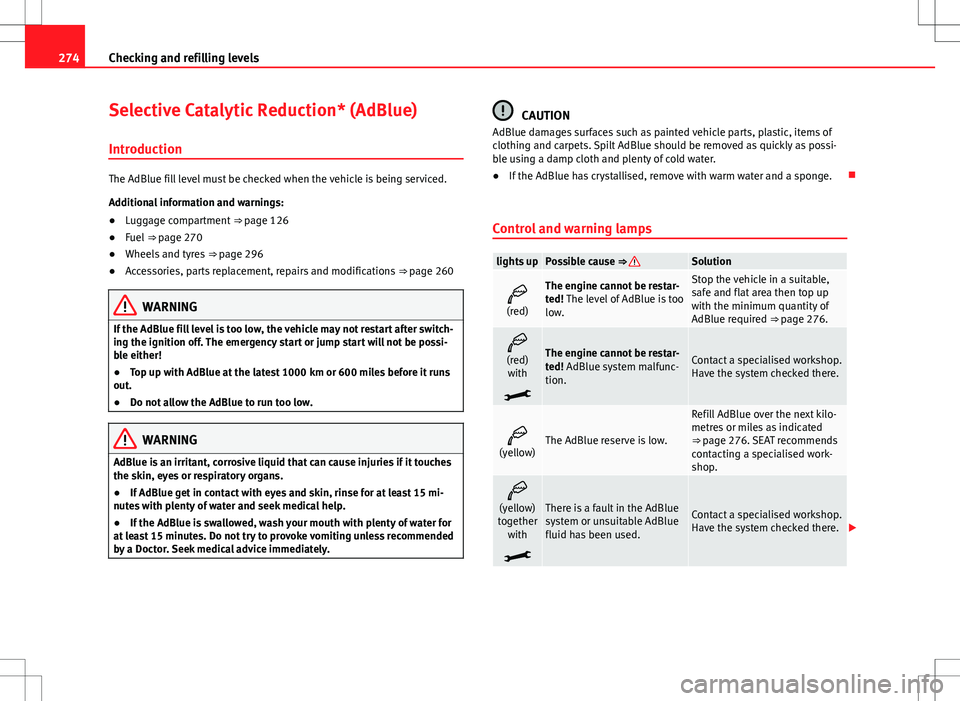
Control and warning lamps
lights upPossible cause ⇒ Solution
(red)The engine cannot be restar-
ted! The level of AdBlue is too
low.Stop the vehicle in a suitable,
safe and flat area then top up
with the minimum quantity of
AdBlue required ⇒ page 276.
(red)
with
The engine cannot be restar-
ted! AdBlue system malfunc-
tion.Contact a specialised workshop.
Have the system checked there.
(yellow)The AdBlue reserve is low.
Refill AdBlue over the next kilo-
metres or miles as indicated
⇒ page 276. SEAT recommends
contacting a specialised work-
shop.
(yellow)
together with
There is a fault in the AdBlue
system or unsuitable AdBlue
fluid has been used.Contact a specialised workshop.
Have the system checked there.
Page 277 of 387
275
Checking and refilling levels
Several warning and control lamps should light up for a few seconds when
the ignition is switched on, signalling that the function is being verified.
They will switch off after a few seconds.
WARNING
If the warning lamps and messages are ignored, the vehicle may stall in
traffic, or may cause accidents and severe injuries.
● Never ignore the warning lamps or text messages.
● Stop the vehicle safely as soon as possible.
CAUTION
Failure to heed the control lamps and text messages when they appear may
result in faults in the vehicle.
Information on AdBlue
In vehicles with Selective Catalytic Reduction, a special urea solution (AdBl-
ue) is injected into the exhaust gas system in front of the catalytic converter
to reduce nitrogen oxide emissions. The consumption of AdBlue depends on individual driving style, the tem-
perature at which the system operates and the outside temperature where
the vehicle is driven.
AdBlue is kept in an independent tank in the vehicle and should be refilled
at an official supplier. The AdBlue tank holds about 17 litres.
A message will be displayed on the dash panel around 2400 km
(1500 miles) before the next service to indicate that AdBlue must be refilled
⇒ page 276. If you ignore this message and do not refill, you will be unable
to start the engine afterwards
⇒ page 274.
SEAT recommends contacting a specialised workshop. If you are unable to
visit a qualified specialised workshop, you should temporarily refill with a
minimum of 10.0 litres of AdBlue. Only refill using AdBlue expressly ap-
proved by SEAT.
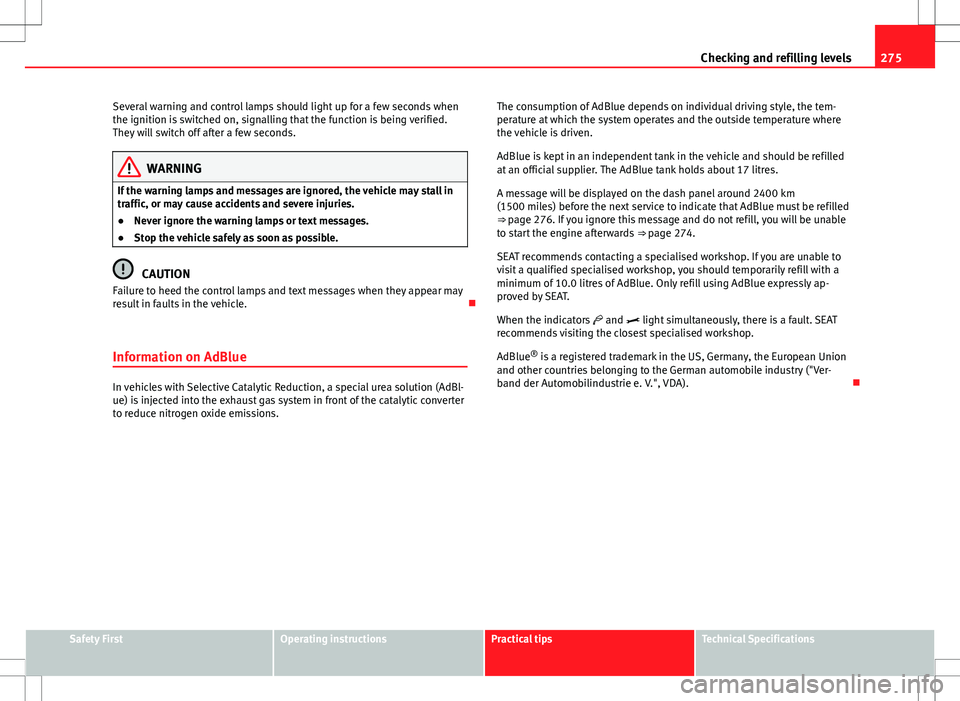
When the indicators and light simultaneously, there is a fault. SEAT
recommends visiting the closest specialised workshop.
AdBlue ®
is a registered trademark in the US, Germany, the European Union
and other countries belonging to the German automobile industry ("Ver-
band der Automobilindustrie e. V.", VDA).
Safety FirstOperating instructionsPractical tipsTechnical Specifications
Page 279 of 387
277
Checking and refilling levels
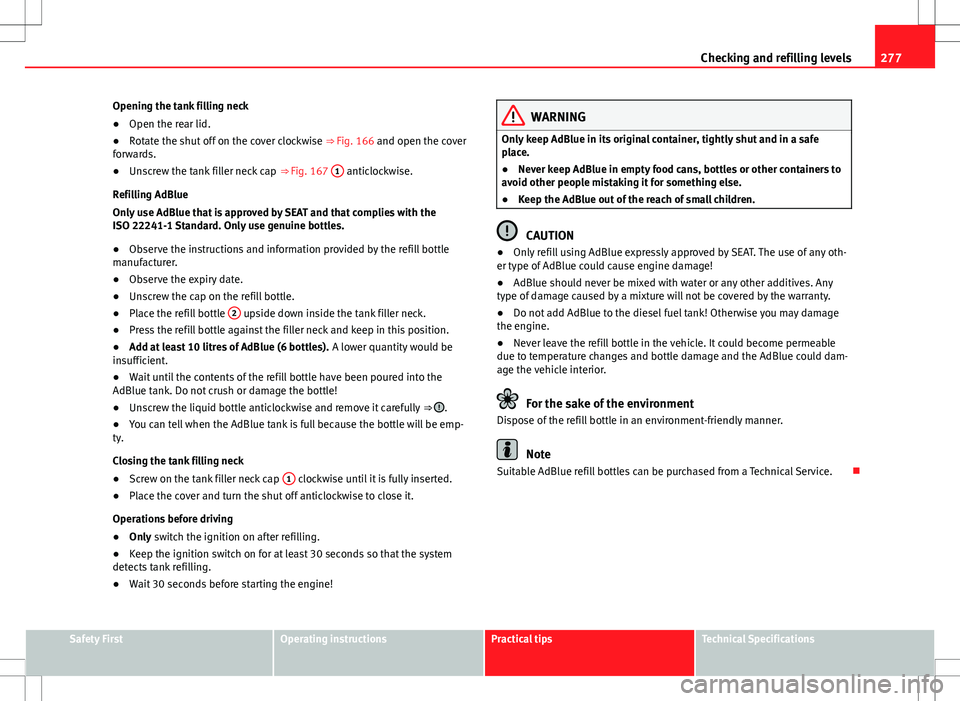
Opening the tank filling neck
● Open the rear lid.
● Rotate the shut off on the cover clockwise ⇒ Fig. 166 and open the cover
forwards.
● Unscrew the tank filler neck cap ⇒ Fig. 167 1
anticlockwise.
Refilling AdBlue
Only use AdBlue that is approved by SEAT and that complies with the
ISO 22241-1 Standard. Only use genuine bottles.
● Observe the instructions and information provided by the refill bottle
manufacturer.
● Observe the expiry date.
● Unscrew the cap on the refill bottle.
● Place the refill bottle 2
upside down inside the tank filler neck.
● Press the refill bottle against the filler neck and keep in this position.
● Add at least 10 litres of AdBlue (6 bottles). A lower quantity would be
insufficient.
● Wait until the contents of the refill bottle have been poured into the
AdBlue tank. Do not crush or damage the bottle!
● Unscrew the liquid bottle anticlockwise and remove it carefully ⇒
.
● You can tell when the AdBlue tank is full because the bottle will be emp-
ty.
Closing the tank filling neck
● Screw on the tank filler neck cap 1
clockwise until it is fully inserted.
● Place the cover and turn the shut off anticlockwise to close it.
Operations before driving
● Only switch the ignition on after refilling.
● Keep the ignition switch on for at least 30 seconds so that the system
detects tank refilling.
● Wait 30 seconds before starting the engine!
WARNING
Only keep AdBlue in its original container, tightly shut and in a safe
place.
● Never keep AdBlue in empty food cans, bottles or other containers to
avoid other people mistaking it for something else.
● Keep the AdBlue out of the reach of small children.
CAUTION
● Only refill using AdBlue expressly approved by SEAT. The use of any oth-
er type of AdBlue could cause engine damage!
● AdBlue should never be mixed with water or any other additives. Any
type of damage caused by a mixture will not be covered by the warranty.
● Do not add AdBlue to the diesel fuel tank! Otherwise you may damage
the engine.
● Never leave the refill bottle in the vehicle. It could become permeable
due to temperature changes and bottle damage and the AdBlue could dam-
age the vehicle interior.
For the sake of the environment
Dispose of the refill bottle in an environment-friendly manner.
Note
Suitable AdBlue refill bottles can be purchased from a Technical Service.
Safety FirstOperating instructionsPractical tipsTechnical Specifications
Page 282 of 387
280Checking and refilling levels
WARNING (Continued)
● Never pour service fluids over the engine. These fluid may ignite hot
engine parts and cause injuries.
● If it is necessary to work on the fuel system or the electrical system,
please follow the instructions below:
–Always disconnect the vehicle battery. When disconnecting the
battery, ensure that the vehicle is unlocked otherwise the anti-theft
alarm will be triggered.
– Never work close to heaters, heat sources or places exposed to
flames or sparks.
● Always keep a recently serviced and perfectly working fire extin-
guisher close by.
CAUTION
When refilling or changing service liquids, ensure that you put the liquids
into the right tank. Making a mistake when refilling could cause serious
malfunctions and damage the engine!
For the sake of the environment
Service fluids leaks are harmful to the environment. For this reason you
should make regular checks on the ground underneath your vehicle. Take
the vehicle to a specialised workshop to be checked if you see stains, oil or
other fluids on the ground. Collect any spilt service fluids and allow a pro-
fessional to dispose of them.
Preparing the vehicle for work in the engine compartment
Checklist
Carry out the operations below in the order indicated before starting work in
the engine compartment ⇒
: ●
Park the vehicle on an even and solid surface.
● Press and hold the brake pedal until the vehicle comes to a standstill.
● Connect the electronic parking brake ⇒ page 184.
● Move the selector lever to its intermediate position or to P ⇒ page 175.
● Stop the engine and remove the key from the ignition ⇒ page 171.
● Wait for the engine to cool down.
● Always keep children and other people far from the engine compart-
ment.
● Ensure that the vehicle can not move off unexpectedly.
WARNING
Ignoring this checklist, drawn up for your own safety, could result in seri-
ous injury.
● Always complete the operations given in the checklist and observe
the general rules of safety.
Page 284 of 387
282Checking and refilling levels
CAUTION
● To avoid damage to the bonnet and to the windscreen wiper arms, only
open the bonnet when the windscreen wipers are in place against the wind-
screen.
● Before driving, always lower the wiper arms.
Engine oil Introduction
Additional information and warnings:
● ⇒ Booklet Maintenance Programme
● Working in the engine compartment ⇒ page 278
● Accessories, parts replacement, repairs and modifications ⇒ page 260
WARNING
Incorrectly handling engine oil can cause injury and serious burns.
● Always protect your eyes when handling engine oil.
● Oil is toxic and must be kept out of the reach of children.
● Engine oil must only be kept closed in its original container. The same
applies to use oil until it has been disposed of.
● Never store engine oil in empty food containers or bottles as other
people may accidentally drink it.
● Regular contact with engine oil can be bad for the skin. If you come
into contact with engine oil, wash your skin with soap and water.
● With the engine running, the engine oil gets extremely hot and can
cause severe skin burns. Always wait until the engine has fully cooled.
For the sake of the environment
Similar to the other service liquids, spilled engine oil can be bad for the en-
vironment. Collect any spilt fluids in suitable containers and dispose of in
accordance with legislation and with the utmost respect for the environ-
ment.
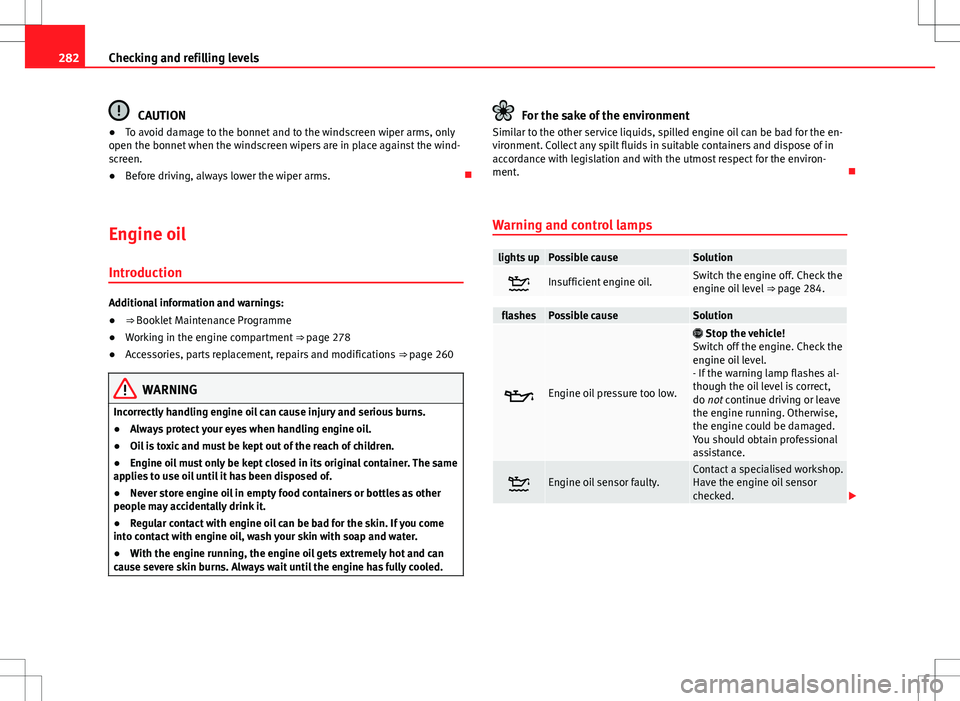
Warning and control lamps
lights upPossible causeSolution
Insufficient engine oil.Switch the engine off. Check the
engine oil level ⇒ page 284.
flashesPossible causeSolution
Engine oil pressure too low.
Stop the vehicle!
Switch off the engine. Check the
engine oil level.
- If the warning lamp flashes al-
though the oil level is correct,
do not continue driving or leave
the engine running. Otherwise,
the engine could be damaged.
You should obtain professional
assistance.
Engine oil sensor faulty.Contact a specialised workshop.
Have the engine oil sensor
checked.
Page 285 of 387
283
Checking and refilling levels
WARNING
If the warning lamps and messages are ignored, the vehicle may stall in
traffic, or may cause accidents and severe injuries.
● Never ignore the warning lamps or text messages.
● Stop the vehicle safely as soon as possible.
CAUTION
Failure to heed the control lamps and text messages when they appear may
result in faults in the vehicle.
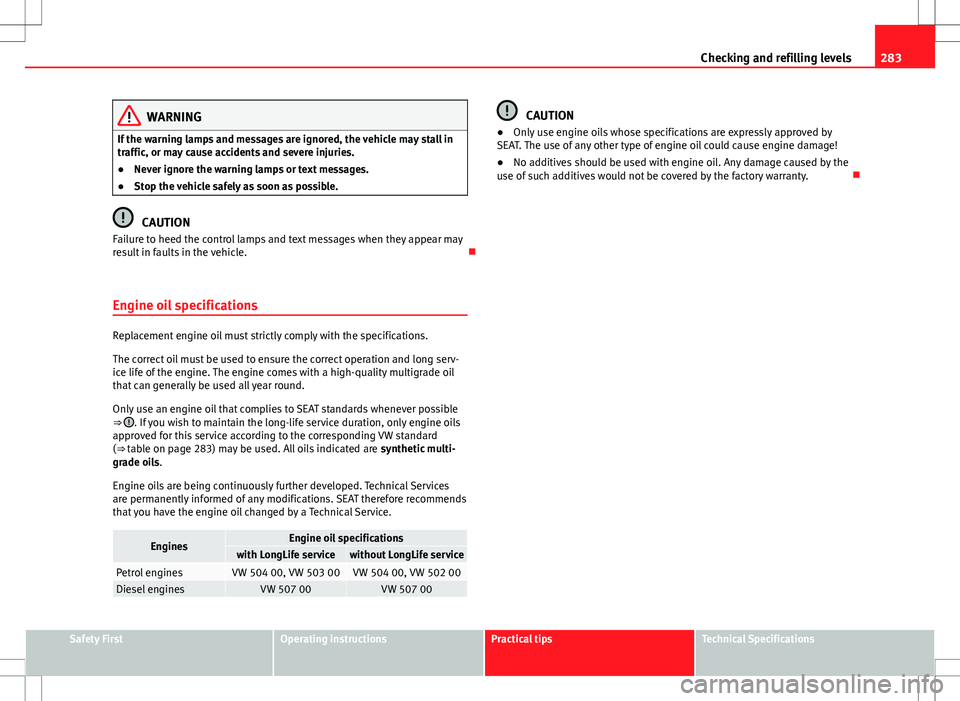
Engine oil specifications
Replacement engine oil must strictly comply with the specifications.
The correct oil must be used to ensure the correct operation and long serv-
ice life of the engine. The engine comes with a high-quality multigrade oil
that can generally be used all year round.
Only use an engine oil that complies to SEAT standards whenever possible
⇒
. If you wish to maintain the long-life service duration, only engine oils
approved for this service according to the corresponding VW standard
( ⇒ table on page 283) may be used. All oils indicated are
synthetic multi-
grade oils.
Engine oils are being continuously further developed. Technical Services
are permanently informed of any modifications. SEAT therefore recommends
that you have the engine oil changed by a Technical Service.
EnginesEngine oil specificationswith LongLife servicewithout LongLife servicePetrol enginesVW 504 00, VW 503 00VW 504 00, VW 502 00Diesel enginesVW 507 00VW 507 00
CAUTION
● Only use engine oils whose specifications are expressly approved by
SEAT. The use of any other type of engine oil could cause engine damage!
● No additives should be used with engine oil. Any damage caused by the
use of such additives would not be covered by the factory warranty.
Safety FirstOperating instructionsPractical tipsTechnical Specifications