page 74 Seat Alhambra 2013 Manual Online
[x] Cancel search | Manufacturer: SEAT, Model Year: 2013, Model line: Alhambra, Model: Seat Alhambra 2013Pages: 387, PDF Size: 6.13 MB
Page 139 of 387
137
Seats and storage
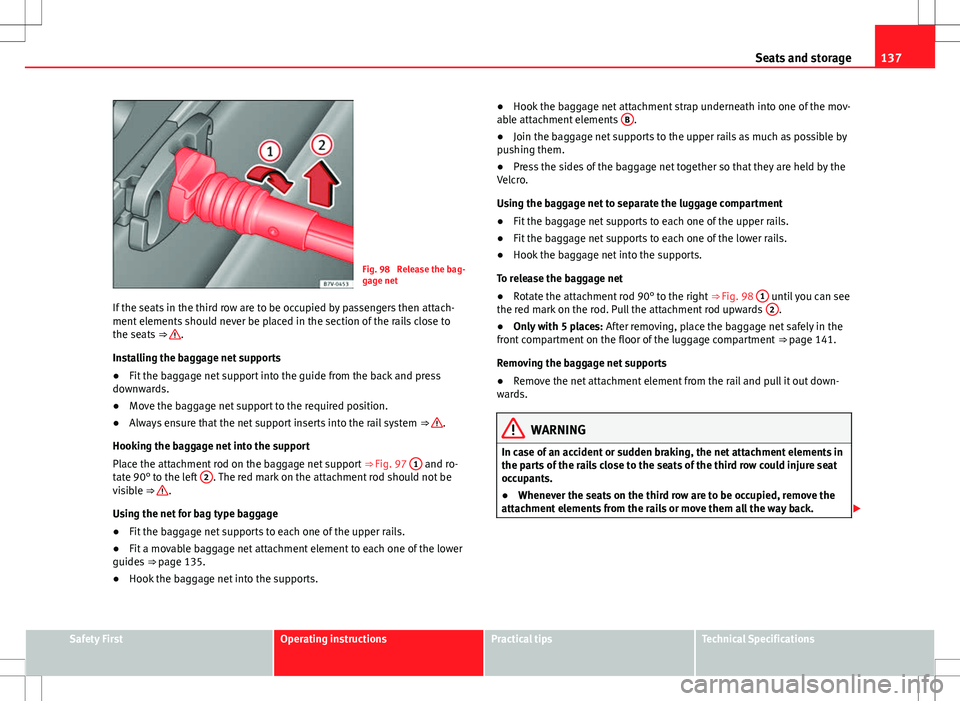
Fig. 98 Release the bag-
gage net
If the seats in the third row are to be occupied by passengers then attach-
ment elements should never be placed in the section of the rails close to
the seats ⇒
.
Installing the baggage net supports
● Fit the baggage net support into the guide from the back and press
downwards.
● Move the baggage net support to the required position.
● Always ensure that the net support inserts into the rail system ⇒
.
Hooking the baggage net into the support
Place the attachment rod on the baggage net support ⇒ Fig. 97 1
and ro-
tate 90° to the left 2. The red mark on the attachment rod should not be
visible ⇒ .
Using the net for bag type baggage
● Fit the baggage net supports to each one of the upper rails.
● Fit a movable baggage net attachment element to each one of the lower
guides ⇒ page 135.
● Hook the baggage net into the supports. ●
Hook the baggage net attachment strap underneath into one of the mov-
able attachment elements B
.
● Join the baggage net supports to the upper rails as much as possible by
pushing them.
● Press the sides of the baggage net together so that they are held by the
Velcro.
Using the baggage net to separate the luggage compartment
● Fit the baggage net supports to each one of the upper rails.
● Fit the baggage net supports to each one of the lower rails.
● Hook the baggage net into the supports.
To release the baggage net
● Rotate the attachment rod 90° to the right ⇒ Fig. 98 1
until you can see
the red mark on the rod. Pull the attachment rod upwards 2.
● Only with 5 places: After removing, place the baggage net safely in the
front compartment on the floor of the luggage compartment ⇒ page 141.
Removing the baggage net supports
● Remove the net attachment element from the rail and pull it out down-
wards.
WARNING
In case of an accident or sudden braking, the net attachment elements in
the parts of the rails close to the seats of the third row could injure seat
occupants.
● Whenever the seats on the third row are to be occupied, remove the
attachment elements from the rails or move them all the way back.
Safety FirstOperating instructionsPractical tipsTechnical Specifications
Page 141 of 387
139
Seats and storage
Hooking the baggage net into the luggage compartment floor
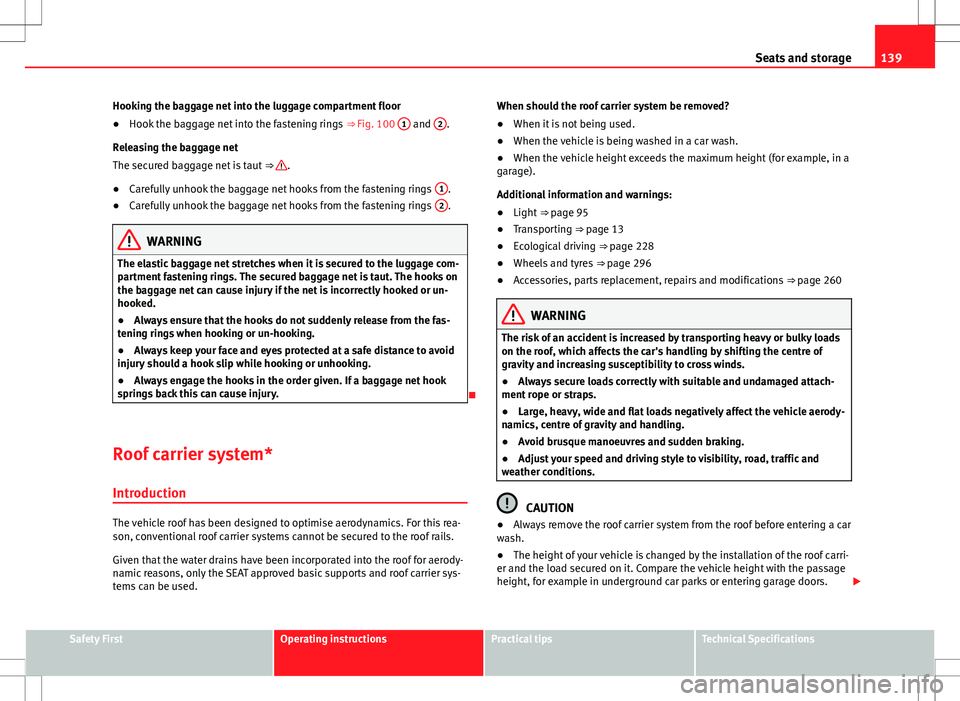
● Hook the baggage net into the fastening rings ⇒ Fig. 100 1
and 2.
Releasing the baggage net
The secured baggage net is taut ⇒
.
● Carefully unhook the baggage net hooks from the fastening rings 1
.
● Carefully unhook the baggage net hooks from the fastening rings 2.
WARNING
The elastic baggage net stretches when it is secured to the luggage com-
partment fastening rings. The secured baggage net is taut. The hooks on
the baggage net can cause injury if the net is incorrectly hooked or un-
hooked.
● Always ensure that the hooks do not suddenly release from the fas-
tening rings when hooking or un-hooking.
● Always keep your face and eyes protected at a safe distance to avoid
injury should a hook slip while hooking or unhooking.
● Always engage the hooks in the order given. If a baggage net hook
springs back this can cause injury.
Roof carrier system* Introduction
The vehicle roof has been designed to optimise aerodynamics. For this rea-
son, conventional roof carrier systems cannot be secured to the roof rails.
Given that the water drains have been incorporated into the roof for aerody-
namic reasons, only the SEAT approved basic supports and roof carrier sys-
tems can be used. When should the roof carrier system be removed?
●
When it is not being used.
● When the vehicle is being washed in a car wash.
● When the vehicle height exceeds the maximum height (for example, in a
garage).
Additional information and warnings:
● Light ⇒ page 95
● Transporting ⇒ page 13
● Ecological driving ⇒ page 228
● Wheels and tyres ⇒ page 296
● Accessories, parts replacement, repairs and modifications ⇒ page 260
WARNING
The risk of an accident is increased by transporting heavy or bulky loads
on the roof, which affects the car's handling by shifting the centre of
gravity and increasing susceptibility to cross winds.
● Always secure loads correctly with suitable and undamaged attach-
ment rope or straps.
● Large, heavy, wide and flat loads negatively affect the vehicle aerody-
namics, centre of gravity and handling.
● Avoid brusque manoeuvres and sudden braking.
● Adjust your speed and driving style to visibility, road, traffic and
weather conditions.
CAUTION
● Always remove the roof carrier system from the roof before entering a car
wash.
● The height of your vehicle is changed by the installation of the roof carri-
er and the load secured on it. Compare the vehicle height with the passage
height, for example in underground car parks or entering garage doors.
Safety FirstOperating instructionsPractical tipsTechnical Specifications
Page 143 of 387
141
Seats and storage
Loading the roof carrier system
Loads can only be correctly secured when the roof carrier system is correctly
fitted ⇒ .
Maximum authorised roof load
The maximum authorised roof load is 100 kg (about 220 lbs). The roof load
includes the roof carrier system and the load being transported ⇒
.
Always check the roof carrier system weight and the weight of the load to be
transported and, if necessary, weigh them. Never exceed the maximum au-
thorised roof load.
If you are using a roof carrier with a lower weight rating, you cannot trans-
port the maximum roof load. Do not exceed the maximum weight limit for
the roof carrier given in the fitting instructions.
Distributing a load
Uniformly distribute loads and secure them correctly ⇒
.
Check attachments
After fitting the base supports and the roof carrier system, always check the
attachments after a short trip or at regular intervals.
WARNING
Exceeding the maximum authorised roof load can result in accidents
and/or vehicle damage.
● Always respect the maximum authorised weight for the roof, the max-
imum authorised weight on the axles and the total maximum authorised
weight of the vehicle.
● Never exceed the capacity of the roof carrier system even if this is
less than the maximum authorised roof load.
● Secure heavy objects towards the front and distribute the load even-
ly.
WARNING
Loose and incorrectly secured loads can fall from the roof carrier system
causing accidents and injury.
● Always use suitable ropes and straps in good condition.
● Always secure loads correctly.
Storage compartments Introduction
Storage compartments must only be used to store light or small objects.
The front central armrest compartment houses the factory-fitted AUX-IN or
multimedia (MEDIA-IN) connection sockets.
The factory-fitted CD changer is located in the left-hand storage compart-
ment of the luggage compartment.
Additional information and warnings:
● Child seats (accessories) ⇒ page 40
● Luggage compartment ⇒ page 126
● Care and cleaning of the vehicle interior ⇒ page 252
● ⇒ Booklet Radio or ⇒ Booklet navigation system
Safety FirstOperating instructionsPractical tipsTechnical Specifications
Page 144 of 387
142Seats and storage
WARNING
In the event of sudden braking movements or turns, loose objects may be
thrown around the vehicle interior. This could cause serious injuries to
passengers and cause the driver to lose control of the vehicle.
● Do not transport animals or place hard, heavy or sharp objects inside
the vehicle in: open storage compartments, dash panel, rear shelf, items
of clothing or bags.
● While driving, always keep object compartments closed.
WARNING
Objects falling into the driver's footwell could prevent use of the pedals.
This could lead the driver to lose control of the vehicle, increasing the
risk of a serious accident.
● Make sure the pedals can be used at all times, with no objects rolling
underneath them.
● The floor mat should always be secured to the floor.
● Never place other mats or rugs on top of the original mat supplied by
the factory.
● Make sure that no objects can fall into the driver's footwell while the
vehicle is in motion.
CAUTION
● Objects on the shelf could chafe against the wires of the heating ele-
ment in the heated rear window and cause damage.
● Do not keep heat-sensitive objects, food or medicines inside the vehi-
cle. Heat and cold could damage them or render them useless.
● Light-transparent objects placed inside the vehicle, such as lenses,
magnifying glasses or transparent suction caps on the windows, could con-
centrate the sun's rays and cause damage to the vehicle.
Note
The ventilating slits between the heated rear window and the shelf must not
be covered so that used air can escape from the vehicle.
Spectacle case in the roof console
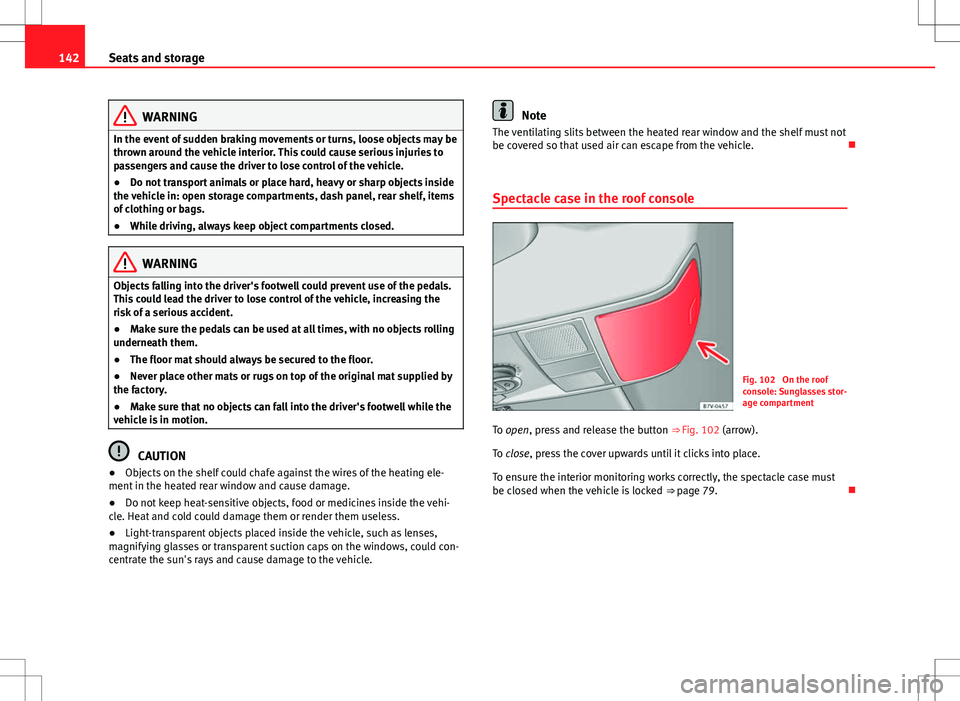
Fig. 102 On the roof
console: Sunglasses stor-
age compartment
To open, press and release the button ⇒ Fig. 102 (arrow).
To close, press the cover upwards until it clicks into place.
To ensure the interior monitoring works correctly, the spectacle case must
be closed when the vehicle is locked ⇒ page 79.
Page 145 of 387
143
Seats and storage
Storage compartment on the roof console
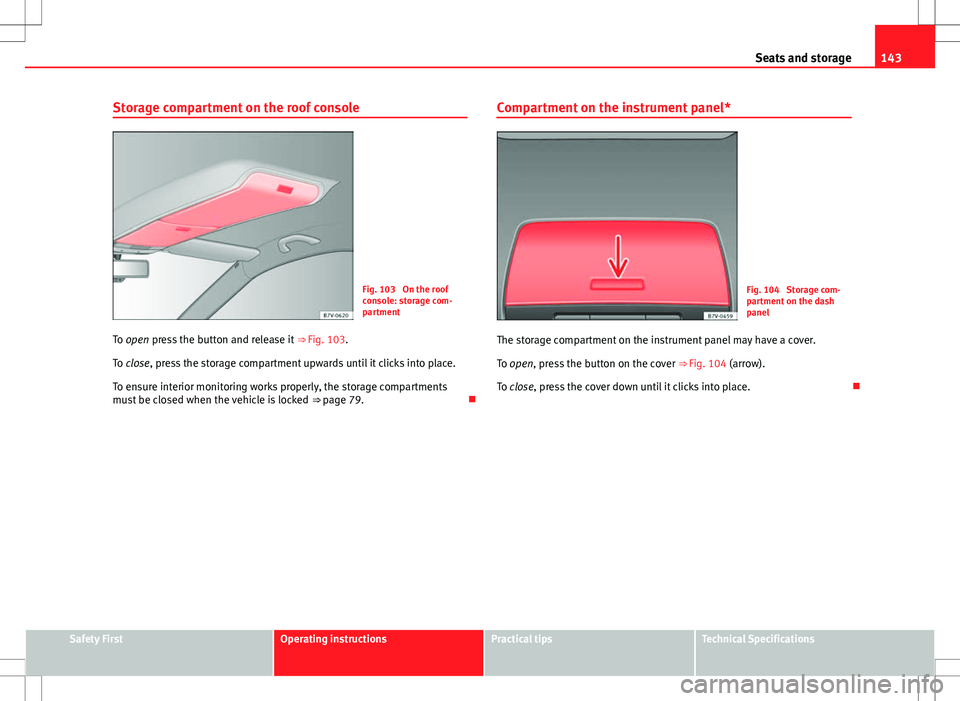
Fig. 103 On the roof
console: storage com-
partment
To open press the button and release it ⇒ Fig. 103.
To close, press the storage compartment upwards until it clicks into place.
To ensure interior monitoring works properly, the storage compartments
must be closed when the vehicle is locked ⇒ page 79.Compartment on the instrument panel*Fig. 104 Storage com-
partment on the dash
panel
The storage compartment on the instrument panel may have a cover.
To open, press the button on the cover ⇒ Fig. 104 (arrow).
To close, press the cover down until it clicks into place.
Safety FirstOperating instructionsPractical tipsTechnical Specifications
Page 146 of 387
144Seats and storage
Compartment on the centre console
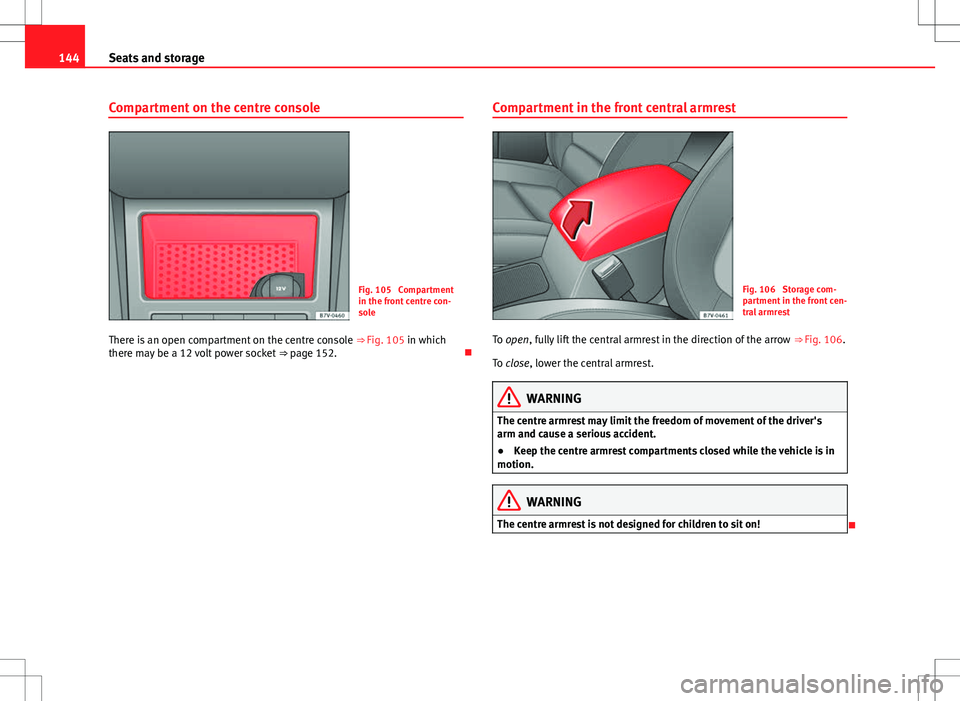
Fig. 105 Compartment
in the front centre con-
sole
There is an open compartment on the centre console ⇒ Fig. 105 in which
there may be a 12 volt power socket ⇒ page 152. Compartment in the front central armrestFig. 106 Storage com-
partment in the front cen-
tral armrest
To open, fully lift the central armrest in the direction of the arrow ⇒ Fig. 106.
To close, lower the central armrest.
WARNING
The centre armrest may limit the freedom of movement of the driver's
arm and cause a serious accident.
● Keep the centre armrest compartments closed while the vehicle is in
motion.
WARNING
The centre armrest is not designed for children to sit on!
Page 149 of 387
147
Seats and storage
WARNING (Continued)
secured when using a child seat with a base or foot then the compart-
ment cover could rupture in an accident and the child will be ejected and
suffer serious injury.
● Please read and observe the child seat manufacturer's handling in-
structions.
Drawers*
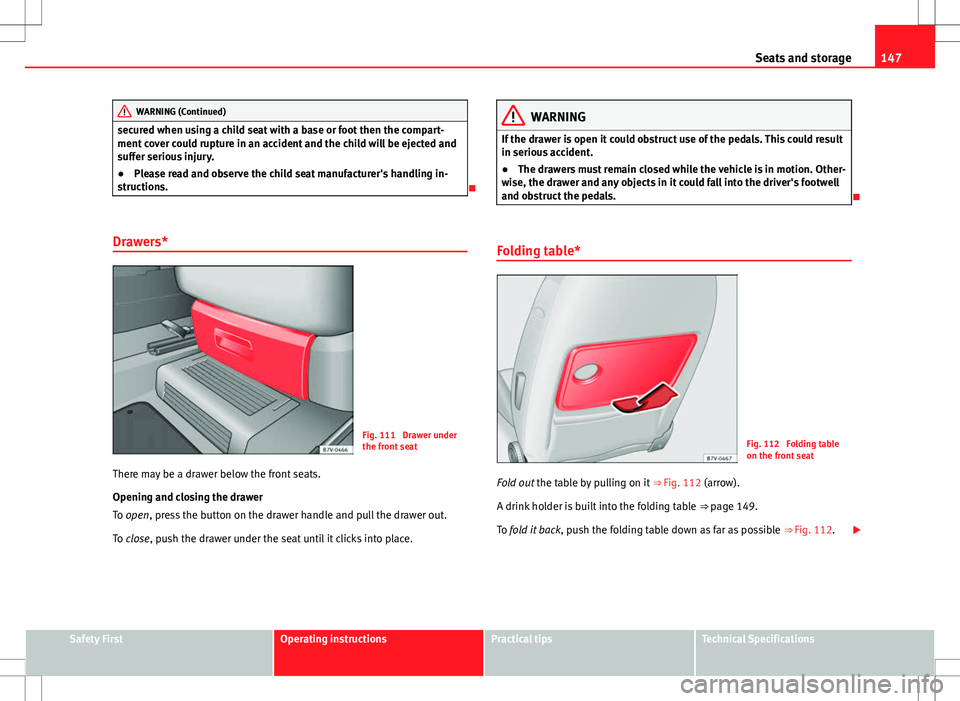
Fig. 111 Drawer under
the front seat
There may be a drawer below the front seats.
Opening and closing the drawer
To open, press the button on the drawer handle and pull the drawer out.
To close, push the drawer under the seat until it clicks into place.
WARNING
If the drawer is open it could obstruct use of the pedals. This could result
in serious accident.
● The drawers must remain closed while the vehicle is in motion. Other-
wise, the drawer and any objects in it could fall into the driver's footwell
and obstruct the pedals.
Folding table*
Fig. 112 Folding table
on the front seat
Fold out the table by pulling on it ⇒ Fig. 112 (arrow).
A drink holder is built into the folding table ⇒ page 149.
To fold it back , push the folding table down as far as possible ⇒ Fig. 112.
Safety FirstOperating instructionsPractical tipsTechnical Specifications
Page 151 of 387
149
Seats and storage
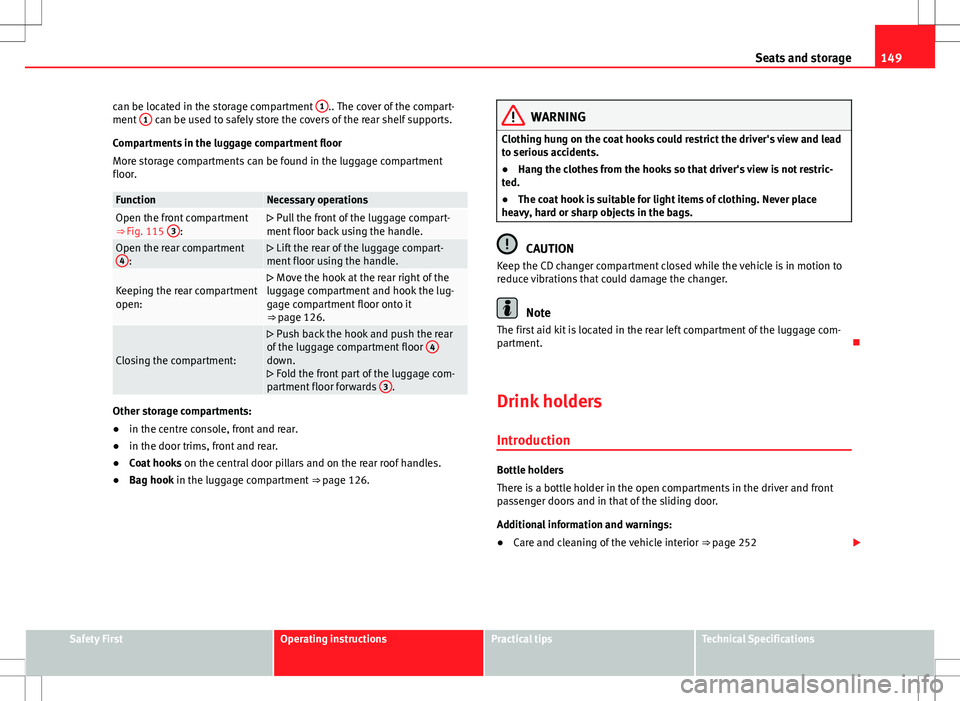
can be located in the storage compartment 1
.. The cover of the compart-
ment 1 can be used to safely store the covers of the rear shelf supports.
Compartments in the luggage compartment floor
More storage compartments can be found in the luggage compartment
floor.
FunctionNecessary operationsOpen the front compartment
⇒ Fig. 115 3:
Pull the front of the luggage compart-
ment floor back using the handle.
Open the rear compartment 4: Lift the rear of the luggage compart-
ment floor using the handle.
Keeping the rear compartment
open: Move the hook at the rear right of the
luggage compartment and hook the lug-
gage compartment floor onto it
⇒ page 126.
Closing the compartment:
Push back the hook and push the rear
of the luggage compartment floor 4
down.
Fold the front part of the luggage com-
partment floor forwards 3
.
Other storage compartments:
●
in the centre console, front and rear.
● in the door trims, front and rear.
● Coat hooks on the central door pillars and on the rear roof handles.
● Bag hook in the luggage compartment ⇒ page 126.
WARNING
Clothing hung on the coat hooks could restrict the driver's view and lead
to serious accidents.
● Hang the clothes from the hooks so that driver's view is not restric-
ted.
● The coat hook is suitable for light items of clothing. Never place
heavy, hard or sharp objects in the bags.
CAUTION
Keep the CD changer compartment closed while the vehicle is in motion to
reduce vibrations that could damage the changer.
Note
The first aid kit is located in the rear left compartment of the luggage com-
partment.
Drink holders Introduction
Bottle holders
There is a bottle holder in the open compartments in the driver and front
passenger doors and in that of the sliding door.
Additional information and warnings:
● Care and cleaning of the vehicle interior ⇒ page 252
Safety FirstOperating instructionsPractical tipsTechnical Specifications
Page 153 of 387
151
Seats and storage
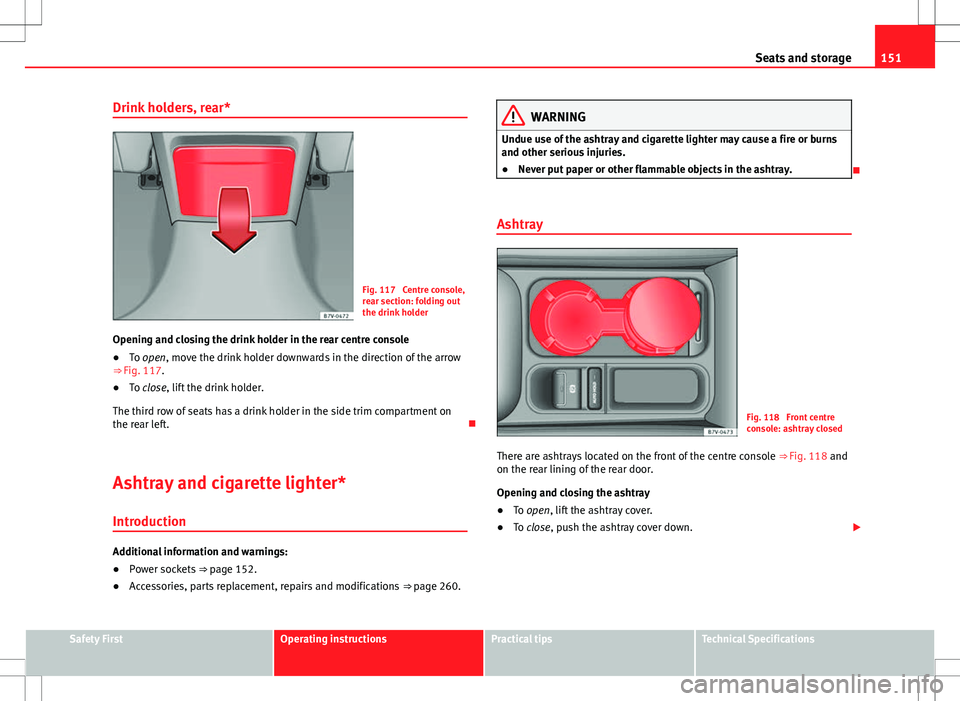
Drink holders, rear*
Fig. 117 Centre console,
rear section: folding out
the drink holder
Opening and closing the drink holder in the rear centre console
● To open, move the drink holder downwards in the direction of the arrow
⇒ Fig. 117.
● To close, lift the drink holder.
The third row of seats has a drink holder in the side trim compartment on
the rear left.
Ashtray and cigarette lighter*
Introduction
Additional information and warnings:
● Power sockets
⇒ page 152.
● Accessories, parts replacement, repairs and modifications
⇒ page 260.
WARNING
Undue use of the ashtray and cigarette lighter may cause a fire or burns
and other serious injuries.
● Never put paper or other flammable objects in the ashtray.
Ashtray
Fig. 118 Front centre
console: ashtray closed
There are ashtrays located on the front of the centre console ⇒ Fig. 118 and
on the rear lining of the rear door.
Opening and closing the ashtray
● To open, lift the ashtray cover.
● To close, push the ashtray cover down.
Safety FirstOperating instructionsPractical tipsTechnical Specifications
Page 154 of 387
152Seats and storage
Emptying the ashtray
● Remove the ashtray from the drink holder or lining of the door by pulling
it upwards.
● After emptying the ashtray, insert it from above into the drink holder or
door lining.
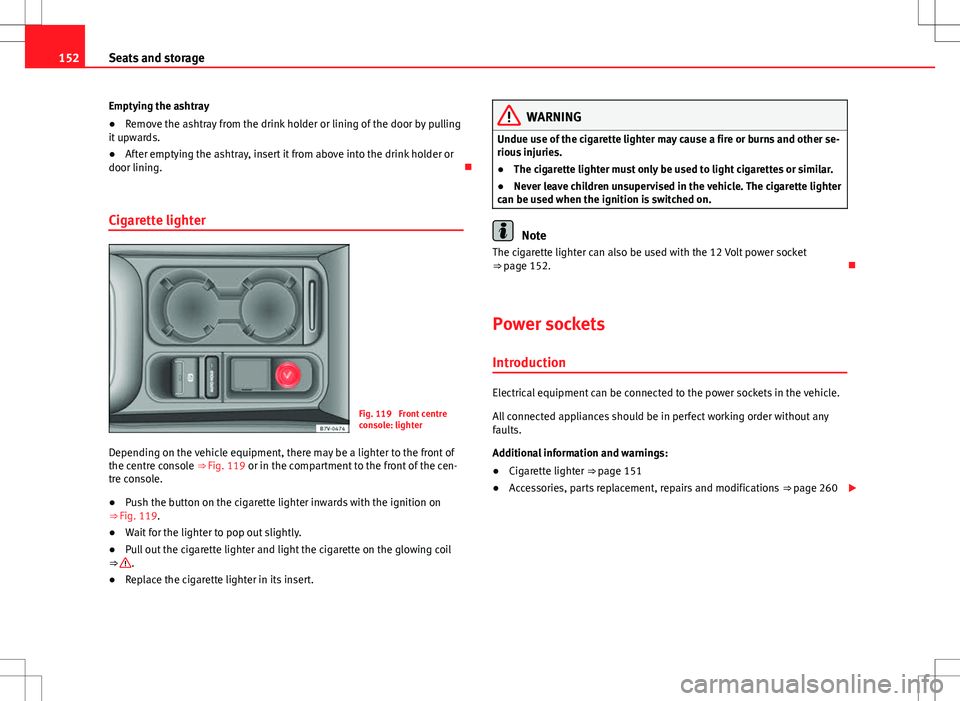
Cigarette lighter
Fig. 119 Front centre
console: lighter
Depending on the vehicle equipment, there may be a lighter to the front of
the centre console ⇒ Fig. 119 or in the compartment to the front of the cen-
tre console.
● Push the button on the cigarette lighter inwards with the ignition on
⇒ Fig. 119.
● Wait for the lighter to pop out slightly.
● Pull out the cigarette lighter and light the cigarette on the glowing coil
⇒
.
● Replace the cigarette lighter in its insert.
WARNING
Undue use of the cigarette lighter may cause a fire or burns and other se-
rious injuries.
● The cigarette lighter must only be used to light cigarettes or similar.
● Never leave children unsupervised in the vehicle. The cigarette lighter
can be used when the ignition is switched on.
Note
The cigarette lighter can also be used with the 12 Volt power socket
⇒ page 152.
Power sockets Introduction
Electrical equipment can be connected to the power sockets in the vehicle.
All connected appliances should be in perfect working order without any
faults.
Additional information and warnings:
● Cigarette lighter
⇒ page 151
● Accessories, parts replacement, repairs and modifications
⇒ page 260