phone Seat Alhambra 2014 User Guide
[x] Cancel search | Manufacturer: SEAT, Model Year: 2014, Model line: Alhambra, Model: Seat Alhambra 2014Pages: 381, PDF Size: 5.75 MB
Page 267 of 381
265
Accessories, replacement of parts and modifications
In vehicles equipped with an emergency call function via the mobile phone
or other appliances connected in the vehicle, it is possible to send the vehi-
cle position. If the control unit records an accident with airbag activation,
the system may automatically send a signal. This will depend on the net-
work operator. Normally, transmission is only possible in areas with good
coverage.
Event Data Recorder
The vehicle is not fitted with an event data recorder.
An event data recorder temporarily stores the vehicle information. There-
fore, in the event of accident, it is possible to obtain detailed information
about how the accident occurred. For example, in vehicles with airbag sys-
tems, data relating to speed of impact, seat belt status, seat positions and
airbag activation times may be stored. The volume of data depends on the
manufacturer.
Event data recorders can only be mounted with authorisation from the vehi-
cle owner and, in some countries, they are governed by local legislation.
Reprogramming control units
On the whole, all the data required for the component management is stor-
ed in the control units. The programming of certain convenience functions,
such as the convenience turn signals, individual door opening and instruc-
tions on the display can be modified using special equipment at the work-
shop. If this is the case, the information and descriptions given in the In-
struction Manual will not match the original functions. Therefore, SEAT rec-
ommends that any modifications are recorded in the section “Other work-
shop notes” in the Maintenance Programme.
The Technical Service must have a record of any modification to the pro-
gramming.
Reading the vehicle fault memory
There is a diagnostics connector in the vehicle interior for reading the vehi-
cle fault memory. The fault memory documents errors and deviations from
the theoretical values of the electronic control units. The diagnostics connector is in the driver side footwell area, next to the lev-
er for opening the bonnet, below a cover.
The fault memory should only be read and reset by a specialised workshop.
Using a mobile telephone in a vehicle without connection
to an exterior aerial
Mobile telephones transmit and receive radio waves, both when in use and
when on stand-by. Scientific studies state that radio waves exceeding cer-
tain values may be harmful to the human body. International committees
and authorities have established limits and directives in order to ensure
electromagnetic radiation from mobile phones remains within certain limits
that do not endanger human health. Nevertheless, there is no conclusive
scientific evidence that wireless telephones are totally safe.
Therefore, some experts recommend that use of mobile phone be kept to a
minimum until the results of current research are published.
When a mobile phone not connected to an exterior aerial is used inside the
vehicle, the electromagnetic radiation may be greater than if the mobile
phone were connected to a built-in aerial or to another exterior aerial.
If the vehicle is fitted with a suitable hands-free device, it will comply with
the legislation in many countries which only permits the use of mobile
phones inside vehicles using a hands-free device.
The hands-free system mounted at the factory has been designed for use
with conventional mobile phones and phones with Bluetooth technology.
Mobile phones should be placed on a suitable phone cradle. In addition,
the cradle should always be correctly fitted into the base plate. This ensures
that the mobile phone is securely attached to the dash panel, it is always
within reach of the driver and is connected to the vehicle exterior aerial.
If the mobile phone is connected to an aerial incorporated into the vehicle
or an exterior aerial connected to the vehicle, this will help to reduce the
Safety FirstOperating instructionsPractical TipsTechnical Specifications
Page 268 of 381

266Accessories, replacement of parts and modifications
electromagnetic radiation transmitted and the risk to human health. It will
also improve the quality of the connection.
If the phone is used inside the vehicle without the hands-free system, it will
not be securely fastened and will not be connected to the exterior aerial of
the vehicle telephone. Nor will the telephone charge if it is not on the sup-
port. In addition, some calls may break off and the quality of the connection
will be affected.
Mobile phones should only be used inside the vehicle if they are connected
to a hands-free system with an exterior aerial.
WARNING
If the mobile phone is not securely fastened in position, it could be sent
flying around the vehicle in the event of sharp braking, sudden manoeu-
vres or accident, causing injury.
● While driving, mobile phones must be securely fastened in position,
outside the radius of action of the airbags, or safely stowed away.
WARNING
When using a mobile phone without a connection to an exterior aerial,
the maximum permitted levels of electromagnetic radiation may be ex-
ceeded. This is also the case if the aerial has not been correctly installed.
● A minimum of 20 centimetres should be kept between mobile phone
aerials and artificial pacemakers, as mobile telephones may affect the
working of pacemakers.
● Do not keep mobile phones in breast pockets directly above pacemak-
ers.
● Switch off the mobile phone immediately if you suspect there may be
interference.
Jacking points for raising vehicle
Fig. 163 Front jacking
points for raising vehicle
with lifting platform or
jack
Fig. 164 Rear jacking
points for raising vehicle
with lifting platform or
jack
Always use the jacking points indicated in the figures ⇒ Fig. 163 and
⇒ Fig. 164 when raising the vehicle. If the vehicle is not lifted at these
points, it could be seriously damaged ⇒
or lead to serious injury ⇒ .
Page 270 of 381
268Checking and refilling levels
Checking and refilling levels
Filling the tank
Introduction
The fuel tank flap is on the rear right of the vehicle.
Additional information and warnings:
● Fuel ⇒ page 271
● Selective Catalytic Reduction (AdBlue) ⇒ page 275
● Working in the engine compartment ⇒ page 279
WARNING
Refuelling or handling fuel carelessly can cause an explosion or fire re-
sulting in serious burns and injuries.
● Always make sure that you correctly close the fuel cap to avoid evap-
oration and fuel spillage.
● Fuels are highly explosive and inflammable substances that can
cause serious burns and injuries.
● Fuel could leak out or be spilt if the engine is not switched off or if the
filler fuel nozzle is not fully inserted into the tank filler neck when refuel-
ling. This could lead to a fire, explosion and severe injuries.
● When refuelling, turn off the engine, the auxiliary heating
(⇒ page 165) and turn off the ignition for safety reasons.
● Always turn off mobile telephones, radio apparatus and other radio
wave emitting equipment before refuelling. Electromagnetic waves could
cause sparks and lead to a fire.
WARNING (Continued)
● Never enter the vehicle while refuelling. If it is absolutely necessary
to enter the vehicle, close the door and touch a metal surface before
touching the filler nozzle again. This will prevent the generation of static
electricity. Sparks could cause a fire when refuelling.
● Never handle fuel close to open flames, sparks or objects with slow
combustion (e.g. cigarettes).
● Avoid static electricity and electro-magnetic radiation when refuel-
ling.
● Observe the safety regulations of the service station.
● Never spill fuel on the vehicle or in the luggage compartment.
WARNING
For safety reasons, SEAT does not recommend carrying a spare fuel canis-
ter in the vehicle. Fuel could be spilled and catch fire, above all in case of
an accident and this applies to a full container as well as empty contain-
ers. This could lead to explosions, fires and injuries.
● Observe the following if you exceptionally have to carry fuel in a can-
ister:
–Never place a fuel container to fill it inside the vehicle or on the ve-
hicle, for example, in the luggage compartment or on the rear lid. Fill-
ing in these circumstances could create an electrostatic charge and
spark that could ignite fuel fumes.
– Always place the canister on the ground to fill it.
– Insert the fuel nozzle into the neck of the canister as far as possi-
ble.
Page 272 of 381
270Checking and refilling levels
WARNING
Driving with insufficient fuel reserve could result in the vehicle breaking
down in traffic and a serious accident.
● If the fuel level is too low then the fuel supply to the engine can be-
come irregular especially on slopes.
● If the engine “is choked” or stalls due to lack of or irregularity of the
fuel supply, the power steering as well as all of the driver assistance sys-
tems including braking assistance will stop working.
● Always refuel when there is only one quarter of the fuel tank left to
avoid running out of fuel.
CAUTION
● Always pay attention to any lit control lamps and to the corresponding
descriptions and instructions to avoid damage to the vehicle.
● Never run the fuel tank completely dry. An irregular fuel supply may lead
to ignition faults and unburnt fuel could enter the exhaust system. This
could damage the catalytic converter filter or the diesel particulate filter!
Note
The arrow next to the fuel pump symbol on the instrument panel ⇒ Fig. 165
indicates the side of the vehicle on which the tank flap is located. Filling the tank with petrol or diesel
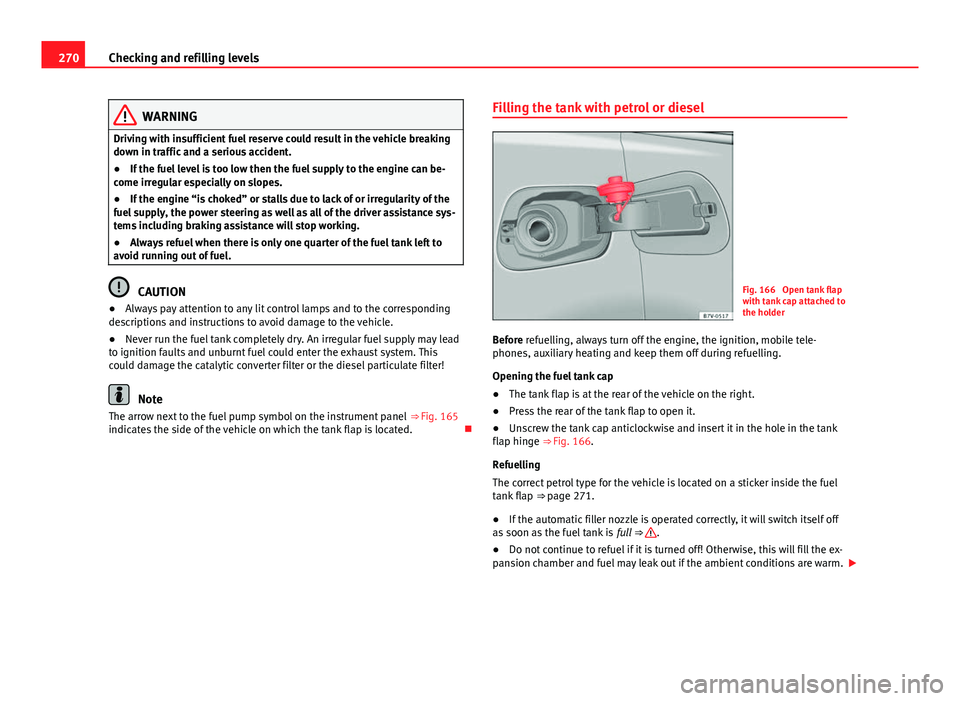
Fig. 166 Open tank flap
with tank cap attached to
the holder
Before refuelling, always turn off the engine, the ignition, mobile tele-
phones, auxiliary heating and keep them off during refuelling.
Opening the fuel tank cap
● The tank flap is at the rear of the vehicle on the right.
● Press the rear of the tank flap to open it.
● Unscrew the tank cap anticlockwise and insert it in the hole in the tank
flap hinge ⇒ Fig. 166.
Refuelling
The correct petrol type for the vehicle is located on a sticker inside the fuel
tank flap ⇒ page 271.
● If the automatic filler nozzle is operated correctly, it will switch itself off
as soon as the fuel tank is full
⇒
.
● Do not continue to refuel if it is turned off! Otherwise, this will fill the ex-
pansion chamber and fuel may leak out if the ambient conditions are warm.
Page 343 of 381
341
If and when
Starting assistance
Introduction
If the engine fails to start because of a discharged battery, the battery of an-
other vehicle can be used to start the engine. Before starting, check the
magic eye on the battery ⇒ page 292.
For starting assistance, jump lead cables conforming to the standard
DIN 72553 are required (see the cable manufacturer instructions). The jump
lead cable must be at least 25 mm 2
in section (0.038 inches 2
) for petrol en-
gines, and 35 mm 2
(0.054 inches 2
) for diesel engines.
For vehicles whose battery is not in the engine compartment, the jump
leads should only be connected to the starting assistance connection
points in the engine compartment.
Additional information and warnings:
● Starter assist systems (Start-Stop function) ⇒ page 196
● Working in the engine compartment ⇒ page 279
● Selective Catalytic Reduction (AdBlue) ⇒ page 275
● Vehicle battery ⇒ page 292
WARNING
Incorrect use of jump leads and incorrectly jump starting could cause the
battery to explode resulting in serious injury. Please observe the follow-
ing rules to minimise the risk of a battery explosion:
● All work involving the vehicle battery and electrical system can cause
corrosion, fire and serious electric shocks. Always read and take into ac-
count the safety warnings and standards before beginning work on the
battery ⇒ page 292, Vehicle battery.
WARNING (Continued)
● The battery providing current must have the same voltage (12V) and
approximately the same capacity (see markings on battery) as the flat
battery.
● Never charge a frozen or recently thawed battery. A flat battery can al-
so freeze at temperatures close to 0 °C (+32 °F).
● If a battery is frozen and/or has been frozen then it must be replaced.
● A highly explosive mixture of gases is released when the battery is
being charged. Always keep lit cigarettes, open flames, sparks and fire
far from the battery. Never use a mobile telephone when connecting and
removing the jump leads.
● Charge the battery only in well ventilated areas given that when the
battery is charged by outside assistance, it creates a mix of highly explo-
sive gases.
● Jump leads should never enter into contact with moving parts in the
engine compartment.
● Never switch the positive and negative poles or connect the jump
leads incorrectly.
● Note the instruction manual provided by the manufacturer of the jump
leads.
CAUTION
To avoid considerable damage to the vehicle electrical system, note the fol-
lowing carefully:
● If the jump leads are incorrectly connected, this could result in a short
circuit.
● The vehicles must not touch each other, otherwise electricity could flow
as soon as the positive terminals are connected.
Safety FirstOperating instructionsPractical TipsTechnical Specifications
Page 371 of 381
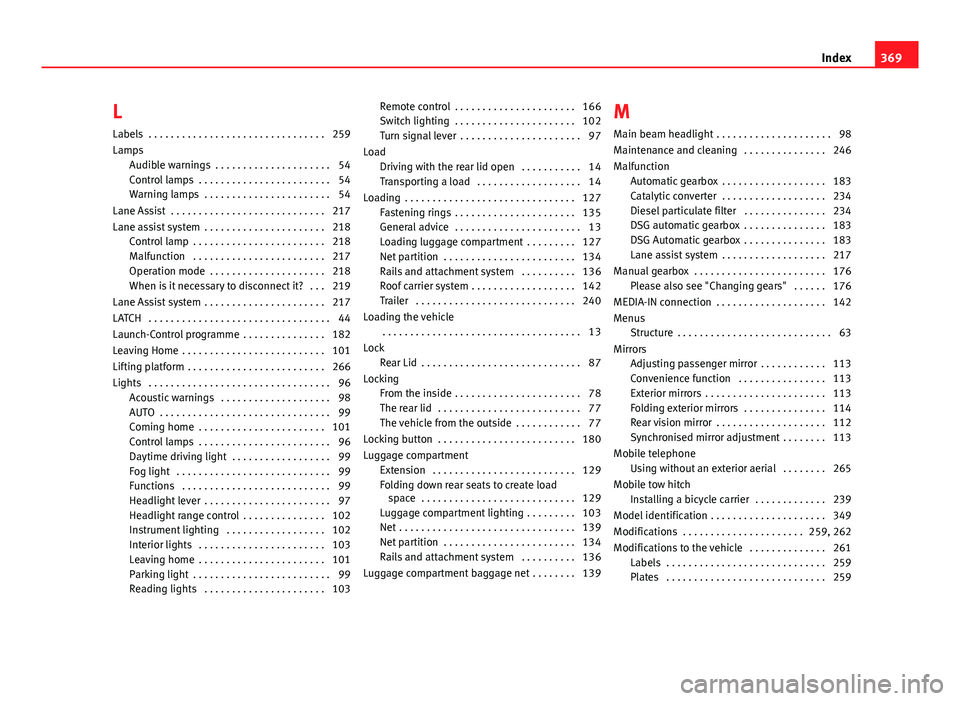
L
Labels . . . . . . . . . . . . . . . . . . . . . . . . . . . . . . . . 259
Lamps Audible warnings . . . . . . . . . . . . . . . . . . . . . 54
Control lamps . . . . . . . . . . . . . . . . . . . . . . . . 54
Warning lamps . . . . . . . . . . . . . . . . . . . . . . . 54
Lane Assist . . . . . . . . . . . . . . . . . . . . . . . . . . . . 217
Lane assist system . . . . . . . . . . . . . . . . . . . . . . 218 Control lamp . . . . . . . . . . . . . . . . . . . . . . . . 218
Malfunction . . . . . . . . . . . . . . . . . . . . . . . . 217
Operation mode . . . . . . . . . . . . . . . . . . . . . 218
When is it necessary to disconnect it? . . . 219
Lane Assist system . . . . . . . . . . . . . . . . . . . . . . 217
LATCH . . . . . . . . . . . . . . . . . . . . . . . . . . . . . . . . . 44
Launch-Control programme . . . . . . . . . . . . . . . 182
Leaving Home . . . . . . . . . . . . . . . . . . . . . . . . . . 101
Lifting platform . . . . . . . . . . . . . . . . . . . . . . . . . 266
Lights . . . . . . . . . . . . . . . . . . . . . . . . . . . . . . . . . 96 Acoustic warnings . . . . . . . . . . . . . . . . . . . . 98
AUTO . . . . . . . . . . . . . . . . . . . . . . . . . . . . . . . 99
Coming home . . . . . . . . . . . . . . . . . . . . . . . 101
Control lamps . . . . . . . . . . . . . . . . . . . . . . . . 96
Daytime driving light . . . . . . . . . . . . . . . . . . 99
Fog light . . . . . . . . . . . . . . . . . . . . . . . . . . . . 99
Functions . . . . . . . . . . . . . . . . . . . . . . . . . . . 99
Headlight lever . . . . . . . . . . . . . . . . . . . . . . . 97
Headlight range control . . . . . . . . . . . . . . . 102
Instrument lighting . . . . . . . . . . . . . . . . . . 102
Interior lights . . . . . . . . . . . . . . . . . . . . . . . 103
Leaving home . . . . . . . . . . . . . . . . . . . . . . . 101
Parking light . . . . . . . . . . . . . . . . . . . . . . . . . 99
Reading lights . . . . . . . . . . . . . . . . . . . . . . 103 Remote control . . . . . . . . . . . . . . . . . . . . . . 166
Switch lighting . . . . . . . . . . . . . . . . . . . . . . 102
Turn signal lever . . . . . . . . . . . . . . . . . . . . . . 97
Load Driving with the rear lid open . . . . . . . . . . . 14
Transporting a load . . . . . . . . . . . . . . . . . . . 14
Loading . . . . . . . . . . . . . . . . . . . . . . . . . . . . . . . 127 Fastening rings . . . . . . . . . . . . . . . . . . . . . . 135
General advice . . . . . . . . . . . . . . . . . . . . . . . 13
Loading luggage compartment . . . . . . . . . 127
Net partition . . . . . . . . . . . . . . . . . . . . . . . . 134
Rails and attachment system . . . . . . . . . . 136
Roof carrier system . . . . . . . . . . . . . . . . . . . 142
Trailer . . . . . . . . . . . . . . . . . . . . . . . . . . . . . 240
Loading the vehicle . . . . . . . . . . . . . . . . . . . . . . . . . . . . . . . . . . . . 13
Lock Rear Lid . . . . . . . . . . . . . . . . . . . . . . . . . . . . . 87
Locking From the inside . . . . . . . . . . . . . . . . . . . . . . . 78
The rear lid . . . . . . . . . . . . . . . . . . . . . . . . . . 77
The vehicle from the outside . . . . . . . . . . . . 77
Locking button . . . . . . . . . . . . . . . . . . . . . . . . . 180
Luggage compartment Extension . . . . . . . . . . . . . . . . . . . . . . . . . . 129
Folding down rear seats to create loadspace . . . . . . . . . . . . . . . . . . . . . . . . . . . . 129
Luggage compartment lighting . . . . . . . . . 103
Net . . . . . . . . . . . . . . . . . . . . . . . . . . . . . . . . 139
Net partition . . . . . . . . . . . . . . . . . . . . . . . . 134
Rails and attachment system . . . . . . . . . . 136
Luggage compartment baggage net . . . . . . . . 139 M
Main beam headlight . . . . . . . . . . . . . . . . . . . . . 98
Maintenance and cleaning . . . . . . . . . . . . . . . 246
Malfunction Automatic gearbox . . . . . . . . . . . . . . . . . . . 183
Catalytic converter . . . . . . . . . . . . . . . . . . . 234
Diesel particulate filter . . . . . . . . . . . . . . . 234
DSG automatic gearbox . . . . . . . . . . . . . . . 183
DSG Automatic gearbox . . . . . . . . . . . . . . . 183
Lane assist system . . . . . . . . . . . . . . . . . . . 217
Manual gearbox . . . . . . . . . . . . . . . . . . . . . . . . 176 Please also see "Changing gears" . . . . . . 176
MEDIA-IN connection . . . . . . . . . . . . . . . . . . . . 142
Menus Structure . . . . . . . . . . . . . . . . . . . . . . . . . . . . 63
Mirrors Adjusting passenger mirror . . . . . . . . . . . . 113
Convenience function . . . . . . . . . . . . . . . . 113
Exterior mirrors . . . . . . . . . . . . . . . . . . . . . . 113
Folding exterior mirrors . . . . . . . . . . . . . . . 114
Rear vision mirror . . . . . . . . . . . . . . . . . . . . 112
Synchronised mirror adjustment . . . . . . . . 113
Mobile telephone Using without an exterior aerial . . . . . . . . 265
Mobile tow hitch Installing a bicycle carrier . . . . . . . . . . . . . 239
Model identification . . . . . . . . . . . . . . . . . . . . . 349
Modifications . . . . . . . . . . . . . . . . . . . . . . 259, 262
Modifications to the vehicle . . . . . . . . . . . . . . 261 Labels . . . . . . . . . . . . . . . . . . . . . . . . . . . . . 259
Plates . . . . . . . . . . . . . . . . . . . . . . . . . . . . . 259
369
Index
Page 373 of 381
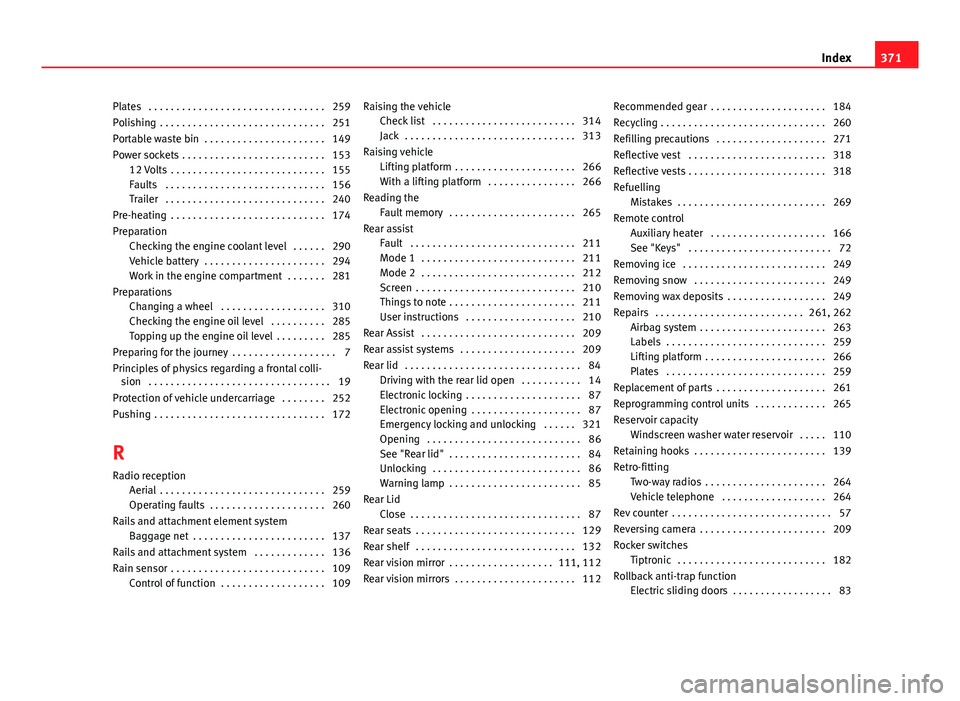
Plates . . . . . . . . . . . . . . . . . . . . . . . . . . . . . . . . 259
Polishing . . . . . . . . . . . . . . . . . . . . . . . . . . . . . . 251
Portable waste bin . . . . . . . . . . . . . . . . . . . . . . 149
Power sockets . . . . . . . . . . . . . . . . . . . . . . . . . . 15312 Volts . . . . . . . . . . . . . . . . . . . . . . . . . . . . 155
Faults . . . . . . . . . . . . . . . . . . . . . . . . . . . . . 156
Trailer . . . . . . . . . . . . . . . . . . . . . . . . . . . . . 240
Pre-heating . . . . . . . . . . . . . . . . . . . . . . . . . . . . 174
Preparation Checking the engine coolant level . . . . . . 290
Vehicle battery . . . . . . . . . . . . . . . . . . . . . . 294
Work in the engine compartment . . . . . . . 281
Preparations Changing a wheel . . . . . . . . . . . . . . . . . . . 310
Checking the engine oil level . . . . . . . . . . 285
Topping up the engine oil level . . . . . . . . . 285
Preparing for the journey . . . . . . . . . . . . . . . . . . . 7
Principles of physics regarding a frontal colli- sion . . . . . . . . . . . . . . . . . . . . . . . . . . . . . . . . . 19
Protection of vehicle undercarriage . . . . . . . . 252
Pushing . . . . . . . . . . . . . . . . . . . . . . . . . . . . . . . 172
R Radio reception Aerial . . . . . . . . . . . . . . . . . . . . . . . . . . . . . . 259
Operating faults . . . . . . . . . . . . . . . . . . . . . 260
Rails and attachment element system Baggage net . . . . . . . . . . . . . . . . . . . . . . . . 137
Rails and attachment system . . . . . . . . . . . . . 136
Rain sensor . . . . . . . . . . . . . . . . . . . . . . . . . . . . 109 Control of function . . . . . . . . . . . . . . . . . . . 109 Raising the vehicle
Check list . . . . . . . . . . . . . . . . . . . . . . . . . . 314
Jack . . . . . . . . . . . . . . . . . . . . . . . . . . . . . . . 313
Raising vehicle Lifting platform . . . . . . . . . . . . . . . . . . . . . . 266
With a lifting platform . . . . . . . . . . . . . . . . 266
Reading the Fault memory . . . . . . . . . . . . . . . . . . . . . . . 265
Rear assist Fault . . . . . . . . . . . . . . . . . . . . . . . . . . . . . . 211
Mode 1 . . . . . . . . . . . . . . . . . . . . . . . . . . . . 211
Mode 2 . . . . . . . . . . . . . . . . . . . . . . . . . . . . 212
Screen . . . . . . . . . . . . . . . . . . . . . . . . . . . . . 210
Things to note . . . . . . . . . . . . . . . . . . . . . . . 211
User instructions . . . . . . . . . . . . . . . . . . . . 210
Rear Assist . . . . . . . . . . . . . . . . . . . . . . . . . . . . 209
Rear assist systems . . . . . . . . . . . . . . . . . . . . . 209
Rear lid . . . . . . . . . . . . . . . . . . . . . . . . . . . . . . . . 84 Driving with the rear lid open . . . . . . . . . . . 14
Electronic locking . . . . . . . . . . . . . . . . . . . . . 87
Electronic opening . . . . . . . . . . . . . . . . . . . . 87
Emergency locking and unlocking . . . . . . 321
Opening . . . . . . . . . . . . . . . . . . . . . . . . . . . . 86
See "Rear lid" . . . . . . . . . . . . . . . . . . . . . . . . 84
Unlocking . . . . . . . . . . . . . . . . . . . . . . . . . . . 86
Warning lamp . . . . . . . . . . . . . . . . . . . . . . . . 85
Rear Lid Close . . . . . . . . . . . . . . . . . . . . . . . . . . . . . . . 87
Rear seats . . . . . . . . . . . . . . . . . . . . . . . . . . . . . 129
Rear shelf . . . . . . . . . . . . . . . . . . . . . . . . . . . . . 132
Rear vision mirror . . . . . . . . . . . . . . . . . . . 111, 112
Rear vision mirrors . . . . . . . . . . . . . . . . . . . . . . 112 Recommended gear . . . . . . . . . . . . . . . . . . . . . 184
Recycling . . . . . . . . . . . . . . . . . . . . . . . . . . . . . . 260
Refilling precautions . . . . . . . . . . . . . . . . . . . . 271
Reflective vest . . . . . . . . . . . . . . . . . . . . . . . . . 318
Reflective vests . . . . . . . . . . . . . . . . . . . . . . . . . 318
Refuelling
Mistakes . . . . . . . . . . . . . . . . . . . . . . . . . . . 269
Remote control Auxiliary heater . . . . . . . . . . . . . . . . . . . . . 166
See "Keys" . . . . . . . . . . . . . . . . . . . . . . . . . . 72
Removing ice . . . . . . . . . . . . . . . . . . . . . . . . . . 249
Removing snow . . . . . . . . . . . . . . . . . . . . . . . . 249
Removing wax deposits . . . . . . . . . . . . . . . . . . 249
Repairs . . . . . . . . . . . . . . . . . . . . . . . . . . . 261, 262 Airbag system . . . . . . . . . . . . . . . . . . . . . . . 263
Labels . . . . . . . . . . . . . . . . . . . . . . . . . . . . . 259
Lifting platform . . . . . . . . . . . . . . . . . . . . . . 266
Plates . . . . . . . . . . . . . . . . . . . . . . . . . . . . . 259
Replacement of parts . . . . . . . . . . . . . . . . . . . . 261
Reprogramming control units . . . . . . . . . . . . . 265
Reservoir capacity Windscreen washer water reservoir . . . . . 110
Retaining hooks . . . . . . . . . . . . . . . . . . . . . . . . 139
Retro-fitting Two-way radios . . . . . . . . . . . . . . . . . . . . . . 264
Vehicle telephone . . . . . . . . . . . . . . . . . . . 264
Rev counter . . . . . . . . . . . . . . . . . . . . . . . . . . . . . 57
Reversing camera . . . . . . . . . . . . . . . . . . . . . . . 209
Rocker switches Tiptronic . . . . . . . . . . . . . . . . . . . . . . . . . . . 182
Rollback anti-trap function Electric sliding doors . . . . . . . . . . . . . . . . . . 83
371
Index
Page 378 of 381
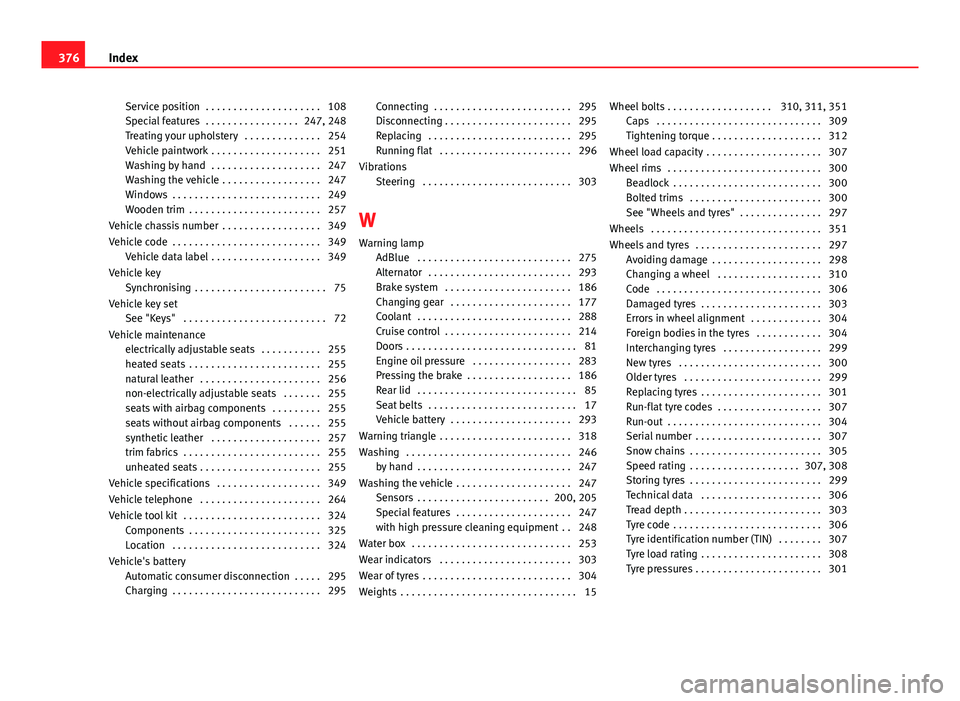
Service position . . . . . . . . . . . . . . . . . . . . . 108
Special features . . . . . . . . . . . . . . . . . 247, 248
Treating your upholstery . . . . . . . . . . . . . . 254
Vehicle paintwork . . . . . . . . . . . . . . . . . . . . 251
Washing by hand . . . . . . . . . . . . . . . . . . . . 247
Washing the vehicle . . . . . . . . . . . . . . . . . . 247
Windows . . . . . . . . . . . . . . . . . . . . . . . . . . . 249
Wooden trim . . . . . . . . . . . . . . . . . . . . . . . . 257
Vehicle chassis number . . . . . . . . . . . . . . . . . . 349
Vehicle code . . . . . . . . . . . . . . . . . . . . . . . . . . . 349 Vehicle data label . . . . . . . . . . . . . . . . . . . . 349
Vehicle key Synchronising . . . . . . . . . . . . . . . . . . . . . . . . 75
Vehicle key set See "Keys" . . . . . . . . . . . . . . . . . . . . . . . . . . 72
Vehicle maintenance electrically adjustable seats . . . . . . . . . . . 255
heated seats . . . . . . . . . . . . . . . . . . . . . . . . 255
natural leather . . . . . . . . . . . . . . . . . . . . . . 256
non-electrically adjustable seats . . . . . . . 255
seats with airbag components . . . . . . . . . 255
seats without airbag components . . . . . . 255
synthetic leather . . . . . . . . . . . . . . . . . . . . 257
trim fabrics . . . . . . . . . . . . . . . . . . . . . . . . . 255
unheated seats . . . . . . . . . . . . . . . . . . . . . . 255
Vehicle specifications . . . . . . . . . . . . . . . . . . . 349
Vehicle telephone . . . . . . . . . . . . . . . . . . . . . . 264
Vehicle tool kit . . . . . . . . . . . . . . . . . . . . . . . . . 324 Components . . . . . . . . . . . . . . . . . . . . . . . . 325
Location . . . . . . . . . . . . . . . . . . . . . . . . . . . 324
Vehicle's battery Automatic consumer disconnection . . . . . 295
Charging . . . . . . . . . . . . . . . . . . . . . . . . . . . 295 Connecting . . . . . . . . . . . . . . . . . . . . . . . . . 295
Disconnecting . . . . . . . . . . . . . . . . . . . . . . . 295
Replacing . . . . . . . . . . . . . . . . . . . . . . . . . . 295
Running flat . . . . . . . . . . . . . . . . . . . . . . . . 296
Vibrations Steering . . . . . . . . . . . . . . . . . . . . . . . . . . . 303
W Warning lamp AdBlue . . . . . . . . . . . . . . . . . . . . . . . . . . . . 275
Alternator . . . . . . . . . . . . . . . . . . . . . . . . . . 293
Brake system . . . . . . . . . . . . . . . . . . . . . . . 186
Changing gear . . . . . . . . . . . . . . . . . . . . . . 177
Coolant . . . . . . . . . . . . . . . . . . . . . . . . . . . . 288
Cruise control . . . . . . . . . . . . . . . . . . . . . . . 214
Doors . . . . . . . . . . . . . . . . . . . . . . . . . . . . . . . 81
Engine oil pressure . . . . . . . . . . . . . . . . . . 283
Pressing the brake . . . . . . . . . . . . . . . . . . . 186
Rear lid . . . . . . . . . . . . . . . . . . . . . . . . . . . . . 85
Seat belts . . . . . . . . . . . . . . . . . . . . . . . . . . . 17
Vehicle battery . . . . . . . . . . . . . . . . . . . . . . 293
Warning triangle . . . . . . . . . . . . . . . . . . . . . . . . 318
Washing . . . . . . . . . . . . . . . . . . . . . . . . . . . . . . 246 by hand . . . . . . . . . . . . . . . . . . . . . . . . . . . . 247
Washing the vehicle . . . . . . . . . . . . . . . . . . . . . 247 Sensors . . . . . . . . . . . . . . . . . . . . . . . . 200, 205
Special features . . . . . . . . . . . . . . . . . . . . . 247
with high pressure cleaning equipment . . 248
Water box . . . . . . . . . . . . . . . . . . . . . . . . . . . . . 253
Wear indicators . . . . . . . . . . . . . . . . . . . . . . . . 303
Wear of tyres . . . . . . . . . . . . . . . . . . . . . . . . . . . 304
Weights . . . . . . . . . . . . . . . . . . . . . . . . . . . . . . . . 15 Wheel bolts . . . . . . . . . . . . . . . . . . . 310, 311, 351
Caps . . . . . . . . . . . . . . . . . . . . . . . . . . . . . . 309
Tightening torque . . . . . . . . . . . . . . . . . . . . 312
Wheel load capacity . . . . . . . . . . . . . . . . . . . . . 307
Wheel rims . . . . . . . . . . . . . . . . . . . . . . . . . . . . 300 Beadlock . . . . . . . . . . . . . . . . . . . . . . . . . . . 300
Bolted trims . . . . . . . . . . . . . . . . . . . . . . . . 300
See "Wheels and tyres" . . . . . . . . . . . . . . . 297
Wheels . . . . . . . . . . . . . . . . . . . . . . . . . . . . . . . 351
Wheels and tyres . . . . . . . . . . . . . . . . . . . . . . . 297 Avoiding damage . . . . . . . . . . . . . . . . . . . . 298
Changing a wheel . . . . . . . . . . . . . . . . . . . 310
Code . . . . . . . . . . . . . . . . . . . . . . . . . . . . . . 306
Damaged tyres . . . . . . . . . . . . . . . . . . . . . . 303
Errors in wheel alignment . . . . . . . . . . . . . 304
Foreign bodies in the tyres . . . . . . . . . . . . 304
Interchanging tyres . . . . . . . . . . . . . . . . . . 299
New tyres . . . . . . . . . . . . . . . . . . . . . . . . . . 300
Older tyres . . . . . . . . . . . . . . . . . . . . . . . . . 299
Replacing tyres . . . . . . . . . . . . . . . . . . . . . . 301
Run-flat tyre codes . . . . . . . . . . . . . . . . . . . 307
Run-out . . . . . . . . . . . . . . . . . . . . . . . . . . . . 304
Serial number . . . . . . . . . . . . . . . . . . . . . . . 307
Snow chains . . . . . . . . . . . . . . . . . . . . . . . . 305
Speed rating . . . . . . . . . . . . . . . . . . . . 307, 308
Storing tyres . . . . . . . . . . . . . . . . . . . . . . . . 299
Technical data . . . . . . . . . . . . . . . . . . . . . . 306
Tread depth . . . . . . . . . . . . . . . . . . . . . . . . . 303
Tyre code . . . . . . . . . . . . . . . . . . . . . . . . . . . 306
Tyre identification number (TIN) . . . . . . . . 307
Tyre load rating . . . . . . . . . . . . . . . . . . . . . . 308
Tyre pressures . . . . . . . . . . . . . . . . . . . . . . . 301
376 Index