roof Seat Alhambra 2014 Owner's Guide
[x] Cancel search | Manufacturer: SEAT, Model Year: 2014, Model line: Alhambra, Model: Seat Alhambra 2014Pages: 381, PDF Size: 5.75 MB
Page 261 of 381
259
Vehicle maintenance and cleaning
Notes for the user Labels and plates
Some parts in the engine compartment come from the factory with certifi-
cates of safety, labels or plates containing important information regarding
the operation of the vehicle, for example, on the petrol cap, on the passeng-
er's sun visor, on the driver door strut, or on the floor of the luggage com-
partment.
● Never remove these certificates of safety, labels or plates, and ensure
they are kept in good condition and are legible.
● If a vehicle part, bearing a certificate of safety, label or plate, is re-
placed, the specialised workshop should attach the information back in the
same place.
Certificate of safety
A certificate of safety on the door strut states that all the safety standards
and regulations established by the national traffic authorities responsible
for road safety were met at the time of manufacture. It may also give the
month and year of manufacture, together with the chassis number.
Warning of high voltage label*
There is a label close to the bonnet lock which warns of high voltage in the
vehicle electrical installation. The vehicle ignition system complies with sev-
eral standards, including the Canadian standard, ICES-002.
Using your vehicle in other countries and continents
The vehicle is manufactured at the factory for use in a particular country in
accordance with the national legislation in force at the time of manufacture. If the vehicle is sold in another country or used in another country for an ex-
tended period of time, the applicable legislation of that country should be
observed.
It may be necessary to fit or remove certain pieces of equipment or to deac-
tivate certain functions. Service work may also be affected. This is particu-
larly true if the vehicle is used in a different climate for an extended period
of time.
As there are different types of frequency bands around the world, you may
find that the radio or navigation system supplied at the factory does not
work in another country.
CAUTION
● SEAT does not accept liability for any damage to the vehicle due to the
use of a lower quality fuel, an inadequate service or the non-availability of
genuine spare parts.
● SEAT does not accept liability if the vehicle does not comply in part or in
full with the legal requirements of other countries or continents.
Radio reception and the aerial
The aerial of radio and navigation systems fitted at the factory may be
mounted in different parts of the vehicle:
● On the inside of the rear window, next to the rear window heating,
● on the inside of the rear side windows,
● on the inside of the windscreen,
● on the roof of the vehicle.
Aerials mounted on the inside of a window can be recognised by the fine
wires.
Safety FirstOperating instructionsPractical TipsTechnical Specifications
Page 265 of 381
263
Accessories, replacement of parts and modifications
The vehicle owner should keep the documentation for the additional equip-
ment safely and hand it over to the scrap yard at the end of the vehicle's
service life. This ensures that any additional equipment mounted in end-of-
life vehicles is correctly disposed of with respect for the environment.
WARNING
Repairs or modifications which are not performed correctly may result in
damage or errors in the vehicle operation, affecting the effectiveness of
the driver assist systems. This could result in serious accident.
● All repairs and modifications to the vehicle should only be performed
by a specialised workshop.
Repair and faults in the airbag system
When performing repairs and technical modifications, SEAT's directives
must be observed! ⇒
Modifications and repairs to the front bumper, doors, front seats, and re-
pairs to the roof or chassis should only be carried out in a specialised work-
shop. These components may contain parts or sensors belonging to the air-
bag system.
If work is carried out on the airbag system or parts have to be removed and
fitted on the system when performing other repair work, parts of the airbag
system may be damaged. The consequence may be that, in the event of an
accident, the airbag inflates incorrectly or does not inflate at all.
So that the effectiveness of the airbag is not reduced and that removed
parts do not cause any injuries or environmental pollution, regulations must
be observed. These requirements are known to specialised workshops.
Modifications to the vehicle suspension may affect the operation of the air-
bag system in the event of collision. For example, if wheel and tyre combi-
nations not approved by SEAT are used, or if the vehicle height is lowered, the suspension is stiffened or the suspension springs, telescopic arms,
dampers, etc., are modified, the results received by the airbag sensors and
sent to the control unit may not be accurate. For example, some modifica-
tions to the suspension could increase the force measured by the sensors
and result in the triggering of the airbag systems in collisions. Under normal
conditions, the measured values would be lower and the airbag would not
have been triggered. Other modifications may reduce the forces measured
by the sensors and therefore the airbags are not triggered in situations
when they should have triggered.
WARNING
Repairs or modifications which are not performed correctly may result in
damage or errors in the vehicle operation, affecting the effectiveness of
the airbag systems. This could result in serious or fatal accident.
● All repairs and modifications to the vehicle should only be performed
by a specialised workshop.
● Airbag modules must never be repaired: if damaged, they must be re-
placed.
● Never fit recycled or reused airbag components in your vehicle.
WARNING
Modifications to the vehicle suspension, including the use of unauthor-
ised wheel and tyre combinations, may affect the performance of the air-
bags and increase the risk of serious or fatal injury in the event of acci-
dent.
● Never fit suspension components which are not identical to the origi-
nal parts mounted in the vehicle.
● Never use wheel and tyre combinations not approved by SEAT.
Safety FirstOperating instructionsPractical TipsTechnical Specifications
Page 320 of 381

318If and when
First aid kit, warning triangle, reflective vests and fire
extinguishers*
Fig. 190 On the rear lid:
Warning triangle bracket
Reflective vests
Some vehicles will have a driver door compartment to store a reflective vest
⇒ page 53.
Warning triangle
With the rear lid open, rotate the lock 90° ⇒ Fig. 190. Lower the bracket and
remove the warning triangle.
First-aid kit
There is a first aid kit
⇒ page 142 in the rear left-hand side storage com-
partment of the luggage compartment.
The first aid kit must comply with legal requirements. Check the expiry date
of the contents of the first aid kit.
Fire extinguisher
There is a Fire extinguisher underneath the front passenger seat. The fire extinguisher must conform to legal requirements, be ready for use
and be checked regularly. Check the certification seal on the extinguisher.
WARNING
Loose objects in the vehicle interior can be violently thrown in case of a
sudden manoeuvre or braking and especially in accidents causing seri-
ous injury.
● Secure fire extinguishers, first aid kit, reflective vests and warning
triangle securely to their respective supports.
Emergency locking and unlocking Introduction
The doors, rear lid and panoramic sliding sunroof can be locked manually
and partially opened, for example if the key or the central locking is dam-
aged.
Additional information and warnings:
● Vehicle key set ⇒ page 72
● Central locking and locking system ⇒ page 75
● Doors ⇒ page 81
● Rear lid ⇒ page 84
● Panoramic sliding sunroof ⇒ page 93
● In case of emergency ⇒ page 316
Page 321 of 381
319
If and when
WARNING
Opening and closing doors carelessly can cause serious injury.
● If the vehicle is locked from outside, the doors and windows cannot
be opened from the inside.
● Never leave children or disabled people alone in the car. They could
be trapped in the car in an emergency and will not be able to get them-
selves to safety.
● Depending on the time of the year, temperatures inside a locked and
closed vehicle can be extremely high or extremely low resulting in seri-
ous injuries and illness or even death, particularly for young children.
WARNING
Getting in the way of the doors and the panoramic sliding sunroof is dan-
gerous and can lead to serious injury.
● Open and close the doors and the panoramic sliding sunroof only
when nobody is in the way.
CAUTION
When opening and closing in an emergency, carefully disassemble compo-
nents and then reassemble them carefully to avoid damage to the vehicle. Manually locking and unlocking the driver door
Fig. 191 Driver door
handle: Hidden lock cyl-
inder
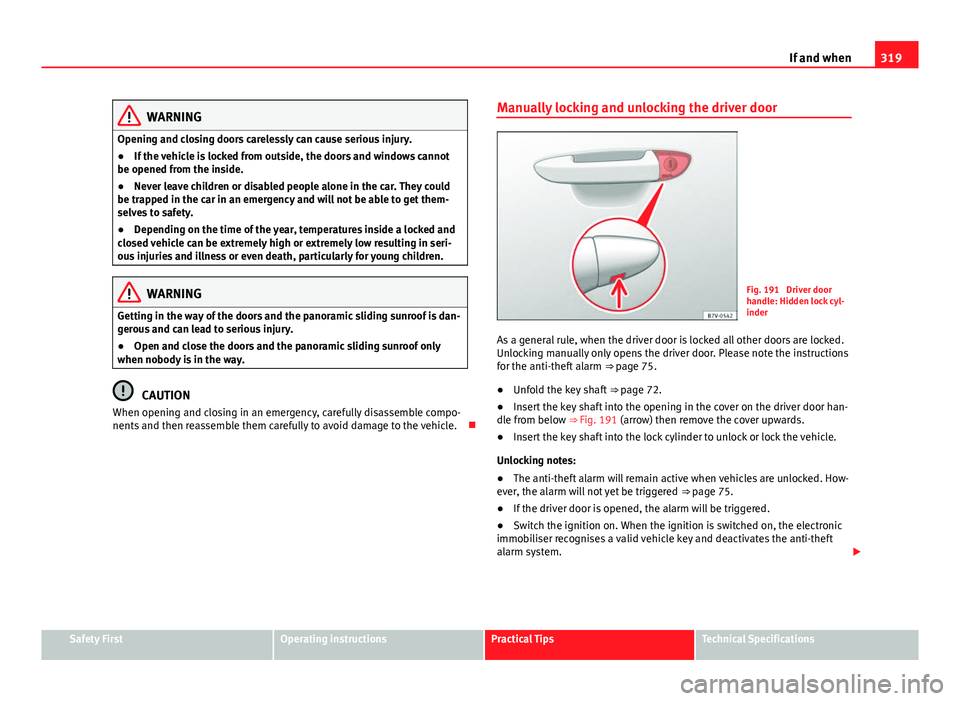
As a general rule, when the driver door is locked all other doors are locked.
Unlocking manually only opens the driver door. Please note the instructions
for the anti-theft alarm ⇒ page 75.
● Unfold the key shaft
⇒ page 72.
● Insert the key shaft into the opening in the cover on the driver door han-
dle from below ⇒ Fig. 191 (arrow) then remove the cover upwards.
● Insert the key shaft into the lock cylinder to unlock or lock the vehicle.
Unlocking notes:
● The anti-theft alarm will remain active when vehicles are unlocked. How-
ever, the alarm will not yet be triggered ⇒ page 75.
● If the driver door is opened, the alarm will be triggered.
● Switch the ignition on. When the ignition is switched on, the electronic
immobiliser recognises a valid vehicle key and deactivates the anti-theft
alarm system.
Safety FirstOperating instructionsPractical TipsTechnical Specifications
Page 324 of 381
322If and when
Manually closing the panoramic sliding sunroof
Fig. 196 On the interior
roof lining: Remove cover
Fig. 197 Allen bolt to
close the panoramic slid-
ing sunroof
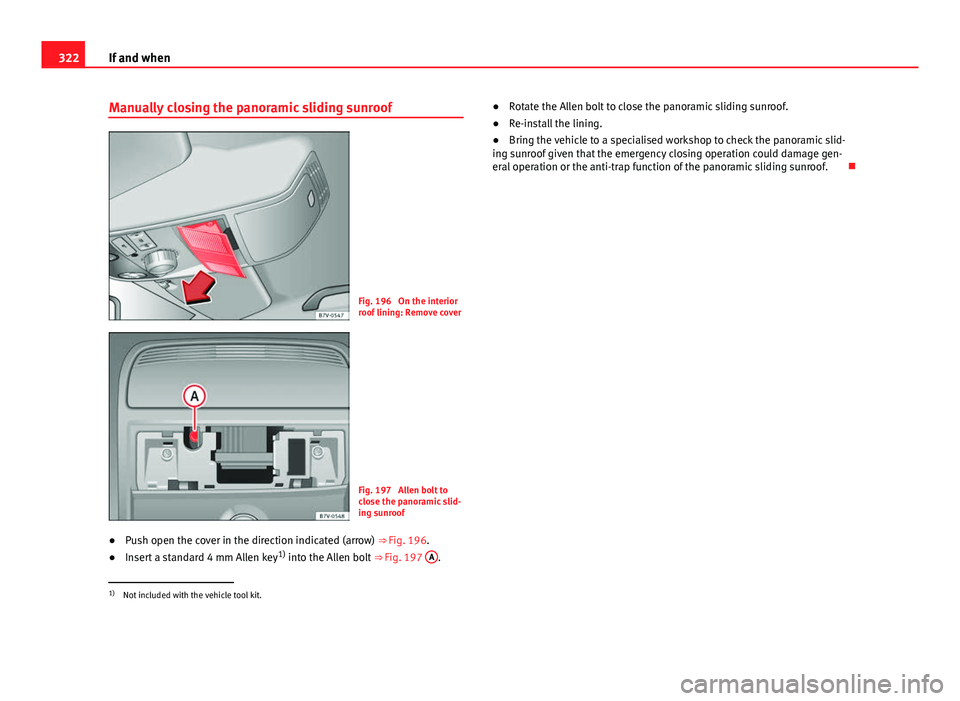
● Push open the cover in the direction indicated (arrow) ⇒ Fig. 196.
● Insert a standard 4 mm Allen key 1)
into the Allen bolt ⇒ Fig. 197 A
. ●
Rotate the Allen bolt to close the panoramic sliding sunroof.
● Re-install the lining.
● Bring the vehicle to a specialised workshop to check the panoramic slid-
ing sunroof given that the emergency closing operation could damage gen-
eral operation or the anti-trap function of the panoramic sliding sunroof.
1)
Not included with the vehicle tool kit.
Page 355 of 381
353
Technical specifications
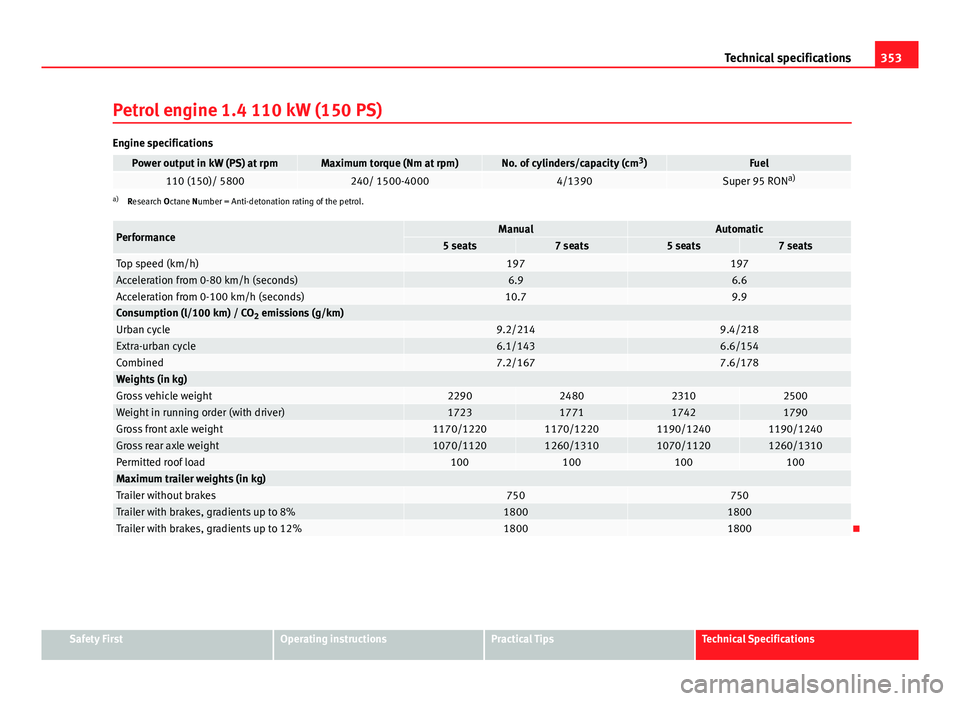
Petrol engine 1.4 110 kW (150 PS)
Engine specifications
Power output in kW (PS) at rpmMaximum torque (Nm at rpm)No. of cylinders/capacity (cm 3
)Fuel110 (150)/ 5800240/ 1500-40004/1390Super 95 RON a)a)
Research Octane Number = Anti-detonation rating of the petrol.
PerformanceManualAutomatic5 seats7 seats5 seats7 seatsTop speed (km/h)197197Acceleration from 0-80 km/h (seconds)6.96.6Acceleration from 0-100 km/h (seconds)10.79.9Consumption (l/100 km) / CO 2 emissions (g/km)Urban cycle9.2/2149.4/218Extra-urban cycle6.1/1436.6/154Combined7.2/1677.6/178Weights (in kg)Gross vehicle weight2290248023102500Weight in running order (with driver)1723177117421790Gross front axle weight1170/12201170/12201190/12401190/1240Gross rear axle weight1070/11201260/13101070/11201260/1310Permitted roof load100100100100Maximum trailer weights (in kg)Trailer without brakes750750Trailer with brakes, gradients up to 8%18001800Trailer with brakes, gradients up to 12%18001800
Safety FirstOperating instructionsPractical TipsTechnical Specifications
Page 356 of 381
354Technical specifications
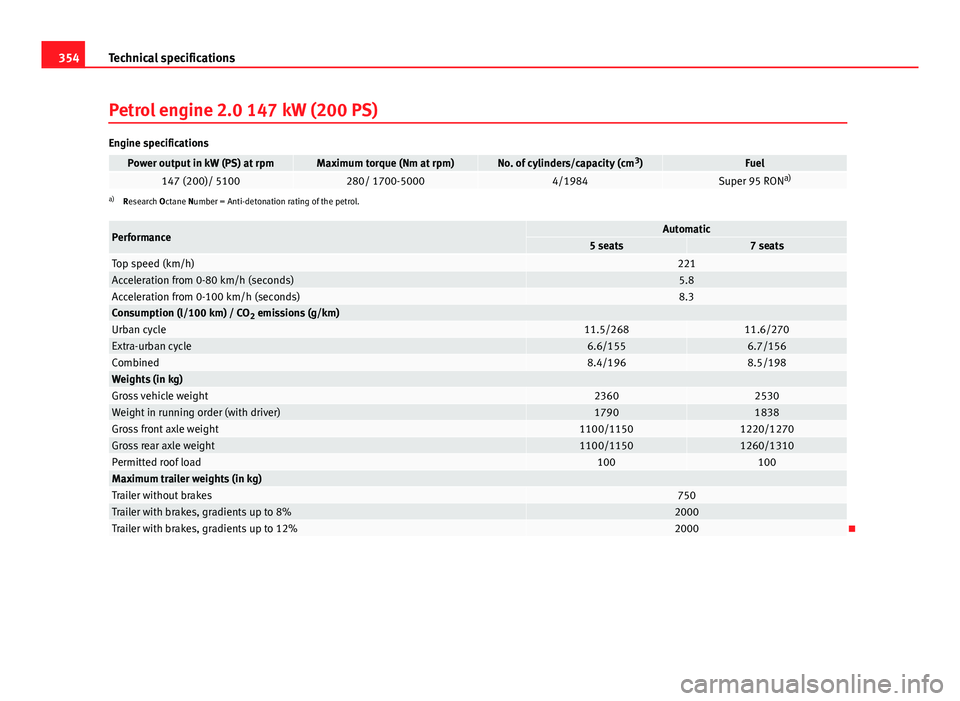
Petrol engine 2.0 147 kW (200 PS)
Engine specifications
Power output in kW (PS) at rpmMaximum torque (Nm at rpm)No. of cylinders/capacity (cm 3
)Fuel147 (200)/ 5100280/ 1700-50004/1984Super 95 RON a)a)
Research Octane Number = Anti-detonation rating of the petrol.
PerformanceAutomatic5 seats7 seatsTop speed (km/h)221Acceleration from 0-80 km/h (seconds)5.8Acceleration from 0-100 km/h (seconds)8.3Consumption (l/100 km) / CO 2 emissions (g/km)Urban cycle11.5/26811.6/270Extra-urban cycle6.6/1556.7/156Combined8.4/1968.5/198Weights (in kg)Gross vehicle weight23602530Weight in running order (with driver)17901838Gross front axle weight1100/11501220/1270Gross rear axle weight1100/11501260/1310Permitted roof load100100Maximum trailer weights (in kg)Trailer without brakes750Trailer with brakes, gradients up to 8%2000Trailer with brakes, gradients up to 12%2000
Page 357 of 381
355
Technical specifications
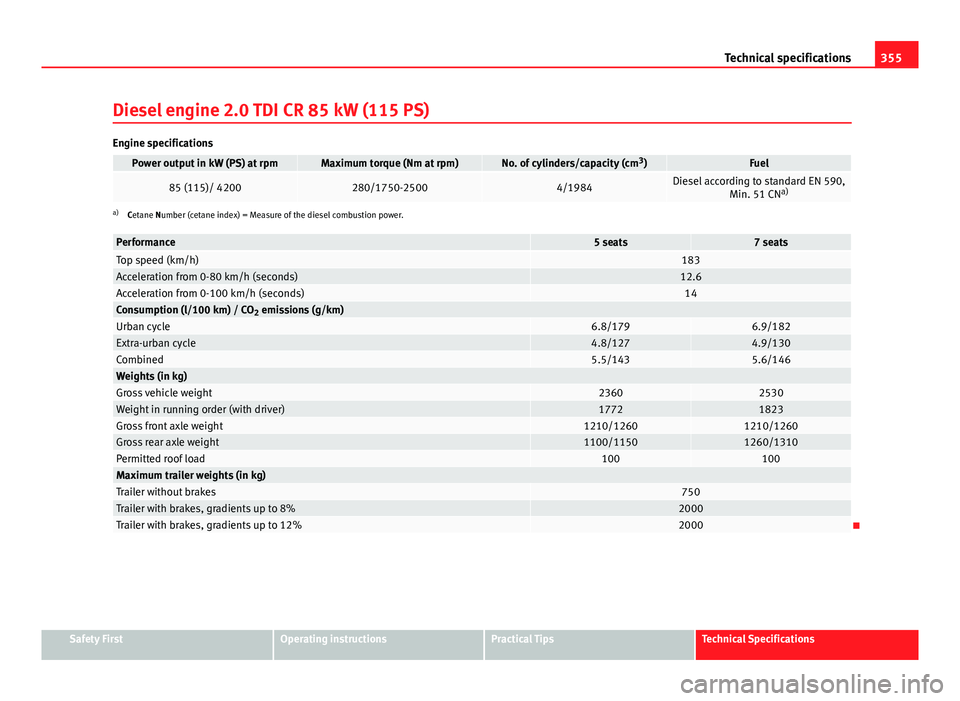
Diesel engine 2.0 TDI CR 85 kW (115 PS)
Engine specifications
Power output in kW (PS) at rpmMaximum torque (Nm at rpm)No. of cylinders/capacity (cm 3
)Fuel
85 (115)/ 4200280/1750-25004/1984Diesel according to standard EN 590,
Min. 51 CNa)
a)
Cetane Number (cetane index) = Measure of the diesel combustion power.
Performance5 seats7 seatsTop speed (km/h)183Acceleration from 0-80 km/h (seconds)12.6Acceleration from 0-100 km/h (seconds)14Consumption (l/100 km) / CO 2 emissions (g/km)Urban cycle6.8/1796.9/182Extra-urban cycle4.8/1274.9/130Combined5.5/1435.6/146Weights (in kg)Gross vehicle weight23602530Weight in running order (with driver)17721823Gross front axle weight1210/12601210/1260Gross rear axle weight1100/11501260/1310Permitted roof load100100Maximum trailer weights (in kg)Trailer without brakes750Trailer with brakes, gradients up to 8%2000Trailer with brakes, gradients up to 12%2000
Safety FirstOperating instructionsPractical TipsTechnical Specifications
Page 358 of 381
356Technical specifications
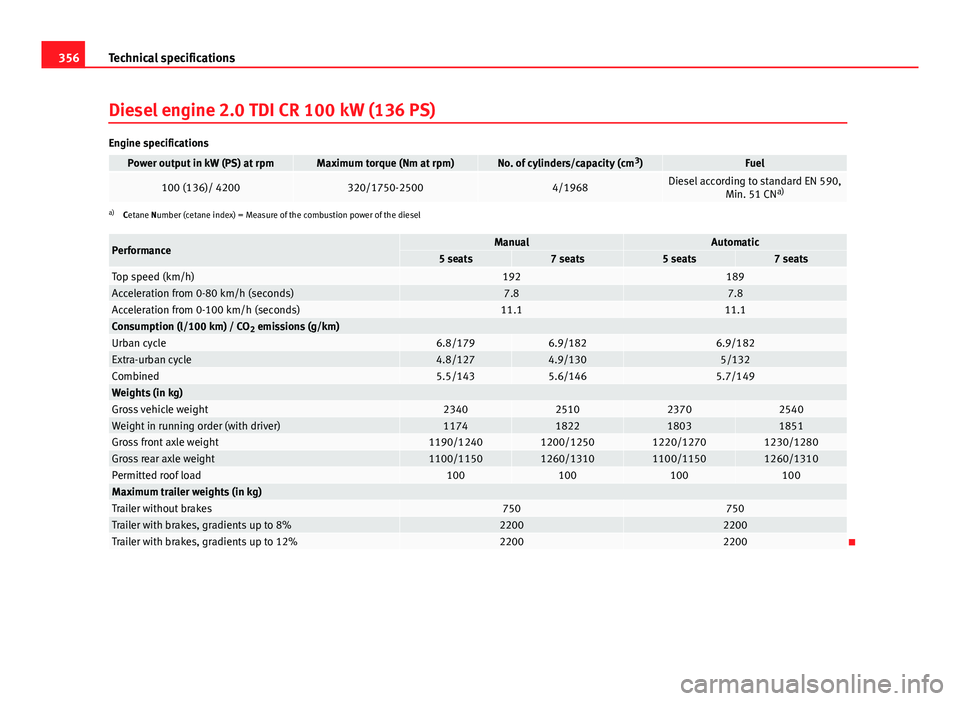
Diesel engine 2.0 TDI CR 100 kW (136 PS)
Engine specifications
Power output in kW (PS) at rpmMaximum torque (Nm at rpm)No. of cylinders/capacity (cm 3
)Fuel
100 (136)/ 4200320/1750-25004/1968Diesel according to standard EN 590,
Min. 51 CNa)
a)
Cetane Number (cetane index) = Measure of the combustion power of the diesel
PerformanceManualAutomatic5 seats7 seats5 seats7 seatsTop speed (km/h)192189Acceleration from 0-80 km/h (seconds)7.87.8Acceleration from 0-100 km/h (seconds)11.111.1Consumption (l/100 km) / CO 2 emissions (g/km)Urban cycle6.8/1796.9/1826.9/182Extra-urban cycle4.8/1274.9/1305/132Combined5.5/1435.6/1465.7/149Weights (in kg)Gross vehicle weight2340251023702540Weight in running order (with driver)1174182218031851Gross front axle weight1190/12401200/12501220/12701230/1280Gross rear axle weight1100/11501260/13101100/11501260/1310Permitted roof load100100100100Maximum trailer weights (in kg)Trailer without brakes750750Trailer with brakes, gradients up to 8%22002200Trailer with brakes, gradients up to 12%22002200
Page 359 of 381
357
Technical specifications
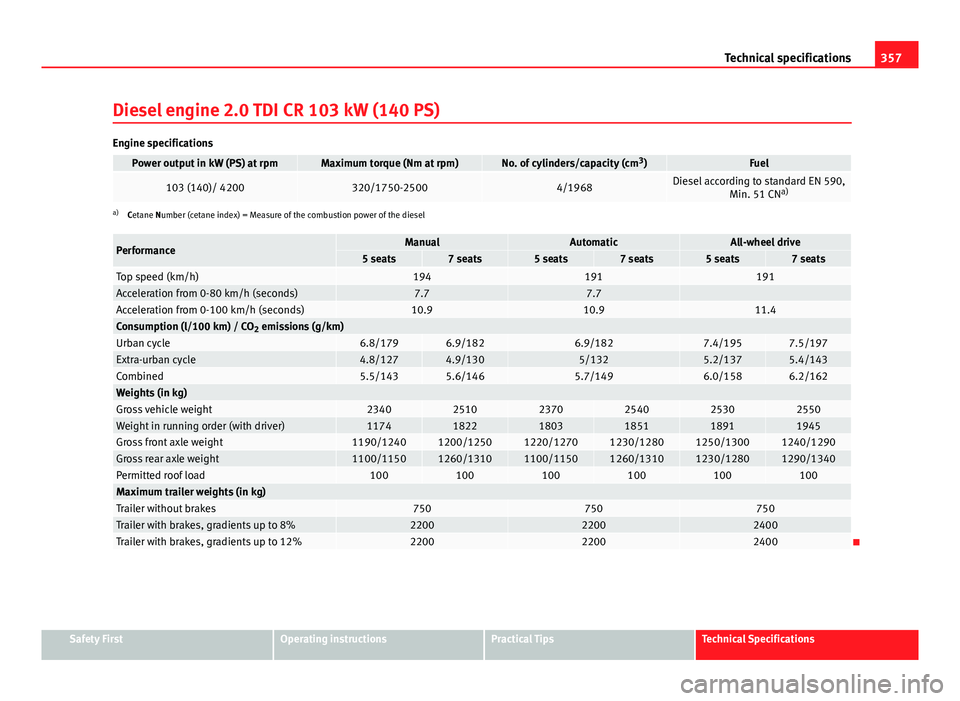
Diesel engine 2.0 TDI CR 103 kW (140 PS)
Engine specifications
Power output in kW (PS) at rpmMaximum torque (Nm at rpm)No. of cylinders/capacity (cm 3
)Fuel
103 (140)/ 4200320/1750-25004/1968Diesel according to standard EN 590,
Min. 51 CNa)
a)
Cetane Number (cetane index) = Measure of the combustion power of the diesel
PerformanceManualAutomaticAll-wheel drive5 seats7 seats5 seats7 seats5 seats7 seatsTop speed (km/h)194191191Acceleration from 0-80 km/h (seconds)7.77.7 Acceleration from 0-100 km/h (seconds)10.910.911.4Consumption (l/100 km) / CO 2 emissions (g/km)Urban cycle6.8/1796.9/1826.9/1827.4/1957.5/197Extra-urban cycle4.8/1274.9/1305/1325.2/1375.4/143Combined5.5/1435.6/1465.7/1496.0/1586.2/162Weights (in kg)Gross vehicle weight234025102370254025302550Weight in running order (with driver)117418221803185118911945Gross front axle weight1190/12401200/12501220/12701230/12801250/13001240/1290Gross rear axle weight1100/11501260/13101100/11501260/13101230/12801290/1340Permitted roof load100100100100100100Maximum trailer weights (in kg)Trailer without brakes750750750Trailer with brakes, gradients up to 8%220022002400Trailer with brakes, gradients up to 12%220022002400
Safety FirstOperating instructionsPractical TipsTechnical Specifications