wheel Seat Alhambra 2014 Workshop Manual
[x] Cancel search | Manufacturer: SEAT, Model Year: 2014, Model line: Alhambra, Model: Seat Alhambra 2014Pages: 381, PDF Size: 5.75 MB
Page 221 of 381
219
Driving
Switching the lane assist system on or off
● Select the corresponding menu option using the button for the driver as-
sist systems ⇒ page 62.
● OR: Activate or deactivate the system in the menu Settings, sub-menu
Assist systems , menu Lane Assist ⇒ page 62. The “confirmation sign” indi-
cates that the driver assist system is switched on.
Automatic deactivation: the lane assist system can be deactivated automat-
ically if there is a system malfunction. Control lamp switches off.
The lane assist system is inactive (control lamp lit in yellow)
● When the speed of travel drops to below approx. 65 km/h (40 mph).
● When the Lane Assist system does not detect the dividing lines of the
road. For example, in the event of road works, and snow, dirt, moisture or
reflections.
● When the radius of a curve is too small.
● When there is no dividing line.
● When the distance to the next dividing line is excessive.
● When there are more than two lane markings per lane.
● When the ASR is switched off.
● When the system does not detect any active rotation of the steering
wheel by the driver during a prolonged period.
● Temporarily, in the event of very dynamic driving.
● When the turn signal is connected.
Note
Before starting travel, verify that the camera's field of vision is not covered
⇒ Fig. 154.
Note
Keep the camera window clean. Disconnect the lane assist system in the following
situations
Due to the limits of the lane assist system, disconnect it in the following sit-
uations:
●
When more attention is required of the driver
● For very sporty driving
● In very unfavourable weather conditions
● In very unfavourable road conditions
● In areas of road works
Safety FirstOperating instructionsPractical TipsTechnical Specifications
Page 225 of 381
223
Driving
Tiredness detection (recommendation to
take a break) Introduction
Additional information and warnings:
● SEAT information system ⇒ page 62
● Accessories, parts replacement, repairs and modifications ⇒ page 261
WARNING
Do not let the extra convenience afforded by the tiredness detection func-
tion tempt you into taking any risks when driving. When making long
trips, conveniently long breaks must be taken.
● The driver is responsible for determining their capacity to drive.
● Never drive when tired.
● The system does not always detect the tiredness of the driver. Please
read the information provided in the section ⇒ page 224, Limited opera-
tion.
● In some situations the system may incorrectly interpret an intended
manoeuvre as a sign of tiredness of the driver.
● In the event of the an episode called “microsleep” at the wheel, a
strong warning is not in place!
● Observe the indications on the display of the instrument panel and
act in accordance with them.
Note
● The tiredness detection function has only been conceived for driving on
motorways and wide roads.
● If there is a fault in the system, refer to a Specialised workshop to have
the system inspected. Function and operation
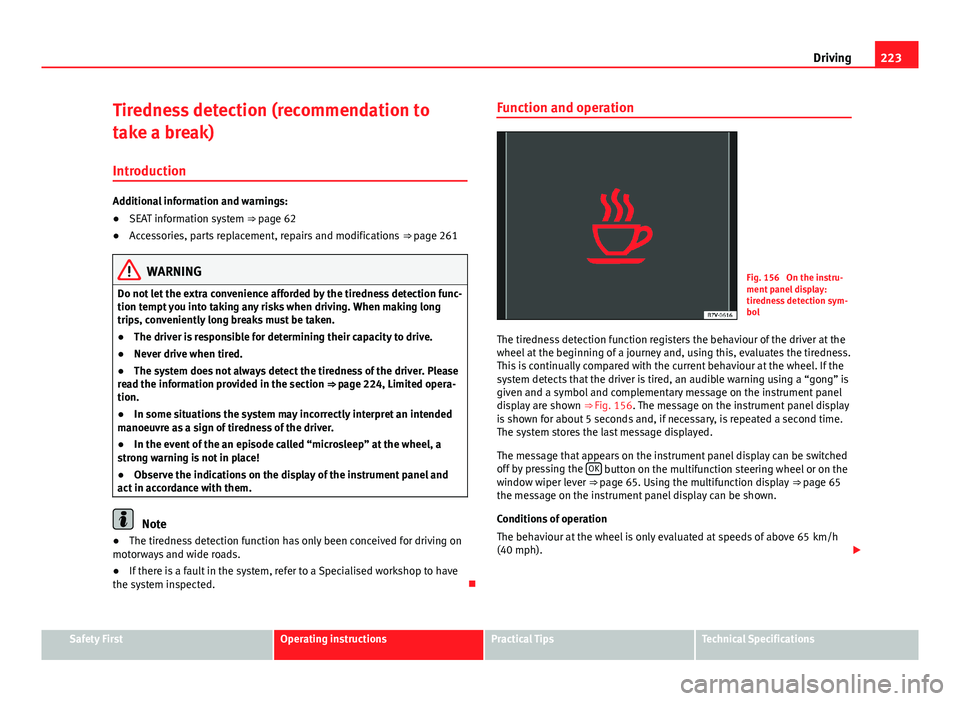
Fig. 156 On the instru-
ment panel display:
tiredness detection sym-
bol
The tiredness detection function registers the behaviour of the driver at the
wheel at the beginning of a journey and, using this, evaluates the tiredness.
This is continually compared with the current behaviour at the wheel. If the
system detects that the driver is tired, an audible warning using a “gong” is
given and a symbol and complementary message on the instrument panel
display are shown ⇒ Fig. 156. The message on the instrument panel display
is shown for about 5 seconds and, if necessary, is repeated a second time.
The system stores the last message displayed.
The message that appears on the instrument panel display can be switched
off by pressing the OK
button on the multifunction steering wheel or on the
window wiper lever ⇒ page 65. Using the multifunction display ⇒ page 65
the message on the instrument panel display can be shown.
Conditions of operation
The behaviour at the wheel is only evaluated at speeds of above 65 km/h
(40 mph).
Safety FirstOperating instructionsPractical TipsTechnical Specifications
Page 226 of 381
224Driving
Switching on and off
The system can be switched on or off in the Assistants menu. If an assis-
tance system is switched on, this is indicated with a mark.
Limited operation
The tiredness detection function is subject to certain limitations. Therefore
it is possible that in some driving situations behaviour at the wheel cannot
be correctly interpreted. E.g. in the following situations:
● at speeds lower than 65 km/h (40 mph),
● in sections with corners,
● on roads in poor condition,
● in the event of adverse weather conditions,
● when a sporty driving style is employed,
● in the event of a major distraction for the driver,
The tiredness detection function switches off when the ignition is switched
off or when the driver unbuckles their seat belt and opens the door. When
driving over a long period of time at a speed below about 65 km/h
(40 mph), the system automatically stops evaluating tiredness. If driving
speed is then increased, the behaviour at the wheel will again be evalu-
ated.
Page 227 of 381
225
Driving
Tyre monitoring systems Introduction
The tyre monitor indicator monitors the tyre pressure of each wheel during
driving using the ABS sensors. The ABS sensors monitor the tyre tread pe-
rimeter and vibrations of each tire. The tyre monitor indicator warns the driv-
er if it detects a considerable drop in tyre pressure of one or several tyres
while driving. Loss of tyre pressure will be indicated by the indicator as
well as an audible warning and sometimes a text message on the instru-
ment panel display. When you open the driver door, you will find a label in-
dicating the tyre pressure recommended by the manufacturer for the maxi-
mum vehicle load for each tyre approved for the vehicle in question. By
pressing the adjustment button on the tyre monitoring indicator, you may
change the reference pressure for the tyres so that the tyre pressure to be
monitored coincides with actual tyre pressure ⇒ page 227.
Suitable use of the adjustment button ⇒ page 227.
Additional information and warnings:
● Transporting ⇒ page 13
● Braking, stopping and parking ⇒ page 185
● Caring for and cleaning the vehicle exterior ⇒ page 246
● Wheels and tyres ⇒ page 297
● Accessories, parts replacement, repairs and modifications ⇒ page 261
WARNING
Unsuitable handling of the wheels and tyres may lead to sudden tyre
pressure losses, to tread separation or even to a blow-out.
● Check tyre pressures regularly and ensure they are maintained at the
pressures indicated. If the tyre pressure is too low, the tyres could over-
heat, resulting in tread detachment or even burst tyres.
● Tyre pressure should be that indicated on the label when the tyres are
cold at all times ⇒ page 301.
● Regularly check the cold inflation pressure of the tyres. If necessary,
change the tyre pressure of the vehicle tyres while they are cold.
● Regularly check your tyres for damage and wear.
● Never exceed the maximum permitted speed or loads specified for the
type of tyre fitted on your vehicle.
WARNING
Incorrect use of the tyre monitoring indicator button could result in the
indicator giving erroneous messages or prevented from indicating the
danger caused by a defective tyre ⇒ page 227.
CAUTION
● The tyre valves may be damaged if the cap is not in place. Check that the
caps are identical to the standard caps and have been correctly tightened.
Do not use metal caps ⇒ page 227.
● Do not damage the valves when changing the tyres ⇒ page 227.
For the sake of the environment
Under-inflated tyres lead to increased fuel consumption and tyre wear.
Safety FirstOperating instructionsPractical TipsTechnical Specifications
Page 228 of 381
226Driving
Note
● Do not only rely on the tyre monitoring system. Regularly check your
tyres to ensure that the tyre pressure is correct and that the tyres are not
damaged due to puncture, cuts, tears and impacts/dents. Remove objects
from the tyres only when the tyres have not been pierced by these.
● The tyre monitoring system is set to the tyre pressure recommended by
the manufacturer and indicated on the label ⇒ Fig. 179.
Elements of the tyre monitoring indicator
Tyre monitoring indicator with button.See ⇒ page 227. Control lamp on the instrument panel. SET button on the centre console.
Monitoring the tread of all tyres using ABS sensors (indirect measure-
ment).
Adjustable medium and full-load tyre pressures. Button to update the system when the tyre pressure is changed. Control lamp
Lights
up or
flashesPossible cause ⇒ Solution
The tyre pressure of a wheel
has dropped considerably in
relation to the pressure set by
the driver ⇒ page 227.
Stop the vehicle! Reduce your
speed immediately! Stop the ve-
hicle safely as soon as possible.
Avoid sudden manoeuvres and
braking!
Check all tyres and pressures.
Replace any damaged tyres.
System malfunction.
Consult a specialised workshop
if the tyre pressure is correct and
the lamp remains lit after
switching the ignition off and
back on again. Have the system
checked there.
Several warning and control lamps should light up for a few seconds when
the ignition is switched on, signalling that the function is being verified.
They will switch off after a few seconds.
WARNING
When the tyres are inflated at different pressures or at a pressure that is
too low then a tyre may be damaged resulting in a loss of control of the
vehicle and a serious or fatal accident.
● If the warning lamp lights up, stop immediately and check the
tyres.
● If the tyres are inflated at different pressures or if a tyre pressure is
too low, this will increase tyre wear, negatively affecting vehicle stability
and increasing braking distances.
Page 229 of 381
227
Driving
WARNING (Continued)
● If tyres are inflated at different pressures or a tyre pressure is too low,
a tyre may be damaged and burst resulting in a loss of control of the ve-
hicle.
● The driver is responsible for ensuring that all of the vehicle tyres are
correctly inflated to the right pressure. The recommended tyre pressure
is indicated on the label ⇒ Fig. 179.
● The tyre monitoring system can only operate correctly if all of the
tyres are inflated to the correct pressure when cold.
● Driving with tyres at the wrong pressure can cause them damage and
result in an accident. Ensure that the tyre pressures of all the tyres corre-
spond to the vehicle load.
● Before starting a journey, always inflate tyres to the correct pressure.
● If tyre pressure is too low then the tyre is subject to greater forces
and it may be heated to such an extent that the tread can rupture and the
tyre will burst.
● With an overloaded vehicle at high speed, the tyres can overheat and
burst resulting in a loss of vehicle control.
● Tyre pressures which are too high or too low reduce the useful life of
the tyre, affecting vehicle performance.
● If a tyre has not been punctured then it does not have to be changed
immediately; drive to the nearest specialised workshop at a moderate
speed and have the tyre checked and inflated to the correct pressure.
WARNING
If the warning lamps and messages are ignored, the vehicle may stall in
traffic, or may cause accidents and severe injuries.
● Never ignore the warning lamps or text messages.
● Stop the vehicle safely as soon as possible.
CAUTION
Failure to heed the control lamps and text messages when they appear may
result in faults in the vehicle.
Tyre monitoring indicator
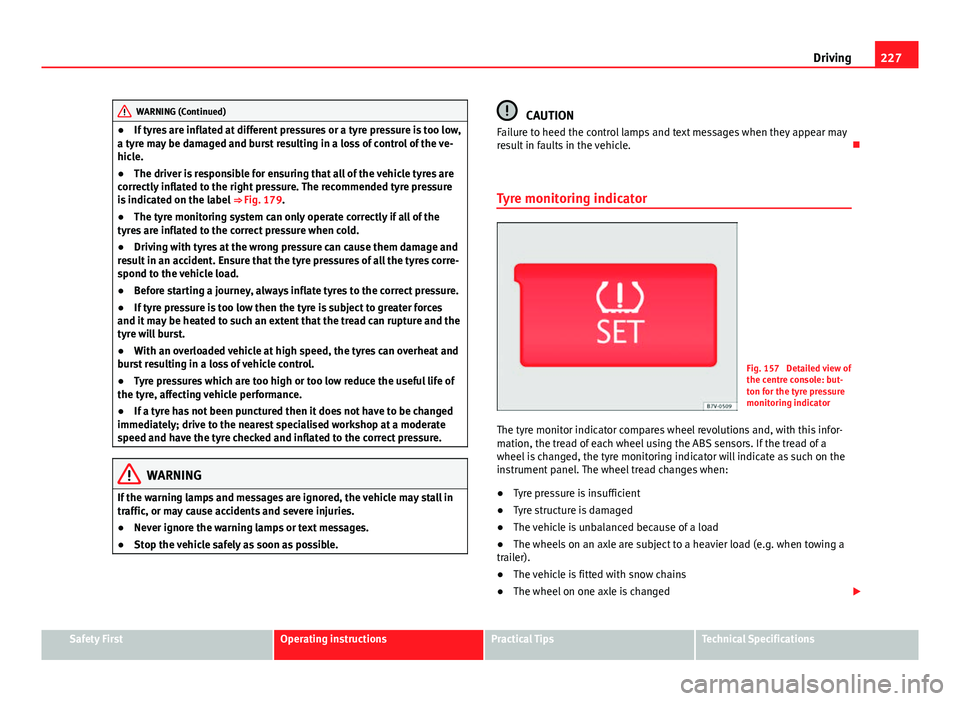
Fig. 157 Detailed view of
the centre console: but-
ton for the tyre pressure
monitoring indicator
The tyre monitor indicator compares wheel revolutions and, with this infor-
mation, the tread of each wheel using the ABS sensors. If the tread of a
wheel is changed, the tyre monitoring indicator will indicate as such on the
instrument panel. The wheel tread changes when:
● Tyre pressure is insufficient
● Tyre structure is damaged
● The vehicle is unbalanced because of a load
● The wheels on an axle are subject to a heavier load (e.g. when towing a
trailer).
● The vehicle is fitted with snow chains
● The wheel on one axle is changed
Safety FirstOperating instructionsPractical TipsTechnical Specifications
Page 230 of 381
228Driving
There may be a delay in the reaction of the tyre monitoring indicator or it
may not indicate anything under certain circumstances (e.g. sports driving,
snow-covered or unpaved roads).
Adaptation of the tyre monitoring indicator
On adjusting tyre pressure or changing one or more wheels, the ⇒ Fig. 157
button on the tyre monitoring indicator must be kept pressed down, with
the ignition on, until an audible warning is heard. Do the same, for exam-
ple, when the front and rear wheels are swapped ⇒ Fig. 178.
If the wheels are subjected to an excessive load (towing a trailer, heavy
load), the tyre pressure must be increased to the maximum recommended
pressure ⇒ page 297. Press the tyre monitoring indicator button to confirm
the new pressure value.
Note
An erroneous indication may be given when snow chains are in use because
the chains increase the tread of the wheel.
Page 231 of 381
229
Driving and the environment
Practical Tips Driving and the environment
Running-in
Please observe the instructions for running-in new components.
Running-in the engine
The engine needs to be run-in over the first 1500 km (1000 miles). During
its first few hours of running, the internal friction in the engine is greater
than later on when all the moving parts have bedded down.
How the vehicle is driven for the first 1500 km (1000 miles) influences the
future engine performance. Throughout the life of the vehicle, it should be
driven at a moderate speed – especially when the engine is cold – this will
reduce engine wear and increase its useful life. Never drive at extremely low
engine speeds. Always engage a lower gear when the engine works “irregu-
larly”. For the first 1000 km or 600 miles, please note:
● Do not use full throttle.
● Do not force the engine above two thirds of its maximum speed.
● Do not tow a trailer.
Between 1000 and 1500 kilometres (600 to 1000 miles), gradually in-
crease power until reaching the maximum speed and high engine speeds.
Running in new tyres and brake pads
● Replacement of new tyres and wheel rims ⇒ page 297
● Notes on the brakes ⇒ page 189
For the sake of the environment
If the engine is run in gently, the life of the engine will be increased and the
engine oil consumption reduced.
Ecological driving Introduction
Fuel consumption, environmental impact and engine, brake and tyre wear
depend largely on three factors:
● Personal driving style.
● Conditions of use (weather, road surface).
● Technical requirements.
Savings of up to 25% in fuel consumption are possible with an appropriate
driving style and the adoption of certain simple tips.
WARNING
Always adapt your speed and the distance to the vehicles ahead in line
with visibility, weather conditions, the condition of the road and the traf-
fic situation.
Safety FirstOperating instructionsPractical TipsTechnical Specifications
Page 234 of 381
232Driving and the environment
Avoid carrying unnecessary loads
The lighter the vehicle, the more economical and ecological the driving
style. For example, an additional weight of 100 kg will increase fuel con-
sumption up to 0.3 l/100 km.
Remove any unnecessary objects or loads from the vehicle.
Remove optional equipment and unnecessary accessories
The more aerodynamic the vehicle, the lower the fuel consumption. Option-
al equipment and accessories (such as roof racks or bike carriers) reduce
the aerodynamic benefits of the vehicle.
Therefore, we recommend you remove all optional and unnecessary equip-
ment and racks, especially if you intend to drive at high speeds.
Environmental friendliness
Environmental protection is a top priority in the design, choice of materials
and manufacture of your new SEAT.
Constructive measures to encourage recycling
● Joints and connections designed for easy dismantling
● Modular construction to facilitate dismantling
● Increased use of single-grade materials.
● Plastic parts and elastomers are marked in accordance with ISO 1043,
ISO 11469 and ISO 1629.
Choice of materials
● Use of recycled materials.
● Use of compatible plastics in the same part if its components are not
easily separated.
● Use of recycled materials and/or materials originating from renewable
sources. ●
Reduction of volatile components, including odour, in plastic materials.
● Use of CFC-free coolants.
Ban on heavy metals, with the exceptions dictated by law (Annex II of ELV
Directive 2000/53/EC): cadmium, lead, mercury, hexavalent chromium.
Manufacturing methods
● Reduction of the quantity of thinner in the protective wax for cavities.
● Use of plastic film as protection during vehicle transport.
● Use of solvent-free adhesives.
● Use of CFC-free coolants in cooling systems.
● Recycling and energy recovery from residues (RDF).
● Improvement in the quality of waste water.
● Use of systems for the recovery of residual heat (thermal recovery, en-
thalpy wheels, etc.).
● The use of water-soluble paints.
Engine management and exhaust gas
purification system Introduction
Additional information and warnings:
● Changing gear ⇒ page 176
● Refuelling ⇒ page 268
● Fuel ⇒ page 271
● Engine oil ⇒ page 283
● Vehicle battery ⇒ page 292
Page 237 of 381
235
Trailer towing
Trailer towing Introduction
Always be aware of the legal requirements for each country to drive with a
trailer and to use a tow hitch.
Your car is intended mainly for transporting passengers however, it can also
be used to tow a trailer provided that it is fitted with the necessary equip-
ment. The additional load has an effect on the useful life, fuel consumption
and the vehicle performance and, in some cases, reduce the service inter-
vals.
Driving with a trailer requires more force from the vehicle and, thus, more
concentration from the driver.
For wintertime temperatures, fit winter tyres to the vehicle and the trailer.
Drawbar load
The maximum permitted Drawbar load exerted by the trailer drawbar on the
ball joint of the tow hitch must not exceed 100 kg (approximately 220 lbs).
Vehicles with the Start-Stop function
With a SEAT factory fitted or retrofitted tow hitch, the Start-Stop function is
automatically deactivated when a trailer is connected. For tow hitches not
installed by SEAT, the Start-Stop function must be deactivated manually us-
ing a button located on the dash panel before driving with a trailer and it
must remain off for the entire journey ⇒
.
Additional information and warnings:
● Anti-theft alarm system ⇒ page 75
● Light ⇒ page 96
● Ecological driving ⇒ page 229
● Starter assist systems (Start-Stop function) ⇒ page 196●
Wheels and tyres ⇒ page 297
● Accessories, parts replacement, repairs and modifications ⇒ page 261
WARNING
Never transport people in a trailer: this will endanger in their life and is
against the law.
WARNING
The incorrect use of the tow hitch can cause accidents and injury.
● Only use a tow hitch in good condition and correctly installed.
● Never change or repair a tow hitch.
● To reduce the risk of injury in case of a reversing collision, injury to
pedestrians and cyclists when parking, always keep the ball joint in
when a trailer is not being used.
● Never fit a trailer tow hitch “that distributes the load” or “balances
the load”. Your vehicle has not been designed for this type of tow hitch.
The tow hitch may fail and the trailer will separate from the vehicle.
WARNING
Driving with a trailer and transporting heavy or large objects can affect
vehicle handling and even cause an accident.
● Always secure loads correctly with suitable and undamaged attach-
ment rope or straps.
● Adjust your speed and driving style to visibility, road, traffic and
weather conditions.
Safety FirstOperating instructionsPractical TipsTechnical Specifications