fuel filter Seat Alhambra 2014 Owner's Manual
[x] Cancel search | Manufacturer: SEAT, Model Year: 2014, Model line: Alhambra, Model: Seat Alhambra 2014Pages: 381, PDF Size: 5.75 MB
Page 57 of 381
55
Cockpit
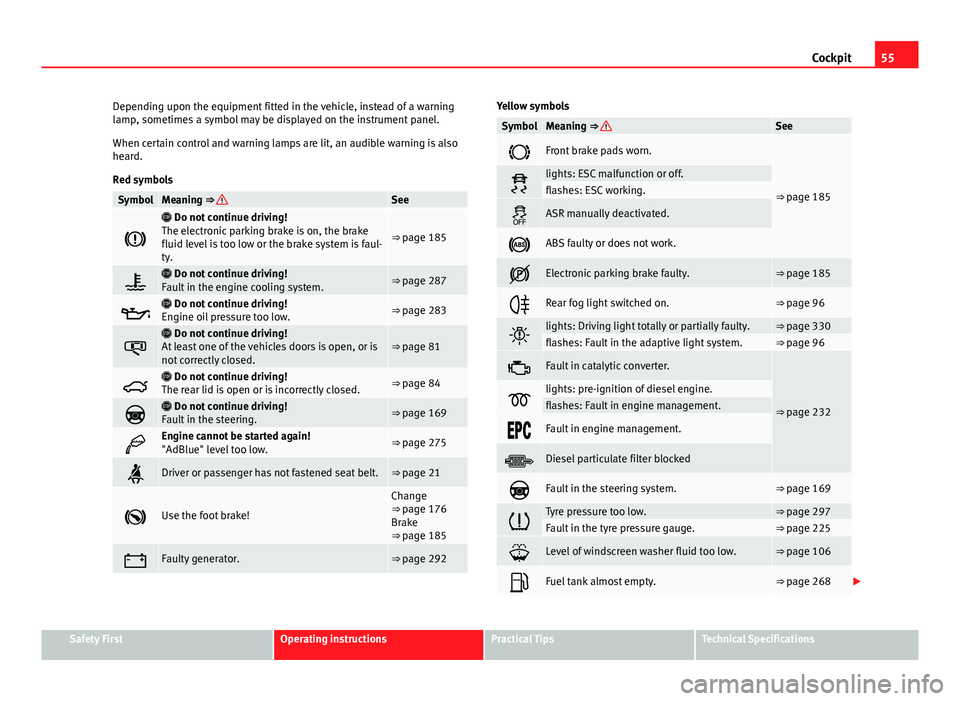
Depending upon the equipment fitted in the vehicle, instead of a warning
lamp, sometimes a symbol may be displayed on the instrument panel.
When certain control and warning lamps are lit, an audible warning is also
heard.
Red symbols
SymbolMeaning ⇒ See
Do not continue driving!
The electronic parking brake is on, the brake
fluid level is too low or the brake system is faul-
ty.
⇒ page 185
Do not continue driving!
Fault in the engine cooling system.⇒ page 287
Do not continue driving!
Engine oil pressure too low.⇒ page 283
Do not continue driving!
At least one of the vehicles doors is open, or is
not correctly closed.⇒ page 81
Do not continue driving!
The rear lid is open or is incorrectly closed.⇒ page 84
Do not continue driving!
Fault in the steering.⇒ page 169
Engine cannot be started again!
"AdBlue" level too low.⇒ page 275
Driver or passenger has not fastened seat belt.⇒ page 21
Use the foot brake!
Change
⇒ page 176
Brake
⇒ page 185
Faulty generator.⇒ page 292
Yellow symbols
SymbolMeaning ⇒ See
Front brake pads worn.
⇒ page 185lights: ESC malfunction or off.flashes: ESC working.
ASR manually deactivated.
ABS faulty or does not work.
Electronic parking brake faulty.⇒ page 185
Rear fog light switched on.⇒ page 96
lights: Driving light totally or partially faulty.⇒ page 330flashes: Fault in the adaptive light system.⇒ page 96
Fault in catalytic converter.
⇒ page 232lights: pre-ignition of diesel engine.flashes: Fault in engine management.
Fault in engine management.
Diesel particulate filter blocked
Fault in the steering system.⇒ page 169
Tyre pressure too low.⇒ page 297Fault in the tyre pressure gauge.⇒ page 225
Level of windscreen washer fluid too low.⇒ page 106
Fuel tank almost empty.⇒ page 268
Safety FirstOperating instructionsPractical TipsTechnical Specifications
Page 171 of 381
169
Driving
Driving SteeringIntroduction
The power steering is not hydraulic but electromechanical. The advantage
of this steering system is that it disposes of hydraulic tubes, hydraulic oil,
the pump, filter and other components. The electromechanical system
saves fuel. While a hydraulic system requires oil pressure to be maintained,
electromechanical steering only requires energy when the steering wheel is
turned.
With the power steering system, the assisted steering function automatical-
ly adjusts according to the vehicle speed, the steering torque and the wheel
turning angle. The power steering only works when the engine is running.
Additional information and warnings:
● Start and stop the engine ⇒ page 172
● Vehicle battery ⇒ page 292
● Tow starting and towing away ⇒ page 344
WARNING
If the power steering is not working then the steering wheel is much
more difficult to turn and the vehicle more difficult to control.
● The power steering only works when the engine is running.
● Never allow the vehicle to move when the engine is switched off.
● Never remove the key from the ignition if the vehicle is in motion. The
steering may lock and it will not be possible to turn the steering wheel.
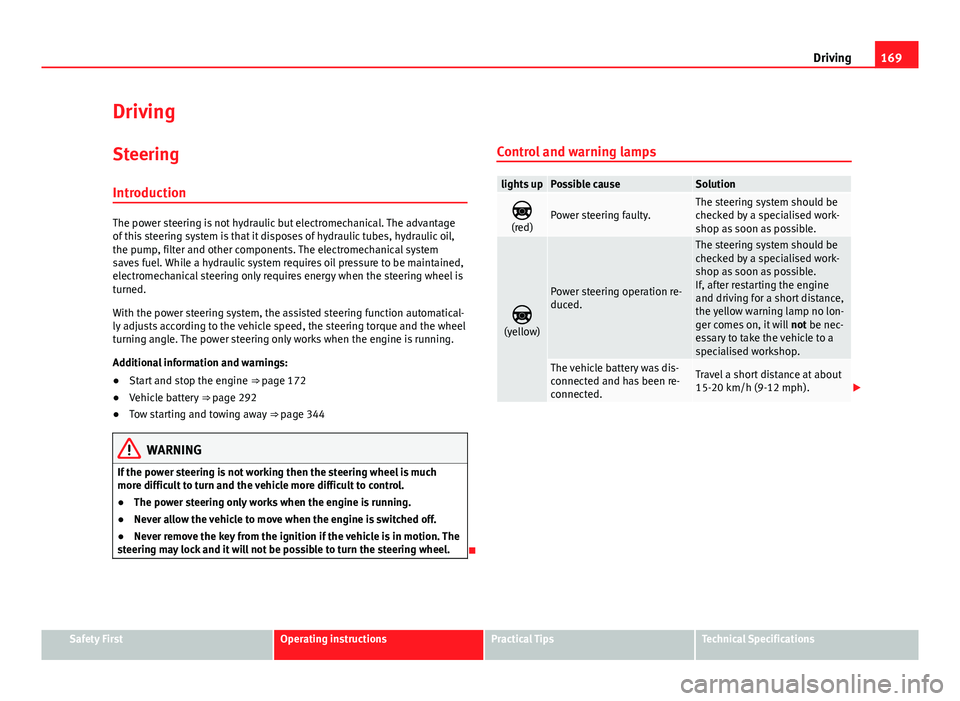
Control and warning lamps
lights upPossible causeSolution
(red)Power steering faulty.The steering system should be
checked by a specialised work-
shop as soon as possible.
(yellow)
Power steering operation re-
duced.
The steering system should be
checked by a specialised work-
shop as soon as possible.
If, after restarting the engine
and driving for a short distance,
the yellow warning lamp no lon-
ger comes on, it will not be nec-
essary to take the vehicle to a
specialised workshop.
The vehicle battery was dis-
connected and has been re-
connected.Travel a short distance at about
15-20 km/h (9-12 mph).
Safety FirstOperating instructionsPractical TipsTechnical Specifications
Page 175 of 381
173
Driving
WARNING
The components of the exhaust system reach very high temperatures.
This could cause a fire and considerable damage.
● Always park your vehicle so that no part of the exhaust system can
come in contact with flammable materials (such as wood, leaves, spilled
fuel, dried grass, etc).
● Do not apply additional underseal or anti-corrosion coatings to the
exhaust pipes, catalytic converter, heat shields or the diesel particulate
filter.
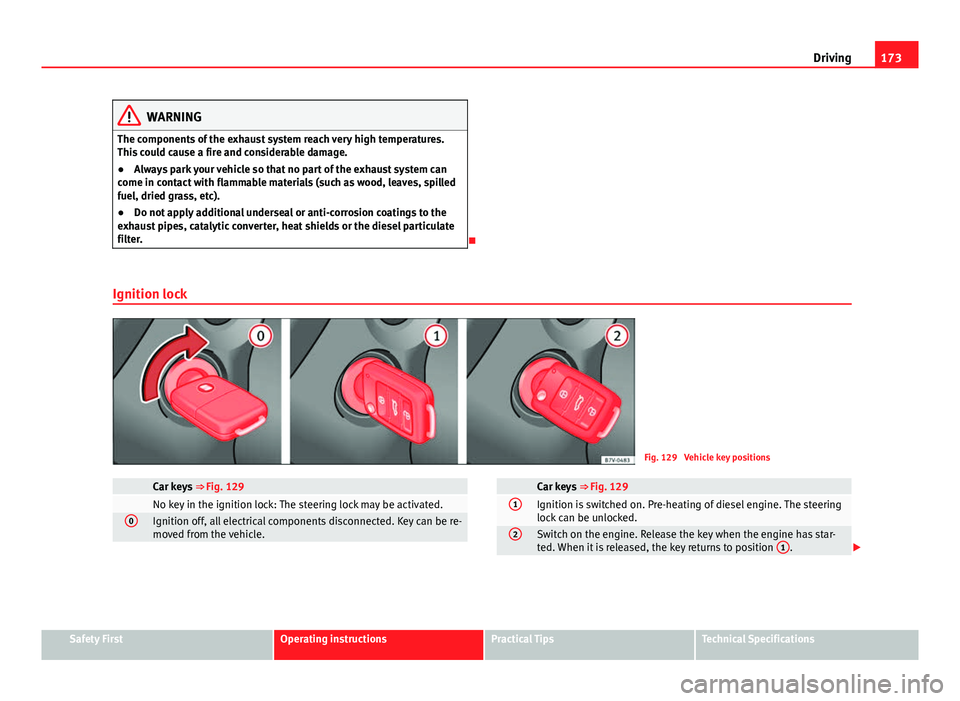
Ignition lock
Fig. 129 Vehicle key positions
Car keys ⇒ Fig. 129 No key in the ignition lock: The steering lock may be activated.0Ignition off, all electrical components disconnected. Key can be re-
moved from the vehicle.
Car keys ⇒ Fig. 1291Ignition is switched on. Pre-heating of diesel engine. The steering
lock can be unlocked.
2Switch on the engine. Release the key when the engine has star-
ted. When it is released, the key returns to position 1.
Safety FirstOperating instructionsPractical TipsTechnical Specifications
Page 186 of 381
184Driving
Recommended gear display
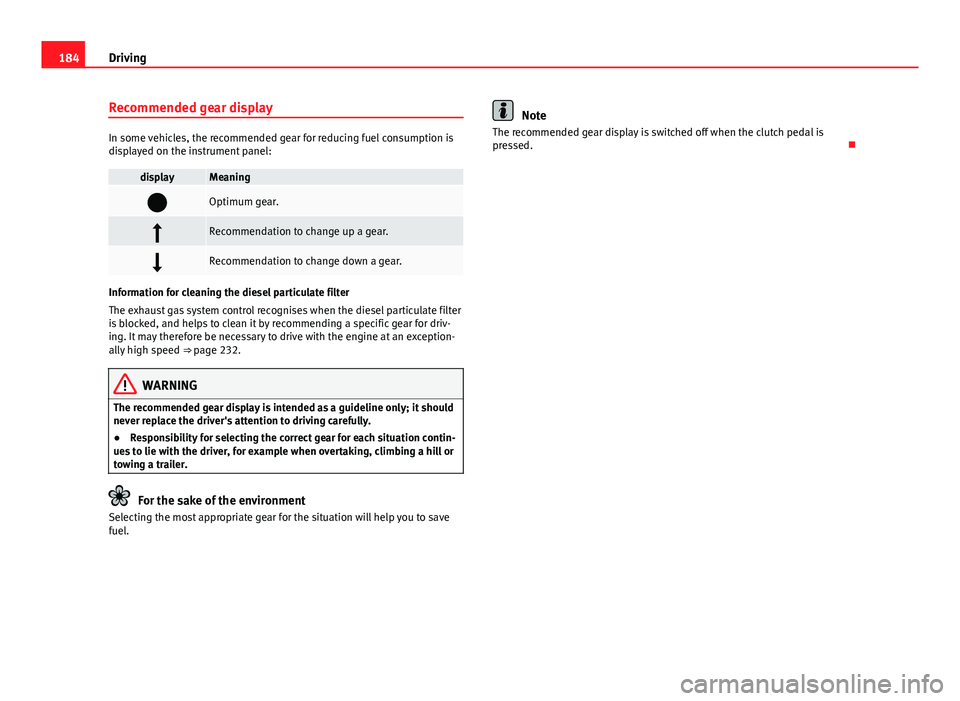
In some vehicles, the recommended gear for reducing fuel consumption is
displayed on the instrument panel:
displayMeaning
Optimum gear.
Recommendation to change up a gear.
Recommendation to change down a gear.
Information for cleaning the diesel particulate filter
The exhaust gas system control recognises when the diesel particulate filter
is blocked, and helps to clean it by recommending a specific gear for driv-
ing. It may therefore be necessary to drive with the engine at an exception-
ally high speed ⇒ page 232.
WARNING
The recommended gear display is intended as a guideline only; it should
never replace the driver's attention to driving carefully.
● Responsibility for selecting the correct gear for each situation contin-
ues to lie with the driver, for example when overtaking, climbing a hill or
towing a trailer.
For the sake of the environment
Selecting the most appropriate gear for the situation will help you to save
fuel.
Note
The recommended gear display is switched off when the clutch pedal is
pressed.
Page 236 of 381
234Driving and the environment
WARNING
Observe traffic regulations when cleaning the diesel particulate filter
while driving.
● Only carry on driving if visibility, weather, road and traffic conditions
so permit.
● Never endanger your safety or that of other road users.
CAUTION
Always pay attention to any lit control lamps and to the corresponding de-
scriptions and instructions to avoid damage to the vehicle.
Note
While the indicators , or remain lit, there may be engine problems,
fuel consumption may be greater and the engine may lose power.
Catalytic converter
The catalytic converter permits the subsequent treatment of the exhaust
gases thus reducing contaminating gas emissions. To ensure a longer work-
ing life for the exhaust system and catalytic converter in a petrol engine:
● Always use unleaded petrol.
● Never run the fuel tank completely dry.
● Do not top up with too much engine oil ⇒ page 283.
● Do not tow-start the vehicle; use the starter cables ⇒ page 341.
If you should notice misfiring, uneven running or loss of power when the car
is moving, reduce speed immediately. Have the car inspected by a special-
ised workshop. If this happens, unburnt fuel can enter the exhaust system
and escape into the atmosphere. The catalytic converter can also be dam-
aged by overheating.
For the sake of the environment
Even when the emission control system is working perfectly, there may be a
smell of sulphur from the exhaust gas under some conditions. This depends
on the sulphur content of the fuel being used.
Diesel particulate filter
The diesel particulate filter removes soot particulates from the exhaust gas.
The filter retains these particulates and burns them. To assist the combus-
tion process, SEAT recommends you avoid frequent short trips.
● Always use diesel with a low sulphur content ⇒ page 271.
● Never use petrol or fuel oil.
● Never use biodiesel. However, a blend prepared by the diesel manufac-
turer containing biodiesel within the limits established by the EN 590
standard may be used ⇒ page 271.
● Never run the fuel tank completely dry.
● Do not top up with too much engine oil ⇒ page 283.
● Do not tow-start the vehicle; use the starter cables ⇒ page 341.
In order to reduce blocking of the diesel particulate filter, some vehicles
with an automatic gearbox may increase the engine speed slightly to auto-
matically start cleaning the diesel particulate filter. The control lamp will not
light up in this case .
For the sake of the environment
Even when the emission control system is working perfectly, there may be a
smell of sulphur from the exhaust gas under some conditions. This depends
on the sulphur content of the fuel being used.
Page 255 of 381
253
Vehicle maintenance and cleaning
WARNING
Additional underseal or anti-corrosion products could catch fire due to
the high temperatures reached by the exhaust gas system and other en-
gine components.
● Do not apply additional underseal or anti-corrosion products to the
exhaust pipes, catalytic converters, heat shields or other parts of the ve-
hicle which reach high temperatures.
Cleaning the engine compartment
The engine compartment of any motor vehicle is a potentially hazardous
area ⇒ page 279. The engine compartment should only be cleaned by qualified personnel. If
it is not correctly cleaned, the anti-corrosion coating and consequently elec-
trical components may be damaged. Moreover, water may filter directly into
the vehicle interior through the water chamber ⇒
.
If the engine compartment is very dirty, always take the vehicle to a special-
ised workshop for professional cleaning. SEAT recommends visiting a Tech-
nical Service.
Water box
The water box is in the engine compartment, between the windscreen and
the engine, and beneath a perforated cover. Air is taken in through the wa-
ter box from outside to the vehicle interior via the heating and air condition-
er.
Leaves and other loose objects should be regularly cleaned away from the
water box either by hand or with a vacuum.
WARNING
When working on the engine or in the engine compartment, there is a
risk of injury, burns, accident or fire.
● Before starting work, please ensure you are familiar with the required
procedure and the safety precautions ⇒ page 279.
● SEAT recommends you have this work performed by a specialised
workshop.
CAUTION
If water is manually poured into the water box (for example, using a high
pressure cleaning appliance), this could cause significant damage to the ve-
hicle.
For the sake of the environment
Only wash the engine compartment in areas allocated for this purpose, to
prevent dirty water which may be contaminated by oil, grease or fuel, from
entering the drains. In some districts, the engine compartment may not be
washed outside the wash bays provided for this purpose.
Caring for and cleaning the vehicle interior Introduction
The dye used in many modern garments, for example dark jeans, is not al-
ways sufficiently colour-fast. Seat upholstery (material and leather), espe-
cially when light-coloured, may visibly discolour if the dye comes out of
clothing (even when used correctly). This is not an upholstery defect but in-
dicates that the dye in the item of clothing is not sufficiently colour-fast.
Safety FirstOperating instructionsPractical TipsTechnical Specifications
Page 272 of 381
270Checking and refilling levels
WARNING
Driving with insufficient fuel reserve could result in the vehicle breaking
down in traffic and a serious accident.
● If the fuel level is too low then the fuel supply to the engine can be-
come irregular especially on slopes.
● If the engine “is choked” or stalls due to lack of or irregularity of the
fuel supply, the power steering as well as all of the driver assistance sys-
tems including braking assistance will stop working.
● Always refuel when there is only one quarter of the fuel tank left to
avoid running out of fuel.
CAUTION
● Always pay attention to any lit control lamps and to the corresponding
descriptions and instructions to avoid damage to the vehicle.
● Never run the fuel tank completely dry. An irregular fuel supply may lead
to ignition faults and unburnt fuel could enter the exhaust system. This
could damage the catalytic converter filter or the diesel particulate filter!
Note
The arrow next to the fuel pump symbol on the instrument panel ⇒ Fig. 165
indicates the side of the vehicle on which the tank flap is located. Filling the tank with petrol or diesel
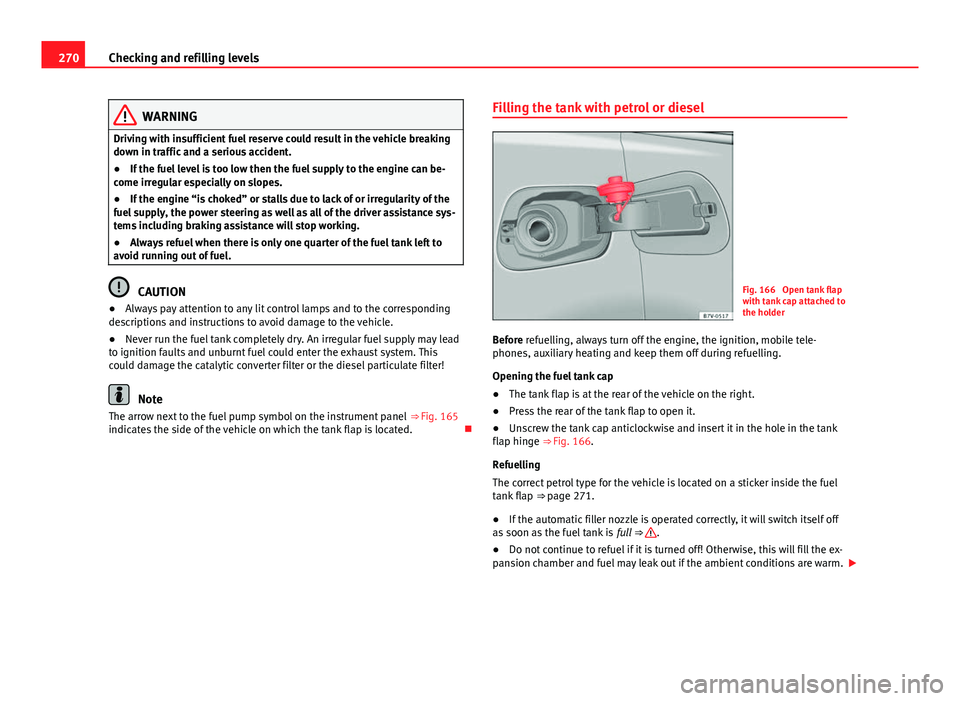
Fig. 166 Open tank flap
with tank cap attached to
the holder
Before refuelling, always turn off the engine, the ignition, mobile tele-
phones, auxiliary heating and keep them off during refuelling.
Opening the fuel tank cap
● The tank flap is at the rear of the vehicle on the right.
● Press the rear of the tank flap to open it.
● Unscrew the tank cap anticlockwise and insert it in the hole in the tank
flap hinge ⇒ Fig. 166.
Refuelling
The correct petrol type for the vehicle is located on a sticker inside the fuel
tank flap ⇒ page 271.
● If the automatic filler nozzle is operated correctly, it will switch itself off
as soon as the fuel tank is full
⇒
.
● Do not continue to refuel if it is turned off! Otherwise, this will fill the ex-
pansion chamber and fuel may leak out if the ambient conditions are warm.
Page 275 of 381
273
Checking and refilling levels
CAUTION
● Do not refuel if the filler indicates that the fuel contains metal. LRP (lead
replacement petrol) fuels contain high concentrations of metal additives.
Using them may damage the engine!
● Only use fuel with an octane rating that is in line with the norm EN 228,
otherwise significant damage could be caused to the engine and fuel sys-
tem. Furthermore, it could lead to a loss of performance with the conse-
quent engine fault.
● The use of unsuitable petrol additives could damage the engine.
● If, in exceptional circumstances, petrol with a lower octane rating to that
recommended is used, only use moderate engine speeds and a light throt-
tle. Avoid using full throttle and overloading the engine. Otherwise you may
damage the engine. Fill up with fuel of a suitable octane rating as soon as
possible.
● Just one full tank of leaded fuel would seriously impair the efficiency of
the catalytic converter and could damage it.
Diesel
Diesel fuel
Diesel fuel must correspond to European standard EN 590 (in Germany,
EN 590 or DIN 51628).
The use of diesel fuel with a high sulphur percentage requires shorter serv-
ice intervals ⇒ Booklet Maintenance Programme ⇒
. Your Technical Serv-
ice will be able to tell you which countries have diesel with a high sulphur
content.
Do not mix fuel additives (thinners, or similar additives) with diesel fuel.
Winter-grade diesel
When using “summer-grade diesel fuel”, difficulties may be experienced at
temperatures below 0 °C (+32 °F) because the fuel thickens due to wax sep- aration. For this reason, “winter-grade diesel fuel” is available in Germany,
for example, during the cold months. It can be used at temperatures as low
as -20 °C (-4 °F).
In countries with different climatic conditions, other types of diesel fuel are
available that are suitable to local temperatures. Technical Services and fill-
ing stations in the country concerned will inform you on the type of diesel
fuels available.
A cold diesel engine makes more noise during winter temperatures than
summer temperatures. Furthermore, the exhaust gases may turn slightly
bluish while the engine is heating. The quantity of exhaust gases will de-
pend on the outside temperature.
Filter pre-heater
Vehicles with a diesel engine are fitted with a fuel filter pre-heating system.
This ensures that the fuel system remains operational to approx. -24 °C
(-11.2 °F), provided you use winter-grade diesel which is safe to -15 °C
(+5,0 °F).
However, if the fuel has waxed to such an extent that the engine will not
start at temperatures of under -24 °C (-11.2 °F), simply place the vehicle in a
warm garage or workshop for a while to heat up.
Auxiliary heater
Vehicles with a diesel engine may be fitted with an auxiliary heater. The
heater runs off the fuel from the fuel tank. On doing so, smells and steam
may be noticed outside the vehicle for a short period. This is normal and it
is not an indication of a fault in the vehicle.
Whenever there is little fuel in the tank (reserve), the auxiliary heater auto-
matically switches off.
Safety FirstOperating instructionsPractical TipsTechnical Specifications
Page 276 of 381
274Checking and refilling levels
WARNING
Never use start boosters. An aerosol start booster could explode or cause
a sudden rise in engine speed leading to engine damage and serious in-
jury.
CAUTION
● The vehicle is not prepared for the use of biodiesel. Never, under any
circumstances refuel with biodiesel. It could damage the fuel system and
subsequently lead to engine faults!
● The addition of biodiesel to diesel by the diesel producer according to
Standard EN 590 or other equivalent (DIN 51628 in Germany, for example)
is authorised and causes no type of damage to the engine or the fuel sys-
tem.
● The diesel engine has been designed for to use diesel fuel exclusively.
Therefore, never use petrol, fuel oil or other unsuitable fuels. The composi-
tion of these fuels may significantly damage the fuel system and the en-
gine.
● The use of diesel fuels with a high sulphur percentage could considera-
bly reduce the service life of the diesel particulate filter. Your Technical Serv-
ice will be able to tell you which countries have diesel with a high sulphur
content.
Information on fuel consumption
The consumption and emission values indicated do not refer to one specific
vehicle. They are only to be used to compare the values of the different ve-
hicle versions. The fuel consumption and CO 2 emissions of a vehicle not on-
ly depend on the effective use of fuel. They also depend on your driving
style and other non-technical factors. Calculation of fuel consumption
Fuel consumption and emission values are determined according to the cur-
rent version of the 715/2007/EC or 80/1268/EEC regulation and are valid
for the vehicle kerb weight. The specifications do
not refer to an individual
vehicle. Two measuring cycles are carried out on a rolling road test bed to
calculate fuel consumption. The test criteria are as follows:
Urban cycleMeasurement of the urban cycle starts with an engine cold
start. City driving is then simulated at between 0 and 50 km/
h (31 mph).
Road cycle
In the road cycle simulation, the car undergoes frequent ac-
celeration and braking in all gears, as in normal everyday
driving. The road speed ranges from 0 to 120 km/h
(75 mph).
CombinedThe average combined consumption is calculated with a
weighting of around 37 % for the urban cycle and 63 % for
the road cycle.
CO 2 emis-
sions of the
combinationThe exhaust gases are collected during both driving cycles
to calculate carbon dioxide emissions (urban and road). The
gas composition is then analysed to evaluate the CO 2 con-
tent and other emissions.
Note
● The kerb weight may vary according to the vehicle equipment. This
could raise consumption and the CO 2 emissions slightly.
● In practice, consumption values could be different to the values calcula-
ted based on the 715/2007/EC or 80/1268/EEC regulations.
Page 366 of 381
Check listPreparations for changing a wheel . . . . . . 310
Raising the vehicle with the jack . . . . . . . . 314
Checklist Refilling precautions . . . . . . . . . . . . . . . . . 271
Seat belts . . . . . . . . . . . . . . . . . . . . . . . . . . . 21
Seat upholstery . . . . . . . . . . . . . . . . . . . . . 254
Transporting children in the vehicle . . . . . . 40
Child safety . . . . . . . . . . . . . . . . . . . . . . . . . . . . . 39
Child safety seat Securing with seat belt . . . . . . . . . . . . . . . . 44
Child seat . . . . . . . . . . . . . . . . . . . . . . . . . . . . . . 39 Integrated child seat . . . . . . . . . . . . . . . . . . 45
ISOFIX child seat on rear seats . . . . . . . . . . 43
Mounting child seats . . . . . . . . . . . . . . . . . . 41
Mounting systems . . . . . . . . . . . . . . . . . . . . 42
On rear seats . . . . . . . . . . . . . . . . . . . . . . . . 43
On the front passenger seat . . . . . . . . . . . . 42
Regulations . . . . . . . . . . . . . . . . . . . . . . . . . . 40
Securing using a Top Tether retaining strap 45
Securing using ISOFIX . . . . . . . . . . . . . . . . . 44
Securing using LATCH . . . . . . . . . . . . . . . . . 44
Transporting children in the vehicle . . . . . . 40
Weight categories . . . . . . . . . . . . . . . . . . . . 41
Child seats Disabling the front passenger front airbag 35
Cigarette lighter . . . . . . . . . . . . . . . . . . . . 152, 153
Cleaning dash panel . . . . . . . . . . . . . . . . . . . . . . . . . 257
Engine compartment . . . . . . . . . . . . . . . . . 253
Seat belts . . . . . . . . . . . . . . . . . . . . . . . . . . 258
See "Care of your vehicle" . . . . . . . . . . . . . 246 wheels . . . . . . . . . . . . . . . . . . . . . . . . . . . . . 252
Windscreen wiper blades . . . . . . . . . . . . . 250
Cleaning chrome parts . . . . . . . . . . . . . . . . . . . 251
Cleaning the vehicle Folding exterior mirrors . . . . . . . . . . . . . . . 114
Climatronic see "Air conditioner" . . . . . . . . . . . . . . . . . 157
Closing Doors . . . . . . . . . . . . . . . . . . . . . . . . . . . . . . . 81
Electric sliding door . . . . . . . . . . . . . . . . . . . 82
Electric windows . . . . . . . . . . . . . . . . . . . . . . 90
Panoramic sliding sunroof . . . . . . . . . . . . . . 93
Rear Lid . . . . . . . . . . . . . . . . . . . . . . . . . . . . . 87
See "Locking" . . . . . . . . . . . . . . . . . . . . . . . . 77
Sliding doors . . . . . . . . . . . . . . . . . . . . . . . . 81
Sun blind . . . . . . . . . . . . . . . . . . . . . . . . . . . 94
Coat hooks . . . . . . . . . . . . . . . . . . . . . . . . . . . . 149
Cockpit . . . . . . . . . . . . . . . . . . . . . . . . . . . . . . . . 53
Code number . . . . . . . . . . . . . . . . . . . . . . . . . . 325
Collection of end-of-life vehicles . . . . . . . . . . . 260
Combined weight rating . . . . . . . . . . . . . . . . . 244
Coming Home . . . . . . . . . . . . . . . . . . . . . . . . . . 101
Compartment Glove compartment . . . . . . . . . . . . . . . . . . 146
Compartments Card compartments . . . . . . . . . . . . . . . . . . 146
Centre console . . . . . . . . . . . . . . . . . . . . . . 145
Drawers . . . . . . . . . . . . . . . . . . . . . . . . . . . . 148
Folding table . . . . . . . . . . . . . . . . . . . . . . . . 148
Front central armrest . . . . . . . . . . . . . . . . . 145
Instrument panel . . . . . . . . . . . . . . . . . . . . 144
Other storage compartments . . . . . . . . . . 149 Portable waste bin . . . . . . . . . . . . . . . . . . . 149
Rear footwell . . . . . . . . . . . . . . . . . . . . . . . . 147
Roof console . . . . . . . . . . . . . . . . . . . . . . . . 144
Spectacle case . . . . . . . . . . . . . . . . . . . . . . 143
Compass . . . . . . . . . . . . . . . . . . . . . . . . . . . . . . . 60
Components . . . . . . . . . . . . . . . . . . . . . . . . . . . 262
Connectors Faults . . . . . . . . . . . . . . . . . . . . . . . . . . . . . 156
Consumer disconnection . . . . . . . . . . . . . . . . . 295
Consumption How it is determined . . . . . . . . . . . . . . . . . 274
Information . . . . . . . . . . . . . . . . . . . . . . . . . 274
Control lamp AdBlue . . . . . . . . . . . . . . . . . . . . . . . . . . . . 275
Airbag system . . . . . . . . . . . . . . . . . . . . . . . . 31
Brake pad wear indication . . . . . . . . . . . . . 186
Brake system . . . . . . . . . . . . . . . . . . . . . . . 186
Catalytic converter . . . . . . . . . . . . . . . . . . . 233
Changing bulbs . . . . . . . . . . . . . . . . . . . . . 330
Changing gear . . . . . . . . . . . . . . . . . . . . . . 177
Checking the engine oil level . . . . . . . . . . 283
Coolant . . . . . . . . . . . . . . . . . . . . . . . . . . . . 288
Cruise control . . . . . . . . . . . . . . . . . . . . . . . 214
Diesel particulate filter . . . . . . . . . . . . . . . 233
Engine management . . . . . . . . . . . . . . . . . 233
Engine oil sensor . . . . . . . . . . . . . . . . . . . . 283
ESC . . . . . . . . . . . . . . . . . . . . . . . . . . . . . . . 186
Exhaust gas purification system . . . . . . . . 233
Filling the tank . . . . . . . . . . . . . . . . . . . . . . 269
Fuel level . . . . . . . . . . . . . . . . . . . . . . . . . . . 269
Lane assist system . . . . . . . . . . . . . . . . . . . 218
Pressing the brake . . . . . . . . . . . . . . . . . . . 186
Steering column lock . . . . . . . . . . . . . . . . . 169
364 Index