ECU Seat Alhambra 2015 User Guide
[x] Cancel search | Manufacturer: SEAT, Model Year: 2015, Model line: Alhambra, Model: Seat Alhambra 2015Pages: 305, PDF Size: 5.46 MB
Page 31 of 305
Transporting children safely
the most protection possible for babies and
small children in most accidents. Note
Other accessories may be required to fit the
child retention system with a base or foot se- curity and safely. Contact a technical service
centre or specialised workshop.
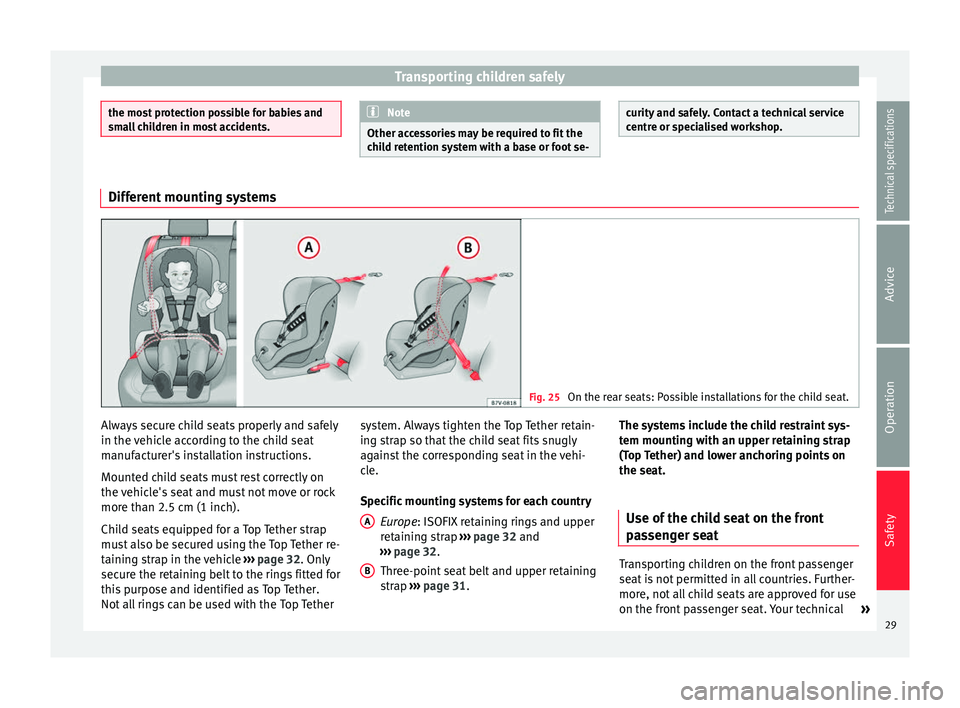
Different mounting systems
Fig. 25
On the rear seats: Possible installations for the child seat. Always secure child seats properly and safely
in the vehicle according to the child seat
manufacturer's installation instructions.
Mounted child seats must rest correctly on
the vehicle's seat and must not move or rock
more than 2.5 cm (1 inch).
Child seats equipped for a Top Tether strap
must also be secured using the Top Tether re-
taining strap in the vehicle
››› page 32. Only
secure the retaining belt to the rings fitted for
this purpose and identified as Top Tether.
Not all rings can be used with the Top Tether system. Always tighten the Top Tether retain-
ing strap so that the child seat fits snugly
against the corresponding seat in the vehi-
cle.
Specific mounting systems for each country
Europe : ISOFIX retaining rings and upper
r et
aining strap ››› page 32 and
››› page 32.
Three-point
seat belt and upper retaining
strap ››› page 31
.
A B The systems include the child restraint sys-
tem mounting with an upper retaining strap
(Top Tether) and lower anchoring points on
the seat.
Use of the child seat on the front
passenger seat Transporting children on the front passenger
seat is not permitted in all countries. Further-
more, not all child seats are approved for use
on the front passenger seat. Your technical
»
29
Technical specifications
Advice
Operation
Safety
Page 32 of 305
Safety
service centre has an updated list of all ap-
proved child seats. Only used child seats that
are approved for each vehicle.
The front airbag on the front passenger side
is highly dangerous for a child. The front pas-
senger seat is life-threatening to a child if he
or she is transported in a rear-facing child
seat.
If a rear-facing child seat is secured to the
front passenger seat, an inflating front airbag
can strike it with such great force that severe
or fatal injuries may result ››› . Therefore,
rear-facing child seats must never be placed
on the fr ont
passenger seat when the front
passenger front airbag is enabled.
Only use a rear-facing child seat on the front
passenger seat if the front passenger front
airbag is disabled. When it is disabled, the
yellow PASSENGER AIR BAG control lamp
on the dash panel will be lit ››› page 20. If
you cannot disable the front passenger front
airbag and it remains activated, it is forbid-
den to transport children on the front pas-
senger seat ››› .
Things to note if using a child seat on the
front passenger seat:
● The front passenger front airbag must be
disabled when using a rear-facing child
seat ››› page 25 .
● The se at
backrest of the front passenger
seat must be upright. ●
The front passenger seat must be moved as
far back as possible.
● The seat backrest of the front passenger
seat must be upright.
● The seat belt height adjustment must be as
high as possible.
Suitable child seats
The child seat must be authorised by the
manufacturer especially for use on a front
passenger seat with a front or side airbag.
If the front passenger seat is equipped with
retaining rings, the child seat can be secured
us
ing an approved retaining system provided
it is approved for this type of vehicle in ac-
cordance with current regulations of the
country in question.
Universal seats for children of groups 0, 0+,
1, 2 or 3 according to the standard ECE-R 44
can be mounted on the front passenger seat
and the rear seats. WARNING
If a child seat is mounted on the front passen-
ger seat, the risk of the child sustaining se-
vere or fatal injuries in the event of an acci-
dent increases. Rear-facing child seats must
never be mounted on the front passenger
seat when the front passenger front airbag is
enabled. This is life-threatening to the child
should the front airbag deploy, as the child seat would be struck by the inflated airbag
and thrown against the seat backrest.
WARNING
If, in exceptional circumstances, a child must
be transported in a rear-facing child seat on
the front passenger seat, strictly observe the
following:
● Always disable the front passenger front
airbag and leave it disabled.
● The child seat must be approved by the
manufacturer for use on a front passenger
seat with front and side airbag.
● Follow the installation instructions of the
child seat manufacturer and observe the
warnings.
● Move the front passenger seat as far back
as possible and adjust it to its highest posi-
tion to keep as far away as possible from the
front airbag.
● Move the seat backrest to the upright posi-
tion.
● The seat belt height adjustment must be as
high as possible.
● Children must always be protected with an
approved child restraint system suited to
their height and weight. Use of the child seat on the rear seat
If a child seat is mounted on the rear seat,
adapt the position of the front passenger
30
Page 33 of 305
Transporting children safely
seat so that the child has enough space.
Therefore, adapt the front passenger seat to
the size of the child seat and the height of
the child. Ensure the passenger is in the cor-
rect position
›
›› page 6.
Move the second and third rows of seats fully
back and lock them. Place the seat backs in a
vertical position and fold the head restraints
down.
ISOFIX child seats approved for rear seats
The rear seats are suitable for child seats
with the ISOFIX system spec
ially designed
for this type of vehicle in accordance with
regulation ECE-R 44.
ISOFIX child seats are divided into “specific
categories for the vehicle”, “limited” or
“semi-universal”.
Child seat manufacturers supply a list of ve-
hicles with each ISOFIX seat, which includes
the models for which the ISOFIX child seat in
question is approved. If the vehicle is inclu-
ded in the manufacturer's list and the ISOFIX
child seat belongs to a seat category inclu-
ded in the list, then it can be used in your ve-
hicle. If necessary, contact the child seat
manufacturer for an updated list of vehicles.
Group
(weight
category)ISOFIX child
seat categorySeat position in the rear seats
Group 0:to 10 kgEIUF a)
Group 0+:
to 13 kgEIUF a)
DIUFa)
CIUFa)
Group 1:
9 to 18 kg
DIUF a)
CIUFa)
BIUFa)
B1IUFa)
AIUFa)
a)
IUF: suitable for “universal” ISOFIX child seats authorised for
use in this group. WARNING
If child seats are fitted to all the seats in the
second row then it is possible that the seats
of this row cannot be folded down from the
third row of seats in case of an accident. In
the event of an emergency, passengers in the
third row of seats will not be able to leave the
vehicle or to help themselves.
● Child seats should never occupy all the
seats of the second row if other passengers
are to occupy the third row of seats. Securing child seats with the seat belt
Securing the child seat using the seat belt
● Please read and observe the child seat
manufacturer's handling instructions.
● Positioning the child seat on the seat ac-
cording to the manufacturer's instructions.
● The seat belt height adjustment must be as
high as possible.
● Fasten the seat belt or pass it around the
child seat structure in the manner described
in the manufacturer's instructions.
● Make sure the seat belt is not twisted.
● Insert the latch plate into the buckle for the
appropriate seat and push it down until it is
securely locked with an audible click.
● Ensure that the upper belt web lies tightly
on the child seat.
● Pull the belt (it must be no longer possible
to pull the lower belt webbing out).
Removing the child seat
The seat belt must not be unfastened until
the vehicle has come to a standstill ››› .
● Press the red button on the buckle. The
latch plate is released from the buckle.
● Guide the belt back by hand so that it rolls
up easily and the trim will not be damaged.
● Remove the child seat from the vehicle. »
31
Technical specifications
Advice
Operation
Safety
Page 34 of 305
Safety
WARNING
Unbuckling the seat belt while the vehicle is
in motion can cause severe or fatal injuries in
the event of an accident or sudden braking.
● The seat belt must not be unfastened until
the vehicle has come to a standstill. Fix the child seat with the lower
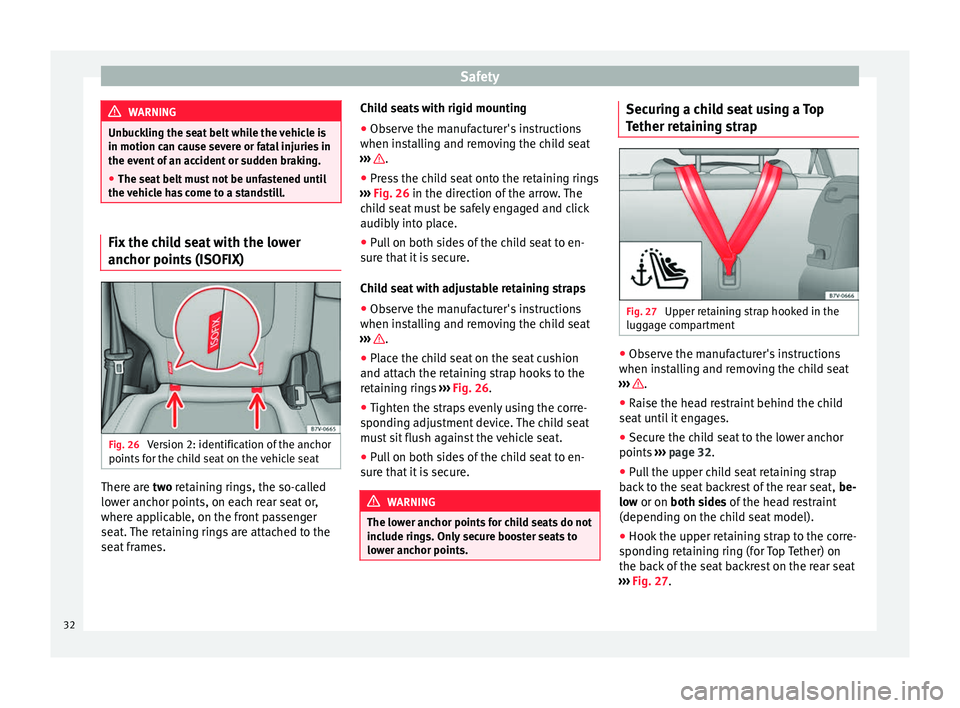
anchor points (ISOFIX)
Fig. 26
Version 2: identification of the anchor
points for the child seat on the vehicle seat There are
two
retaining rings, the so-called
lo
wer anchor points, on each rear seat or,
where applicable, on the front passenger
seat. The retaining rings are attached to the
seat frames. Child seats with rigid mounting
● Observe the manufacturer's instructions
when installing and removing the child seat
››› .
● Press the child seat onto the retaining rings
››› Fig. 26 in the direction of the arrow. The
c hi
ld seat must be safely engaged and click
audibly into place.
● Pull on both sides of the child seat to en-
sure that it is secure.
Child seat with adjustable retaining straps
● Observe the manufacturer's instructions
when installing and removing the child seat
››› .
● Place the child seat on the seat cushion
and attach the retaining strap hooks to the
retaining rings ››› Fig. 26 .
● Tight en the s
traps evenly using the corre-
sponding adjustment device. The child seat
must sit flush against the vehicle seat.
● Pull on both sides of the child seat to en-
sure that it is secure. WARNING
The lower anchor points for child seats do not
include rings. Only secure booster seats to
lower anchor points. Securing a child seat using a Top
Tether retaining strap
Fig. 27
Upper retaining strap hooked in the
luggage compartment ●
Observe the manufacturer's instructions
when installing and removing the child seat
››› .
● Raise the head restraint behind the child
seat until it engages.
● Secure the child seat to the lower anchor
points ››› page 32 .
● Pu
ll the upper child seat retaining strap
back to the seat backrest of the rear seat, be-
low or on both sides
of the head restraint
(depending on the child seat model).
● Hook the upper retaining strap to the corre-
sponding retaining ring (for Top Tether) on
the back of the seat backrest on the rear seat
››› Fig. 27.
32
Page 35 of 305
Transporting children safely
● Push the head restraint down as far as it
will go. Ensure that it does not interfere with
the seatbelt from the upper attachment.
● Tighten the strap so that the top of the
child seat rests on the seat backrest. WARNING
Child seats with lower anchor points and with
an upper retaining strap must be installed in
line with the manufacturer's instructions.
Failure to comply could result in severe inju-
ries.
● Always secure just one retaining strap from
a c hi
ld seat to a retaining ring (for Top Tether)
on the seat backrest on the rear seat in the
boot.
● Never secure a child seat to the retaining
rings.
● Never secure a child seat to the movable at-
tachment elements for vehicles with an at-
tachment element and rail system .Integrated child seat
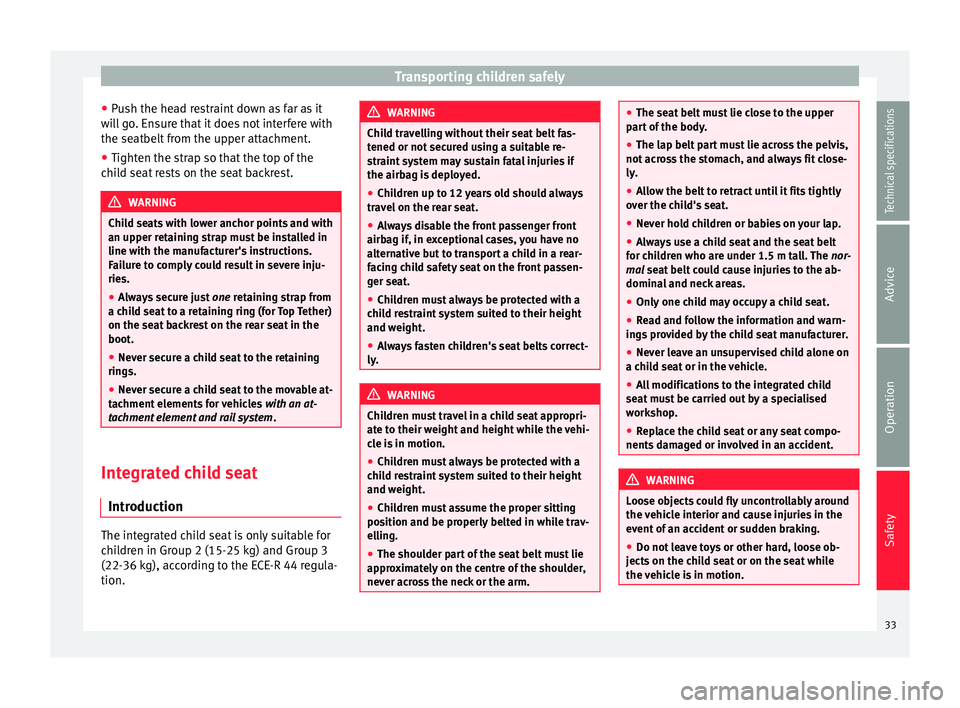
Introduction The integrated child seat is only suitable for
children in Group 2 (15-25 kg) and Group 3
(22-36 kg), according to the ECE-R 44 regula-
tion. WARNING
Child travelling without their seat belt fas-
tened or not secured using a suitable re-
straint system may sustain fatal injuries if
the airbag is deployed.
● Children up to 12 years old should always
travel on the rear seat.
● Always disable the front passenger front
airbag if, in exceptional cases, you have no
alternative but to transport a child in a rear-
facing child safety seat on the front passen-
ger seat.
● Children must always be protected with a
child restraint system suited to their height
and weight.
● Always fasten children's seat belts correct-
ly. WARNING
Children must travel in a child seat appropri-
ate to their weight and height while the vehi-
cle is in motion.
● Children must always be protected with a
child restraint system suited to their height
and weight.
● Children must assume the proper sitting
position and be properly belted in while trav-
elling.
● The shoulder part of the seat belt must lie
approximately on the centre of the shoulder,
never across the neck or the arm. ●
The seat belt must lie close to the upper
part of the body.
● The lap belt part must lie across the pelvis,
not across the stomach, and always fit close-
ly.
● Allow the belt to retract until it fits tightly
over the child's seat.
● Never hold children or babies on your lap.
● Always use a child seat and the seat belt
for children who are under 1.5 m tall. The nor-
mal seat belt could cause injuries to the ab-
domin a
l and neck areas.
● Only one child may occupy a child seat.
● Read and follow the information and warn-
ings provided by the child seat manufacturer.
● Never leave an unsupervised child alone on
a child seat or in the vehicle.
● All modifications to the integrated child
seat must be carried out by a specialised
workshop.
● Replace the child seat or any seat compo-
nents damaged or involved in an accident. WARNING
Loose objects could fly uncontrollably around
the vehicle interior and cause injuries in the
event of an accident or sudden braking.
● Do not leave toys or other hard, loose ob-
jects on the child seat or on the seat while
the vehicle is in motion. 33
Technical specifications
Advice
Operation
Safety
Page 37 of 305
Transporting children safely
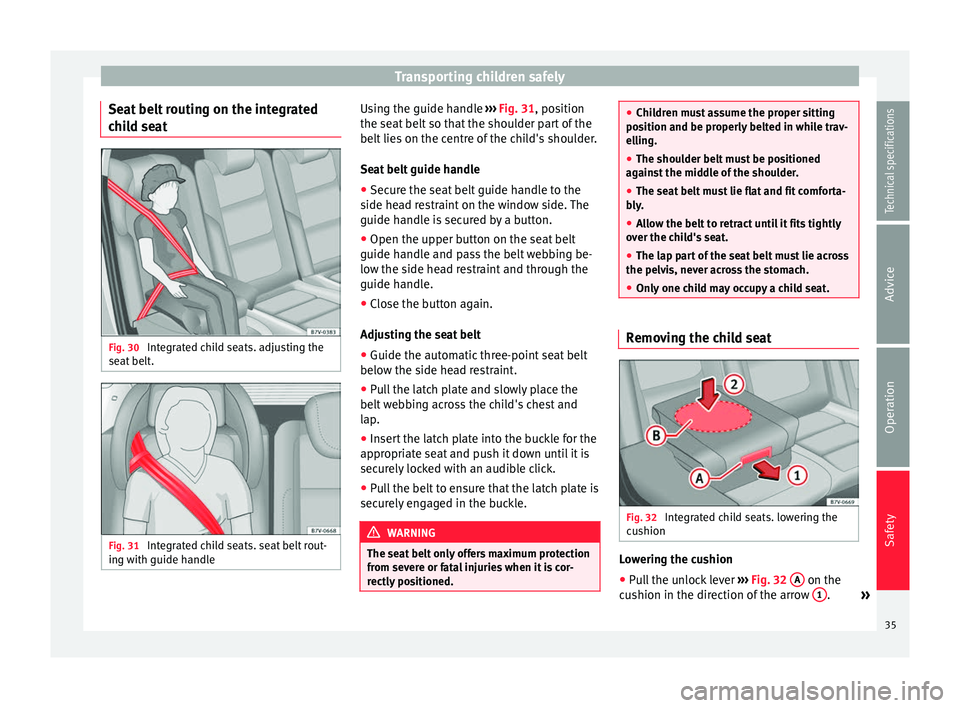
Seat belt routing on the integrated
child seat Fig. 30
Integrated child seats. adjusting the
seat belt. Fig. 31
Integrated child seats. seat belt rout-
ing with guide handle Using the guide handle
››› Fig. 31 , position
the se at
belt so that the shoulder part of the
belt lies on the centre of the child's shoulder.
Seat belt guide handle
● Secure the seat belt guide handle to the
side head restraint on the window side. The
guide handle is secured by a button.
● Open the upper button on the seat belt
guide handle and pass the belt webbing be-
low the side head restraint and through the
guide handle.
● Close the button again.
Adjusting the seat belt
● Guide the automatic three-point seat belt
below the side head restraint.
● Pull the latch plate and slowly place the
belt webbing across the child's chest and
lap.
● Insert the latch plate into the buckle for the
appropriate seat and push it down until it is
securely locked with an audible click.
● Pull the belt to ensure that the latch plate is
securely engaged in the buckle. WARNING
The seat belt only offers maximum protection
from severe or fatal injuries when it is cor-
rectly positioned. ●
Children must assume the proper sitting
position and be properly belted in while trav-
elling.
● The shoulder belt must be positioned
against the middle of the shoulder.
● The seat belt must lie flat and fit comforta-
bly.
● Allow the belt to retract until it fits tightly
over the child's seat.
● The lap part of the seat belt must lie across
the pelvis, never across the stomach.
● Only one child may occupy a child seat. Removing the child seat
Fig. 32
Integrated child seats. lowering the
cushion Lowering the cushion
● Pull the unlock lever ››› Fig. 32 A on the
cushion in the direction of the arrow 1 .
»
35
Technical specifications
Advice
Operation
Safety
Page 62 of 305
Operation
● Keyless-Entry: unlocking of the vehicle with
the handles on the four doors or the button
located on the boot hatch.
● Keyless-Go: engine ignition and driving. For
this to occur, there has to be a valid key in-
side the vehicle and the ignition push button
needs to be pressed ››› page 133.
● Keyless-Exit: unlocking of the vehicle with
one of the four door handle.
The central locking and locking systems oper-
ate in the same way as a normal locking and
u n
locking system. Only the controls change.
Unlocking the vehicle is confirmed with a
double flash of the indicator lights; locking
by
a single flash.
The vehicle will lock again after a few sec-
onds if you unlock the vehicle but fail to open
any door or boot hatch.
Unlocking and opening the doors (Keyless-
Entry)
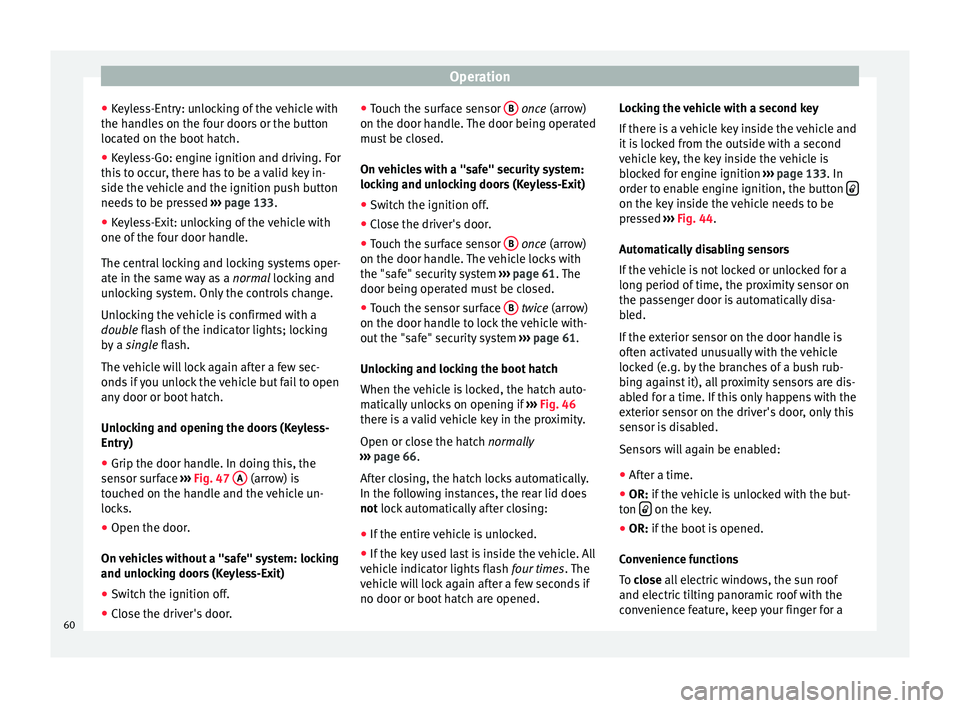
● Grip the door handle. In doing this, the
sensor surface ››› Fig. 47 A (arrow) is
touched on the handle and the vehicle un-
locks.
● Open the door.
On vehicles without a "safe" system: locking
and unlocking doors (Keyless-Exit)
● Switch the ignition off.
● Close the driver's door. ●
Touch the surface sensor B
once
(arrow)
on the door h
andle. The door being operated
must be closed.
On vehicles with a "safe" security system:
locking and unlocking doors (Keyless-Exit)
● Switch the ignition off.
● Close the driver's door.
● Touch the surface sensor B
once
(arrow)
on the door h
andle. The vehicle locks with
the "safe" security system ››› page 61. The
door being operated must be closed.
● Touch the sensor surface B
twice
(arrow)
on the door h
andle to lock the vehicle with-
out the "safe" security system ››› page 61.
Unlocking and locking the boot hatch
When the vehicle is locked, the hatch auto-
matically unlocks on opening if ››› Fig. 46
there is a valid vehicle key in the proximity.
Open or close the hatch normally
››
› page 66.
Aft
er closing, the hatch locks automatically.
In the following instances, the rear lid does
not
lock automatically after closing:
● If the entire vehicle is unlocked.
● If the key used last is inside the vehicle. All
vehicle indicator lights flash four times. The
vehicle will lock again after a few seconds if
no door or boot hatch are opened. Locking the vehicle with a second key
If there is a vehicle key inside the vehicle and
it is locked from the outside with a second
vehicle key, the key inside the vehicle is
blocked for engine ignition
››› page 133. In
order to enable engine ignition, the button on the key inside the vehicle needs to be
pressed
››› Fig. 44 .
Aut om
atically disabling sensors
If the vehicle is not locked or unlocked for a
long period of time, the proximity sensor on
the passenger door is automatically disa-
bled.
If the exterior sensor on the door handle is
often activated unusually with the vehicle
locked (e.g. by the branches of a bush rub-
bing against it), all proximity sensors are dis-
abled for a time. If this only happens with the
exterior sensor on the driver's door, only this
sensor is disabled.
Sensors will again be enabled:
● After a time.
● OR:
if the vehicle is unlocked with the but-
ton on the key.
● OR: if the boot is opened.
C on
venience functions
To
close all electric windows, the sun roof
and electric tilting panoramic roof with the
convenience feature, keep your finger for a
60
Page 63 of 305
Opening and closing
few seconds on the lock sensor surface
››› Fig. 47 B located on the exterior part of
the driver or passenger door handle until the
windows and roof close.
Opening the doors by touching the sensor
s ur
face on the handle takes places in accord-
ance with the settings activated on the menu
Configuration - Convenience ››› page 47. CAUTION
The sensor surfaces on the door handles
could engage if hit with a water jet or high
pressure steam if there is a valid vehicle key
in the nearby area. If at least one of the win-
dows is open and the sensor surface B on
one of the handle permanently activates, all
windows will close. If the water jet or steam
is briefly moved away from the sensor sur-
face A on one of the handles and then poin-
ted at it again, all the windows will probably
open ››› page 60, Convenience functions. Note
● If the vehicle battery has little or no charge,
or the vehicle key battery is almost or entire-
ly out of charge, it is likely that the vehicle
will not be able to be lock or unlocked with
the Keyless Access system. The vehicle can
be unlocked or locked manually ››› page 259.
● If there is no valid key inside the vehicle or
the system fails to detect one, a warning will
display on the dash panel screen. This could
happen if any other radio frequency signal in- terferes with the key signal (e.g. from a mo-
bile device accessory) or if the key is covered
by another object (e.g. an aluminium case).
● If the sensors are very dirty, e.g. have a lay-
er of salt, how the sensors on the door han-
dles operate may be affected. If this is the
case, wash the vehicle ››› page 195.
● If the vehicle is equipped with an automatic
gearbox, it may only be locked in the gear
stick is in position P. Deadlock
FunctionNecessary operations
Locks the vehicle with
the "Safe" security sys-
tem.Press the button once on
the vehicle key.
Locks the vehicle with-
out the "Safe" security
system.
Press the button twice on
the vehicle key.
Touch the Keyless Access
close and ignition lock sensor
surface located on the exteri-
or part of the door handle
twice ››› page 59.
Press the central locking but-
ton on the driver door
once. Depending on the vehicle, when disabling
the ignition, a warning on the dash panel
screen may display stating that the "safe" se-curity system is activated (
Lock SAFE or SAFE-
L OCK
).
Disabling the "safe" security system
The "safe" security system may be disable in
one of the following ways:
● Press the button on the vehicle key
twice .
● Touc
h the Keyless Access close and igni-
tion lock sensor surface located on the exteri-
or part of the door handle twice ››› p
age 59.
● Switch the ignition on.
● Press the ignition push button of the
Keyless Access lock and ignition system.
When the “safe” security system is disabled,
the following needs to be taken into account:
● The vehicle can be opened and unlocked
from the inside using an inside door handle.
● The anti-theft alarm is activated.
● The vehicle interior monitoring system and
the anti-tow system are disabled. WARNING
Careless use of the “Safe” security system
can cause serious injury.
● Never leave anybody inside the vehicle if it
has been locked using the key. When the
"Safe" security system is activated, doors
cannot be opened from the inside! » 61
Technical specifications
Advice
Operation
Safety
Page 83 of 305
Lights and visibility
Vanity mirror light
There may be a vanity mirror, with a cover, on
the rear of the sun visor. When the cover is
opened ››› Fig. 63 2 a light comes on.
The lamp goes out when the vanity mirror
cover is closed or the sun visor is pushed
back up. WARNING
Sun visors and sun blinds may reduce visibili-
ty when open.
● Always roll or fold sun blinds and visors
away when not in use. Note
The light above the sun visor automatically
switches off after a few minutes in certain
conditions. This prevents the battery from
discharging. Rear side window sun blinds
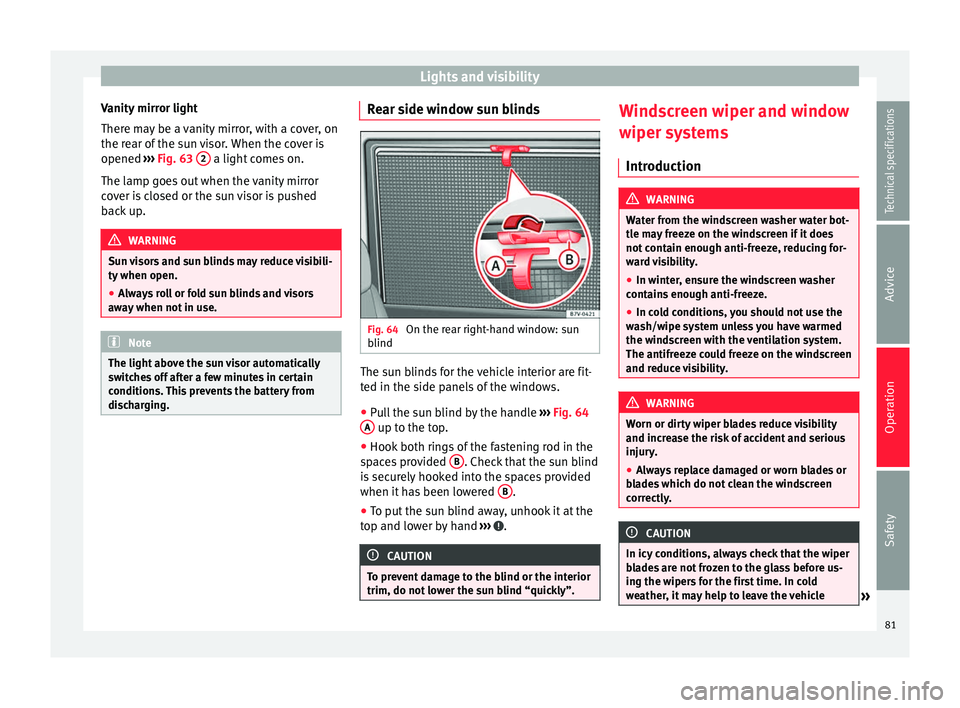
Fig. 64
On the rear right-hand window: sun
blind The sun blinds for the vehicle interior are fit-
ted in the side panels of the windows.
● Pull the sun blind by the handle ›››
Fig. 64
A up to the top.
● Hook both rings of the fastening rod in the
spaces provided B . Check that the sun blind
is securely hooked into the spaces provided
when it has been lowered B .
● To put the sun blind away, unhook it at the
top and lower by hand ››› .
CAUTION
To prevent damage to the blind or the interior
trim, do not lower the sun blind “quickly”. Windscreen wiper and window
wiper systems
Introduction WARNING
Water from the windscreen washer water bot-
tle may freeze on the windscreen if it does
not contain enough anti-freeze, reducing for-
ward visibility.
● In winter, ensure the windscreen washer
contains enough anti-freeze.
● In cold conditions, you should not use the
wash/wipe system unless you have warmed
the windscreen with the ventilation system.
The antifreeze could freeze on the windscreen
and reduce visibility. WARNING
Worn or dirty wiper blades reduce visibility
and increase the risk of accident and serious
injury.
● Always replace damaged or worn blades or
blades which do not clean the windscreen
correctly. CAUTION
In icy conditions, always check that the wiper
blades are not frozen to the glass before us-
ing the wipers for the first time. In cold
weather, it may help to leave the vehicle » 81Technical specifications
Advice
Operation
Safety
Page 92 of 305
Operation
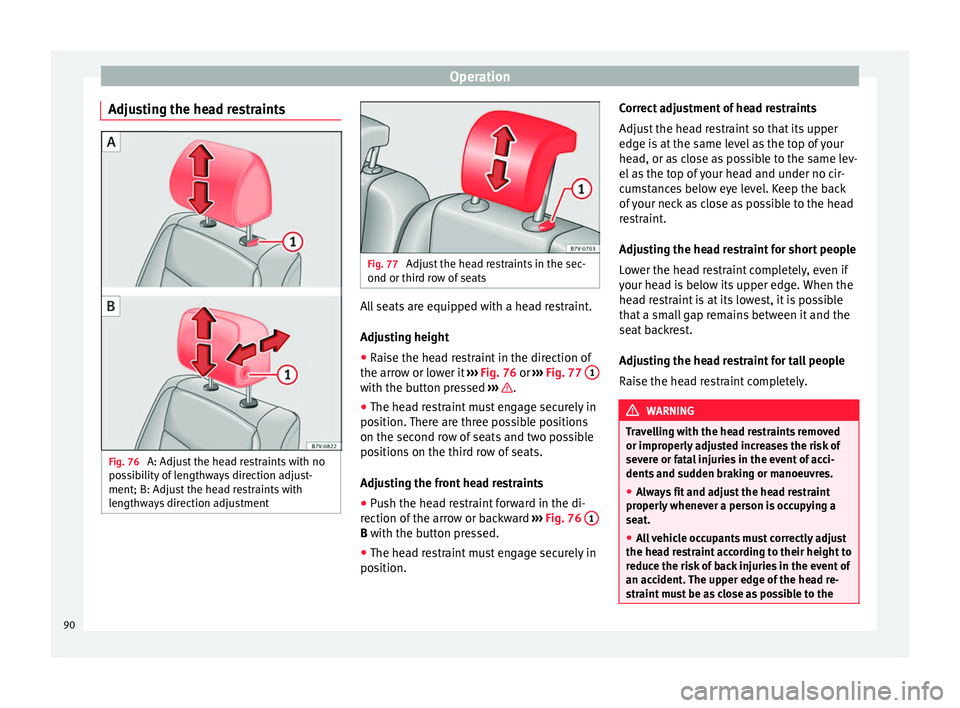
Adjusting the head restraints Fig. 76
A: Adjust the head restraints with no
possibility of lengthways direction adjust-
ment; B: Adjust the head restraints with
lengthways direction adjustment Fig. 77
Adjust the head restraints in the sec-
ond or third row of seats All seats are equipped with a head restraint.
Adjusting height
● Raise the head restraint in the direction of
the arrow or lower it ››› Fig. 76 or
›
›› Fig. 77 1 with the button pressed
››› .
● The head restraint must engage securely in
position. There are three possible positions
on the second row of seats and two possible
positions on the third row of seats.
Adjusting the front head restraints
● Push the head restraint forward in the di-
rection of the arrow or backward ››› Fig. 76 1 B
with the button pressed.
● The he a
d restraint must engage securely in
position. Correct adjustment of head restraints
Adjust the head restraint so that its upper
edge is at the same level as the top of your
head, or as close as possible to the same lev-
el as the top of your head and under no cir-
cumstances below eye level. Keep the back
of your neck as close as possible to the head
restraint.
Adjusting the head restraint for short people
Lower the head restraint completely, even if
your head is below its upper edge. When the
head restraint is at its lowest, it is possible
that a small gap remains between it and the
seat backrest.
Adjusting the head restraint for tall people
Raise the head restraint completely.
WARNING
Travelling with the head restraints removed
or improperly adjusted increases the risk of
severe or fatal injuries in the event of acci-
dents and sudden braking or manoeuvres.
● Always fit and adjust the head restraint
properly whenever a person is occupying a
seat.
● All vehicle occupants must correctly adjust
the head restraint according to their height to
reduce the risk of back injuries in the event of
an accident. The upper edge of the head re-
straint must be as close as possible to the 90