phone Seat Alhambra 2015 User Guide
[x] Cancel search | Manufacturer: SEAT, Model Year: 2015, Model line: Alhambra, Model: Seat Alhambra 2015Pages: 305, PDF Size: 5.46 MB
Page 191 of 305
Care and maintenance
Advice
Care and maintenance
Accessories, replacement of
parts and modifications Introduction WARNING
The use of spare parts and accessories, or in-
correctly performed modifications or repairs
may result in damage to the vehicle, acci-
dents and serious injury.
● SEAT strongly recommends you to only use
SEAT approved accessories and SEAT ®
origi-
nal spare parts. These parts and accessories
have been specially tested by SEAT for suita-
bility, reliability and safety.
● Have any repairs or modifications carried
out at a specialised workshop. These work-
shops have the necessary tools, diagnostics
equipment, repair information and qualified
personnel.
● Only mount parts with the same specifica-
tions as the parts fitted at factory.
● Never mount, fasten or fit objects such as
drink holders or telephone cradles over the
covers of the airbag modules or within their
radius of action. ●
Only use wheels and tyre combinations
which have been approved by SEAT for your
vehicle type. Accessories and spare parts
SEAT recommends you consult an Official
Service before purchasing accessories and
spare parts or consumables. For example,
when fitting accessories at a later date, or
when replacing a component. A technical
service centre will advise you as to the legal
requirements and manufacturer's recommen-
dations regarding accessories, spare parts
and other components.
SEAT recommend you use only approved
SEAT accessories
and
genuine SEAT spare
p
arts ®
. These parts and accessories have
been specially tested by SEAT for suitability,
reliability and safety. In addition the techni-
cal service centre will guarantee that the as-
sembly is carried out professionally.
Although we continually monitor the market,
SEAT cannot guarantee that products not ap-
proved by SEAT are reliable, safe and suita-
ble for the vehicle. Therefore, SEAT cannot ac-
cept liability, even in those cases authorised
by an officially recognised technical inspec-
tion office or other official body.
Any retro-fitted equipment which has a direct
effect
on the vehicle and/or the way it is driv- en must be approved by SEAT for use in your
vehicle and bear the e mark (the European
Union's authorisation symbol). This includes
cruise control systems or electronically con-
trolled suspension.
If any
additional electrical devices are fitted
which do not serve to control the vehicle it-
self, these must bear the mark (European
Union manuf
acturer conformity declaration).
This includes refrigerator boxes, laptops or
ventilator fans. WARNING
Unprofessional repairs or modifications to
the vehicle may affect the performance of the
airbags, and may cause operating faults or fa-
tal accidents.
● Never mount, fasten or fit objects such as
drink holders or telephone cradles over the
covers of the airbag modules or within their
radius of action.
● Objects placed over the airbag covers, or
within their radius of action, could lead to se-
rious injury or loss of life if the airbags are
triggered. Fluids and consumables
All vehicle fluids and consumables
, such as
notched belts, tyres, coolant fluids, engine
oils, spark plugs and batteries are continual-
ly being developed. Therefore all fluids and »
189Technical specifications
Advice
Operation
Safety
Page 194 of 305
Advice
Check first with a specialised workshop that
understands the technical possibilities of in-
stallation if you wish to use a two-way radio
with a transmitting power of over 10 watts.
SEAT recommends taking your car in for tech-
nical service.
All legal requirements, together with the in-
structions for the use of two-way radios must
be observed. WARNING
If the two-way radio is not securely fastened
in position, it could be sent flying around the
vehicle in the event of sharp braking, sudden
manoeuvres or accident, causing injury.
● While driving, two-way radios must be se-
curely fastened in position, outside the radi-
us of action of the airbags, or safely stowed
away. WARNING
When using a two-way radio without a con-
nection to an exterior aerial, the maximum
permitted levels of electromagnetic radiation
may be exceeded. This is also the case if the
aerial has not been correctly installed.
● You should only use a two-way radio inside
the vehicle if it has first been correctly con-
nected to an exterior aerial. Information stored by the control
units
Your vehicle is fitted at the factory with a ser-
ies of electronic control units responsible for
the engine and gearbox management. In ad-
dition, the control units supervise the per-
formance of the exhaust gas system and the
airbag systems.
Therefore, while the vehicle is being driven,
these electronic control units are continuous-
ly analysing the vehicle data. In the event of
faults or deviations from the theoretical val-
ues, only this data is stored. Normally, the
warning lamps on the instrument panel light
up in the event of faults.
This data can only be read and analysed us-
ing special equipment.
The storing of the data allows specialised
workshops to detect and repair faults. Stored
data may include:
● Data relating to the engine or the gearbox
● Speed
● Direction of travel
● Braking force
● Detection of seat belt
The vehicle control units never record conver-
sations held by passengers in the vehicle.
In vehicles equipped with an emergency call
function via the mobile phone or other appli- ances connected in the vehicle, it is possible
to send the vehicle position. If the control
unit records an accident with airbag activa-
tion, the system may automatically send a
signal. This will depend on the network oper-
ator. Normally, transmission is only possible
in areas with good coverage.
Event Data Recorder
The vehicle is
not
fitted with an event data re-
c or
der.
An event data recorder temporarily stores the
vehicle information. Therefore, in the event of
an accident, it is possible to obtain detailed
information about how the accident occur-
red. For example, in vehicles with airbag sys-
tems, data relating to speed of impact, seat
belt status, seat positions and airbag activa-
tion times may be stored. The volume of data
depends on the manufacturer.
Event data recorders can only be mounted
with authorisation from the vehicle owner
and, in some countries, they are governed by
local legislation.
Reprogramming control units
On the whole, all the data required for the
component management is stored in the con-
trol units. The programming of certain con-
venience functions, such as the turn signals,
individual door opening and instructions on
the display can be modified using special
192
Page 195 of 305
Care and maintenance
equipment at the workshop. If this is the
case, the information and descriptions given
in the Instruction Manual will not match the
original functions. Therefore, SEAT recom-
mends that any modifications be recorded in
the section “Other workshop notes” in the
Maintenance Programme.
The technical service centre must have a re-
cord of any modification to the programming.
Reading the vehicle fault memory
There is a diagnostics connector in the vehi-
cle interior for reading the vehicle fault mem-
ory. The fault memory documents errors and
deviations from the theoretical values of the
electronic control units.
The diagnostics connector is in the driver
side footwell area, next to the lever for open-
ing the bonnet, below a cover.
The fault memory should only be read and re-
set by a specialised workshop.
Using a mobile telephone in a vehicle
without connection to an exterior
aerial Mobile telephones transmit and receive radio
waves, both when in use and when on stand-
by. Scientific studies state that radio waves
exceeding certain values may be harmful to
the human body. International committees and authorities have established limits and
directives in order to ensure electromagnetic
radiation from mobile phones remains within
certain limits that do not endanger health.
Nevertheless, there is no conclusive scientif-
ic evidence that wireless telephones are to-
tally safe.
Therefore, some experts recommend that use
of mobile phone be kept to a minimum until
the results of current research are published.
When a mobile phone not connected to an
exterior aerial is used inside the vehicle, the
electromagnetic radiation may be greater
than if the mobile phone were connected to a
built-in aerial or to another exterior aerial.
If the vehicle is fitted with a suitable hands-
free device, it will comply with the legislation
in many countries which only permits the use
of mobile phones inside vehicles using a
hands-free device.
The hands-free system mounted at the facto-
ry has been designed for use with conven-
tional mobile phones and phones with Blue-
tooth technology. Mobile phones should be
placed on a suitable phone cradle. In addi-
tion, the cradle should always be correctly fit-
ted into the base plate. This ensures that the
mobile phone is securely attached to the
dash panel, it is always within reach of the
driver and is connected to the vehicle exterior
aerial.
If the mobile phone is connected to an aerial
incorporated into the vehicle or an exterior
aerial connected to the vehicle, it will help re-
duce the electromagnetic radiation transmit-
ted and the risk to human health. It will also
improve the quality of the connection.
If the phone is used inside the vehicle with-
out the hands-free system, it will not be se-
curely fastened and will not be connected to
the exterior aerial of the vehicle telephone.
Nor will the telephone charge if it is not on
the support. In addition, some calls may
break off and the quality of the connection
will be affected.
Mobile phones should only be used inside
the vehicle if they are connected to a hands-
free system with an exterior aerial.
WARNING
If the mobile phone is not securely fastened
in position, it could be sent flying around the
vehicle in the event of sharp braking, sudden
manoeuvres or accident, causing injury.
● While driving, mobile phones must be se-
curely fastened in position, outside the radi-
us of action of the airbags, or safely stowed
away. WARNING
When using a mobile phone without a con-
nection to an exterior aerial, the maximum
permitted levels of electromagnetic radiation » 193Technical specifications
Advice
Operation
Safety
Page 196 of 305
Advice
may be exceeded. This is also the case if the
aerial has not been correctly installed.
●
A minimum of 20 centimetres should be
kept between mobile phone aerials and artifi-
cial pacemakers, as mobile telephones may
affect the working of pacemakers.
● Do not keep mobile phones in breast pock-
ets directly above pacemakers.
● Switch off the mobile phone immediately if
you suspect there may be interference. Jacking points for raising vehicle
Fig. 156
Front jacking points for raising vehi-
cle with lifting platform or jack Fig. 157
Rear jacking points for raising vehi-
cle with lifting platform or jack Always use the jacking points indicated in
the figures
››› Fig. 156 and
›
›› Fig. 157 when
raising the vehicle. If the vehicle is not lifted
at these points, it could be seriously dam-
aged ››› or lead to serious injury
››› .
The vehicle should not be lifted using lifting
platforms with lift pads containing fluid.
When raising a vehicle using a platform or
jack, a series of precautionary measures are
required. Do not raise the vehicle with a lift-
ing platform or jack unless you have received
training in how to do so and know how to do
so safely.
Notes on raising the vehicle with a jack
››› page 249 . WARNING
The improper use of the lifting platform or
the jack when raising the vehicle may result
in accidents or serious injury.
● Before raising the vehicle, please observe
the manufacturer's instructions for the plat-
form or jack, and the legal requirements,
where applicable.
● There should not be anyone inside the ve-
hicle when it is being raised or once it is in
the air.
● Only use the jacking points indicated in the
figures ››› Fig. 156 and ››› Fig. 157
when rais-
ing the
vehicle. If the vehicle is not lifted at
the indicated points, it may fall from the plat-
form while the engine or gearbox is being
dismounted, for example.
● The jacking points should be centrally
aligned and firmly positioned on the platform
support plates.
● Never start the engine when the vehicle is
raised! The vehicle may fall from the platform
due to the engine vibrations.
● If it is necessary to work underneath the ve-
hicle while it is raised, you should check that
the supporting stands have an adequate load
capacity.
● Never climb onto the lifting platform.
● Always make sure that the weight of the ve-
hicle does not exceed the lifting platform
load capacity. 194
Page 208 of 305
Advice
Note
If electrical equipment is used near an aerial
built-into the window, you may observe inter-
ference in the reception of AM stations. Notes on SEAT repairs
WARNING
Repairs or modifications which are not per-
formed correctly may result in damage or er-
rors in the vehicle operation, affecting the ef-
fectiveness of the driver assist and airbag
systems. This could result in serious acci-
dent.
● Have any repairs or modifications carried
out at a specialised workshop. Collection and scrapping of end-of-life
vehicles
Collection of end-of-life vehicles
An extensive network of used car reception
centres already exists in much of Europe. Af-
ter the vehicle has been delivered, you will
receive a certificate of destruction describing
the environmentally friendly scrapping of the
vehicle in accordance with applicable legisla-
tion. We will collect the used vehicle free of
charge, provided it complies with all national
legislation.
Please see your technical service for further
information about the collection and scrap-
ping of end-of-life vehicles.
Scrapping
The relevant safety requirements must be ob-
served when the vehicle or components of
the airbag or belt tensioner systems are
scrapped. These requirements are known to
specialised workshops. Checking and refilling levels
Filling the tank Introduction The fuel tank flap is on the rear right of the
vehicle.
WARNING
Refuelling or handling fuel carelessly can
cause an explosion or fire resulting in serious
burns and injuries.
● Always make sure that you correctly close
the fuel cap to avoid evaporation and fuel
spillage.
● Fuels are highly explosive and inflammable
substances that can cause serious burns and
injuries.
● Fuel could leak out or be spilt if the engine
is not switched off or if the filler fuel nozzle is
not fully inserted into the tank filler neck
when refuelling. This could lead to a fire, ex-
plosion and severe injuries.
● When refuelling, turn off the engine, the
auxiliary heating ( ››› page 128) and turn off
the ignition f or s
afety reasons.
● Always turn off mobile telephones, radio
apparatus and other radio wave emitting
equipment before refuelling. Electromagnetic
waves could cause sparks and lead to a fire. 206
Page 210 of 305
Advice
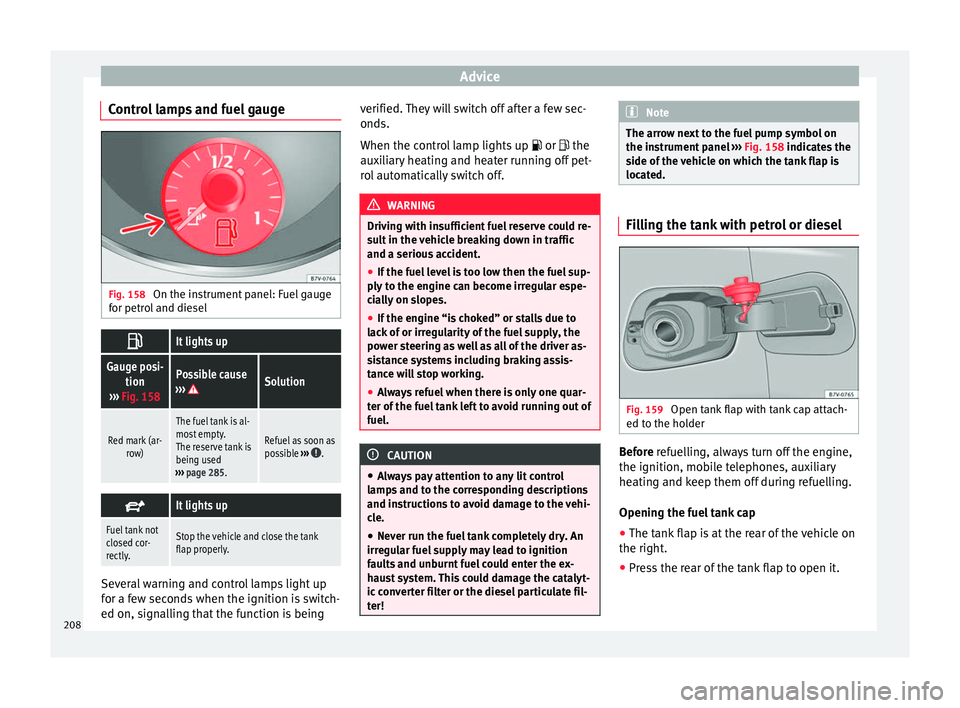
Control lamps and fuel gauge Fig. 158
On the instrument panel: Fuel gauge
for petrol and diesel It lights up
Gauge posi-
tion
››› Fig. 158Possible cause
››› Solution
Red mark (ar- row)
The fuel tank is al-most empty.
The reserve tank is
being used
››› page 285.
Refuel as soon as
possible ››› .
It lights up
Fuel tank not
closed cor-
rectly.Stop the vehicle and close the tank
flap properly.
Several warning and control lamps light up
for a few seconds when the ignition is switch-
ed on, signalling that the function is being verified. They will switch off after a few sec-
onds.
When the control lamp lights up
or
the
auxiliary heating and heater running off pet-
rol automatically switch off. WARNING
Driving with insufficient fuel reserve could re-
sult in the vehicle breaking down in traffic
and a serious accident.
● If the fuel level is too low then the fuel sup-
ply to the engine can become irregular espe-
cially on slopes.
● If the engine “is choked” or stalls due to
lack of or irregularity of the fuel supply, the
power steering as well as all of the driver as-
sistance systems including braking assis-
tance will stop working.
● Always refuel when there is only one quar-
ter of the fuel tank left to avoid running out of
fuel. CAUTION
● Always pay attention to any lit control
lamps and to the corresponding descriptions
and instructions to avoid damage to the vehi-
cle.
● Never run the fuel tank completely dry. An
irregular fuel supply may lead to ignition
faults and unburnt fuel could enter the ex-
haust system. This could damage the catalyt-
ic converter filter or the diesel particulate fil-
ter! Note
The arrow next to the fuel pump symbol on
the instrument panel ››› Fig. 158 indicates the
s ide of
the vehicle on which the tank flap is
located. Filling the tank with petrol or diesel
Fig. 159
Open tank flap with tank cap attach-
ed to the holder Before
refuelling, always turn off the engine,
the ignition, mo b
ile telephones, auxiliary
heating and keep them off during refuelling.
Opening the fuel tank cap
● The tank flap is at the rear of the vehicle on
the right.
● Press the rear of the tank flap to open it.
208
Page 255 of 305
Emergencies
●
Protect hands and skin from hot parts.
● Do not place the air compressor or inflator
tube onto flammable materials while they are
hot.
● Before storing the equipment, let it cool.
● If a minimum pressure of 2.0 bar
(29 psi / 200 kPa) cannot be reached, the tyre
is badly damaged. In this instance, the seal-
ant will not be able to seal the tyre. Do not
continue driving. Seek specialist assistance. CAUTION
The air compressor should be turned off after
a maximum of 8 minutes since otherwise it
will overheat. Before switching it on again, let
it cool for a few minutes. Check after 10 minutes of driving
Screw the inflator tube
››› Fig. 190 8 again
and check the tyre pressure on the gauge 7 .
Equal to or below 1.3 bar (19 psi/130 kPa):
● Stop driving! The tyre could not be suffi-
c iently
sealed with the tyre mobility system.
● You should obtain professional assistance
››› .
Equal to or above 1.4 bar (20 psi/140 kPa):
● Correct the tyre pressure until the correct
level is reached ››› page 231 . ●
Car
efully head to the nearest specialised
workshop at a maximum speed of 80 km/h
(50 mph).
● Ask the workshop to change the damaged
tyre. WARNING
Driving with a tyre that cannot be sealed is
dangerous and may lead to accidents and se-
rious injury.
● Do not continue driving if the tyre pressure
is 1.3 bar (19 psi / 130 kPa) or lower.
● Seek specialist assistance. Starting assistance
Introduction If the engine fails to start because of a dis-
charged battery, the battery of another vehi-
cle can be used to start the engine. Before
starting, check the magic eye on the battery
››› page 227 .
F or s
tarting assistance, jump lead cables con-
forming to the standard DIN 72553 are re-
quired (see the cable manufacturer instruc-
tions). The jump lead cable must be at least
25 mm 2
in section (0.038 inches 2
) for petrol
engines, and 35 mm 2
(0.054 inches 2
) for die-
sel engines. For vehicles whose battery is not in the en-
gine compartment, the jump leads should
only be connected to the starting assistance
connection points in the engine compart-
ment.
WARNING
Incorrect use of jump leads and incorrectly
jump starting could cause the battery to ex-
plode resulting in serious injury. Please ob-
serve the following rules to minimise the risk
of a battery explosion:
● The battery providing current must have
the same voltage (12V) and approximately
the same capacity (see markings on battery)
as the flat battery.
● Never charge a frozen or recently thawed
battery. A flat battery can also freeze at tem-
peratures close to 0 °C (+32 °F).
● If a battery is frozen and/or has been frozen
then it must be replaced.
● A highly explosive mixture of gases is re-
leased when the battery is being charged. Al-
ways keep lit cigarettes, flames, sparks and
fire far from the battery. Never use a mobile
telephone when connecting and removing the
jump leads.
● Charge the battery only in well ventilated
areas given that when the battery is charged
by outside assistance, it creates a mix of
highly explosive gases.
● Jump leads should never enter into contact
with moving parts in the engine compart-
ment. » 253
Technical specifications
Advice
Operation
Safety
Page 296 of 305
Index
Headlight range control . . . . . . . . . . . . . . . . . . . 79
Instrument lighting . . . . . . . . . . . . . . . . . . . . . . . 79
Interior lights . . . . . . . . . . . . . . . . . . . . . . . . . . . 80
Leaving home . . . . . . . . . . . . . . . . . . . . . . . . . . . 78
Main beam lever . . . . . . . . . . . . . . . . . . . . . . . . . 76
Parking light . . . . . . . . . . . . . . . . . . . . . . . . . . . . 76
Reading lights . . . . . . . . . . . . . . . . . . . . . . . . . . . 80
Remote control . . . . . . . . . . . . . . . . . . . . . . . . . 129
Switch lighting . . . . . . . . . . . . . . . . . . . . . . . . . . 79
Turn signal lever . . . . . . . . . . . . . . . . . . . . . . . . . 76
Load Driving with the rear lid open . . . . . . . . . . . . . . 99
Transporting a load . . . . . . . . . . . . . . . . . . . . . . 99
Loading . . . . . . . . . . . . . . . . . . . . . . . . . . . . . . . . . 100 Fastening rings . . . . . . . . . . . . . . . . . . . . . . . . . 105
General advice . . . . . . . . . . . . . . . . . . . . . . . . . . 98
Loading luggage compartment . . . . . . . . . . . . 100
Net partition . . . . . . . . . . . . . . . . . . . . . . . . . . . 104
Rails and attachment system . . . . . . . . . . . . . . 106
Roof carrier system . . . . . . . . . . . . . . . . . . . . . . 111
Trailer . . . . . . . . . . . . . . . . . . . . . . . . . . . . . . . . . 185
Loading the vehicle . . . . . . . . . . . . . . . . . . . . . . . . . . . . . . . . . . . . . . . 98
Lock vehicle, with Keyless Access . . . . . . . . . . . . . . . 59
Locking From the inside . . . . . . . . . . . . . . . . . . . . . . . . . . 59
Rear lid . . . . . . . . . . . . . . . . . . . . . . . . . . . . . . . . 68
The rear lid . . . . . . . . . . . . . . . . . . . . . . . . . . . . . 58
The vehicle from the outside . . . . . . . . . . . . . . . 58
Locking button . . . . . . . . . . . . . . . . . . . . . . . . . . . 145
Locking the vehicle with Keyless Access . . . . . . . . . . . . . . . . . . . . . . 59
Luggage compartment Extension . . . . . . . . . . . . . . . . . . . . . . . . . . . . . 101
Folding down rear seats to create load space 101
Luggage compartment lighting . . . . . . . . . . . . . 80 Net . . . . . . . . . . . . . . . . . . . . . . . . . . . . . . . . . . . 109
Net partition . . . . . . . . . . . . . . . . . . . . . . . . . . . 104
Rails and attachment system . . . . . . . . . . . . . . 106
Luggage compartment baggage net . . . . . . . . . . 109
M Main beam headlight . . . . . . . . . . . . . . . . . . . . . . . 75
Main beam lever . . . . . . . . . . . . . . . . . . . . . . . . . . . 76
Main panel Turn signal and main beam lever . . . . . . . . . . . 76
Maintenance and cleaning . . . . . . . . . . . . . . . . . 189
Malfunction Automatic gearbox . . . . . . . . . . . . . . . . . 146, 147
Catalytic converter . . . . . . . . . . . . . . . . . . . . . . 152
Diesel particulate filter . . . . . . . . . . . . . . . . . . . 152
DSG automatic gearbox . . . . . . . . . . . . . . . . . . 146
DSG Automatic gearbox . . . . . . . . . . . . . . . . . . 147
Lane assist system . . . . . . . . . . . . . . . . . . . . . . 172
Manual gearbox . . . . . . . . . . . . . . . . . . . . . . . . . . 143 Please also see "Changing gears" . . . . . . . . . 143
MEDIA-IN connection . . . . . . . . . . . . . . . . . . . . . . 112
Menus Structure . . . . . . . . . . . . . . . . . . . . . . . . . . . . . . . 47
Mirrors Adjusting passenger mirror . . . . . . . . . . . . . . . . 86
Convenience function . . . . . . . . . . . . . . . . . . . . . 86
Exterior mirrors . . . . . . . . . . . . . . . . . . . . . . . . . . 86
Folding exterior mirrors . . . . . . . . . . . . . . . . . . . 87
Rear vision mirror . . . . . . . . . . . . . . . . . . . . . . . . 85
Synchronised mirror adjustment . . . . . . . . . . . . 86
Mobile telephone Using without an exterior aerial . . . . . . . . . . . 193
Mobile tow hitch Installing a bicycle carrier . . . . . . . . . . . . . . . . 183
Model identification . . . . . . . . . . . . . . . . . . . . . . . 274
Modifications . . . . . . . . . . . . . . . . . . . . . . . 190, 205 Modifications to the vehicle . . . . . . . . . . . . . . . . 189
Labels . . . . . . . . . . . . . . . . . . . . . . . . . . . . . . . . 205
Plates . . . . . . . . . . . . . . . . . . . . . . . . . . . . . . . . 205
N
Net Luggage compartment . . . . . . . . . . . . . . . . . . . 109
Net partition . . . . . . . . . . . . . . . . . . . . . . . . . . . . . 104
New engine . . . . . . . . . . . . . . . . . . . . . . . . . . . . . . 148
New tyres . . . . . . . . . . . . . . . . . . . . . . . . . . . . . . . 234
New tyres and wheels About your tyres and wheels . . . . . . . . . . . . . . 232
Noise Auxiliary heater . . . . . . . . . . . . . . . . . . . . . . . . . 131
Engine . . . . . . . . . . . . . . . . . . . . . . . . . . . . . . . . 211
Parking brake . . . . . . . . . . . . . . . . . . . . . . . . . . 140
Tyres . . . . . . . . . . . . . . . . . . . . . . . . . . . . . . . . . 241
Noises Brake assist systems . . . . . . . . . . . . . . . . . . . . 156
Engine . . . . . . . . . . . . . . . . . . . . . . . . . . . . . . . . 136
Notes for the user . . . . . . . . . . . . . . . . . . . . . . . . . 205
Number of seats . . . . . . . . . . . . . . . . . . . . . . . . . . . . 8
O Octane rating . . . . . . . . . . . . . . . . . . . . . . . . . . . . 209
Odometer . . . . . . . . . . . . . . . . . . . . . . . . . . . . . . . . 40
Oil See engine oil . . . . . . . . . . . . . . . . . . . . . . . . . . 218
Older tyres . . . . . . . . . . . . . . . . . . . . . . . . . . . . . . 233
Onboard diagnostic system (ODB) . . . . . . . . . . . 193
Opening Doors . . . . . . . . . . . . . . . . . . . . . . . . . . . . . . . . . . 63
Electric sliding door . . . . . . . . . . . . . . . . . . . . . . 65
Electric windows . . . . . . . . . . . . . . . . . . . . . . . . . 70
From the inside . . . . . . . . . . . . . . . . . . . . . . . . . . 59
Panoramic sliding sunroof . . . . . . . . . . . . . . . . . 72
Rear lid . . . . . . . . . . . . . . . . . . . . . . . . . . . . . . . . 67
294
Page 298 of 305
Index
Electronic locking . . . . . . . . . . . . . . . . . . . . . . . . 68
Electronic opening . . . . . . . . . . . . . . . . . . . . . . . 68
Emergency locking and unlocking . . . . . . . . . . 261
Opening . . . . . . . . . . . . . . . . . . . . . . . . . . . . . . . 67
See "Rear lid" . . . . . . . . . . . . . . . . . . . . . . . . . . . 66
Unlocking . . . . . . . . . . . . . . . . . . . . . . . . . . . . . . 67
Warning lamp . . . . . . . . . . . . . . . . . . . . . . . . . . . 67
Rear seats . . . . . . . . . . . . . . . . . . . . . . . . . . . . . . . 101
Rear shelf . . . . . . . . . . . . . . . . . . . . . . . . . . . . . . . 103
Rear vision mirror . . . . . . . . . . . . . . . . . . . . . . . . . . 85
Rear vision mirrors . . . . . . . . . . . . . . . . . . . . . . . . . 85
Recommended gear . . . . . . . . . . . . . . . . . . . . . . . 147
Recycling . . . . . . . . . . . . . . . . . . . . . . . . . . . . . . . . 206
Reflective vest . . . . . . . . . . . . . . . . . . . . . . . . . . . 242
Reflective vests . . . . . . . . . . . . . . . . . . . . . . . . . . . 242
Refuelling Mistakes . . . . . . . . . . . . . . . . . . . . . . . . . . . . . . 207
Remote control Auxiliary heater . . . . . . . . . . . . . . . . . . . . . . . . . 129
See "Keys" . . . . . . . . . . . . . . . . . . . . . . . . . . . . . . 54
Removing ice . . . . . . . . . . . . . . . . . . . . . . . . . . . . 198
Removing snow . . . . . . . . . . . . . . . . . . . . . . . . . . 198
Removing wax deposits . . . . . . . . . . . . . . . . . . . . 197
Repairs . . . . . . . . . . . . . . . . . . . . . . . . . . . . 189, 190 Airbag system . . . . . . . . . . . . . . . . . . . . . . . . . . 191
Labels . . . . . . . . . . . . . . . . . . . . . . . . . . . . . . . . 205
Lifting platform . . . . . . . . . . . . . . . . . . . . . . . . . 194
Plates . . . . . . . . . . . . . . . . . . . . . . . . . . . . . . . . 205
Replacement of parts . . . . . . . . . . . . . . . . . . . . . . 189
Reprogramming control units . . . . . . . . . . . . . . . 192
Reservoir capacity Windscreen washer water reservoir . . . . . . . . 227
Retaining hooks . . . . . . . . . . . . . . . . . . . . . . . . . . 109
Retro-fitting Two-way radios . . . . . . . . . . . . . . . . . . . . . . . . . 191
Vehicle telephone . . . . . . . . . . . . . . . . . . . . . . . 191
Rev counter . . . . . . . . . . . . . . . . . . . . . . . . . . . . . . . 40 Reversing camera . . . . . . . . . . . . . . . . . . . . . . . . . 166
Rocker switches
Tiptronic . . . . . . . . . . . . . . . . . . . . . . . . . . . . . . 146
Rollback anti-trap function Electric sliding doors . . . . . . . . . . . . . . . . . . . . . 65
Roof carrier system . . . . . . . . . . . . . . . . . . . . . . . . 110
Rubber seals . . . . . . . . . . . . . . . . . . . . . . . . . . . . . 199
Run-flat tyres Codes . . . . . . . . . . . . . . . . . . . . . . . . . . . . . . . . 239
Running-in Brake pads . . . . . . . . . . . . . . . . . . . . . . . . . . . . 141
First trips . . . . . . . . . . . . . . . . . . . . . . . . . . . . . . 148
Running-in brake pads Please also see "Brakes" . . . . . . . . . . . . . . . . . 141
Running in Engine . . . . . . . . . . . . . . . . . . . . . . . . . . . . . . . . 148
Tyres . . . . . . . . . . . . . . . . . . . . . . . . . . . . . . . . . 234
Wheels and tyres . . . . . . . . . . . . . . . . . . . . . . . 234
S SAFE . . . . . . . . . . . . . . . . . . . . . . . . . . . . . . . 61, 137
Safe driving . . . . . . . . . . . . . . . . . . . . . . . . . . . . . . . 5
Safety . . . . . . . . . . . . . . . . . . . . . . . . . . . . . . . . . . . . 5
Safety equipment . . . . . . . . . . . . . . . . . . . . . . . . . . . 6
Sale of vehicle In other countries / continents . . . . . . . . . . . . 205
Salt water . . . . . . . . . . . . . . . . . . . . . . . . . . . . . . . 153
Scrapping . . . . . . . . . . . . . . . . . . . . . . . . . . . . . . . 206
Seat belt position . . . . . . . . . . . . . . . . . . . . . . . . . . 15
Seat belt protection . . . . . . . . . . . . . . . . . . . . . . . . 12
Seat belts . . . . . . . . . . . . . . . . . . . . . . . . . . . . . . . . 10 Automatic belt retainer . . . . . . . . . . . . . . . . . . . 17
Belt height adjustments . . . . . . . . . . . . . . . . . . 16
Belt tensioner . . . . . . . . . . . . . . . . . . . . . . . . . . . 17
Belt tension limiter . . . . . . . . . . . . . . . . . . . . . . . 17
Fastening . . . . . . . . . . . . . . . . . . . . . . . . . . . . . . 14
Seat belt position . . . . . . . . . . . . . . . . . . . . . . . . 15 Seat belt status display . . . . . . . . . . . . . . . . . . . 11
Twisted belt . . . . . . . . . . . . . . . . . . . . . . . . . . . . . 13
Unfastened . . . . . . . . . . . . . . . . . . . . . . . . . . . . . 13
Unfastening . . . . . . . . . . . . . . . . . . . . . . . . . . . . 14
Use . . . . . . . . . . . . . . . . . . . . . . . . . . . . . . . . . . . 13
Warning lamp . . . . . . . . . . . . . . . . . . . . . . . . . . . 11
With two buckles . . . . . . . . . . . . . . . . . . . . . . . . 16
Seat belt warning lamp . . . . . . . . . . . . . . . . . . . . . 11
Seat belt with two buckles Fastening . . . . . . . . . . . . . . . . . . . . . . . . . . . . . . 16
Twisting . . . . . . . . . . . . . . . . . . . . . . . . . . . . . . . . 16
Unfastening . . . . . . . . . . . . . . . . . . . . . . . . . . . . 16
Seat functions . . . . . . . . . . . . . . . . . . . . . . . . . . . . 93 Convenient entry function for the third row ofseats . . . . . . . . . . . . . . . . . . . . . . . . . . . . . . . . 95
Folding the seat backrest of the front passen- ger seat . . . . . . . . . . . . . . . . . . . . . . . . . . . . . . 96
Seat heating . . . . . . . . . . . . . . . . . . . . . . . . . . . . . . 93
SEAT information system . . . . . . . . . . . . . . . . . . . . 47
Seats . . . . . . . . . . . . . . . . . . . . . . . . . . . . . . . . . . . 6, 8 Adjusting the head restraints . . . . . . . . . . . . . . 90
Adjusting the steering wheel position . . . . . . . . 7
Convenient entry function for the third row ofseats . . . . . . . . . . . . . . . . . . . . . . . . . . . . . . . . 95
Correct position . . . . . . . . . . . . . . . . . . . . . . . . . . 6
Electric front seat . . . . . . . . . . . . . . . . . . . . . . . . 88
Fitting the head restraints . . . . . . . . . . . . . . . . . 91
Folding the seat backrest of the front passen- ger seat . . . . . . . . . . . . . . . . . . . . . . . . . . . . . . 96
Heated seats . . . . . . . . . . . . . . . . . . . . . . . . . . . . 93
manual adjustment . . . . . . . . . . . . . . . . . . . . . . 88
Number of seats . . . . . . . . . . . . . . . . . . . . . . . . . . 8
Rear seats . . . . . . . . . . . . . . . . . . . . . . . . . . . . . . 89
Removing the head restraints . . . . . . . . . . . . . . 91
Seat with position memory . . . . . . . . . . . . . . . . 94
Seat upholstery Alcantara . . . . . . . . . . . . . . . . . . . . . . . . . . . . . . 201
cleaning Alcantara . . . . . . . . . . . . . . . . . . . . . . 201
296
Page 300 of 305
Index
Park Assist . . . . . . . . . . . . . . . . . . . . . . . . . . . . 162
Park Assist system . . . . . . . . . . . . . . . . . . . . . . 162
Parking aid . . . . . . . . . . . . . . . . . . . . . . . . . . . . 160
Parking sensor system . . . . . . . . . . . . . . . . . . . 160
Rear Assist . . . . . . . . . . . . . . . . . . . . . . . . . . . . 166
Rear assist system . . . . . . . . . . . . . . . . . . . . . . 166
Sign Assist . . . . . . . . . . . . . . . . . . . . . . . . . . . . 174
Start-Stop . . . . . . . . . . . . . . . . . . . . . . . . . . . . . 158
Start assist . . . . . . . . . . . . . . . . . . . . . . . . . . . . 156
Tiredness detection . . . . . . . . . . . . . . . . . . . . . 176
Traction control system . . . . . . . . . . . . . . . . . . 156
Traction control when accelerating (ASR) . . . . 155
Tyre monitoring indicator . . . . . . . . . . . . . . . . . 179
Tyre monitoring systems . . . . . . . . . . . . . . . . . 177
T Technical data Axle loads . . . . . . . . . . . . . . . . . . . . . . . . . . . . . 275
Curb weight . . . . . . . . . . . . . . . . . . . . . . . . . . . . 275
Engine oil specifications . . . . . . . . . . . . . . . . . 218
Reservoir capacity . . . . . . . . . . . . . . . . . . . . . . 227
Roof load . . . . . . . . . . . . . . . . . . . . . . . . . . . . . . 111
Total weight . . . . . . . . . . . . . . . . . . . . . . . . . . . 275
Tyre pressures . . . . . . . . . . . . . . . . . . . . . . . . . . 235
Weights . . . . . . . . . . . . . . . . . . . . . . . . . . . . . . . 275
Technical details Type of fuel . . . . . . . . . . . . . . . . . . . . . . . . . . . . 209
Technical modifications . . . . . . . . . . . . . . . . . . . . 190 Labels . . . . . . . . . . . . . . . . . . . . . . . . . . . . . . . . 205
Lifting platform . . . . . . . . . . . . . . . . . . . . . . . . . 194
Plates . . . . . . . . . . . . . . . . . . . . . . . . . . . . . . . . 205
Technical specifications . . . . . . . . . . . . . . . . . . . . 274
Telephone . . . . . . . . . . . . . . . . . . . . . . . . . . . . . . . . 53
Telephone management . . . . . . . . . . . . . . . . . . . . 53
Temperature display Outside temperature . . . . . . . . . . . . . . . . . . . . . 42 Temperature gauge
Coolant . . . . . . . . . . . . . . . . . . . . . . . . . . . . . . . 222
The rear lid Locking . . . . . . . . . . . . . . . . . . . . . . . . . . . . . . . . 58
See "The rear lid" . . . . . . . . . . . . . . . . . . . . . . . . 58
Unlocking . . . . . . . . . . . . . . . . . . . . . . . . . . . . . . 58
Things to note Auxiliary heater . . . . . . . . . . . . . . . . . . . . 128, 131
Diesel particulate filter . . . . . . . . . . . . . . . . . . . 211
Electric sliding doors . . . . . . . . . . . . . . . . . . . . . 65
Fumes . . . . . . . . . . . . . . . . . . . . . . . . . . . . . . . . 131
Increase in exhaust gases . . . . . . . . . . . . . . . . 211
Keyless Access . . . . . . . . . . . . . . . . . . . . . . . . . . 61
Parking sensor system . . . . . . . . . . . . . . . . . . . 160
Rear assist . . . . . . . . . . . . . . . . . . . . . . . . . . . . . 167
Removing the vehicle key . . . . . . . . . . . . . . . . 134
Switching Auto Hold off . . . . . . . . . . . . . . . . . . 158
washing the vehicle . . . . . . . . . . . . . . . . . . . . . . 61
Water underneath the vehicle . . . . . . . . . . . . . 126
Tightening torque Wheel bolts . . . . . . . . . . . . . . . . . . . . . . . . . . . . 248
Tightening torque of wheel bolts . . . . . . . . . . . . 276
TIN . . . . . . . . . . . . . . . . . . . . . . . . . . . . . . . . . . . . . 239
Tips for driving . . . . . . . . . . . . . . . . . . . . . . . . . . . . . 5 Before starting out . . . . . . . . . . . . . . . . . . . . . . . . 5
Tiptronic . . . . . . . . . . . . . . . . . . . . . . . . . . . . . . . . 146
Tiredness detection . . . . . . . . . . . . . . . . . . . . . . . 176
Total weight . . . . . . . . . . . . . . . . . . . . . . . . . . . . . 275
Tow hitch Function control . . . . . . . . . . . . . . . . . . . . . . . . 184
Installing a bicycle carrier . . . . . . . . . . . . . . . . 183
Tow hitch ball See "Trailer" . . . . . . . . . . . . . . . . . . . . . . . . . . . 179
Towing . . . . . . . . . . . . . . . . . . . . . . . . . . . . . . . . . . 255 All-wheel drive . . . . . . . . . . . . . . . . . . . . . . . . . 256
Automatic gearbox . . . . . . . . . . . . . . . . . . . . . . 256
Driving tips . . . . . . . . . . . . . . . . . . . . . . . . . . . . 258 Front towline anchorage . . . . . . . . . . . . . . . . . 257
Rear towline anchorage . . . . . . . . . . . . . . . . . . 258
Special notes . . . . . . . . . . . . . . . . . . . . . . . . . . 257
Tow bar . . . . . . . . . . . . . . . . . . . . . . . . . . . . . . . 256
Towing prohibited . . . . . . . . . . . . . . . . . . . . . . . 256
Towing rope . . . . . . . . . . . . . . . . . . . . . . . . . . . 256
With a tow hitch . . . . . . . . . . . . . . . . . . . . . . . . 256
Towing a trailer . . . . . . . . . . . . . . . . . . . . . . . . . . . 276
Towing bracket Optical parking system . . . . . . . . . . . . . . . . . . 162
Parking sensor system . . . . . . . . . . . . . . . . . . . 160
Tow starting . . . . . . . . . . . . . . . . . . . . . . . . . . . . . 256
Traction . . . . . . . . . . . . . . . . . . . . . . . . . . . . . . . . . 240
Traction control system (ASR) . . . . . . . . . . . . . . . 156
Traction control when accelerating (ASR) . . . . . . 155
Trailer Adjusting the headlights . . . . . . . . . . . . . . . . . 185
Anti-theft alarm . . . . . . . . . . . . . . . . . . . . . . . . . 184
Connection . . . . . . . . . . . . . . . . . . . . . . . . . . . . 183
Drawbar load . . . . . . . . . . . . . . . . . . . . . . . . . . 179
Driving with a trailer . . . . . . . . . . . . . . . . 179, 185
Electrically releasing the hitch ball . . . . . . . . . 182
Fitting a trailer tow hitch . . . . . . . . . . . . . . . . . 187
Function control . . . . . . . . . . . . . . . . . . . . . . . . 184
Hitch ball . . . . . . . . . . . . . . . . . . . . . . . . . . . . . . 182
Hitching . . . . . . . . . . . . . . . . . . . . . . . . . . . . . . . 183
Loading . . . . . . . . . . . . . . . . . . . . . . . . . . . . . . . 185
Power socket . . . . . . . . . . . . . . . . . . . . . . . . . . . 183
Rear LED lights . . . . . . . . . . . . . . . . . . . . 181, 184
Rear lights . . . . . . . . . . . . . . . . . . . . . . . . 181, 184
Stabilising the vehicle and trailer combina-tion . . . . . . . . . . . . . . . . . . . . . . . . . . . . . . . . 186
Trailer cable . . . . . . . . . . . . . . . . . . . . . . . 181, 184
Trailer weight . . . . . . . . . . . . . . . . . . . . . . . . . . 188
Wing mirrors . . . . . . . . . . . . . . . . . . . . . . . . . . . 181
Trailer cable . . . . . . . . . . . . . . . . . . . . . . . . 181, 184
Trailer tow hitch Electric release . . . . . . . . . . . . . . . . . . . . . . . . . 182
298