warning Seat Alhambra 2015 Owner's Manual
[x] Cancel search | Manufacturer: SEAT, Model Year: 2015, Model line: Alhambra, Model: Seat Alhambra 2015Pages: 305, PDF Size: 5.46 MB
Page 243 of 305
Wheels and tyres
max. 240 km/h (149 mph)
max. 270 km/h (168 mph)
max. 300 km/h (186 mph)
Some manufacturers use the letters “ZR” for
tyres with a maximum authorised speed
above 240 km/h (149 mph).
Winter service
Winter tyres* In winter conditions winter tyres will consid-
erably improve the vehicle's handling. The
design of summer tyres (width, rubber com-
pound, tread pattern) gives less grip on ice
and snow. Winter tyres also improve the vehi-
cle braking performance, reducing the brak-
ing distance in winter weather. SEAT recom-
mend that winter tyres be fitted to the vehicle
at temperatures below +7 °C (+45 °F).
The performance of winter tyres is much re-
duced if the
tyre tread is worn below 4 mm
(1/16 inc h).
The age of the tyre is another
factor affecting performance, regardless of
the depth of the tyre tread.
Please observe the following when using
winter tyres:
● Observe legal requirements in each coun-
try. Z
W
Y ●
Winter tyres must be fitted on all four
wheels.
● Only use winter tyres in wintery weather
conditions.
● Only use winter tyres of the size authorised
for the vehicle.
● Only use radial winter tyres of the same
type, size (rolling circumference) and tread
pattern.
● Adjust speeds to within the limits indicated
(code letter on tyre) ››› .
Speed limit
A code letter indicating the speed limit is
stamped on all winter tyres ››› page 240.
In some vehicles, it is possible to set a speed
warning in the MFA (multifunction display)
menu on the instrument panel ››› page 47.
If you use V-rated tyres the speed limits and
ty r
e pressure will be determined by engine
size. Please ask your technical service centre
for further information on the maximum per-
mitted speed and the required pressures for
the tyres.
All-wheel drive*
Thanks to its all-wheel drive, your car will
have plenty of traction in winter conditions,
even with the standard tyres. Nevertheless,
SEAT still recommend that winter tyres or all-
season tyres should be fitted on all fourwheels when winter road conditions are ex-
pected, mainly because this will give a better
braking response
.
Please observe all instructions and warnings
when using
snow chains ››› page 242. WARNING
Although winter tyres help to make driving
safer in the winter, you should not take un-
necessary risks.
● Adjust your speed and driving style to visi-
bility, road, traffic and weather conditions.
● Never exceed the maximum permitted
speed or loads specified for the type of winter
tyre fitted on your vehicle. For the sake of the environment
When winter is over, change back to summer
tyres. In temperatures above +7 °C (+45 °F),
performance will be improved if summer tyres
are used. Fuel consumption, wear and noises
while driving will all be reduced. Note
● If the vehicle is fitted with a tyre control
system, this should be “reprogrammed”
whenever a tyre is changed ››› page 179.
● Please ask at a technical service centre for
information about the permitted sizes for
winter tyres. 241
Technical specifications
Advice
Operation
Safety
Page 244 of 305
Advice
Snow chains When using snow chains, applicable local
legislation and maximum permitted speed
limits must be observed.
In winter weather, snow chains not only help
to improve grip but also improve the braking
capacity.
Snow chains must only be mounted
on the
front wheels , even on all-wheel drive vehi-
cles, and only with the tyre and rim combina-
tions listed below:Tyre sizeWheel rim
205/60 R166 1/2 J x 16 ET 33 SEAT recommends you ask a technical serv-
ice for further information on wheel, tyre and
chain sizes.
Wherever possible use fine-link chains meas-
uring less than 15 mm (37/64 inch) includ-
ing the lock.
Remove wheel hub covers and trim rings be-
fore fitting snow chains
››› . The wheel bolts
should be covered with caps for safety rea-
sons. These are available from technical serv-
ices. WARNING
The use of unsuitable or incorrectly fitted
chains could lead to serious accidents and
damage.
● Always the appropriate snow chains.
● Observe the fitting instructions provided by
the snow chain manufacturer.
● Never exceed the maximum permitted
speeds when driving with snow chains. CAUTION
● Remove the snow chains to drive on roads
without snow. Otherwise they will impair
handling, damage the tyres and wear out very
quickly.
● Wheel rims may be damaged or scratched if
the chains come into direct contact with
them. SEAT recommends the use of covered
snow chains. Note
Snow chains are available in different sizes
according to the vehicle type. Emergencies
In case of emergency First aid kit, warning triangle,
reflective vests and fire
extinguishers* Fig. 178
On the rear lid: Warning triangle
bracket Reflective vests
Some vehicles will have a driver door com-
partment to store a reflective vest
››› page 38 .
W arnin
g triangle
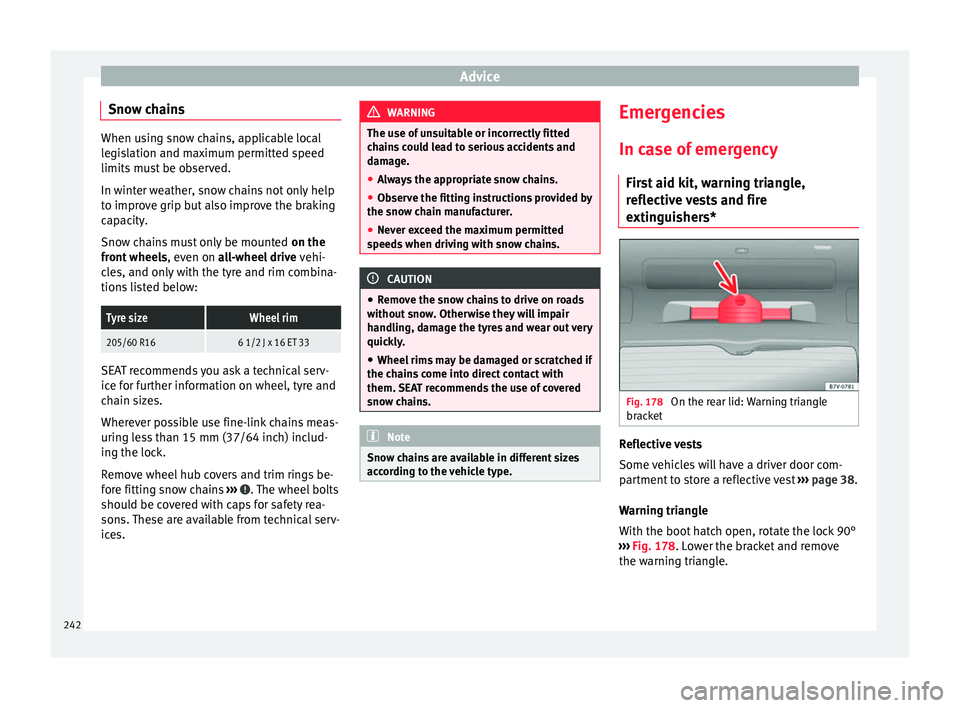
With the boot hatch open, rotate the lock 90°
››› Fig. 178. Lower the bracket and remove
the warnin
g triangle.
242
Page 245 of 305
Emergencies
First-aid kit
There is a first aid kit ››› page 112 in the rear
left-hand side storage compartment of the
luggage compartment.
The first aid kit must comply with legal re-
quirements. Check the expiry date of the con-
tents of the first aid kit.
Fire extinguisher
There is a Fire extinguisher underneath the
fr ont
passenger seat.
The fire extinguisher must conform to legal
requirements, be ready for use and be
checked regularly. Check the certification
seal on the extinguisher. WARNING
Loose objects in the vehicle interior can be vi-
olently thrown in case of a sudden manoeu-
vre or braking and especially in accidents
causing serious injury.
● Secure fire extinguishers, first aid kit, re-
flective vests and warning triangle securely
to their respective supports. Protecting yourself and securing the
vehicle
Fig. 179
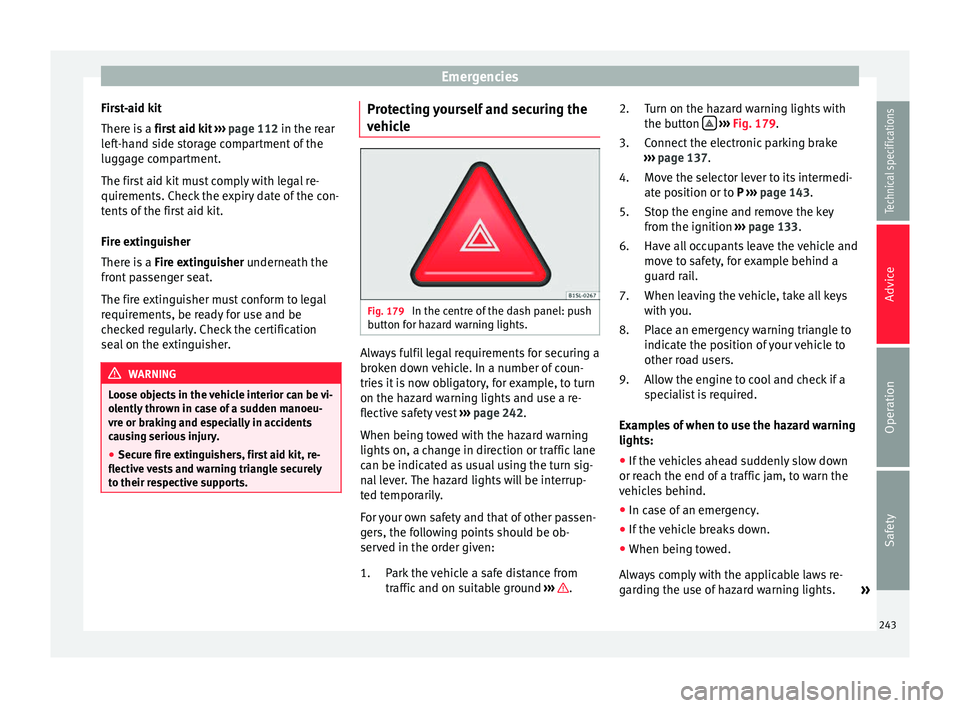
In the centre of the dash panel: push
button for hazard warning lights. Always fulfil legal requirements for securing a
broken down vehicle. In a number of coun-
tries it is now obligatory, for example, to turn
on the hazard warning lights and use a re-
flective safety vest
››› page 242.
When being towed with the hazard warning
lights on, a change in direction or traffic lane
can be indicated as usual using the turn sig-
nal lever. The hazard lights will be interrup-
ted temporarily.
For your own safety and that of other passen-
gers, the following points should be ob-
served in the order given:
Park the vehicle a safe distance from
traffic and on suitable ground ››› .
1. Turn on the hazard warning lights with
the button
››› Fig. 179.
Connect the electronic parking brake
››› page 137 .
Mo v
e the selector lever to its intermedi-
ate position or to
P ››› page 143.
Stop the engine and remove the key
from the ignition ››› page 133.
Have all occupants leave the vehicle and
move to safety, for example behind a
guard rail.
When leaving the vehicle, take all keys
with you.
Place an emergency warning triangle to
indicate the position of your vehicle to
other road users.
Allow the engine to cool and check if a
specialist is required.
Examples of when to use the hazard warning
lights:
● If the vehicles ahead suddenly slow down
or reach the end of a traffic jam, to warn the
vehicles behind.
● In case of an emergency.
● If the vehicle breaks down.
● When being towed.
Always comply with the applicable laws re-
garding the use of hazard warning lights. »
2.
3.
4.
5.
6.
7.
8.
9.
243Technical specifications
Advice
Operation
Safety
Page 246 of 305
Advice
If the hazard warning lights are not working,
you must use an alternative method of draw-
ing attention to your vehicle. This method
must comply with traffic legislation. WARNING
A faulty vehicle in traffic represents a risk of
accident for the driver and for other road
users.
● Stop the vehicle safely as soon as possible.
Park the vehicle a safe distance from sur-
rounding traffic to lock all the doors in case of
an emergency. Turn on the hazard warning
lights to warn other road users.
● Never leave children or disabled people
alone in the vehicle if the doors are to be
locked. In case of an emergency, passengers
will be trapped inside the vehicle. Individuals
locked in the vehicle can be exposed to very
high or very low temperatures. WARNING
The components of the exhaust system reach
very high temperatures. This could cause a
fire and considerable damage.
● Always park your vehicle so that no part of
the exhaust system can come in contact with
flammable materials (such as dried grass or
fuel). Note
● The vehicle battery will discharge and run
down if the hazard warning lights remain on for too long (even with the ignition turned
off).
● For some vehicles, the brake lights will
blink when braking suddenly at speeds of ap-
proximately 80 km/h (50 mph) to alert vehi-
cles to the rear. If braking continues, the haz-
ard warning lights system will automatically be turned on at a speed of less than approxi-
mately 10 km/h (6 mph). The brake lights re-
main lit. Upon accelerating, the hazard warn-
ing lights will be automatically turned off. Vehicle tool kit*
Introduction When securing the vehicle in case of a break-
down, please note the legal requirements for
each country.
WARNING
Loose objects in the vehicle interior can be vi-
olently fired through the compartment in
case of a sudden manoeuvre or braking and
especially in accidents causing serious in-
jury.
● Make sure that the vehicle tools are stored
safely in the luggage compartment. WARNING
Unsuitable or damaged vehicle tools can
cause injury or accidents.
● Never work with inappropriate or damaged
tools. Location
Fig. 180
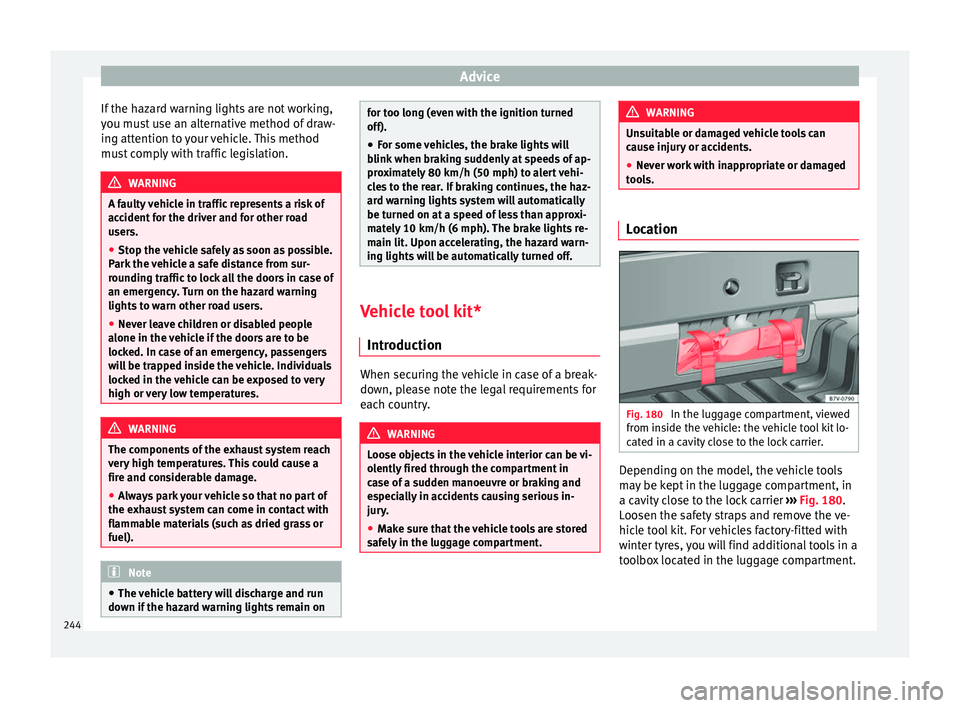
In the luggage compartment, viewed
from inside the vehicle: the vehicle tool kit lo-
cated in a cavity close to the lock carrier. Depending on the model, the vehicle tools
may be kept in the luggage compartment, in
a cavity close to the lock carrier
››› Fig. 180 .
L oo
sen the safety straps and remove the ve-
hicle tool kit. For vehicles factory-fitted with
winter tyres, you will find additional tools in a
toolbox located in the luggage compartment.
244
Page 248 of 305
Advice
WARNING
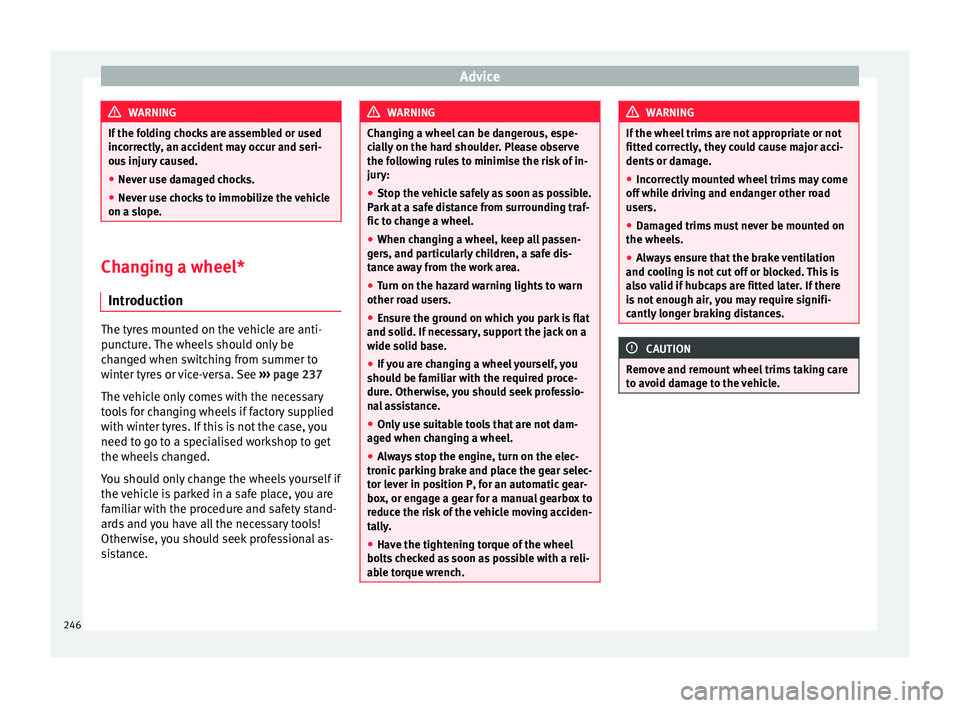
If the folding chocks are assembled or used
incorrectly, an accident may occur and seri-
ous injury caused.
● Never use damaged chocks.
● Never use chocks to immobilize the vehicle
on a slope. Changing a wheel*
Introduction The tyres mounted on the vehicle are anti-
puncture. The wheels should only be
changed when switching from summer to
winter tyres or vice-versa. See
›››
page 237
The vehicle only comes with the necessary
tools for changing wheels if factory supplied
with winter tyres. If this is not the case, you
need to go to a specialised workshop to get
the wheels changed.
You should only change the wheels yourself if
the vehicle is parked in a safe place, you are
familiar with the procedure and safety stand-
ards and you have all the necessary tools!
Otherwise, you should seek professional as-
sistance. WARNING
Changing a wheel can be dangerous, espe-
cially on the hard shoulder. Please observe
the following rules to minimise the risk of in-
jury:
● Stop the vehicle safely as soon as possible.
Park at a safe distance from surrounding traf-
fic to change a wheel.
● When changing a wheel, keep all passen-
gers, and particularly children, a safe dis-
tance away from the work area.
● Turn on the hazard warning lights to warn
other road users.
● Ensure the ground on which you park is flat
and solid. If necessary, support the jack on a
wide solid base.
● If you are changing a wheel yourself, you
should be familiar with the required proce-
dure. Otherwise, you should seek professio-
nal assistance.
● Only use suitable tools that are not dam-
aged when changing a wheel.
● Always stop the engine, turn on the elec-
tronic parking brake and place the gear selec-
tor lever in position P, for an automatic gear-
box, or engage a gear for a manual gearbox to
reduce the risk of the vehicle moving acciden-
tally.
● Have the tightening torque of the wheel
bolts checked as soon as possible with a reli-
able torque wrench. WARNING
If the wheel trims are not appropriate or not
fitted correctly, they could cause major acci-
dents or damage.
● Incorrectly mounted wheel trims may come
off while driving and endanger other road
users.
● Damaged trims must never be mounted on
the wheels.
● Always ensure that the brake ventilation
and cooling is not cut off or blocked. This is
also valid if hubcaps are fitted later. If there
is not enough air, you may require signifi-
cantly longer braking distances. CAUTION
Remove and remount wheel trims taking care
to avoid damage to the vehicle. 246
Page 250 of 305
Advice
If the wheel bolt is very tight, you may be
able to loosen it by pushing down on the end
of the wheel brace carefully with your foot.
Hold on to the vehicle for support and take
care not to slip.
Loosening wheel bolts
● Fit the wheel brace as far as it will go over
the wheel bolt ››› Fig. 185 .
● Ho l
d the wheel brace at the end and rotate
the bolt approximately one turn anticlockwise
››
› .
Loosening anti-theft wheel bolts
For wheels with full trim, the anti-theft wheel
lock must be threaded into position
››› Fig. 186 2 or
3 . Otherwise it will not be
possible to mount the entire hubcap.
● Take the adapter for anti-theft wheel bolts
out of the vehicle tool kit.
● Insert the adapter onto the anti-theft wheel
bolt.
● Fit the wheel brace onto the adapter as far
as possible.
● Hold the wheel brace at the end and rotate
the bolt approximately one turn anticlockwise
› ›
› .
Important information about wheel bolts
The wheel rims and bolts have been de-
signed to be fitted to factory options. If differ- ent rims are fitted, the correct wheel bolts
with the right length and correctly shaped
bolt heads must be used. This ensures that
wheels are fitted securely and that the brake
system functions correctly.
In some circumstances, wheel bolts from the
same model vehicle should not be used.
Wheel bolt tightening torque
The prescribed tightening torque for wheel
bolts for steel and alloy wheels is
140 Nm.
Hav e the tight
ening torque of the wheel bolts
checked as soon as possible with a reliable
torque wrench.
If wheel bolts are rusty and it is difficult to
tighten them, the threads should be replaced
and cleaned before checking the tightening
tor
que.
Never grease or lubricate wheel bolts or the
wheel hub threads. Although they have been
tightened to the prescribed torque, they
could come loose while driving. WARNING
If the wheel bolts are not fitted correctly they
could be released while driving leading to
loss of vehicle control and serious damage.
● Only use wheel bolts which correspond to
the wheel rims in question.
● Never use different wheel bolts. ●
The bolts and threads should be clean, free
of oil and grease and easy to thread.
● To loosen and tighten the wheel bolts, al-
ways use the wheel brace supplied with the
vehicle.
● Loosen the wheel bolts only about one turn
before raising the vehicle with the jack.
● Never grease or lubricate wheel bolts or the
wheel hub threads. Although they have been
tightened to the prescribed torque, they
could come loose while driving.
● Never loosen the bolted joints of wheel
rims with bolted ring trims.
● If the wheel bolts are not tightened to the
correct torque, they may come loose while
driving, and the bolts and rims may come
out. If the tightening torque is too high, the
wheel bolts and threads can be damaged. 248
Page 251 of 305
Emergencies
Raising the vehicle with the jack Fig. 187
Jack position points Fig. 188
Jack mounted on the left rear part of
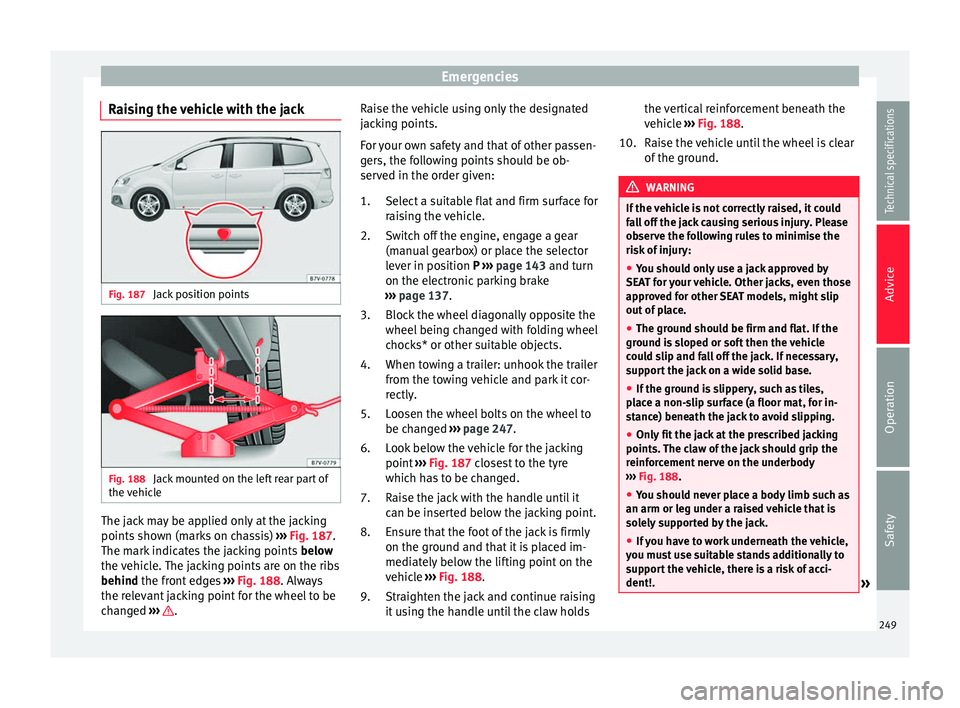
the vehicle The jack may be applied only at the jacking
points shown (marks on chassis)
››› Fig. 187 .
The m ark
indicates the jacking points below
the vehicle. The jacking points are on the ribs
behind
the front edges ››› Fig. 188. Always
the rel
evant jacking point for the wheel to be
changed ››› . Raise the vehicle using only the designated
jacking points.
For your own safety and that of other passen-
gers, the following points should be ob-
served in the order given:
Select a suitable flat and firm surface for
raising the vehicle.
Switch off the engine, engage a gear
(manual gearbox) or place the selector
lever in position P
›
›› p
age 143 and turn
on the electronic parking brake
››› page 137.
Block
the wheel diagonally opposite the
wheel being changed with folding wheel
chocks* or other suitable objects.
When towing a trailer: unhook the trailer
from the towing vehicle and park it cor-
rectly.
Loosen the wheel bolts on the wheel to
be changed ››› page 247.
Look below the vehicle for the jacking
point ››› Fig. 187 closest to the tyre
which h
as to be changed.
Raise the jack with the handle until it
can be inserted below the jacking point.
Ensure that the foot of the jack is firmly
on the ground and that it is placed im-
mediately below the lifting point on the
vehicle ››› Fig. 188
.
Straighten the jack and continue raising
it using the handle until the claw holds
1.
2.
3.
4.
5.
6.
7.
8.
9. the vertical reinforcement beneath the
vehicle
››› Fig. 188
.
Raise the vehicle until the wheel is clear
of the ground. WARNING
If the vehicle is not correctly raised, it could
fall off the jack causing serious injury. Please
observe the following rules to minimise the
risk of injury:
● You should only use a jack approved by
SEAT for your vehicle. Other jacks, even those
approved for other SEAT models, might slip
out of place.
● The ground should be firm and flat. If the
ground is sloped or soft then the vehicle
could slip and fall off the jack. If necessary,
support the jack on a wide solid base.
● If the ground is slippery, such as tiles,
place a non-slip surface (a floor mat, for in-
stance) beneath the jack to avoid slipping.
● Only fit the jack at the prescribed jacking
points. The claw of the jack should grip the
reinforcement nerve on the underbody
››› Fig. 188.
● You shou
ld never place a body limb such as
an arm or leg under a raised vehicle that is
solely supported by the jack.
● If you have to work underneath the vehicle,
you must use suitable stands additionally to
support the vehicle, there is a risk of acci-
dent!. » 10.
249
Technical specifications
Advice
Operation
Safety
Page 252 of 305
Advice
●
Never raise the vehicle if it is tilting to one
side or the engine is running.
● Never start the engine when the vehicle is
raised. The vehicle may come loose from the
jack due to the engine vibrations. Changing a wheel
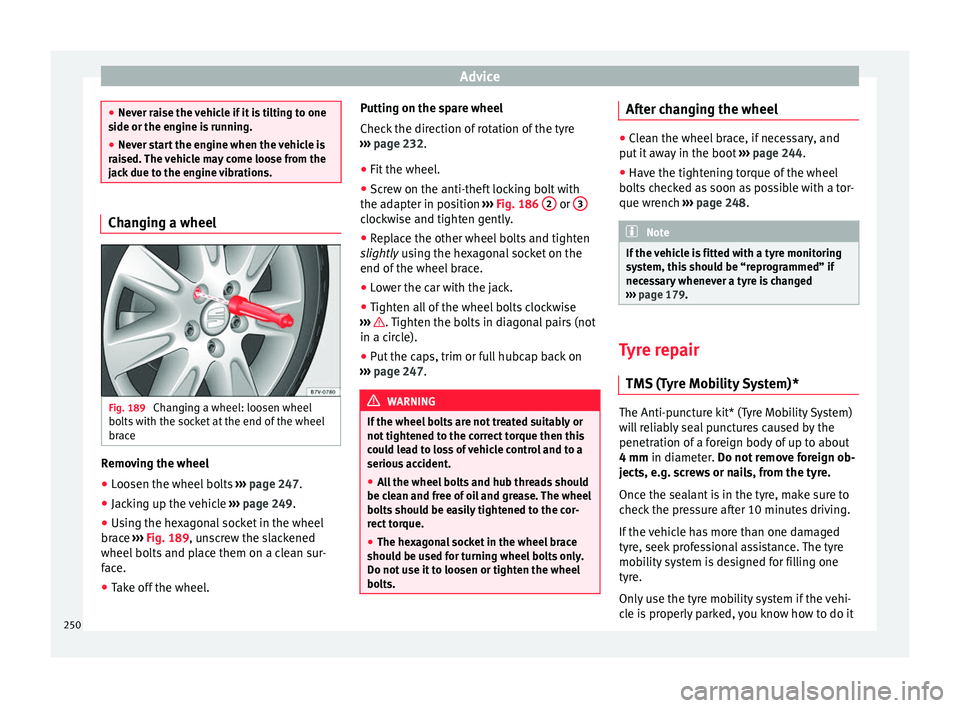
Fig. 189
Changing a wheel: loosen wheel
bolts with the socket at the end of the wheel
brace Removing the wheel
● Loosen the wheel bolts ››› page 247 .
● Jacking up the vehicle ››› page 249.
● Using the hexagonal socket in the wheel
brace ››› Fig. 189 , unscrew the slackened
wheel bo
lts and place them on a clean sur-
face.
● Take off the wheel. Putting on the spare wheel
Check the direction of rotation of the tyre
››› page 232.
● Fit the wheel
.
● Screw on the anti-theft locking bolt with
the adapter in position ››› Fig. 186 2 or
3 clockwise and tighten gently.
●
Replace the other wheel bolts and tighten
slightly using the hexagonal socket on the
end of the wheel
brace.
● Lower the car with the jack.
● Tighten all of the wheel bolts clockwise
››› . Tighten the bolts in diagonal pairs (not
in a circle).
● Put the caps, trim or full hubcap back on
››› page 247 . WARNING
If the wheel bolts are not treated suitably or
not tightened to the correct torque then this
could lead to loss of vehicle control and to a
serious accident.
● All the wheel bolts and hub threads should
be clean and free of oil and grease. The wheel
bolts should be easily tightened to the cor-
rect torque.
● The hexagonal socket in the wheel brace
should be used for turning wheel bolts only.
Do not use it to loosen or tighten the wheel
bolts. After changing the wheel
●
Clean the wheel brace, if necessary, and
put it away in the boot ››› page 244.
● Have the tightening torque of the wheel
bolts checked as soon as possible with a tor-
que wrench ››› page 248. Note
If the vehicle is fitted with a tyre monitoring
system, this should be “reprogrammed” if
necessary whenever a tyre is changed
››› page 179. Tyre repair
TMS (Tyre Mobility System)* The Anti-puncture kit* (Tyre Mobility System)
will reliably seal punctures caused by the
penetration of a foreign body of up to about
4 mm
in diameter.
Do not remove foreign ob-
j
ects, e.g. screws or nails, from the tyre.
Once the sealant is in the tyre, make sure to
check the pressure after 10 minutes driving.
If the vehicle has more than one damaged
tyre, seek professional assistance. The tyre
mobility system is designed for filling one
tyre.
Only use the tyre mobility system if the vehi-
cle is properly parked, you know how to do it
250
Page 253 of 305
Emergencies
and the necessary safety measures, and if
you have the right kit! Otherwise, you should
seek professional assistance.
The tyre sealant should not be used in the
following cases:
● If the wheel is damaged.
● The outside temperature is lower than -20
℃ (-4 °F).
● If the tear or puncture on the tyre is over 4
mm wide.
● If you have driven with very low pressure or
a flat tyre.
● If the expiry date on the bottle of tyre seal-
ant has passed. WARNING
Using the tyre mobility system can be dan-
gerous, especially when filling the tyre at the
roadside. Please observe the following rules
to minimise the risk of injury:
● Stop the vehicle safely as soon as possible.
Park it at a safe distance from surrounding
traffic to fill the tyre.
● Ensure the ground is flat and firm.
● All occupants, and especially children,
should always be at a safe distance outside
the work area.
● Turn on the hazard warning lights to warn
other road users. ●
Use the tyre mobility system only if you are
familiar with the necessary procedures. Oth-
erwise, you should seek professional assis-
tance.
● Only use the tyre mobility system in the
event of an emergency to get to the nearest
workshop.
● Replace the repaired tyre with the tire mo-
bility set as soon as possible.
● The sealant is hazardous for your health
and if it touches your skin, it must be imme-
diately washed off.
● Keep children away from the tyre mobility
system.
● Never use a jack even if it is approved for
the vehicle.
● To reduce the risk of the vehicle possibly
moving on its own, always turn off the en-
gine, set the electronic parking brake and put
the selector lever in position P or put into
gear if the gearbox is a manual. WARNING
A tyre repaired with sealant does not have
the normal drive properties.
● Never drive faster than 80 km/h (50 mph).
● Avoid hard acceleration, heavy braking and
fast cornering.
● Check the tyre after travelling 10 minutes
at no more than 80 km/h (50 mph). For the sake of the environment
Once used or expired, dispose of the sealant
according to legal provisions. Note
● Sealant bottles can be purchased from
SEAT dealers.
● Observe the usage instructions provided by
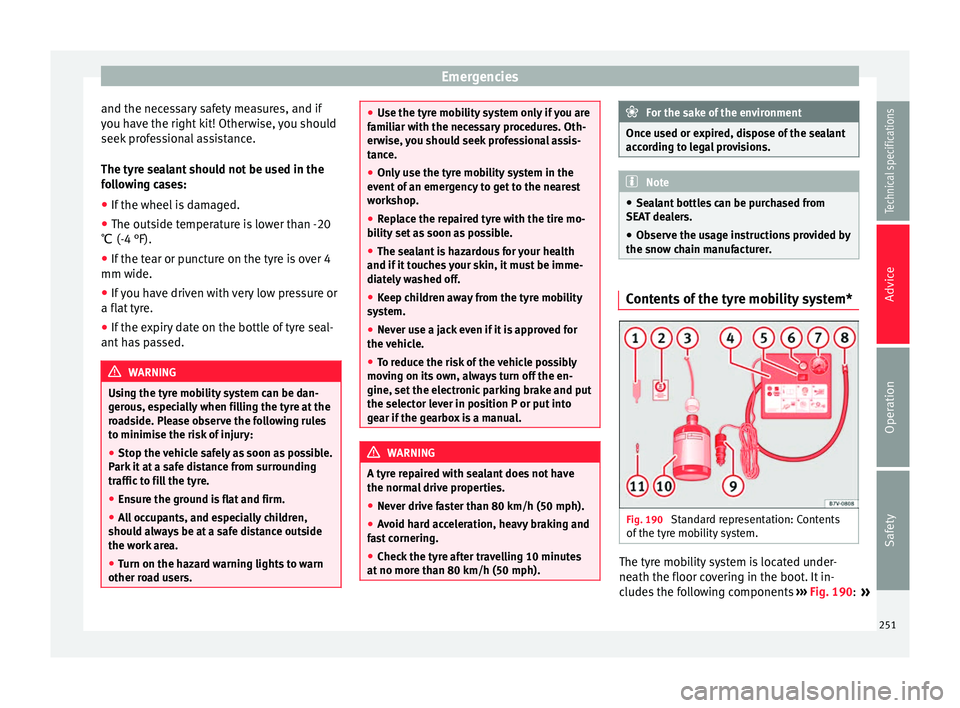
the snow chain manufacturer. Contents of the tyre mobility system*
Fig. 190
Standard representation: Contents
of the tyre mobility system. The tyre mobility system is located under-
neath the floor covering in the boot. It in-
cludes the following components
››› Fig. 190 :
»
251Technical specifications
Advice
Operation
Safety
Page 254 of 305
Advice
Tyre valve remover
Sticker indicating maximum speed “max.
80 km/h” or “max. 50 mph”
Filler tube with cap
Air compressor
ON/OFF switch
Air bleed screw 1)
Tyre pressure monitoring 1)
Tube for inflating tyres
12 volt connector
Bottle of sealant
Spare insert for valve
The valve insert remover
1 has a gap at the
lower end for a valve insert. The valve insert
can only be screwed or unscrewed in this
way. This also applies to its replacement part 11 .
Seal and inflate a tyre Sealing a tyre
● Unscrew the tyre valve cap.
● Use the enclosed extractor ›››
Fig. 190 1 to unscrew the valve insert. Place it on a
clean surface.1 2
3
4
5
6
7
8
9
10
11 ●
Shake the bottle of sealant ››› Fig. 190 10 well.
●
Screw the inflator tube ››› Fig. 190 3 into
the sealant bottle in a clockwise direction.
The seal on the mouth of the bottle pierces
automatically.
● Remove the lid from the filling tube
››› Fig. 190 3 and insert the open end of the
tube into the tyre valve.
● Keep the bottle mouth facing down and
empty all the contents into the tyre.
● Remo
ve the empty bottle from the valve.
● Screw in the valve insert again with the aid
of the extractor ››› Fig. 190
1 .
Inflating the tyre
● Screw the tyre inflator tube ››› Fig. 190 8 of the air compressor into the tyre valve.
●
Check whether the air bleed screw
››› Fig. 190 6 is tightened.
● Start the engine and leave it running in
neutral.
● Attach the connector ››› Fig. 190 9 to one
of the vehicle's 12 volt sockets ››› page 119.
● Switch on the air compressor with the
ON/OFF switch ››› Fig. 190 5 .
● Keep the air compressor running until it
reaches 2.0 to 2.5 bar (29-36 psi / 200-250 kPa)
››› .
Do not leave it running
f or mor
e than 8 minutes ››› .
● Switch off the compressor.
● If it fails to reach a pressure of between
2.0 and 2.5 bar (29-36 psi / 200-250 kPa),
unscrew the inflator tube from the tyre valve.
● Move the vehicle some 10 metres forwards
or backwards so that the sealant is evenly
distributed in the tyre interior.
● Securely screw the compressor tyre inflator
tube into the tyre valve again and repeat the
inflation process.
● If the indicated pressure can still not be
reached, the tyre is too badly damaged. The
tyre cannot be sealed with the tyre mobility
system. Do not continue driving. You should
obtain professional assistance ››› .
● Disconnect the air compressor and unscrew
the inflator tube from the tyre valve.
● If a pressure between 2.0 and 2.5 bar
(29-36 psi / 200-250 kPa) is reached, then
continue driving at 80 km/h (50 mph) maxi-
mum.
● After 10 minutes , check the pressure again
› ›
› page 253. WARNING
When inflating the tyre, the air compressor
and the inflator tube may become hot. 1)
An inflator tube may also be included.
252