boot Seat Alhambra 2015 Owner's Guide
[x] Cancel search | Manufacturer: SEAT, Model Year: 2015, Model line: Alhambra, Model: Seat Alhambra 2015Pages: 305, PDF Size: 5.46 MB
Page 114 of 305
Operation
Storage compartments Introduction Storage compartments must only be used to
store light or small objects.
The front central armrest compartment hous-
es the factory-fitted
AUX-IN or multimedia
(MEDIA-IN) connection sockets.
The factory-fitted
CD changer is located in the
left-hand storage compartment of the boot. WARNING
In the event of sudden braking movements or
turns, loose objects may be thrown around
the vehicle interior. This could cause serious
injuries to passengers and cause the driver to
lose control of the vehicle.
● Do not transport animals or place hard,
heavy or sharp objects inside the vehicle in:
open storage compartments, dash panel, rear
shelf, items of clothing or bags.
● While driving, always keep object compart-
ments closed. WARNING
Objects falling into the driver's footwell could
prevent use of the pedals. This could lead the
driver to lose control of the vehicle, increas-
ing the risk of a serious accident. ●
Make sure the pedals can be used at all
times, with no objects rolling underneath
them.
● The floor mat should always be secured to
the floor.
● Never place other mats or rugs on top of
the original mat supplied by the factory.
● Make sure that no objects can fall into the
driver's footwell while the vehicle is in mo-
tion. CAUTION
● Objects on the shelf could chafe against
the wires of the heating element in the heat-
ed rear window and cause damage.
● Do not keep heat-sensitive objects, food or
medicines inside the vehicle. Heat and cold
could damage them or render them useless.
● Light-transparent objects placed inside the
vehicle, such as lenses, magnifying glasses
or transparent suction caps on the windows,
may concentrate the sun's rays and cause
damage to the vehicle. Note
The ventilating slits between the heated rear
window and the shelf must not be covered so
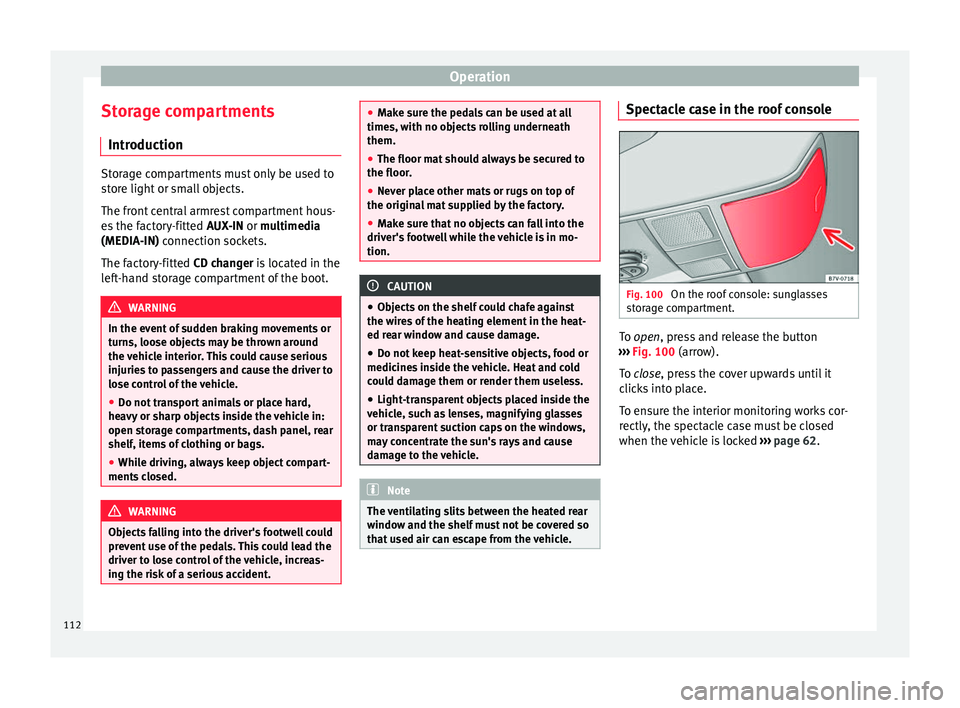
that used air can escape from the vehicle. Spectacle case in the roof console
Fig. 100
On the roof console: sunglasses
storage compartment. To
open
, press and release the button
›
›› Fig. 100 (arrow).
To
close, press the cover upwards until it
clicks into place.
To ensure the interior monitoring works cor-
rectly, the spectacle case must be closed
when the vehicle is locked ››› page 62.
112
Page 118 of 305
Operation
To close
, push the drawer under the seat until
it
clicks into place. WARNING
If the drawer is open it could obstruct use of
the pedals. This could result in serious acci-
dent.
● The drawers must remain closed while the
vehicle is in motion. Otherwise, the drawer
and any objects in it could fall into the driv-
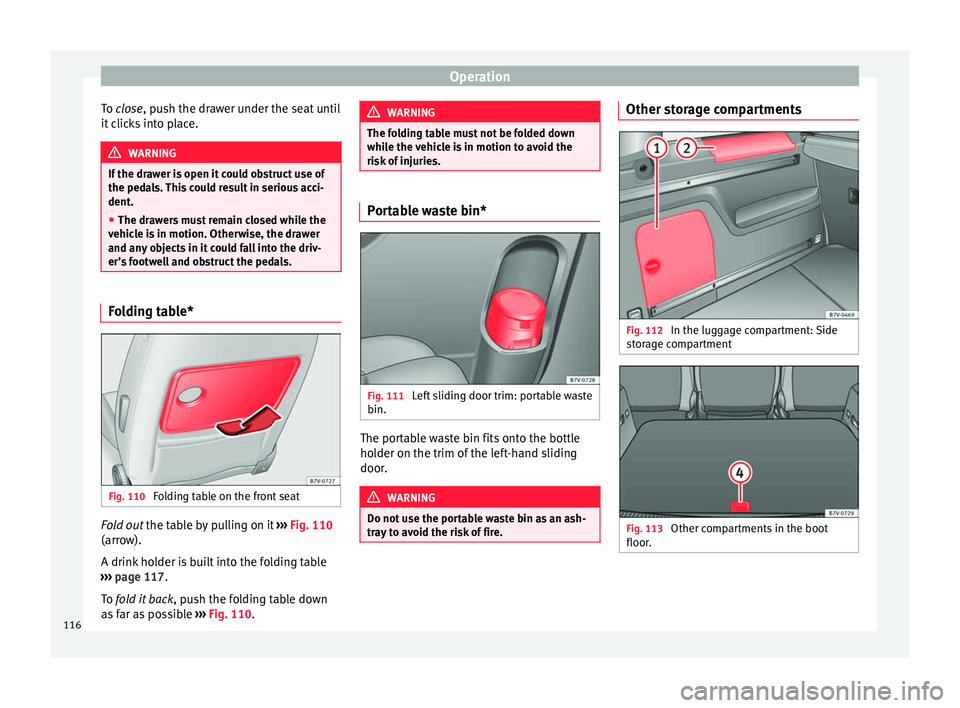
er's footwell and obstruct the pedals. Folding table*
Fig. 110
Folding table on the front seat Fold out
the table by pulling on it
›
›
› Fig. 110
(arrow).
A drink holder is built into the folding table
››› page 117
.
To
fold it back , push the folding table down
as far as possible ››› Fig. 110. WARNING
The folding table must not be folded down
while the vehicle is in motion to avoid the
risk of injuries. Portable waste bin*
Fig. 111
Left sliding door trim: portable waste
bin. The portable waste bin fits onto the bottle
holder on the trim of the left-hand sliding
door.
WARNING
Do not use the portable waste bin as an ash-
tray to avoid the risk of fire. Other storage compartments
Fig. 112
In the luggage compartment: Side
storage compartment Fig. 113
Other compartments in the boot
floor. 116
Page 119 of 305
Transport and practical equipment
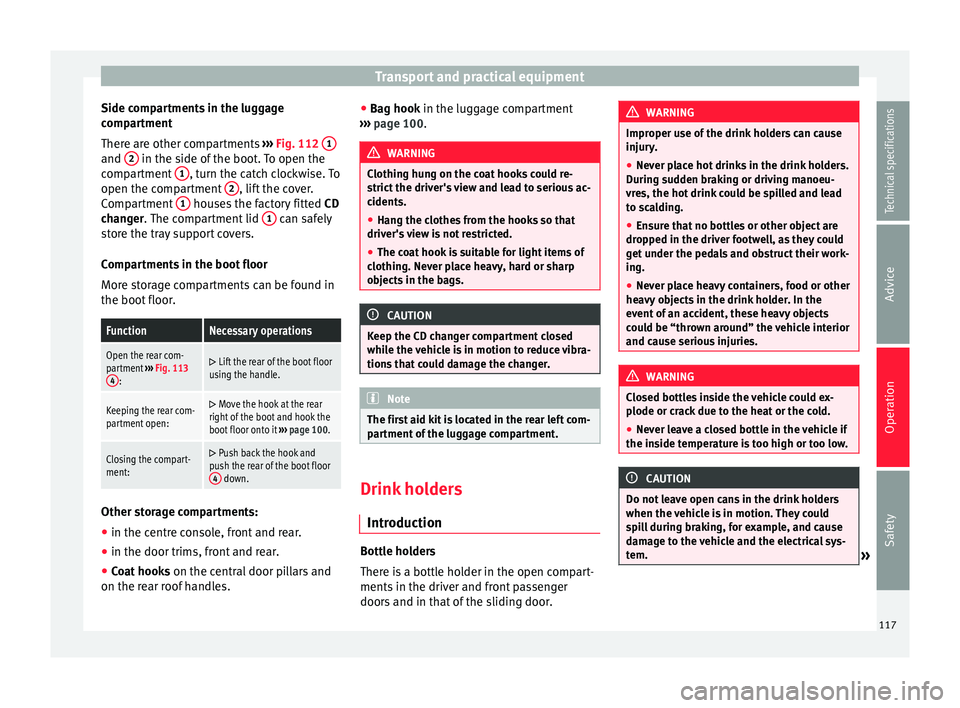
Side compartments in the luggage
compartment
There are other compartments ››› Fig. 112 1 and
2 in the side of the boot. To open the
compartment 1 , turn the catch clockwise. To
open the compartment 2 , lift the cover.
Compartment 1 houses the factory fitted
CD
changer . The compartment lid 1 can safely
store the tray support covers.
Compartments in the boot floor
More storage compartments can be found in
the boot floor.FunctionNecessary operations
Open the rear com-
partment ››› Fig. 113
4
:
Lift the rear of the boot floor
using the handle.
Keeping the rear com-
partment open: Move the hook at the rear
right of the boot and hook the
boot floor onto it ››› page 100.
Closing the compart-
ment: Push back the hook and
push the rear of the boot floor 4
down. Other storage compartments:
● in the centre console, front and rear.
● in the door trims, front and rear.
● Coat hooks on the central door pillars and
on the rear roof handles. ●
Bag hook in the luggage compartment
› ›
› page 100. WARNING
Clothing hung on the coat hooks could re-
strict the driver's view and lead to serious ac-
cidents.
● Hang the clothes from the hooks so that
driver's view is not restricted.
● The coat hook is suitable for light items of
clothing. Never place heavy, hard or sharp
objects in the bags. CAUTION
Keep the CD changer compartment closed
while the vehicle is in motion to reduce vibra-
tions that could damage the changer. Note
The first aid kit is located in the rear left com-
partment of the luggage compartment. Drink holders
Introduction Bottle holders
There is a bottle holder in the open compart-
ments in the driver and front passenger
doors and in that of the sliding door. WARNING
Improper use of the drink holders can cause
injury.
● Never place hot drinks in the drink holders.
During sudden braking or driving manoeu-
vres, the hot drink could be spilled and lead
to scalding.
● Ensure that no bottles or other object are
dropped in the driver footwell, as they could
get under the pedals and obstruct their work-
ing.
● Never place heavy containers, food or other
heavy objects in the drink holder. In the
event of an accident, these heavy objects
could be “thrown around” the vehicle interior
and cause serious injuries. WARNING
Closed bottles inside the vehicle could ex-
plode or crack due to the heat or the cold.
● Never leave a closed bottle in the vehicle if
the inside temperature is too high or too low. CAUTION
Do not leave open cans in the drink holders
when the vehicle is in motion. They could
spill during braking, for example, and cause
damage to the vehicle and the electrical sys-
tem. » 117
Technical specifications
Advice
Operation
Safety
Page 161 of 305
Driver assistance systems
Conditions requiring the key to restart the
engine
The engine must be started manually under
the following conditions:
● If the driver unbuckles his/her seat belt.
● If the driver door is opened.
● If the bonnet is opened.
● In vehicles with a manual gearbox: if a gear
has been selected.
Switching Start-Stop mode on and off
manually
● Press the button on the centre console
››› Fig. 136 .
● The b utt
on will light up when the Start-Stop
function is switched off.
The engine will start immediately if the vehi-
cle is in Stop mode when it is switched off
manually. WARNING
The brake servo and the power steering do
not work when the engine is switched off.
● Never allow the vehicle to move when the
engine is switched off. CAUTION
Using the Start-Stop function for a long peri-
od at very high outside temperatures could
damage the vehicle's battery. Note
● In some cases, you may have to restart the
vehicle using the key. Observe the corre-
sponding message on the instrument panel
display.
● If the steering wheel is turned more than
270°, Stop will not function; however, the an-
gle of steering wheel turn does not affect
starting the vehicle. Parking sensor system*
Introduction The parking sensor system assists the driver
when parking. When the vehicle approaches
an obstacle, forwards or backwards, an inter-
mittent audible warning will be heard, higher
or lower depending on the distance. The
shorter the distance, the shorter the intervals
between tones. If the vehicle is too close to
the obstacle, the audible warning becomes
constant.
If you continue to approach an obstacle when
the sound is continuous, this means the sys-
tem can no longer measure the distance.
The sensor system on the bumpers transmit
and receive ultrasound. Using the ultrasound
signal (transmission, reflection from the ob-
stacle and reception), this system continu-ously calculates the distance between the
bumper and the obstacle. WARNING
The parking sensor system and the optical
parking system cannot replace driver aware-
ness.
● The sensors have blind spots in which ob-
stacles and people are not registered.
● Always observe the area around the vehi-
cle, as the sensors do not always detect
small children, animals or objects.
● The surface of certain objects and some
clothing do not reflect the ultrasound signals
from the parking distance system. The sys-
tem cannot detect or incorrectly detects
these objects and people wearing these
types of clothes.
● External sound sources can affect the park-
ing distance aid signals. In this case, under
certain circumstances, people and objects
will not be detected. CAUTION
● The sensors may not always be able to de-
tect objects such as trailer draw bars, thin
rails, fences, posts, trees and open boots,
etc. This could result in damage to your car.
● Although the parking sensor system de-
tects and warns of the presence of an obsta-
cle, the obstacle could disappear from the an-
gle of measurement of the sensors if it is too
high or low and the system would no longer » 159
Technical specifications
Advice
Operation
Safety
Page 168 of 305
Operation
● Press the foot brake ››› !
Following the intervention of the brakes, the
Park Assist will stop. WARNING
Despite the assistance provided by the park
assist system, do not run any risks when
parking. The system is not a replacement for
driver awareness.
● Always be ready to brake.
● Automatic brake intervention will end after
1.5 seconds approximately. Following auto-
matic intervention of the brakes, stop the ve-
hicle yourself. Rear Assist system*
Introduction The camera fitted to the rear lid helps drivers
during parking or reversing manoeuvres. The
camera image and certain orientation points
generated by the system are indicated on the
factory-fitted radio or navigation system
screen.
Two types of location point (modes) can be
selected:
● Mode 1: reverse parking perpendicular to
the road (e.g. in a car park). ●
Mode 2 : reverse parking parallel to the
c urb
.
The mode can be changed by pressing the
button on the radio or navigation system
screen. Only the mode to which the points
can be changed will be displayed. WARNING
Use of the camera to calculate the distance
from obstacles (people, vehicles, etc.) is inac-
curate and may cause accidents and severe
injuries.
● The camera lens expands and distorts the
field of vision and displays the objects on the
screen in a different, vague manner.
● Some objects may not be displayed or may
not be very clear (e.g. very thin posts or fen-
ces), due to the resolution of the monitor or if
the light is dim.
● The camera has blind spots in which obsta-
cles and people are not detected.
● Keep the camera lens clean and clear of
snow and ice. Do not cover it. WARNING
The intelligent technology in the rear assist
system cannot change the limits imposed by
the laws of physics and by the system itself.
Careless or uncontrolled use of the rear assist
system may result in severe injuries and acci-
dents. The system is not a replacement for
driver awareness. ●
Adjust your speed and driving style to visi-
bility, road, traffic and weather conditions.
● Always keep a close eye on the area around
the vehicle and always look towards where
you are parking. The display shows the path
of the rear end of the vehicle using the cur-
rent steering angle. The front of the vehicle
turns more in comparison with the rear.
● Do not be distracted from the traffic when
looking at the screen.
● Always observe the area around the vehi-
cle, as the cameras do not always detect chil-
dren, animals or objects.
● The system might not show all areas clear-
ly.
● Only use the rear assist system when the
boot hatch is completely closed. CAUTION
● The camera only displays 2D images on the
screen. Due to the lack of depth, it might be
difficult or impossible to recognise protrud-
ing objects or cracks in the road.
● The cameras may not always be able to de-
tect objects such as thin rails, fences, posts
and trees, etc. This could result in damage to
your car. 166
Page 184 of 305
Operation
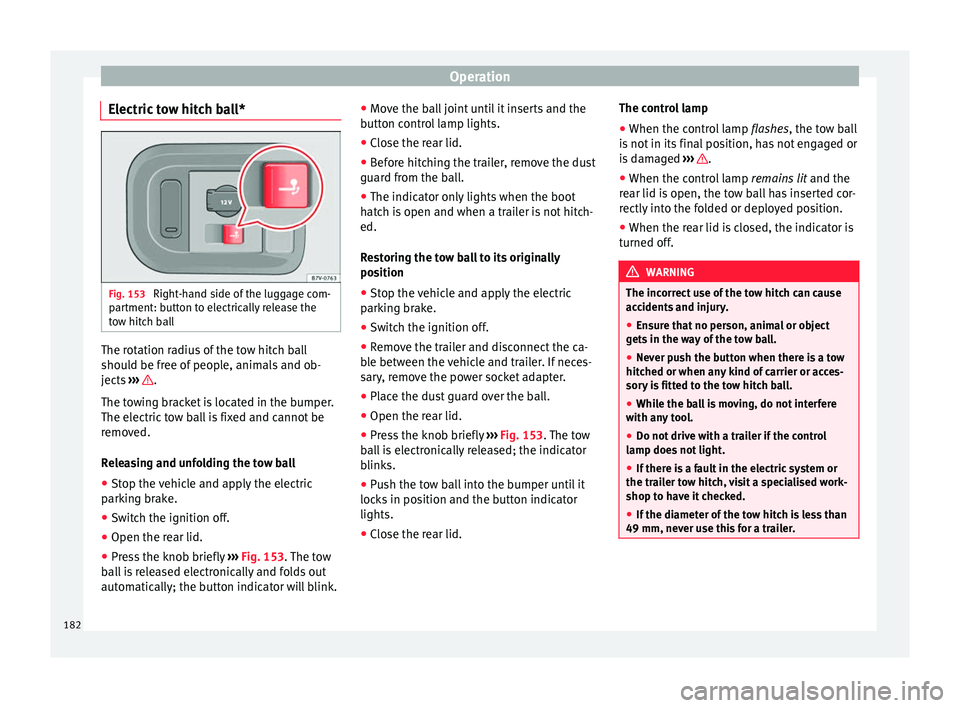
Electric tow hitch ball* Fig. 153
Right-hand side of the luggage com-
partment: button to electrically release the
tow hitch ball The rotation radius of the tow hitch ball
should be free of people, animals and ob-
jects
››› .
The towing bracket is located in the bumper.
The electric tow ball is fixed and cannot be
removed.
Releasing and unfolding the tow ball
● Stop the vehicle and apply the electric
parking brake.
● Switch the ignition off.
● Open the rear lid.
● Press the knob briefly ››› Fig. 153 . The tow
b al
l is released electronically and folds out
automatically; the button indicator will blink. ●
Move the ball joint until it inserts and the
button control lamp lights.
● Close the rear lid.
● Before hitching the trailer, remove the dust
guard from the ball.
● The indicator only lights when the boot
hatch is open and when a trailer is not hitch-
ed.
Restoring the tow ball to its originally
position
● Stop the vehicle and apply the electric
parking brake.
● Switch the ignition off.
● Remove the trailer and disconnect the ca-
ble between the vehicle and trailer. If neces-
sary, remove the power socket adapter.
● Place the dust guard over the ball.
● Open the rear lid.
● Press the knob briefly ››› Fig. 153
. The tow
ball is electronically released; the indicator
blinks.
● Push the tow ball into the bumper until it
locks in position and the button indicator
lights.
● Close the rear lid. The control lamp
●
When the control lamp flashes, the tow ball
is
not in its final position, has not engaged or
is damaged ››› .
● When the control lamp remains lit and the
rear lid is open, the tow ball has inserted cor-
rectly into the folded or deployed position.
● When the rear lid is closed, the indicator is
turned off. WARNING
The incorrect use of the tow hitch can cause
accidents and injury.
● Ensure that no person, animal or object
gets in the way of the tow ball.
● Never push the button when there is a tow
hitched or when any kind of carrier or acces-
sory is fitted to the tow hitch ball.
● While the ball is moving, do not interfere
with any tool.
● Do not drive with a trailer if the control
lamp does not light.
● If there is a fault in the electric system or
the trailer tow hitch, visit a specialised work-
shop to have it checked.
● If the diameter of the tow hitch is less than
49 mm, never use this for a trailer. 182
Page 207 of 305
Care and maintenance
Notes for the user Labels and plates Some parts in the engine compartment come
from the factory with certificates of safety, la-
bels or plates containing important informa-
tion regarding the operation of the vehicle,
for example, on the petrol cap, on the pas-
senger's sun visor, on the driver door strut, or
on the floor of the boot.
● Never remove these certificates of safety,
labels or plates, and ensure they are kept in
good condition and are legible.
● If a vehicle part, bearing a certificate of
safety, label or plate, is replaced, the special-
ised workshop should attach the information
back in the same place.
Certificate of safety
A certificate of safety on the door strut states
that all the safety standards and regulations
established by the national traffic authorities
responsible for road safety were met at the
time of manufacture. It may also give the
month and year of manufacture, together
with the chassis number.
Warning of high voltage label*
There is a label close to the bonnet lock
which warns of high voltage in the vehicle's
electrical system. The vehicle ignition system complies with several standards, including
the Canadian standard, ICES-002.
Using your vehicle in other countries
and continents The vehicle is manufactured at the factory for
use in a particular country in accordance with
the national legislation in force at the time of
manufacture.
If the vehicle is sold in another country or
used in another country for an extended peri-
od of time, the applicable legislation of that
country should be observed.
It may be necessary to fit or remove certain
pieces of equipment or to deactivate certain
functions. Service work may also be affected.
This is particularly true if the vehicle is used
in a different climate for an extended period
of time.
As there are different types of frequency
bands around the world, you may find that
the radio or navigation system supplied at
the factory does not work in another country.
CAUTION
● SEAT does not accept liability for any dam-
age to the vehicle due to the use of a lower
quality fuel, an inadequate service or the
non-availability of genuine spare parts. ●
SEAT does not accept liability if the vehicle
does not comply in part or in full with the le-
gal requirements of other countries or conti-
nents. Radio reception and the aerial
The aerial of radio and navigation systems
fitted at the factory may be mounted in differ-
ent parts of the vehicle:
● On the inside of the rear window, next to
the rear window heating,
● on the inside of the rear side windows,
● on the inside of the windscreen,
● on the roof of the vehicle.
Aerials mounted on the inside of a window
can be recognised by the fine wires. CAUTION
Aerials on the inside of windows may be dam-
aged if knocked or if cleaned with corrosive or
acid cleaning products. Do not stick adhesive
labels over the heating elements and never
clean the inside of the rear window with cor-
rosive or acid products or other similar chem-
ical cleaning products. » 205Technical specifications
Advice
Operation
Safety
Page 209 of 305
Checking and refilling levels
●
Never enter the vehicle while refuelling. If it
is absolutely necessary to enter, close the
door and touch a metal surface before touch-
ing the filler nozzle again. This will prevent
the generation of static electricity. Sparks
could cause a fire when refuelling.
● Never handle fuel close to flames, sparks or
objects with slow combustion (e.g. ciga-
rettes).
● Avoid static electricity and electro-magnet-
ic radiation when refuelling.
● Observe the safety regulations of the serv-
ice station.
● Never spill fuel on the vehicle or in the lug-
gage compartment. WARNING
For safety reasons, SEAT does not recommend
carrying a spare fuel canister in the vehicle.
Fuel could be spilled and catch fire, above all
in case of an accident and this applies to a
full container as well as empty containers.
This could lead to explosions, fires and inju-
ries.
● Observe the following if you exceptionally
have to carry fuel in a canister:
–Never place a fuel container to fill it in-
side the vehicle or on the vehicle, for ex-
ample, in the boot or on the hatch. Filling
in these circumstances could create an
electrostatic charge and spark that could
ignite fuel fumes. –
Always place the canister on the ground
to fill it.
– Insert the fuel nozzle into the neck of the
canister as far as possible.
– If you are using a metal fuel canister, the
nozzle must always touch the canister
while it is being filled to avoid static elec-
tricity.
– Follow the legal requirements for the use,
storage and transport of spare fuel canis-
ters.
– Insure that the fuel container complies
with manufacturing standards, for exam-
ple, ANSI or ASTM F852-86. CAUTION
● Always remove any fuel spilled on the vehi-
cle paintwork immediately to avoid damage
to the wheel housing, the tyre and vehicle
paintwork.
● Refuelling a petrol engine with diesel or a
diesel engine with petrol can cause serious
engine and fuel system damage; the resulting
malfunctions are not covered by the SEAT
warranty. If you refuel with the wrong type of
fuel, never start the engine. This applies to
even the smallest amount of the wrong fuel.
Seek specialist assistance. With the engine
running, the composition of the wrong fuel
could significantly damage the fuel system
and the engine itself.
● In vehicles with a diesel engine, under no
circumstances should you refuel or drive with petrol, kerosene, heating oil or any other
type of different fuel. Other types of fuels
could cause serious damage to the engine
and to the fuel supply system and the result-
ing problems are not covered by the SEAT
warranty.
For the sake of the environment
Fuels can contaminate the environment. Col-
lect any spilt service fluids and allow a pro-
fessional to dispose of them. Note
There is no emergency mechanism for the
manual release of the tank flap. If necessary,
request assistance from specialised person-
nel. 207Technical specifications
Advice
Operation
Safety
Page 244 of 305
Advice
Snow chains When using snow chains, applicable local
legislation and maximum permitted speed
limits must be observed.
In winter weather, snow chains not only help
to improve grip but also improve the braking
capacity.
Snow chains must only be mounted
on the
front wheels , even on all-wheel drive vehi-
cles, and only with the tyre and rim combina-
tions listed below:Tyre sizeWheel rim
205/60 R166 1/2 J x 16 ET 33 SEAT recommends you ask a technical serv-
ice for further information on wheel, tyre and
chain sizes.
Wherever possible use fine-link chains meas-
uring less than 15 mm (37/64 inch) includ-
ing the lock.
Remove wheel hub covers and trim rings be-
fore fitting snow chains
››› . The wheel bolts
should be covered with caps for safety rea-
sons. These are available from technical serv-
ices. WARNING
The use of unsuitable or incorrectly fitted
chains could lead to serious accidents and
damage.
● Always the appropriate snow chains.
● Observe the fitting instructions provided by
the snow chain manufacturer.
● Never exceed the maximum permitted
speeds when driving with snow chains. CAUTION
● Remove the snow chains to drive on roads
without snow. Otherwise they will impair
handling, damage the tyres and wear out very
quickly.
● Wheel rims may be damaged or scratched if
the chains come into direct contact with
them. SEAT recommends the use of covered
snow chains. Note
Snow chains are available in different sizes
according to the vehicle type. Emergencies
In case of emergency First aid kit, warning triangle,
reflective vests and fire
extinguishers* Fig. 178
On the rear lid: Warning triangle
bracket Reflective vests
Some vehicles will have a driver door com-
partment to store a reflective vest
››› page 38 .
W arnin
g triangle
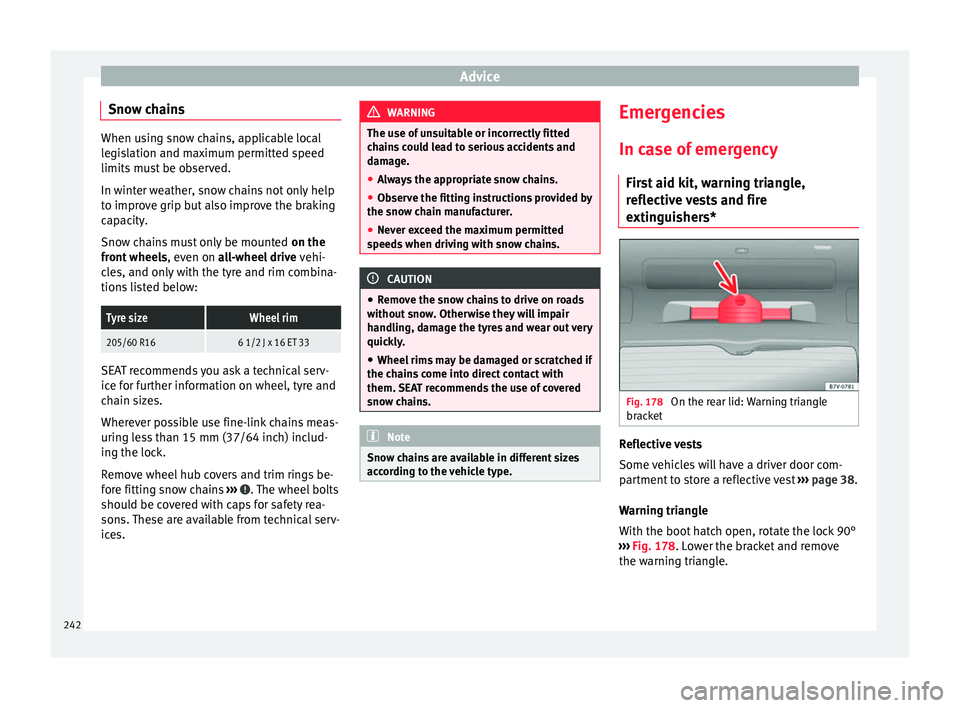
With the boot hatch open, rotate the lock 90°
››› Fig. 178. Lower the bracket and remove
the warnin
g triangle.
242
Page 252 of 305
Advice
●
Never raise the vehicle if it is tilting to one
side or the engine is running.
● Never start the engine when the vehicle is
raised. The vehicle may come loose from the
jack due to the engine vibrations. Changing a wheel
Fig. 189
Changing a wheel: loosen wheel
bolts with the socket at the end of the wheel
brace Removing the wheel
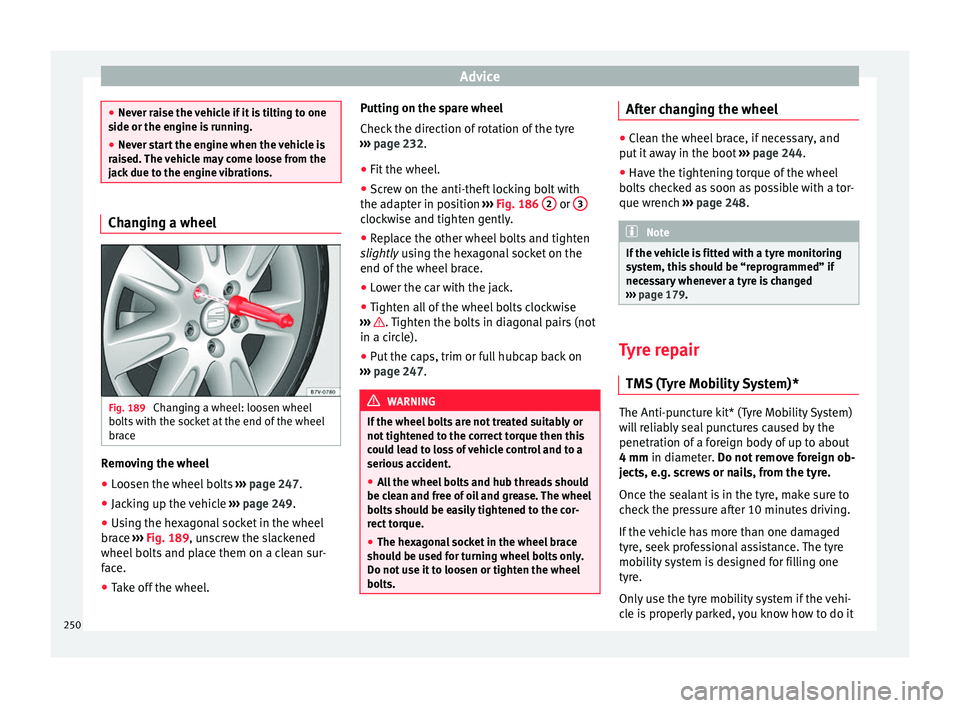
● Loosen the wheel bolts ››› page 247 .
● Jacking up the vehicle ››› page 249.
● Using the hexagonal socket in the wheel
brace ››› Fig. 189 , unscrew the slackened
wheel bo
lts and place them on a clean sur-
face.
● Take off the wheel. Putting on the spare wheel
Check the direction of rotation of the tyre
››› page 232.
● Fit the wheel
.
● Screw on the anti-theft locking bolt with
the adapter in position ››› Fig. 186 2 or
3 clockwise and tighten gently.
●
Replace the other wheel bolts and tighten
slightly using the hexagonal socket on the
end of the wheel
brace.
● Lower the car with the jack.
● Tighten all of the wheel bolts clockwise
››› . Tighten the bolts in diagonal pairs (not
in a circle).
● Put the caps, trim or full hubcap back on
››› page 247 . WARNING
If the wheel bolts are not treated suitably or
not tightened to the correct torque then this
could lead to loss of vehicle control and to a
serious accident.
● All the wheel bolts and hub threads should
be clean and free of oil and grease. The wheel
bolts should be easily tightened to the cor-
rect torque.
● The hexagonal socket in the wheel brace
should be used for turning wheel bolts only.
Do not use it to loosen or tighten the wheel
bolts. After changing the wheel
●
Clean the wheel brace, if necessary, and
put it away in the boot ››› page 244.
● Have the tightening torque of the wheel
bolts checked as soon as possible with a tor-
que wrench ››› page 248. Note
If the vehicle is fitted with a tyre monitoring
system, this should be “reprogrammed” if
necessary whenever a tyre is changed
››› page 179. Tyre repair
TMS (Tyre Mobility System)* The Anti-puncture kit* (Tyre Mobility System)
will reliably seal punctures caused by the
penetration of a foreign body of up to about
4 mm
in diameter.
Do not remove foreign ob-
j
ects, e.g. screws or nails, from the tyre.
Once the sealant is in the tyre, make sure to
check the pressure after 10 minutes driving.
If the vehicle has more than one damaged
tyre, seek professional assistance. The tyre
mobility system is designed for filling one
tyre.
Only use the tyre mobility system if the vehi-
cle is properly parked, you know how to do it
250