turn signal Seat Alhambra 2015 Owner's Guide
[x] Cancel search | Manufacturer: SEAT, Model Year: 2015, Model line: Alhambra, Model: Seat Alhambra 2015Pages: 305, PDF Size: 5.46 MB
Page 174 of 305
Operation
Travelling down hills with the CCS
When travelling down hills the CCS cannot
maintain a constant speed. Slow the vehicle
down using the brake pedal and reduce
gears if required.
Automatic off
The cruise control system (CCS) is switched
off automatically or temporarily:
● If the system detects a fault that could af-
fect the working order of the CCS.
● If you increase the stored speed by using
the accelerator for a certain time.
● if the brake or clutch pedal is depressed.
● If you change gears.
● If the airbag is triggered.
Lane Assist system* Introduction WARNING
The intelligent technology in the lane assist
system cannot change the limits imposed by
the laws of physics and by the system itself.
Careless or uncontrolled use of the Lane As-
sist system may cause accidents and injury.
The system is not a replacement for driver
awareness. ●
Always adapt your speed and the distance
to the vehicles ahead in line with visibility,
weather conditions, the condition of the road
and the traffic situation.
● Always keep your hands on the steering
wheel so you can turn it at any time.
● The lane assist system does not detect all
road markings. In some circumstances, the
poor state of the road, structures located on
it or certain objects may be mistakenly recog-
nised as road markings by the lane assist
system. In such situations, switch the lane
assist system off immediately.
● Pay attention to the instructions on the in-
strument panel display and act accordingly to
its requests.
● Always pay attention to the vehicle's sur-
roundings. Note
The lane assist system has been exclusively
developed for driving on asphalted roads. Note
If the lane assist system does not work as de-
scribed in this chapter, do not use it and con-
tact a specialised workshop. Note
If you observe any system malfunction, have
the system checked by a specialised work-
shop. Control lampsBlinks
or
lights up
Possible causeSolution
(yellow)
Lane assist system
connected but in-
active.
The system cannot
clearly detect the
lane. See
page 173,
The lane assist sys-
tem is inactive (con-
trol lamp lit in yel-
low).
(green)
Lane assist system
connected and ac-
tive.–
Several warning and control lamps light up
for a few seconds when the ignition is switch-
ed on, signalling that the function is being
verified. They will switch off after a few sec-
onds.
WARNING
Observe the safety warnings ››› in Control
and warning lamps on page 47. 172
Page 175 of 305
Driver assistance systems
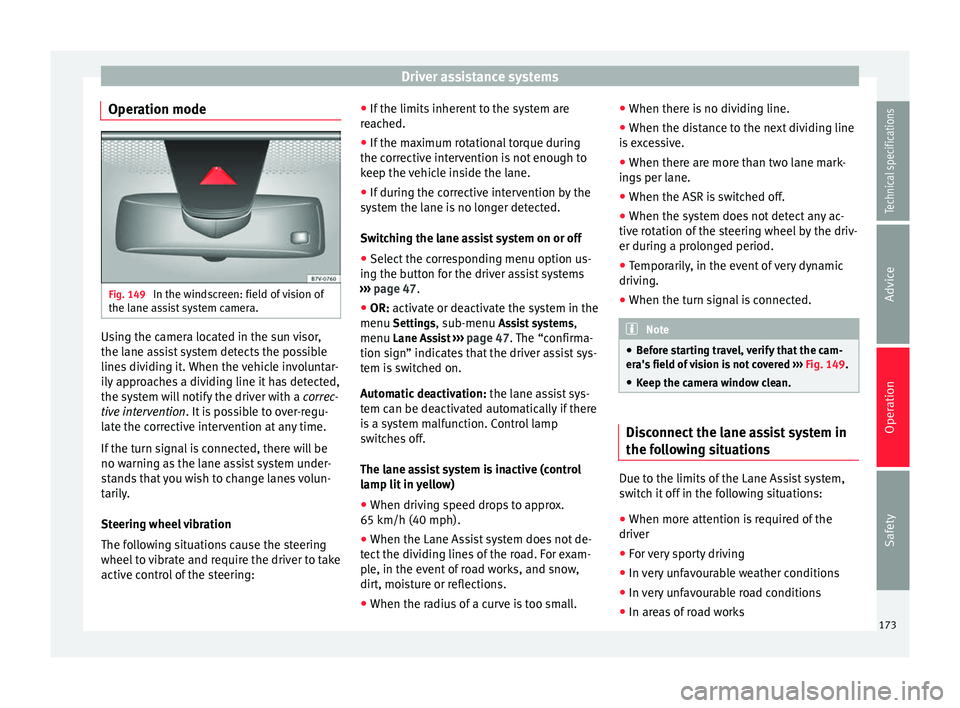
Operation mode Fig. 149
In the windscreen: field of vision of
the lane assist system camera. Using the camera located in the sun visor,
the lane assist system detects the possible
lines dividing it. When the vehicle involuntar-
ily approaches a dividing line it has detected,
the system will notify the driver with a
correc-
tive intervention . It is possible to over-regu-
l at
e the corrective intervention at any time.
If the turn signal is connected, there will be
no warning as the lane assist system under-
stands that you wish to change lanes volun-
tarily.
Steering wheel vibration
The following situations cause the steering
wheel to vibrate and require the driver to take
active control of the steering: ●
If the limits inherent to the system are
reached.
● If the maximum rotational torque during
the corrective intervention is not enough to
keep the vehicle inside the lane.
● If during the corrective intervention by the
system the lane is no longer detected.
Switching the lane assist system on or off
● Select the corresponding menu option us-
ing the button for the driver assist systems
››› page 47.
● OR: activate or deactivate the system in the
menu Setting
s, sub-menu Assist systems ,
menu Lane Assist ››› page 47. The “confirma-
tion sign” indic
ates that the driver assist sys-
tem is switched on.
Automatic deactivation: the lane assist sys-
tem can be deactivated automatically if there
is a system malfunction. Control lamp
switches off.
The lane assist system is inactive (control
lamp lit in yellow)
● When driving speed drops to approx.
65 km/h (40 mph).
● When the Lane Assist system does not de-
tect the dividing lines of the road. For exam-
ple, in the event of road works, and snow,
dirt, moisture or reflections.
● When the radius of a curve is too small. ●
When there is no dividing line.
● When the distance to the next dividing line
is excessive.
● When there are more than two lane mark-
ings per lane.
● When the ASR is switched off.
● When the system does not detect any ac-
tive rotation of the steering wheel by the driv-
er during a prolonged period.
● Temporarily, in the event of very dynamic
driving.
● When the turn signal is connected. Note
● Before starting travel, verify that the cam-
era's field of vision is not covered ››› Fig. 149.
● Keep the c
amera window clean. Disconnect the lane assist system in
the following situations
Due to the limits of the Lane Assist system,
switch it off in the following situations:
● When more attention is required of the
driver
● For very sporty driving
● In very unfavourable weather conditions
● In very unfavourable road conditions
● In areas of road works
173
Technical specifications
Advice
Operation
Safety
Page 183 of 305
Towing bracket device
Bumper mounted tow hitch
Never fit a tow hitch or its attachments to the
bumper. A tow hitch should never interfere
with the bumper performance. Do not modify
the exhaust system and brake system. Regu-
larly check the tow hitch to ensure it is firmly
fitted.
Engine cooling system
Driving with a trailer increases the load on
the engine and cooling system. The cooling
system should always have sufficient coolant
and to be able to cope with the vehicle and
trailer.
Electric trailer brake
If the trailer has its own braking system,
please note the relevant legal requirements.
The trailer braking system should never be
connected to the vehicle braking system.
Trailer cable
Always use a cable between the vehicle and
the trailer ››› page 183 .
T r
ailer rear lights
The rear lights of a trailer must fulfil the cor-
responding standards ››› page 183.
Never connect the trailer's rear lights directly
to the vehicle electric system. In case of any
doubt about the electrical connection of the trailer, ask a specialised workshop. SEAT rec-
ommends visiting a technical service.
Wing mirrors
When the field of vision behind the trailer
cannot be seen using the standard wing mir-
rors of the towing vehicle, additional wing
mirrors are required according to the legal re-
quirements of each country. The wing mirrors
must be fitted before driving and must pro-
vide a sufficient field of vision behind.
Trailer electricity consumption
Never exceed the specifications:
DevicesMaximum power
Side lights and rear lights50 Watts
Turn signal (each side)54 Watts
Brake lights (total)84 Watts
Reversing lights (total)42 Watts
Rear fog light42 Watts
WARNING
If the tow hitch is badly fitted or unsuitable,
the trailer may separate from the vehicle
causing an accident with serious consequen-
ces. CAUTION
● If the rear lights of the trailer are not cor-
rectly connected, the vehicle electronics may
be damaged.
● If the trailer absorbs excessive electric cur-
rent, the vehicle electronics may be dam-
aged.
● Never connect the trailer's electric system
to the electrical connections of the rear lights
or any other power sources. Only use suitable
connections for providing electric current to
the trailer. Note
● Towing a trailer places additional demands
on the vehicle. At SEAT, we recommend addi-
tional services between the normal inspec-
tion intervals if the vehicle is used frequently
for towing a trailer.
● In some countries, an additional fire extin-
guisher is required if the trailer weight is
more than 2500 kg 181
Technical specifications
Advice
Operation
Safety
Page 185 of 305
Towing bracket device
CAUTION
● If anything is attached to the tow hitch ball,
do not, under any circumstances press the
button.
● Never direct a high-pressure or steam
cleaning system directly at the tow hitch ball
or trailer power socket. This could cause
damage to seals or remove lubricating
grease. Note
In extremely low temperatures, it is possible
that the tow hitch is not released. In this
case, place the vehicle in a warmer location
(e.g. a garage). Installing a bicycle carrier to the tow
hitch
The maximum load permitted for a bicycle
carrier on the tow hitch ball is
75 kg, with a
m ax
imum distance of 30 cm from the sup-
port. The distance between supports is the
distance between the bicycle carrier centre of
gravity (with the bicycles) and the centre of
point of the tow hitch ball. WARNING
The incorrect use of the tow hitch with a bicy-
cle carrier installed can cause accidents and
injury. ●
Never exceed the load and distances be-
tween supports indicated.
● Never fit the bicycle carrier to the tow hitch
ball neck, underneath the tow hitch given
that the bicycle carrier may be incorrectly fit-
ted due to the shape of the tow hitch and the
model of bicycle carrier.
● Always read and take the manufacturer as-
sembly instructions into account. CAUTION
Exceeding the maximum load and distance
between supports indicated can cause con-
siderable damage to the vehicle.
● Never exceed the specifications. Hitching and connecting the trailer
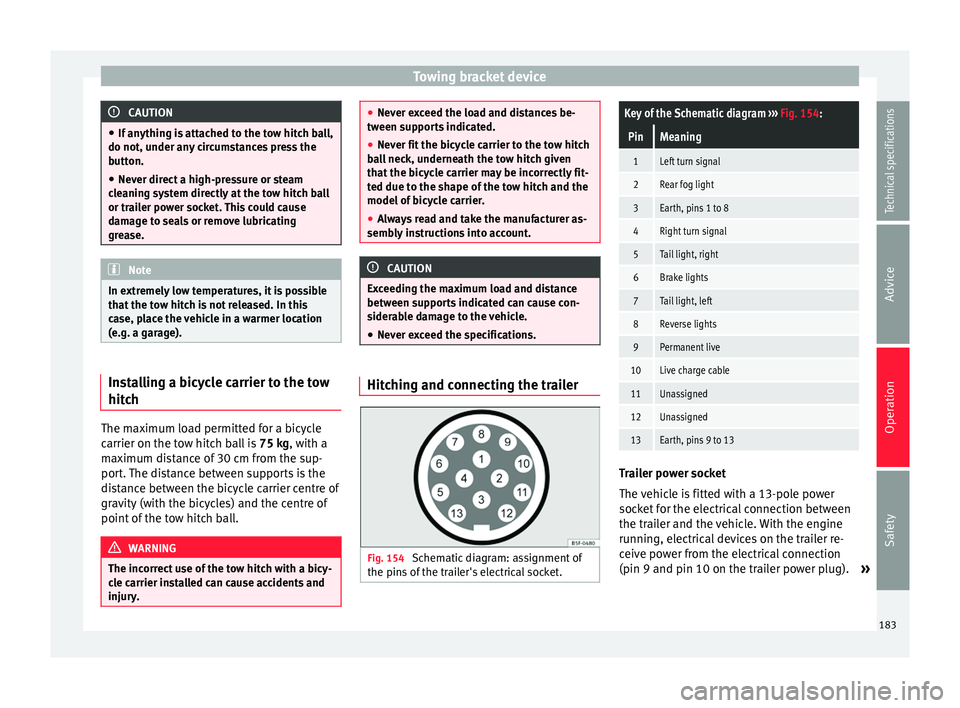
Fig. 154
Schematic diagram: assignment of
the pins of the trailer's electrical socket.
Key of the Schematic diagram ››› Fig. 154:
PinMeaning
1Left turn signal
2Rear fog light
3Earth, pins 1 to 8
4Right turn signal
5Tail light, right
6Brake lights
7Tail light, left
8Reverse lights
9Permanent live
10Live charge cable
11Unassigned
12Unassigned
13Earth, pins 9 to 13 Trailer power socket
The vehicle is fitted with a 13-pole power
socket for the electrical connection between
the trailer and the vehicle. With the engine
running, electrical devices on the trailer re-
ceive power from the electrical connection
(pin 9 and pin 10 on the trailer power plug).
»
183
Technical specifications
Advice
Operation
Safety
Page 194 of 305
Advice
Check first with a specialised workshop that
understands the technical possibilities of in-
stallation if you wish to use a two-way radio
with a transmitting power of over 10 watts.
SEAT recommends taking your car in for tech-
nical service.
All legal requirements, together with the in-
structions for the use of two-way radios must
be observed. WARNING
If the two-way radio is not securely fastened
in position, it could be sent flying around the
vehicle in the event of sharp braking, sudden
manoeuvres or accident, causing injury.
● While driving, two-way radios must be se-
curely fastened in position, outside the radi-
us of action of the airbags, or safely stowed
away. WARNING
When using a two-way radio without a con-
nection to an exterior aerial, the maximum
permitted levels of electromagnetic radiation
may be exceeded. This is also the case if the
aerial has not been correctly installed.
● You should only use a two-way radio inside
the vehicle if it has first been correctly con-
nected to an exterior aerial. Information stored by the control
units
Your vehicle is fitted at the factory with a ser-
ies of electronic control units responsible for
the engine and gearbox management. In ad-
dition, the control units supervise the per-
formance of the exhaust gas system and the
airbag systems.
Therefore, while the vehicle is being driven,
these electronic control units are continuous-
ly analysing the vehicle data. In the event of
faults or deviations from the theoretical val-
ues, only this data is stored. Normally, the
warning lamps on the instrument panel light
up in the event of faults.
This data can only be read and analysed us-
ing special equipment.
The storing of the data allows specialised
workshops to detect and repair faults. Stored
data may include:
● Data relating to the engine or the gearbox
● Speed
● Direction of travel
● Braking force
● Detection of seat belt
The vehicle control units never record conver-
sations held by passengers in the vehicle.
In vehicles equipped with an emergency call
function via the mobile phone or other appli- ances connected in the vehicle, it is possible
to send the vehicle position. If the control
unit records an accident with airbag activa-
tion, the system may automatically send a
signal. This will depend on the network oper-
ator. Normally, transmission is only possible
in areas with good coverage.
Event Data Recorder
The vehicle is
not
fitted with an event data re-
c or
der.
An event data recorder temporarily stores the
vehicle information. Therefore, in the event of
an accident, it is possible to obtain detailed
information about how the accident occur-
red. For example, in vehicles with airbag sys-
tems, data relating to speed of impact, seat
belt status, seat positions and airbag activa-
tion times may be stored. The volume of data
depends on the manufacturer.
Event data recorders can only be mounted
with authorisation from the vehicle owner
and, in some countries, they are governed by
local legislation.
Reprogramming control units
On the whole, all the data required for the
component management is stored in the con-
trol units. The programming of certain con-
venience functions, such as the turn signals,
individual door opening and instructions on
the display can be modified using special
192
Page 210 of 305
Advice
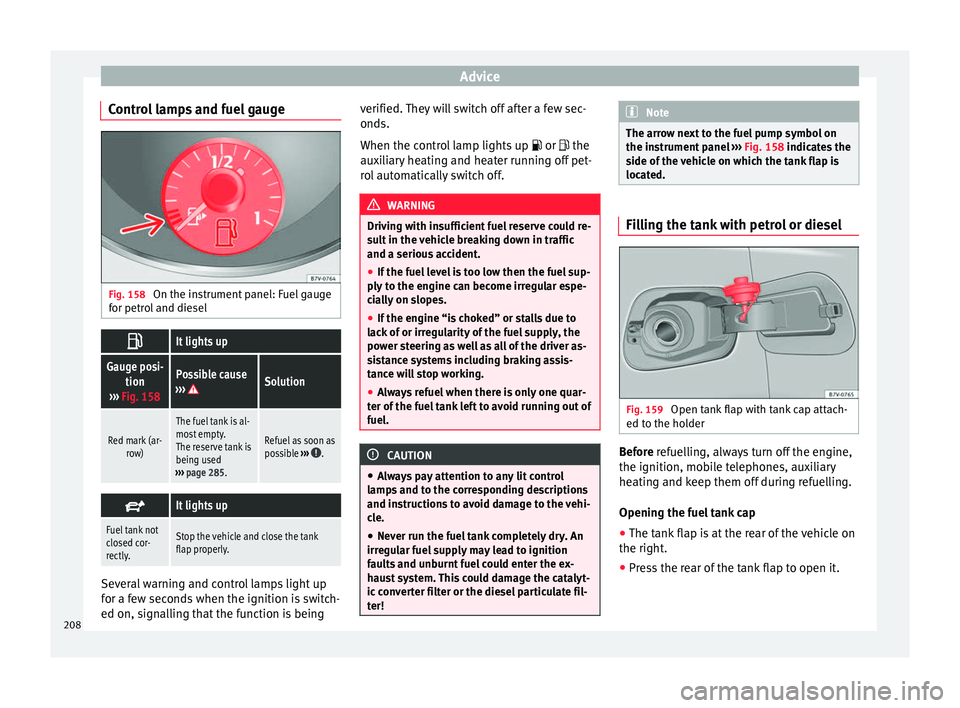
Control lamps and fuel gauge Fig. 158
On the instrument panel: Fuel gauge
for petrol and diesel It lights up
Gauge posi-
tion
››› Fig. 158Possible cause
››› Solution
Red mark (ar- row)
The fuel tank is al-most empty.
The reserve tank is
being used
››› page 285.
Refuel as soon as
possible ››› .
It lights up
Fuel tank not
closed cor-
rectly.Stop the vehicle and close the tank
flap properly.
Several warning and control lamps light up
for a few seconds when the ignition is switch-
ed on, signalling that the function is being verified. They will switch off after a few sec-
onds.
When the control lamp lights up
or
the
auxiliary heating and heater running off pet-
rol automatically switch off. WARNING
Driving with insufficient fuel reserve could re-
sult in the vehicle breaking down in traffic
and a serious accident.
● If the fuel level is too low then the fuel sup-
ply to the engine can become irregular espe-
cially on slopes.
● If the engine “is choked” or stalls due to
lack of or irregularity of the fuel supply, the
power steering as well as all of the driver as-
sistance systems including braking assis-
tance will stop working.
● Always refuel when there is only one quar-
ter of the fuel tank left to avoid running out of
fuel. CAUTION
● Always pay attention to any lit control
lamps and to the corresponding descriptions
and instructions to avoid damage to the vehi-
cle.
● Never run the fuel tank completely dry. An
irregular fuel supply may lead to ignition
faults and unburnt fuel could enter the ex-
haust system. This could damage the catalyt-
ic converter filter or the diesel particulate fil-
ter! Note
The arrow next to the fuel pump symbol on
the instrument panel ››› Fig. 158 indicates the
s ide of
the vehicle on which the tank flap is
located. Filling the tank with petrol or diesel
Fig. 159
Open tank flap with tank cap attach-
ed to the holder Before
refuelling, always turn off the engine,
the ignition, mo b
ile telephones, auxiliary
heating and keep them off during refuelling.
Opening the fuel tank cap
● The tank flap is at the rear of the vehicle on
the right.
● Press the rear of the tank flap to open it.
208
Page 224 of 305
Advice
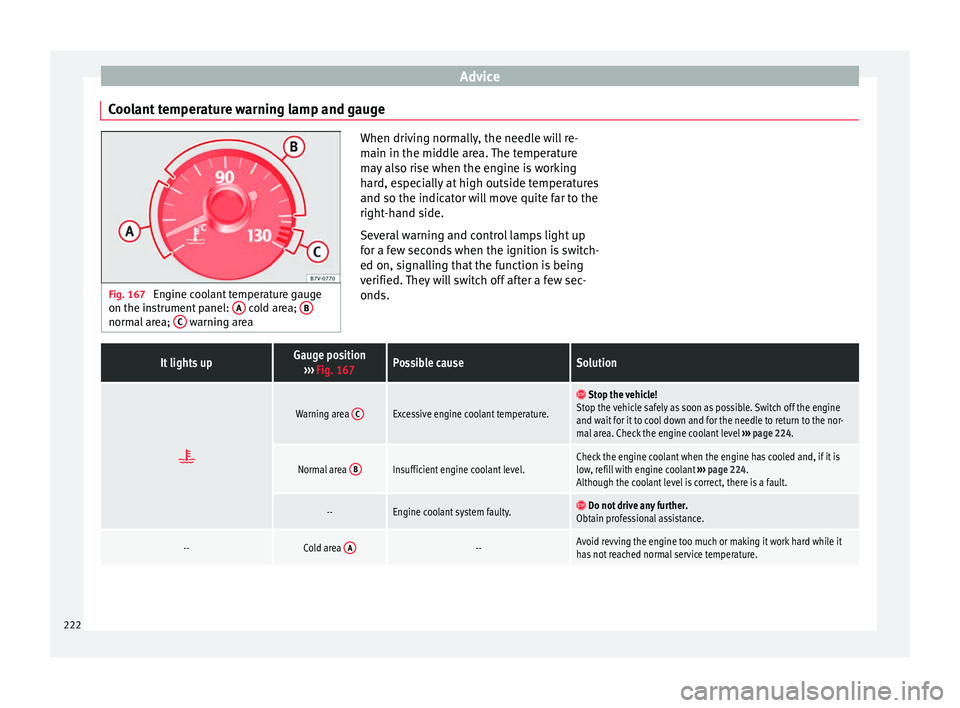
Coolant temperature warning lamp and gauge Fig. 167
Engine coolant temperature gauge
on the instrument panel: A cold area;
B normal area;
C warning area When driving normally, the needle will re-
main in the middle area. The temperature
may also rise when the engine is working
hard, especially at high outside temperatures
and so the indicator will move quite far to the
right-hand side.
Several warning and control lamps light up
for a few seconds when the ignition is switch-
ed on, signalling that the function is being
verified. They will switch off after a few sec-
onds.It lights upGauge position
››› Fig. 167Possible causeSolution
Warning area
CExcessive engine coolant temperature.
Stop the vehicle!
Stop the vehicle safely as soon as possible. Switch off the engine
and wait for it to cool down and for the needle to return to the nor-
mal area. Check the engine coolant level ››› page 224.
Normal area BInsufficient engine coolant level.Check the engine coolant when the engine has cooled and, if it is
low, refill with engine coolant
››› page 224.
Although the coolant level is correct, there is a fault.
--Engine coolant system faulty. Do not drive any further.
Obtain professional assistance.
--Cold area A--Avoid revving the engine too much or making it work hard while it
has not reached normal service temperature.222
Page 260 of 305
Advice
● After towing, remove the towline anchorage
by turning it clockwise and put the cover
b ac
k in place. CAUTION
The towline anchorage must always be com-
pletely and firmly tightened. Otherwise, it
could be released while towing and tow-start-
ing. Fitting the rear towline anchorage
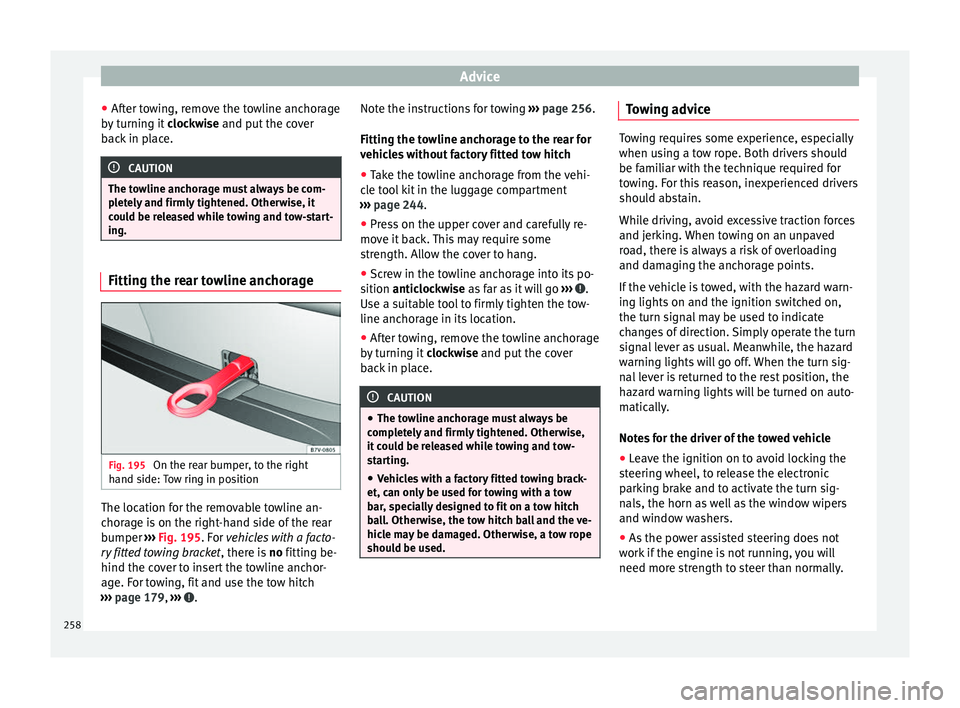
Fig. 195
On the rear bumper, to the right
hand side: Tow ring in position The location for the removable towline an-
chorage is on the right-hand side of the rear
bumper
››› Fig. 195 . For
vehicles with a facto-
ry
fitted towing bracket , there is no fitting be-
hind the cover to insert the towline anchor-
age. For towing, fit and use the tow hitch
››› page 179, ››› . Note the instructions for towing
››› page 256.
Fitting the towline anchorage to the rear for
vehicles without factory fitted tow hitch ● Take the towline anchorage from the vehi-
cle tool kit in the luggage compartment
››› page 244 .
● Pr e
ss on the upper cover and carefully re-
move it back. This may require some
strength. Allow the cover to hang.
● Screw in the towline anchorage into its po-
sition anticlockwise as far as it will go ›
›› .
Use a suitable tool to firmly tighten the tow-
line anchorage in its location.
● After towing, remove the towline anchorage
by turning it clockwise and put the cover
b ac
k in place. CAUTION
● The towline anchorage must always be
completely and firmly tightened. Otherwise,
it could be released while towing and tow-
starting.
● Vehicles with a factory fitted towing brack-
et, can only be used for towing with a tow
bar, specially designed to fit on a tow hitch
ball. Otherwise, the tow hitch ball and the ve-
hicle may be damaged. Otherwise, a tow rope
should be used. Towing advice
Towing requires some experience, especially
when using a tow rope. Both drivers should
be familiar with the technique required for
towing. For this reason, inexperienced drivers
should abstain.
While driving, avoid excessive traction forces
and jerking. When towing on an unpaved
road, there is always a risk of overloading
and damaging the anchorage points.
If the vehicle is towed, with the hazard warn-
ing lights on and the ignition switched on,
the turn signal may be used to indicate
changes of direction. Simply operate the turn
signal lever as usual. Meanwhile, the hazard
warning lights will go off. When the turn sig-
nal lever is returned to the rest position, the
hazard warning lights will be turned on auto-
matically.
Notes for the driver of the towed vehicle
●
Leave the ignition on to avoid locking the
steering wheel, to release the electronic
parking brake and to activate the turn sig-
nals, the horn as well as the window wipers
and window washers.
● As the power assisted steering does not
work if the engine is not running, you will
need more strength to steer than normally.
258
Page 269 of 305
Fuses and bulbs
WARNING
Failure to replace bulbs correctly may cause
serious accidents.
● Before carrying out any work in the engine
compartment please read and observe the
warnings ››› page 214. In any vehicle, the en-
gine c omp
artment is a hazardous area and
could cause severe injury.
● Discharge lamps work with high-voltage
and can cause serious or fatal injury if han-
dled incorrectly.
● H7 and discharge lamps are highly pressur-
ised and could explode when being changed.
● Only replace the bulbs concerned when
they have cooled.
● Never replace bulbs alone if you are not fa-
miliar with the operations necessary. If you
are not sure about procedures then visit a
specialised workshop to carry out the neces-
sary work.
● Never touch the bulb glass directly. Finger-
prints will be evaporated by the heat of the
operating bulb thus “fogging” up the reflec-
tor.
● The headlamp frameworks in the engine
compartment and the tail lamps contain sharp elements. Always protect your hands
when changing bulbs.
CAUTION
● After changing a bulb, if the rubber covers
are not replaced correctly on the headlamp
framework, the electrical installation may be
damaged, especially if water is allowed to en-
ter.
● Remove the ignition key before working on
the electric system. Otherwise, a short circuit
could occur.
● Switch off the lights and the parking light
before changing a bulb.
● Take good care to avoid damaging any com-
ponents. Control lamp
It
lights upPossible causeSolution
A vehicle exterior
lighting bulb is not
working.Replace the faulty
bulb. Several warning and control lamps light up
for a few seconds when the ignition is switch-
ed on, signalling that the function is being
verified. They will switch off after a few sec-
onds.
Checking the bulbs of a trailer
For vehicles with the factory fitted towing
bracket, certain trailer lights are also control-
led if the power socket is correctly connected.
A fault on a trailer turn signal is indicated on
the instrument panel by the turn signal blink-
ing twice as fast (
or ) ››› page 74.
● General fault of all turn signals on one side.
● Fault in one tail light (on some models, al-
so the registration light).
● Fault in two brake lights. WARNING
Observe the safety warnings ››› in Control
and warning lamps on page 47. Note
A fault in the LED on the tail lights will not be
indicated. However, if the fault affects all the
LEDs then this will be indicated by the control
lamp . 267
Technical specifications
Advice
Operation
Safety
Page 270 of 305
Advice
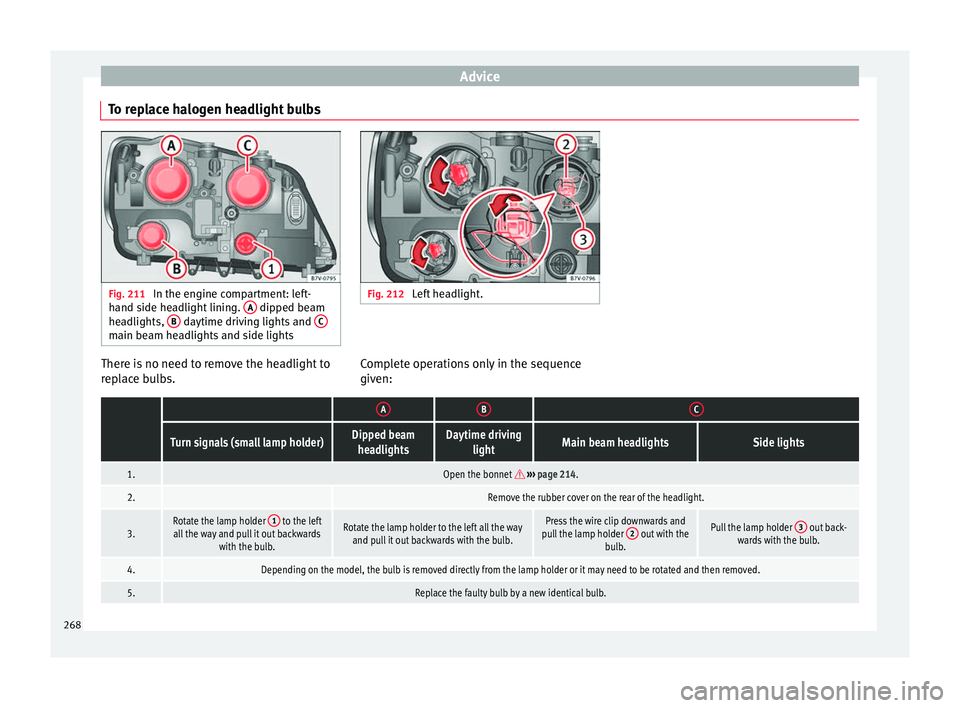
To replace halogen headlight bulbs Fig. 211
In the engine compartment: left-
hand side headlight lining. A dipped beam
headlights, B daytime driving lights and
Cmain beam headlights and side lights Fig. 212
Left headlight. There is no need to remove the headlight to
replace bulbs.
Complete operations only in the sequence
given:
ABC
Turn signals (small lamp holder)Dipped beam
headlightsDaytime driving lightMain beam headlightsSide lights
1.Open the bonnet ››› page 214.
2. Remove the rubber cover on the rear of the headlight.
3.Rotate the lamp holder 1 to the left
all the way and pull it out backwards with the bulb.Rotate the lamp holder to the left all the wayand pull it out backwards with the bulb.Press the wire clip downwards and
pull the lamp holder 2 out with the
bulb.Pull the lamp holder 3 out back-
wards with the bulb.
4.Depending on the model, the bulb is removed directly from the lamp holder or it may need to be rotated and then removed.
5.Replace the faulty bulb by a new identical bulb. 268