ECU Seat Alhambra 2017 User Guide
[x] Cancel search | Manufacturer: SEAT, Model Year: 2017, Model line: Alhambra, Model: Seat Alhambra 2017Pages: 320, PDF Size: 6.88 MB
Page 68 of 320
Safety
●
The seat belt
itself, or a loose seat belt, can
cause severe injuries if the belt moves from
hard areas of the body to soft areas (e.g. the
stomach).
● The shoulder part of the seat belt must lie
on the centre of
the shoulder, never across
the neck or the arm.
● The seat belt must lie flat and fit comforta-
bly on the t
orso
● The lap part of the seat belt must lie across
the pelvis, nev
er across the stomach. The
seat belt must lie flat and fit comfortably on
the pelvis Pull the belt tight if necessary to
take up any slack.
● For pregnant women, the lap part of the
seat belt
must lie as low as possible over the
pelvis and always lie flat, “surrounding” the
stomach ››› Fig. 88.
● Do not twist the seat belt while it is fas-
tened.
● Once the se
at belt is positioned correctly,
don't pu
ll it away from your body with your
hand.
● Do not lie the seat belt across rigid or frag-
ile o
bjects, e.g. glasses, pens or keys.
● Never use seat belt clips, retaining rings or
simil
ar instruments to alter the position of
the belt webbing. Note
If your physical constitution prevents you
from m aint
aining the correct position of the belt webbing, contact a specialised workshop
for help w
ith an
y special devices to ensure
the optimum protection of the seat belt and
airbag. SEAT recommends taking your car in
for technical service. Fastening or unfastening the seat belt
with tw
o b
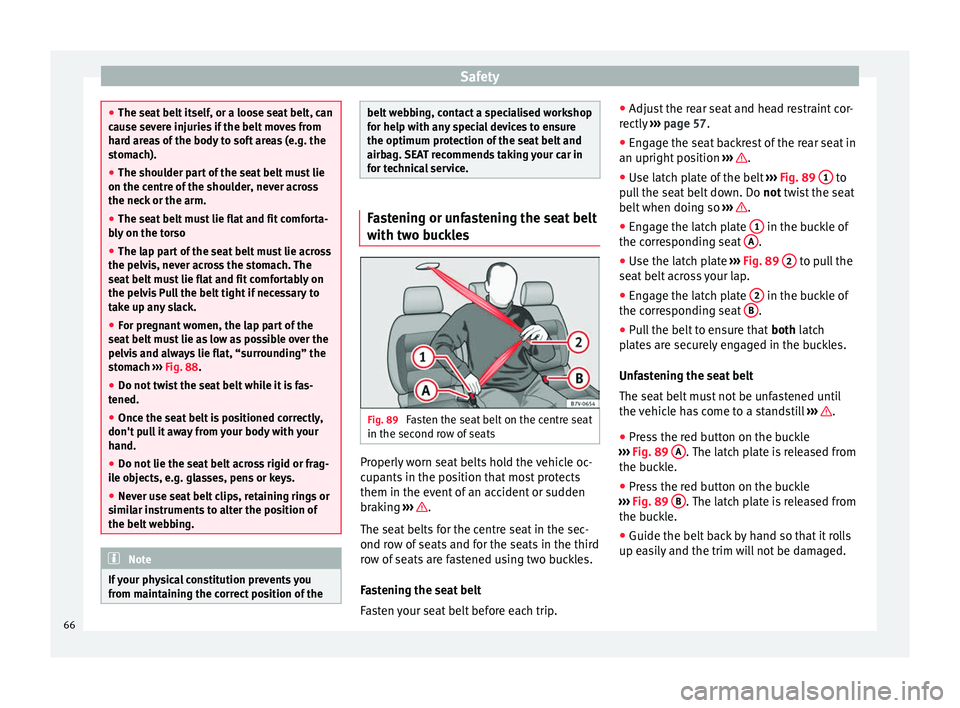
uckles Fig. 89
Fasten the seat belt on the centre seat
in the sec ond r
o
w of seats Properly worn seat belts hold the vehicle oc-
c
up
ants
in the position that most protects
them in the event of an accident or sudden
braking ››› .
The se at
belts
for the centre seat in the sec-
ond row of seats and for the seats in the third
row of seats are fastened using two buckles.
Fastening the seat belt
Fasten your seat belt before each trip. ●
Adjust
the rear seat and head restraint cor-
rectly ››› page 57.
● Engage the seat backrest of the rear seat in
an upright pos
ition ››› .
● Use latch plate of the belt ››
›
Fig. 89 1 to
p u
l
l the seat belt down. Do not twist the seat
belt when doing so ››› .
● Engage the latch plate 1 in the buckle of
the c orr
e
sponding seat A .
● Use the latch plate ››
›
Fig. 89 2 to pull the
se at
belt
across your lap.
● Engage the latch plate 2 in the buckle of
the c orr
e
sponding seat B .
● Pull the belt to ensure that both lat
c
h
plates are securely engaged in the buckles.
Unfastening the seat belt
The seat belt must not be unfastened until
the vehicle has come to a standstill ››› .
● Press the red button on the buckle
› ›
›
Fig. 89 A . The latch plate is released from
the b uc
k
le.
● Press the red button on the buckle
›››
Fig. 89 B . The latch plate is released from
the b uc
k
le.
● Guide the belt back by hand so that it rolls
up eas
ily and the trim will not be damaged.
66
Page 69 of 320
Seat belts
WARNING
An incorrectly worn seat belt web can cause
sever e or f
atal injuries in the event of an acci-
dent.
● The seat belt cannot offer its full protection
unl
ess the seat backrests are in an upright
position and the seat belt is worn correctly,
according to your size.
● Unbuckling your seat belt while the vehicle
is in motion c
an cause severe or fatal injuries
in the event of an accident or sudden braking. Note
Seat belts with two buckles include a dia-
gram t o sho
w how to fasten the seat belt.Belt height adjustment
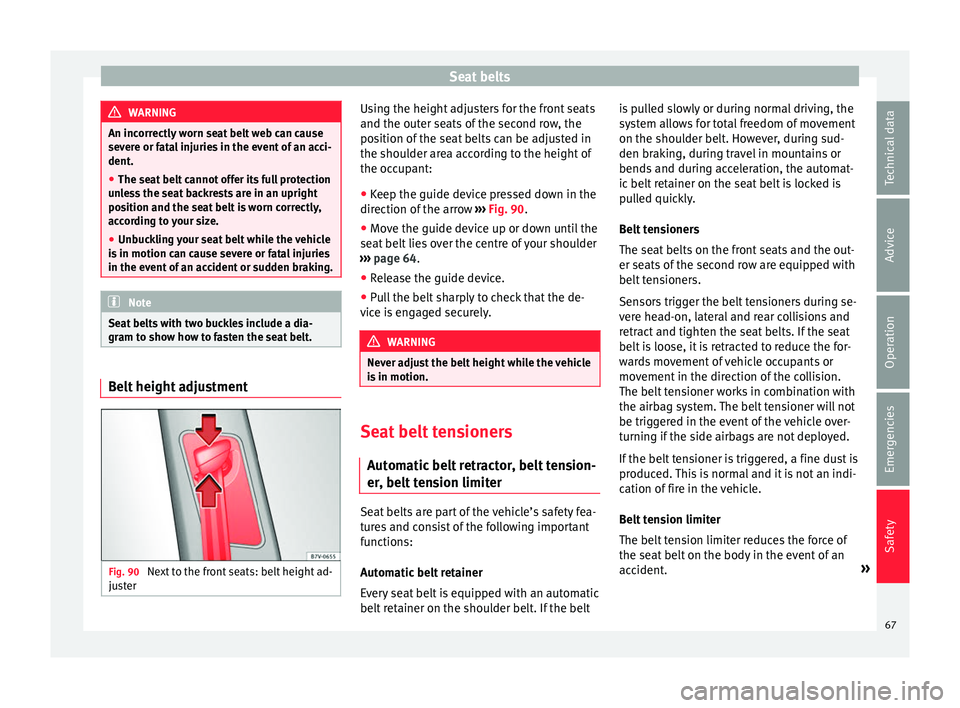
Fig. 90
Next to the front seats: belt height ad-
ju s
t
er Using the height adjusters for the front seats
and the out
er se
ats
of the second row, the
position of the seat belts can be adjusted in
the shoulder area according to the height of
the occupant:
● Keep the guide device pressed down in the
direction of the arr
ow ››› Fig. 90.
● Move the guide device up or down until the
seat belt
lies over the centre of your shoulder
››› page 64.
● Release the guide device.
● Pull the belt sharply to check that the de-
vice i
s engaged securely. WARNING
Never adjust the belt height while the vehicle
is in motion. Seat belt tensioners
Aut omatic
belt retractor, belt tension-
er, belt tension limiter Seat belts are part of the vehicle’s safety fea-
t
ur
e
s and consist of the following important
functions:
Automatic belt retainer
Every seat belt is equipped with an automatic
belt retainer on the shoulder belt. If the belt is pulled slowly or during normal driving, the
syst
em allows for total freedom of movement
on the shoulder belt. However, during sud-
den braking, during travel in mountains or
bends and during acceleration, the automat-
ic belt retainer on the seat belt is locked is
pulled quickly.
Belt tensioners
The seat belts on the front seats and the out-
er seats of the second row are equipped with
belt tensioners.
Sensors trigger the belt tensioners during se-
vere head-on, lateral and rear collisions and
retract and tighten the seat belts. If the seat
belt is loose, it is retracted to reduce the for-
wards movement of vehicle occupants or
movement in the direction of the collision.
The belt tensioner works in combination with
the airbag system. The belt tensioner will not
be triggered in the event of the vehicle over-
turning if the side airbags are not deployed.
If the belt tensioner is triggered, a fine dust is
produced. This is normal and it is not an indi-
cation of fire in the vehicle.
Belt tension limiter
The belt tension limiter reduces the force of
the seat belt on the body in the event of an
accident. »
67
Technical data
Advice
Operation
Emergencies
Safety
Page 73 of 320
Airbag system
Airbag safety instructions Fr ont
airb
agsRead the additional information carefully
›› ›
page 17. WARNING
The airbag is deployed at high speed in frac-
tions of
a second.
● Always keep the deployment areas of the
front airb
ags free.
● Never secure objects to the covers or in the
deployment
area of the airbag modules, e.g.
drink holders or phone supports.
● The deployment space between the front
pas
sengers and the airbags must not in any
case be occupied by other passenger, pets
and objects.
● Never fix any object to the windscreen
above the fr
ont airbag on the front passenger
side.
● Do not alter, cover or stick anything to the
steerin
g wheel hub or the surface of the air-
bag module on the passenger side of the
dash panel. WARNING
Front airbags are deployed in front of the
st eerin
g wheel ›››
Fig. 25 and the dash
panel ›››
Fig. 26. ●
When drivin g, a
lways hold the steering
wheel on the outer edge of the ring with both
hands: 9 o'clock and 3 o'clock position.
● Adjust the driver seat so that there is at
lea
st 25 cm distance between your chest and
the hub of the steering wheel. If your physi-
cal constitution prevents you from meeting
these requirements, make sure you contact a
specialised workshop.
● Adjust the front passenger seat so there is
as muc
h distance as possible between the
front passenger and the dash panel. Knee airbag*
Read the additional information carefully
› ›
›
page 18. WARNING
The airbag is deployed at high speed in frac-
tions of
a second.
● The knee airbag is deployed in front of the
driver's knee
s. Always keep the deployment
areas of the knee airbags free.
● Never not fix objects to the cover or in the
deployment
area of the knee airbag.
● Adjust the driver seat so that there is a dis-
tance of
at least 10 cm (4 inches) between
your knees and the location of the knee air-
bag. If your physical constitution prevents
you from meeting these requirements, make
sure you contact a specialised workshop. Side airbags*
Read the additional information carefully
›› ›
page 19. WARNING
The airbag is deployed at high speed in frac-
tions of
a second.
● Always keep the deployment areas of the
side airbag
s free.
● Vehicle occupants of the front and outer
rear se
ats must never carry any other people,
pets or objects in the deployment space be-
tween them and the airbags.
● The built-in coat hooks should be used only
for lightweight
clothing. Do not leave any
heavy or sharp-edged objects in the pockets.
● Do not mount accessories on the doors.
● Only used protective covers for the seats
that ar
e approved for the vehicle. Otherwise,
the side airbag would be obstructed when de-
ployed. WARNING
Incorrect handling of the driver's and front
pa s
senger seat could prevent the side airbag
from deploying properly and cause severe in-
juries.
● Never remove the front seats of the vehicle
or modify an
y of their components. » 71
Technical data
Advice
Operation
Emergencies
Safety
Page 74 of 320
Safety
●
Gre at
forces must not be exerted on the
seat backrest bolsters because the side air-
bags might not deploy correctly, might not
deploy at all or might deploy unexpectedly.
● Any damage to the original seat upholstery
or around the se
ams of the side airbag units
must be repaired immediately by a special-
ised workshop. Curtain airbags*
Read the additional information carefully
› ›
›
page 20. WARNING
The airbag is deployed at high speed in frac-
tions of
a second.
● Always keep the deployment areas of the
head-pr
otection airbags free.
● Do not fix objects to the cover or in the de-
ployment
area of the curtain airbag.
● Vehicle occupants of the front and outer
rear se
ats must never carry any other people,
pets or objects in the deployment space be-
tween them and the airbags.
● The built-in coat hooks should be used only
for lightweight
clothing. Do not leave any
heavy or sharp-edged objects in the pockets.
● Do not mount accessories on the doors. ●
Do not fit c
urtains to the windows other
than those expressly approved for use in the
vehicle.
● Only turn the sun blinds towards the win-
dows
if there is no object, e.g. pens or garage
remote controls, secured to the sun blind. Deactivating airbags
Contr o
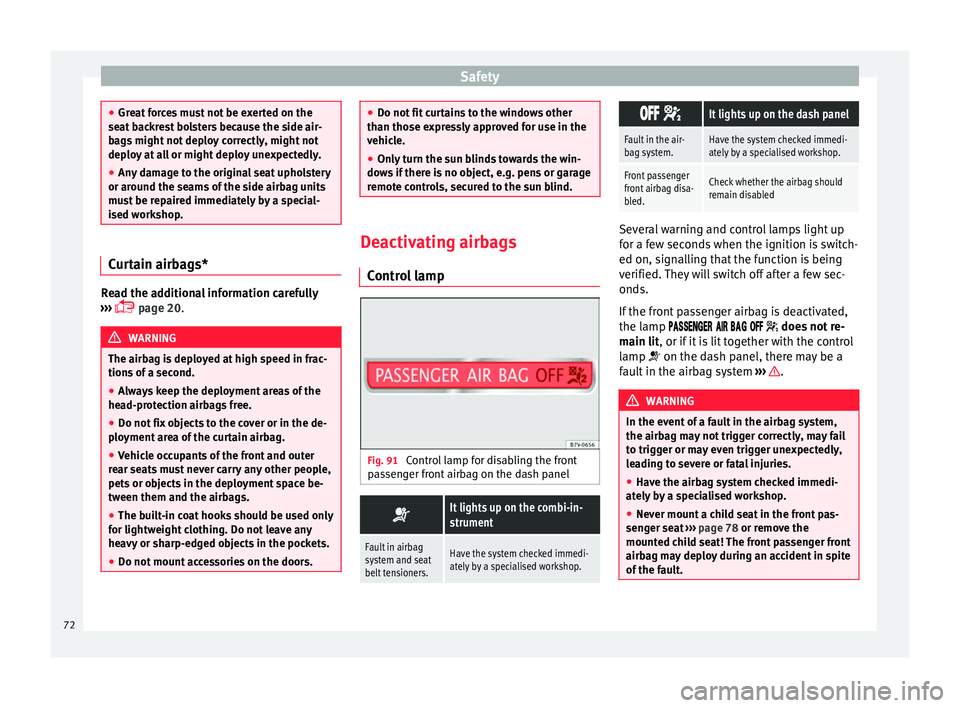
l lamp Fig. 91
Control lamp for disabling the front
p a
s
senger front airbag on the dash panel
It lights up on the combi-in-
strument
Fault in airbag
system and seat
belt tensioners.Have the system checked immedi-
ately by a specialised workshop.
It lights up on the dash panel
Fault in the air-
bag system.Have the system checked immedi-
ately by a specialised workshop.
Front passenger
front airbag disa-
bled.Check whether the airbag should
remain disabled
Several warning and control lamps light up
for a f
ew sec
onds when the ignition is switch-
ed on, signalling that the function is being
verified. They will switch off after a few sec-
onds.
If the front passenger airbag is deactivated,
the lamp does not re-
main lit, or if it is lit together with the control
lamp on the dash panel, there may be a
fault in the airbag system ››› .
WARNING
In the event of a fault in the airbag system,
the airbag m a
y not trigger correctly, may fail
to trigger or may even trigger unexpectedly,
leading to severe or fatal injuries.
● Have the airbag system checked immedi-
ately b
y a specialised workshop.
● Never mount a child seat in the front pas-
senger se
at ››› page 78 or remove the
mounted child seat! The front passenger front
airbag may deploy during an accident in spite
of the fault. 72
Page 76 of 320
Safety
Transporting children safely Saf ety
f
or children
Introduction Read the additional information carefully
›› ›
page 21.
Please read the information regarding the air-
bag system fully before transporting babies
and children in a child seat or other child re-
straint system installed on the front passen-
ger seat.
This information is extremely important for
driver and passenger safety, particularly that
of babies and children.
SEAT recommends the use of child seats from
the SEAT accessory programme. These child
seats have been designed and tested for use
in SEAT vehicles. You can purchase child
seats with different mountings from a techni-
cal service centre.
Using child restraint systems with a base or
foot
Some child retention systems are secured to
the seat using a base or support leg. For cer-
tain kinds of equipment the use of an addi-
tional accessory will be necessary (e.g. an ac-
cessory for the footwell) to fit the child reten-
tion system correctly and securely. WARNING
Make sure children are properly belted in and
corr ectly
secured to avoid severe or fatal inju-
ries while the vehicle is in motion.
● If a child seat is secured to the front pas-
senger se
at, the risk to the child of sustain-
ing critical or fatal injuries in the event of an
accident increases.
● An inflating front passenger airbag can
strike the r
ear-facing child seat and project it
with great force against the door, the roof or
the backrest.
● Never install a child seat facing backwards
on the front p
assenger seat unless the front
passenger front airbag has been disabled.
Risk of potentially fatal injuries to the child!
However, if it is necessary, in exceptional ca-
ses, to transport a child in the front passen-
ger seat, the front passenger front airbag
must always be disabled ››› page 72. If the
passenger seat has a height adjustment op-
tion, move it to the highest, most upright po-
sition. If you have a fixed seat, do not install
any child restraint system in this location.
● For those vehicles that do not include a key
lock sw
itch to deactivate the airbag, the vehi-
cle must be taken to a technical service.
● Children up to 12 years old should always
travel
on the rear seat.
● Children must always be protected with an
appro
ved child restraint system suited to
their height and weight. ●
Chil dr
en must assume the proper sitting
position and be properly belted in while trav-
elling.
● Ensure the seat backrest is upright when a
chil
d seat is being used on it.
● Do not allow the child's head or other part
of his
or her body to fall into the deployment
area of the side airbags.
● Make sure the belt webbing is correctly
positioned.
● Nev
er hold children or babies on your lap or
in your arms.
● On
ly one child may occupy a child seat.
● If you are using a child seat with a base or
foot, alw
ays install this base or foot correctly
and safely.
● If the vehicle has a storage compartment in
the footwel
l in front of the last row of seats,
this compartment cannot be used as de-
signed; on the contrary: It must be filled us-
ing the specially designed accessory so that
the base or foot is correctly supported by the
closed compartment and the child seat is se-
cured properly. If this compartment is not
suitably secured when using a child seat with
a base or foot then the compartment cover
could rupture in an accident and the child will
be ejected and suffer serious injury.
● Please read and observe the child seat
manufact
urer's handling instructions.74
Page 77 of 320
Transporting children safely
WARNING
An empty or loose child seat could fly uncon-
tro l
lably around the vehicle interior and
cause injuries in the event of an accident or
sudden braking.
● When not in use while the vehicle is in mo-
tion, alwa
ys safely secure the child seat or
store it in the luggage compartment. Note
Replace the child seat after an accident, as it
ma y
have invisible damage. Important information regarding the
fr
ont
p
assenger's airbag Read the additional information carefully
› ›
›
page 21.
Read and always observe the safety informa-
tion included in the following chapters:
● Child seats and passenger side airbag
›››
page 76, Use of the child seat on the
front passenger seat .
● Safety distance with respect to the passen-
ger airbag ›
›› in Introduction on page 68.
● Objects between the passenger and the
p a
s
senger side airbag ››› in Front airbags
on p age 71
. Child seats
Safety in
structions Read the additional information carefully
›› ›
page 21. WARNING
The lower anchor points for child seats are
not anc hor
s meant to support cargo. Only se-
cure booster seats to lower anchor points. WARNING
Child seats with lower anchor points and with
an upper r et
aining strap must be installed in
line with the manufacturer's instructions.
Failure to comply could result in severe inju-
ries.
● Always secure just one r
etaining strap from
a child seat to a retaining ring (for Top Tether)
on the seat backrest on the rear seat in the
boot.
● Never fix child seats to the cargo anchors in
the luggag
e compartment.
● Never secure a child seat to the movable at-
tachment
elements for vehicles with an at-
tachment element and rail system . WARNING
In general, the rear seat is always the safest
pl ac
e for correctly belted in children in the
event of an accident. ●
A suit ab
le child seat that is correctly instal-
led and used on one of the rear seats offer
the most protection possible for babies and
small children in most accidents. WARNING
Unbuckling the seat belt while the vehicle is
in motion c an cau
se severe or fatal injuries in
the event of an accident or sudden braking.
● The seat belt must not be unfastened until
the vehic
le has come to a standstill. Note
Other accessories may be required to fit the
chi l
d retention system with a base or foot se-
curity and safely. Contact a technical service
centre or specialised workshop. General information on transporting
c
hi
l
dren in the vehicle Read the additional information carefully
› ›
›
page 22.
Legal regulations and provisions will always
take priority over the descriptions of this in-
struction manual. There are different regula-
tions and provisions for the use of child seats
and their mountings ( ›››
table on page 76).
In some countries, for example, the use of
child seats on certain seats in the vehicle
may be forbidden. »
75
Technical data
Advice
Operation
Emergencies
Safety
Page 78 of 320
Safety
The physical principles and the forces acting
on the v
ehic
le in the event of a collision or
other type of accidents also apply to children
››› page 64. However, unlike adults and
youngsters, children do not have fully devel-
oped muscle and bone structures. In the
event of an accident, children are subject to a
greater risk than adults of sustaining severe
injuries.
Given that children's bodies are not yet fully
developed, child restraint systems must be
used that are especially adapted to their
height, weight and constitution. There are
laws in force in many countries that indicate
the use of approved seat systems for trans-
porting babies and children.
Only used authorised, approved child seats
that are suitable for the vehicle. Always con-
sult with a technical service centre or a speci-
alised workshop should you have any
doubts.
Specific child seat regulations for each coun-
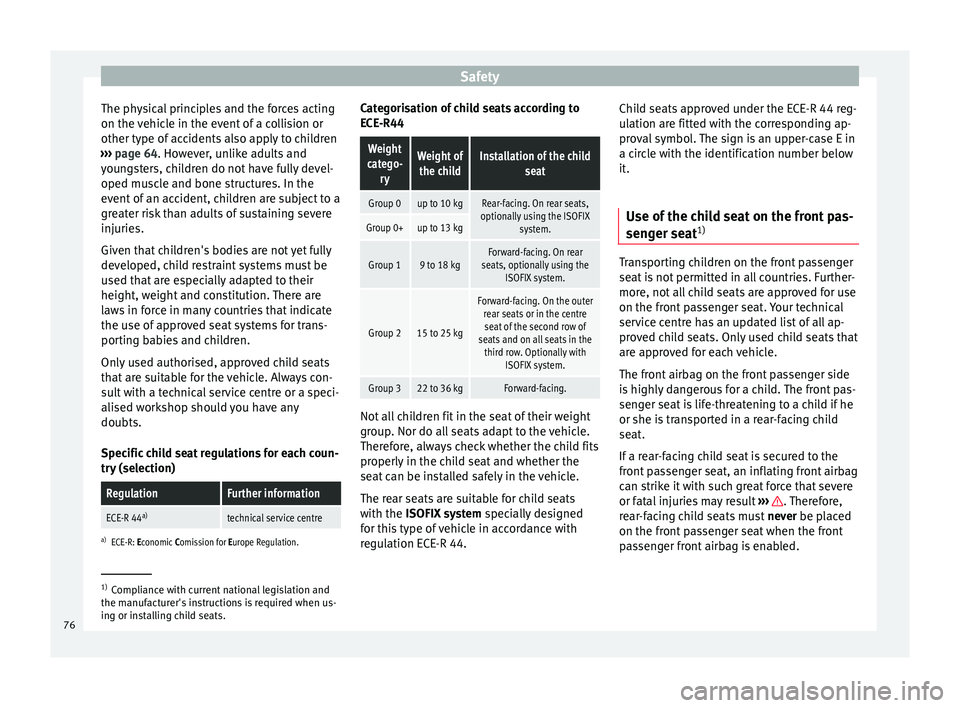
try (selection)
RegulationFurther information
ECE-R 44 a)technical service centre
a)
ECE-R: Economic Comission for Europe Regulation.
Categorisation of child seats according to
ECE-R44
Weight
catego- ryWeight ofthe childInstallation of the child seat
Group 0up to 10 kgRear-facing. On rear seats,
optionally using the ISOFIX system.
Group 0+up to 13 kg
Group 19 to 18 kgForward-facing. On rear
seats, optionally using the ISOFIX system.
Group 215 to 25 kg
Forward-facing. On the outerrear seats or in the centreseat of the second row of
seats and on all seats in the third row. Optionally with ISOFIX system.
Group 322 to 36 kgForward-facing. Not all children fit in the seat of their weight
gr
oup
. Nor do al
l seats adapt to the vehicle.
Therefore, always check whether the child fits
properly in the child seat and whether the
seat can be installed safely in the vehicle.
The rear seats are suitable for child seats
with the ISOFIX system specially designed
for this type of vehicle in accordance with
regulation ECE-R 44. Child seats approved under the ECE-R 44 reg-
ulation ar
e fitted with the corresponding ap-
proval symbol. The sign is an upper-case E in
a circle with the identification number below
it.
Use of the child seat on the front pas-
senger se
at1) Transporting children on the front passenger
seat
i
s not permitted in all countries. Further-
more, not all child seats are approved for use
on the front passenger seat. Your technical
service centre has an updated list of all ap-
proved child seats. Only used child seats that
are approved for each vehicle.
The front airbag on the front passenger side
is highly dangerous for a child. The front pas-
senger seat is life-threatening to a child if he
or she is transported in a rear-facing child
seat.
If a rear-facing child seat is secured to the
front passenger seat, an inflating front airbag
can strike it with such great force that severe
or fatal injuries may result ››› . Therefore,
r e
ar
-facing child seats must never be placed
on the front passenger seat when the front
passenger front airbag is enabled. 1)
Compliance with current national legislation and
the manuf act
urer's instructions is required when us-
ing or installing child seats.
76
Page 79 of 320
Transporting children safely
Only use a rear-facing child seat on the front
p a
s
senger seat if the front passenger front
airbag is disabled. When it is disabled, the
yellow PASSENGER AIR BAG control
lamp on the dash panel will be lit ››› page 72.
If you cannot disable the front passenger
front airbag and it remains activated, it is
forbidden to transport children on the front
passenger seat ››› .
Thin g
s
to note if using a child seat on the
front passenger seat:
● The front passenger front airbag must
be
disabled when using a rear-facing child
seat ››› page 73.
● The seat backrest of the front passenger
seat mu
st be upright.
● The front passenger seat must be moved as
far bac
k as possible.
● The seat backrest of the front passenger
seat mu
st be upright.
● The seat belt height adjustment must be as
high as po
ssible.
Suitable child seats
The child seat must be authorised by the
manufacturer especially for use on a front
passenger seat with a front or side airbag.
If the front passenger seat is equipped with
retaining rings, the child seat can be secured
using an approved retaining system provided
it is approved for this type of vehicle in ac- cordance with current regulations of the
countr
y in question.
Universal seats for children of groups 0, 0+,
1, 2 or 3 according to the standard ECE-R 44
can be mounted on the front passenger seat
and the rear seats. WARNING
If a child seat is mounted on the front passen-
ger se at, the ri
sk of the child sustaining se-
vere or fatal injuries in the event of an acci-
dent increases. Rear-facing child seats must
never be mounted on the front passenger
seat when the front passenger front airbag is
enabled. This is life-threatening to the child
should the front airbag deploy, as the child
seat would be struck by the inflated airbag
and thrown against the seat backrest. WARNING
If, in exceptional circumstances, a child must
be tran s
ported in a rear-facing child seat on
the front passenger seat, strictly observe the
following:
● Always disable the front passenger front
airbag and le
ave it disabled.
● The child seat must be approved by the
manufact
urer for use on a front passenger
seat with front and side airbag.
● Follow the installation instructions of the
chil
d seat manufacturer and observe the
warnings. ●
Mov e the fr
ont passenger seat as far back
as possible and adjust it to its highest posi-
tion to keep as far away as possible from the
front airbag.
● Move the seat backrest to the upright posi-
tion.
● The seat belt height adjustment must be as
high as po
ssible.
● Children must always be protected with an
appro
ved child restraint system suited to
their height and weight. Use of the child seat on the rear seat
If a child seat is mounted on the rear seat,
a
d
apt
the position of the front passenger
seat so that the child has enough space.
Therefore, adapt the front passenger seat to
the size of the child seat and the height of
the child. Ensure the passenger is in the cor-
rect position ››› page 57.
Move the second and third rows of seats fully
back and lock them. Place the seat backs in a
vertical position and fold the head restraints
down.
ISOFIX child seats approved for rear seats
The rear seats are suitable for child seats
with the ISOFIX system specially designed
for this type of vehicle in accordance with
regulation ECE-R 44. »
77
Technical data
Advice
Operation
Emergencies
Safety
Page 82 of 320
Safety
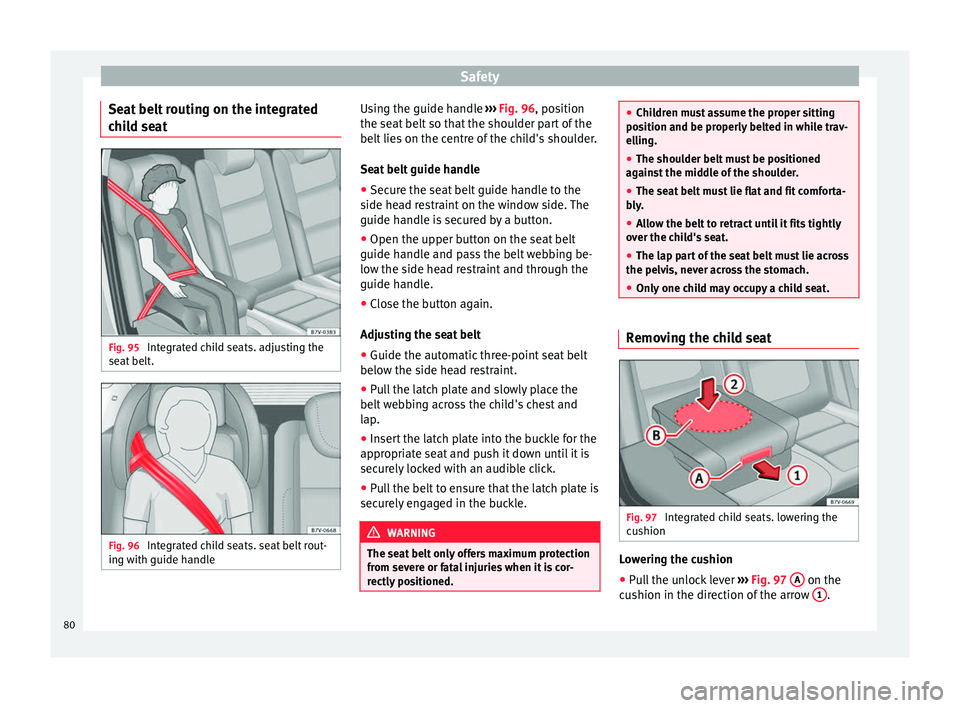
Seat belt routing on the integrated
c hi
l
d seat Fig. 95
Integrated child seats. adjusting the
se at
belt
. Fig. 96
Integrated child seats. seat belt rout-
in g w
ith guide h
andle Using the guide handle
››
›
Fig. 96, position
the seat belt so that the shoulder part of the
belt lies on the centre of the child's shoulder.
Seat belt guide handle
● Secure the seat belt guide handle to the
side hea
d restraint on the window side. The
guide handle is secured by a button.
● Open the upper button on the seat belt
guide handle and p
ass the belt webbing be-
low the side head restraint and through the
guide handle.
● Close the button again.
Adjustin
g the seat belt
● Guide the automatic three-point seat belt
below the side he
ad restraint.
● Pull the latch plate and slowly place the
belt we
bbing across the child's chest and
lap.
● Insert the latch plate into the buckle for the
appropri
ate seat and push it down until it is
securely locked with an audible click.
● Pull the belt to ensure that the latch plate is
securely
engaged in the buckle. WARNING
The seat belt only offers maximum protection
from sev er
e or fatal injuries when it is cor-
rectly positioned. ●
Chil dr
en must assume the proper sitting
position and be properly belted in while trav-
elling.
● The shoulder belt must be positioned
agains
t the middle of the shoulder.
● The seat belt must lie flat and fit comforta-
bly.
● A
llow the belt to retract until it fits tightly
over the c
hild's seat.
● The lap part of the seat belt must lie across
the pelvis, nev
er across the stomach.
● Only one child may occupy a child seat. Removing the child seat
Fig. 97
Integrated child seats. lowering the
c u
shion Lowering the cushion
● Pull the unlock lever ››
›
Fig. 97 A on the
c u
shion in the dir
ection of the arrow 1 .
80
Page 84 of 320
Emergencies
Emergencies
Self -help
In c a
se of emergency
First aid kit, warning triangle, reflec-
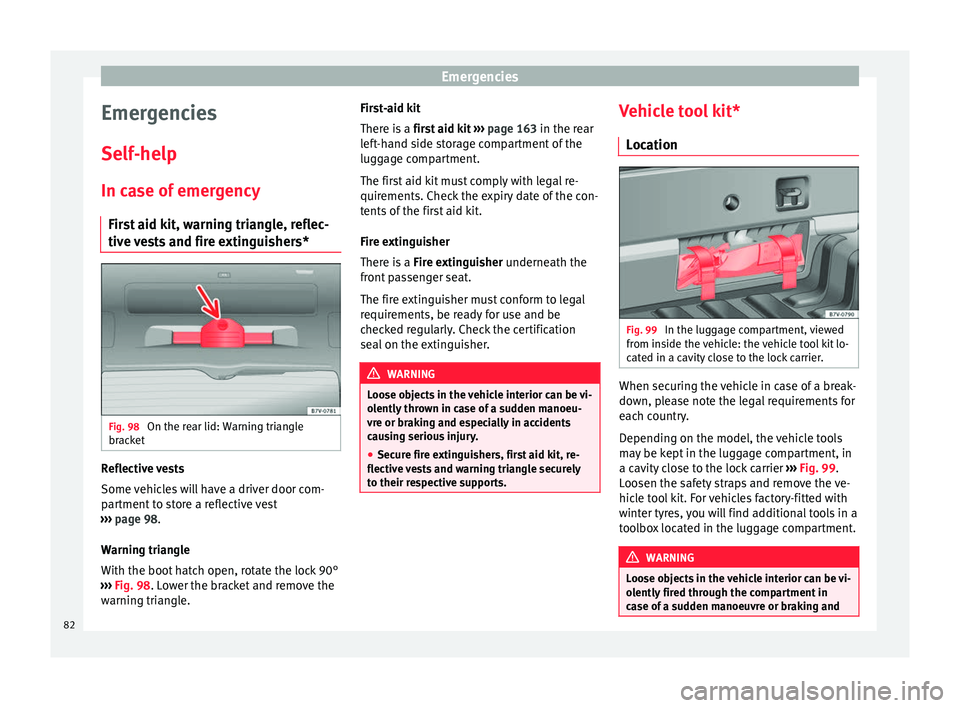
tive vests and fire extinguishers* Fig. 98
On the rear lid: Warning triangle
br ac
k
et Reflective vests
Some
v
ehic
les will have a driver door com-
partment to store a reflective vest
››› page 98.
Warning triangle
With the boot hatch open, rotate the lock 90°
››› Fig. 98. Lower the bracket and remove the
warning triangle. First-aid kit
There is
a first aid kit ››› page 163 in the rear
left-hand side storage compartment of the
luggage compartment.
The first aid kit must comply with legal re-
quirements. Check the expiry date of the con-
tents of the first aid kit.
Fire extinguisher
There is a Fire extinguisher underneath the
front passenger seat.
The fire extinguisher must conform to legal
requirements, be ready for use and be
checked regularly. Check the certification
seal on the extinguisher. WARNING
Loose objects in the vehicle interior can be vi-
ol ently
thrown in case of a sudden manoeu-
vre or braking and especially in accidents
causing serious injury.
● Secure fire extinguishers, first aid kit, re-
flective
vests and warning triangle securely
to their respective supports. Vehicle tool kit*
Loc
ation Fig. 99
In the luggage compartment, viewed
fr om in
s
ide the vehicle: the vehicle tool kit lo-
cated in a cavity close to the lock carrier. When securing the vehicle in case of a break-
do
wn, p
l
ease note the legal requirements for
each country.
Depending on the model, the vehicle tools
may be kept in the luggage compartment, in
a cavity close to the lock carrier ››› Fig. 99.
Loosen the safety straps and remove the ve-
hicle tool kit. For vehicles factory-fitted with
winter tyres, you will find additional tools in a
toolbox located in the luggage compartment. WARNING
Loose objects in the vehicle interior can be vi-
ol ently
fired through the compartment in
case of a sudden manoeuvre or braking and 82