service Seat Alhambra 2017 Workshop Manual
[x] Cancel search | Manufacturer: SEAT, Model Year: 2017, Model line: Alhambra, Model: Seat Alhambra 2017Pages: 320, PDF Size: 6.88 MB
Page 270 of 320
Advice
Closing the tank filling neck
● Screw on the tank filler neck cap ››
› Fig. 237
1 clockwise until it is fully inserted.
● Place the cover and turn the shut off anti-
c loc
k
wise to close it.
Operations before driving
● Only switch the ignition on after refilling.
● Keep the ignition sw
itch on for at least 30
seconds
so that the system detects tank re-
filling.
● Wait 30 seconds before starting the en-
gine! WARNING
Only keep AdBlue in its original container,
tightly shut and in a s
afe place.
● Never keep AdBlue in empty food cans, bot-
tles
or other containers to avoid other people
mistaking it for something else.
● Keep the AdBlue out of the reach of small
chil
dren. CAUTION
● Only r
efill using AdBlue expressly approved
by SEAT. The use of any other type of AdBlue
could cause engine damage!
● AdBlue should never be mixed with water
or any other a
dditives. Any type of damage
caused by a mixture will not be covered by
the warranty. ●
Do not a d
d AdBlue to the diesel fuel tank!
Otherwise you may damage the engine.
● Never leave the refill bottle in the vehicle. It
coul
d become permeable due to temperature
changes and bottle damage and the AdBlue
could damage the vehicle interior. For the sake of the environment
Dispose of the refill bottle in an environment-
friendly manner
. Note
Suitable AdBlue refill bottles can be pur-
ch a
sed from a technical service centre. Working in the engine compart-
ment
Intr oduction Before working in the engine compartment,
m
ak
e s
ure that the vehicle is parked on hori-
zontal and firm ground.
The engine compartment of the vehicle is a
hazardous area. Never work on the engine or
in the engine compartment if you are not fa-
miliar with the operations to be carried out,
the applicable safety standards and especial-
ly if you do not have the necessary instru-
ments, liquids and tools ››› ! Have the workcarried out by a specialised workshop if you
ar
e u
nc
ertain. Negligent work can cause seri-
ous injury. WARNING
If the vehicle moves unexpectedly, this could
cau se seriou
s injury.
● Never work under the vehicle if it has not
been immobi
lized. If you must work under-
neath the vehicle with the wheels in contact
with the ground then it should be parked on
flat ground, the wheels should be prevented
from moving and the key should be removed
from the ignition.
● If you have to work underneath the vehicle,
you mus
t use suitable stands additionally to
support the vehicle, there is a risk of acci-
dent!. The jack is not intended for this kind of
work and its failure could lead to severe inju-
ries. WARNING
The engine compartment is a dangerous area
cap ab
le of causing serious injury.
● For all type of work, always take the utmost
precaution
s, work carefully and note the gen-
eral safety standards in force. Never take per-
sonal risks.
● Never work on the engine or in the engine
compar
tment if you are not familiar with the
necessary operations. If you are not sure
about procedures then visit a specialised
workshop to carry out the necessary work. 268
Page 271 of 320
Checking and refilling levels
Working incorrectly can cause serious
injuries.
● Nev er open the bonnet
if you see steam or
cool
ant escaping from the engine compart-
ment. This may cause serious burns. Always
wait until you cannot see or hear the sound of
steam or coolant coming from the engine
compartment.
● Always allow the engine to cool down be-
fore openin
g the bonnet.
● Contact with hot elements of the engine
and the exhau
st system can cause burns.
● Once the engine has cooled, follow the in-
structions
below before opening the bonnet:
– Turn on the electronic parking brake and
place the gear selector lever in P or the
gearbox lever in neutral.
– Remove the key from the ignition.
– Keep children away from the engine com-
partment and never leave them unsuper-
vised.
● When the engine is warm or hot, the cool-
ing sys
tem is pressurised. Do not unscrew
the cap on the expansion tank when the en-
gine is hot. Otherwise, coolant may spray out
under pressure causing burns and serious in-
jury.
– Carefully and slowly unscrew the cap an-
ticlockwise, gently pressing down on it.
– Always protect your face, hands and arms
from hot coolant and steam using a large,
thick cloth. ●
When refi l
ling liquids, avoid spilling them
on parts of the engine and the exhaust sys-
tem. Spilled liquids could cause a fire. WARNING
The high voltages of the electrical system can
giv e el ectric
shocks as well as causing burns
and serious injury and possibly even death!
● Never cause short circuits in the electrical
syst
em. The battery could explode.
● To minimise the risk of electric shock and
serious c
onsequences while the engine is
running or starting the engine, note the fol-
lowing:
– Never touch the electrical wiring of the
ignition system.
– Never touch electric cables or the gas dis-
charge lamps. WARNING
In the engine compartment, there are rotat-
ing p ar
ts that could cause serious injury.
● Never place your hands on or near the radi-
ator fan.
Touching the rotor blades could seri-
ously harm you. The ventilator works accord-
ing to the engine temperature and could start
suddenly even when the ignition is turned off
and the key is removed.
● If any work has to be performed when the
engine is
started or with the engine running,
there is an additional, potentially fatal, safety
risk from rotating parts, such as the drive belts, alternator, radiator fan, etc., as well as
from the high-
v
oltage ignition system. Al-
ways work with the utmost caution.
– Always make sure that no parts of your
body, jewellery, ties, loose clothing and
long hair can be trapped by the rotating
parts of the engine. Before any work, re-
move ties and jewellery (necklaces, etc),
tie long hair back and tie all items of
loose clothing to your body to make sure
that they cannot be trapped by engine
components.
– Take extreme caution when operating the
accelerator and remain attentive. The ve-
hicle could move, even with the electron-
ic parking brake activated.
● Always make sure you have not left any ob-
jects, s
uch as cleaning cloths and tools, in
the engine compartment. If any object is left
in the engine compartment, this could cause
malfunctions, engine faults and even a fire. WARNING
Refill liquids and certain materials can catch
fire e a
sily in the engine compartment, caus-
ing a fire and serious injury!
● Never smoke.
● Never work close to places exposed to
flames
or sparks.
● Never pour service fluids over the engine.
These fluid ma
y ignite hot engine parts and
cause injuries. » 269
Technical data
Advice
Operation
Emergencies
Safety
Page 272 of 320
Advice
●
If it i
s necessary to work on the fuel system
or the electrical system, please follow the in-
structions below:
–Always disconnect the vehicle battery.
When disconnecting the battery, ensure
that the vehicle is unlocked otherwise
the anti-theft alarm will be triggered.
– Never work close to heaters, heat sources
or places exposed to flames or sparks.
● Always keep a recently serviced and per-
fectly w
orking fire extinguisher close by.
● Never cover the engine with additional in-
sul
ating materials such as a blanket. Risk of
fire! CAUTION
When refilling or changing service liquids,
ens ur
e that you put the liquids into the right
tank. Making a mistake when refilling could
cause serious malfunctions and damage the
engine! For the sake of the environment
Service fluids leaks are harmful to the envi-
ronment . F
or this reason you should make
regular checks on the ground underneath
your vehicle. Take the vehicle to a specialised
workshop to be checked if you see stains, oil
or other fluids on the ground. Collect any
spilt service fluids and allow a professional to
dispose of them. Opening and closing the bonnet
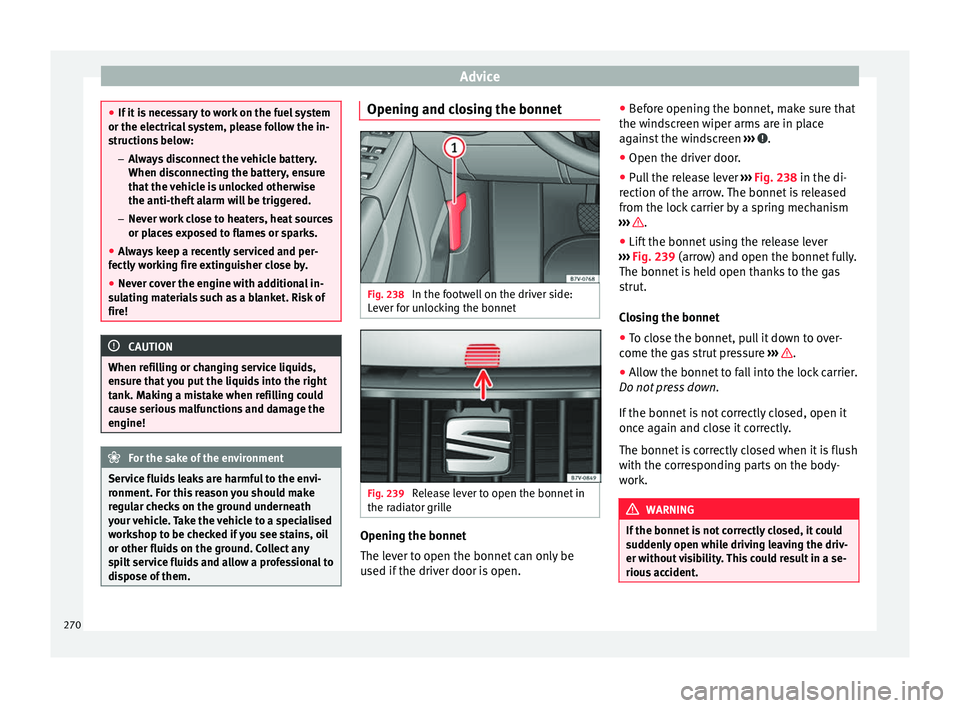
Fig. 238
In the footwell on the driver side:
L ev
er f
or unlocking the bonnet Fig. 239
Release lever to open the bonnet in
the r a
di
ator grille Opening the bonnet
The l
ev
er t
o open the bonnet can only be
used if the driver door is open. ●
Befor
e opening the bonnet, make sure that
the windscreen wiper arms are in place
against the windscreen ››› .
● Open the driver door.
● Pull the release lever ››
›
Fig. 238 in the di-
rection of the arrow. The bonnet is released
from the lock carrier by a spring mechanism
››› .
● Lift the bonnet using the release lever
› ›
›
Fig. 239 (arrow) and open the bonnet fully.
The bonnet is held open thanks to the gas
strut.
Closing the bonnet
● To close the bonnet, pull it down to over-
come the ga
s strut pressure ››› .
● Allow the bonnet to fall into the lock carrier.
Do not pr
e
ss down.
If the bonnet is not correctly closed, open it
once again and close it correctly.
The bonnet is correctly closed when it is flush
with the corresponding parts on the body-
work. WARNING
If the bonnet is not correctly closed, it could
sud den
ly open while driving leaving the driv-
er without visibility. This could result in a se-
rious accident. 270
Page 273 of 320
Checking and refilling levels
●
Aft er c
losing the bonnet, always check that
it is properly secured by the locking mecha-
nism in the lock carrier. The bonnet must be
flush with the surrounding body panels.
● While driving, if you notice that the bonnet
is not
correctly closed then stop immediately
and close it correctly.
● Only open and close the bonnet when there
is no
body within its range. CAUTION
● To av oid d
amage to the bonnet and to the
windscreen wiper arms, only open it when
the windscreen wipers are in place against
the windscreen.
● Before driving, always lower the wiper
arms. Checking fluid levels
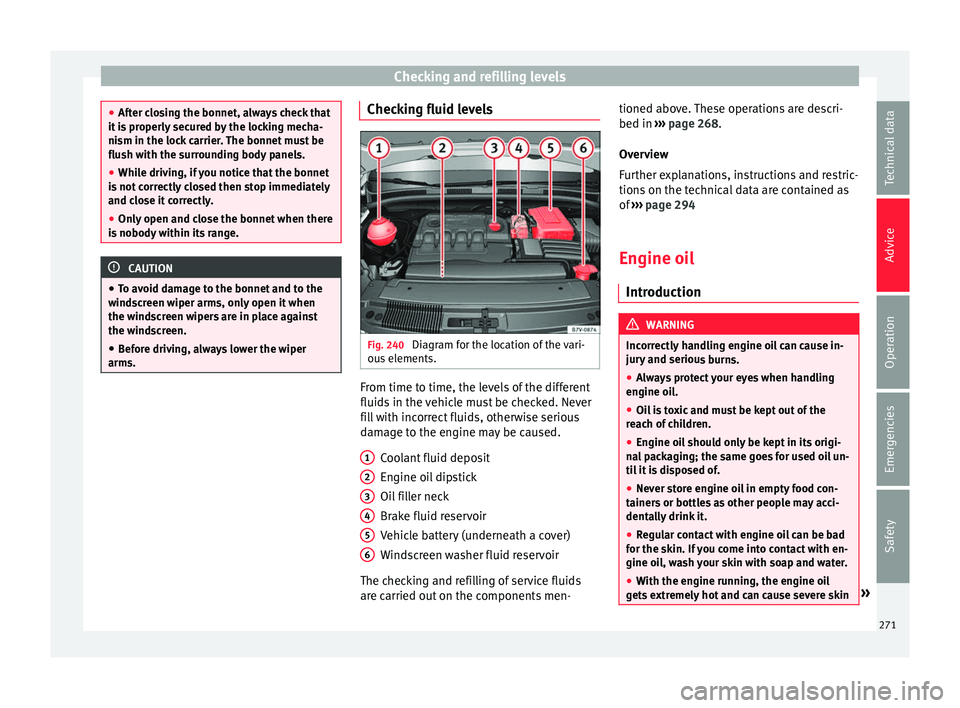
Fig. 240
Diagram for the location of the vari-
ou s
el
ements. From time to time, the levels of the different
fluid
s
in the
vehicle must be checked. Never
fill with incorrect fluids, otherwise serious
damage to the engine may be caused.
Coolant fluid deposit
Engine oil dipstick
Oil filler neck
Brake fluid reservoir
Vehicle battery (underneath a cover)
Windscreen washer fluid reservoir
The checking and refilling of service fluids
are carried out on the components men- 1 2
3
4
5
6 tioned above. These operations are descri-
bed in
››
›
page 268.
Overview
Further explanations, instructions and restric-
tions on the technical data are contained as
of ››› page 294
Engine oil Introduction WARNING
Incorrectly handling engine oil can cause in-
jury and seriou
s burns.
● Always protect your eyes when handling
engine oil
.
● Oil is toxic and must be kept out of the
reac
h of children.
● Engine oil should only be kept in its origi-
nal
packaging; the same goes for used oil un-
til it is disposed of.
● Never store engine oil in empty food con-
tainers
or bottles as other people may acci-
dentally drink it.
● Regular contact with engine oil can be bad
for the skin. If
you come into contact with en-
gine oil, wash your skin with soap and water.
● With the engine running, the engine oil
gets
extremely hot and can cause severe skin » 271
Technical data
Advice
Operation
Emergencies
Safety
Page 274 of 320
Advice
burns. Always wait until the engine has fully
coo
l
ed. For the sake of the environment
Similar to the other service liquids, spilled
en gine oi l
can be bad for the environment.
Collect these liquids in suitable containers
and dispose of them while respecting the en-
vironment. Warning and control lamps
It lights up
Insufficient en-
gine oil.Switch the ignition off. Check the en-
gine oil level
››› page 273.
Flashes
Engine oil sen-
sor faulty.Contact a specialised workshop.
Have the engine oil sensor checked.
Meanwhile, check the oil level man-
ually.
Flashes
Engine oil pres-
sure too low.
Stop the vehicle!
Switch off the engine. Check the en-
gine oil level.
- If the warning lamp flashes al-
though the oil level is correct, do not
continue driving or leave the engine
running. Otherwise, the engine
could be damaged. Seek specialist
assistance. WARNING
Observe the safety warnings ›››
in Control
and warnin g l
amps on page 105. Engine oil specifications
Replacement engine oil must strictly comply
w
ith the s
pec
ifications.
The correct oil must be used to ensure the
correct operation and long service life of the
engine. The engine comes with a high-quality
multigrade oil that can generally be used all
year round.
Only use an engine oil that complies to SEAT
standards whenever possible ››› . If you
w i
sh t
o maintain the long-life service dura-
tion, only engine oils approved for this serv-
ice according to the corresponding VW stand-
ard ( ›››
table on page 40) may be used.
All oils indicated are synthetic multigrade
oils. Engine oils are being continuously further
developed. T
echnical services are constantly
updated with any modifications. SEAT there-
fore recommends that you have the engine
oil changed by a technical service. CAUTION
● Only u
se engine oils whose specifications
are expressly approved by SEAT. The use of
any other type of oil could cause engine dam-
age! 272
Page 276 of 320
Advice
●
When refi l
ling or changing service liquids,
ensure that you put the liquids into the right
tank. Making a mistake when refilling could
cause serious malfunctions and damage the
engine! For the sake of the environment
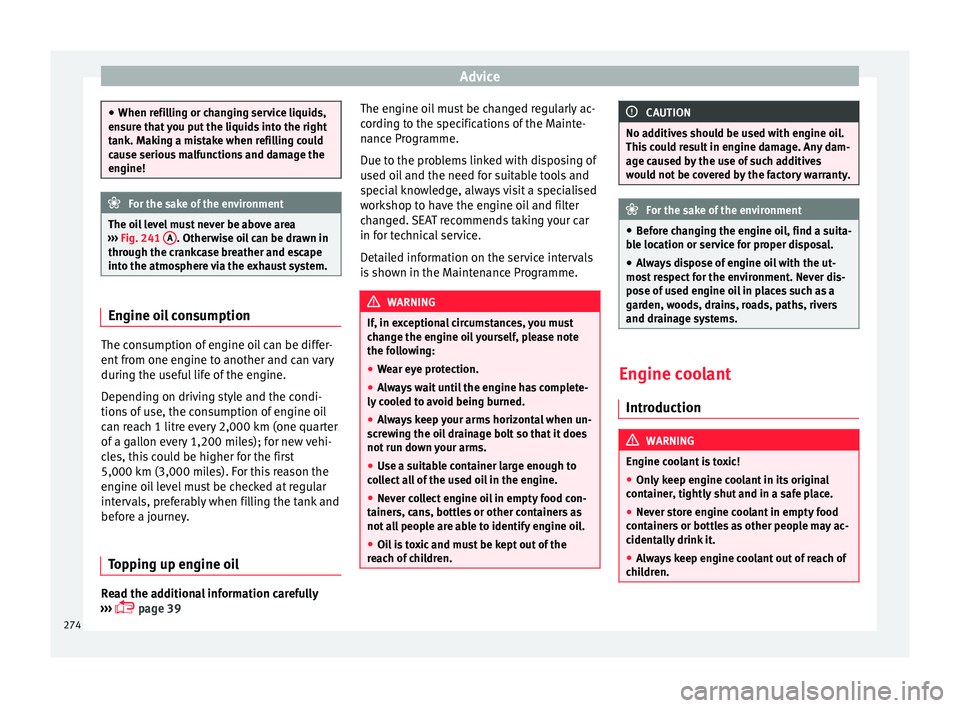
The oil level must never be above area
› ››
Fig. 241 A . Otherwise oil can be drawn in
through the c r
ankcase breather and escape
into the atmosphere via the exhaust system. Engine oil consumption
The consumption of engine oil can be differ-
ent
fr
om one en
gine to another and can vary
during the useful life of the engine.
Depending on driving style and the condi-
tions of use, the consumption of engine oil
can reach 1 litre every 2,000 km (one quarter
of a gallon every 1,200 miles); for new vehi-
cles, this could be higher for the first
5,000 km (3,000 miles). For this reason the
engine oil level must be checked at regular
intervals, preferably when filling the tank and
before a journey.
Topping up engine oil Read the additional information carefully
› ›
›
page 39 The engine oil must be changed regularly ac-
cordin
g to the specifications of the Mainte-
nance Programme.
Due to the problems linked with disposing of
used oil and the need for suitable tools and
special knowledge, always visit a specialised
workshop to have the engine oil and filter
changed. SEAT recommends taking your car
in for technical service.
Detailed information on the service intervals
is shown in the Maintenance Programme. WARNING
If, in exceptional circumstances, you must
ch an
ge the engine oil yourself, please note
the following:
● Wear eye protection.
● Always wait until the engine has complete-
ly coo
led to avoid being burned.
● Always keep your arms horizontal when un-
scr
ewing the oil drainage bolt so that it does
not run down your arms.
● Use a suitable container large enough to
col
lect all of the used oil in the engine.
● Never collect engine oil in empty food con-
tainers, c
ans, bottles or other containers as
not all people are able to identify engine oil.
● Oil is toxic and must be kept out of the
reac
h of children. CAUTION
No additives should be used with engine oil.
This c
ould result in engine damage. Any dam-
age caused by the use of such additives
would not be covered by the factory warranty. For the sake of the environment
● Bef or
e changing the engine oil, find a suita-
ble location or service for proper disposal.
● Always dispose of engine oil with the ut-
most
respect for the environment. Never dis-
pose of used engine oil in places such as a
garden, woods, drains, roads, paths, rivers
and drainage systems. Engine coolant
Intr oduction WARNING
Engine coolant is toxic!
● Only keep engine coolant in its original
cont ainer
, tightly shut and in a safe place.
● Never store engine coolant in empty food
container
s or bottles as other people may ac-
cidentally drink it.
● Always keep engine coolant out of reach of
chil
dren. 274
Page 278 of 320
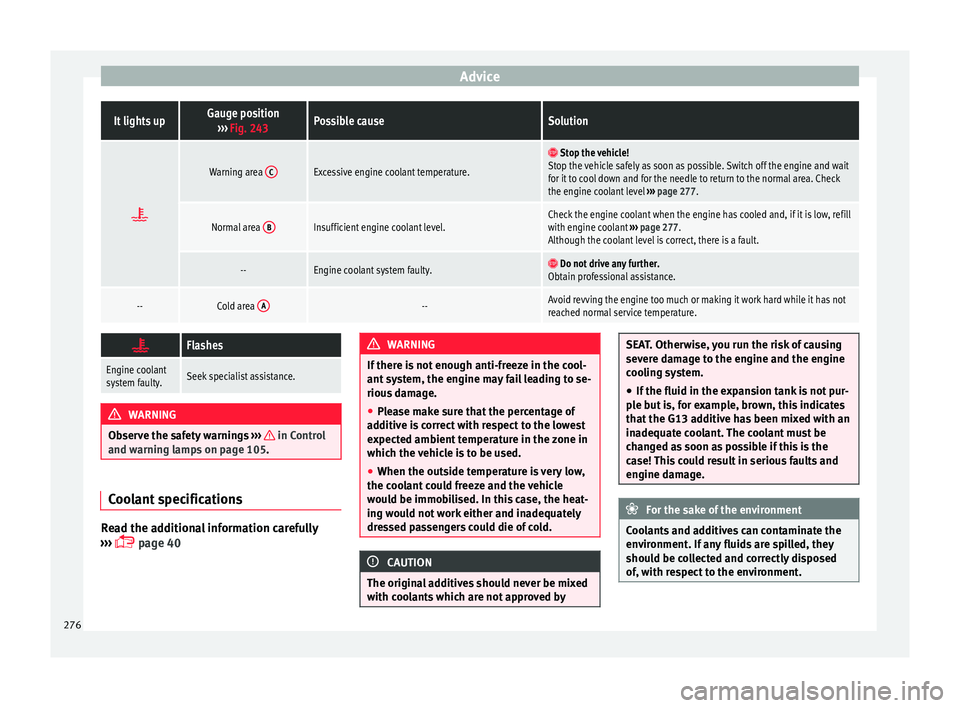
AdviceIt lights upGauge position
››› Fig. 243Possible causeSolution
Warning area
CExcessive engine coolant temperature.
Stop the vehicle!
Stop the vehicle safely as soon as possible. Switch off the engine and wait
for it to cool down and for the needle to return to the normal area. Check
the engine coolant level ››› page 277.
Normal area BInsufficient engine coolant level.Check the engine coolant when the engine has cooled and, if it is low, refill
with engine coolant
››› page 277.
Although the coolant level is correct, there is a fault.
--Engine coolant system faulty. Do not drive any further.
Obtain professional assistance.
--Cold area A--Avoid revving the engine too much or making it work hard while it has not
reached normal service temperature.
Flashes
Engine coolant
system faulty.Seek specialist assistance.
WARNING
Observe the safety warnings ›››
in Control
and warnin g l
amps on page 105. Coolant specifications
Read the additional information carefully
› ››
page 40 WARNING
If there is not enough anti-freeze in the cool-
ant sy s
tem, the engine may fail leading to se-
rious damage.
● Please make sure that the percentage of
additiv
e is correct with respect to the lowest
expected ambient temperature in the zone in
which the vehicle is to be used.
● When the outside temperature is very low,
the cool
ant could freeze and the vehicle
would be immobilised. In this case, the heat-
ing would not work either and inadequately
dressed passengers could die of cold. CAUTION
The original additives should never be mixed
with c oo
lants which are not approved by SEAT. Otherwise, you run the risk of causing
sever
e d
amage to the engine and the engine
cooling system.
● If the fluid in the expansion tank is not pur-
ple b
ut is, for example, brown, this indicates
that the G13 additive has been mixed with an
inadequate coolant. The coolant must be
changed as soon as possible if this is the
case! This could result in serious faults and
engine damage. For the sake of the environment
Coolants and additives can contaminate the
en vir
onment. If any fluids are spilled, they
should be collected and correctly disposed
of, with respect to the environment. 276
Page 280 of 320
Advice
●
When refi l
ling liquids, avoid spilling them
on parts of the engine and the exhaust sys-
tem. Spilled liquids could cause a fire. Under
specific circumstances, the ethylene glycol
can catch fire. CAUTION
● On ly fi
ll with distilled water. Any other type
of water may lead to considerable rusting in
the engine due to its chemical components.
This could consequently damage the engine.
If you have not used distilled water but an-
other type of water to top up the coolant, a
specialised workshop must immediately re-
place all of the fluid in the engine cooling
system.
● Only top up coolant to the top level of the
marked ar
ea ››› Fig. 244. Otherwise the ex-
cess coolant will be forced out of the cooling
system when the engine is hot, causing dam-
age.
● If a lot of liquid coolant has been lost, wait
for the engine t
o cool down completely before
adding coolant. Extensive coolant loss is an
indication of leaks in the engine cooling sys-
tem. Have the engine cooling system inspec-
ted immediately by a specialised workshop.
Otherwise engine damage may occur.
● When refilling service liquids, ensure that
you put
the liquids into the right tank. Mak-
ing a mistake when refilling could cause seri-
ous malfunctions and damage the engine! Brake fluid
Chec k
in
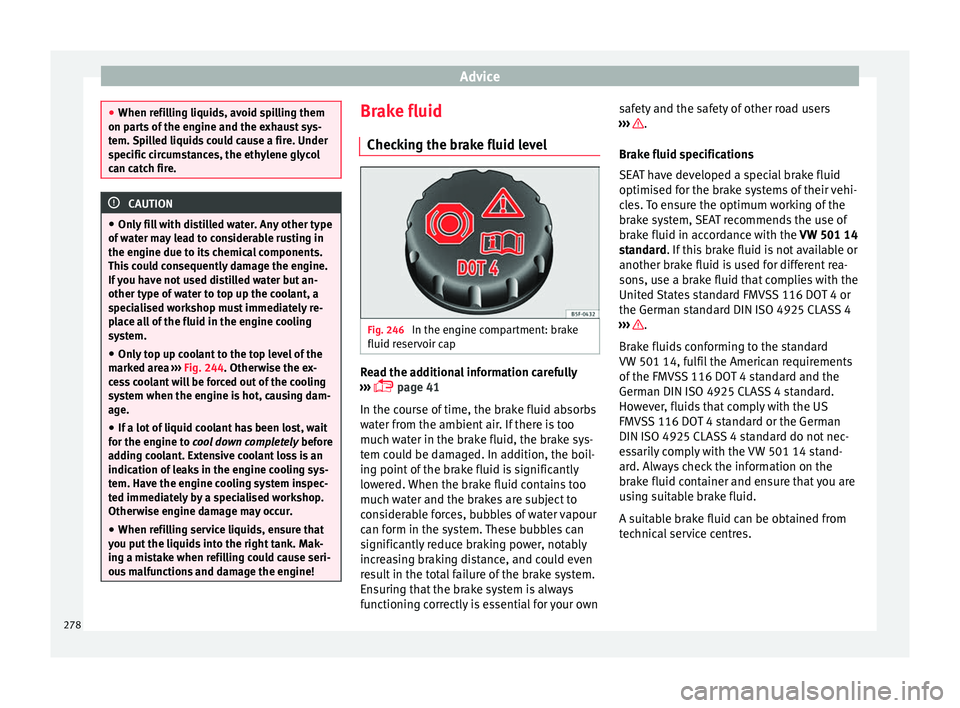
g the brake fluid level Fig. 246
In the engine compartment: brake
fluid r e
ser
voir cap Read the additional information carefully
› ›
›
page 41
In the course of time, the brake fluid absorbs
water from the ambient air. If there is too
much water in the brake fluid, the brake sys-
tem could be damaged. In addition, the boil-
ing point of the brake fluid is significantly
lowered. When the brake fluid contains too
much water and the brakes are subject to
considerable forces, bubbles of water vapour
can form in the system. These bubbles can
significantly reduce braking power, notably
increasing braking distance, and could even
result in the total failure of the brake system.
Ensuring that the brake system is always
functioning correctly is essential for your own safety and the safety of other road users
›››
.
Br ak
e fluid s
pecifications
SEAT have developed a special brake fluid
optimised for the brake systems of their vehi-
cles. To ensure the optimum working of the
brake system, SEAT recommends the use of
brake fluid in accordance with the VW 501 14
standard. If this brake fluid is not available or
another brake fluid is used for different rea-
sons, use a brake fluid that complies with the
United States standard FMVSS 116 DOT 4 or
the German standard DIN ISO 4925 CLASS 4
››› .
Br ak
e fluid
s conforming to the standard
VW 501 14, fulfil the American requirements
of the FMVSS 116 DOT 4 standard and the
German DIN ISO 4925 CLASS 4 standard.
However, fluids that comply with the US
FMVSS 116 DOT 4 standard or the German
DIN ISO 4925 CLASS 4 standard do not nec-
essarily comply with the VW 501 14 stand-
ard. Always check the information on the
brake fluid container and ensure that you are
using suitable brake fluid.
A suitable brake fluid can be obtained from
technical service centres.
278
Page 281 of 320
Checking and refilling levels
Brake fluid level
The l ev
el
of the brake fluid should always be
between the MIN and MAX marks, or above
the MIN mark ››› .
It i
s
not always possible to check the level of
the brake fluid, as in some models the en-
gine components make it difficult to see the
brake fluid reservoir. If you cannot read the
exact brake fluid level, consult a specialist.
The brake fluid level drops slightly when the
vehicle is being used due to wear of the
brake pads and the automatic readjustment
of the brake.
Changing the brake fluid
The brake fluid should be changed in accord-
ance with the instructions given in the Main-
tenance Programme. Have the brake fluid
changed by a specialised workshop. SEAT
recommends taking your car in for technical
service. This means that only brake fluid
complying with the required specifications
will be used. WARNING
If the brake fluid level is low or unsuita-
bl e/o
ld brake fluid is used, the brake system
may fail or braking power may be reduced.
● Check the brake system and the brake fluid
level
regularly! ●
The brak e fluid shou
ld be changed regular-
ly in accordance with the instructions given
in the Maintenance Programme.
● When the brake fluid is used and brakes
are sub
jected to extreme braking forces, bub-
bles of vapour form in the brake system.
These bubbles can significantly reduce brak-
ing power, notably increasing braking dis-
tance, and could result in the total failure of
the brake system.
● Only used brake fluid that conforms to the
VW 501 14 stand
ard, FMVSS 116 DOT 4
standard or even the DIN ISO 4925 CLASS 4
standard. Other types of brake fluid could af-
fect brake operation and reduce braking pow-
er. Do not use a brake fluid if the container
does not specify compliance with the
VW 501 14, FMVSS 116 DOT 4 or
DIN ISO 4925 CLASS 4 standards.
● The replacement brake fluid must be new.
● Always ensure that you use suitable brake
fluid. Do not use a br
ake fluid if the container
does not specify compliance with the
VW 501 14, FMVSS 116 DOT 4 or
DIN ISO 4925 CLASS 4 standards. WARNING
Brake fluid is poisonous.
● To reduce the risk of poisoning, do not keep
brak e fluid in drink
s bottles/containers or
similar. Other people could drink from these
recipients even if the contents are clearly
marked. ●
Alw a
ys keep brake fluid in the original con-
tainer; keep it correctly sealed and out of
reach of children. CAUTION
Brake fluid damages the vehicle paintwork.
W ipe off an
y brake fluid from the paintwork
immediately. For the sake of the environment
Brake fluid is an environmental pollutant.
Co l
lect any spilt service fluids and allow a
professional to dispose of them. 279
Technical data
Advice
Operation
Emergencies
Safety
Page 282 of 320

Advice
Windscreen washer reservoir Chec k
in
g and topping up the wind-
screen washer reservoir Fig. 247
In the engine compartment: wind-
s c
r
een washer reservoir top Read the additional information carefully
› ›
›
page 41
Check the level in the windscreen washer
tank regularly and top up as required.
● Open the bonnet ›››
page 268.
● The washer reservoir is marked with the
symbol
on the lid ››› Fig. 247.
● Check there is enough water in the reser-
voir.
● T
o top up, mix water with a window cleaner
recommended b
y SEAT ››› . Please follow
the in struction
s for use found on the packag-
ing. ●
In col
d weather, a special antifreeze should
also be added to prevent the water from
freezing ››› .
Fi l
lin
g amounts
The capacity of the tank is approximately 3 li-
tres; in vehicles with a headlight washer sys-
tem, it is approximately 7 litres. WARNING
Never mix an unsuitable antifreeze or other
simi l
ar additives with the windscreen washer
water. A greasy layer may be formed on the
windscreen which will impair visibility.
● Use clean water with a window cleaner rec-
ommended by
SEAT.
● If necessary, add a suitable antifreeze to
the water in the r
eservoir. CAUTION
● Do not mi x
cleaning products recommen-
ded by SEAT with other products. This could
lead to flocculation and may block the wind-
screen washer jets.
● When topping up service fluids, make abso-
lutely c
ertain that you fill the fluids into the
correct reservoirs. Using the wrong fluids
could cause serious malfunctions and engine
damage! Vehicle battery
Intr oduction The battery is a component of the vehicle's
electric
al
system.
Never work on the electrical system without
fully understanding the operations required,
the applicable safety standards and without
the correct tools ››› ! If required, have any
work c
arried out by a specialised workshop.
SEAT recommends taking your car in for tech-
nical service. Negligent work can cause seri-
ous injury.
Location and number of batteries in the vehi-
cle
The battery is located in the engine compart-
ment.
Explanation of the warning indications on
the vehicle's battery
SymbolMeaning
Wear eye protection!
Battery acid is extremely corrosive. Al-
ways wear protective gloves and eye pro-
tection!
Fires, sparks, open flames and smoking
are prohibited.
280