service Seat Alhambra 2017 Repair Manual
[x] Cancel search | Manufacturer: SEAT, Model Year: 2017, Model line: Alhambra, Model: Seat Alhambra 2017Pages: 320, PDF Size: 6.88 MB
Page 285 of 320
Checking and refilling levels
and they must be charged in a controlled en-
v ir
onment
››› . SEAT recommends taking
y our c
ar in f
or technical service.
Replacing a vehicle battery
The battery has been developed to suit the
conditions of its location and has special
safety features. If the battery must be re-
placed, consult a technical service for infor-
mation on electromagnetic compatibility, the
size and maintenance, performance and
safety requirements of the new battery in
your vehicle before you purchase one. SEAT
recommends you have the battery replaced
by a technical service.
Use only maintenance-free genuine batteries
conforming to TL 825 06 and VW 7 50 73
Standards. These standards must be dated
April 2008 or later.
Start-Stop systems ( ››› page 207) are equip-
ped with a special battery. Therefore, it must
only be replaced with a battery of the same
specifications.
Disconnecting the vehicle's battery
If you must disconnect the battery from the
electrical system, please note the following:
● Switch off the ignition and all electrical
equipment. ●
The vehic le must be unlocked before dis-
connecting the battery, otherwise the alarm
will be triggered.
● First disconnect the negative cable and
then the positiv
e ››› .
C onnectin
g the
vehicle's battery
● Before reconnecting the battery, switch off
the engine and all
electrical devices.
● First reconnect the positive cable and then
the negativ
e ››› .
Diff er
ent
control lamps may light up after
connecting the battery and switching the ig-
nition on. They will be turned off after a short
trip at a speed of between 15-20 km/h
(10-12 mph). If the warning indicators remain
lit, please visit a specialised workshop to
have the vehicle checked.
If the battery has been disconnected for a
long time, it is possible that the next service
date is not displayed or calculated correctly
››› page 100. Respect the maximum service
intervals permitted ››› Booklet Maintenance
Programme.
Vehicles with Keyless Access (››› page 115):
if, after connecting the battery, the ignition
cannot be switched on, lock and unlock the
vehicle from outside. Then try to switch on
the ignition again. If the ignition does not
work, seek professional assistance. Automatically disconnecting devices
The intellig
ent vehicle electrical system auto-
matically implements a range of measures to
prevent the battery from discharging when
high demands are made on it:
● the idling speed is increased so that the al-
ternat
or provides more electricity.
● where necessary, the power of the most
power
ful devices is reduced or even com-
pletely disconnected.
● On starting the engine, the power supply
from the 12-v
olt power sockets and the ciga-
rette lighter may be interrupted for a short
time.
The on-board management program cannot
always prevent the battery from running flat.
For example, if the ignition is left on for a
long period with the engine off or if the side
lights or parking lights are left on while the
vehicle is stationary.
Why does the battery run flat?
● When stationary for a long time without
star
ting the engine, particularly if the ignition
is switched on.
● Use of electrical devices with the engine
switc
hed off.
● If the auxiliary heater is running
›››
page 177. »
283
Technical data
Advice
Operation
Emergencies
Safety
Page 286 of 320
Advice
WARNING
Incorrectly securing the battery or using the
wron g b
attery can cause short-circuits, fire
and serious injuries.
● Always use only maintenance free batteries
that do not
run flat alone and whose proper-
ties, specifications and size correspond to
the standard battery. The specifications are
indicated on the battery case. WARNING
A highly explosive mixture of gases is re-
le a
sed when the battery is under charge.
● The batteries should be charged in a well-
ventil
ated room only.
● Never charge a frozen or recently thawed
batter
y. A flat battery can also freeze at tem-
peratures close to 0°C (+32°F).
● Always replace a battery which has frozen.
● Battery cables not correctly connected may
cause a shor
t circuit. Reconnect first the posi-
tive cable and then the negative cable. CAUTION
● Never di s
connect the battery if the ignition
is switched on or if the engine is running.
This could damage the electrical system or
electronic components.
● Never plug accessories that supply current,
such a
s solar panels or a battery charger, to
the 12-volt power sockets or the cigarette lighter. This could damage the vehicle's elec-
trica
l
system. For the sake of the environment
● Di spo
se of the battery in an environment-
friendly manner. Batteries contain toxic sub-
stances such as sulphuric acid and lead.
● Battery acid can contaminate the environ-
ment. If it
has leaked use adequate care col-
lecting it (gloves and protective glasses), and
dispose of it correctly. Wheels and tyres
T y
r
es
Introduction The SEAT Alhambra is equipped as standard
with anti-p
u
ncture technology tyres (Conti-
Seal). In the event of a puncture or air leak of
up to 5 mm, the tyre seals the hole with a
protective layer inside the tread.
The inclusion of this technology means that
there is no type of spare wheel included in
the vehicle's equipment.
SEAT recommend that all work on tyres and
wheels is carried out by a specialised work-
shop. These workshops have the necessary
special tools and replacement parts, trained
personnel and facilities for disposing of the
old tyres while respecting the environment.
SEAT recommends taking your car in for tech-
nical service. WARNING
The vehicle cannot be totally controlled or
brak ed if
the tyres (new or used) are worn or
damaged.
● Incorrect use of wheels and tyres could
make driv
ing more dangerous and result in
serious accidents and damage. 284
Page 287 of 320
Wheels and tyres
●
All
four wheels must be fitted with radial
tyres of the same type, size (rolling
circumference) and the same tread pattern.
● New tyres do not give maximum grip and
wil
l not have reached their maximum braking
capacity to start with, and therefore need
running in. To prevent accidents and major
damage, extreme caution should be taken for
the first 500 km (310 miles).
● Check tyre pressures regularly and ensure
they are m
aintained at the pressures indica-
ted. If the tyre pressure is too low, they could
overheat, resulting in tread detachment or
even burst tyres.
● Never drive on damaged (punctured, cut,
crac
ked or dented) or worn tyres. Driving on
damaged or worn tyres could result in burst
tyres, serious accidents or damage. Worn or
damaged tyres must be replaced immediate-
ly.
● Never exceed the maximum permitted
speed or loa
ds specified for the type of tyre
fitted on your vehicle.
● The effectiveness of driver and brake assist
syst
ems also depends on the grip of the
tyres.
● If you notice unusual vibration or if the ve-
hicle p
ulls to one side when driving, stop the
car immediately and check the tyres and
wheels for damage.
● To minimise the risk of losing control of the
vehicl
e or causing a serious accident, never
undo the bolted joints of beadlock wheels. ●
Never mou nt
used tyres or wheels if you are
not sure of their previous history. They may
be damaged, although the damage is not im-
mediately visible.
● Old tyres, even if they have never been
used, ma
y lose air or burst unexpectedly
while driving, resulting in serious accident or
damage. If tyres are over six years old, they
should only be used in an emergency and
with extreme caution. Note
● For t ec
hnical reasons, it is not generally
possible to use the wheels from other vehi-
cles. In some cases, this may also be true for
the same model of wheel. Please refer to the
vehicle documentation or ask at a technical
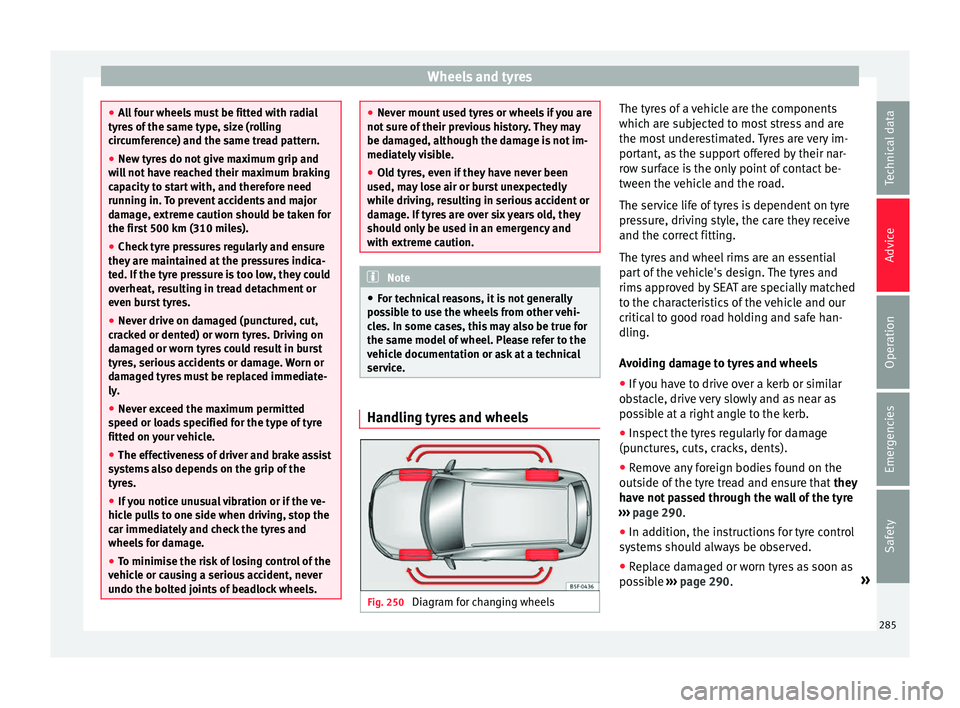
service. Handling tyres and wheels
Fig. 250
Diagram for changing wheels The tyres of a vehicle are the components
whic
h ar
e s
ubjected to most stress and are
the most underestimated. Tyres are very im-
portant, as the support offered by their nar-
row surface is the only point of contact be-
tween the vehicle and the road.
The service life of tyres is dependent on tyre
pressure, driving style, the care they receive
and the correct fitting.
The tyres and wheel rims are an essential
part of the vehicle's design. The tyres and
rims approved by SEAT are specially matched
to the characteristics of the vehicle and our
critical to good road holding and safe han-
dling.
Avoiding damage to tyres and wheels
● If you have to drive over a kerb or similar
obs
tacle, drive very slowly and as near as
possible at a right angle to the kerb.
● Inspect the tyres regularly for damage
(punct
ures, cuts, cracks, dents).
● Remove any foreign bodies found on the
outside of the ty
re tread and ensure that they
have not passed through the wall of the tyre
››› page 290.
● In addition, the instructions for tyre control
syst
ems should always be observed.
● Replace damaged or worn tyres as soon as
poss
ible ››› page 290. »
285
Technical data
Advice
Operation
Emergencies
Safety
Page 289 of 320
Wheels and tyres
Wheel bolts
Wheel bo
lts
must be tightened to the correct
torque ››› page 84.
Beadlock wheel rims
Beadlock wheel rims have various compo-
nents. These are joined together by special
bolts using a special procedure. This ensures
good performance, a better seal, improved
safety and wheel run out. Therefore, worn
rims should always be replaced and must on-
ly be repaired in a specialised workshop.
SEAT recommends visiting a technical service
››› .
Wheel rims
w
ith bolted trims
Wheel rims may be fitted with interchangea-
ble trim parts which are attached to the rim
using self-locking bolts. Worn trims should
only be replaced at a specialised workshop.
SEAT recommends visiting a technical service
››› .
WARNING
The use of worn or damaged wheel rims could
mak e driv
ing more dangerous and result in
serious accidents and damage.
● Only wheel rims which have been approved
for use w
ith your vehicle should be used.
● Inspect wheel rims regularly for damage
and repl
ace as required. WARNING
If the bolted joints of wheel rims with bolted
ring trims ar
e not correctly tightened or loos-
ened, this could result in serious accident.
● Never loosen the bolted joints of wheel
rims with bo
lted ring trims.
● Any work relating to wheel rims with bolted
rims shoul
d be carried out at specialised
workshop. SEAT recommends taking your car
in for technical service. Note
A SEAT Service Centre should be consulted to
find out whether wheel s
or tyres of different
sizes to those originally fitted by SEAT can be
fitted, and to find out about the combinations
allowed between the front axle (axle 1) and
the rear axle (axle 2). Replacement of wheel rims and new
ty
r
e
s New tyres
● When tyres are new, drive with extreme
c aution f
or the fir
st 500 km (310 miles), as
all tyres need to be run in. Tyres which have
not been run in do not have such good grip
or ››› braking capacity
››
›
.
● All four wheels must be fitted with radial
ty r
e
s of the same type, size (rolling circumfer-
ence) and the same tread pattern. ●
The trea
d depth of new tyres may vary, ac-
cording to the type and make of tyre and the
tread pattern.
Replacing tyres
● Where possible, always replace both
wheels on an ax
le (both wheels on the front
axle or both wheels on the rear axle) ››› .
● Old tyres should only be replaced by SEAT
ap pr
o
ved tyres for the vehicle in question,
and in accordance with the maximum permit-
ted size, diameter, load and speed capacity.
● If replacing tyres, make sure the new ones
have an emer
gency ride system (Conti-
Seal/Run flat). Otherwise, we recommend
carrying a tyre mobility system.
● Never use tyres which are larger than SEAT
appro
ved tyres. If the tyres are too big, they
may knock or rub against the chassis or other
components, resulting in damage. WARNING
New tyres do not give maximum grip and will
not h av
e reached their maximum braking ca-
pacity to start with, and therefore need run-
ning in.
● To prevent accidents and major damage,
extreme c
aution should be taken for the first
500 km (310 miles). » 287
Technical data
Advice
Operation
Emergencies
Safety
Page 291 of 320
Wheels and tyres
WARNING
If tyre pressures are too high or too low, the
tyr e m
ay deflate or burst suddenly while driv-
ing. This could result in a serious accident.
● If the tyre pressure is too low, they could
overhe
at, resulting in tread detachment or
even burst tyres.
● When driving at high speeds and/or fully
loaded, the ty
re could suddenly overheat,
burst or be subject to tread detachment, with
the resultant loss of control of the vehicle.
● Tyre pressures which are too high or too
low reduc
e the service life of the tyre, affect-
ing the vehicle's performance.
● Tyre pressures should be checked regularly,
at le
ast once a month and before long jour-
neys.
● Adjust the pressures of all the tyres to the
vehicl
e load.
● Never deflate excess pressure from hot
tyre
s. CAUTION
● Tak e c
are not to tilt the manometer when
placing it on the valve. Otherwise, the valve
may be damaged.
● If tyre valves are not protected by caps, or if
the caps
are not screwed on correctly, they
may become damaged. Check that the caps
are identical to the standard caps and have
been correctly tightened. For the sake of the environment
Under-inflated tyres will increase fuel con-
sumption. Note
When checking tyre pressures, please ob-
serv e the in
structions for the tyre control sys-
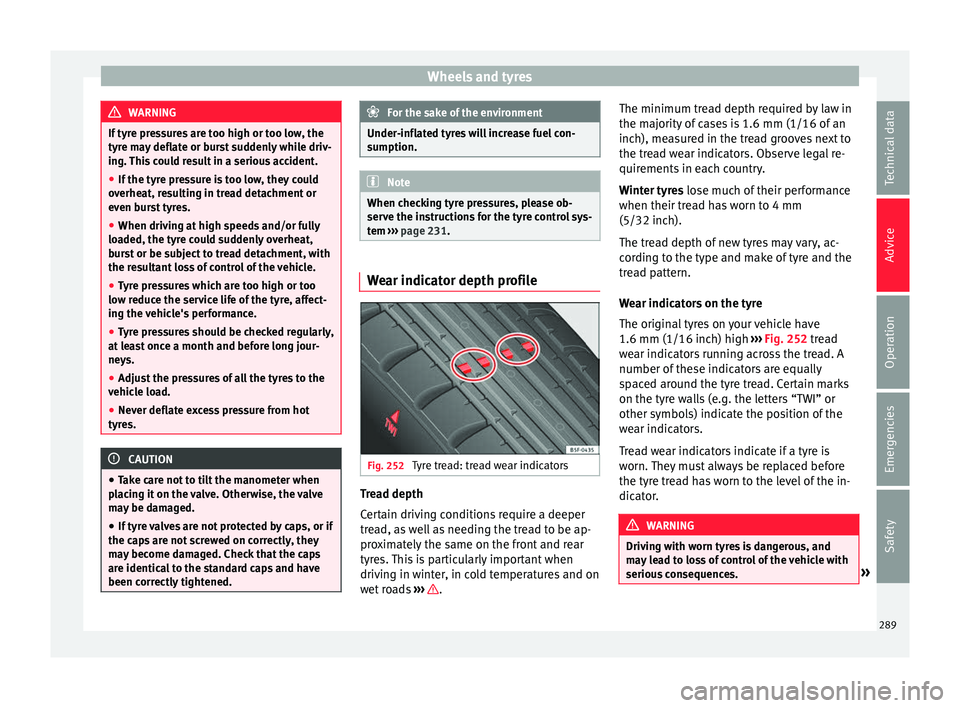
tem ››› page 231. Wear indicator depth profile
Fig. 252
Tyre tread: tread wear indicators Tread depth
C
er
t
ain driving conditions require a deeper
tread, as well as needing the tread to be ap-
proximately the same on the front and rear
tyres. This is particularly important when
driving in winter, in cold temperatures and on
wet roads ››› .The minimum tread depth required by law in
the m
aj
ority
of cases is 1.6 mm (1/16 of an
inch), measured in the tread grooves next to
the tread wear indicators. Observe legal re-
quirements in each country.
Winter tyres lose much of their performance
when their tread has worn to 4 mm
(5/32 inch).
The tread depth of new tyres may vary, ac-
cording to the type and make of tyre and the
tread pattern.
Wear indicators on the tyre
The original tyres on your vehicle have
1.6 mm (1/16 inch) high ››› Fig. 252 tread
wear indicators running across the tread. A
number of these indicators are equally
spaced around the tyre tread. Certain marks
on the tyre walls (e.g. the letters “TWI” or
other symbols) indicate the position of the
wear indicators.
Tread wear indicators indicate if a tyre is
worn. They must always be replaced before
the tyre tread has worn to the level of the in-
dicator. WARNING
Driving with worn tyres is dangerous, and
ma y
lead to loss of control of the vehicle with
serious consequences. » 289
Technical data
Advice
Operation
Emergencies
Safety
Page 294 of 320
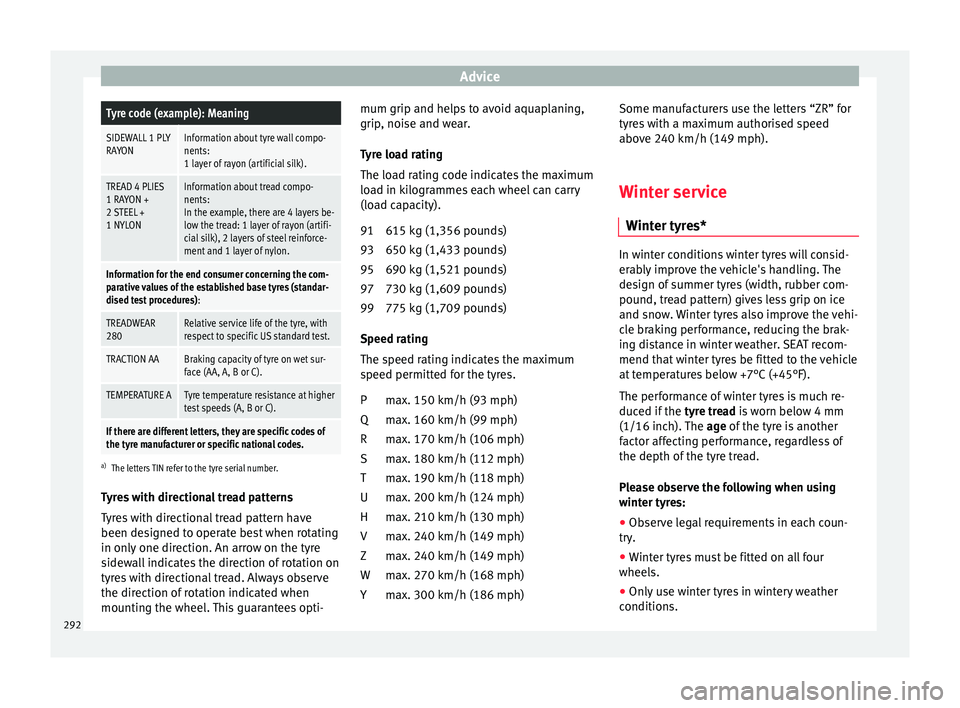
AdviceTyre code (example): Meaning
SIDEWALL 1 PLY
RAYONInformation about tyre wall compo-
nents:
1 layer of rayon (artificial silk).
TREAD 4 PLIES
1 RAYON +
2 STEEL +
1 NYLONInformation about tread compo-
nents:
In the example, there are 4 layers be-
low the tread: 1 layer of rayon (artifi-
cial silk), 2 layers of steel reinforce-
ment and 1 layer of nylon.
Information for the end consumer concerning the com-
parative values of the established base tyres (standar-
dised test procedures) :
TREADWEAR
280Relative service life of the tyre, with
respect to specific US standard test.
TRACTION AABraking capacity of tyre on wet sur-
face (AA, A, B or C).
TEMPERATURE ATyre temperature resistance at higher
test speeds (A, B or C).
If there are different letters, they are specific codes of
the tyre manufacturer or specific national codes.
a)
The letters TIN refer to the tyre serial number.
Tyres with directional tread patterns
Tyres with directional tread pattern have
been designed to operate best when rotating
in only one direction. An arrow on the tyre
sidewall indicates the direction of rotation on
tyres with directional tread. Always observe
the direction of rotation indicated when
mounting the wheel. This guarantees opti- mum grip and helps to avoid aquaplaning,
grip, noise and w
ear.
Tyre load rating
The load rating code indicates the maximum
load in kilogrammes each wheel can carry
(load capacity). 615 kg (1,356 pounds)
650 kg (1,433 pounds)
690 kg (1,521 pounds)
730 kg (1,609 pounds)
775 kg (1,709 pounds)
Speed rating
The speed rating indicates the maximum
speed permitted for the tyres. max. 150 km/h (93 mph)
max. 160 km/h (99 mph)
max. 170 km/h (106 mph)
max. 180 km/h (112 mph)
max. 190 km/h (118 mph)
max. 200 km/h (124 mph)
max. 210 km/h (130 mph)
max. 240 km/h (149 mph)
max. 240 km/h (149 mph)
max. 270 km/h (168 mph)
max. 300 km/h (186 mph)
91
93
95
97
99
P
Q
R
S
T
U
H
V
Z
W
Y Some manufacturers use the letters “ZR” for
tyre
s with a maximum authorised speed
above 240 km/h (149 mph).
Winter service Winter ty
res* In winter conditions winter tyres will consid-
erab
ly
improve the vehicle's handling. The
design of summer tyres (width, rubber com-
pound, tread pattern) gives less grip on ice
and snow. Winter tyres also improve the vehi-
cle braking performance, reducing the brak-
ing distance in winter weather. SEAT recom-
mend that winter tyres be fitted to the vehicle
at temperatures below +7°C (+45°F).
The performance of winter tyres is much re-
duced if the tyre tread is worn below 4 mm
(1/16 inch). The age of the tyre is another
factor affecting performance, regardless of
the depth of the tyre tread.
Please observe the following when using
winter tyres:
● Observe legal requirements in each coun-
try .
● W
inter tyres must be fitted on all four
wheels.
● Only
use winter tyres in wintery weather
conditions.
292
Page 295 of 320
Wheels and tyres
● On ly
u
se winter tyres of the size authorised
for the vehicle.
● Only use radial winter tyres of the same
type, size (r
olling circumference) and tread
pattern.
● Adjust speeds to within the limits indicated
(code lett
er on tyre) ››› .
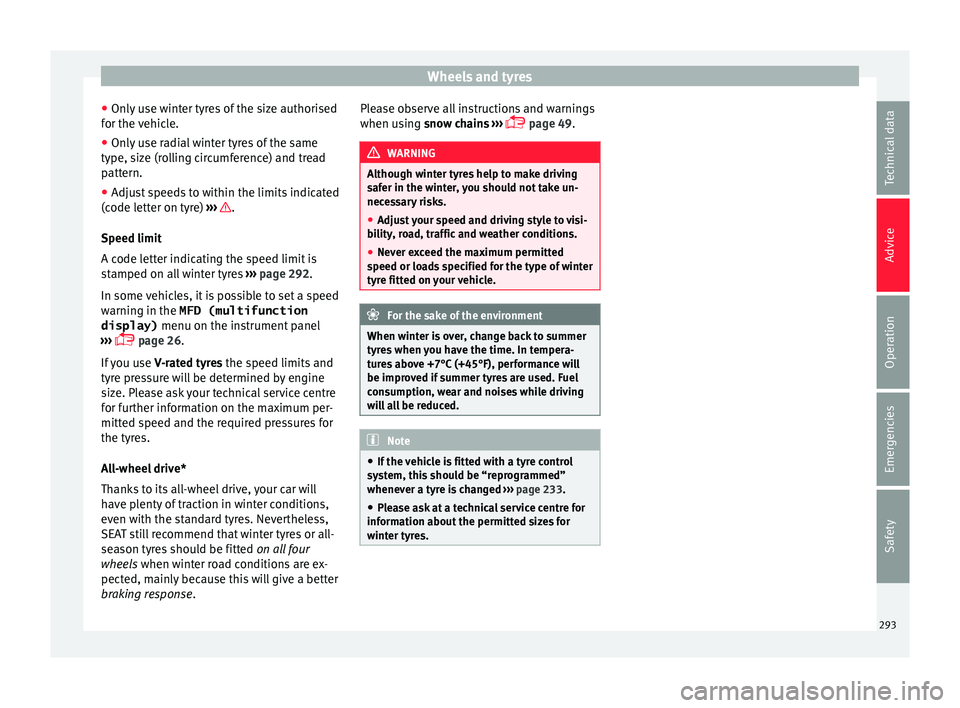
S peed limit
A c ode l
etter indicating the speed limit is
stamped on all winter tyres ››› page 292.
In some vehicles, it is possible to set a speed
warning in the MFD (multifunction
display) menu on the instrument panel
››› page 26.
If you use V-rated tyres the speed limits and
tyre pressure will be determined by engine
size. Please ask your technical service centre
for further information on the maximum per-
mitted speed and the required pressures for
the tyres.
All-wheel drive*
Thanks to its all-wheel drive, your car will
have plenty of traction in winter conditions,
even with the standard tyres. Nevertheless,
SEAT still recommend that winter tyres or all-
season tyres should be fitted on all four
wheels when winter road conditions are ex-
pected, mainly because this will give a better
braking response. Please observe all instructions and warnings
when usin
g snow chains ›››
page 49. WARNING
Although winter tyres help to make driving
saf er in the w
inter, you should not take un-
necessary risks.
● Adjust your speed and driving style to visi-
bility
, road, traffic and weather conditions.
● Never exceed the maximum permitted
speed or loa
ds specified for the type of winter
tyre fitted on your vehicle. For the sake of the environment
When winter is over, change back to summer
tyr e
s when you have the time. In tempera-
tures above +7°C (+45°F), performance will
be improved if summer tyres are used. Fuel
consumption, wear and noises while driving
will all be reduced. Note
● If the v
ehicle is fitted with a tyre control
system, this should be “reprogrammed”
whenever a tyre is changed ››› page 233.
● Please ask at a technical service centre for
information about
the permitted sizes for
winter tyres. 293
Technical data
Advice
Operation
Emergencies
Safety
Page 306 of 320
Index
tiredness detection . . . . . . . . . . . . . . . . . . . . . 229
ty r
e monit
oring indicator . . . . . . . . . . . . . . . . . 233
Assisted starting . . . . . . . . . . . . . . . . . . . . . . . . . . 51
Assist systems adaptive headlights . . . . . . . . . . . . . . . . . . . . . 130
auto Hold . . . . . . . . . . . . . . . . . . . . . . . . . . . . . 206
blind spot detector (BSD) with rear cross traf-fic alert (RTA) . . . . . . . . . . . . . . . . . . . . . . . . . 222
brake assist system (BAS) . . . . . . . . . . . . . . . . 204
cruise control system . . . . . . . . . . . . . . . . . . . . 219
dynamic chassis control (DCC) . . . . . . . . . . . . 230
lane Assist . . . . . . . . . . . . . . . . . . . . . . . . . . . . . 220
lane assist system . . . . . . . . . . . . . . . . . . . . . . 220
optical parking system . . . . . . . . . . . . . . . . . . . 210
park Assist . . . . . . . . . . . . . . . . . . . . . . . . . . . . 211
park assist system . . . . . . . . . . . . . . . . . . . . . . 211
parking assistance . . . . . . . . . . . . . . . . . . . . . . 209
parking distance warning system . . . . . . . . . . 209
rear assist . . . . . . . . . . . . . . . . . . . . . . . . . . . . . 215
rear cross traffic alert (RTA) . . . . . . . . . . . . . . . 222
rear View Camera . . . . . . . . . . . . . . . . . . . . . . . 215
sign Assist . . . . . . . . . . . . . . . . . . . . . . . . . . . . . 227
Start-Stop . . . . . . . . . . . . . . . . . . . . . . . . . . . . . 207
start assistance . . . . . . . . . . . . . . . . . . . . . . . . 206
traction control when accelerating (ASR) . . .204, 205
traffic signal detection . . . . . . . . . . . . . . . . . . . 227
Auto Hold . . . . . . . . . . . . . . . . . . . . . . . . . . . . . . . 206
Automatic belt retractor . . . . . . . . . . . . . . . . . . . . . 67
Automatic car wash switching Auto Hold off . . . . . . . . . . . . . . . . . . 207
switching the start assist off . . . . . . . . . . . . . . 207
Automatic dipped beam control . . . . . . . . . . . . . 130
Automatic gearbox . . . . . . . . . . . . . . . . . . . . . . . . 193 driving tips . . . . . . . . . . . . . . . . . . . . . . . . . . . . 195
emergency release . . . . . . . . . . . . . . . . . . . . . . . 35
ignition key removal lock . . . . . . . . . . . . . . . . . 184
kick-down . . . . . . . . . . . . . . . . . . . . . . . . . . . . . 195
malfunction . . . . . . . . . . . . . . . . . . . . . . . . . . . . 196 AUX-IN . . . . . . . . . . . . . . . . . . . . . . . . . . . . . . . . . . 108
Auxili
ary heater . . . . . . . . . . . . . . . . . . . . . . . . . . 177
automatic off . . . . . . . . . . . . . . . . . . . . . . . . . . . 263
operating instructions . . . . . . . . . . . . . . . . . . . 180
programming . . . . . . . . . . . . . . . . . . . . . . . . . . 179
remote control . . . . . . . . . . . . . . . . . . . . . . . . . 178
remote control range . . . . . . . . . . . . . . . . . . . . 179
remote control: replacing the battery . . . . . . . 179
special features . . . . . . . . . . . . . . . . . . . . . . . . 178
switching off . . . . . . . . . . . . . . . . . . . . . . . . . . . 178
switching on . . . . . . . . . . . . . . . . . . . . . . . . . . . 178
things to note . . . . . . . . . . . . . . . . . . . . . . . . . . 180
Auxiliary heater remote control auxiliary heater . . . . . . . . . . . . . . . . . . . . . . . . . 178
replacing the battery . . . . . . . . . . . . . . . . . . . . 179
B BAS see Brake assist systems . . . . . . . . . . . . . . . . . 204
Battery changing in the vehicle key . . . . . . . . . . . . . . . 111
Before setting off . . . . . . . . . . . . . . . . . . . . . . . . . . 56
Belt height adjustment . . . . . . . . . . . . . . . . . . . . . 67
Belt tension device service and disposal . . . . . . . . . . . . . . . . . . . . . 68
Belt tensioner . . . . . . . . . . . . . . . . . . . . . . . . . . . . . 67
Belt tension limiter . . . . . . . . . . . . . . . . . . . . . . . . . 67
Belt tightening . . . . . . . . . . . . . . . . . . . . . . . . . . . . 67
Bicycle carrier fitting on the tow hitch ball . . . . . . . . . . . . . . . 237
maximum load . . . . . . . . . . . . . . . . . . . . . . . . . 237
Biodiesel . . . . . . . . . . . . . . . . . . . . . . . . . . . . . . . . 265
Blind spot detector (BSD) . . . . . . . . . . . . . . . . . . 222 control lamps . . . . . . . . . . . . . . . . . . . . . . . . . . 222
driving situations . . . . . . . . . . . . . . . . . . . . . . . 225
indication in the external rear view mirror . . . 223
malfunction . . . . . . . . . . . . . . . . . . . . . . . . . . . . 222 operating . . . . . . . . . . . . . . . . . . . . . . . . . . . . . . 223
tow
ing . . . . . . . . . . . . . . . . . . . . . . . . . . . . . . . . 227
Bonnet . . . . . . . . . . . . . . . . . . . . . . . . . . . . . . . . . . 11 opening and closing . . . . . . . . . . . . . . . . . . . . 270
Boot hatch emergency locking and unlocking . . . . . . . . . . . 10
Bottle holders . . . . . . . . . . . . . . . . . . . . . . . . . . . . 168
Brake brake servo . . . . . . . . . . . . . . . . . . . . . . . . . . . . 191
emergency braking function . . . . . . . . . . . . . . 189
Brake assist system . . . . . . . . . . . . . . . . . . . . . . . 203
Brake assist systems . . . . . . . . . . . . . . . . . . . . . . 203
Brake fluid . . . . . . . . . . . . . . . . . . . . . . . . . . . . . . . 41 specification . . . . . . . . . . . . . . . . . . . . . . . . . . . 278
Brakes . . . . . . . . . . . . . . . . . . . . . . . . . . . . . . . . . . 187 brake assist systems . . . . . . . . . . . . . . . . . . . . 203
brake fluid . . . . . . . . . . . . . . . . . . . . . . . . . . . . . 278
brake fluid level . . . . . . . . . . . . . . . . . . . . . . . . 279
brake pads . . . . . . . . . . . . . . . . . . . . . . . . . . . . 190
changing the brake fluid . . . . . . . . . . . . . . . . . 279
control and warning lamps . . . . . . . . . . . . . . . 187
electronic parking brake . . . . . . . . . . . . . . . . . 189
running in new brake pads . . . . . . . . . . . . . . . 190
Brake servo . . . . . . . . . . . . . . . . . . . . . . . . . 191, 203
Brake system fault . . . . . . . . . . . . . . . . . . . . . . . . . . . . . . . . . . 191
Brake systems . . . . . . . . . . . . . . . . . . . . . . . . . . . 203
Braking brake assist system . . . . . . . . . . . . . . . . . . . . . 203
BSD see Blind spot detector . . . . . . . . . . . . . . . . . . 222
Bulb malfunction see Changing bulbs . . . . . . . . . . . . . . . . . . . . . . 91
C
Capacities . . . . . . . . . . . . . . . . . . . . . . . . . . . . . . . . 39 windshield wiper fluid tank . . . . . . . . . . . . . . . 280
304
Page 311 of 320
Index
Headlamp range adjustment . . . . . . . . . . . . . . . . . 99
He a
dlight
range control . . . . . . . . . . . . . . . . . . . . 133
Headlights adaptive headlights . . . . . . . . . . . . . . . . . . . . . 130
driving abroad . . . . . . . . . . . . . . . . . . . . . . . . . 133
headlight adjustment . . . . . . . . . . . . . . . . . . . . 130
headlight washers . . . . . . . . . . . . . . . . . . . . . . 136
Head restraint assembly and removal . . . . . . . . . . . . . . . . . . . 143
Head restraints . . . . . . . . . . . . . . . . . . . . . . . . . . . 143 adjustment . . . . . . . . . . . . . . . . . . . . . . . . 15, 142
Headrests adjustment . . . . . . . . . . . . . . . . . . . . . . . . 15, 142
assembly and removal . . . . . . . . . . . . . . . . . . . 143
Heat and air conditioning . . . . . . . . . . . . . . . . . . 173
Heated rear window . . . . . . . . . . . . . . . . . . . . . . . . 37
Heated windscreen . . . . . . . . . . . . . . . . . . . . . . . . 37
Heating and air conditioning controls . . . . . . . . . . . . . . . . . . . . . . . . . . . . . . . . 36
Hitch ball electric release . . . . . . . . . . . . . . . . . . . . . . . . . 236
Horn . . . . . . . . . . . . . . . . . . . . . . . . . . . . . . . . . . . . 99
How to jump start . . . . . . . . . . . . . . . . . . . . . . . . . . 51
Hubcaps . . . . . . . . . . . . . . . . . . . . . . . . . . . . . . . . . 45
I Identifying letters on engine . . . . . . . . . . . . . . . . 294
Ignition . . . . . . . . . . . . . . . . . . . . . . . . . . . . . . . . . . 24 see Engine and ignition . . . . . . . . . . . . . . . . . . 182
Ignition lock . . . . . . . . . . . . . . . . . . . . . . . . . . . . . . 24 removal lock . . . . . . . . . . . . . . . . . . . . . . . . . . . 184
unauthorised vehicle key . . . . . . . . . . . . . . . . . 183
Immobiliser . . . . . . . . . . . . . . . . . . . . . . . . . . . . . . 186
In case of emergency . . . . . . . . . . . . . . . . . . . . . . . 82
Indication on display Sign Assist . . . . . . . . . . . . . . . . . . . . . . . . . . . . 228 Indications on the display . . . . . . . . . . . . . . . . . . 101
outside temper ature . . . . . . . . . . . . . . . . . . . . . 102
Information call . . . . . . . . . . . . . . . . . . . . . . . . . . 109
Instrument panel . . . . . . . . . . . . . . . . . . . . . 27, 100 control and warning lamps . . . . . . . . . . . 32, 105
display . . . . . . . . . . . . . . . . . . . . . . . . 27, 100, 101
general instrument panel . . . . . . . . . . . . . . . . . . 99
instruments . . . . . . . . . . . . . . . . . . . . . . . . . . . . 100
menus . . . . . . . . . . . . . . . . . . . . . . . . . . . . . . . . . 28
service intervals . . . . . . . . . . . . . . . . . . . . . . . . 103
symbols . . . . . . . . . . . . . . . . . . . . . . . . . . . 32, 105
Instruments . . . . . . . . . . . . . . . . . . . . . . . . . . . . . 100
Integrated child seat . . . . . . . . . . . . . . . . . . . . . . . 78 removing . . . . . . . . . . . . . . . . . . . . . . . . . . . . . . . 80
seat belt routing . . . . . . . . . . . . . . . . . . . . . . . . . 80
setting up . . . . . . . . . . . . . . . . . . . . . . . . . . . . . . 79
Interior door release lever . . . . . . . . . . . . . . . . . . . 99
Interior lights . . . . . . . . . . . . . . . . . . . . . . . . . . . . . 26
Interior rear vision mirror . . . . . . . . . . . . . . . . . . . 137 anti-dazzle . . . . . . . . . . . . . . . . . . . . . . . . . . . . 138
Interior view left guide . . . . . . . . . . . . . . . . . . . . . . . . . . . . . . . . 7
ISOFIX . . . . . . . . . . . . . . . . . . . . . . . . . . . . . . . . . . . 23
ISOFIX system . . . . . . . . . . . . . . . . . . . . . . . . . . . . . 23
J Jack . . . . . . . . . . . . . . . . . . . . . . . . . . . . . . 45, 82, 84 mounting points . . . . . . . . . . . . . . . . . . . . . . . . . 47
Jump leads . . . . . . . . . . . . . . . . . . . . . . . . . . . . . . . 51
K
Keyless Access keyless-Entry . . . . . . . . . . . . . . . . . . . . . . . . . . . 115
keyless-Exit . . . . . . . . . . . . . . . . . . . . . . . . . . . . 115
locking and unlocking the vehicle . . . . . . . . . . 115
starter button . . . . . . . . . . . . . . . . . . . . . . . . . . 184
things to note . . . . . . . . . . . . . . . . . . . . . . . . . . 116 Keyless Access locking and ignition system
see Keyle ss Access . . . . . . . . . . . . . . . . . . . . . . 115
Keys control lamp . . . . . . . . . . . . . . . . . . . . . . . . . . . 111
locking and unlocking . . . . . . . . . . . . . . . . . . . . . 8
remote control . . . . . . . . . . . . . . . . . . . . . . . . . 110
replacing the battery . . . . . . . . . . . . . . . . . . . . 111
spare key . . . . . . . . . . . . . . . . . . . . . . . . . . . . . . 110
synchronising . . . . . . . . . . . . . . . . . . . . . . . . . . 112
unlocking and locking . . . . . . . . . . . . . . 113, 114
vehicle key . . . . . . . . . . . . . . . . . . . . . . . . . . . . 110
L
Labels and plates . . . . . . . . . . . . . . . . . . . . . . . . . 260
Lane Assist . . . . . . . . . . . . . . . . . . . . . . . . . . . . . . 220
Lane assist system . . . . . . . . . . . . . . . . . . . . . . . . 220 control lamp . . . . . . . . . . . . . . . . . . . . . . . . . . . 220
malfunction . . . . . . . . . . . . . . . . . . . . . . . . . . . . 220
operation mode . . . . . . . . . . . . . . . . . . . . . . . . 221
when is it necessary to disconnect it? . . . . . . . 221
Lane Assist system . . . . . . . . . . . . . . . . . . . . . . . . 220
Leaving Home . . . . . . . . . . . . . . . . . . . . . . . . . . . . 131
Lift platform . . . . . . . . . . . . . . . . . . . . . . . . . . . . . 249
Lighting of the instrument panel . . . . . . . . . . . . . 133
Lights . . . . . . . . . . . . . . . . . . . . . . . . . . . . . . 24, 128 AUTO . . . . . . . . . . . . . . . . . . . . . . . . . . . . . . . . . 130
automatic dipped beam control . . . . . . . . . . . 130
coming home . . . . . . . . . . . . . . . . . . . . . . . . . . 131
control and warning lamps . . . . . . . . . . . . . . . 128
cornering lights . . . . . . . . . . . . . . . . . . . . . . . . 130
daytime running lights . . . . . . . . . . . . . . . . . . . 129
dipped beam headlights . . . . . . . . . . . . . . . . . 128
driving abroad . . . . . . . . . . . . . . . . . . . . . . . . . 133
fog lights . . . . . . . . . . . . . . . . . . . . . . . . . . . . . . . 25
functions . . . . . . . . . . . . . . . . . . . . . . . . . . . . . . 129
hazard warning lights . . . . . . . . . . . . . . . . . . . . 25
headlight range control . . . . . . . . . . . . . . . . . . 133
309
Page 315 of 320
Index
Selector lever locking . . . . . . . . . . . . . . . . . . . . . . 194
Ser v
ic
e fluids . . . . . . . . . . . . . . . . . . . . . . . . . . . . 244
Service interval display . . . . . . . . . . . . . . . . . . . . 103
Service notification: read . . . . . . . . . . . . . . . . . . . 104
Signal lever . . . . . . . . . . . . . . . . . . . . . . . . . . . . . . . 25
Sign Assist . . . . . . . . . . . . . . . . . . . . . . . . . 227, 228 connection . . . . . . . . . . . . . . . . . . . . . . . . . . . . 229
disconnection . . . . . . . . . . . . . . . . . . . . . . . . . . 229
indication on display . . . . . . . . . . . . . . . . . . . . 228
operation mode . . . . . . . . . . . . . . . . . . . . . . . . 229
trailer . . . . . . . . . . . . . . . . . . . . . . . . . . . . . . . . . 229
Sliding door . . . . . . . . . . . . . . . . . . . . . . . . . . . . . 119 childproof lock . . . . . . . . . . . . . . . . . . . . . . . . . 121
manually opening and closing . . . . . . . . . . . . 120
opening and closing electrically . . . . . . . . . . . 120
Snow chains . . . . . . . . . . . . . . . . . . . . . . . . . 49, 296 all-wheel drive . . . . . . . . . . . . . . . . . . . . . . . . . . 49
Spanner symbol . . . . . . . . . . . . . . . . . . . . . . . . . . 104
Spare fuel canister . . . . . . . . . . . . . . . . . . . . . . . . 262
Spare parts . . . . . . . . . . . . . . . . . . . . . . . . . . . . . . 244
Specifications combined weight . . . . . . . . . . . . . . . . . . . . . . . 242
drawbar load . . . . . . . . . . . . . . . . . . . . . . . . . . . 234
trailer weights . . . . . . . . . . . . . . . . . . . . . . . . . . 242
Speed rating . . . . . . . . . . . . . . . . . . . . . . . . . . . . . 292
Stabilising the vehicle and trailer combination . 241
Start-Stop function driving with a trailer . . . . . . . . . . . . . . . . . . . . . 234
Start-Stop Function . . . . . . . . . . . . . . . . . . . . . . . 207
Start assist see Start assist systems . . . . . . . . . . . . . . . . . . 205
Starter button . . . . . . . . . . . . . . . . . . . . . . . . . . . . 184
Starting assistance description . . . . . . . . . . . . . . . . . . . . . . . . . . . . . 53
jump leads . . . . . . . . . . . . . . . . . . . . . . . . . . . . . 53
positive pole . . . . . . . . . . . . . . . . . . . . . . . . . . . . 52
Starting the vehicle . . . . . . . . . . . . . . . . . . . . . . . . 24 Steering
contro l and warning lamps . . . . . . . . . . . . . . . 181
counter steering assistance system . . . . . . . . 182
electromechanical . . . . . . . . . . . . . . . . . . . . . . 182
power steering . . . . . . . . . . . . . . . . . . . . . . . . . 182
steering column lock . . . . . . . . . . . . . . . . . . . . 182
tendency to pull to one side . . . . . . . . . . . . . . 290
Steering wheel adjustment . . . . . . . . . . . . . . . . . . . . . . . . . . . . . 16
setting . . . . . . . . . . . . . . . . . . . . . . . . . . . . . . . . . 58
Steering wheel controls . . . . . . . . . . . . . . . . . . . . 106
Storage compartment for (sun)glasses . . . . . . . . . . . . . 164
Storage compartment other storage compartments . . . . . . . . . . . . . . 168
Storage compartment in the roof console . . . . . 164
Storage compartments . . . . . . . . . . . . . . . . . . . . 163 cards . . . . . . . . . . . . . . . . . . . . . . . . . . . . . . . . . 165
drawers . . . . . . . . . . . . . . . . . . . . . . . . . . . . . . . 167
folding table . . . . . . . . . . . . . . . . . . . . . . . . . . . 167
glove compartment . . . . . . . . . . . . . . . . . . . . . 166
glove compartment lighting . . . . . . . . . . . . . . 134
instrument panel . . . . . . . . . . . . . . . . . . . . . . . 164
portable waste bin . . . . . . . . . . . . . . . . . . . . . . 167
rear footwell . . . . . . . . . . . . . . . . . . . . . . . . . . . 166
roof console . . . . . . . . . . . . . . . . . . . . . . . . . . . 164
Sun blind anti-trap function . . . . . . . . . . . . . . . . . . . . . . . 127
opening and closing . . . . . . . . . . . . . . . . . . . . 127
Sun blinds rear side windows . . . . . . . . . . . . . . . . . . . . . . 135
Sun protection . . . . . . . . . . . . . . . . . . . . . . . . . . . 134
Sun visors . . . . . . . . . . . . . . . . . . . . . . . . . . . . . . . 134
Switch hazard warning lights . . . . . . . . . . . . . . . . . . . 132
Switching lights off . . . . . . . . . . . . . . . . . . . . . . . 128
Switching lights on . . . . . . . . . . . . . . . . . . . . . . . 128 Switching the ignition on and off . . . . . . . . . . . . . 24
Symbol
s
see Control and warning lamps . . . . . . . . 32, 105
Systems tyre monitoring systems . . . . . . . . . . . . . . . . . 231
T Technical data engine oil specifications . . . . . . . . . . . . . . . . . 272
roof load . . . . . . . . . . . . . . . . . . . . . . . . . . . . . . 162
Technical details capacities . . . . . . . . . . . . . . . . . . . . . . . . . . . . . 280
loads on the axles . . . . . . . . . . . . . . . . . . . . . . 295
tyre pressure . . . . . . . . . . . . . . . . . . . . . . . . . . . 288
weights . . . . . . . . . . . . . . . . . . . . . . . . . . . . . . . 295
Technical features . . . . . . . . . . . . . . . . . . . . . . . . 294
Technical modifications . . . . . . . . . . . . . . . . . . . . 245
Technical specifications dimensions . . . . . . . . . . . . . . . . . . . . . . . . . . . . 302
Telephone management three button unit . . . . . . . . . . . . . . . . . . . . . . . . 108
Tightening torque . . . . . . . . . . . . . . . . . . . . . . . . . 296 wheel bolts . . . . . . . . . . . . . . . . . . . . . . . . . . . . . 47
TIN . . . . . . . . . . . . . . . . . . . . . . . . . . . . . . . . . . . . . 291
Tiptronic . . . . . . . . . . . . . . . . . . . . . . . . . . . . . . . . 195
Tiredness detection . . . . . . . . . . . . . . . . . . . . . . . 229
Top Tether . . . . . . . . . . . . . . . . . . . . . . . . . . . . . . . . 23
Top Tether system . . . . . . . . . . . . . . . . . . . . . . . . . 23
Tow-starting . . . . . . . . . . . . . . . . . . . . . . . . . . . 51, 87
Tow hitch electric release . . . . . . . . . . . . . . . . . . . . . . . . . 236
fitting a bicycle carrier . . . . . . . . . . . . . . . . . . . 237
function control . . . . . . . . . . . . . . . . . . . . . . . . 239
Towing blind spot detector (BSD) . . . . . . . . . . . . . . . . 227
parking distance warning system . . . . . . . . . . 210
313