ESP Seat Alhambra 2018 Owners Manual
[x] Cancel search | Manufacturer: SEAT, Model Year: 2018, Model line: Alhambra, Model: Seat Alhambra 2018Pages: 324, PDF Size: 7.04 MB
Page 295 of 324
Wheels and tyres
●
Ty r
es must be replaced before the wear in-
dicators are at the same level as the tread
pattern.
● Worn tyres have significantly reduced grip,
espec
ially on wet surfaces, increasing the
risk of “aquaplaning”.
● Worn tyres make control of the vehicle
more difficu
lt in normal or difficult driving
conditions, increasing the braking distance
and the risk of skidding. Tyre damage
Damage to wheels and tyres is often invisible
t
o the n
ak
ed eye. If you notice unusual vibra-
tion or the car pulling to one side, this may
indicate that one of the tyres is damaged
››› .
● Slow down immediately if you think you
h av
e a d
amaged wheel.
● Check the wheels and tyres for damage.
● If tyres are worn, stop driving and seek
qualified ass
istance.
● If there is no visible exterior damage, drive
slowly
and carefully to the nearest special-
ised workshop and have the vehicle checked.
Foreign bodies in the tyre
● Do not remove foreign bodies if they have
penetrated thr
ough the tyre wall! ●
If the v
ehicle comes with a tyre mobility
system, where necessary seal the damaged
tyre as shown in section ››› page 86. Use a
specialised workshop for repair or replace-
ment. SEAT recommends visiting a SEAT deal-
ership for this.
The sealant at the lower part of the tyre tread
wraps around the foreign body and provision-
ally seals the tyre.
Tyre wear
The wear of tyres depends on a number of
factors, for example:
● Driving style.
● Unbalanced wheels.
● Running gear settings.
Driving
style: Driving round bends quickly or
sudden acceleration or braking speed accel-
erates tyre wear. When the driving style is
normal, if the tyres wear too quickly, have the
running gear settings checked at a special-
ised workshop.
Wheel run-out: The wheels on new vehicles
are balanced. However, certain circumstan-
ces may lead to imbalance (run-out), which is
detected as vibrations in the steering wheel.
Run-out leads to wear of the steering and
suspension. In the event of run out, the
wheels should be balanced again. When a
new wheel is fitted, it should be balanced
again. Running gear settings
: an incorrectly
posi-
tioned running gear increases the wear of
tyres and affects your safety while driving. If
tyres wear too quickly, have the wheel align-
ment checked at a specialised workshop. WARNING
If you notice unusual vibration or the car pulls
to one s ide whi
le driving, this may indicate
that one of the tyres is damaged.
● Reduce speed immediately and stop, while
obser
ving the highway code.
● Check the wheels and tyres for damage.
● Never carry on driving on worn tyres or
wheels. Reque
st qualified assistance immedi-
ately.
● If there is no visible exterior damage, drive
slowly
and carefully to the nearest special-
ised workshop and have the vehicle checked. 293
Technical data
Advice
Operation
Emergencies
Safety
Page 296 of 324
Advice
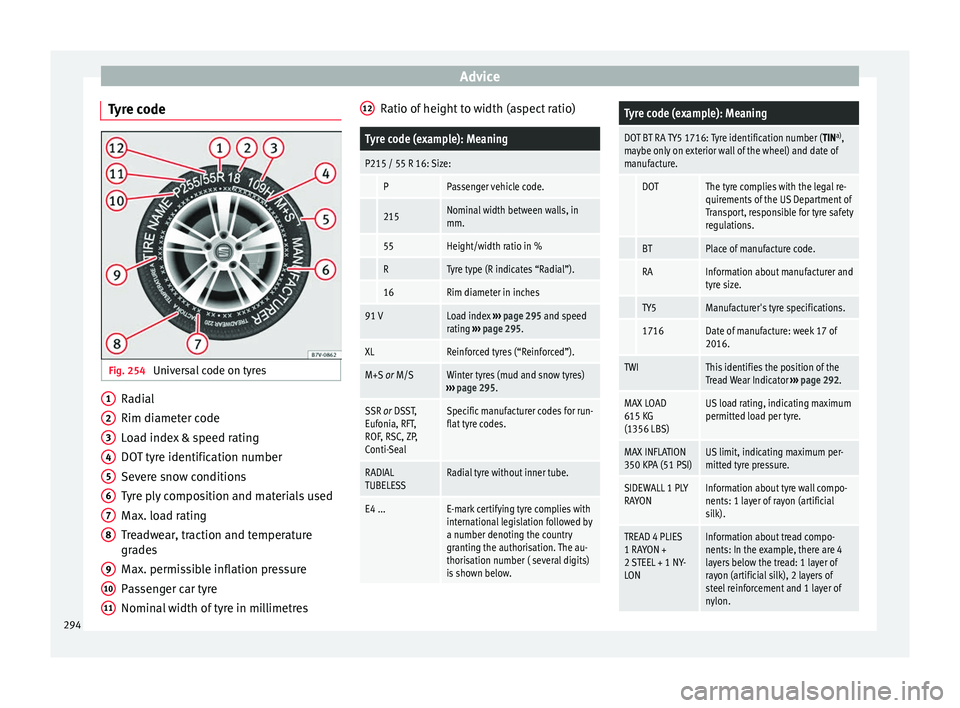
Tyre code Fig. 254
Universal code on tyres Radial
Rim di
amet
er c
ode
Load index & speed rating
DOT tyre identification number
Severe snow conditions
Tyre ply composition and materials used
Max. load rating
Treadwear, traction and temperature
grades
Max. permissible inflation pressure
Passenger car tyre
Nominal width of tyre in millimetres
1 2
3
4
5
6
7
8
9
10
11 Ratio of height to width (aspect ratio)
Tyre code (example): Meaning
P215 / 55 R 16: Size:
PPassenger vehicle code.
215Nominal width between walls, in
mm.
55Height/width ratio in %
RTyre type (R indicates “Radial”).
16Rim diameter in inches
91 VLoad index
››› page 295 and speed
rating ››› page 295.
XLReinforced tyres (“Reinforced”).
M+S or M/SWinter tyres (mud and snow tyres)
››› page 295.
SSR or DSST,
Eufonia, RFT,
ROF, RSC, ZP,
Conti-SealSpecific manufacturer codes for run-
flat tyre codes.
RADIAL
TUBELESSRadial tyre without inner tube.
E4 ...E-mark certifying tyre complies with
international legislation followed by
a number denoting the country
granting the authorisation. The au-
thorisation number ( several digits)
is shown below. 12
Tyre code (example): Meaning
DOT BT RA TY5 1716: Tyre identification number (
TINa)
,
maybe only on exterior wall of the wheel) and date of
manufacture.
DOTThe tyre complies with the legal re-
quirements of the US Department of
Transport, responsible for tyre safety
regulations.
BTPlace of manufacture code.
RAInformation about manufacturer and
tyre size.
TY5Manufacturer's tyre specifications.
1716Date of manufacture: week 17 of
2016.
TWIThis identifies the position of the
Tread Wear Indicator ››› page 292.
MAX LOAD
615 KG
(1356 LBS)US load rating, indicating maximum
permitted load per tyre.
MAX INFLATION
350 KPA (51 PSI)US limit, indicating maximum per-
mitted tyre pressure.
SIDEWALL 1 PLY
RAYONInformation about tyre wall compo-
nents: 1 layer of rayon (artificial
silk).
TREAD 4 PLIES
1 RAYON +
2 STEEL + 1 NY-
LONInformation about tread compo-
nents: In the example, there are 4
layers below the tread: 1 layer of
rayon (artificial silk), 2 layers of
steel reinforcement and 1 layer of
nylon. 294
Page 297 of 324
Wheels and tyresTyre code (example): Meaning
Information for the end consumer concerning the com-
parative values of the established base tyres (standar-
dised test procedures)
:
TREADWEAR 280Relative service life of the tyre, with
respect to specific US standard test.
TRACTION AABraking capacity of tyre on wet sur-
face (AA, A, B or C).
TEMPERATURE ATyre temperature resistance at high-
er test speeds (A, B or C).
If there are different letters, they are specific codes of
the tyre manufacturer or specific national codes.
a)
The letters TIN refer to the tyre serial number.
Tyres with directional tread patterns
Tyres with directional tread pattern have
been designed to operate best when rotating
in only one direction. An arrow on the tyre
sidewall indicates the direction of rotation on
tyres with directional tread. Always observe
the direction of rotation indicated when
mounting the wheel. This guarantees opti-
mum grip and helps to avoid aquaplaning,
grip, noise and wear.
Tyre load rating
The load rating code indicates the maximum
load in kilogrammes each wheel can carry
(load capacity).
615 kg (1,356 pounds)
91 650 kg (1,433 pounds)
690 kg (1,521 pound
s)
730 kg (1,609 pounds)
775 kg (1,709 pounds)
Speed rating
The speed rating indicates the maximum
speed permitted for the tyres. max. 150 km/h (93 mph)
max. 160 km/h (99 mph)
max. 170 km/h (106 mph)
max. 180 km/h (112 mph)
max. 190 km/h (118 mph)
max. 200 km/h (124 mph)
max. 210 km/h (130 mph)
max. 240 km/h (149 mph)
max. 240 km/h (149 mph)
max. 270 km/h (168 mph)
max. 300 km/h (186 mph)
Some manufacturers use the letters “ZR” for
tyres with a maximum authorised speed
above 240 km/h (149 mph). 93
95
97
99
P
Q
R
S
T
U
H
V
Z
W
Y Winter service
Winter ty res* In winter conditions winter tyres will consid-
erab
ly
improve the vehicle's handling. The
design of summer tyres (width, rubber com-
pound, tread pattern) gives less grip on ice
and snow. Winter tyres also improve the vehi-
cle braking performance, reducing the brak-
ing distance in winter weather. SEAT recom-
mend that winter tyres be fitted to the vehicle
at temperatures below +7°C (+45°F).
The performance of winter tyres is much re-
duced if the tyre tread is worn below 4 mm
(1/16 inch). The age of the tyre is another
factor affecting performance, regardless of
the depth of the tyre tread.
Please observe the following when using
winter tyres:
● Observe legal requirements in each coun-
try .
● W
inter tyres must be fitted on all four
wheels.
● Only
use winter tyres in wintery weather
conditions.
● On
ly use winter tyres of the size authorised
for the v
ehicle.
● Only use radial winter tyres of the same
type, siz e (r
olling circumference) and tread
pattern. »
295
Technical data
Advice
Operation
Emergencies
Safety
Page 298 of 324
Advice
● Adju s
t
speeds to within the limits indicated
(code letter on tyre) ››› .
S peed limit
A c ode l
etter indicating the speed limit is
stamped on all winter tyres ››› page 295.
In some vehicles, it is possible to set a speed
warning in the MFD (multifunction
display) menu on the instrument panel
››› page 27.
If you use V-rated tyres the speed limits and
tyre pressure will be determined by engine
size. Please ask your technical service centre
for further information on the maximum per-
mitted speed and the required pressures for
the tyres.
All-wheel drive*
Thanks to its all-wheel drive, your car will
have plenty of traction in winter conditions,
even with the standard tyres. Nevertheless,
SEAT still recommend that winter tyres or all-
season tyres should be fitted on all four
wheels when winter road conditions are ex-
pected, mainly because this will give a better
braking response.
Please observe all instructions and warnings
when using snow chains ›››
page 50. WARNING
Although winter tyres help to make driving
saf er in the w
inter, you should not take un-
necessary risks.
● Adjust your speed and driving style to visi-
bility
, road, traffic and weather conditions.
● Never exceed the maximum permitted
speed or loa
ds specified for the type of winter
tyre fitted on your vehicle. For the sake of the environment
When winter is over, change back to summer
tyr e
s when you have the time. In tempera-
tures above +7°C (+45°F), performance will
be improved if summer tyres are used. Fuel
consumption, wear and noises while driving
will all be reduced. Note
● If the v
ehicle is fitted with a tyre control
system, this should be “reprogrammed”
whenever a tyre is changed ››› page 236.
● Please ask at a technical service centre for
information about
the permitted sizes for
winter tyres. 296
Page 300 of 324
Technical data
● Gr o
s
s vehicle weight
● Maximum authorised weight of vehicle and
trail
er
● Maximum gross front axle weight
● Maximum rear axle weight
Fuel consumption Approved consumption values are derived
from me
a
surements performed or supervised
by certified EU laboratories, according to the
legislation in force at the time (for more infor-
mation, see the Publications Office of the Eu-
ropean Union on the EUR-Lex website: © Eu-
ropean Union, http://eur-lex.europa.eu/) and
apply to the specified vehicle characteristics.
The values relating to fuel consumption and
CO 2 emissions can be found in the documen-
tation provided to the purchaser of the vehi-
cle at the time of purchase.
Fuel consumption and CO 2 emissions depend
on the equipment/features of each individual
vehicle, as well as on the driving style, road
conditions, traffic conditions, environmental
conditions, load or number of passengers. Note
In practice, and considering all the factors
mentioned here, c on
sumption values can dif-
fer from those calculated in the current Euro-
pean regulations. Weights
Kerb weight refers to the basic model with a
fuel
t
ank filled to 90% capacity and without
optional extras. The figure quoted includes
75 kg to allow for the weight of the driver.
Special versions, optional equipment fittings
or retro-fitting accessories will increase the
weight of the vehicle ››› .
WARNING
● Ple a
se note that the centre of gravity may
shift when transporting heavy objects; this
may affect vehicle handling and lead to an ac-
cident. Always adjust your speed and driving
style to suit road conditions and require-
ments.
● Never exceed the gross axle weight rating
or the gros
s vehicle weight rating. If the per-
missible axle load or the permissible total
weight is exceeded, the driving characteris-
tics of the vehicle may change, leading to ac-
cidents, injuries and damage to the vehicle. Towing a trailer
Trai
ler weights Trailer weight
The tr
ai
l
er weights and drawbar loads ap-
proved are selected in intensive trials accord-
ing to precisely defined criteria. The ap- proved trailer weights are valid for vehicles in
the EU f
or maximum speeds of 80 km/h (50
mph) (in certain circumstances up to 100
km/h (62 mph)). The figures may be different
in other countries. All data in the official vehi-
cle documentation takes precedence over
these data at all times ››› .
Dr a
wb
ar loads
The maximum permitted drawbar load on the
ball joint of the towing bracket must not ex-
ceed 100 kg.
In the interest of road safety, we recommend
that you always tow approaching the maxi-
mum drawbar load. The response of the trail-
er on the road will be poor, if the drawbar
load is too small.
If the maximum permissible drawbar load
cannot be met (e.g. with small, empty and
light-weight single axle trailers or tandem
axle trailers with a wheelbase of less than 1
metre), a minimum of 4% of the actual trailer
weight is legally required for the drawbar
load. WARNING
● For s af
ety reasons, do not exceed the 80
km/h (50 mph) limit. This is also valid in
countries where higher speeds are permitted.
● Never exceed the maximum trailer weights
or the drawb
ar load. If the permissible axle298