steering Seat Altea 2005 Owner's Guide
[x] Cancel search | Manufacturer: SEAT, Model Year: 2005, Model line: Altea, Model: Seat Altea 2005Pages: 286, PDF Size: 9.59 MB
Page 162 of 286

Driving
160Glow plug system for the diesel engine
To avoid unnecessary load on the battery, do not use any other major elec-
trical equipment while the glow plugs are pre-heating.
Start the engine as soon as the glow plug warning lamp ⇒page 80 goes out.
Starting the engine after the fuel tank has been completely run dry
If the fuel tank has been completely run dry, it may take longer than normal
(up to one minute) to start the engine afte r refuelling with diesel fuel. This is
because the system must eliminate air first.
WARNING
•
Never start or run the engine in un ventilated or closed rooms. The
exhaust fumes contain carbon mono xide, an odourless and colourless
poisonous gas. Risk of fatal accidents. Carbon monoxide can cause loss of
consciousness. It can also cause death.
•
Never leave the vehicle unattended if the engine is running.
•
Never use “cold start sprays”, they could explode or cause the engine
to run at high revs. Risk of injury.Caution
•
When the engine is cold, you should av oid high engine speeds, driving at
full throttle and over-loading the engine. Risk of engine damage.
•
The vehicle should not be pushed or towed for more than approximately
50 metres to start the engine. Fuel could enter the catalytic converter and
damage it.
•
Before attempting to push-start or tow a vehicle to start it, you should first
try to start it using the battery of another vehicle. Note and follow the instruc-
tions ⇒page 249, “Jump-starting”.
For the sake of the environment
Do not warm-up the engine by running th e engine with the vehicle stationary.
You should drive off as soon as you start the engine. This helps the engine
reach operating temperature faster and reduces emissions.Switching off the engine– Stopping the engine.
– Turn the ignition key to position ⇒page 157, fig. 131 .After the engine is switched off the radiator fan may run on for up to 10
minutes, even if the ignition is switched of f. It is also possible that it will turn
itself on once more if the temperature of the coolant increases due to the
elimination of built up heat in the engine compartment or if this is heated due
to prolonged exposure to the heat of the sun.
WARNING
•
Never switch off the engine until the vehicle is stationary.
•
The brake servo works only when the engine is running. You will need
more strength to brake the vehicle when the engine is switched off. As you
cannot brake in the normal manner, there is a greater risk of accidents and
serious injury.
•
The steering lock can engage immediately when the key is removed
from the ignition lock. The vehicle cannot be steered. Risk of accident.
A0
altea_ingles Seite 160 Donnerstag, 19. Mai 2005 3:02 15
Page 169 of 286

Driving167
Safety First
Operating instructions
Tips and Maintenance
Te c h n i c a l D a t a
Parking
The handbrake should always be firmly applied when the
vehicle is parked.Always note the following points when parking the vehicle:
– Use the foot brake to stop the vehicle.
–Apply the handbrake.
– The first gear should also be selected.
– Switch off the engine and remove the key from the ignition lock.
Turn the steering wheel slightly to engage the steering lock.
– Always take you car keys with you when you leave the vehicle ⇒ .Additional notes on parking the vehicle on gradients:
Turn the steering wheel so that the vehicle would roll against the kerb if it did
start to roll.•
If the vehicle is facing downhill, turn the front wheels so that they point
towards the kerb.
•
If the vehicle is facing uphill , turn the front wheels so that they point away
from the kerb .
•
Secure the vehicle as normal by applying the handbrake firmly and
selecting first gear.
WARNING
•
Take measures to reduce the risk of injury when you leave your vehicle
unattended.
•
Never park where the hot exhaust system could ignite inflammable
materials, such as dry grass, low bushes, spilt fuel etc.
•
Never allow vehicle occupants to remain in the vehicle when it is
locked. They would be unable to open the vehicle from the inside, and
could become trapped in the vehicle in an emergency. In the event of an
emergency, locked doors will delay assistance to occupants.
•
Never leave children unsupervised in the vehicle. They could set the
vehicle in motion, for example, by releasing the handbrake or the gear
lever / selector lever.
•
Depending on weather conditions, it may become extremely hot or cold
inside the vehicle. This can be fatal.
Acoustic parking aid system*Rear parking aid
The parking aid system will use an acoustic signal to warn of
the approach of any object towards the rear of the vehicle.Description
The acoustic parking aid system will measure the distance between the rear
of the vehicle and any possible obstacle using four ultrasonic sensors located
on the rear bumper. The measuring range of the sensors starts at approxi-
mately and depending on the nature of the obstacle at a distance of:•
outer zone of the rear bumper: 0.8 m
•
central zone of the rear bumper: 1.3 mWARNING (continued)
altea_ingles Seite 167 Donnerstag, 19. Mai 2005 3:02 15
Page 177 of 286

Intelligent technology175
Safety First
Operating instructions
Tips and Maintenance
Te c h n i c a l D a t a
The TCS should be switched on again afterwards as soon as possible.
WARNING
•
It must be remembered that TCS cann
ot defy the laws of physics. This
should be kept in mind, particular ly on slippery and wet roads and when
towing a trailer.
•
Always adapt your driving style to suit the condition of the roads and
the traffic situation. Do not let the extra safety afforded by TCS tempt you
into taking any risks when driving, this can cause accidents.Caution
•
In order to ensure that TCS function correctly, all four wheels must be
fitted with the same tyres. Any differences in the rolling radius of the tyres can
cause the system to reduce engine power when this is not desired.
•
Modifications to the vehicle (e.g. to the engine, the brake system, running
gear or any components affecting the wh eels and tyres) could affect the effi-
ciency of the ABS and TCS.
Electronic stabilisation program (ESP)*General notes
The electronic stabilisation program increases the vehicles
stability on the road.The electronic stabilisation program helps to reduce the danger of skidding.
The electronic stabilisation programme (ESP) consists of ABS, EDL, TCS and
Steering manoeuvre recommendations. Electronic Stabilising Program (ESP)*
ESP reduces the danger of skidding by braking the wheels individually.
The system uses the steering wheel angle and road speed to calculate the
changes of direction desired by the driver, and constantly compares them
with the actual behaviour of the vehi
cle. If the desired course is not being
maintained (for instance, if the car is starting to skid), then the ESP compen-
sates automatically by braking the appropriate wheel.
The forces acting on the braked wheel bring the vehicle back to a stable
condition. If the vehicle tends to oversteer, the system will act on the front
wheel on the outside of the turn.
Steering manoeuvre recommendations
This is a complementary safety function included in the ESP This function aids
the driver to better stabilize the vehicle in a critical situation. For example, in
case of sudden braking surface with varied adherence, the vehicle will tend
to destabilize its trajectory to the right to or to the left. In this case the ESP
recognizes the situation and helps the driver with a counter steering
manoeuvre from the power steering.
This function simply provides the dr iver with a recommended manoeuver in
critical situations.
The vehicle doesn't steer itself with this function, the driver has full control of
the vehicle at all times.
WARNING
•
It must be remembered that ESP cann ot defy the laws of physics. This
should be kept in mind, particularly on slippery and wet roads and when
towing a trailer.
•
Always adapt your driving style to suit the condition of the roads and
the traffic situation. Do not let the extra safety afforded by ESP tempt you
into taking any risks when driving, this can cause accidents.
altea_ingles Seite 175 Donnerstag, 19. Mai 2005 3:02 15
Page 222 of 286
Checking and refilling levels
220Wear indicators
The original tyres on your vehicle have 1.6 mm high “tread wear
indicators” ⇒page 219, fig. 162 running across the tread. Depending on the
make, there will be six to eight of them evenly spaced around the tyre. Mark-
ings o n the tyre sidewall (fo r instance the letters “TWI” or other symbols) indi-
cate the positions of the tread wear indicators. The minimum tread depth
required by law is 1.6 mm (measured in the tread grooves next to the tread
wear indicators). Worn tyres must be replaced. Different figures may apply in
export countries ⇒.
Tyre pressure
Incorrect tyre pressure causes premature wear and could cause tyre blow-out.
For this reason, the tyre pressure should be checked at least once per month
⇒ page 219.
Driving style
Fast cornering, heavy acceleration and hard braking all increase tyre wear.
Changing wheels around
If the front tyres are worn considerably more than the rear ones it is advisable
to change them around as shown ⇒page 219, fig. 163. All the tyres will then
last for about the same time.
Wheel balance
The wheels on new vehicles are balanced. However, various factors encoun-
tered in normal driving can cause them to become unbalanced, which results
in steering vibration.
Unbalanced wheels should be rebalanced, as they otherwise cause excessive
wear on steering, suspension and tyre s. A wheel must also be rebalanced
when a new tyre is fitted.
Incorrect wheel alignment
Incorrect wheel alignment causes excessiv e tyre wear, impairing the safety of
the vehicle. If tyres show excessive wear, you should have the wheel align-
ment checked by an Authorised Service Centre.
WARNING
There is a serious danger of accidents if a tyre bursts during driving!•
The tyres must be replaced at the latest when the tread is worn down to
the tread wear indicators. Failure to do so could result in an accident. Worn
tyres do not grip well at high speeds on wet roads. There is also a greater
risk of “aquaplaning”.
•
At continuously high speeds, a tyre with insufficient pressure flexes
more. This causes it to overheat. This can cause tread separation and tyre
blow-out. Risk of accident. Always observe the recommended tyre pres-
sures.
•
If tyres show excessive wear, you should have the running gear checked
by an Authorised Service Centre.
•
Keep chemicals such as oil, fuel and brake fluid away from tyres.
•
Damaged wheels and tyres must be replaced immediately!For the sake of the environment
Under-inflated tyres will increase fuel consumption.New tyres and wheels
New tyres and wheels have to be run-in.The tyres and wheel rims are an essen tial part of the vehicles design. The
tyres and rims approved by SEAT are specially matched to the characteristics
of the vehicle and make a major contribution to good road holding and safe
handling ⇒.
Tyres should be replaced at least in pairs and not individually (i.e. both front
tyres or both rear tyres together). A knowledge of tyre designations makes it
altea_ingles Seite 220 Donnerstag, 19. Mai 2005 3:02 15
Page 236 of 286
If and when
234
Fuse cover underneath the steering wheel
– Switch off the ignition and the component concerned.
– Identify the fuse for the failed component ⇒page 235.
– Take the plastic clip from inside the fuse cover, fit it onto the
blown fuse and pull the fuse out.
– Replace the blown fuse (which will have a melted metal strip) with a new fuse of the same ampere rating.
Fuse cover in engine compartment
– Switch off the ignition and the component concerned.
– Prise off the fuse cover in the engine compartment by pressing the tabs towards the centre of the cover ⇒page 233, fig. 172 .
– Identify the fuse for the failed component ⇒page 235.
– Take the plastic clip from inside the fuse cover (at left-hand end of the dash panel), fit it onto the blown fuse and pull the fuse out.
– Replace the blown fuse (which will have a melted metal strip) with a new fuse of the same ampere rating.
– Carefully fit the fuse cover back on to ensure no water can enter
the fuse box.The individual electrical circuits are pr otected by fuses. The fuses are located
behind a cover at the left-hand end of the dash panel and on the left-hand
side of the engine compartment.
The electric windows are protected by circuit breakers. These reset automat-
ically after a few seconds when the overload (caused for example by frozen
windows) has been corrected. Colour coding of fuses
WARNING
Never “repair” damaged fuses and neve
r replace them with fuses with a
higher rating. Failure to comply could result in fire. This could also cause
damage to other parts of the electrical system.
Note
•
If a newly replaced fuse blows again after a short time, the electrical
system must be checked by a qualifi ed workshop as soon as possible.
•
If you replace a fuse with a stronger fuse, you could cause damage to
another location in th e electrical system.
•
Always keep some spare fuses in the vehicle. These are available from
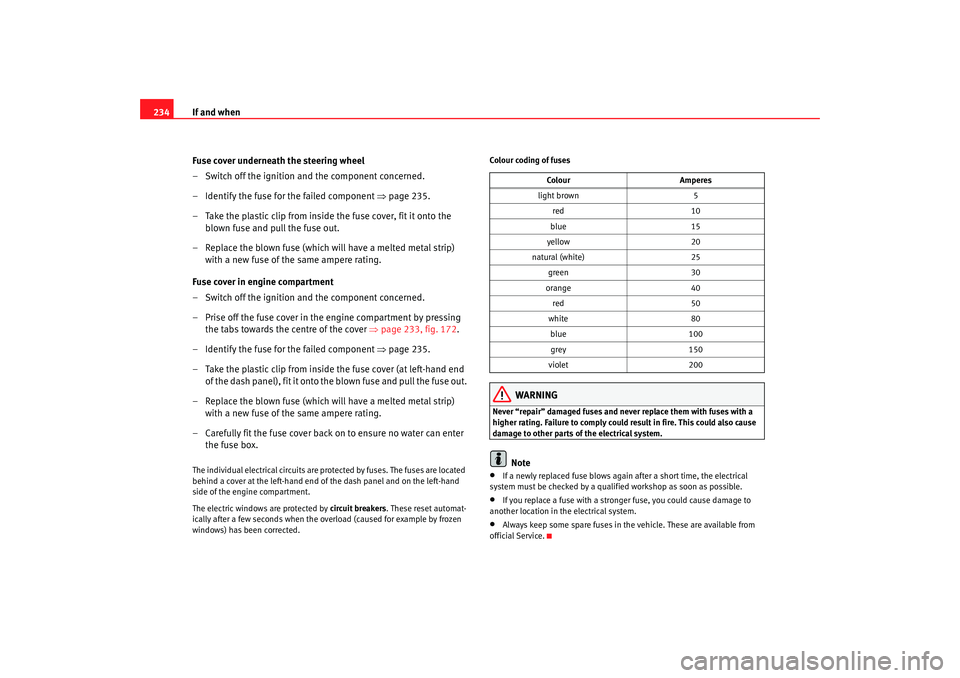
official Service. Colour
Amperes
light brown 5
red 10
blue 15
yellow 20
natural (white) 25
green 30
orange 40
red 50
white 80
blue 100
grey 150
violet 200
altea_ingles Seite 234 Donnerstag, 19. Mai 2005 3:02 15
Page 237 of 286

If and when235
Safety First
Operating instructions
Tips and Maintenance
Te c h n i c a l D a t a
Fuses on left side of dash panelFuses
Number Electrical equipment Amperes
1 Electro-chromatic mirror / relay 50 5
2 Engine control unit 5
3 Lights switch / Headlight control unit / Right hand side headlight / Telephone 5
4 Telephone pre-installation 5
5 Flow meter, frequency tube 10
6A ir b ag 5
7 Vacant
8 Vacant
9 Power steering 5
10 Diagnosis, reverse gear switch 5
11 Heated windscreen 5
12 FSI measure 10
13 Trailer control unit 5
14 ESP/TCP, ABS/ESP control unit 5
15 Automatic gearbox 5
16 Heating controls / Climatronic / Pressure sensor / Heated seats 10
17 Engine 7,5
18 Vacant
19 Vacant
20 Engine fuse box supply 5
21 Gear lever 5
altea_ingles Seite 235 Donnerstag, 19. Mai 2005 3:02 15
Page 239 of 286
If and when237
Safety First
Operating instructions
Tips and Maintenance
Te c h n i c a l D a t a
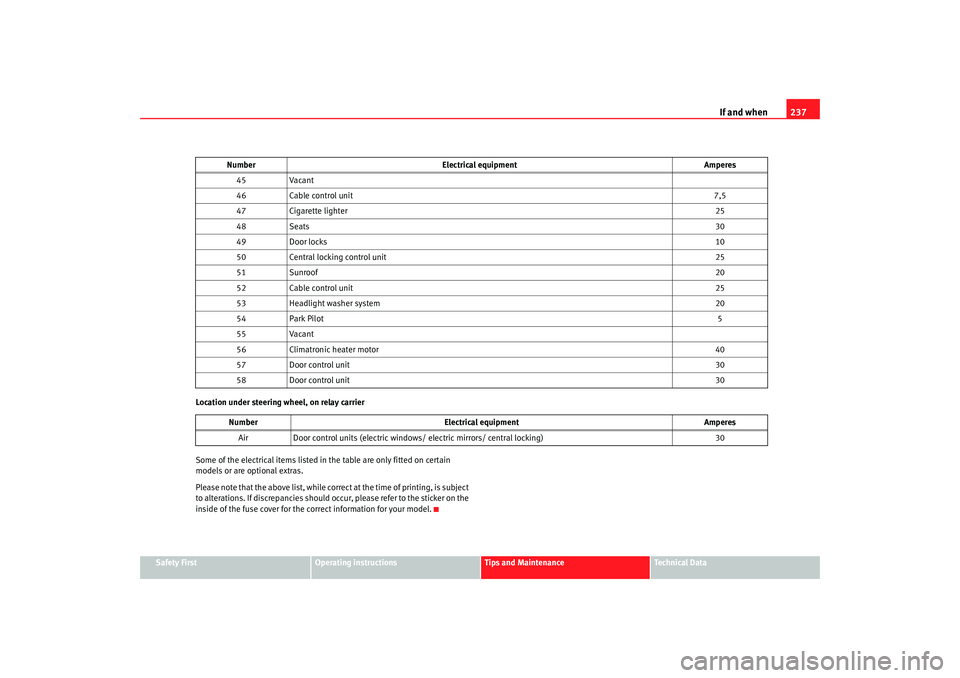
Location under steering wheel, on relay carrier
Some of the electrical items listed in
the table are only fitted on certain
models or are optional extras.
Please note that the above list, while correct at the time of printing, is subject
to alterations. If discrepancies should occur, please refer to the sticker on the
inside of the fuse cover for the co rrect information for your model.
45
Vacant
46 Cable control unit 7,5
47 Cigarette lighter 25
48 Seats 30
49 Door locks 10
50 Central locking control unit 25
51 Sunroof 20
52 Cable control unit 25
53 Headlight washer system 20
54 Park Pilot 5
55 Vacant
56 Climatronic heater motor 40
57 Door control unit 30
58 Door control unit 30
Number Electrical equipment Amperes
Air Door control units (electric windows/ electric mirrors/ central locking) 30
Number
Electrical equipment Amperes
altea_ingles Seite 237 Donnerstag, 19. Mai 2005 3:02 15
Page 240 of 286
If and when
238Fuses layout, engine compartment, left partFuses
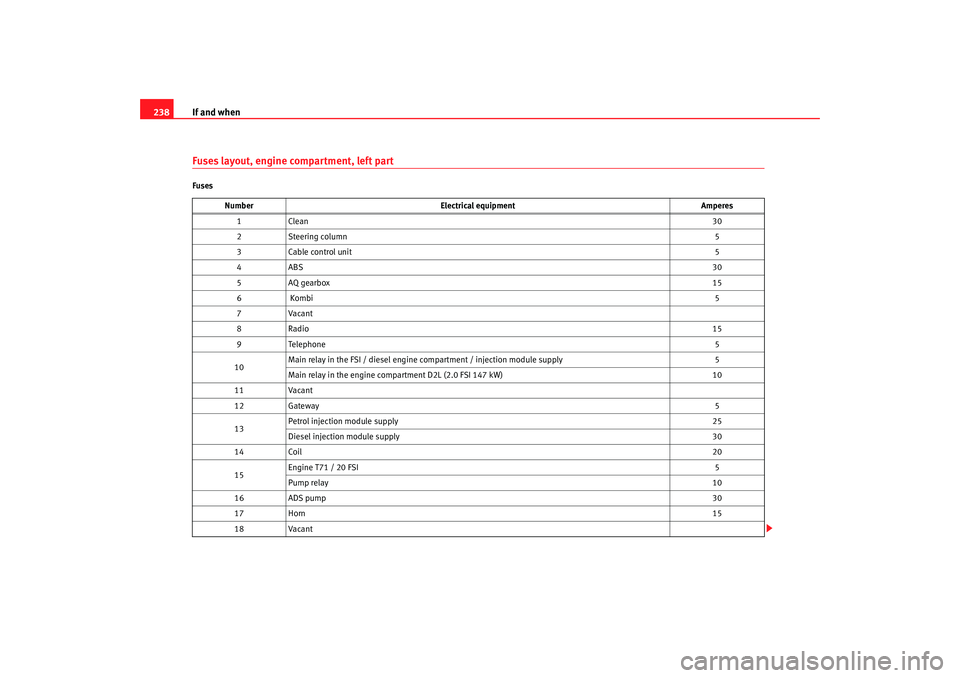
Number Electrical equipment Amperes
1C le a n 30
2 Steering column 5
3 Cable control unit 5
4A BS 30
5 AQ gearbox 15
6 Kombi 5
7 Vacant
8R ad io 15
9 Telephone 5
10 Main relay in the FSI / diesel engine compartment / injection module supply
5
Main relay in the engine compartment D2L (2.0 FSI 147 kW) 10
11 Vacant
12 Gateway 5
13 Petrol injection module supply
25
Diesel injection module supply 30
14 Coil 20
15 Engine T71 / 20 FSI
5
Pump relay 10
16 ADS pump 30
17 Horn 15
18 Vacant
altea_ingles Seite 238 Donnerstag, 19. Mai 2005 3:02 15
Page 242 of 286
If and when
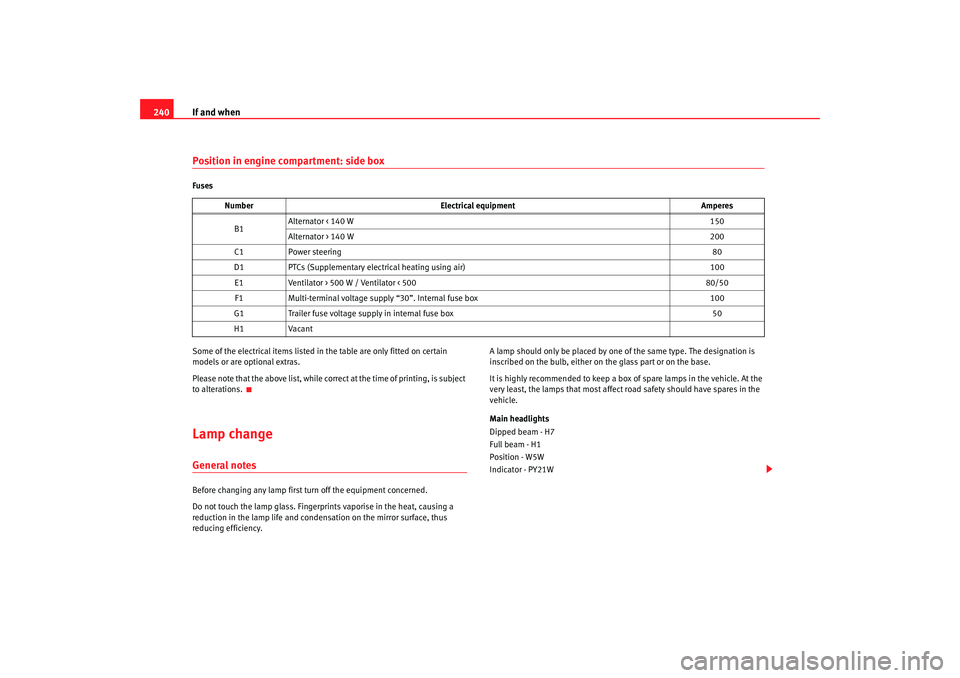
240Position in engine compartment: side boxFuses
Some of the electrical items listed in the table are only fitted on certain
models or are optional extras.
Please note that the above list, while corr ect at the time of printing, is subject
to alterations. Lamp changeGeneral notesBefore changing any lamp first turn off the equipment concerned.
Do not touch the lamp glass. Fingerprints vaporise in the heat, causing a
reduction in the lamp life and conden sation on the mirror surface, thus
reducing efficiency. A lamp should only be placed by one of the same type. The designation is
inscribed on the bulb, either on the glass part or on the base.
It is highly recommended to keep a box of spare lamps in the vehicle. At the
very least, the lamps that most affect
road safety should have spares in the
vehicle.
Main headlights
Dipped beam - H7
Full beam - H1
Position - W5W
Indicator - PY21W
Number
Electrical equipment Amperes
B1 Alternator < 140 W
150
Alternator > 140 W 200
C1 Power steering 80
D1 PTCs (Supplementary electrical heating using air) 100
E1 Ventilator > 500 W / Ventilator < 500 80/50
F1 Multi-terminal voltage supply “30”. Internal fuse box 100
G1 Trailer fuse voltage supply in internal fuse box 50
H1 Vacant
altea_ingles Seite 240 Donnerstag, 19. Mai 2005 3:02 15
Page 255 of 286
If and when253
Safety First
Operating instructions
Tips and Maintenance
Te c h n i c a l D a t a
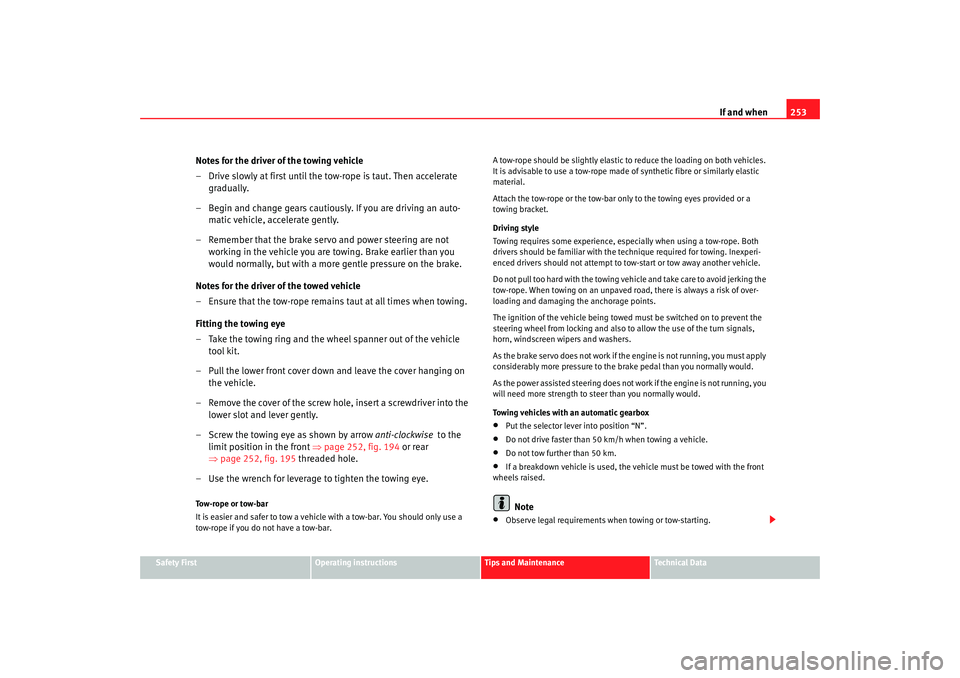
Notes for the driver of the towing vehicle
– Drive slowly at first until the tow-rope is taut. Then accelerate
gradually.
– Begin and change gears cautiously. If you are driving an auto- matic vehicle, accelerate gently.
– Remember that the brake servo and power steering are not working in the vehicle you are towing. Brake earlier than you
would normally, but with a more gentle pressure on the brake.
Notes for the driver of the towed vehicle
– Ensure that the tow-rope remains taut at all times when towing.
Fitting the towing eye
– Take the towing ring and the wheel spanner out of the vehicle tool kit.
– Pull the lower front cover down and leave the cover hanging on the vehicle.
– Remove the cover of the screw hole, insert a screwdriver into the lower slot and lever gently.
– Screw the towing eye as shown by arrow anti-clockwise to the
limit position in the front ⇒page 252, fig. 194 or rear
⇒ page 252, fig. 195 threaded hole.
– Use the wrench for leverage to tighten the towing eye.Tow-rope or tow-bar
It is easier and safer to tow a vehicle with a tow-bar. You should only use a
tow-rope if you do not have a tow-bar. A tow-rope should be slightly elastic to
reduce the loading on both vehicles.
It is advisable to use a tow-rope made of synthetic fibre or similarly elastic
material.
Attach the tow-rope or the tow-bar only to the towing eyes provided or a
towing bracket.
Driving style
Towing requires some experience, especially when using a tow-rope. Both
drivers should be familiar with the technique required for towing. Inexperi-
enced drivers should not attempt to tow-start or tow away another vehicle.
Do not pull too hard with the towing vehicle and take care to avoid jerking the
tow-rope. When towing on an unpaved road, there is always a risk of over-
loading and damaging the anchorage points.
The ignition of the vehicle being towed must be switched on to prevent the
steering wheel from locking and also to allow the use of the turn signals,
horn, windscreen wipers and washers.
As the brake servo does not work if th e engine is not running, you must apply
considerably more pressure to the brake pedal than you normally would.
As the power assisted steering does not work if the engine is not running, you
will need more strength to steer than you normally would.
Towing vehicles with an automatic gearbox
•
Put the selector lever into position “N”.
•
Do not drive faster than 50 km/h when towing a vehicle.
•
Do not tow further than 50 km.
•
If a breakdown vehicle is used, the vehicle must be towed with the front
wheels raised.Note
•
Observe legal requirements when towing or tow-starting.
altea_ingles Seite 253 Donnerstag, 19. Mai 2005 3:02 15