Page 71 Seat Altea 2014 User Guide
[x] Cancel search | Manufacturer: SEAT, Model Year: 2014, Model line: Altea, Model: Seat Altea 2014Pages: 321, PDF Size: 4.52 MB
Page 27 of 321
25
Seat belts
Seat belts
Seat belt adjustment
The seat belts for the front and rear occupants are locked in-
to position by a latch.
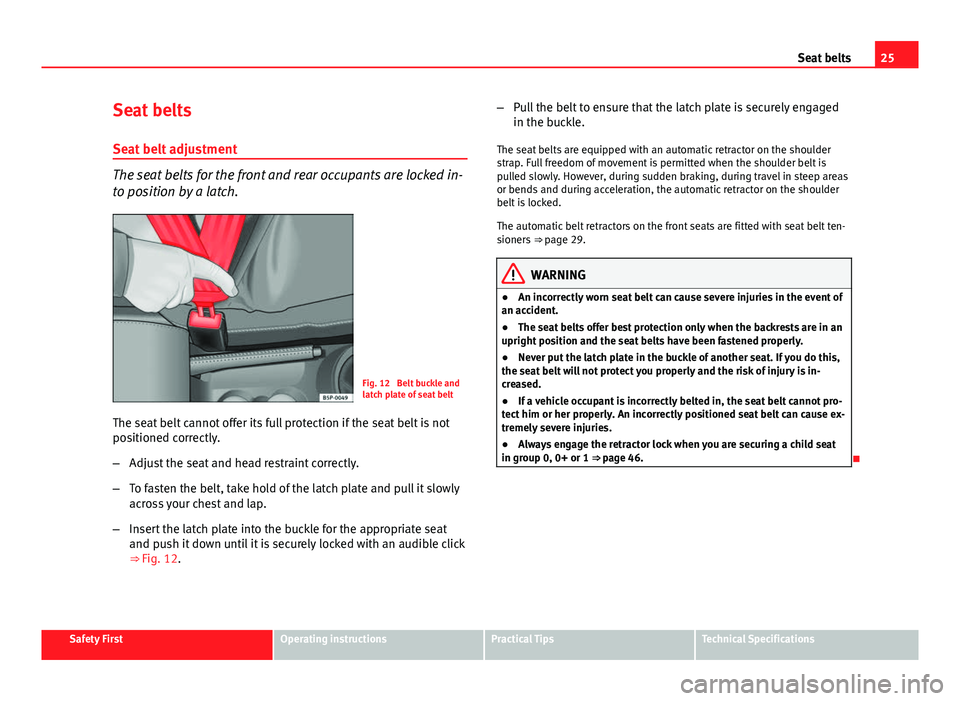
Fig. 12 Belt buckle and
latch plate of seat belt
The seat belt cannot offer its full protection if the seat belt is not
positioned correctly.
– Adjust the seat and head restraint correctly.
– To fasten the belt, take hold of the latch plate and pull it slowly
across your chest and lap.
– Insert the latch plate into the buckle for the appropriate seat
and push it down until it is securely locked with an audible click
⇒ Fig. 12. –
Pull the belt to ensure that the latch plate is securely engaged
in the buckle.
The seat belts are equipped with an automatic retractor on the shoulder
strap. Full freedom of movement is permitted when the shoulder belt is
pulled slowly. However, during sudden braking, during travel in steep areas
or bends and during acceleration, the automatic retractor on the shoulder
belt is locked.
The automatic belt retractors on the front seats are fitted with seat belt ten-
sioners ⇒ page 29.
WARNING
● An incorrectly worn seat belt can cause severe injuries in the event of
an accident.
● The seat belts offer best protection only when the backrests are in an
upright position and the seat belts have been fastened properly.
● Never put the latch plate in the buckle of another seat. If you do this,
the seat belt will not protect you properly and the risk of injury is in-
creased.
● If a vehicle occupant is incorrectly belted in, the seat belt cannot pro-
tect him or her properly. An incorrectly positioned seat belt can cause ex-
tremely severe injuries.
● Always engage the retractor lock when you are securing a child seat
in group 0, 0+ or 1 ⇒ page 46.
Safety FirstOperating instructionsPractical TipsTechnical Specifications
Page 28 of 321
26Seat belts
Seat belt position
Seat belts offer their maximum protection only when they
are properly positioned.
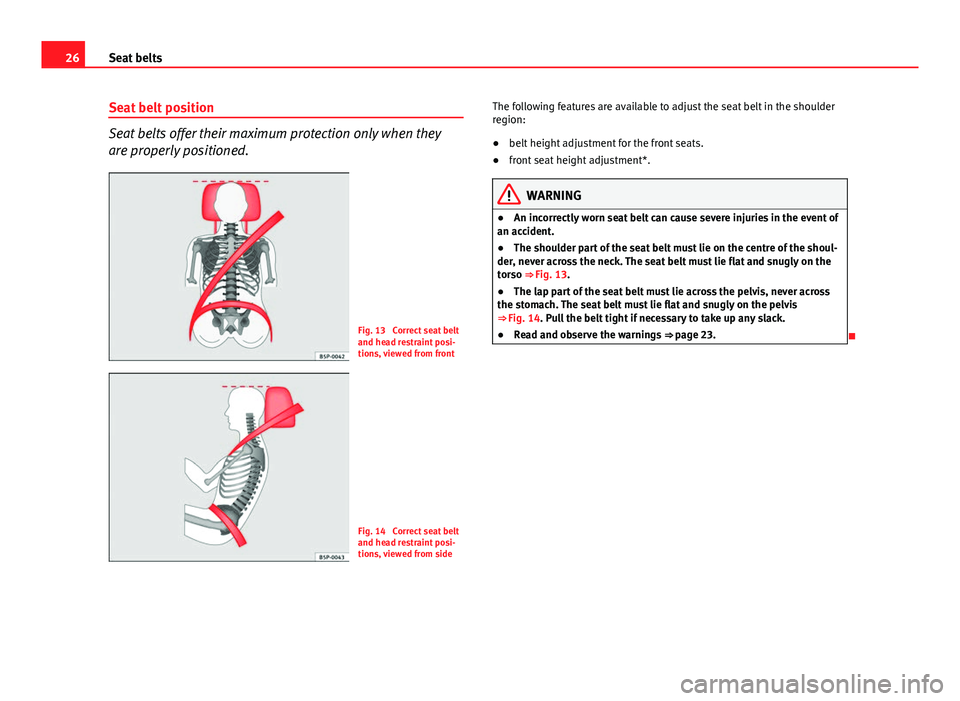
Fig. 13 Correct seat belt
and head restraint posi-
tions, viewed from front
Fig. 14 Correct seat belt
and head restraint posi-
tions, viewed from side The following features are available to adjust the seat belt in the shoulder
region:
●
belt height adjustment for the front seats.
● front seat height adjustment*.
WARNING
● An incorrectly worn seat belt can cause severe injuries in the event of
an accident.
● The shoulder part of the seat belt must lie on the centre of the shoul-
der, never across the neck. The seat belt must lie flat and snugly on the
torso ⇒ Fig. 13.
● The lap part of the seat belt must lie across the pelvis, never across
the stomach. The seat belt must lie flat and snugly on the pelvis
⇒ Fig. 14. Pull the belt tight if necessary to take up any slack.
● Read and observe the warnings ⇒ page 23.
Page 29 of 321
27
Seat belts
Pregnant women must also fasten their seat belts properly
The best protection for the unborn child is for the mother to
wear the seat belt properly at all times during the pregnan-
cy.
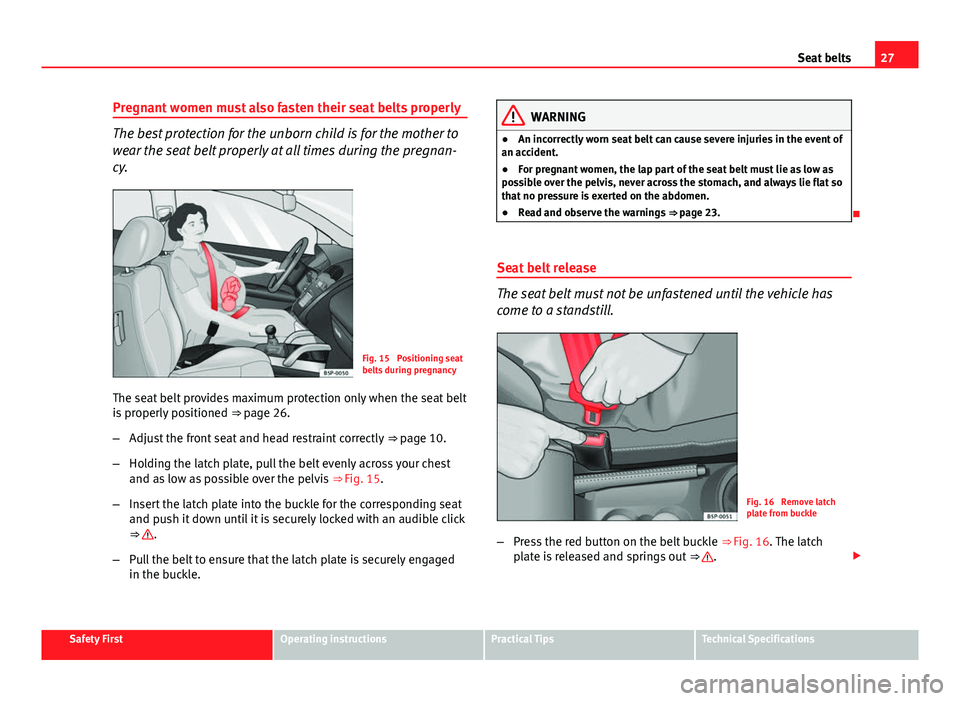
Fig. 15 Positioning seat
belts during pregnancy
The seat belt provides maximum protection only when the seat belt
is properly positioned ⇒ page 26.
– Adjust the front seat and head restraint correctly ⇒ page 10.
– Holding the latch plate, pull the belt evenly across your chest
and as low as possible over the pelvis ⇒ Fig. 15.
– Insert the latch plate into the buckle for the corresponding seat
and push it down until it is securely locked with an audible click
⇒
.
– Pull the belt to ensure that the latch plate is securely engaged
in the buckle.
WARNING
● An incorrectly worn seat belt can cause severe injuries in the event of
an accident.
● For pregnant women, the lap part of the seat belt must lie as low as
possible over the pelvis, never across the stomach, and always lie flat so
that no pressure is exerted on the abdomen.
● Read and observe the warnings ⇒ page 23.
Seat belt release
The seat belt must not be unfastened until the vehicle has
come to a standstill.
Fig. 16 Remove latch
plate from buckle
– Press the red button on the belt buckle ⇒
Fig. 16. The latch
plate is released and springs out ⇒
.
Safety FirstOperating instructionsPractical TipsTechnical Specifications
Page 30 of 321
28Seat belts
–Guide the belt back by hand so that it rolls up easily and the
trim is not damaged.
WARNING
Never unbuckle a seat belt while the vehicle is in motion. If you do, you
increase the risk of sustaining severe or fatal injuries.
Adjusting the seat belt height
Seat belt height adjusters can be used to adjust the position
of the seat belt at the shoulder.
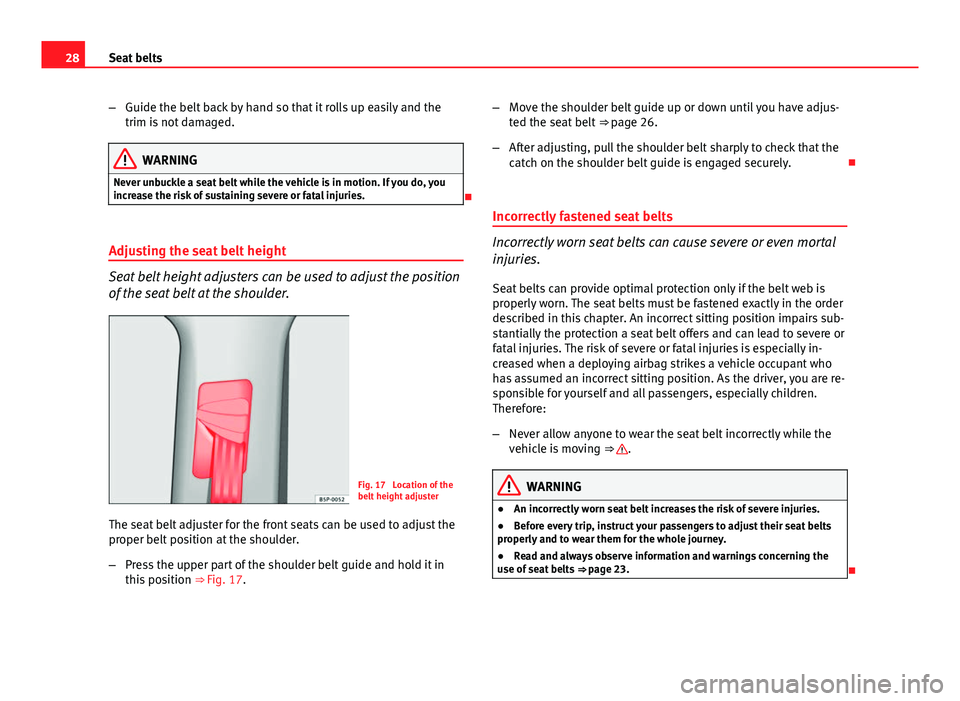
Fig. 17 Location of the
belt height adjuster
The seat belt adjuster for the front seats can be used to adjust the
proper belt position at the shoulder.
– Press the upper part of the shoulder belt guide and hold it in
this position ⇒
Fig. 17. –
Move the shoulder belt guide up or down until you have adjus-
ted the seat belt ⇒ page 26.
– After adjusting, pull the shoulder belt sharply to check that the
catch on the shoulder belt guide is engaged securely.
Incorrectly fastened seat belts
Incorrectly worn seat belts can cause severe or even mortal
injuries. Seat belts can provide optimal protection only if the belt web is
properly worn. The seat belts must be fastened exactly in the order
described in this chapter. An incorrect sitting position impairs sub-
stantially the protection a seat belt offers and can lead to severe or
fatal injuries. The risk of severe or fatal injuries is especially in-
creased when a deploying airbag strikes a vehicle occupant who
has assumed an incorrect sitting position. As the driver, you are re-
sponsible for yourself and all passengers, especially children.
Therefore:
– Never allow anyone to wear the seat belt incorrectly while the
vehicle is moving ⇒
.
WARNING
● An incorrectly worn seat belt increases the risk of severe injuries.
● Before every trip, instruct your passengers to adjust their seat belts
properly and to wear them for the whole journey.
● Read and always observe information and warnings concerning the
use of seat belts ⇒ page 23.
Page 32 of 321
30Airbag system
Airbag system
Brief introduction Why wear a seat belt and assume the correct sitting
position?
For the inflating airbags to achieve the best protection, the
seat belt must always be worn properly and the correct sit-
ting position must be assumed.For your own safety and the safety of the passengers, please en-
sure the following before driving:
– Always wear the seat belt properly ⇒ page 19.
– Adjust the driver seat and the steering wheel correctly
⇒ page 10.
– Adjust the front passenger seat correctly ⇒ page 11.
– Adjust the head restraint correctly ⇒ page 13.
– Use the correct child restraint system to protect children in your
vehicle ⇒ page 46.
The airbag is deployed at high speed in fractions of a second. If you have an
incorrect seating position at the time the airbag is deployed, it could cause
you critical injuries. Therefore, it is essential that all vehicle occupants as-
sume a correct sitting position while travelling.
Sharp braking before an accident may cause a passenger not wearing a seat
belt to be thrown forward into the area of the deploying airbag. In this case, the inflating airbag may inflict critical or fatal injuries on the occupant. This
also applies to children.
Always maintain the greatest possible distance between yourself and the
front airbag. This way, the front airbags can completely deploy when trig-
gered, providing their maximum protection.
The most important factors that will trigger an airbag are: the type of acci-
dent, the angle of collision and the speed of the vehicle.
Whether the airbags are triggered depends primarily on the vehicle deceler-
ation rate resulting from the collision and detected by the control unit. If the
vehicle deceleration occurring during the collision and measured by the
control unit remains below the specified reference values, the front, side
and/or curtain airbag will not be triggered. Take into account that the visible
damage in a vehicle involved in an accident, no matter how serious, is not a
determining factor for the airbags to have been triggered.
WARNING
● Wearing the seat belt incorrectly or assuming an incorrect sitting po-
sition can lead to critical or fatal injuries.
● All vehicle occupants, including children, who are not properly belted
can sustain critical or fatal injuries if the airbag is triggered. Children up
to 12 years old should always travel on the rear seat. Never transport
children in the vehicle if they are not restrained or the restraint system is
not appropriate for their age, size or weight.
● If you are not wearing a seat belt, if you lean forward or to the side
while travelling or assume an incorrect sitting position, there is a sub-
stantially increased risk of injury. This increased risk of injury will be fur-
ther increased if you are struck by an inflating airbag.
Page 33 of 321
31
Airbag system
WARNING (Continued)
● To reduce the risk of injury from an inflating airbag, always wear the
seat belt properly ⇒ page 19.
● Always adjust the front seats properly.
The danger of fitting a child seat on the front passenger
seat
Rear-facing child seats must never be used on the front pas-
senger seat when the front passenger airbag is enabled. The front passenger front airbag is a serious risk for a child if it is activated.
The front passenger seat is life threatening to a child if he/she is transpor-
ted in a rear-facing child seat. Children up to 12 years old should always
travel on the rear seat.
If a rear-facing child seat is secured to the front passenger seat, an inflating
airbag can strike it with such force that it can cause critical or fatal injuries.
Therefore we strongly recommend you to transport children on the rear
seats. That is the safest place for children in the vehicle. Alternatively, the
front passenger airbag can be disabled with a key-operated switch
⇒ page 44. When transporting children, use a child seat suitable for the
age and size of each child ⇒ page 46.
For those vehicles that do not include a key lock switch to deactivate the air-
bag, the vehicle must be taken to a Technical Service.
WARNING
● If a child seat is secured to the front passenger seat, the risk to the
child of sustaining critical or fatal injuries in the event of an accident in-
creases.
● Never secure a rear-facing child seat to the front passenger seat if the
front passenger airbag is enabled. The child can suffer critical or fatal in-
juries if the front passenger airbag is triggered.
● An inflating front passenger airbag can strike the rear-facing child
seat and project it with great force against the door, the roof or the back-
rest.
● If, under special circumstances, it is necessary to transport a child in
a rear-facing child seat on the front passenger seat, it is absolutely es-
sential that you observe the following safety measures:
–Deactivate the front passenger airbag ⇒ page 44, Deactivating
airbags*.
– Child seats must be approved by the child seat manufacturer for
use on a front passenger seat with front or side airbag.
– Follow the installation instructions given by the child seat manu-
facturer and observe the safety instructions ⇒ page 46, Child safe-
ty.
– Before properly installing the child seat, push the front passenger
seat completely backwards so that the greatest possible distance to
the front passenger airbag is ensured.
– Ensure that no objects prevent the front passenger seat from being
pushed completely back.
– The backrest of the front passenger seat must be in an upright po-
sition.
Safety FirstOperating instructionsPractical TipsTechnical Specifications
Page 36 of 321
34Airbag system
Front airbags
Description of front airbags
The airbag system is not a substitute for the seat belts.
Fig. 18 Driver airbag lo-
cated in steering wheel
Fig. 19 Front passenger
airbag located in dash
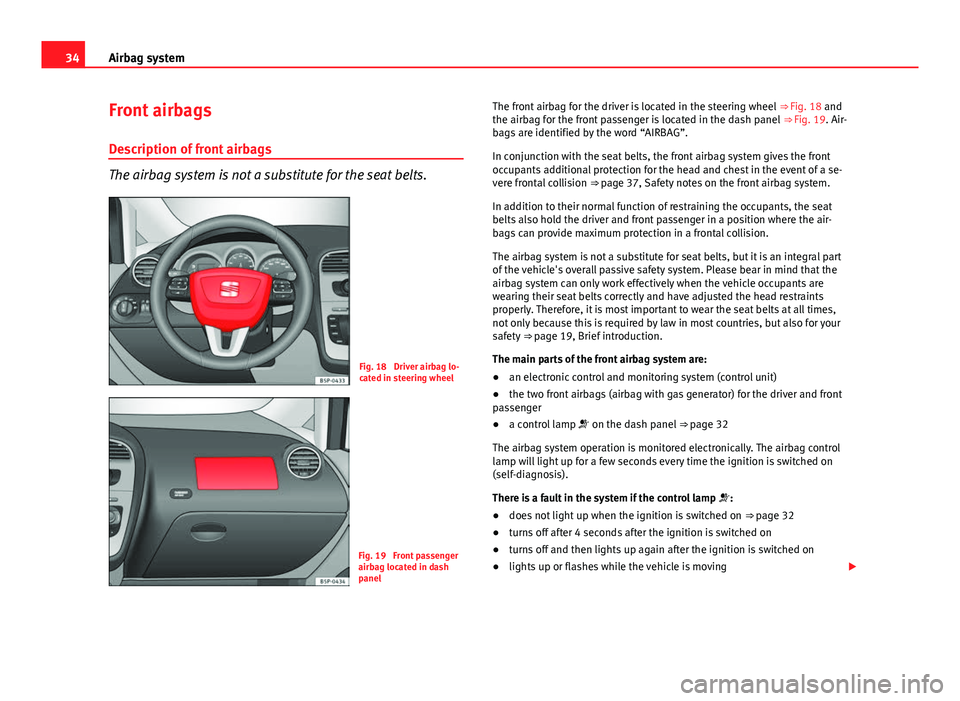
panel The front airbag for the driver is located in the steering wheel
⇒ Fig. 18 and
the airbag for the front passenger is located in the dash panel ⇒ Fig. 19. Air-
bags are identified by the word “AIRBAG”.
In conjunction with the seat belts, the front airbag system gives the front
occupants additional protection for the head and chest in the event of a se-
vere frontal collision ⇒ page 37, Safety notes on the front airbag system.
In addition to their normal function of restraining the occupants, the seat
belts also hold the driver and front passenger in a position where the air-
bags can provide maximum protection in a frontal collision.
The airbag system is not a substitute for seat belts, but it is an integral part
of the vehicle's overall passive safety system. Please bear in mind that the
airbag system can only work effectively when the vehicle occupants are
wearing their seat belts correctly and have adjusted the head restraints
properly. Therefore, it is most important to wear the seat belts at all times,
not only because this is required by law in most countries, but also for your
safety ⇒ page 19, Brief introduction.
The main parts of the front airbag system are:
● an electronic control and monitoring system (control unit)
● the two front airbags (airbag with gas generator) for the driver and front
passenger
● a control lamp on the dash panel ⇒ page 32
The airbag system operation is monitored electronically. The airbag control
lamp will light up for a few seconds every time the ignition is switched on
(self-diagnosis).
There is a fault in the system if the control lamp :
● does not light up when the ignition is switched on ⇒ page 32
● turns off after 4 seconds after the ignition is switched on
● turns off and then lights up again after the ignition is switched on
● lights up or flashes while the vehicle is moving
Page 37 of 321
35
Airbag system
The front airbag system will not be triggered if:
● the ignition is switched off
● there is a minor frontal collision
● there is a side collision
● there is a rear-end collision
● the vehicle turns over
WARNING
● The seat belts and airbags can only provide maximum protection if
the occupants are seated correctly ⇒ page 10, Proper sitting position for
occupants.
● If a fault has occurred in the airbag system, have the system checked
immediately by a specialised workshop. Otherwise, during a frontal colli-
sion the system may fail to trigger, or not trigger correctly.
Operation of front airbags
Inflated airbags reduce the risk of injuries to the head or
chest.
Fig. 20 Inflated front air-
bags
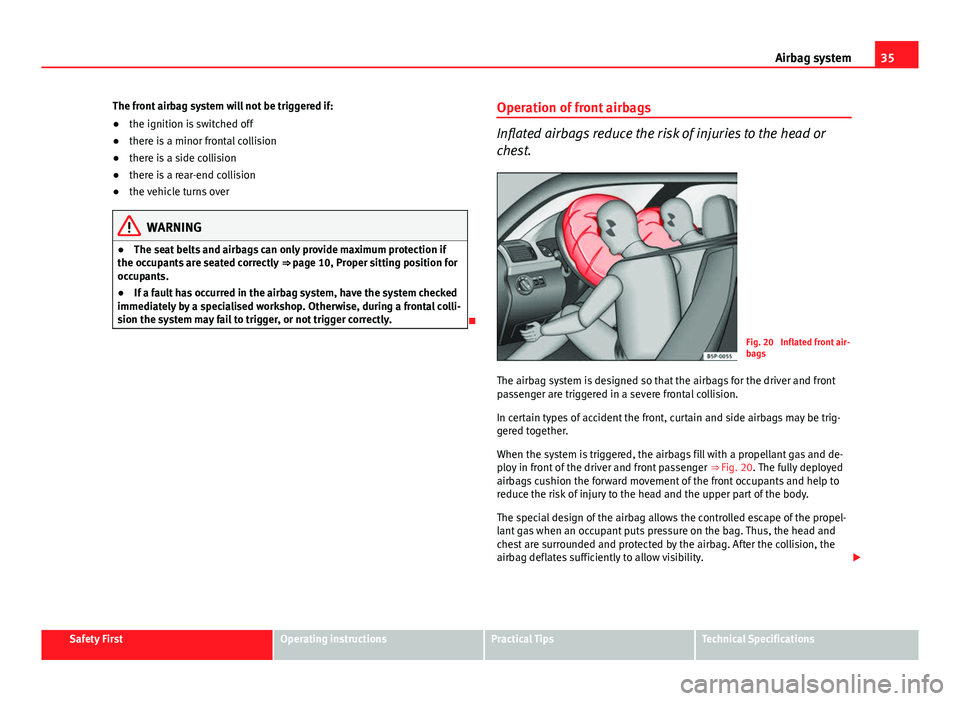
The airbag system is designed so that the airbags for the driver and front
passenger are triggered in a severe frontal collision.
In certain types of accident the front, curtain and side airbags may be trig-
gered together.
When the system is triggered, the airbags fill with a propellant gas and de-
ploy in front of the driver and front passenger ⇒ Fig. 20. The fully deployed
airbags cushion the forward movement of the front occupants and help to
reduce the risk of injury to the head and the upper part of the body.
The special design of the airbag allows the controlled escape of the propel-
lant gas when an occupant puts pressure on the bag. Thus, the head and
chest are surrounded and protected by the airbag. After the collision, the
airbag deflates sufficiently to allow visibility.
Safety FirstOperating instructionsPractical TipsTechnical Specifications
Page 39 of 321
37
Airbag system
Safety notes on the front airbag system
If you use airbags correctly, they can considerably reduce
the risk of injury in many kinds of accident.
WARNING
● It is important for the driver and front passenger to keep a distance of
at least 25 cm from the steering wheel and dash panel. If the minimum
distance is not observed then the airbags do not correctly protect the ve-
hicle occupants; risk of fatal injuries! In addition, the front seats and
head restraints must always be positioned correctly for the height of the
occupant.
● If you are not wearing a seat belt, if you lean forward or to the side
while travelling or assume an incorrect sitting position, there is a sub-
stantially increased risk of injury. This increased risk of injury will be fur-
ther increased if you are struck by an inflating airbag.
● Never let a child travel on the front seat without an appropriate re-
straint system. If the airbag is triggered in an accident, children can sus-
tain serious or fatal injuries from the airbag as it inflates ⇒ page 46,
Child safety.
● The deployment space between the front passengers and the airbags
must not in any case be occupied by other passenger, pets and objects.
● The airbags provide protection for just one accident; replace them
once they have deployed.
● It is also important not to attach any objects such as cup holders or
telephone mountings to the surfaces covering the airbag units.
● Do not attempt to modify components of the airbag system in any
way.
Side airbags*
Description of side airbags
The airbag system is not a substitute for the seat belts.
Fig. 22 Side airbag in
driver seat
The front side airbags are located in the driver seat and front passenger
seat backrests ⇒ Fig. 22. The rear side airbags are located in the rear wheel
housing lining. The locations are identified by the text “AIRBAG” in the up-
per region of the backrests and in the rear wheel housing lining.
Together with the seat belts, the side airbag system gives the front seat oc-
cupants additional protection for the upper body in the event of a severe
side collision ⇒ page 39, Safety notes on the operation of the side airbag
system.
In a side collision, the side airbags reduce the risk of injury to passengers
on the front seats to the areas of the body facing the impact. In addition to
their normal function of protecting the occupants in a collision, the seat
belts also hold the passengers in the front seats and the outer rear seats in
a position where the side airbags can provide maximum protection.
Safety FirstOperating instructionsPractical TipsTechnical Specifications
Page 40 of 321
38Airbag system
The airbag system is not a substitute for seat belts, but it is an integral part
of the vehicle's overall passive safety system. Please bear in mind that the
airbag system can only work effectively when the occupants are wearing
their seat belts. Therefore, it is most important to wear the seat belts at all
times, not only because this is required by law in most countries, but also
for your safety ⇒ page 19, Brief introduction.
The side airbag system will not be triggered if:
● the ignition is switched off
● there is a minor side collision
● there is a frontal collision
● there is a rear-end collision
● the vehicle turns over
The main parts of the airbag system are:
● an electronic control and monitoring system (control unit)
● The front side airbags in the backrests of the front seats and the rear
side airbags in the lining of the rear wheel housing
● a control lamp on the dash panel ⇒ page 32
The airbag system operation is monitored electronically. The airbag control
lamp will light up for approx. 4 seconds every time the ignition is switched
on (self-diagnosis).
WARNING
● In a side collision, the side airbags will not work, if the sensors do
not correctly measure the pressure increase on the interior of the doors,
due to air escaping through the areas with holes or openings in the door
panel.
● Never drive the vehicle if the interior panels have been removed.
● Never drive if the interior door panels have been removed or if the
panels have not been correctly fitted.
WARNING (Continued)
● Never drive the vehicle if the loudspeakers in the door panels have
been removed, unless the holes left by the loudspeakers have been cor-
rectly closed.
● Always check that the openings are closed or covered if loudspeakers
or other equipment are fitted in the interior door panels.
● Any work carried out to the doors should be made in an authorised
specialised workshop.
● The seat belts and airbags can only provide maximum protection if
the occupants are seated correctly ⇒ page 10, Proper sitting position for
occupants.
● If a fault has occurred in the airbag system, have the system checked
immediately by a specialised workshop. Otherwise, during a side colli-
sion, the system may fail to trigger, or not trigger correctly.