buttons Seat Altea 2014 User Guide
[x] Cancel search | Manufacturer: SEAT, Model Year: 2014, Model line: Altea, Model: Seat Altea 2014Pages: 321, PDF Size: 4.52 MB
Page 169 of 321
167
Air conditioning
Climatronic maintains a constant temperature. The temperature of the air
supplied to the interior, the blower speed and the air distribution are regu-
lated automatically. The system also considers the sunlight radiation, so
there is no need for manual readjustment. Therefore, automatic mode al-
most always provides the best comfort for the vehicle occupants throughout
the year.
Automatic mode is switched off whenever an adjustment is made using the
buttons for the air distribution, air flow or
or the air recirculation button
. The temperature will continue to be regulated within the parameters
manually selected by the user.
Note
There are two automatic modes:
● Automatic mode LO: This calculates the air flow for two people.
● Automatic mode HI: This calculates the air flow for more than two peo-
ple.
Manual mode
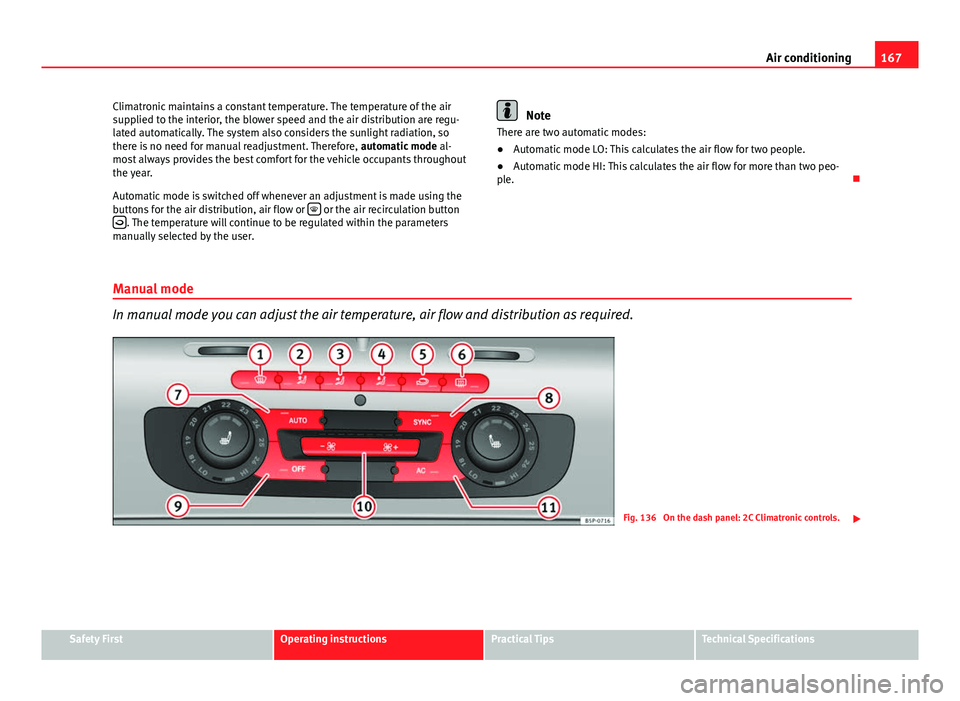
In manual mode you can adjust the air temperature, air flow and distribution as required.
Fig. 136 On the dash panel: 2C Climatronic controls.
Safety FirstOperating instructionsPractical TipsTechnical Specifications
Page 170 of 321
168Air conditioning
Switching on manual mode
–To enter manual mode, press one of the buttons ⇒ Fig. 136 1
to 5 or press the air flow control 10. The selected function is
shown on the radio or navigator display.
Temperature
There are separate temperature selectors for the left and right sides of the
vehicle interior. The selected temperature is displayed above the selector. It
is possible to select interior temperatures from +18 °C (+64 °F) to +26 °C
(+80 °F). These are approximate temperatures and the actual temperature
may be slightly higher or lower depending on the ambient conditions.
If you select temperatures below +18 °C (+64 °F) the indication LO will ap-
pear on the screen. In this setting the system runs at maximum cooling out-
put and the temperature is not regulated.
If you select temperatures above +26 °C (+80 °F) the indication HI will ap-
pear on the screen. In this setting the system runs at maximum heating out-
put and the temperature is not regulated.
Blower
The air flow may be adjusted freely using the control 10
. Always have the
blower running at a low setting to ensure a constant flow of fresh air into
the vehicle. Pushing the button to the minimum -1, turns the Climatronic
off.
Air distribution
The air distribution is adjusted using the buttons
, and . It is also
possible to open and close some of the air vents separately.
Switching the air conditioning on and off
When the AC
button is on (LED lit), the air conditioning system is on.
When the AC
button is off (LED off), the air conditioning system is off. When the
AC
button is off, the air conditioning system is switched off to
save fuel. The temperature continues to self-regulate. The set temperature
can then only be reached if it is higher than the outside temperature.
Driver and passenger temperature control
The SYNC
button controls the synchronisation of the 2 Climatronic climate
zones.
When the SYNC
button is off (LED off), the climate zone of the Climatronic is
personalised. For example: driver side temperature +22 °C (+72 °F) and pas-
senger side temperature +24 °C (+75 °F).
When the SYNC
button is on (LED lit), the climate zone of the Climatronic is
synchronised. For example: driver side temperature +22 °C (+72 °F) and
passenger side temperature +22 °C (+72 °F).
If the SYNC
button is on and the passenger side temperature is changed,
the function is automatically deactivated.
Air recirculation mode
Air recirculation mode prevents fumes or unpleasant smells
from coming from the outside. – Press the button
⇒ Fig. 136
2 to switch air recirculation
mode on or off. It is switched on if the following symbol appears
in the display .
Air recirculation mode prevents strong odours in the ambient air from enter-
ing the vehicle interior, for example when passing through a tunnel or in a
traffic jam.
With low outside temperatures, the air recirculation increases the effective-
ness of the heating system by heating the air inside the vehicle rather than
the air from outside.
Page 248 of 321
246Checking and refilling levels
To change the blades it is necessary to change the rest position of
the wipers to the service position.
Service position (For changing wiper blades)
–Ensure that the wiper blades are not frozen.
– Turn ignition on and off and then (before approx. 8 seconds
have elapsed), move the windscreen wiper lever to the intermit-
tent wipe position. The windscreen wipers will move to the serv-
ice position.
Changing the windscreen wiper blades
– Lift the wiper arm away from the windscreen.
– Push the side buttons, free the blade and pull in the direction of
the arrow ⇒ Fig. 171
Fitting the wiper blade
– Insert a blade of identical length and design into the wiper arm.
– Slide the blade until it clicks into position.
– Push the wiper arms back against the windscreen.
The windscreen wiper arms return to their original position when the igni-
tion is turned on and the windscreen wiper lever is operated, or when driv-
ing faster than 6 km/h (4 mph).
If the windscreen wipers smear , they should be replaced if they are dam-
aged, or cleaned if they are soiled.
If this does not produce the desired results, the setting angle of the wind-
screen wiper arms might be incorrect. They should be checked by a special-
ised workshop and corrected if necessary.
WARNING
Do not drive unless you have good visibility through all windows!
● Clean the windscreen wiper blades and all windows regularly.
● The wiper blades should be changed once or twice a year.
CAUTION
● Damaged or dirty windscreen wipers could scratch the windscreen.
● Never use fuel, nail varnish remover, paint thinner or similar products to
clean the windows. This could damage the windscreen wiper blades.
● Never move the windscreen wiper or windscreen wiper arm manually.
This could cause damage.
● Do not pull the windscreen wipers forward unless they are in the service
position. Otherwise the bonnet could be damaged.
Note
● The windscreen wiper arms can be moved to the service position only
when the bonnet is properly closed.
Page 317 of 321
Remote control keyButtons . . . . . . . . . . . . . . . . . . . . . . . . . . . . 104
Synchronising . . . . . . . . . . . . . . . . . . . . . . . 105
Removing and fitting the wheel . . . . . . . . . . . 268
Repairs Airbags . . . . . . . . . . . . . . . . . . . . . . . . . . . . . 32
Replacement keys . . . . . . . . . . . . . . . . . . . . . . 102
Replacement of parts . . . . . . . . . . . . . . . . . . . . 226
Rev counter . . . . . . . . . . . . . . . . . . . . . . . . . . . . . 59
Reverse gear Manual gearbox . . . . . . . . . . . . . . . . . . . . . 182
Roll-back function Sliding/tilting sunroof . . . . . . . . . . . . . . . . 114
Windows . . . . . . . . . . . . . . . . . . . . . . . . . . . 111
Roof aerial . . . . . . . . . . . . . . . . . . . . . . . . . . . . . 227
Roof rack . . . . . . . . . . . . . . . . . . . . . . . . . . . . . . 158
Roof storage compartment . . . . . . . . . . . . . . . 143
Rubber seals . . . . . . . . . . . . . . . . . . . . . . . . . . . 218
Run-flat tyres . . . . . . . . . . . . . . . . . . . . . . . . . . 257
Running in Engine . . . . . . . . . . . . . . . . . . . . . . . . . . . . . 204
S Safe- security system . . . . . . . . . . . . . . . . . . . . . 97
Safe driving . . . . . . . . . . . . . . . . . . . . . . . . . . . . . 7
Safety . . . . . . . . . . . . . . . . . . . . . . . . . . . . . . . . . . 8
Safety equipment . . . . . . . . . . . . . . . . . . . . . . . . . 7
Safety instructions Coolant temperature . . . . . . . . . . . . . . . . . . 81 Safety notes
Airbags . . . . . . . . . . . . . . . . . . . . . . . . . . . . . 32
Curtain airbags . . . . . . . . . . . . . . . . . . . . . . . 42
Deactivating front passenger airbag . . . . . . 45
Front airbags . . . . . . . . . . . . . . . . . . . . . . . . 37
Seat belt tensioners . . . . . . . . . . . . . . . . . . . 29
Side airbags . . . . . . . . . . . . . . . . . . . . . . . . . 39
Using child seats . . . . . . . . . . . . . . . . . . . . . 46
Using seat belts . . . . . . . . . . . . . . . . . . . . . . 23
Seals . . . . . . . . . . . . . . . . . . . . . . . . . . . . . . . . . 218
Seat adjustment . . . . . . . . . . . . . . . 134, 137, 139
Seat belt cleaning . . . . . . . . . . . . . . . . . . . . . . 225
Seat belt control lamp . . . . . . . . . . . . . . . . . . . . 19
Seat belt position Pregnant women . . . . . . . . . . . . . . . . . . . . . 27
Seat belts . . . . . . . . . . . . . . . . . . . . . . . . . . . 26
Seat belt protection . . . . . . . . . . . . . . . . . . . . . . 23
Seat belt release . . . . . . . . . . . . . . . . . . . . . . . . 27
Seat belts . . . . . . . . . . . . . . . . . . . . . . . . . . . . . . 19 Adjustment . . . . . . . . . . . . . . . . . . . . . . . . . . 25
control lamp . . . . . . . . . . . . . . . . . . . . . . . . . 19
Incorrectly fastened . . . . . . . . . . . . . . . . . . . 28
Not worn . . . . . . . . . . . . . . . . . . . . . . . . . . . . 22
Safety notes . . . . . . . . . . . . . . . . . . . . . . . . . 23
Seat belt tensioner control lamp . . . . . . . . . . . . . . . . . . . . . . . . . 32
Seat belt tensioners . . . . . . . . . . . . . . . . . . . . . . 29
Seat heating . . . . . . . . . . . . . . . . . . . . . . . . . . . 138
Seat upholstery Alcantara . . . . . . . . . . . . . . . . . . . . . . . . . . . 222
Checklist . . . . . . . . . . . . . . . . . . . . . . . . . . . 221
cleaning Alcantara . . . . . . . . . . . . . . . . . . . 222 Cleaning and maintenance of natural leath-
er . . . . . . . . . . . . . . . . . . . . . . . . . . . . . . . 223
cleaning the trim fabric . . . . . . . . . . . . . . . 222
synthetic leather . . . . . . . . . . . . . . . . . . . . 224
Selective opening . . . . . . . . . . . . . . . . . . . . . . . 97
Selector lever locking . . . . . . . . . . . . . . . . . . . . 184
Selector lever positions . . . . . . . . . . . . . . . . . . 183
servotronic . . . . . . . . . . . . . . . . . . . . . . . . . . . . 202
Side airbags . . . . . . . . . . . . . . . . . . . . . . . . . . . . 37 Description . . . . . . . . . . . . . . . . . . . . . . . . . . 37
Operation . . . . . . . . . . . . . . . . . . . . . . . . . . . 39
Safety notes . . . . . . . . . . . . . . . . . . . . . . . . . 39
Side lights . . . . . . . . . . . . . . . . . . . . . . . . . . . . . 115
Sitting position driver . . . . . . . . . . . . . . . . . . . . . . . . . . . . . . . 10
Sitting position, occupants . . . . . . . . . . . . . . . . 10
Sliding/tilting sunroof . . . . . . . . . . . . . . . . . . . 112
Snow chains . . . . . . . . . . . . . . . . . . . . . . . 260, 296
Soot accumulation in the diesel engine particu- late filter *
Indicator . . . . . . . . . . . . . . . . . . . . . . . . . . . . 82
Spare parts . . . . . . . . . . . . . . . . . . . . . . . . . . . . 226
Spare wheel . . . . . . . . . . . . . . . . . . . . . . . . . . . 262
Start-Stop Activating and deactivating . . . . . . . . . . . . 180
Function . . . . . . . . . . . . . . . . . . . . . . . . . . . 179
Starting petrol engines . . . . . . . . . . . . . . 174, 175
Starting the engine . . . . . . . . . . . . . . . . . 174, 175 After the fuel tank has been run dry . . . . . 175
Steam jets . . . . . . . . . . . . . . . . . . . . . . . . . . . . . 216
Steering . . . . . . . . . . . . . . . . . . . . . . . . . . . . . . 171 Steering lock . . . . . . . . . . . . . . . . . . . . . . . . 173
315
Index