check engine light Seat Altea 2015 Owner's Guide
[x] Cancel search | Manufacturer: SEAT, Model Year: 2015, Model line: Altea, Model: Seat Altea 2015Pages: 236, PDF Size: 4.23 MB
Page 174 of 236
Advice
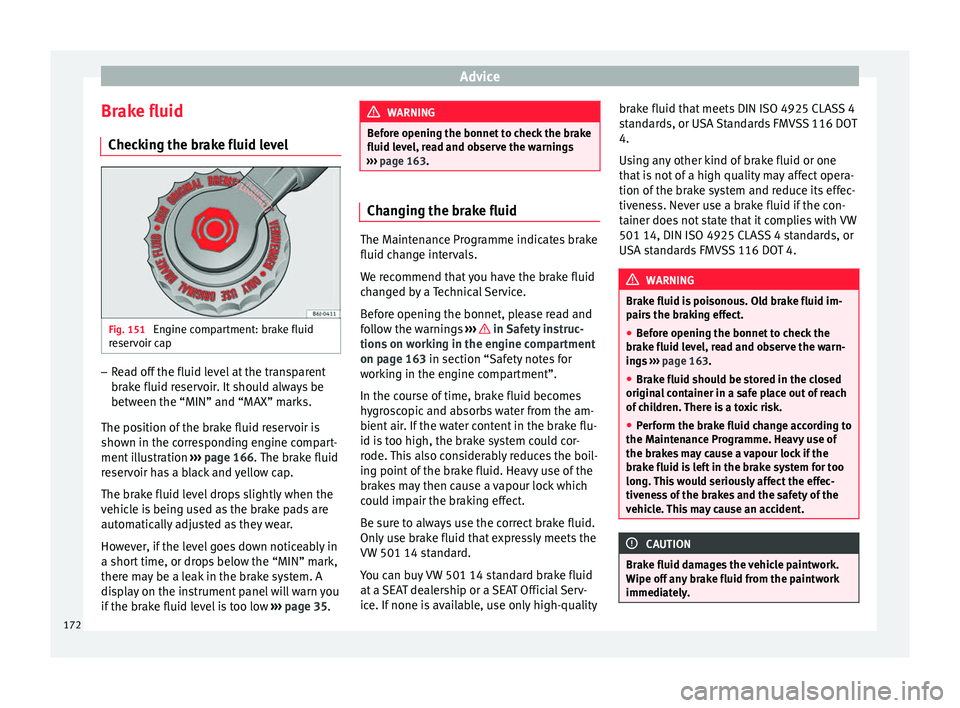
Brake fluid Checking the brake fluid level Fig. 151
Engine compartment: brake fluid
reservoir cap –
Read off the fluid level at the transparent
brake fluid reservoir. It should always be
between the “MIN” and “MAX” marks.
The position of the brake fluid reservoir is
shown in the corresponding engine compart-
ment illustration ››› page 166. The brake fluid
reservoir has a black and yellow cap.
The brake fluid level drops slightly when the
vehicle is being used as the brake pads are
automatically adjusted as they wear.
However, if the level goes down noticeably in
a short time, or drops below the “MIN” mark,
there may be a leak in the brake system. A
display on the instrument panel will warn you
if the brake fluid level is too low ››› page 35. WARNING
Before opening the bonnet to check the brake
fluid level, read and observe the warnings
››› page 163. Changing the brake fluid
The Maintenance Programme indicates brake
fluid change intervals.
We recommend that you have the brake fluid
changed by a Technical Service.
Before opening the bonnet, please read and
follow the warnings
››› in Safety instruc-
tions on working in the engine compartment
on page 163 in section “Safety notes for
w ork
ing in the engine compartment”.
In the course of time, brake fluid becomes
hygroscopic and absorbs water from the am-
bient air. If the water content in the brake flu-
id is too high, the brake system could cor-
rode. This also considerably reduces the boil-
ing point of the brake fluid. Heavy use of the
brakes may then cause a vapour lock which
could impair the braking effect.
Be sure to always use the correct brake fluid.
Only use brake fluid that expressly meets the
VW 501 14 standard.
You can buy VW 501 14 standard brake fluid
at a SEAT dealership or a SEAT Official Serv-
ice. If none is available, use only high-quality brake fluid that meets DIN ISO 4925 CLASS 4
standards, or USA Standards FMVSS 116 DOT
4.
Using any other kind of brake fluid or one
that is not of a high quality may affect opera-
tion of the brake system and reduce its effec-
tiveness. Never use a brake fluid if the con-
tainer does not state that it complies with VW
501 14, DIN ISO 4925 CLASS 4 standards, or
USA standards FMVSS 116 DOT 4.
WARNING
Brake fluid is poisonous. Old brake fluid im-
pairs the braking effect.
● Before opening the bonnet to check the
brake fluid level, read and observe the warn-
ings ››› page 163.
● Br ak
e fluid should be stored in the closed
original container in a safe place out of reach
of children. There is a toxic risk.
● Perform the brake fluid change according to
the Maintenance Programme. Heavy use of
the brakes may cause a vapour lock if the
brake fluid is left in the brake system for too
long. This would seriously affect the effec-
tiveness of the brakes and the safety of the
vehicle. This may cause an accident. CAUTION
Brake fluid damages the vehicle paintwork.
Wipe off any brake fluid from the paintwork
immediately. 172
Page 175 of 236
Checking and refilling levels
For the sake of the environment
The brake pads and brake fluid must be col-
lected and disposed of according the applica-
ble regulations. The SEAT Technical Service
network has the necessary equipment and
qualified personnel for collecting and dispos-
ing of this waste material. Vehicle battery
Warnings on handling the battery Wear eye protection
Battery acid is extremely corrosive. Wear pro-
tective gloves and eye protection!
Fires, sparks, open flames and smoking are
prohibited!
A highly explosive mixture of gases is released
when the battery is under charge.
Keep children away from acid and batteries!
WARNING
Always be aware of the danger of injury and
chemical burns as well as the risk of accident
or fire when working on the battery and the
electrical system:
● Wear eye protection. Protect your eyes,
skin and clothing from acid and particles con-
taining lead. ●
Battery acid is extremely corrosive. Wear
protective gloves and eye protection. Do not
tilt the batteries. This could spill acid through
the vents. Rinse battery acid from eyes imme-
diately for several minutes with clear water.
Then seek medical care immediately. Neutral-
ise any acid splashes on the skin or clothing
with a soapy solution, and rinse off with plen-
ty of water. If acid is swallowed by mistake,
consult a doctor immediately.
● Fires, sparks, open flames and smoking are
prohibited. When handling cables and electri-
cal equipment, avoid causing sparks and
electrostatic charge. Never short the battery
terminals. High-energy sparks can cause in-
jury.
● A highly explosive mixture of gases is re-
leased when the battery is under charge. The
batteries should be charged in a well-ventila-
ted room only.
● Keep children away from acid and batteries.
● Before working on the electrical system,
you must switch off the engine, the ignition
and all electrical devices. The negative cable
on the battery must be disconnected. When a
light bulb is changed, you need only switch
off the light.
● Deactivate the anti-theft alarm by unlock-
ing the vehicle before you disconnect the bat-
tery! The alarm will otherwise be triggered.
● When disconnecting the battery from the
vehicle on-board network, disconnect first
the negative cable and then the positive ca-
ble. ●
Switch off all electrical devices before re-
connecting the battery. Reconnect first the
positive cable and then the negative cable.
Never reverse the polarity of the connections.
This could cause an electrical fire.
● Never charge a frozen battery, or one which
has thawed. This could result in explosions
and chemical burns. Always replace a battery
which has frozen. A flat battery can also
freeze at temperatures close to 0 °C (+32 °F).
● Ensure that the vent hose is always connec-
ted to the battery.
● Never use a defective battery. This could
cause an explosion. Replace a damaged bat-
tery immediately. CAUTION
● Never disconnect the battery if the ignition
is switched on or if the engine is running.
This could damage the electrical system or
electronic components.
● Do not expose the battery to direct sunlight
over a long period of time, as the intense ul-
traviolet radiation can damage the battery
housing.
● If the vehicle is left standing in cold condi-
tions for a long period, protect the battery
from “freezing”. If it freezes it will be dam-
aged. 173
Technical specifications
Advice
Operation
Safety
Page 185 of 236
Emergencies
– Switch off the engine. Switch on the hazard
warning lights.
– Apply the handbrake firmly.
– En g
age the first gear , or put
the selector
lever to position P for those vehicles with
an automatic gearbox.
– If you are towing a trailer, unhitch it from
your vehicle.
– Take the vehicle tools and the spare wheel
out of
the luggage compartment. WARNING
Put the hazard warning lights on and place
the warning triangle in position. This is for
your own safety and also warns other road
users. CAUTION
If you have to change the tyre on a gradient,
block the wheel opposite the wheel being
changed by placing a stone or similar object
under it to prevent the vehicle from rolling
away. Note
Please observe related legal requirements. Changing a wheel
Change the wheel as described below: –
Remove the wheel cover
. A
l
so refer to
››› Fig. 155.
– Slac
ken the wheel bolts .
– Rai
se the vehicle with the jack at the corre-
spondin
g area.
– Remove the wheel and put
on the spare
one.
– Lower the vehicle.
– Tighten the wheel
bolts firmly with the box
sp
anner.
– Replace the hub cap.
Aft
er changing a wheel –
Put the tools back in their storage location.
– Place the wheel with the defective tyre in
the luggage compartment and secure it.
– Check the tyre pressure of the newly fitted
tyre as soon as possible.
– Have the tightening torque of the wheel
bolts checked as soon as possible with a
torque wrench. The prescribed torque must
be 120 Nm. Note
● If you notice that the wheel bolts are corro-
ded and difficult to turn when changing a wheel, they must be replaced before having
the wheel bolt tightening torque checked.
● For safety reasons, drive at moderate
speeds until the wheel bolt tightening torque
has been checked. Wheel trims
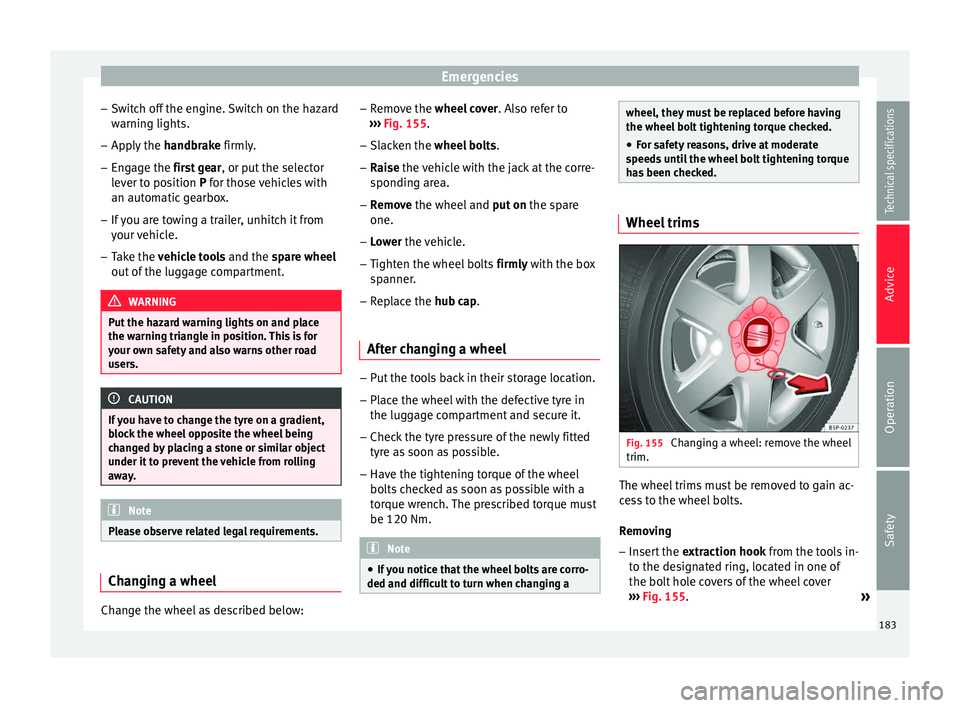
Fig. 155
Changing a wheel: remove the wheel
trim. The wheel trims must be removed to gain ac-
cess to the wheel bolts.
Removing
– Insert the extraction hook from the tools in-
to the designated ring, located in one of
the bolt hole covers of the wheel cover
››› Fig. 155 .
»
183
Technical specifications
Advice
Operation
Safety
Page 189 of 236
Emergencies
After inserting the sealant residue in the tyre,
you must again check the tyre pressure about
10 minutes after starting the engine.
You should only use the tire mobility set if
the vehicle is parked in a safe place, you are
familiar with the procedure and you have the
necessary tire mobility set! Otherwise, you
should seek professional assistance.
The tyre sealant must not be used in the
following cases:
● If the wheel rim has been damaged.
● In outside temperatures below -20 °C
(-4 °F).
● In the event of cuts or perforations in the
tyre greater than 4 mm.
● If you have been driving with very low pres-
sure or a completely flat tyre.
● If the sealant bottle has passed its use by
date. WARNING
Using the tyre mobility system can be dan-
gerous, especially when filling the tyre at the
roadside. Please observe the following rules
to minimise the risk of injury:
● Stop the vehicle safely as soon as possible.
Park it at a safe distance from surrounding
traffic to fill the tyre.
● Ensure the ground on which you park is flat
and solid. ●
All passengers and particularly children
must keep a safe distance from the work area.
● Turn on the hazard warning lights to warn
other road users.
● Use the tyre mobility system only if you are
familiar with the necessary procedures. Oth-
erwise, you should seek professional assis-
tance.
● The tyre mobility set is intended for tempo-
rary emergency use only until you can reach
the nearest specialised workshop.
● Replace the repaired tyre with the tire mo-
bility set as soon as possible.
● The sealant is a health hazard and must be
cleaned immediately if it comes into contact
with the skin.
● Always keep the tire mobility set out of the
reach of small children.
● Never use an equivalent jack, even if it has
been approved for your vehicle.
● Always stop the engine, apply the hand-
brake lever firmly and engage gear if using a
manual gearbox, in order to reduce the risk of
vehicle involuntary movement. WARNING
A tyre filled with sealant does not have the
same performance properties as a conven-
tional tyre.
● Never drive faster than 80 km/h (50 mph).
● Avoid heavy acceleration, hard braking and
fast cornering. ●
Drive only during 10 minutes at a maximum
speed of 80 km/h (50 mph) and subsequently
check the tyre. For the sake of the environment
Dispose of used or expired sealant observing
any legal requirements. Note
● A new bottle of sealant can be purchased at
SEAT dealerships.
● Take into account the separate instruction
manual from the tyre mobility set* manufac-
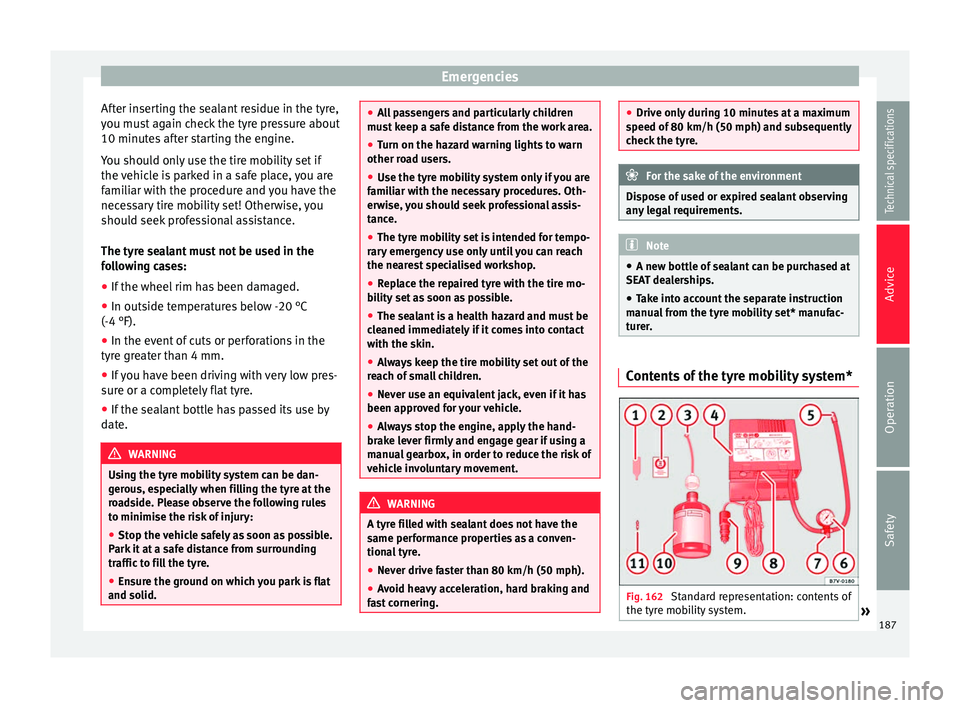
turer. Contents of the tyre mobility system*
Fig. 162
Standard representation: contents of
the tyre mobility system. » 187Technical specifications
Advice
Operation
Safety
Page 226 of 236
Index
Emergency unlocking system . . . . . . . . . . . . . . 65
Selective unlocking system . . . . . . . . . . . . . . . . 64
Unlocking system . . . . . . . . . . . . . . . . . . . . . . . . 64
Centre armrest . . . . . . . . . . . . . . . . . . . . . . . . . . . . 93
Cetane number . . . . . . . . . . . . . . . . . . . . . . . . . . . 160
Changing gear see Manual gearbox . . . . . . . . . . . . . . . . . . . . . 126
Ch an
ging gear in Tiptronic mode . . . . . . . . . . . . 129
Changing the bulbs Main headlight bulbs . . . . . . . . . . . . . . . . . . . . 200
Changing the lights general remarks . . . . . . . . . . . . . . . . . . . . . . . . 198
Changing the main headlight bulbs Main beam lights . . . . . . . . . . . . . . . . . . . . . . . 201
Side lights . . . . . . . . . . . . . . . . . . . . . . . . . . . . . 201
Turn signal bulbs . . . . . . . . . . . . . . . . . . . . . . . 200
Changing the main headlight lamps dipped lights . . . . . . . . . . . . . . . . . . . . . . . . . . 200
Changing the tail light bulbs Position light, fog light and tail light on therear lid . . . . . . . . . . . . . . . . . . . . . . . . . . . . . . 204
Changing the tail lights Luggage compartment lights . . . . . . . . . . . . . 205
Rear fog light . . . . . . . . . . . . . . . . . . . . . . . . . . 203
Reverse light . . . . . . . . . . . . . . . . . . . . . . . . . . . 203
Side lights . . . . . . . . . . . . . . . . . . . . . . . . . . . . . 202
Turn signal light . . . . . . . . . . . . . . . . . . . . . . . . 202
Turn signal, side and brake lights on the body . . .203
Changing windscreen wiper blades . . . . . . . . . . 194
Chassis number . . . . . . . . . . . . . . . . . . . . . . . . . . 208
Checking . . . . . . . . . . . . . . . . . . . . . . . . . . . . . . . . 174
Checking battery electrolyte level . . . . . . . . . . . . 174
Checking engine oil level . . . . . . . . . . . . . . . . . . . 167
Child safety . . . . . . . . . . . . . . . . . . . . . . . . . . . . . . . 24
Child seat Categorisation in groups . . . . . . . . . . . . . . . . . . 26 Child seats . . . . . . . . . . . . . . . . . . . . . . . . . . . . . . . 26
ISOFIX system . . . . . . . . . . . . . . . . . . . . . . . . . . . 27
safety instructions . . . . . . . . . . . . . . . . . . . . . . . 25
Top Tether system . . . . . . . . . . . . . . . . . . . . . . . . 27
Cigarette lighter . . . . . . . . . . . . . . . . . . . . . . . . . . . 98
Cleaning alloy wheel rims . . . . . . . . . . . . . . . . . . 152
Cleaning chrome . . . . . . . . . . . . . . . . . . . . . . . . . 152
Cleaning engine compartment . . . . . . . . . . . . . . 153
Cleaning exterior mirrors . . . . . . . . . . . . . . . . . . . 151
Cleaning plastic parts . . . . . . . . . . . . . . . . . . . . . 156
Cleaning steel wheel rims . . . . . . . . . . . . . . . . . . 152
Cleaning the instrument panel . . . . . . . . . . . . . . 156
Cleaning windows . . . . . . . . . . . . . . . . . . . . . . . . 151
Climatic . . . . . . . . . . . . . . . . . . . . . . . . . . . . . . . . . 109
Climatronic General notes . . . . . . . . . . . . . . . . . . . . . . . . . . 116
Clock . . . . . . . . . . . . . . . . . . . . . . . . . . . . . . . . . . . . 35
Clothes hook . . . . . . . . . . . . . . . . . . . . . . . . . . . . . 95
Coming/Leaving Home function . . . . . . . . . . . . . . 79
Compartment for on-board documentation . . . . . 93
control lamp . . . . . . . . . . . . . . . . . . . . . . . . . . . . . . 19
Control lamps . . . . . . . . . . . . . . . . . . . . . . . . . . . . . 35
Controls electric windows . . . . . . . . . . . . . . . . . . . . . . . . . 72
Exterior mirrors . . . . . . . . . . . . . . . . . . . . . . . . . . 87
Sliding/tilting sunroof . . . . . . . . . . . . . . . . . . . . 74
Convenience closing sliding/tilting sunroof . . . . . . . . . . . . . . . . . . . . 74
Windows . . . . . . . . . . . . . . . . . . . . . . . . . . . . . . . 73
Convenience opening Windows . . . . . . . . . . . . . . . . . . . . . . . . . . . . . . . 73
Coolant . . . . . . . . . . . . . . . . . . . . . . . . . . . . . . . . . 170 control lamp . . . . . . . . . . . . . . . . . . . . . . . . . . . . 49
Coolant fluid . . . . . . . . . . . . . . . . . . . . . . . . . . . . . 169
Coolant level . . . . . . . . . . . . . . . . . . . . . . . . . . . . . 170 control lamp . . . . . . . . . . . . . . . . . . . . . . . . . . . . 40
Coolant loss . . . . . . . . . . . . . . . . . . . . . . . . . . . . . 170 Coolant temperature
control lamp . . . . . . . . . . . . . . . . . . . . . . . . . . . . 40
Gauge . . . . . . . . . . . . . . . . . . . . . . . . . . . . . . . . . 34
Safety instructions . . . . . . . . . . . . . . . . . . . . . . . 40
Cornering lights Dynamic . . . . . . . . . . . . . . . . . . . . . . . . . . . . . . . 80
Correct adjustment of front seat head restraints . . 9
Correct adjustment of rear seat head restraints In-use and non-use positions . . . . . . . . . . . . . . 10
Correct sitting position front passenger . . . . . . . . . . . . . . . . . . . . . . . . . . 8
Incorrect sitting position . . . . . . . . . . . . . . . . . . . 9
passenger . . . . . . . . . . . . . . . . . . . . . . . . . . . . . . . 8
Cruise control Complete system deactivation . . . . . . . . . . . . 144
Control lamp . . . . . . . . . . . . . . . . . . . . . . . . . . . . 45
Cruise control system . . . . . . . . . . . . . . . . . . . . . . 142
Cruise speed . . . . . . . . . . . . . . . . . . . . . . . . . . . . . 142 Control lamp . . . . . . . . . . . . . . . . . . . . . . . . . . . . 45
D Dangers in not using the seat belt . . . . . . . . . . . . 13
Dash panel . . . . . . . . . . . . . . . . . . . . . . . . . . . . . . . 31
Daytime driving lights . . . . . . . . . . . . . . . . . . . . . . 78
Daytime running lights Nordic countries . . . . . . . . . . . . . . . . . . . . . . . . . 78
Deactivating front passenger airbags safety instructions . . . . . . . . . . . . . . . . . . . . . . . 24
Deactivating the airbag Front passenger front airbag . . . . . . . . . . . . . . . 23
Diesel . . . . . . . . . . . . . . . . . . . . . . . . . . . . . . . . . . 160
Diesel engine Winter operation . . . . . . . . . . . . . . . . . . . . . . . . 160
Diesel engine particulate filter . . . . . . . . . . . . . . 132
Differential lock . . . . . . . . . . . . . . . . . . . . . . . . . . 135
Differential lock fault (EDL) control lamp . . . . . . . . . . . . . . . . . . . . . . . . . . . . 46
224
Page 227 of 236
Index
Digital clock . . . . . . . . . . . . . . . . . . . . . . . . . . . . . . 35
Dipped beam headlights . . . . . . . . . . . . . . . . . . . . 75
Display (without warning or information texts) . . 47
Disposal Seat belt tensioners . . . . . . . . . . . . . . . . . . . . . . 16
Door lock . . . . . . . . . . . . . . . . . . . . . . . . . . . . . . . . 152
Door lock cylinder . . . . . . . . . . . . . . . . . . . . . . . . 152
Door lock handle . . . . . . . . . . . . . . . . . . . . . . . . . 152
Door release lever . . . . . . . . . . . . . . . . . . . . . . . . . 31
Doors Childproof locks . . . . . . . . . . . . . . . . . . . . . . . . . 66
control lamp . . . . . . . . . . . . . . . . . . . . . . . . . . . . 45
Drawer . . . . . . . . . . . . . . . . . . . . . . . . . . . . . . . . . . . 94
Driver see Correct sitting position . . . . . . . . . . . . . . . 6, 8
Driv e
shaft differential
XDS . . . . . . . . . . . . . . . . . . . . . . . . . . . . . . . . . . 137
Drive wheel traction control system (ASR) . . . . . 137
Driving Economically/with Respect for the Environ-ment . . . . . . . . . . . . . . . . . . . . . . . . . . . . . . . 132
journeys abroad . . . . . . . . . . . . . . . . . . . . . . . . 120
steering lock . . . . . . . . . . . . . . . . . . . . . . . . . . . 120
With a trailer . . . . . . . . . . . . . . . . . . . . . . . . . . . 145
Driving abroad Headlights . . . . . . . . . . . . . . . . . . . . . . . . . . . . 120
Driving Economically . . . . . . . . . . . . . . . . . . . . . . 132
Driving programmes . . . . . . . . . . . . . . . . . . . . . . 127
Driving safety . . . . . . . . . . . . . . . . . . . . . . . . . . . . . . 5
Driving with automatic gearbox/DSG automatic gearbox . . . . . . . . . . . . . . . . . . . . . . . . . . . . . . . 128
Driving with Respect for the Environment . . . . . 132
Duplicate keys . . . . . . . . . . . . . . . . . . . . . . . . . . . . 67
Dust filter . . . . . . . . . . . . . . . . . . . . . . . . . . . . . . . 116
Dynamic headlight range control . . . . . . . . . . . . . 79 E
EDL . . . . . . . . . . . . . . . . . . . . . . . . . . . . . . . . . . . . 135
control lamp . . . . . . . . . . . . . . . . . . . . . . . . . . . . 41
Electric power steering Control lamp . . . . . . . . . . . . . . . . . . . . . . . . . . . . 45
Electric windows . . . . . . . . . . . . . . . . . . . . . . . . . . . 72
Electronic differential lock . . . . . . . . . . . . . . . . . . 135 control lamp . . . . . . . . . . . . . . . . . . . . . . . . . . . . 41
Electronic immobiliser . . . . . . . . . . . . . . . . . 46, 121
Electronic Stability Control . . . . . . . . . . . . . . . . . . 45 description . . . . . . . . . . . . . . . . . . . . . . . . . . . . 134
Emergency braking warning . . . . . . . . . . . . 81, 136
Emergency manual locking . . . . . . . . . . . . . . . . . 193
Emergency opening Doors . . . . . . . . . . . . . . . . . . . . . . . . . . . . . . . . . . 69
Emission control system control lamp . . . . . . . . . . . . . . . . . . . . . . . . . . . . 45
Engine Running in . . . . . . . . . . . . . . . . . . . . . . . . . . . . . 130
Engine compartment . . . . . . . . . . . . . . . . . . . . . . 165 Working in the engine compartment . . . . . . . . 163
Engine coolant G 12 plus-plus . . . . . . . . . . . . . . . . . . . . . . . . . 169
G 13 . . . . . . . . . . . . . . . . . . . . . . . . . . . . . . . . . . 169
Specifications . . . . . . . . . . . . . . . . . . . . . . . . . . 169
Engine coolant fluid . . . . . . . . . . . . . . . . . . . . . . . 169
Engine fault Control lamp . . . . . . . . . . . . . . . . . . . . . . . . . . . . 41
Engine management control lamp . . . . . . . . . . . . . . . . . . . . . . . . . . . . 41
Engine oil . . . . . . . . . . . . . . . . . . . . . . . . . . . . . . . 166 Changing . . . . . . . . . . . . . . . . . . . . . . . . . . . . . . 169
Checking engine oil level . . . . . . . . . . . . . . . . . 167
Oil properties . . . . . . . . . . . . . . . . . . . . . . . . . . 167
Specifications . . . . . . . . . . . . . . . . . . . . . . . . . . 166
Topping up . . . . . . . . . . . . . . . . . . . . . . . . . . . . 168
Engine oil dipstick . . . . . . . . . . . . . . . . . . . . . . . . 167 Engine oil pressure
control lamp . . . . . . . . . . . . . . . . . . . . . . . . . 44, 49
Environment . . . . . . . . . . . . . . . . . . . . . . . . . . . . . 132 Environmental friendliness . . . . . . . . . . . . . . . 131
Environmental tip Avoiding pollution . . . . . . . . . . . . . . . . . . . . . . 159
Equipment . . . . . . . . . . . . . . . . . . . . . . . . . . . . . . 147
ESC . . . . . . . . . . . . . . . . . . . . . . . . . . . . . . . . 45, 134 see also Electronic Stability Control . . . . . . . . 134
Examp
le of menu use
Open the Configuration menu with the steer- ing wheel controls . . . . . . . . . . . . . . . . . . . . . 50
Program a speed limit warning . . . . . . . . . . . . . 50
To activate and deactivate the speed limit warning . . . . . . . . . . . . . . . . . . . . . . . . . . . . . . 50
Example of the use of the menus Open the Configuration menu with the MFIlever . . . . . . . . . . . . . . . . . . . . . . . . . . . . . . . . . 50
Examples of menu use Open the main menu . . . . . . . . . . . . . . . . . . . . . 50
Open the winter tyres menu . . . . . . . . . . . . . . . . 50
To close the winter tyres menu . . . . . . . . . . . . . 50
Exhaust gas emission control system . . . . . . . . . 131
F Fastening rings . . . . . . . . . . . . . . . . . . . . . . . . . . . 103
Filling the tank . . . . . . . . . . . . . . . . . . . . . . . . . . . 158
Fire extinguisher . . . . . . . . . . . . . . . . . . . . . . . . . . 100
First-aid kit . . . . . . . . . . . . . . . . . . . . . . . . . . . . . . 100
Flexible service interval display . . . . . . . . . . . . . . 48
Floor mats . . . . . . . . . . . . . . . . . . . . . . . . . . . . . . . . 11
Fog lights . . . . . . . . . . . . . . . . . . . . . . . . . . . . . . . . 76
Fog lights with cornering function . . . . . . . . . . . . 81
Folding table . . . . . . . . . . . . . . . . . . . . . . . . . . . . . . 94
Folding the seat backrest . . . . . . . . . . . . . . . . . . . . 92
Front airbags . . . . . . . . . . . . . . . . . . . . . . . . . . . . . 20 safety instructions . . . . . . . . . . . . . . . . . . . . . . . 20
225