seats Seat Altea 2015 Owner's Guide
[x] Cancel search | Manufacturer: SEAT, Model Year: 2015, Model line: Altea, Model: Seat Altea 2015Pages: 236, PDF Size: 4.23 MB
Page 91 of 236
Seats and head restraints
●
Never transport more than the permitted
amount of people in your vehicle.
● Every vehicle occupant must properly fas-
ten and wear the seat belt belonging to his or
her seat. Children must be protected with an
appropriate child restraint system ››› page 24,
Transporting children safety.
● The front seats and all head restraints must
always be adjusted to body size and the seat
belt must always be properly adjusted to pro-
vide you and your passengers with optimum
protection.
● Always keep your feet on the footwell when
the vehicle is moving; never rest them on the
dash panel, out of the window or on the seat.
This is also applied to passengers. An incor-
rect sitting position exposes you to an in-
creased risk of injury in case of a sudden
braking or an accident. If the airbag is trig-
gered, you could sustain severe injuries due
to an incorrect sitting position.
● It is important for the driver and front pas-
senger to keep a distance of at least 25 cm
from the steering wheel and dash panel. Fail-
ure to respect the minimum distance means
that the airbag will not protect you. Risk of
fatal injury. The distance between the driver
and the steering wheel or between the front
passenger and the dash panel should always
be as great as possible.
● Adjust the driver or front passenger seat
only when the vehicle is stationary. This also
applies to the forwards/backwards adjust-
ment of the rear seats. Otherwise, your seat
could move unexpectedly while the vehicle is moving. This could increase the risk of an ac-
cident and therefore, injury. In addition,
while adjusting your seat, you will assume an
incorrect sitting position. Risk of fatal acci-
dents.
●
Special guidelines apply to installing a
child seat on the front passenger seat. When
installing a child seat, please observe the
warnings described in ››› page 24, Transport-
ing children safety. Adjustment of the front seats
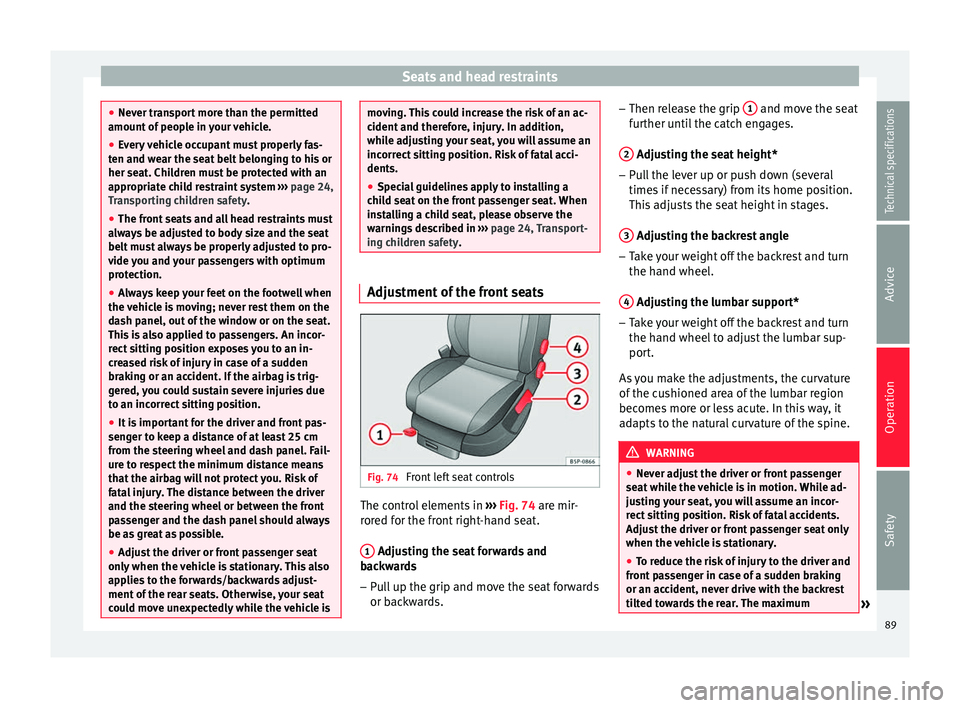
Fig. 74
Front left seat controls The control elements in
››› Fig. 74 are mir-
r or
ed for the front right-hand seat.
1 Adjusting the seat forwards and
backwards
– Pull up the grip and move the seat forwards
or backwards. –
Then release the grip 1 and move the seat
further until the catch engages.
2 Adjusting the seat height*
– Pull the lever up or push down (several
times if necessary) from its home position.
This adjusts the seat height in stages.
3 Adjusting the backrest angle
– Take your weight off the backrest and turn
the hand wheel.
4 Adjusting the lumbar support*
– Take your weight off the backrest and turn
the hand wheel to adjust the lumbar sup-
port.
As you make the adjustments, the curvature
of the cushioned area of the lumbar region
becomes more or less acute. In this way, it
adapts to the natural curvature of the spine. WARNING
● Never adjust the driver or front passenger
seat while the vehicle is in motion. While ad-
justing your seat, you will assume an incor-
rect sitting position. Risk of fatal accidents.
Adjust the driver or front passenger seat only
when the vehicle is stationary.
● To reduce the risk of injury to the driver and
front passenger in case of a sudden braking
or an accident, never drive with the backrest
tilted towards the rear. The maximum » 89
Technical specifications
Advice
Operation
Safety
Page 92 of 236
Operation
protection of the seat belt can be achieved
only when the backrests are in an upright po-
sition and the driver and front passenger
have properly adjusted their seat belts. The
further the backrests are tilted to the rear,
the greater the risk of injury due to improper
positioning of the belt web!
●
Exercise caution when securing the seat
height into forwards/backwards position. In-
juries can be caused if the seat height is ad-
justed without due care and attention. Correct adjustment of head restraints
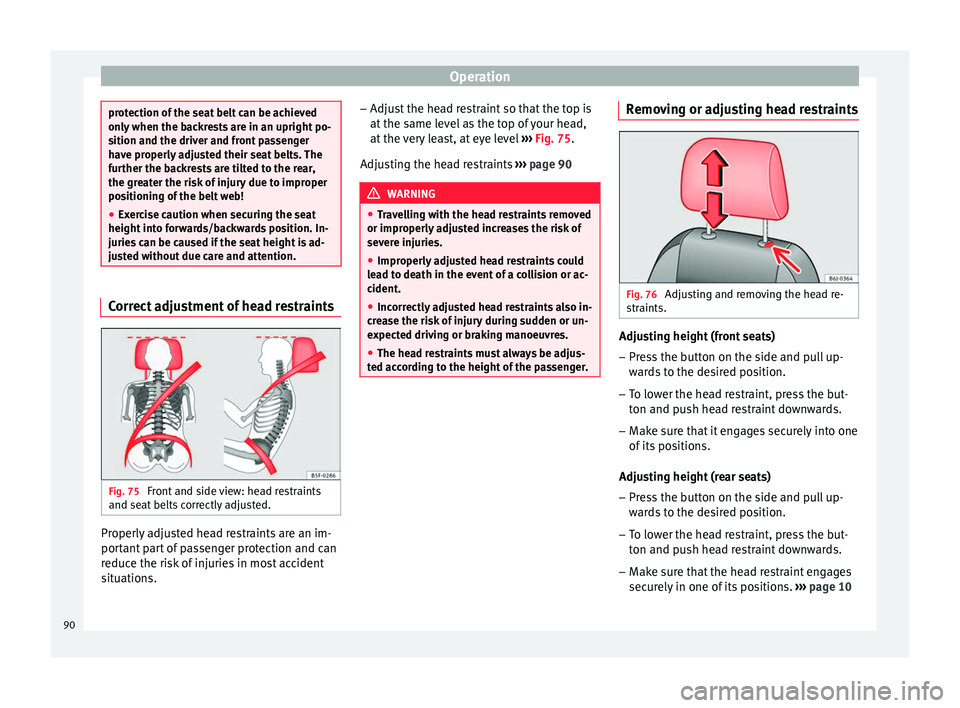
Fig. 75
Front and side view: head restraints
and seat belts correctly adjusted. Properly adjusted head restraints are an im-
portant part of passenger protection and can
reduce the risk of injuries in most accident
situations. –
Adjust the head restraint so that the top is
at the same level as the top of your head,
at the very least, at eye level ››› Fig. 75 .
Adju s
ting the head restraints ››› page 90 WARNING
● Travelling with the head restraints removed
or improperly adjusted increases the risk of
severe injuries.
● Improperly adjusted head restraints could
lead to death in the event of a collision or ac-
cident.
● Incorrectly adjusted head restraints also in-
crease the risk of injury during sudden or un-
expected driving or braking manoeuvres.
● The head restraints must always be adjus-
ted according to the height of the passenger. Removing or adjusting head restraints
Fig. 76
Adjusting and removing the head re-
straints. Adjusting height (front seats)
– Press the button on the side and pull up-
wards to the desired position.
– To lower the head restraint, press the but-
ton and push head restraint downwards.
– Make sure that it engages securely into one
of its positions.
Adjusting height (rear seats) – Press the button on the side and pull up-
wards to the desired position.
– To lower the head restraint, press the but-
ton and push head restraint downwards.
– Make sure that the head restraint engages
securely in one of its positions. ››› page 10
90
Page 93 of 236
Seats and head restraints
Angle adjustment (front seats) – Press the head restraint forward or back to
the required position.
Removing the head restraint – Push the head restraint up as far as it will
go.
– Press the button ››› Fig. 76 (arrow).
– Pull head restraint out of fitting without re-
leasing the button.
Fitting the head restraint
– Insert the head restraint into the guides on
the backrest.
– Push head restraint down.
– Adjust the head restraint to suit body size
››› page 10 and
›
›› page 9. WARNING
● Never drive if the head restraints have been
removed. Risk of injury.
● Never drive if the head restraints are in an
unsuitable position, there is a risk of serious
injury.
● After refitting the head restraint, you must
always adjust it properly for height to achieve
optimal protection.
● Please observe the safety warnings in
››› page 90, Correct adjustment of head re-
straints. Seat functions
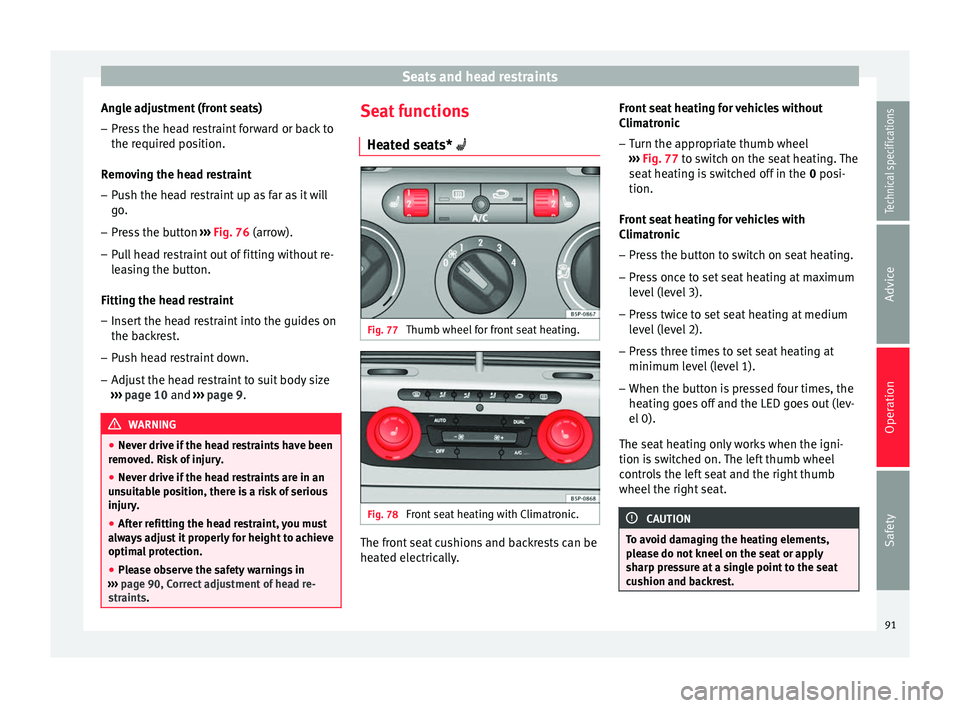
Heated seats* Fig. 77
Thumb wheel for front seat heating. Fig. 78
Front seat heating with Climatronic. The front seat cushions and backrests can be
heated electrically.Front seat heating for vehicles without
Climatronic
– Turn the appropriate thumb wheel
››› Fig. 77 to switch on the seat heating. The
se at
heating is switched off in the 0 posi-
tion.
Front seat heating for vehicles with
Climatronic – Press the button to switch on seat heating.
– Press once to set seat heating at maximum
level (level 3).
– Press twice to set seat heating at medium
level (level 2).
– Press three times to set seat heating at
minimum level (level 1).
– When the button is pressed four times, the
heating goes off and the LED goes out (lev-
el 0).
The seat heating only works when the igni-
tion is switched on. The left thumb wheel
controls the left seat and the right thumb
wheel the right seat. CAUTION
To avoid damaging the heating elements,
please do not kneel on the seat or apply
sharp pressure at a single point to the seat
cushion and backrest. 91
Technical specifications
Advice
Operation
Safety
Page 94 of 236
Operation
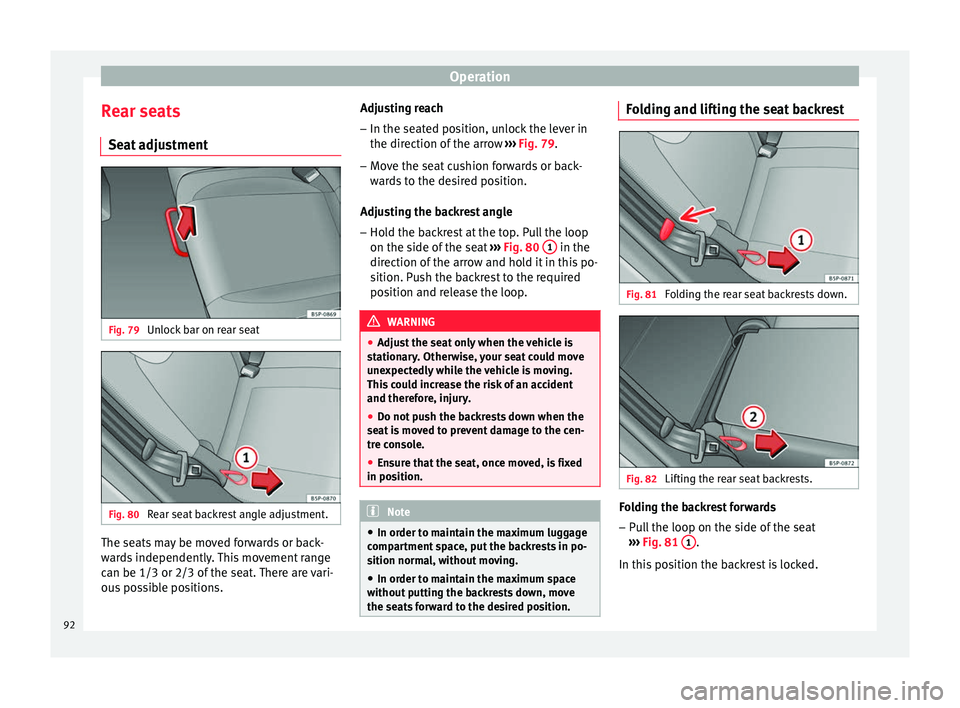
Rear seats Seat adjustment Fig. 79
Unlock bar on rear seat Fig. 80
Rear seat backrest angle adjustment. The seats may be moved forwards or back-
wards independently. This movement range
can be 1/3 or 2/3 of the seat. There are vari-
ous possible positions. Adjusting reach
– In the seated position, unlock the lever in
the direction of the arrow ››› Fig. 79 .
– Mo v
e the seat cushion forwards or back-
wards to the desired position.
Adjusting the backrest angle
– Hold the backrest at the top. Pull the loop
on the side of the seat ››› Fig. 80 1 in the
direction of the arrow and hold it in this po-
sition. Push the backrest to the required
position and release the loop. WARNING
● Adjust the seat only when the vehicle is
stationary. Otherwise, your seat could move
unexpectedly while the vehicle is moving.
This could increase the risk of an accident
and therefore, injury.
● Do not push the backrests down when the
seat is moved to prevent damage to the cen-
tre console.
● Ensure that the seat, once moved, is fixed
in position. Note
● In order to maintain the maximum luggage
compartment space, put the backrests in po-
sition normal, without moving.
● In order to maintain the maximum space
without putting the backrests down, move
the seats forward to the desired position. Folding and lifting the seat backrest
Fig. 81
Folding the rear seat backrests down. Fig. 82
Lifting the rear seat backrests. Folding the backrest forwards
– Pull the loop on the side of the seat
››› Fig. 81 1 .
In this position the backrest is locked.
92
Page 95 of 236
Transport and practical equipment
Converting the table to a seat – Pull the loop on the side of the seat
››› Fig. 82 2 in the direction of the arrow
and lift the seat backrest until it is in place.
When folding and lifting the backrest, make
sure to place the side seat belts in the trim
clip ››› Fig. 81 to prevent them from being
d am
aged by becoming trapped in the back-
rest lock. WARNING
● You should check that the backrest has en-
gaged properly in position after the loop is
released.
● For safety reasons the locking system loops
on the seats may not be used to secure any
items.
● After locking the seat backrest into position
ensure that the seat belts protrude from the
seat. Transport and practical
equipment
Compartments Storage compartment on the front
passenger side Fig. 83
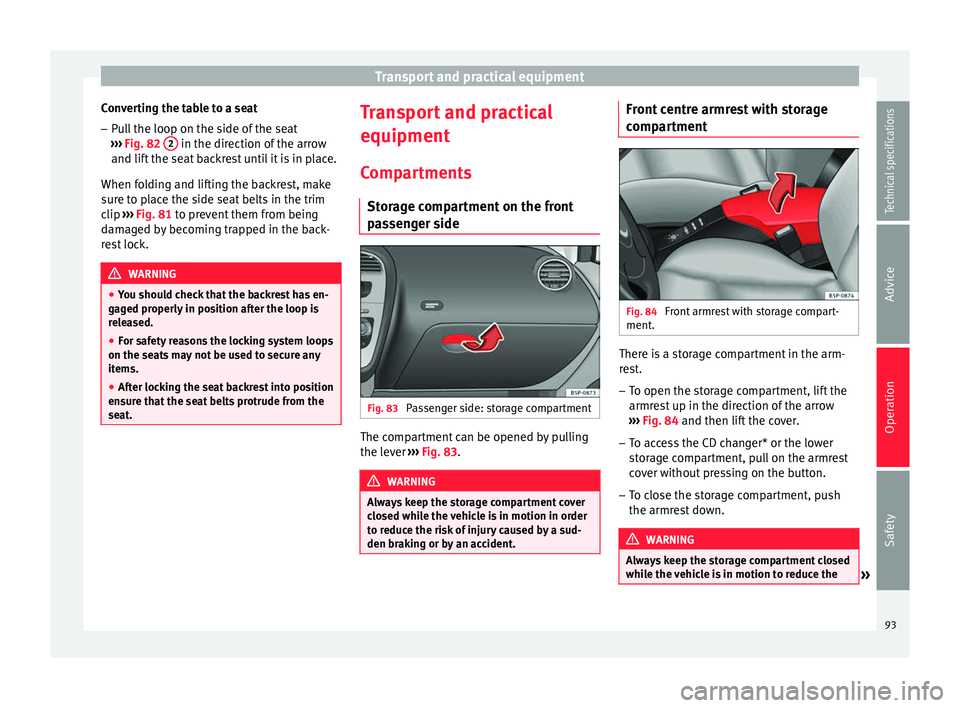
Passenger side: storage compartment The compartment can be opened by pulling
the lever
››› Fig. 83 . WARNING
Always keep the storage compartment cover
closed while the vehicle is in motion in order
to reduce the risk of injury caused by a sud-
den braking or by an accident. Front centre armrest with storage
compartment
Fig. 84
Front armrest with storage compart-
ment. There is a storage compartment in the arm-
rest.
– To open the storage compartment, lift the
armrest up in the direction of the arrow
››› Fig. 84 and then lift the cover.
– To ac
cess the CD changer* or the lower
storage compartment, pull on the armrest
cover without pressing on the button.
– To close the storage compartment, push
the armrest down. WARNING
Always keep the storage compartment closed
while the vehicle is in motion to reduce the » 93
Technical specifications
Advice
Operation
Safety
Page 96 of 236
Operation
risk of injury from the armrest during a sud-
den braking manoeuvre or in the event of an
accident.
Note
The CD changer is located in this compart-
ment. Storage compartment under the front
seats*
Fig. 85
Storage compartment under the front
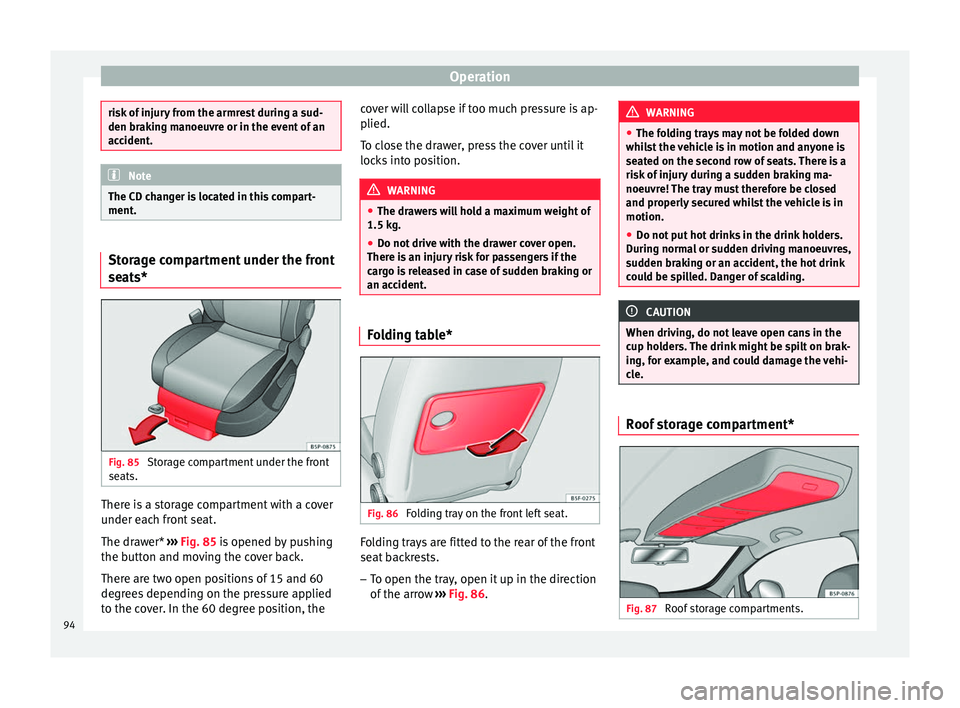
seats. There is a storage compartment with a cover
under each front seat.
The drawer*
››› Fig. 85 is opened by pushing
the b utt
on and moving the cover back.
There are two open positions of 15 and 60
degrees depending on the pressure applied
to the cover. In the 60 degree position, the cover will collapse if too much pressure is ap-
plied.
To close the drawer, press the cover until it
locks into position.
WARNING
● The drawers will hold a maximum weight of
1.5 kg.
● Do not drive with the drawer cover open.
There is an injury risk for passengers if the
cargo is released in case of sudden braking or
an accident. Folding table*
Fig. 86
Folding tray on the front left seat. Folding trays are fitted to the rear of the front
seat backrests.
– To open the tray, open it up in the direction
of the arrow ›››
Fig. 86 . WARNING
● The folding trays may not be folded down
whilst the vehicle is in motion and anyone is
seated on the second row of seats. There is a
risk of injury during a sudden braking ma-
noeuvre! The tray must therefore be closed
and properly secured whilst the vehicle is in
motion.
● Do not put hot drinks in the drink holders.
During normal or sudden driving manoeuvres,
sudden braking or an accident, the hot drink
could be spilled. Danger of scalding. CAUTION
When driving, do not leave open cans in the
cup holders. The drink might be spilt on brak-
ing, for example, and could damage the vehi-
cle. Roof storage compartment*
Fig. 87
Roof storage compartments.94
Page 126 of 236
Operation
WARNING
● Apply the brakes heavily to clean the brake
system only in a suitable traffic situation. Do
not put other road users in danger: there is
risk of causing an accident.
● Ensure the vehicle does not move while in
neutral, when the engine is stopped. Failure
to follow this instruction could result in an
accident.
● If the brake fluid loses its viscosity and is
subjected to heavy use, vapour bubbles can
form in the brake system. This reduces the ef-
ficiency of the brakes.
● If a brake system circuit fails, the braking
distance will be increased considerably. Con-
tact a specialised workshop immediately and
avoid unnecessary journeys. CAUTION
● Never let the brakes “drag” by leaving your
foot on the pedal when it is not necessary to
brake. This overheats the brakes, resulting in
longer stopping distances and greater wear.
● Before driving down a long, steep gradient,
it is advisable to reduce speed and select a
lower gear. This makes use of engine braking
and relieves the brakes. If you still have to
use the brakes, it is better to brake firmly at
intervals than to apply the brakes continu-
ously. Note
● If the brake servo is out of action, for exam-
ple when the car is being towed, you will
have to press the brake pedal considerably
harder than normal to make up for the lack of
servo assistance.
● If you wish to equip the vehicle with acces-
sories such as a front spoiler or wheel covers,
it is important that the flow of air to the front
wheels is not obstructed, otherwise the
brakes can overheat. Before purchasing ac-
cessories please observe the relevant instruc-
tions ››› page 147, Technical modifications . Operating the handbrake
Fig. 123
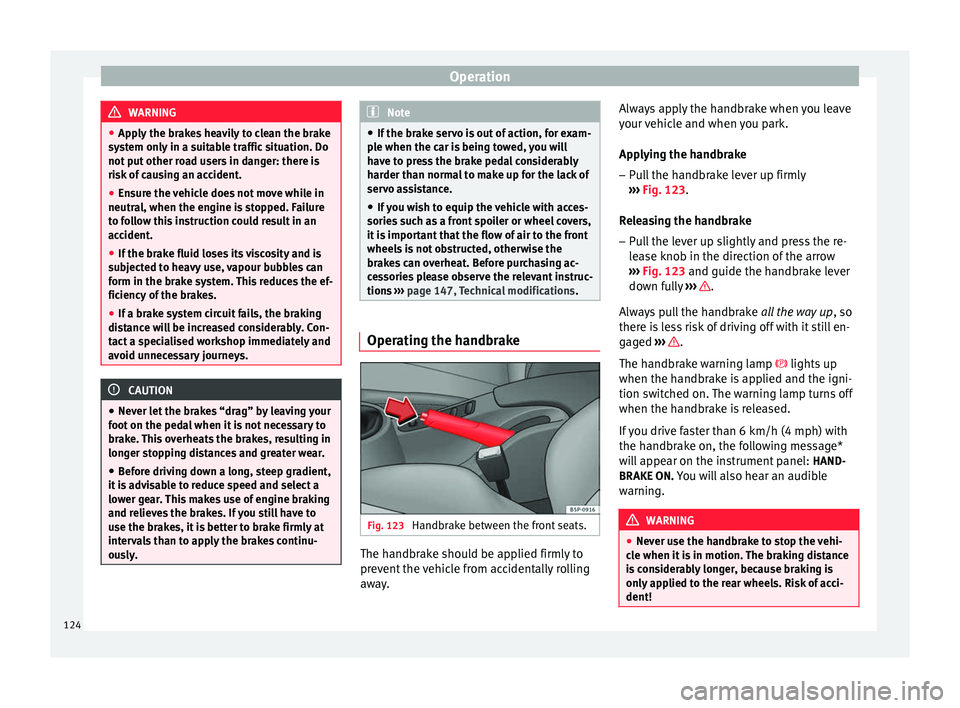
Handbrake between the front seats. The handbrake should be applied firmly to
prevent the vehicle from accidentally rolling
away.Always apply the handbrake when you leave
your vehicle and when you park.
Applying the handbrake
– Pull the handbrake lever up firmly
››› Fig. 123 .
R el
easing the handbrake
– Pull the lever up slightly and press the re-
lease knob in the direction of the arrow
››› Fig. 123 and guide the handbrake lever
down f
ully ››› .
Always pull the handbrake all the way up, so
there is less risk of driving off with it still en-
gaged ››› .
The handbrake warning lamp lights up
when the handbrake is applied and the igni-
tion switched on. The warning lamp turns off
when the handbrake is released.
If you drive faster than 6 km/h (4 mph) with
the handbrake on, the following message*
will appear on the instrument panel: HAND-
BRAKE ON. You will also hear an audible
warning. WARNING
● Never use the handbrake to stop the vehi-
cle when it is in motion. The braking distance
is considerably longer, because braking is
only applied to the rear wheels. Risk of acci-
dent! 124
Page 156 of 236
Advice
using them in the wrong way, may cause acci-
dents, serious injury, burns or intoxication.
●
Keep your car-care products in their origi-
nal containers.
● Read the instructions.
● Never keep car-care products in empty food
containers, bottles or other similar contain-
ers. Other people may confuse them.
● Keep all car-care products out of the reach
of children.
● Some products may give off harmful va-
pours during use. Therefore, they should be
used outdoors in well-ventilated places.
● Never use fuel, turpentine, engine oil, nail-
varnish remover or any other volatile product
for washing, maintenance or cleaning. These
are toxic and highly flammable. WARNING
Unsuitable maintenance and cleaning of vehi-
cle components may impair proper operation
of safety equipment and cause serious injury.
● Maintain and clean vehicle components ac-
cording to the manufacturer's instructions.
● Only use approved or recommended clean-
ing products. CAUTION
● Cleaning products which contain solvents
have a corrosive effect and may damage the
material irreparably. ●
Stains and dirt containing aggressive sub-
stances or solvents attack the material and
may damage it irreparably, even when they
are cleaned quickly.
● Dirt and stains should not be allowed to dry
and should be cleaned as quickly as possible.
● In the case of stubborn stains, take the ve-
hicle to a specialised workshop to avoid dam-
age. Treating your upholstery
To treat and maintain your seat upholstery,
keep the following in mind
››› :
Before entering the vehicle, close any Velcro
fasteners that might snag on the upholstery
or trim fabric. Any open Velcro fasteners may
damage the trim or upholstery fabrics.
To prevent damage, avoid direct contact be-
tween sharp decorative objects and the up-
holstery and trim fabrics. Decorative objects
include zips, rivets and rhinestones on cloth-
ing and belts.
From time to time, clean the dust that gath-
ers in the perforations, folds and seams so
that the surfaces of the seats are not dam-
aged by its abrasive effect.
Make sure clothes are colour-fast to avoid
them running and staining the upholstery.
This is especially important if the upholstery
is light in colour. CAUTION
If you ignore this checklist, which is impor-
tant for maintaining your seat upholstery, the
fabric may be damaged or stained.
● Consult the checklist and carry out the op-
erations it describes. Note
SEAT recommends you take the vehicle to a
specialised workshop to treat any stains on
the upholstery caused by the discolouration
of clothing. How to clean the upholstery, trim
fabrics and Alcantara
® Cleaning the fabric on heated seats and
electrically adjustable seats or seats with
airbag components
There may be important airbag components
and electrical connections inside the driver
seat, passenger seat and possibly the outer
rear seats. If these seats and seat backrests
are damaged, or are cleaned and are treated
incorrectly, or if they get wet, the vehicle
electric system may be destroyed and the air-
bag system damaged
››› .
Electric and heated seats contain compo-
nents and electrical connections that may be
damaged if the seats are cleaned or incor-
rectly treated ››› . Similarly, damage may be
154
Page 157 of 236
Care and maintenance
caused at other points in the vehicle's electri-
cal system.
For this reason, bear the following indica-
tions in mind for cleaning:
● Do not use high-pressure or steam cleaning
equipment or cold aerosols.
● Do not use cream detergents or detergent-
based solutions for delicate garments.
● Prevent the fabric from getting wet at all
times.
● Only use cleaning products approved by
SEAT.
● If in doubt, take the vehicle to a professio-
nal cleaning company.
Cleaning the fabric on unheated seats, non-
electrically adjustable seats and seats
without airbag components
● Before using any cleaning products, con-
sult and keep in mind the instructions of use,
indications and warnings on the container.
● Use a vacuum cleaner (with the brush at-
tachment) on the trim and seat fabrics, the
Alcantara ®
upholstery of the seats and the
carpet.
● Do not use high-pressure or steam cleaning
equipment or cold aerosols.
● For general cleaning, use a soft sponge or
an ordinary lint-free microfibre cloth ››› .●
Clean Alcantara ®
surfaces with a slightly
damp cotton or woollen cloth, or a standard
lint-free microfibre cloth ››› .
If the dirt on the trim and upholstery fabrics
is only superficial, you can use a standard
foam cleaner.
If the upholstery and trim are very dirty, be-
fore cleaning them we recommend you find
out about the most suitable cleaning options
from a professional cleaning company. If nec-
essary, cleaning should be done by a special-
ised firm.
Stain removal
When removing stains, it may be necessary
to clean the whole surface and not just the
stain itself. Especially if the surface has been
dirtied through normal use. If you only clean
the stained area, that part may then look
lighter than the rest. If in doubt, take the ve-
hicle to a professional cleaning company. WARNING
If there is a fault in the airbag system, it is
likely that the airbag will not deploy correct-
ly, not deploy at all, or do so unexpectedly,
which could cause serious or fatal injuries.
● Have the system checked immediately by a
specialised workshop. CAUTION
If the upholstery on electrically operated
seats or seats with airbag components gets
soaked, the vehicle's electric system and cer-
tain other components may be damaged.
● If the seat gets soaked, take the vehicle im-
mediately to a specialised workshop to be
dried and for the system components to be
inspected.
● Do not use steam cleaning equipment as
the dirt becomes more encrusted and fixed in
the material.
● High-pressure cleaning equipment and cold
aerosols may damage the upholstery. CAUTION
● Brushes should only be used to clean the
mats and floor mat! Other fabrics may be
damaged if cleaned with a brush.
● If cream detergents or detergents for deli-
cate garments are applied with a damp cloth
or sponge, they may, for example, leave rings
when dry because of the surfactant compo-
nents they contain. Generally, such rings are
very difficult or almost impossible to remove. CAUTION
● Do not let water soak into Alcantara ®
car-
pet under any circumstances.
● Do not use leather cleaning products, sol-
vents, wax polish, shoe cream, stain remov-
ers or similar products on Alcantara ®
. » 155Technical specifications
Advice
Operation
Safety
Page 158 of 236
Advice
●
Never use brushes for cleaning damp mate-
rial as they could damage the surface. Cleaning and maintenance of natural
leather upholstery
Consult a professional cleaning workshop if
you have any doubts on cleaning and main-
taining the leather equipment in your vehicle.
Maintenance and treatment
Nappa natural leather is delicate because it
has no additional protective layer.
● After cleaning, regularly apply a condition-
er with sun-screen and impregnating action.
These products nourish the leather, soften it
and make it more breathable, as well as re-
hydrating it. They also provide it with a pro-
tective film.
● Clean the leather every two or three months
and remove stains as they appear.
● Treat the leather regularly (about twice a
year) with a suitable maintenance product.
● Apply as few cleaning and maintenance
products as possible, always using a dry, lint-
free cotton or woollen cloth. Do not apply
cleaning and maintenance products directly
to the leather. ●
Remove recent ball-point pen and ink
stains, lipstick, shoe cream and similar
stains as soon as possible.
● Maintain the colour of the leather. To do
this, use a special cream especially coloured
for leather to achieve the same overall colour,
if necessary.
● Afterwards, go over it with a soft cloth.
Cleaning the vehicle
SEAT recommends using a slightly damp cot-
ton or woollen cloth for general cleaning pur-
poses.
Generally, the leather should never be
soaked at any point, nor should water pene-
trate the seams.
Before cleaning the leather upholstery, bear
in mind the f o
llowing recommendations
››› page 154, Cleaning the fabric on heated
seats and electrically adjustable seats or
seats with airbag components . CAUTION
● On no account use solvents, wax polish,
shoe cream, stain removers or similar materi-
als on leather.
● If the stain remains on the leather for long,
it will soak in and be impossible to remove.
● In the event of spilt liquids, dry immediate-
ly with an absorbent cloth to prevent the liq-
uid penetrating through the leather or seams. ●
If the vehicle is left standing in the sun for
long periods, the leather should be protected
against direct sunlight to prevent it from fad-
ing. Note
The leather will usually change colour slight-
ly with use. Cleaning synthetic leather upholstery
Before cleaning synthetic leather upholstery,
bear in mind the following recommendations
››› page 154, Cleaning the fabric on heated
seats and electrically adjustable seats or
seats with airbag components
Only use water and neutral cleaning products
to clean synthetic leather upholstery. CAUTION
Do not use solvents, floor wax, shoe cream,
stain removers or similar products on syn-
thetic leather. These will stiffen the material,
causing it to crack prematurely. Cleaning plastic parts and the
instrument panel
–
Use a clean, damp cloth to clean plastic
parts and the dash panel.
156