warning Seat Altea 2015 Owner's Guide
[x] Cancel search | Manufacturer: SEAT, Model Year: 2015, Model line: Altea, Model: Seat Altea 2015Pages: 236, PDF Size: 4.23 MB
Page 26 of 236
Safety
››› Fig. 19 . About 3/4 of the key should en-
t er
, as far as it will go.
– Then turn the key gently to the ON position.
Do not f
orce it if you feel resistance, and
make sure you have inserted the key fully.
– Check that the control lamp on the instru-
ment panel ››› Fig. 20 does not light up
when the ignition i
s switched on ››› .
WARNING
● It is the driver's responsibility to ensure
that the key-operated switch is set to the cor-
rect position.
● You should deactivate the front passenger
front airbag only if you have to use a rear-fac-
ing child seat in exceptional cases
››› page 24, Transporting children safety.
● Never install a child seat facing backwards
on the front passenger seat unless the front
passenger front airbag has been disabled.
Otherwise, there is a risk of death.
● As soon as the child seat is no longer nee-
ded on the front passenger seat, enable the
front passenger front airbag again.
● Only deactivate the front passenger front
airbag when the ignition is off, otherwise a
fault may occur in the airbag system, which
could cause the airbag to not deploy properly
or not deploy at all in case of an accident.
● Never leave the key in the airbag deactiva-
tion switch as it could get damaged or acti-
vate or deactivate the airbag during driving. ●
When the front passenger front airbag is
deactivated, if the control lamp AIRBAG OFF
is not continuously lit up, there may be a
fault in the airbag system:
– Have the airbag system inspected imme-
diately by a specialised workshop.
– Do not use a child seat on the front pas-
senger seat! The front passenger front
airbag could be triggered in the event of
an accident, even if there is a fault in the
system and, as a result, a child could sus-
tain serious or fatal injuries.
– It is unpredictable whether the front pas-
senger airbag will deploy in the event of
an accident. Warn all your passengers of
this.
● When using the ignition key to activate/de-
activate the front passenger front airbag, on-
ly the front passenger airbag will be activa-
ted/deactivated. The side airbag and head
airbag on the passenger side will remain ac-
tive. Transporting children safety
Safety for children Introduction For safety reasons, as we have learned from
accident statistics, we recommend that chil-
dren under 12 years of age travel in the rear
seats. Depending on their age, height and
weight, children travelling in the rear seat
must use a child seat or a seat belt. For safety
reasons, the child seat should be installed in
the rear seat, behind the front passenger
seat or in the centre back seat.
The physical laws involved and the forces
acting in a collision apply also to children
››› page 13 . But unlike adults, children do not
h av
e fully developed muscle and bone struc-
tures. This means that children are subject to
a greater risk of injury.
To reduce the risk of injuries, children must
always use special child restraint systems
when travelling in the vehicle.
We recommend the use of child safety prod-
ucts from the SEAT Original Accessories Pro-
gramme, which includes systems for all ages
made by “Peke” (not for all countries).
These systems have been especially de-
signed and approved, complying with the
ECE-R44. regulation.
24
Page 27 of 236
Transporting children safety
Follow the manufacturer's instructions and
observe any statutory requirements when in-
stalling and using child seats. Always read
and note ››› page 25 .
W e r
ecommend you always carry the manu-
facturer's Child Seat Instruction Manual to-
gether with the on-board documentation.
Important information regarding the
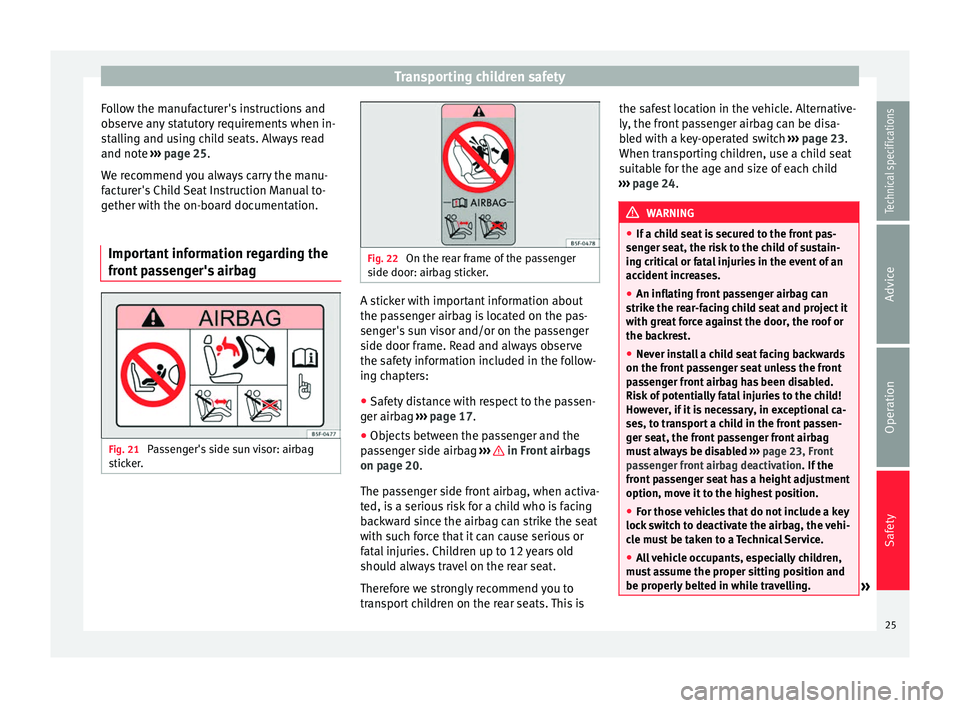
front passenger's airbag Fig. 21
Passenger's side sun visor: airbag
sticker. Fig. 22
On the rear frame of the passenger
side door: airbag sticker. A sticker with important information about
the passenger airbag is located on the pas-
senger's sun visor and/or on the passenger
side door frame. Read and always observe
the safety information included in the follow-
ing chapters:
● Safety distance with respect to the passen-
ger airbag ››› page 17 .
● Ob
jects between the passenger and the
passenger side airbag ››› in Front airbags
on page 20 .
The p a
ssenger side front airbag, when activa-
ted, is a serious risk for a child who is facing
backward since the airbag can strike the seat
with such force that it can cause serious or
fatal injuries. Children up to 12 years old
should always travel on the rear seat.
Therefore we strongly recommend you to
transport children on the rear seats. This is the safest location in the vehicle. Alternative-
ly, the front passenger airbag can be disa-
bled with a key-operated switch
››› page 23.
When transporting children, use a child seat
suitable for the age and size of each child
››› page 24. WARNING
● If a child seat is secured to the front pas-
senger seat, the risk to the child of sustain-
ing critical or fatal injuries in the event of an
accident increases.
● An inflating front passenger airbag can
strike the rear-facing child seat and project it
with great force against the door, the roof or
the backrest.
● Never install a child seat facing backwards
on the front passenger seat unless the front
passenger front airbag has been disabled.
Risk of potentially fatal injuries to the child!
However, if it is necessary, in exceptional ca-
ses, to transport a child in the front passen-
ger seat, the front passenger front airbag
must always be disabled ››› page 23, Front
passenger front airbag deactivation . If the
front passenger seat has a height adjustment
option, move it to the highest position.
● For those vehicles that do not include a key
lock switch to deactivate the airbag, the vehi-
cle must be taken to a Technical Service.
● All vehicle occupants, especially children,
must assume the proper sitting position and
be properly belted in while travelling. » 25
Technical specifications
Advice
Operation
Safety
Page 28 of 236
Safety
●
Never hold children or babies on your lap,
this can result in potentially fatal injuries to
the child!
● Never allow a child to be transported in a
vehicle without being properly secured, or to
stand up or kneel on a seat while travelling.
In an accident, the child could be flung
through the vehicle, causing possibly fatal in-
juries to themselves and to the other vehicle
occupants.
● If children assume an improper sitting posi-
tion when the vehicle is moving, they expose
themselves to greater risk of injury in the
event of a sudden braking manoeuvre or in an
accident. This is particularly important if the
child is travelling on the front passenger seat
and the airbag system is triggered in an acci-
dent; as this could cause serious injury or
even death.
● A suitable child seat can protect your child!
● Never leave a child alone in the child seat
or inside the vehicle because depending on
the season, very high temperatures may be
reached inside a parked vehicle, which could
be fatal.
● Children who are less than 1.5 metres tall
must not wear a normal seat belt without a
child seat, as this could cause injuries to the
abdominal and neck areas during a sudden
braking manoeuvre or in an accident.
● Only one child may occupy a child seat
››› page 26, Child seats. ●
When a child seat is mounted in the rear
seats, the door child-proof lock should be ac-
tivated ››› page 66. Child seats
Categorisation of child seats into
groups Use only child seats that are officially ap-
proved and suitable for the child.
Child seats are subject to the regulation ECE-
R 44. ECE-R stands for: Economic Commis-
sion for Europe Regulation.
The child seats are grouped into 5 catego-
ries:
Group 0 : Up to 10 kg (up to around 9
months)
Gr oup 0+: Up to 13 kg (up to around 18
months)
Group 1
: From 9 to 18 kg (up to around 4
years old)
Group 2
: From 15 to 25 kg (up to around 7
years old)
Group 3
: From 22 to 36 kg (over around 7
years old) Child seats that have been tested and ap-
proved under the ECE R44 standard bear the
test mark on the seat (the letter E in a circle
with the test number below it).
Follow the manufacturer's instructions and
observe any statutory requirements when in-
stalling and using child seats.
We recommend you to always include the
manufacturer's Child Seat Instruction Manual
together with the on-board documentation.
WARNING
Read and always observe information and
warnings concerning the use of child seats
››› page 25. Ways to secure a child seat
You can secure a child seat to the rear seat or
front passenger seat in the following ways:
● Child seats in groups 0 to 3 can be secured
w ith a se
at belt.
● Child seats for groups 0, 0+ and 1
can be
fastened without seatbelts, using the “ISO-
FIX” and Top Tether* system, using the “ISO-
FIX” and Top Tether* securing rings
››› page 27.
26
Page 29 of 236
Transporting children safetyWeight
group
Seating position
Front
passen-
ger seatRear side seatRear cen-tral seat
Group 0
to 10 kgU*UU
Group 0+ to 13 kgU*UU
Group I
9 to 18 kgU*UU
Group II
15 to 25 kgU*UU
Group III
22 to 36 kgU*UU Suitable for universal restraint systems
for use in this weight group.
Move the front passenger seat as far
back as possible, as high as possible
and always disable the airbag.
WARNING
● When travelling, children must be secured
in the vehicle with a restraint system suitable
for age, weight and size.
● Read and always observe information and
warnings concerning the use of child seats
››› page 25. U:
*:
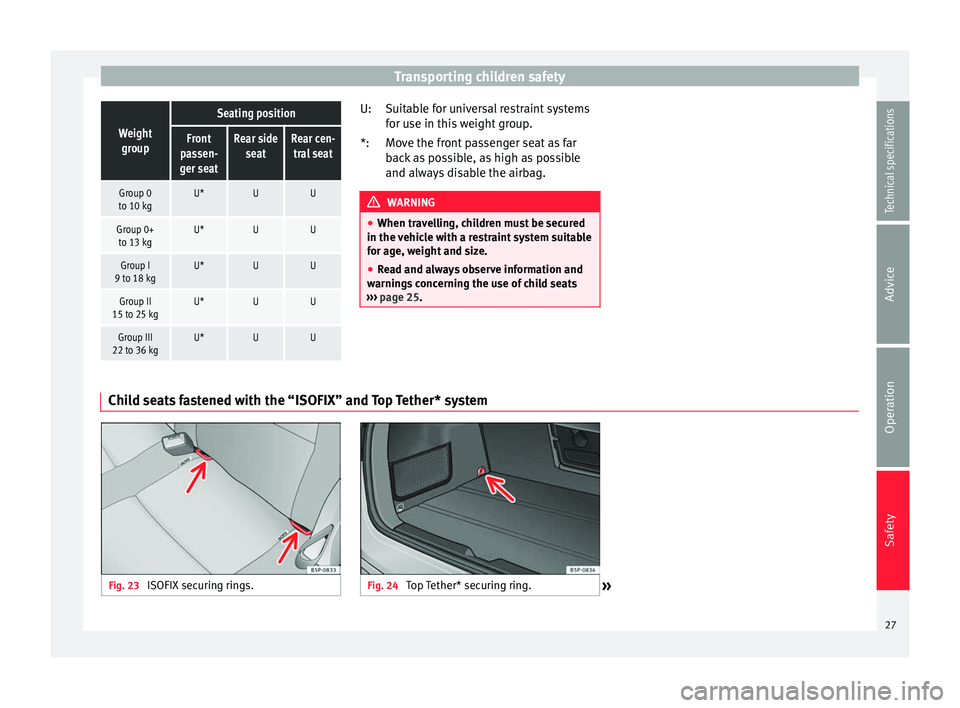
Child seats fastened with the “ISOFIX” and Top Tether* system Fig. 23
ISOFIX securing rings. Fig. 24
Top Tether* securing ring.
» 27
Technical specifications
Advice
Operation
Safety
Page 31 of 236
Transporting children safetyWeight groupSize classElectrical equipmentMounting directionVehicle Isofix positions
Rear side seats
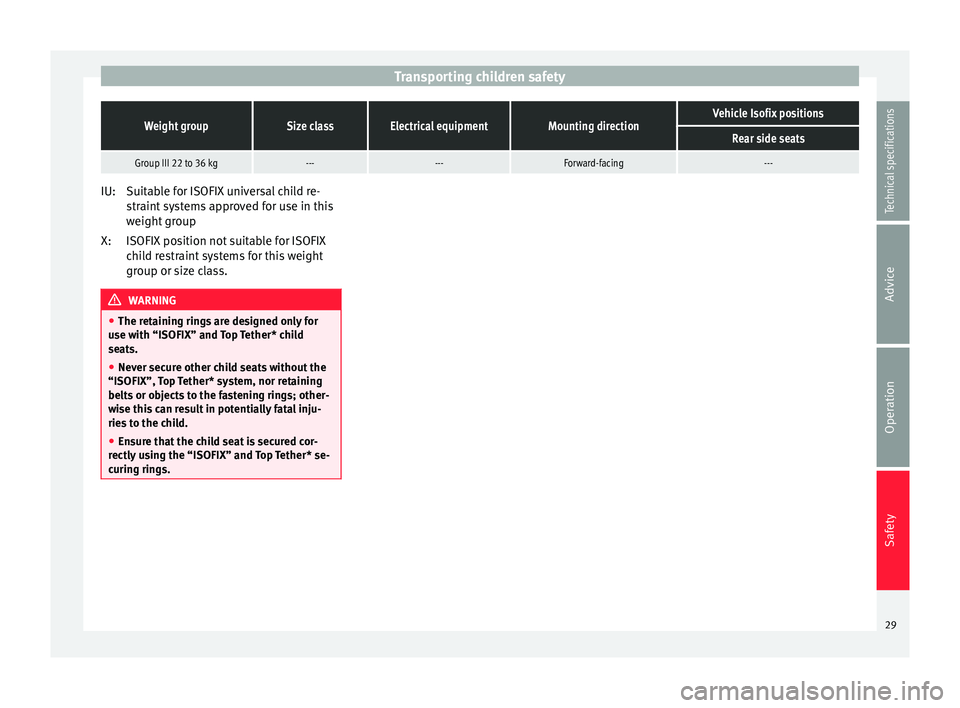
Group III 22 to 36 kg------Forward-facing---
Suitable for ISOFIX universal child re-
straint systems approved for use in this
weight group
ISOFIX position not suitable for ISOFIX
child restraint systems for this weight
group or size class.
WARNING
● The retaining rings are designed only for
use with “ISOFIX” and Top Tether* child
seats.
● Never secure other child seats without the
“ISOFIX”, Top Tether* system, nor retaining
belts or objects to the fastening rings; other-
wise this can result in potentially fatal inju-
ries to the child.
● Ensure that the child seat is secured cor-
rectly using the “ISOFIX” and Top Tether* se-
curing rings. IU:
X:
29
Technical specifications
Advice
Operation
Safety
Page 33 of 236
Dash panel
Operation
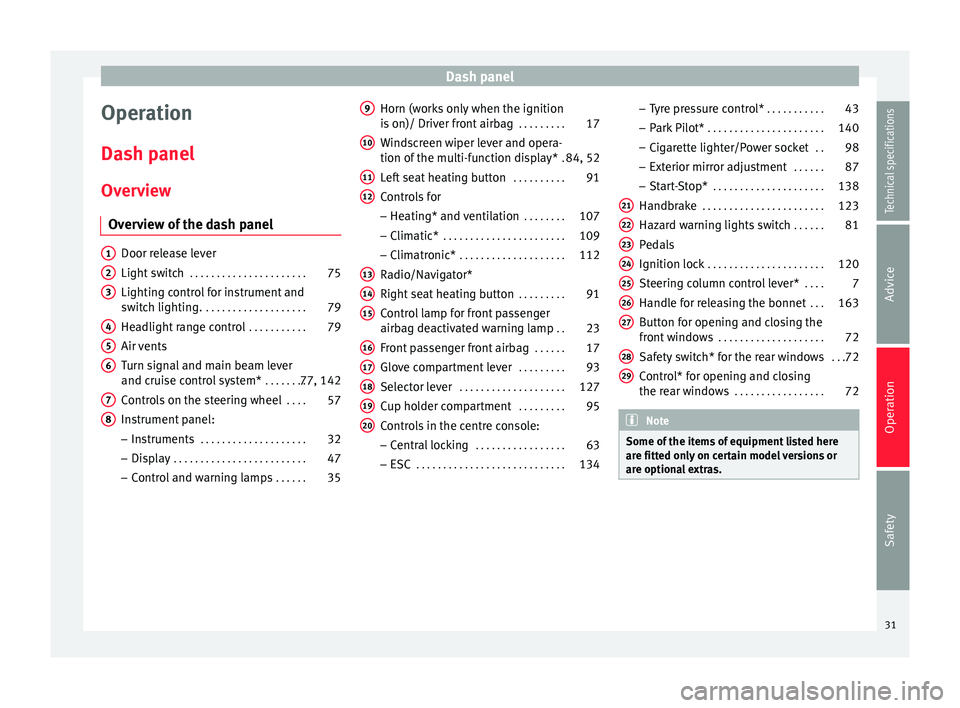
Dash panel Overview Overview of the dash panel Door release lever
Light switch
. . . . . . . . . . . . . . . . . . . . . . 75
Lighting control for instrument and
switch lighting. . . . . . . . . . . . . . . . . . . . 79
Headlight range control . . . . . . . . . . .79
Air vents
Turn signal and main beam lever
and cruise control system* . . . . . . . .77, 142
Controls on the steering wheel . . . .57
Instrument panel:
– Instruments . . . . . . . . . . . . . . . . . . . . 32
– Display . . . . . . . . . . . . . . . . . . . . . . . . . 47
– Control and warning lamps . . . . . .35
1 2
3
4
5
6
7
8 Horn (works only when the ignition
is on)/ Driver front airbag
. . . . . . . . .17
Windscreen wiper lever and opera-
tion of the multi-function display* .84, 52
Left seat heating button . . . . . . . . . .91
Controls for
– Heating* and ventilation . . . . . . . .107
– Climatic* . . . . . . . . . . . . . . . . . . . . . . . 109
– Climatronic* . . . . . . . . . . . . . . . . . . . . 112
Radio/Navigator*
Right seat heating button . . . . . . . . .91
Control lamp for front passenger
airbag deactivated warning lamp . .23
Front passenger front airbag . . . . . .17
Glove compartment lever . . . . . . . . .93
Selector lever . . . . . . . . . . . . . . . . . . . . 127
Cup holder compartment . . . . . . . . .95
Controls in the centre console: – Central locking . . . . . . . . . . . . . . . . . 63
– ESC . . . . . . . . . . . . . . . . . . . . . . . . . . . . 134
9 10
11
12
13
14
15
16
17
18
19
20 –
Tyre pressure control* . . . . . . . . . . .43
– Park Pilot* . . . . . . . . . . . . . . . . . . . . . . 140
– Cigarette lighter/Power socket . .98
– Exterior mirror adjustment . . . . . .87
– Start-Stop* . . . . . . . . . . . . . . . . . . . . . 138
Handbrake . . . . . . . . . . . . . . . . . . . . . . . 123
Hazard warning lights switch . . . . . .81
Pedals
Ignition lock . . . . . . . . . . . . . . . . . . . . . . 120
Steering column control lever* . . . .7
Handle for releasing the bonnet . . .163
Button for opening and closing the
front windows . . . . . . . . . . . . . . . . . . . . 72
Safety switch* for the rear windows . . .72
Control* for opening and closing
the rear windows . . . . . . . . . . . . . . . . . 72 Note
Some of the items of equipment listed here
are fitted only on certain model versions or
are optional extras. 21
22
23
24
25
26
27
28
29
31Technical specifications
Advice
Operation
Safety
Page 35 of 236
Dash panel
Speedometer The speedometer is equipped with a digital
odometer and a trip odometer, in addition to
a service intervals display.
During the running-in period, the instructions
shown on
››› page 130 should be followed.
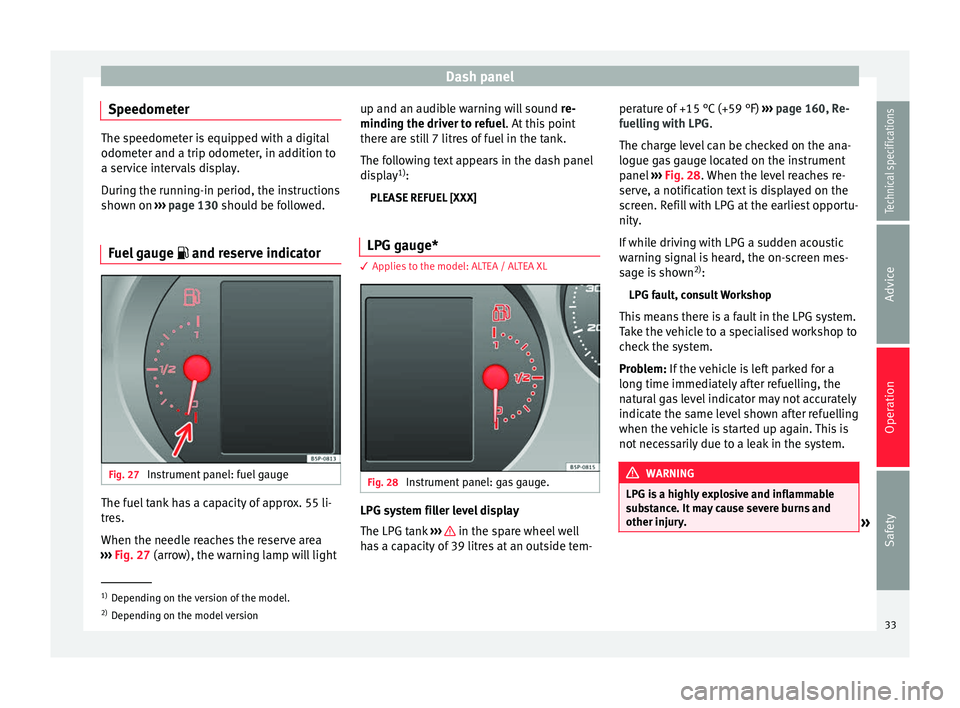
F uel
gauge and reserve indicator Fig. 27
Instrument panel: fuel gauge The fuel tank has a capacity of approx. 55 li-
tres.
When the needle reaches the reserve area
››› Fig. 27 (arrow), the warning lamp will light up and an audib
l
e warning will sound
re-
minding the driver to refuel. At this point
there are still 7 litres of fuel in the tank.
The following text appears in the dash panel
display 1)
:
PLEASE REFUEL [XXX]
LPG gauge* 3 Applies to the model: ALTEA / ALTEA XL
Fig. 28
Instrument panel: gas gauge. LPG system filler level display
The LPG tank
››› in the spare wheel well
has a capacity of 39 litres at an outside tem- perature of +15 °C (+59 °F)
››› page 160, Re-
fuelling with LPG .
The c h
arge level can be checked on the ana-
logue gas gauge located on the instrument
panel ››› Fig. 28. When the level reaches re-
serv
e, a notification text is displayed on the
screen. Refill with LPG at the earliest opportu-
nity.
If while driving with LPG a sudden acoustic
warning signal is heard, the on-screen mes-
sage is shown 2)
:
LPG fault, consult Workshop
This means there is a fault in the LPG system.
Take the vehicle to a specialised workshop to
check the system.
Problem: If the vehicle is left parked for a
long time immedi
ately after refuelling, the
natural gas level indicator may not accurately
indicate the same level shown after refuelling
when the vehicle is started up again. This is
not necessarily due to a leak in the system. WARNING
LPG is a highly explosive and inflammable
substance. It may cause severe burns and
other injury. »1)
Depending on the version of the model.
2) Depending on the model version
33
Technical specifications
Advice
Operation
Safety
Page 36 of 236
Operation
●
Due care must be taken to avoid any risk of
fire or explosion.
● When parking the vehicle in a closed area
(e.g. in a garage), make sure that there is ad-
equate ventilation, either natural or mechani-
cal, to neutralise the LPG in the event of a
leak. Note
● The values shown in the average fuel con-
sumption and distance to empty indications
on the multifunction display (MFI) 1)
on the in-
strument panel display 2)
are approximate val-
ues only.
● Two different consumption values are given
on the MFI, depending on whether the vehi-
cle is running in gas or petrol mode.
● Please check the fuel level on the fuel level
gauge on the instrument panel ››› page 33.
● If frequent short journeys are made, espe-
cially when the outside temperature is low,
the vehicle will tend to run on petrol more of-
ten than on LPG. Therefore, the petrol tank
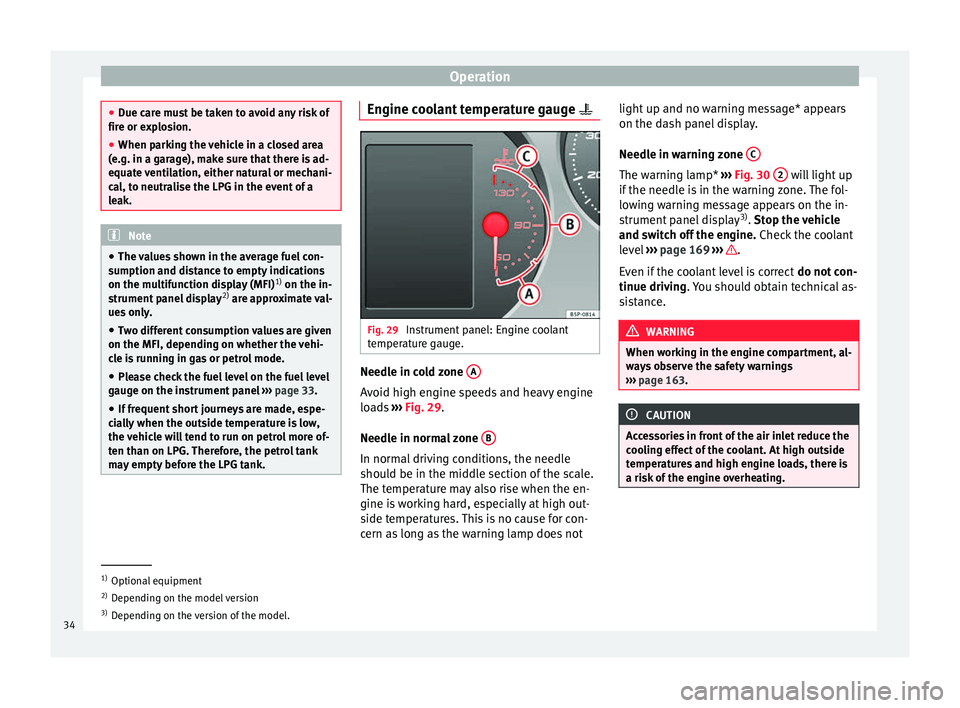
may empty before the LPG tank. Engine coolant temperature gauge
Fig. 29
Instrument panel: Engine coolant
temperature gauge. Needle in cold zone
A Avoid high engine speeds and heavy engine
loads
››› Fig. 29 .
Needl e in norm
al zone B In normal driving conditions, the needle
should be in the middle section of the scale.
The temperature may also rise when the en-
gine is working hard, especially at high out-
side temperatures. This is no cause for con-
cern as long as the warning lamp does notlight up and no warning message* appears
on the dash panel display.
Needle in warning zone
C The warning lamp*
››› Fig. 30 2 will light up
if the needle is in the warning zone. The fol-
lowing warning message appears on the in-
strument panel display 3)
. Stop the vehicle
and sw it
ch off the engine. Check the coolant
level ››› page 169 ››› .
Even if the coolant level is correct do not con-
tinue driving . You should obtain technical as-
s i
stance. WARNING
When working in the engine compartment, al-
ways observe the safety warnings
››› page 163. CAUTION
Accessories in front of the air inlet reduce the
cooling effect of the coolant. At high outside
temperatures and high engine loads, there is
a risk of the engine overheating. 1)
Optional equipment
2) Depending on the model version
3) Depending on the version of the model.
34
Page 37 of 236
Dash panel
Setting the digital clock* The digital clock is located in the instrument
panel display.
–
Turn the setting knob ››› Fig. 26
5 clock-
wise until the first “click” to set the hour.
The hour will flash. To change the hour,
press the button. –
Turn the setting knob clockwise to the sec-
ond “click” to set the minutes. The minutes
will flash. To change the minutes, press the
button.
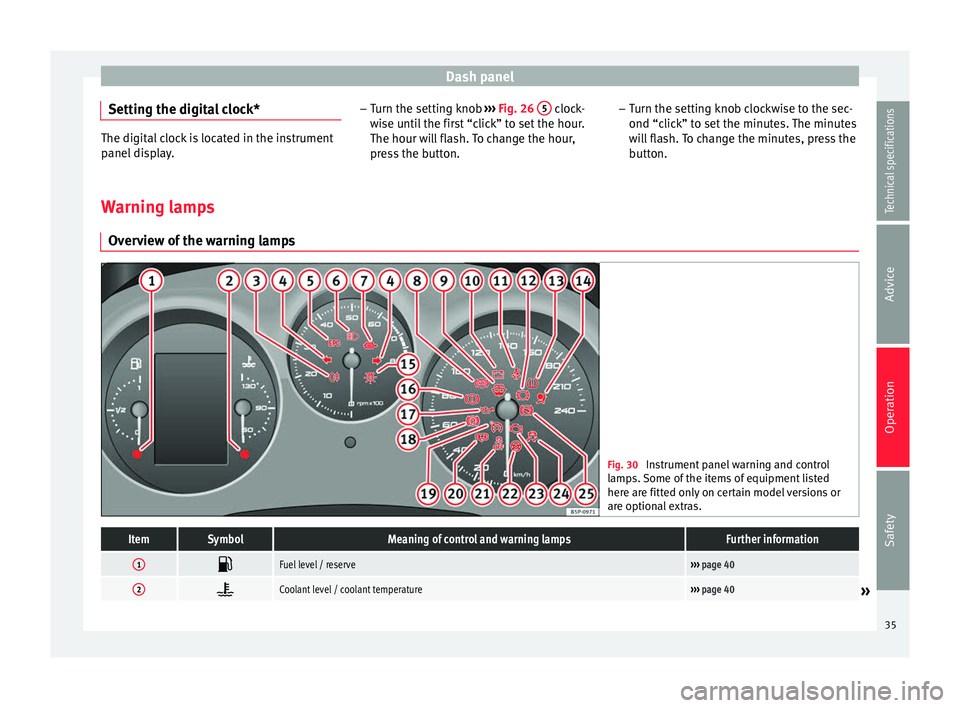
Warning lamps Overview of the warning lamps Fig. 30
Instrument panel warning and control
lamps. Some of the items of equipment listed
here are fitted only on certain model versions or
are optional extras.ItemSymbolMeaning of control and warning lampsFurther information
1 Fuel level / reserve›››
page 40
2 Coolant level / coolant temperature›››
page 40» 35
Technical specifications
Advice
Operation
Safety
Page 38 of 236
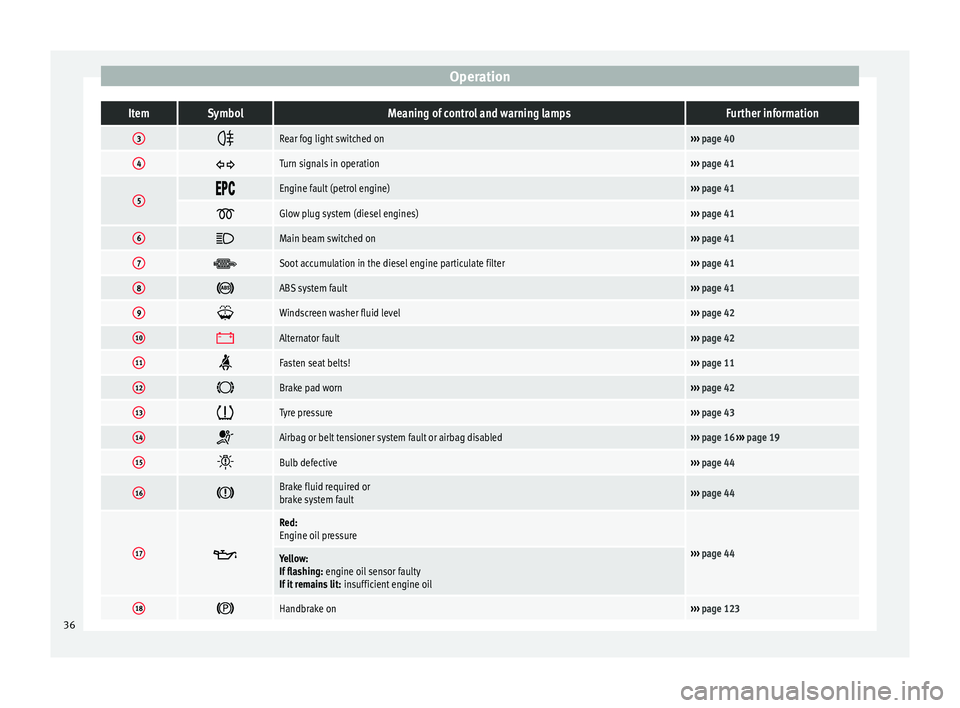
OperationItemSymbolMeaning of control and warning lampsFurther information
3
Rear fog light switched on›››
page 40
4 Turn signals in operation›››
page 41
5 Engine fault (petrol engine)›››
page 41
Glow plug system (diesel engines)›››
page 41
6 Main beam switched on›››
page 41
7 Soot accumulation in the diesel engine particulate filter›››
page 41
8 ABS system fault›››
page 41
9 Windscreen washer fluid level›››
page 42
10 Alternator fault›››
page 42
11 Fasten seat belts!›››
page 11
12 Brake pad worn›››
page 42
13 Tyre pressure›››
page 43
14 Airbag or belt tensioner system fault or airbag disabled›››
page 16 ››› page 19
15 Bulb defective›››
page 44
16 Brake fluid required or
brake system fault›››
page 44
17
Red:
Engine oil pressure
›››
page 44Yellow:
If flashing: engine oil sensor faulty
If it remains lit: insufficient engine oil
18 Handbrake on›››
page 123 36