warning lights Seat Altea 2015 Owner's Guide
[x] Cancel search | Manufacturer: SEAT, Model Year: 2015, Model line: Altea, Model: Seat Altea 2015Pages: 236, PDF Size: 4.23 MB
Page 137 of 236

Driver assistance systems
The ESC system is always active and cannot
be switched off. The ESC switch only switches
the ASR off.
The ASR can be deactivated when wheel spin
is desirable.
For example:
● When driving with snow chains.
● When driving in deep snow or on loose sur-
faces.
● When the vehicle is stuck, to rock it back-
wards and forwards.
Press the button to switch the ASR back on
when you no longer need wheel spin.
Electronic Stability Control (ESC)*
The ESC reduces the risk of skidding by brak-
ing the wheels individually.
The system uses the steering wheel angle
and road speed to calculate the changes of
direction desired by the driver, and constant-
ly compares them with the actual behaviour
of the vehicle. When irregularities occur, for
example, if the vehicle begins to skid, the
ESC brakes the appropriate wheel automati-
cally.
The forces acting on the braked wheel bring
the vehicle back to a stable condition. If the
vehicle tends to oversteer (the rear end
slides out), the system will act on the front
wheel on the outside of the turn. Steering manoeuvre recommendations
This is a complementary safety function in-
cluded in the ESC. This function aids the driv-
er to better stabilize the vehicle in a critical
situation. For example, in case of sudden
braking on a surface with varied adherence,
the vehicle will tend to destabilise its trajec-
tory to the right or to the left. In this case, the
ESC recognises the situation and assists the
driver with a counter steering manoeuvre
from the power steering.
This function simply provides the driver with
a recommended manoeuvre in critical situa-
tions.
The vehicle does not steer itself with this
function, the driver has full control of the ve-
hicle at all times.
WARNING
● Remember that not even the ESC can defy
the laws of physics. This should be kept in
mind, particularly on slippery and wet roads
and when towing a trailer.
● Always adapt your driving style to suit the
condition of the roads and the traffic situa-
tion. The greater safety provided by the ESC
should not encourage you to run any risks. CAUTION
● To ensure that the ESC works correctly, all
four wheels must be fitted with the same
tyres. Any differences in the rolling radius of the tyres can cause the system to reduce en-
gine power when this is not desired.
● Any modifications made to the vehicle (for
example, to the engine, brake system, run-
ning gear or to the combination of wheels
and tyres) may affect the operation of the
ABS, EDL, ESC and ASR. Electronic differential lock (EDL)*
EDL helps the vehicle to start moving, accel-
erate and climb a gradient in slippery condi-
tions where this may otherwise be difficult or
even impossible.
It uses the ABS sensors to monitor the speed
of the driven wheels. In case of an EDL fault,
the warning light for ABS lights up
››› page 41 .
At s
peeds of up to approximately 80 km/h
(50 mph), it is able to balance out differences
in the speed of the driven wheels of approxi-
mately 100 rpm/min caused by a partially
slippery road surface. It does this by braking
the wheel which has lost traction and distrib-
uting more driving force to the other driven
wheel via the differential.
To prevent the disc brake of the braking
wheel from overheating, the EDL cuts out au-
tomatically if subjected to excessive loads.
The vehicle will continue to function normally »
135
Technical specifications
Advice
Operation
Safety
Page 138 of 236
Operation
without EDL. For this reason, the driver is not
informed that the EDL has been switched off.
The EDL will switch on again automatically
when the brake has cooled down. WARNING
● When accelerating on a slippery surface,
for example on ice and snow, press the accel-
erator carefully. Despite EDL, the driven
wheels may start to spin. This could impair
the vehicle's stability.
● Always adapt your driving style to suit road
conditions and the traffic situation. Do not let
the extra safety afforded by EDL tempt you in-
to taking any risks when driving, this can
cause accidents. CAUTION
Modifications to the vehicle (e.g. to the en-
gine, the brake system, running gear or any
components affecting the wheels and tyres)
could affect the efficiency of the EDL
››› page 147. Hydraulic Brake Assist (HBA)*
The function (Hydraulic Brake Assist HBA) is
only included in vehicles with ESC.
In an emergency, most drivers brake in time,
but not with maximum force. This results in
unnecessarily long braking distances. This is when the brake assist system comes
into action. When pressing the brake pedal
rapidly, the assistant interprets it as an emer-
gency. It very quickly builds up the full brake
pressure so that the ABS can be activated
more quickly and efficiently, thus reducing
braking distance.
Do not reduce the pressure on the brake ped-
al, since the brake assist system switches off
automatically as soon as you release the
brake.
Emergency braking warning
If the vehicle is braked suddenly and continu-
ously at a speed of more than 80 km/h, the
brake light flashes several times per second
to warn vehicles driving behind. If you contin-
ue braking, the hazard warning lights will
come on automatically when the vehicle
comes to a standstill. They switch off auto-
matically when the vehicle starts to move
again.
WARNING
● The risk of accident is higher if you drive
too fast, if you do not keep your distance from
the vehicle in front, and when the road sur-
face is slippery or wet. The increased acci-
dent risk cannot be reduced by the brake as-
sist system.
● The brake assist system cannot defy the
laws of physics. Slippery and wet roads are
dangerous even with the brake assist system! Therefore, it is essential that you adjust your
speed to suit the road and traffic conditions.
Do not let the extra safety features tempt you
into taking any risks when driving.
Anti-lock brake system (ABS)
The anti-lock brake (ABS) system prevents
the wheels from locking during braking and
is an important part of the vehicle's active
safety system.
How the ABS works
If one of the wheels turns too slowly in rela-
tion to the vehicle's speed, and is close to
locking, the system will reduce the braking
pressure to this wheel. The driver is made
aware of this control process by a
pulsating
of the brake pedal and audible noise. This is
a deliberate warning to the driver that one or
more of the wheels is tending to lock and the
ABS control function has intervened. In this
situation it is important to keep the brake
pedal fully depressed so the ABS can regu-
late the brake application. Do not “pump”.
If you brake hard on a slippery road surface,
the best possible control is retained as the
wheels do not lock.
However, ABS will not necessarily guarantee
shorter braking distances in all conditions.
Br ak
ing distance could even be further if you
136
Page 141 of 236
Driver assistance systems
● The windscreen de-mist function is turned
on.
● The temperature of the passenger compart-
ment exceeds comfort limits (button A/C
11 ›››
Fig. 120 should be selected).
● If in an inc
rease in airflow 10
››› Fig. 120 is
r equir
ed for more than three presses.
● Temperature setting HI or LO is selected.
● The engine coolant temperature is insuffi-
cient.
● The alternator is faulty, for example the V-
belt has ruptured.
● If any of the conditions described in the
previous section are not fulfilled. WARNING
Never allow the vehicle to move with the en-
gine off for any reason. You could lose control
of your vehicle. This could cause an accident
and serious injury.
● Power steering does not work when the en-
gine is not running. That is why it is much
more difficult to turn the steering wheel.
● Turn off the Start-Stop system when driving
through water (fording streams, etc.). Note
● For vehicles with the Start-Stop function
and a manual gearbox, when the engine is
started, the clutch must be pressed. ●
When the conditions for the Start-Stop
function are not fulfilled, the instrument pan-
el displays the Start-Stop indicator dimmed.
● If the steering wheel is turned more than
270°, Stop will not function; however, the an-
gle of steering wheel turn does not affect
starting the vehicle. Activating and deactivating the Start-
Stop function
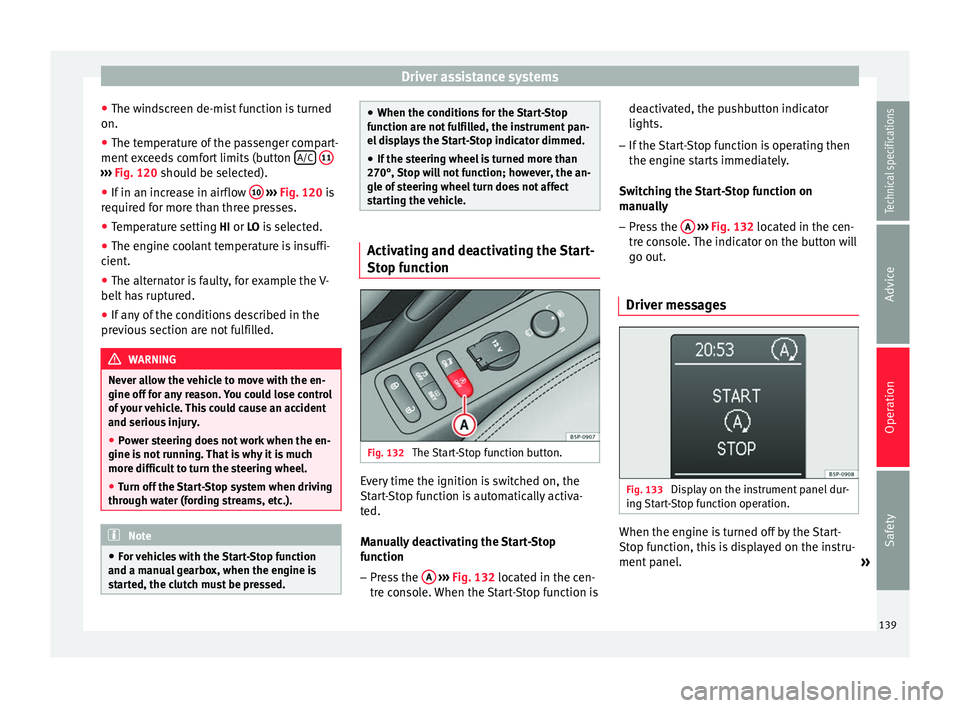
Fig. 132
The Start-Stop function button. Every time the ignition is switched on, the
Start-Stop function is automatically activa-
ted.
Manually deactivating the Start-Stop
function
– Press the A
››› Fig. 132 located in the cen-
tre console. When the Start-Stop function is deactivated, the pushbutton indicator
lights.
– If the Start-Stop function is operating then
the engine starts immediately.
Switching the Start-Stop function on
manually – Press the A
››› Fig. 132 located in the cen-
tre console. The indicator on the button will
go out.
Driver messages Fig. 133
Display on the instrument panel dur-
ing Start-Stop function operation. When the engine is turned off by the Start-
Stop function, this is displayed on the instru-
ment panel.
»
139Technical specifications
Advice
Operation
Safety
Page 173 of 236
Checking and refilling levels
WARNING
Any work carried out in the engine compart-
ment or on the engine must be carried out
cautiously.
● When working in the engine compartment,
always observe the safety warnings
››› page 163.
● When the engine is warm or hot, the cool-
ing system is pressurised! Do not unscrew
the cap on the coolant expansion tank when
the engine is hot. This is a burn injury risk. CAUTION
● When mixed with other additives the colour
of G12 will change to brown. If this occurs
you should have the coolant changed imme-
diately. Failure to do so will result in engine
damage!
● If a lot of coolant fluid has been lost, wait
for the engine to cool. This avoids damaging
the en gine. Lar
ge coolant losses are an indi-
cation of leaks in the cooling system. See a
specialised workshop immediately and have
the cooling system checked. Otherwise, there
is a risk of engine damage. Windscreen washer reservoir
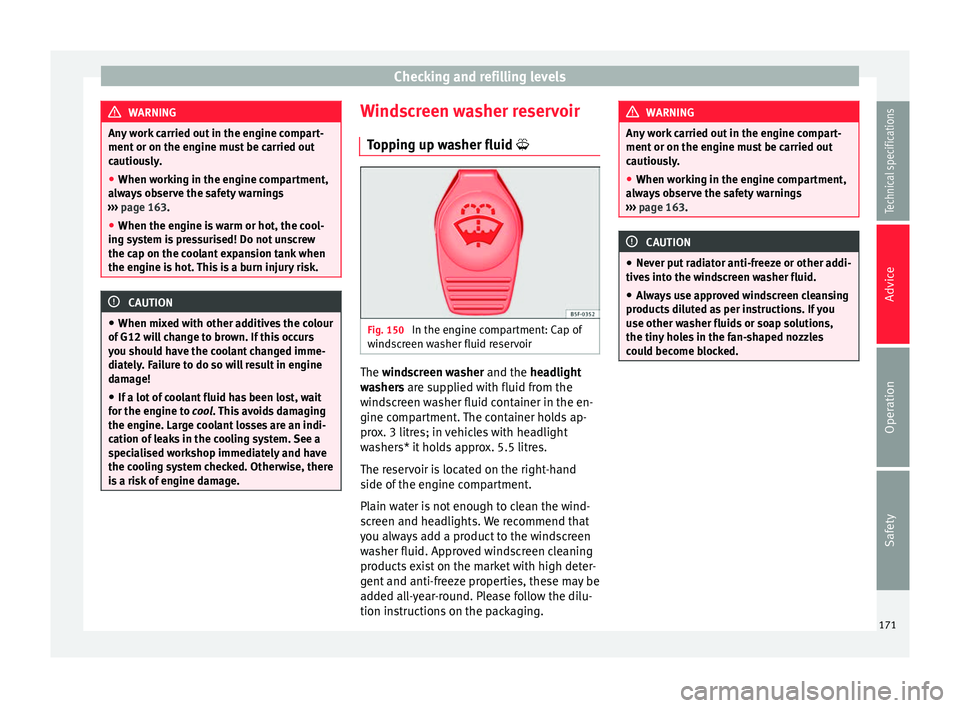
Topping up washer fluid Fig. 150
In the engine compartment: Cap of
windscreen washer fluid reservoir The
windscreen washer
and the
headlight
washers are supplied with fluid from the
windscreen washer fluid container in the en-
gine compartment. The container holds ap-
prox. 3 litres; in vehicles with headlight
washers* it holds approx. 5.5 litres.
The reservoir is located on the right-hand
side of the engine compartment.
Plain water is not enough to clean the wind-
screen and headlights. We recommend that
you always add a product to the windscreen
washer fluid. Approved windscreen cleaning
products exist on the market with high deter-
gent and anti-freeze properties, these may be
added all-year-round. Please follow the dilu-
tion instructions on the packaging. WARNING
Any work carried out in the engine compart-
ment or on the engine must be carried out
cautiously.
● When working in the engine compartment,
always observe the safety warnings
››› page 163. CAUTION
● Never put radiator anti-freeze or other addi-
tives into the windscreen washer fluid.
● Always use approved windscreen cleansing
products diluted as per instructions. If you
use other washer fluids or soap solutions,
the tiny holes in the fan-shaped nozzles
could become blocked. 171
Technical specifications
Advice
Operation
Safety
Page 185 of 236
Emergencies
– Switch off the engine. Switch on the hazard
warning lights.
– Apply the handbrake firmly.
– En g
age the first gear , or put
the selector
lever to position P for those vehicles with
an automatic gearbox.
– If you are towing a trailer, unhitch it from
your vehicle.
– Take the vehicle tools and the spare wheel
out of
the luggage compartment. WARNING
Put the hazard warning lights on and place
the warning triangle in position. This is for
your own safety and also warns other road
users. CAUTION
If you have to change the tyre on a gradient,
block the wheel opposite the wheel being
changed by placing a stone or similar object
under it to prevent the vehicle from rolling
away. Note
Please observe related legal requirements. Changing a wheel
Change the wheel as described below: –
Remove the wheel cover
. A
l
so refer to
››› Fig. 155.
– Slac
ken the wheel bolts .
– Rai
se the vehicle with the jack at the corre-
spondin
g area.
– Remove the wheel and put
on the spare
one.
– Lower the vehicle.
– Tighten the wheel
bolts firmly with the box
sp
anner.
– Replace the hub cap.
Aft
er changing a wheel –
Put the tools back in their storage location.
– Place the wheel with the defective tyre in
the luggage compartment and secure it.
– Check the tyre pressure of the newly fitted
tyre as soon as possible.
– Have the tightening torque of the wheel
bolts checked as soon as possible with a
torque wrench. The prescribed torque must
be 120 Nm. Note
● If you notice that the wheel bolts are corro-
ded and difficult to turn when changing a wheel, they must be replaced before having
the wheel bolt tightening torque checked.
● For safety reasons, drive at moderate
speeds until the wheel bolt tightening torque
has been checked. Wheel trims
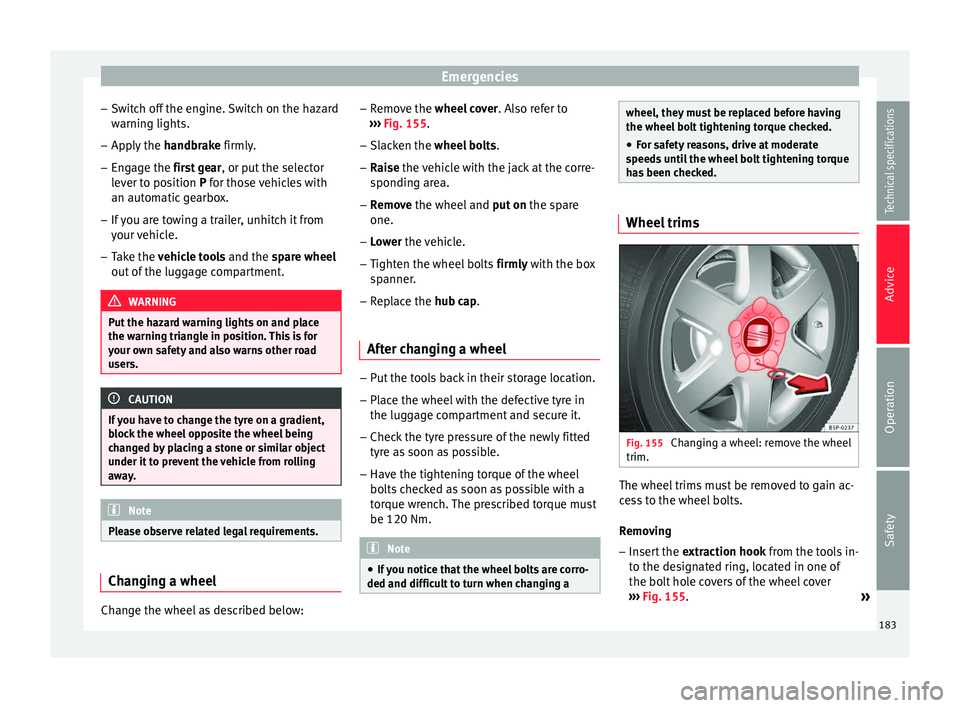
Fig. 155
Changing a wheel: remove the wheel
trim. The wheel trims must be removed to gain ac-
cess to the wheel bolts.
Removing
– Insert the extraction hook from the tools in-
to the designated ring, located in one of
the bolt hole covers of the wheel cover
››› Fig. 155 .
»
183
Technical specifications
Advice
Operation
Safety
Page 189 of 236
Emergencies
After inserting the sealant residue in the tyre,
you must again check the tyre pressure about
10 minutes after starting the engine.
You should only use the tire mobility set if
the vehicle is parked in a safe place, you are
familiar with the procedure and you have the
necessary tire mobility set! Otherwise, you
should seek professional assistance.
The tyre sealant must not be used in the
following cases:
● If the wheel rim has been damaged.
● In outside temperatures below -20 °C
(-4 °F).
● In the event of cuts or perforations in the
tyre greater than 4 mm.
● If you have been driving with very low pres-
sure or a completely flat tyre.
● If the sealant bottle has passed its use by
date. WARNING
Using the tyre mobility system can be dan-
gerous, especially when filling the tyre at the
roadside. Please observe the following rules
to minimise the risk of injury:
● Stop the vehicle safely as soon as possible.
Park it at a safe distance from surrounding
traffic to fill the tyre.
● Ensure the ground on which you park is flat
and solid. ●
All passengers and particularly children
must keep a safe distance from the work area.
● Turn on the hazard warning lights to warn
other road users.
● Use the tyre mobility system only if you are
familiar with the necessary procedures. Oth-
erwise, you should seek professional assis-
tance.
● The tyre mobility set is intended for tempo-
rary emergency use only until you can reach
the nearest specialised workshop.
● Replace the repaired tyre with the tire mo-
bility set as soon as possible.
● The sealant is a health hazard and must be
cleaned immediately if it comes into contact
with the skin.
● Always keep the tire mobility set out of the
reach of small children.
● Never use an equivalent jack, even if it has
been approved for your vehicle.
● Always stop the engine, apply the hand-
brake lever firmly and engage gear if using a
manual gearbox, in order to reduce the risk of
vehicle involuntary movement. WARNING
A tyre filled with sealant does not have the
same performance properties as a conven-
tional tyre.
● Never drive faster than 80 km/h (50 mph).
● Avoid heavy acceleration, hard braking and
fast cornering. ●
Drive only during 10 minutes at a maximum
speed of 80 km/h (50 mph) and subsequently
check the tyre. For the sake of the environment
Dispose of used or expired sealant observing
any legal requirements. Note
● A new bottle of sealant can be purchased at
SEAT dealerships.
● Take into account the separate instruction
manual from the tyre mobility set* manufac-
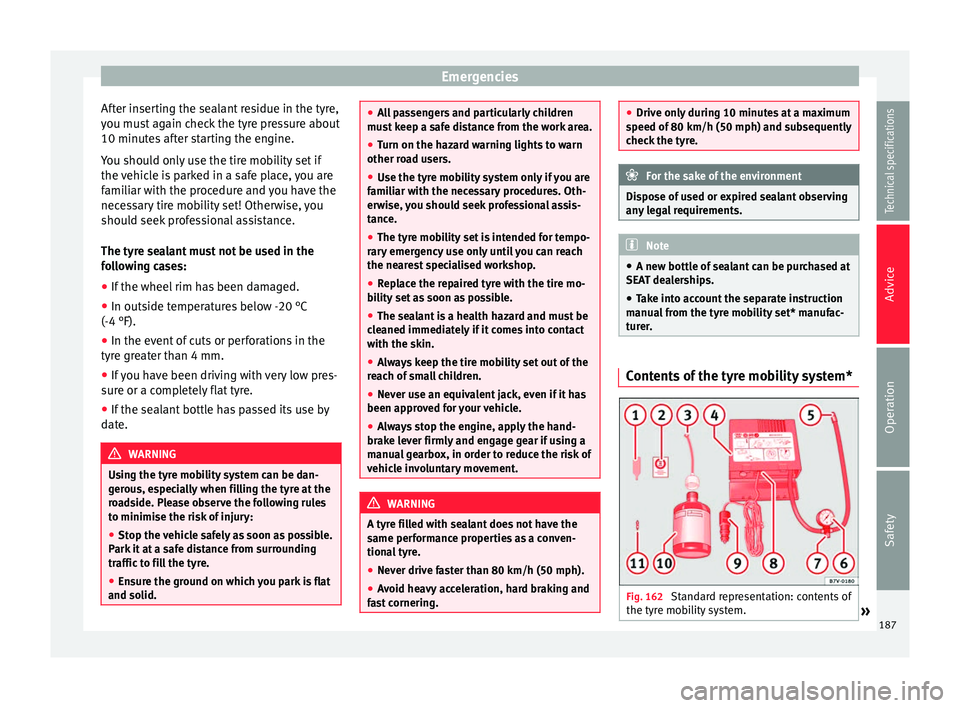
turer. Contents of the tyre mobility system*
Fig. 162
Standard representation: contents of
the tyre mobility system. » 187Technical specifications
Advice
Operation
Safety
Page 192 of 236
Advice
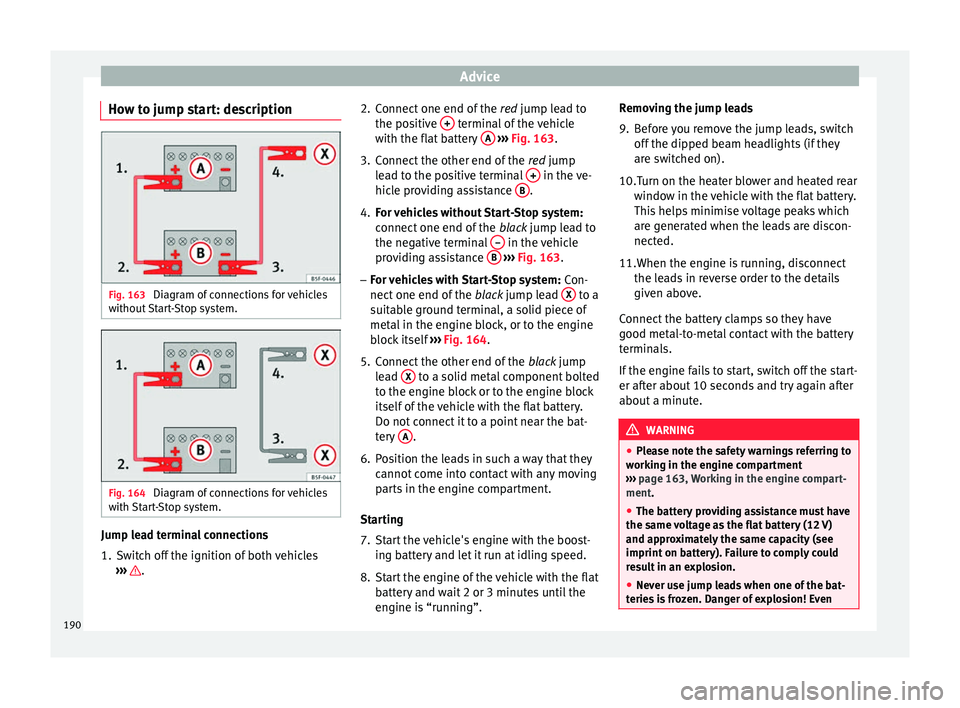
How to jump start: description Fig. 163
Diagram of connections for vehicles
without Start-Stop system. Fig. 164
Diagram of connections for vehicles
with Start-Stop system. Jump lead terminal connections
1. Switch off the ignition of both vehicles
››› . 2. Connect one end of the
red jump lead to
the po s
itive + terminal of the vehicle
with the flat battery A
››› Fig. 163 .
3. C
onnect the other end of the red
jump
lead to the positive terminal + in the ve-
hicle providing assistance B .
4. For vehicles without Start-Stop system:
connect one end of the black jump lead to
the negative terminal – in the vehicle
providing assistance B
››› Fig. 163 .
– For
vehicles with Start-Stop system: Con-
nect one end of the black jump lead X to a
suitable ground terminal, a solid piece of
metal in the engine block, or to the engine
block itself ››› Fig. 164.
5. Connect the other end of the black jump
lead X to a solid metal component bolted
to the engine block or to the engine block
itself of the vehicle with the flat battery.
Do not connect it to a point near the bat-
tery A .
6. Position the leads in such a way that they cannot come into contact with any moving
parts in the engine compartment.
Starting
7. Start the vehicle's engine with the boost- ing battery and let it run at idling speed.
8. Start the engine of the vehicle with the flat battery and wait 2 or 3 minutes until the
engine is “running”. Removing the jump leads
9. Before you remove the jump leads, switch
off the dipped beam headlights (if they
are switched on).
10.Turn on the heater blower and heated rear window in the vehicle with the flat battery.
This helps minimise voltage peaks which
are generated when the leads are discon-
nected.
11. When the engine is running, disconnect
the l e
ads in reverse order to the details
given above.
Connect the battery clamps so they have
good metal-to-metal contact with the battery
terminals.
If the engine fails to start, switch off the start-
er after about 10 seconds and try again after
about a minute. WARNING
● Please note the safety warnings referring to
working in the engine compartment
››› page 163, Working in the engine compart-
ment.
● The b att
ery providing assistance must have
the same voltage as the flat battery (12 V)
and approximately the same capacity (see
imprint on battery). Failure to comply could
result in an explosion.
● Never use jump leads when one of the bat-
teries is frozen. Danger of explosion! Even 190
Page 194 of 236
Advice
Driving style
Towing requires some experience, especially
when using a tow rope. Both drivers should
be familiar with the technique required for
towing. Inexperienced drivers should not at-
tempt to tow.
Do not pull too hard with the towing vehicle
and take care to avoid jerking the tow rope.
When towing on an unpaved road, there is al-
ways a risk of overloading and damaging the
anchorage points.
The ignition of the vehicle being towed must
be switched on to prevent the steering wheel
from locking and also to allow the use of the
turn signals, horn, windscreen wipers and
washers.
The brake servo only works when the engine
is running. When not running, you must ap-
ply considerably more pressure to the brake
pedal.
As the power assisted steering does not work
if the engine is not running, you will need
more strength to steer than you normally
would.
● The vehicle must not be towed faster than
50 km/h (31 mph).
Towing vehicles with an automatic gearbox
● Put the selector lever into position “N”.
● Do not drive faster than 50 km/h (31 mph). ●
Do not tow further than 50 km.
● If a breakdown vehicle is used, the vehicle
must be towed with the front wheels raised. Note
● Observe legal requirements when towing or
tow-starting.
● Switch on the hazard warning lights of both
vehicles. However, observe any regulations
to the contrary.
● For technical reasons, vehicles with an au-
tomatic gearbox must not be tow-started.
● If there is no lubricant in the gearbox as the
result of a fault, you must raise the driven
wheels while the vehicle is being towed.
● If the vehicle has to be towed more than
50 km, the front wheels should be raised dur-
ing towing, and towing should be carried out
by a qualified person.
● The steering wheel is locked when the vehi-
cle has no electrical power. The vehicle must
then be towed with the front wheels raised.
Towing should be carried out by a qualified
person.
● The towline anchorage should always be
kept in the vehicle. Please refer to the notes
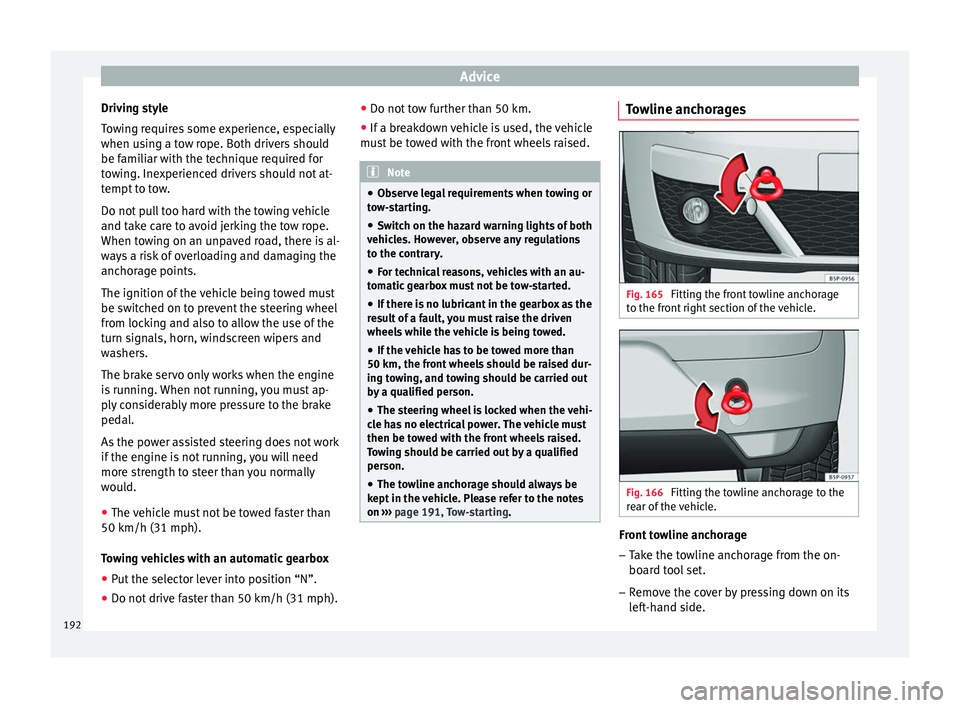
on ››› page 191, Tow-starting. Towline anchorages
Fig. 165
Fitting the front towline anchorage
to the front right section of the vehicle. Fig. 166
Fitting the towline anchorage to the
rear of the vehicle. Front towline anchorage
– Take the towline anchorage from the on-
board tool set.
– Remove the cover by pressing down on its
left-hand side.
192
Page 199 of 236
Fuses and bulbs
WARNING
The high voltages in the electrical system can
give serious electrical shocks, causing burns
and even death!
● Never touch the electrical wiring of the igni-
tion system.
● Take care not to cause short circuits in the
electrical system. WARNING
Using unsuitable fuses, repairing fuses or
bridging a current circuit without fuses can
cause a fire and serious injury.
● Never use a fuse with a higher value. Only
replace fuses with a fuse of the same amper-
age (same colour and markings) and size.
● Never repair a fuse.
● Never replace a fuse by a metal strip, staple
or similar. CAUTION
● To prevent damage to the vehicle's electric
system, before replacing a fuse turn off the
ignition, the lights and all electrical elements
and remove the key from the ignition.
● If you replace a fuse with higher-rating
fuse, you could cause damage to another part
of the electrical system.
● Protect the fuse boxes when open to pre-
vent the entry of dust or humidity as they can
damage the electrical system. Note
● One component may have more than one
fuse.
● Several components may run on a single
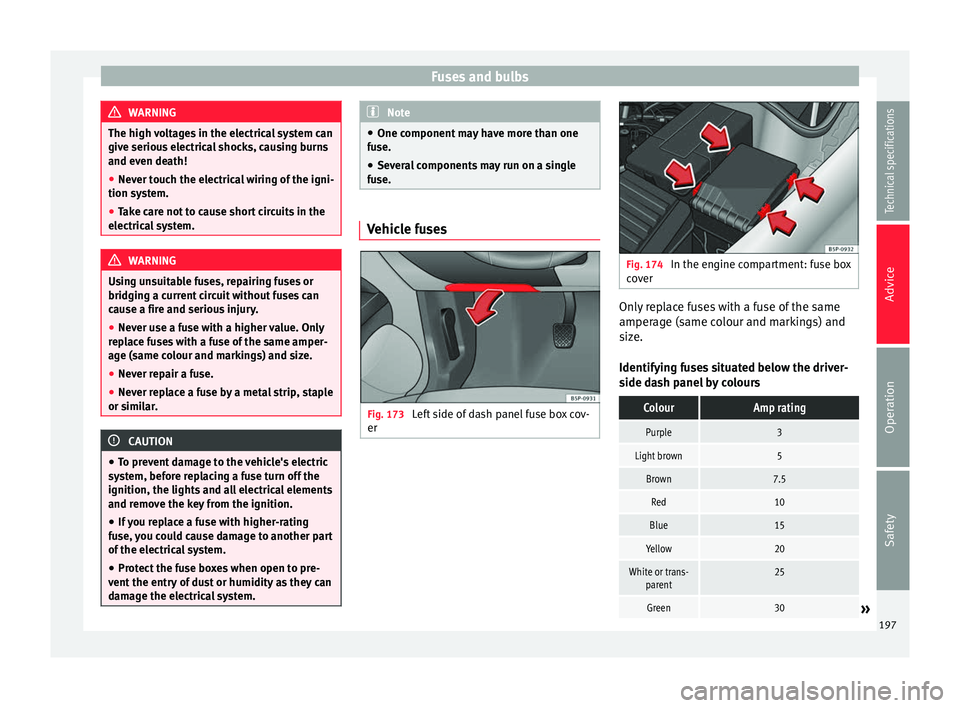
fuse. Vehicle fuses
Fig. 173
Left side of dash panel fuse box cov-
er Fig. 174
In the engine compartment: fuse box
cover Only replace fuses with a fuse of the same
amperage (same colour and markings) and
size.
Identifying fuses situated below the driver-
side dash panel by coloursColourAmp rating
Purple3
Light brown5
Brown7.5
Red10
Blue15
Yellow20
White or trans-
parent25
Green30» 197
Technical specifications
Advice
Operation
Safety
Page 225 of 236
Index
Index
A
ABS . . . . . . . . . . . . . . . . . . . . . . . . . . . . . . . . . . . . 136 control lamp . . . . . . . . . . . . . . . . . . . . . . . . . . . . 41
Accessories . . . . . . . . . . . . . . . . . . . . . . . . . . . . . . 147
Acoustic warning . . . . . . . . . . . . . . . . . . . . . . . . . 120
Adaptive headlights . . . . . . . . . . . . . . . . . . . . . . . . 80
Adjusting the seat belt height . . . . . . . . . . . . . . . . 16
AFS (cornering lights) . . . . . . . . . . . . . . . . . . . . . . 80
Airbag covers . . . . . . . . . . . . . . . . . . . . . . . . . . . . . 20
Airbags description . . . . . . . . . . . . . . . . . . . . . . . . . . . . . 18
Airbag system . . . . . . . . . . . . . . . . . . . . . . . . . . 17, 20 activation . . . . . . . . . . . . . . . . . . . . . . . . . . . . . . 18
control lamp . . . . . . . . . . . . . . . . . . . . . . . . . . . . 19
functioning . . . . . . . . . . . . . . . . . . . . . . . . . . . . . 18
head-protection airbags . . . . . . . . . . . . . . . . . . 22
side airbags . . . . . . . . . . . . . . . . . . . . . . . . . . . . 21
Air conditioner 2C-Climatronic . . . . . . . . . . . . . . . . . . . . . . . . . 112
General notes . . . . . . . . . . . . . . . . . . . . . . . . . . 116
Air conditioner automatic mode 2C-Climatronic . . . . . . . . . . . . . . . . . . . . . . . . . 113
Air conditioning . . . . . . . . . . . . . . . . . . . . . . . . . . 109
Air recirculation mode 2C-Climatronic . . . . . . . . . . . . . . . . . . . . . . . . . 115
Manual air conditioner . . . . . . . . . . . . . . . . . . . 111
Alarm system Switching off . . . . . . . . . . . . . . . . . . . . . . . . . . . . 69
Alcantara . . . . . . . . . . . . . . . . . . . . . . . . . . . . . . . . 154
All-wheel drive . . . . . . . . . . . . . . . . . . . . . . . . . . . 117
Alternator Warning lamp . . . . . . . . . . . . . . . . . . . . . . . . . . . 42
Anti-lock brake system . . . . . . . . . . . . . . . . . . . . . 136 control lamp . . . . . . . . . . . . . . . . . . . . . . . . . . . . 41 Anti-theft alarm system . . . . . . . . . . . . . . . . . . . . . 68
Interior monitoring . . . . . . . . . . . . . . . . . . . . . . . 70
Switching off . . . . . . . . . . . . . . . . . . . . . . . . . . . . 69
Tow-away protection . . . . . . . . . . . . . . . . . . . . . . 70
Anti-theft wheel bolts . . . . . . . . . . . . . . . . . . . . . 184
Antifreeze . . . . . . . . . . . . . . . . . . . . . . . . . . . . . . . 169
Aquaplaning . . . . . . . . . . . . . . . . . . . . . . . . . . . . . 177
Ashtray . . . . . . . . . . . . . . . . . . . . . . . . . . . . . . . . . . 98
Aspects to note before setting off . . . . . . . . . . . . . . 5
ASR . . . . . . . . . . . . . . . . . . . . . . . . . . . . . . . . . . . . 137 Control lamp . . . . . . . . . . . . . . . . . . . . . . . . . . . . 46
Audible warning . . . . . . . . . . . . . . . . . . . . . . . . . . . 12
Automatic anti-dazzle interior rear vision mirror Activating the anti-dazzle function . . . . . . . . . . 86
Deactivating the anti-dazzle function . . . . . . . . 86
Automatic car wash tunnel . . . . . . . . . . . . . . . . . 149
Automatic gearbox Kick-down feature . . . . . . . . . . . . . . . . . . . . . . . 130
Automatic gearbox/DSG automatic gearbox . . . 127
Automatic lighting . . . . . . . . . . . . . . . . . . . . . . . . . 76
Automatic windscreen wiping . . . . . . . . . . . . . . . . 84
Automatic wipe with rain sensor . . . . . . . . . . . . . . 84
Auxiliary audio input: AUX-IN . . . . . . . . . . . . . . . . 99
B Ball coupling . . . . . . . . . . . . . . . . . . . . . . . . . . . . . 145
Battery . . . . . . . . . . . . . . . . . . . . . . . . . . . . . . . . . . . 68 Changing . . . . . . . . . . . . . . . . . . . . . . . . . . . . . . 174
Charging . . . . . . . . . . . . . . . . . . . . . . . . . . . . . . 174
Winter conditions . . . . . . . . . . . . . . . . . . . . . . . 173
Before setting off . . . . . . . . . . . . . . . . . . . . . . . . . . . 5
Belt tightening . . . . . . . . . . . . . . . . . . . . . . . . . . . . 16
Biodiesel . . . . . . . . . . . . . . . . . . . . . . . . . . . . . . . . 160
Biodiesel fuel . . . . . . . . . . . . . . . . . . . . . . . . . . . . 160
Bonnet . . . . . . . . . . . . . . . . . . . . . . . . . . . . . . . . . 165 Boot hatch . . . . . . . . . . . . . . . . . . . . . . . . . . . . . . . 71
control lamp . . . . . . . . . . . . . . . . . . . . . . . . . . . . 45
Emergency opening . . . . . . . . . . . . . . . . . . . . . 194
Boot lid . . . . . . . . . . . . . . . . . . . . . . . . . . . . . . . . . . 71 Emergency opening . . . . . . . . . . . . . . . . . . . . . 194
Brake fluid . . . . . . . . . . . . . . . . . . . . . . . . . . . . . . 172 Changing . . . . . . . . . . . . . . . . . . . . . . . . . . . . . . 172
control lamp . . . . . . . . . . . . . . . . . . . . . . . . . . . . 49
Brake pads . . . . . . . . . . . . . . . . . . . . . . . . . . . . . . 123
Brake pedal Control lamp . . . . . . . . . . . . . . . . . . . . . . . . . . . . 46
Brakes . . . . . . . . . . . . . . . . . . . . . . . . . . . . . . . . . . 123 Worn brake pads . . . . . . . . . . . . . . . . . . . . . . . . . 42
Brake servo . . . . . . . . . . . . . . . . . . . . . . . . . 123, 138
Brake system . . . . . . . . . . . . . . . . . . . . . . . . . . . . 172 Brakes . . . . . . . . . . . . . . . . . . . . . . . . . . . . . . . . 123
Brake servo . . . . . . . . . . . . . . . . . . . . . . . . . . . . 123
warning lamp . . . . . . . . . . . . . . . . . . . . . . . . . . . 44
Bulb defect Control lamp . . . . . . . . . . . . . . . . . . . . . . . . . . . . 44
Buzzer . . . . . . . . . . . . . . . . . . . . . . . . . . . . . . 77, 120
C
Car care Exterior . . . . . . . . . . . . . . . . . . . . . . . . . . . . . . . 149
Car care products . . . . . . . . . . . . . . . . . . . . . . . . . 148
Catalytic converter . . . . . . . . . . . . . . . . . . . . . . . . 131
CCS . . . . . . . . . . . . . . . . . . . . . . . . . . . . . . . . . . . . 142
CD changer . . . . . . . . . . . . . . . . . . . . . . . . . . . . . . . 93
Central lock button Locking . . . . . . . . . . . . . . . . . . . . . . . . . . . . . . . . 65
Unlocking . . . . . . . . . . . . . . . . . . . . . . . . . . . . . . 65
Central locking . . . . . . . . . . . . . . . . . . . . . . . . . . . . 63 Automatic locking system for involuntary un-locking . . . . . . . . . . . . . . . . . . . . . . . . . . . . . . . 65
Automatic speed-dependent locking and un- locking system . . . . . . . . . . . . . . . . . . . . . . . . 64
223