engine Seat Altea 2015 Manual PDF
[x] Cancel search | Manufacturer: SEAT, Model Year: 2015, Model line: Altea, Model: Seat Altea 2015Pages: 236, PDF Size: 4.23 MB
Page 174 of 236
Advice
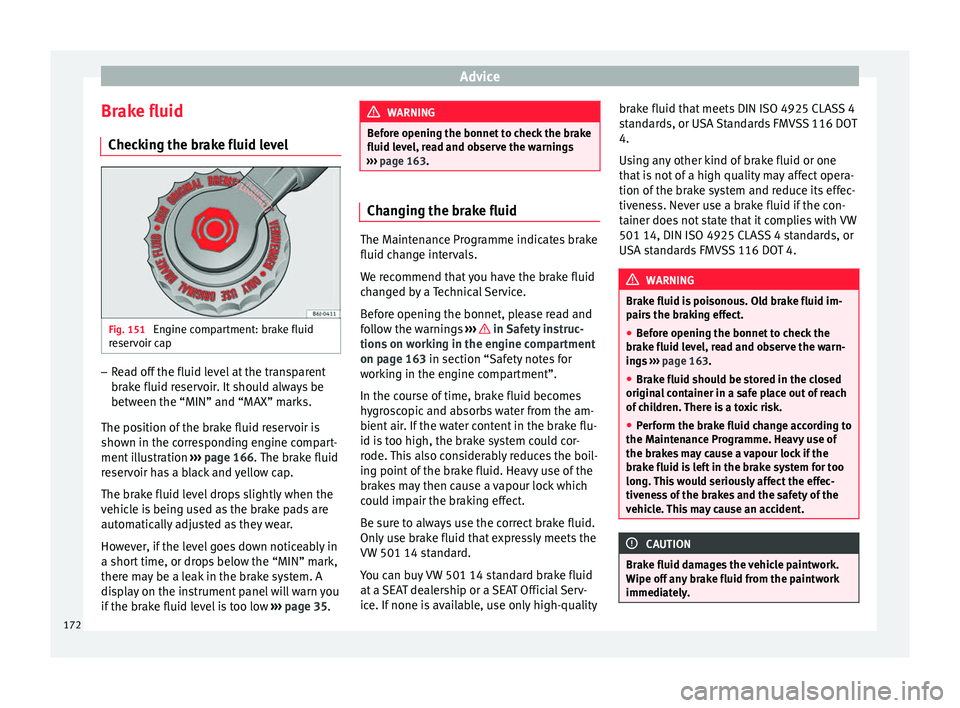
Brake fluid Checking the brake fluid level Fig. 151
Engine compartment: brake fluid
reservoir cap –
Read off the fluid level at the transparent
brake fluid reservoir. It should always be
between the “MIN” and “MAX” marks.
The position of the brake fluid reservoir is
shown in the corresponding engine compart-
ment illustration ››› page 166. The brake fluid
reservoir has a black and yellow cap.
The brake fluid level drops slightly when the
vehicle is being used as the brake pads are
automatically adjusted as they wear.
However, if the level goes down noticeably in
a short time, or drops below the “MIN” mark,
there may be a leak in the brake system. A
display on the instrument panel will warn you
if the brake fluid level is too low ››› page 35. WARNING
Before opening the bonnet to check the brake
fluid level, read and observe the warnings
››› page 163. Changing the brake fluid
The Maintenance Programme indicates brake
fluid change intervals.
We recommend that you have the brake fluid
changed by a Technical Service.
Before opening the bonnet, please read and
follow the warnings
››› in Safety instruc-
tions on working in the engine compartment
on page 163 in section “Safety notes for
w ork
ing in the engine compartment”.
In the course of time, brake fluid becomes
hygroscopic and absorbs water from the am-
bient air. If the water content in the brake flu-
id is too high, the brake system could cor-
rode. This also considerably reduces the boil-
ing point of the brake fluid. Heavy use of the
brakes may then cause a vapour lock which
could impair the braking effect.
Be sure to always use the correct brake fluid.
Only use brake fluid that expressly meets the
VW 501 14 standard.
You can buy VW 501 14 standard brake fluid
at a SEAT dealership or a SEAT Official Serv-
ice. If none is available, use only high-quality brake fluid that meets DIN ISO 4925 CLASS 4
standards, or USA Standards FMVSS 116 DOT
4.
Using any other kind of brake fluid or one
that is not of a high quality may affect opera-
tion of the brake system and reduce its effec-
tiveness. Never use a brake fluid if the con-
tainer does not state that it complies with VW
501 14, DIN ISO 4925 CLASS 4 standards, or
USA standards FMVSS 116 DOT 4.
WARNING
Brake fluid is poisonous. Old brake fluid im-
pairs the braking effect.
● Before opening the bonnet to check the
brake fluid level, read and observe the warn-
ings ››› page 163.
● Br ak
e fluid should be stored in the closed
original container in a safe place out of reach
of children. There is a toxic risk.
● Perform the brake fluid change according to
the Maintenance Programme. Heavy use of
the brakes may cause a vapour lock if the
brake fluid is left in the brake system for too
long. This would seriously affect the effec-
tiveness of the brakes and the safety of the
vehicle. This may cause an accident. CAUTION
Brake fluid damages the vehicle paintwork.
Wipe off any brake fluid from the paintwork
immediately. 172
Page 175 of 236
Checking and refilling levels
For the sake of the environment
The brake pads and brake fluid must be col-
lected and disposed of according the applica-
ble regulations. The SEAT Technical Service
network has the necessary equipment and
qualified personnel for collecting and dispos-
ing of this waste material. Vehicle battery
Warnings on handling the battery Wear eye protection
Battery acid is extremely corrosive. Wear pro-
tective gloves and eye protection!
Fires, sparks, open flames and smoking are
prohibited!
A highly explosive mixture of gases is released
when the battery is under charge.
Keep children away from acid and batteries!
WARNING
Always be aware of the danger of injury and
chemical burns as well as the risk of accident
or fire when working on the battery and the
electrical system:
● Wear eye protection. Protect your eyes,
skin and clothing from acid and particles con-
taining lead. ●
Battery acid is extremely corrosive. Wear
protective gloves and eye protection. Do not
tilt the batteries. This could spill acid through
the vents. Rinse battery acid from eyes imme-
diately for several minutes with clear water.
Then seek medical care immediately. Neutral-
ise any acid splashes on the skin or clothing
with a soapy solution, and rinse off with plen-
ty of water. If acid is swallowed by mistake,
consult a doctor immediately.
● Fires, sparks, open flames and smoking are
prohibited. When handling cables and electri-
cal equipment, avoid causing sparks and
electrostatic charge. Never short the battery
terminals. High-energy sparks can cause in-
jury.
● A highly explosive mixture of gases is re-
leased when the battery is under charge. The
batteries should be charged in a well-ventila-
ted room only.
● Keep children away from acid and batteries.
● Before working on the electrical system,
you must switch off the engine, the ignition
and all electrical devices. The negative cable
on the battery must be disconnected. When a
light bulb is changed, you need only switch
off the light.
● Deactivate the anti-theft alarm by unlock-
ing the vehicle before you disconnect the bat-
tery! The alarm will otherwise be triggered.
● When disconnecting the battery from the
vehicle on-board network, disconnect first
the negative cable and then the positive ca-
ble. ●
Switch off all electrical devices before re-
connecting the battery. Reconnect first the
positive cable and then the negative cable.
Never reverse the polarity of the connections.
This could cause an electrical fire.
● Never charge a frozen battery, or one which
has thawed. This could result in explosions
and chemical burns. Always replace a battery
which has frozen. A flat battery can also
freeze at temperatures close to 0 °C (+32 °F).
● Ensure that the vent hose is always connec-
ted to the battery.
● Never use a defective battery. This could
cause an explosion. Replace a damaged bat-
tery immediately. CAUTION
● Never disconnect the battery if the ignition
is switched on or if the engine is running.
This could damage the electrical system or
electronic components.
● Do not expose the battery to direct sunlight
over a long period of time, as the intense ul-
traviolet radiation can damage the battery
housing.
● If the vehicle is left standing in cold condi-
tions for a long period, protect the battery
from “freezing”. If it freezes it will be dam-
aged. 173
Technical specifications
Advice
Operation
Safety
Page 176 of 236
Advice
Checking the electrolyte level The electrolyte level should be checked regu-
larly in high-mileage vehicles, in hot coun-
tries and in older batteries.
– Open the bonnet and open the battery cov-
er at the front ››› in Safety instructions
on working in the engine compartment on
page 164 ››› in Warnings on handling
the battery on page 173.
– Check the colour display in the "magic eye"
on the top of the battery.
– If there are air bubbles in the window, tap
the window gently until they disperse.
The position of the battery is shown in the
corresponding engine compartment diagram
››› page 166 .
The “m agic
eye” indicator, located on the top
of the battery changes colour, depending on
the charge state and electrolyte level of the
battery.
There are two different colours:
● Black: correct charge status.
● Transparent/clear yellow: the battery must
be replaced. Contact a specialised workshop. Charging and changing the vehicle
battery The battery is maintenance-free and is
checked during the inspection service. All
work on the vehicle battery requires special-
ist knowledge.
If you often drive short distances or if the ve-
hicle is not driven for long periods, the bat-
tery should be checked by a specialised
workshop between the scheduled services.
If the battery has discharged and you have
problems starting the vehicle, the battery
might be damaged. If this happens, we rec-
ommend you have the vehicle battery
checked by a Technical Service where it will
be re-charged or replaced.
Charging the battery
The vehicle battery should be charged by a
specialised workshop only, as batteries us-
ing special technology have been installed
and they must be charged in a controlled en-
vironment.
Replacing a vehicle battery
The battery has been developed to suit the
conditions of its location and has special
safety features.
Genuine SEAT batteries meet the mainte-
nance, performance and safety specifications
of your vehicle. WARNING
● We recommend you use only maintenance-
free or cycle free leak-proof batteries which
comply with standards T 825 06 and
VW 7 50 73. This standard applies as of
2001.
● Before starting any work on the batteries,
you must read and observe the warnings
››› in Warnings on handling the battery on
page 173. For the sake of the environment
Batteries contain toxic substances such as
sulphuric acid and lead. They must be dis-
posed of appropriately and must not be dis-
posed of with ordinary household waste. 174
Page 184 of 236
Advice
●
Never start the engine when the vehicle is
on the jack. Risk of accident.
● If work is to be carried out underneath the
vehicle, this must be secured by suitable
stands. Otherwise, there is a risk of injury. Note
The jack does not generally require any main-
tenance. If required, it should be greased us-
ing universal-type grease. Compact spare wheel* (temporary
spare wheel)
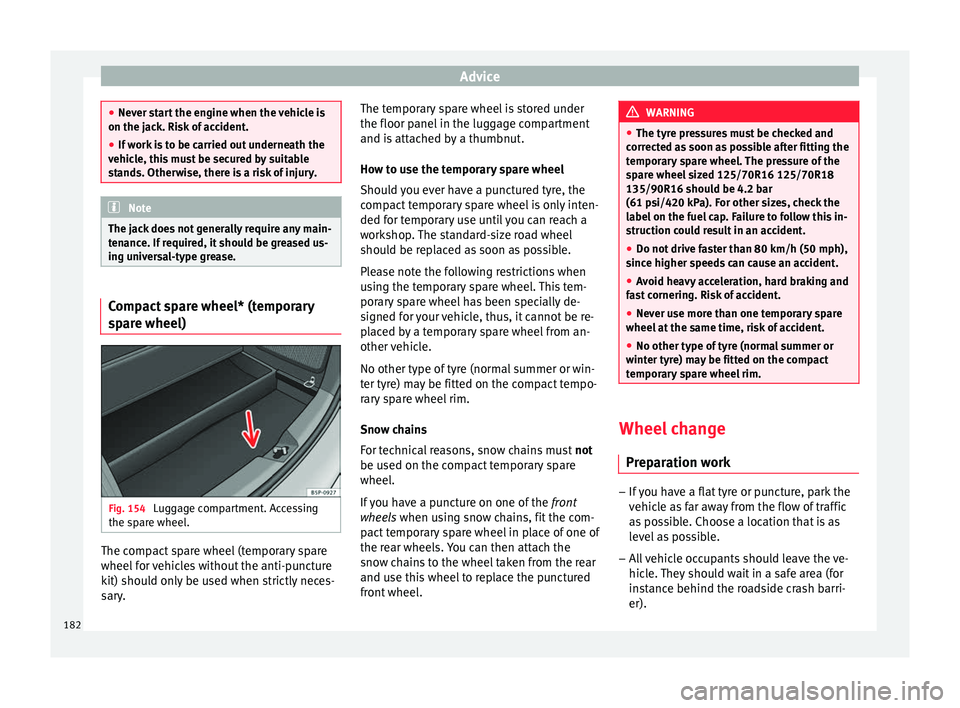
Fig. 154
Luggage compartment. Accessing
the spare wheel. The compact spare wheel (temporary spare
wheel for vehicles without the anti-puncture
kit) should only be used when strictly neces-
sary. The temporary spare wheel is stored under
the floor panel in the luggage compartment
and is attached by a thumbnut.
How to use the temporary spare wheel
Should you ever have a punctured tyre, the
compact temporary spare wheel is only inten-
ded for temporary use until you can reach a
workshop. The standard-size road wheel
should be replaced as soon as possible.
Please note the following restrictions when
using the temporary spare wheel. This tem-
porary spare wheel has been specially de-
signed for your vehicle, thus, it cannot be re-
placed by a temporary spare wheel from an-
other vehicle.
No other type of tyre (normal summer or win-
ter tyre) may be fitted on the compact tempo-
rary spare wheel rim.
Snow chains
For technical reasons, snow chains must
not
be used on the compact temporary spare
wheel.
If you have a puncture on one of the front
wheels when using snow chains, fit the com-
p act
temporary spare wheel in place of one of
the rear wheels. You can then attach the
snow chains to the wheel taken from the rear
and use this wheel to replace the punctured
front wheel. WARNING
● The tyre pressures must be checked and
corrected as soon as possible after fitting the
temporary spare wheel. The pressure of the
spare wheel sized 125/70R16 125/70R18
135/90R16 should be 4.2 bar
(61 psi/420 kPa). For other sizes, check the
label on the fuel cap. Failure to follow this in-
struction could result in an accident.
● Do not drive faster than 80 km/h (50 mph),
since higher speeds can cause an accident.
● Avoid heavy acceleration, hard braking and
fast cornering. Risk of accident.
● Never use more than one temporary spare
wheel at the same time, risk of accident.
● No other type of tyre (normal summer or
winter tyre) may be fitted on the compact
temporary spare wheel rim. Wheel change
Preparation work –
If you have a flat tyre or puncture, park the
vehicle as far away from the flow of traffic
as possible. Choose a location that is as
level as possible.
– All vehicle occupants should leave the ve-
hicle. They should wait in a safe area (for
instance behind the roadside crash barri-
er).
182
Page 185 of 236
Emergencies
– Switch off the engine. Switch on the hazard
warning lights.
– Apply the handbrake firmly.
– En g
age the first gear , or put
the selector
lever to position P for those vehicles with
an automatic gearbox.
– If you are towing a trailer, unhitch it from
your vehicle.
– Take the vehicle tools and the spare wheel
out of
the luggage compartment. WARNING
Put the hazard warning lights on and place
the warning triangle in position. This is for
your own safety and also warns other road
users. CAUTION
If you have to change the tyre on a gradient,
block the wheel opposite the wheel being
changed by placing a stone or similar object
under it to prevent the vehicle from rolling
away. Note
Please observe related legal requirements. Changing a wheel
Change the wheel as described below: –
Remove the wheel cover
. A
l
so refer to
››› Fig. 155.
– Slac
ken the wheel bolts .
– Rai
se the vehicle with the jack at the corre-
spondin
g area.
– Remove the wheel and put
on the spare
one.
– Lower the vehicle.
– Tighten the wheel
bolts firmly with the box
sp
anner.
– Replace the hub cap.
Aft
er changing a wheel –
Put the tools back in their storage location.
– Place the wheel with the defective tyre in
the luggage compartment and secure it.
– Check the tyre pressure of the newly fitted
tyre as soon as possible.
– Have the tightening torque of the wheel
bolts checked as soon as possible with a
torque wrench. The prescribed torque must
be 120 Nm. Note
● If you notice that the wheel bolts are corro-
ded and difficult to turn when changing a wheel, they must be replaced before having
the wheel bolt tightening torque checked.
● For safety reasons, drive at moderate
speeds until the wheel bolt tightening torque
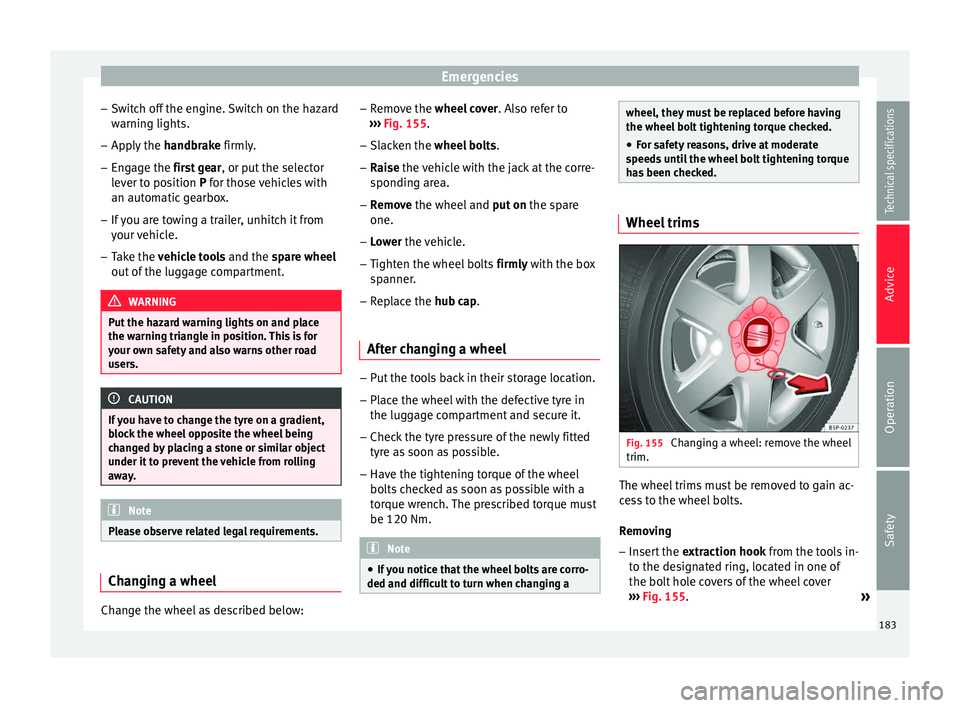
has been checked. Wheel trims
Fig. 155
Changing a wheel: remove the wheel
trim. The wheel trims must be removed to gain ac-
cess to the wheel bolts.
Removing
– Insert the extraction hook from the tools in-
to the designated ring, located in one of
the bolt hole covers of the wheel cover
››› Fig. 155 .
»
183
Technical specifications
Advice
Operation
Safety
Page 189 of 236
Emergencies
After inserting the sealant residue in the tyre,
you must again check the tyre pressure about
10 minutes after starting the engine.
You should only use the tire mobility set if
the vehicle is parked in a safe place, you are
familiar with the procedure and you have the
necessary tire mobility set! Otherwise, you
should seek professional assistance.
The tyre sealant must not be used in the
following cases:
● If the wheel rim has been damaged.
● In outside temperatures below -20 °C
(-4 °F).
● In the event of cuts or perforations in the
tyre greater than 4 mm.
● If you have been driving with very low pres-
sure or a completely flat tyre.
● If the sealant bottle has passed its use by
date. WARNING
Using the tyre mobility system can be dan-
gerous, especially when filling the tyre at the
roadside. Please observe the following rules
to minimise the risk of injury:
● Stop the vehicle safely as soon as possible.
Park it at a safe distance from surrounding
traffic to fill the tyre.
● Ensure the ground on which you park is flat
and solid. ●
All passengers and particularly children
must keep a safe distance from the work area.
● Turn on the hazard warning lights to warn
other road users.
● Use the tyre mobility system only if you are
familiar with the necessary procedures. Oth-
erwise, you should seek professional assis-
tance.
● The tyre mobility set is intended for tempo-
rary emergency use only until you can reach
the nearest specialised workshop.
● Replace the repaired tyre with the tire mo-
bility set as soon as possible.
● The sealant is a health hazard and must be
cleaned immediately if it comes into contact
with the skin.
● Always keep the tire mobility set out of the
reach of small children.
● Never use an equivalent jack, even if it has
been approved for your vehicle.
● Always stop the engine, apply the hand-
brake lever firmly and engage gear if using a
manual gearbox, in order to reduce the risk of
vehicle involuntary movement. WARNING
A tyre filled with sealant does not have the
same performance properties as a conven-
tional tyre.
● Never drive faster than 80 km/h (50 mph).
● Avoid heavy acceleration, hard braking and
fast cornering. ●
Drive only during 10 minutes at a maximum
speed of 80 km/h (50 mph) and subsequently
check the tyre. For the sake of the environment
Dispose of used or expired sealant observing
any legal requirements. Note
● A new bottle of sealant can be purchased at
SEAT dealerships.
● Take into account the separate instruction
manual from the tyre mobility set* manufac-
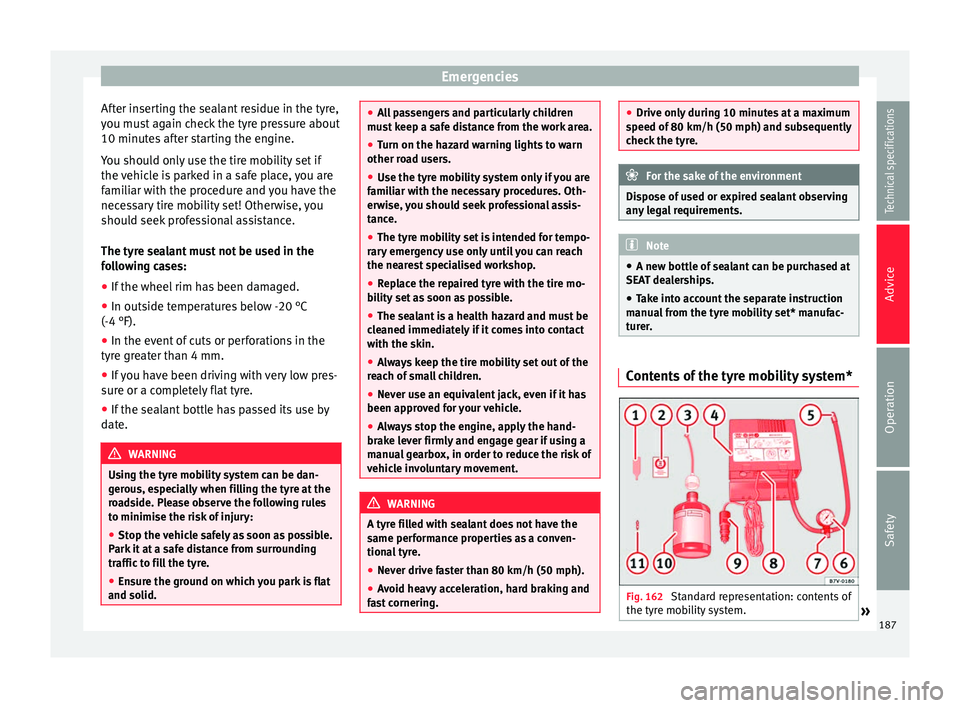
turer. Contents of the tyre mobility system*
Fig. 162
Standard representation: contents of
the tyre mobility system. » 187Technical specifications
Advice
Operation
Safety
Page 190 of 236
Advice
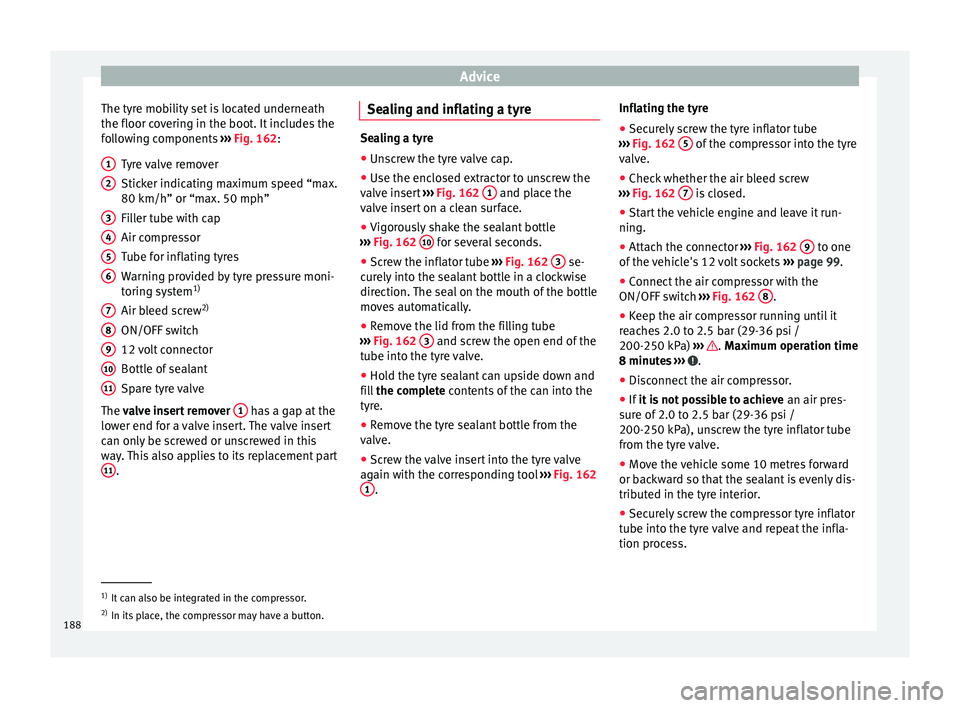
The tyre mobility set is located underneath
the floor covering in the boot. It includes the
following components ››› Fig. 162 :
T y
re valve remover
Sticker indicating maximum speed “max.
80 km/h” or “max. 50 mph”
Filler tube with cap
Air compressor
Tube for inflating tyres
Warning provided by tyre pressure moni-
toring system 1)
Air bleed screw 2)
ON/OFF switch
12 volt connector
Bottle of sealant
Spare tyre valve
The
valve insert remover 1 has a gap at the
lower end for a valve insert. The valve insert
can only be screwed or unscrewed in this
way. This also applies to its replacement part 11 .
1 2
3
4
5
6
7
8
9
10
11 Sealing and inflating a tyre
Sealing a tyre
● Unscrew the tyre valve cap.
● Use the enclosed extractor to unscrew the
valve insert ››› Fig. 162 1 and place the
valve insert on a clean surface.
● Vigorously shake the sealant bottle
››› Fig. 162 10 for several seconds.
● Screw the inflator tube ››› Fig. 162 3 se-
curely into the sealant bottle in a clockwise
direction. The seal on the mouth of the bottle
moves automatically.
● Remove the lid from the filling tube
››› Fig. 162 3 and screw the open end of the
tube into the tyre valve.
● Hold the tyre sealant can upside down and
fill the complete contents of the can into the
ty r
e.
● Remove the tyre sealant bottle from the
valve.
● Screw the valve insert into the tyre valve
again with the corresponding tool ›››
Fig. 162
1 .Inflating the tyre
●
Securely screw the tyre inflator tube
››› Fig. 162 5 of the compressor into the tyre
valve.
● Check whether the air bleed screw
››› Fig. 162 7 is closed.
● Start the vehicle engine and leave it run-
ning.
● Attach the connector ››› Fig. 162 9 to one
of the vehicle's 12 volt sockets ››› page 99.
● Connect the air compressor with the
ON/OFF switch ››› Fig. 162 8 .
● Keep the air compressor running until it
reaches 2.0 to 2.5 bar (29-36 psi /
200-250 kPa) ››› .
Maximum operation time
8 minut e
s ››› .
● Disconnect the air compressor.
● If it is not possible to achieve an air pres-
sure of 2.0 to 2.5 bar (29-36 psi /
200-250 kPa), unscrew the tyre inflator tube
from the tyre valve.
● Move the vehicle some 10 metres forward
or backward so that the sealant is evenly dis-
tributed in the tyre interior.
● Securely screw the compressor tyre inflator
tube into the tyre valve and repeat the infla-
tion process. 1)
It can also be integrated in the compressor.
2) In its place, the compressor may have a button.
188
Page 191 of 236
Emergencies
● If the indicated pressure still cannot be
reached, the tyre is too badly damaged. The
tyre cannot be sealed with the anti-puncture
kit. Do not continue driving. You should ob-
tain professional assistance ››› .
● Disconnect the air compressor and unscrew
the flexible inflator tube from the tyre valve.
● When the tyre pressure is between 2.5 and
2.0 bars, immediately continue driving with-
out exceeding 80 km/h (50 mph).
● After 10 minutes
, Check the pressure again
›
›› page 189. WARNING
When inflating the wheel, the air compressor
and the inflator tube may become hot.
● Protect hands and skin from hot parts.
● Do not place the hot flexible inflator tube or
hot air compressor on flammable material.
● Allow them to cool before storing the de-
vice.
● If it is not possible to inflate the tyre to at
least 2.0 bars (29 psi / 200 kPa), the tyre is
too badly damaged. The sealant is not in a
good condition to seal the tyre. Do not con-
tinue driving. Seek specialist assistance. CAUTION
Switch off the air compressor after a maxi-
mum of 8 operational minutes to prevent it
from overheating! Before switching on the air compressor again, let it cool for several mi-
nutes.
Check after 10 minutes of driving
Screw the inflator tube
››› Fig. 162 5 again
and check the pressure on the gauge 6 .
1.3 bar (19 psi / 130 kPa) and lower:
● Stop the vehicle! The tyre cannot be sealed
sufficiently with the tyre mobility set.
● You should obtain professional assistance
››› .
1.4 bar (20 psi / 140 kPa) and higher:
● Set the tyre pressure to the correct value
again.
● Carefully resume your journey until you
reach the nearest specialised workshop with-
out exceeding 80 km/h (50 mph).
● Have the damaged tyre replaced. WARNING
Driving with an unsealed tyre is dangerous
and can cause accidents and serious injury.
● Do not continue driving if the tyre pressure
is 1.3 bar (19 psi / 130 kPa) and lower.
● Seek specialist assistance. Jump-starting
Jump leads The jump lead must have a sufficient wire
cross section.
If the engine fails to start because of a dis-
charged battery, the battery can be connec-
ted to the battery of another vehicle to start
the engine.
Jump leads
Jump leads must comply with standard
DIN
72553 (see cable manufacturer's instruc-
tion s).
The wire cross section must be at least
25 mm 2
for petrol engines and at least
35 mm 2
for diesel engines. Note
● The vehicles must not touch each other,
otherwise electricity could flow as soon as
the positive terminals are connected.
● The discharged battery must be properly
connected to the on-board network. 189
Technical specifications
Advice
Operation
Safety
Page 192 of 236
Advice
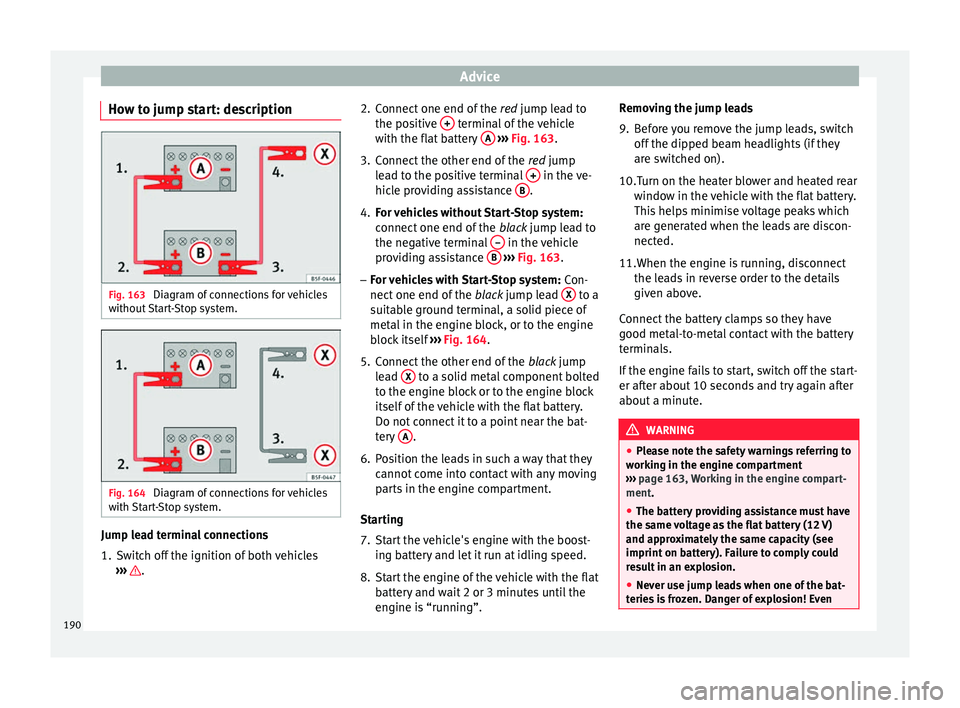
How to jump start: description Fig. 163
Diagram of connections for vehicles
without Start-Stop system. Fig. 164
Diagram of connections for vehicles
with Start-Stop system. Jump lead terminal connections
1. Switch off the ignition of both vehicles
››› . 2. Connect one end of the
red jump lead to
the po s
itive + terminal of the vehicle
with the flat battery A
››› Fig. 163 .
3. C
onnect the other end of the red
jump
lead to the positive terminal + in the ve-
hicle providing assistance B .
4. For vehicles without Start-Stop system:
connect one end of the black jump lead to
the negative terminal – in the vehicle
providing assistance B
››› Fig. 163 .
– For
vehicles with Start-Stop system: Con-
nect one end of the black jump lead X to a
suitable ground terminal, a solid piece of
metal in the engine block, or to the engine
block itself ››› Fig. 164.
5. Connect the other end of the black jump
lead X to a solid metal component bolted
to the engine block or to the engine block
itself of the vehicle with the flat battery.
Do not connect it to a point near the bat-
tery A .
6. Position the leads in such a way that they cannot come into contact with any moving
parts in the engine compartment.
Starting
7. Start the vehicle's engine with the boost- ing battery and let it run at idling speed.
8. Start the engine of the vehicle with the flat battery and wait 2 or 3 minutes until the
engine is “running”. Removing the jump leads
9. Before you remove the jump leads, switch
off the dipped beam headlights (if they
are switched on).
10.Turn on the heater blower and heated rear window in the vehicle with the flat battery.
This helps minimise voltage peaks which
are generated when the leads are discon-
nected.
11. When the engine is running, disconnect
the l e
ads in reverse order to the details
given above.
Connect the battery clamps so they have
good metal-to-metal contact with the battery
terminals.
If the engine fails to start, switch off the start-
er after about 10 seconds and try again after
about a minute. WARNING
● Please note the safety warnings referring to
working in the engine compartment
››› page 163, Working in the engine compart-
ment.
● The b att
ery providing assistance must have
the same voltage as the flat battery (12 V)
and approximately the same capacity (see
imprint on battery). Failure to comply could
result in an explosion.
● Never use jump leads when one of the bat-
teries is frozen. Danger of explosion! Even 190
Page 193 of 236
Emergencies
after the battery has thawed, battery acid
could leak and cause chemical burns. If a bat-
tery freezes, it should be replaced.
●
Keep sparks, flames and lighted cigarettes
away from batteries, danger of explosion.
Failure to comply could result in an explo-
sion.
● Observe the instructions provided by the
manufacturer of the jump leads.
● Do not connect the negative cable from the
other vehicle directly to the negative terminal
of the flat battery. The gas emitted from the
battery could be ignited by sparks. Danger of
explosion.
● Do not attach the negative cable from the
other vehicle to parts of the fuel system or to
the brake line.
● The non-insulated parts of the battery
clamps must not be allowed to touch. The
jump lead attached to the positive battery
terminal must not touch metal parts of the ve-
hicle, this can cause a short circuit.
● Position the leads in such a way that they
cannot come into contact with any moving
parts in the engine compartment.
● Do not lean on the batteries. This could re-
sult in chemical burns. Note
The vehicles must not touch each other, oth-
erwise electricity could flow as soon as the
positive terminals are connected. Towing and tow-starting
Tow-starting We recommend that you do
not tow-start your
v ehic
le. Jump-starting is preferable
››› page 189.
How
ever, if your vehicle has to be tow-
started:
– Engage 2 nd
or 3 rd
gear.
– Keep the clutch pressed down.
– Switch the ignition on.
– Once both vehicles are moving, release the
clutch.
– As soon as the engine starts, press the
clutch and move the gear lever into neutral.
This helps to prevent driving into the tow-
ing vehicle. WARNING
The risk of accidents is high when tow-start-
ing. The vehicle being towed can easily col-
lide with the towing vehicle. CAUTION
When tow-starting, fuel could enter the cata-
lytic converter and damage it. General notes
Please observe the following points if you
use a tow rope:
Notes for the driver of the towing vehicle
– Drive slowly at first until the tow rope is
taut. Then accelerate gradually.
– Begin and change gears cautiously. If you
are driving an automatic vehicle, accelerate
gently.
– Remember that the brake servo and power
steering are not working in the vehicle you
are towing. Brake sooner than normal and
pressing the pedal gently.
Notes for the driver of the towed vehicle
– Ensure that the tow rope remains taut at all
times when towing.
Tow rope or tow bar
It is easier and safer for the vehicle to be tow-
ed using a tow bar. You should only use a
tow-rope if you do not have a tow-bar.
A tow rope should be slightly elastic to re-
duce the loading on both vehicles. It is advis-
able to use a tow rope made of synthetic fi-
bre or similarly elastic material.
Attach the tow rope or the tow bar only to the
towline anchorages provided or a towing
bracket. »
191Technical specifications
Advice
Operation
Safety