Panel Seat Altea XL 2010 Repair Manual
[x] Cancel search | Manufacturer: SEAT, Model Year: 2010, Model line: Altea XL, Model: Seat Altea XL 2010Pages: 312, PDF Size: 8.41 MB
Page 178 of 312
Driving
176Deactivating and activating the Start-Stop functionEvery time the ignition is switched on, the Start-Stop function is
automatically switched on.
Manually deactivating the Start-Stop function
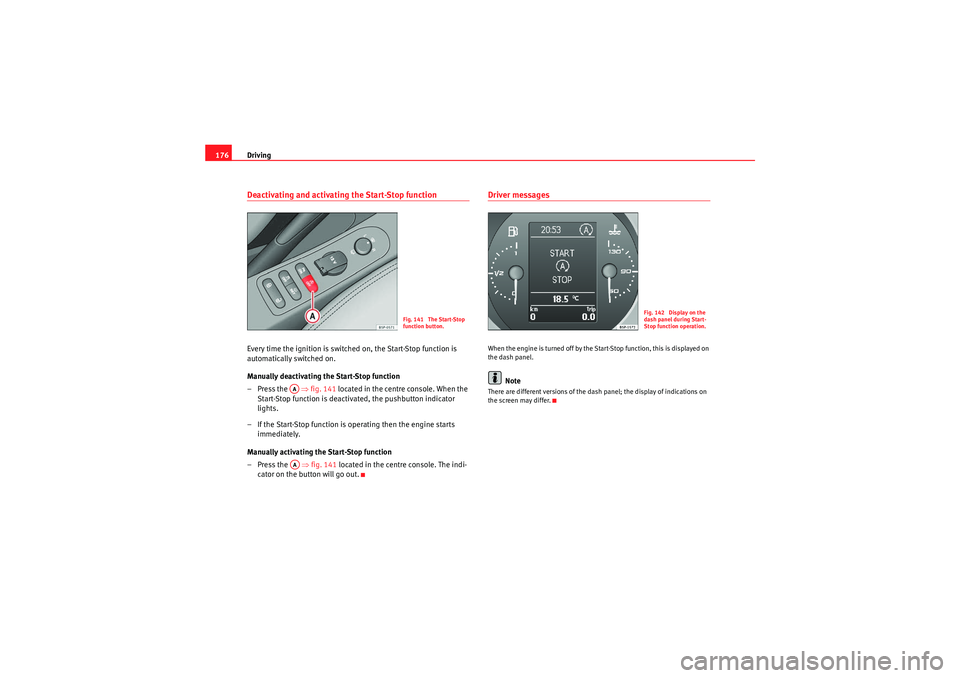
–Press the ⇒fig. 141 located in the centre console. When the
Start-Stop function is deactivated, the pushbutton indicator
lights.
– If the Start-Stop function is operating then the engine starts immediately.
Manually activating the Start-Stop function
–Press the ⇒fig. 141 located in the centre console. The indi-
cator on the button will go out.
Driver messagesWhen the engine is turned off by the Start-Stop function, this is displayed on
the dash panel.
Note
There are different versions of the dash panel; the display of indications on
the screen may differ.
Fig. 141 The Start-Stop
function button.
AAAA
Fig. 142 Display on the
dash panel during Start-
Stop function operation.
AlteaXL_EN.book Seite 176 Dienstag, 1. September 2009 10:37 10
Page 190 of 312
Driving
188
NoteIf the fault is not corrected before you switch off the ignition, it will only be
indicated by the flashing LED on the switch
the next time you switch on
the parking aid.
Cruise control* (GRA)Description
The cruise control system is able to maintain the set speed in
the range from approx. 30 km/h to 180 km/h.Once the speed setting has been saved, you may take your foot off the accel-
erator.
WARNING
It could be dangerous to use the cruise control system if it is not possible
to drive at constant speed.•For safety reasons the cruise control system should not be used in
dense traffic, in sections with bends or where roads are in bad conditions
(e.g. aquaplaning, loose chippings, slippery surfaces, snow). Risk of acci-
dent.•Always switch the CCS off when finish to use it in order to avoid an
involuntary use.•It is dangerous to use a set speed which is too high for the current road,
traffic or weather conditions. Risk of accident.
Note
The cruise control cannot maintain a constant speed when descending down-
hill. The vehicle will accelerate due to its own weight. Use the foot brake to
slow the vehicle.Switching the cruise control system on and offSwitching on the system
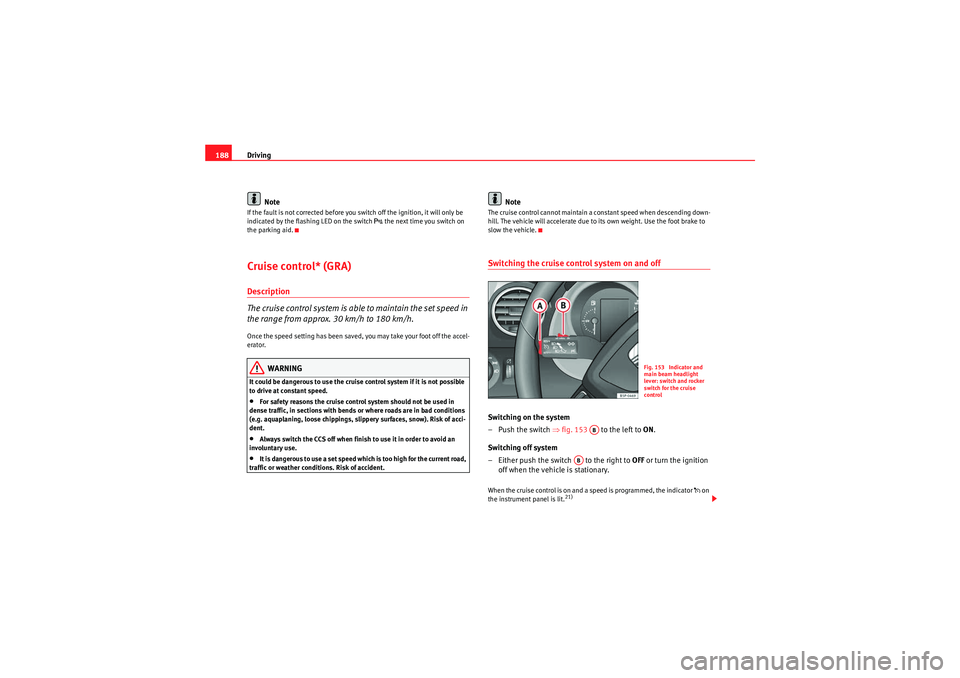
–Push the switch ⇒fig. 153 to the left to ON.
Switching off system
– Either push the switch to the right to OFF or turn the ignition
off when the vehicle is stationary.W h en the cr uis e cont rol is o n an d a sp ee d is pr ogra m m e d, the in di cato r on
the instrument panel is lit.
21)
Fig. 153 Indicator and
main beam headlight
lever: switch and rocker
switch for the cruise
control
AB
AB
AlteaXL_EN.book Seite 188 Dienstag, 1. September 2009 10:37 10
Page 212 of 312
Cleaning and caring for your vehicle
210Vehicle exterior maintenanceAutomatic car wash tunnel
The car can normally be washed without problem in an auto-
matic car wash.The vehicle paintwork is so durable that the car can normally be washed
without problems in an automatic car washing tunnel. However, the paint-
work wear depends to a large extent, on the kind of the car washing tunnel,
the brushes used, its water filtering and the type of cleaning and preservative
products.
Before going through a car wash, be sure to take the usual precautions such
as closing the windows and sunroof. There is nothing to note apart from that.
If the vehicle has special accessories such as spoilers or a roof carrier or two-
way radio aerial, etc., it is advisable to consult the car washing tunnel oper-
ator.
After washing, the brakes could hesitate to respond as the brake discs and
pads could be wet, or even frozen in winter. “Dry” the brakes by braking
several times.
WARNING
Water, ice and salt on the brakes can reduce braking efficiency. Risk of acci-
dent.
Caution
If an automatic car wash tunnel is used, before entering the tunnel, put the
aerial down parallel to the roof and do not tighten to avoid damage.
Washing by handVehicle washing
– First soften the dirt with plenty of water and rinse it off.
– Clean your vehicle from top to bottom with a soft sponge, a glove or a brush. Use very light pressure.
– Rinse the sponge or glove often with clean water.
– Special car shampoo should only be used for very stubborn dirt.
– Clean the wheels, sill panels etc. until last with a different sponge or glove.
– Rinse the vehicle thoroughly with water.
– Dry your vehicle surface gently with a chamois leather.
–When temperature is cold , dry the rubber seals and its surfaces
to prevent them from freezing. Apply silicone spray to the rubber
seals.
After washing
– Directly after washing, avoid sudden and sharp braking. “Dry” ⇒page 200, “Braking effect and braking distance”the brakes by
braking several times.
WARNING
•Wash your car with the ignition switched off.•Protect your hands and arms from cuts on sharp metal edges when
cleaning the underbody, the inside of the wheel housings etc. Risk of
injury.
AlteaXL_EN.book Seite 210 Dienstag, 1. September 2009 10:37 10
Page 218 of 312
Cleaning and caring for your vehicle
216Vehicle interior maintenancePlastic parts and dash panel cleaning– Use a clean, damp cloth to clean plastic parts and the dash
panel.
– If this does not provide satisfactory results, use a special solvent-free plastic cleaning product.
WARNING
Never clean the dash panel and the airbag module surface with cleansers
containing solvents. Solvents cause the surface to become porous. If the
airbag triggered, disintegrating plastic parts could cause substantial inju-
ries.
Caution
Cleaning products which contain solvents will damage the material.Wooden trim cleaning*– Clean the wooden trim with a water-moistened clean cloth.
– If this does not provide satisfactory results, use a gentle soap
solution.
CautionCleaning products which contain solvents will damage the material.
Cloth seat covers and fabric trim cleaningCloth seat covers and fabric trim on the doors, headlining etc. can be cleaned
with a special interior cleanser or with dry foam and a soft brush.Cleaning the radio and climate controlsTo clean the radio and/or climate controls, use a soft damp cloth. For more
resistant dirt, a neutral soap solution may be used.Leather cleaning*Normal cleaning
– Moisten a cotton or woollen cloth with water and wipe over the leather surfaces.
Cleaning stubborn stains
– More stubborn dirt can be removed using a mild soap solution (pure liquid soap; two tablespoons diluted in one litre of water)
and a cloth.
– Do not let the water soak through the leather or soak into the seams.
– Then wipe off with a soft, dry cloth.
Leather maintenance
– The leather should be treated twice a year with a special leather- care product, available in your Authorised Service Centre.
AlteaXL_EN.book Seite 216 Dienstag, 1. September 2009 10:37 10
Page 232 of 312
Checking and refilling levels
230•Wait until no more steam, smoke or coolant is emitted from the bonnet,
then carefully open the bonnet.•When working in the engine compartment, always observe the safety
warnings ⇒page 227.
Closing the bonnet– Raise the bonnet slightly.
– Release the bonnet stay and replace it in its support.
– At a height of about 30 cm let it fall so it is locked.If the b onn et d o es n ot clos e , do not p ress d ownwa rds . Op e n it o nce m or e an d
let it fall as before.
WARNING
If the bonnet is not closed properly, it could open while you are driving and
completely obscure your view of the road. Risk of accident.•After closing the bonnet, always check that it is properly secured. The
bonnet must be flush with the surrounding body panels.•If you notice that the bonnet latch is not secured when the vehicle is
moving, stop the vehicle immediately and close the bonnet properly. Risk
of accident.
Engine oilEngine oil specifications
The engine oil used must conf orm with exact specifications.Specifications
The engine comes with a special, high quality, multi grade oil that can be
used in all seasons of the year except for those regions affected by extreme
cold.
As the use of high quality oil is essential for the correct operation of the
engine and its long useful life, when topping up or replacement is necessary
use only those oils that conform to the requirements of the VW standards.
If it is not possible to find oil conforming to the VW standards then oil
conforming to the ACEA or API standards with an appropriate viscosity at
atmospheric temperature should be used instead. The use of this type of oil
may have some repercussions on the performance of the engine for example,
long starting time, increased consumption and a higher emission level.
If a top up is required then different oils may be mixed as long as they all
conform to the VW standards.
The specifications (VW standards) set out in the following page should
appear on the container of the service oil; the container will display together
the different standards for petrol and diesel engines, the oil can be used for
both types of engines.
WARNING (continued)
AlteaXL_EN.book Seite 230 Dienstag, 1. September 2009 10:37 10
Page 242 of 312
Checking and refilling levels
240Brake fluidChecking the brake fluid level
The brake fluid is checked at the intervals given in the service
schedule.– Read off the fluid level at the transparent brake fluid reservoir. It
should always be between the “MIN” and “MAX” marks.The position of the brake fluid reservoir is shown in the corresponding engine
compartment diagram ⇒page 287. The brake fluid reservoir has a black and
yellow cap.
The brake fluid level drops slightly when the vehicle is being used as the
brake pads are automatically adjusted as they wear. However, if the level goes down noticeably in a short time, or drops below the
“MIN” mark, there may be a leak in the brake system. A display on the instru-
ment panel will warn you if the brake fluid level is too low
⇒page 77.
WARNING
Before opening the bonnet to check the brake fluid level, read and observe
the warnings ⇒page 227.Changing the brake fluid
The Maintenance Program indicates the brake fluid change
intervals.We recommend that you have the brake fluid changed by an Authorised
Service Centre.
Before opening the bonnet, please read and follow the warnings ⇒ in
“Safety instructions on working in the engine compartment” on page 227 in
“Working in the engine compartment”.
Brake fluid absorbs moisture. In the course of time, it will absorb water from
the ambient air. If the water content in the brake fluid is too high, the brake
system could corrode. This also considerably reduces the boiling point of the
brake fluid. Heavy use of the brakes may then cause a vapour lock which
could impair the braking effect.
It is important that you use only brake fluid compliant with the US standard
FMVSS 116 DOT 4. We recommend the use of Genuine SEAT brake fluid.
WARNING
Brake fluid is poisonous. Old brake fluid impairs the braking effect.
Fig. 174 In the engine
compartment: Brake fluid
reservoir cover
AlteaXL_EN.book Seite 240 Dienstag, 1. September 2009 10:37 10
Page 249 of 312
Wheels and tyres247
Safety First
Operating instructions
Practical tips
Technical Data
Wear indicators
The original tyres on your vehicle have 1.6 mm high “tread wear indicators”
⇒
page 246, fig. 175 , running across the tread. Depending on the make,
there will be six to eight of them evenly spaced around the tyre. Markings on
the tyre sidewall (for instance the letters “TWI” or other symbols) indicate the
positions of the tread wear indicators. The minimum tread depth required by
law is 1.6 mm (measured in the tread grooves next to the tread wear indica-
tors). Worn tyres must be replaced. Different figures may apply in export
countries ⇒.
Tyre pressure
Incorrect tyre pressure causes premature wear and could cause tyre blow-out.
For this reason, the tyre pressure should be checked at least once per month
⇒ page 244.
Driving style
Fast cornering, heavy acceleration and hard braking all increase tyre wear.
Changing wheels around
If the front tyres are worn considerably more than the rear ones it is advisable
to cha nge t he m ar oun d as sh own ⇒ page 246, fig. 176. All the tyres will then
last for about the same time.
Wheel balance
The wheels on new vehicles are balanced. However, various factors encoun-
tered in normal driving can cause them to become unbalanced, which results
in steering vibration.
Unbalanced wheels should be rebalanced, as they otherwise cause excessive
wear on steering, suspension and tyres. A wheel must also be rebalanced
when a new tyre is fitted.
Incorrect wheel alignment
Incorrect wheel alignment causes excessive tyre wear, impairing the safety of
the vehicle. If tyres show excessive wear, you should have the wheel align-
ment checked by an Authorised Service Centre.
WARNING
There is a serious danger of accidents if a tyre bursts during driving!•The tyres must be replaced at the latest when the tread is worn down to
the tread wear indicators. Failure to do so could result in an accident. Worn
tyres do not grip well at high speeds on wet roads. There is also a greater
risk of “aquaplaning” •At continuously high speeds, a tyre with insufficient pressure flexes
more. This causes it to overheat. This can cause tread separation and tyre
blow-out. Risk of accident. Always observe the recommended tyre pres-
sures.•If tyres show excessive wear, you should have the running gear checked
by an Authorised Service Centre.•Keep chemicals such as oil, fuel and brake fluid away from tyres.•Damaged wheels and tyres must be replaced immediately!For the sake of the environment
Under-inflated tyres will increase fuel consumption.Anti-puncture tyres
Anti-puncture tyres allow you to continue driving even with a
punctured tyre, in the majority of cases.Vehicles equipped with anti-puncture
23) tyres from the factory indi-
cate the loss of tyre pressure on the instrument panel.
23)Depending upon version and country.
AlteaXL_EN.book Seite 247 Dienstag, 1. September 2009 10:37 10
Page 250 of 312
Wheels and tyres
248
Driving with anti-puncture tyres (emergency gear)
– Leave the ESP/TCS (electronic stabilisation programme) switched on, or switch on ⇒page 195.
– Continue driving carefully and slowly (80 km/h maximum).
– Avoid sudden manoeuvres and sharp turns.
– Avoid driving over obstacles (for example kerbs) or potholes.
– Look out for the ESP/TCS intervening often, smoke coming from the tyres or the smell of rubber, the vehicle vibrating or a clat-
tering noise. If any of these occur, stop the vehicle.The anti-puncture tyres have a tag on the side of the tyre, with the description:
“DSST”, “Eufonia”, “RFT”, “ROF”, “RSC”, “SSR” or “ZP”.
The sides of this type of tyre are reinforced. When the tyres lose air they are
supported on the sides (emergency driving).
The loss of pressure in the tyre is shown on the instrument panel. You can
then drive a maximum of 80 km and if the circumstances are favourable (for
example, low load), even more.
The damaged tyre should be changed as soon as possible. The rim should be
checked in a specialist workshop to detect possible damage and replace it if
necessary. We recommend you contact Technical Service. If more than one
tyre is being used under emergency co nditions, this reduces the distance
which can be travelled.
Starting driving in emergency conditions
When the loss in tyre pressure is displayed on the instrument panel, this
implies that at least one tyre is being driven in emergency conditions ⇒.
End of emergency operation
Do not drive on if:
•smoke is coming from one of the tyres,•there is a smell of rubber,•the vehicle vibrates,•there is a rattling noise.
When is it no longer possible to continue driving even using anti-puncture
tyres?•If one of the tyres has been severely damaged in an accident, etc. If a tyre
has been badly damaged there is a risk that parts of the tread can be thrown
off and cause damage to the fuel lines, brake pipes or fuel filler.•It is also advisable to stop driving if severe vibrations occur, or if the wheel
starts overheating and gives off smoke.WARNING
When driving in emergency conditions, the driving quality of the vehicle is
considerably impaired.•The maximum permitted speed of 80 km/h is subject to road and
weather conditions. Please observe legal requirements when doing so.•Avoid sharp turns and rapid manoeuvres, and brake earlier than usual.•Avoid driving over obstacles (for example kerbs) or potholes.•If one or more tyres is being driven in emergency conditions, the driving
quality of the vehicle is impaired and there is a risk of accident.Note
•The anti-puncture tyres do not “deflate” on losing pressure because they
are supported on the reinforced sides. Therefore defects in the tyre can not be
detected with a visual inspection.•Snow chains must not be used on front tyres used in emergency
conditions.
AlteaXL_EN.book Seite 248 Dienstag, 1. September 2009 10:37 10
Page 254 of 312
If and when
252If and whenTools, tyre repair kit and spare wheelVehicle Tools
The vehicle onboard tools are located under the floor panel in
the luggage compartment.– Lift the cover of the luggage compartment, by pulling it up with a
finger in the fitting.
– Take the onboard tools out of the vehicle.The tool kit includes:•Jack*•Hook for removing wheel covers* or hub caps*•Box spanner for wheel bolts*•Reversible screwdriver with handle (including hexagonal interior) for the
wheel bolts. The screwdriver is a combination tool.•Towi ng e ye•Adapter for the anti-theft wheel bolts*
Some of the items listed are only provided in certain models / model years,
or are optional extras.WARNING
•Do not use the hexagonal socket in the screwdriver handle to tighten
the wheel bolts as with this it is not possible to tighten the bolts to the
required torque. Risk of accident.
•The jack* supplied by the factory is only designed for changing wheels
on this model. On no account attempt to use it for lifting heavier vehicles
or other loads. Risk of injury.•Use the jack* only on firm, level ground.•Never start the engine when the vehicle is on the jack. Risk of accident.•If work is to be carried out underneath the vehicle, this must be secured
by suitable stands. Otherwise, there is a risk of injury.WARNING (continued)
AlteaXL_EN.book Seite 252 Dienstag, 1. September 2009 10:37 10
Page 255 of 312
If and when253
Safety First
Operating instructions
Practical tips
Technical Data
Compact temporary spare wheel*
The compact spare wheel (emergency wheel for vehicles
without the anti-puncture kit) should only be used when
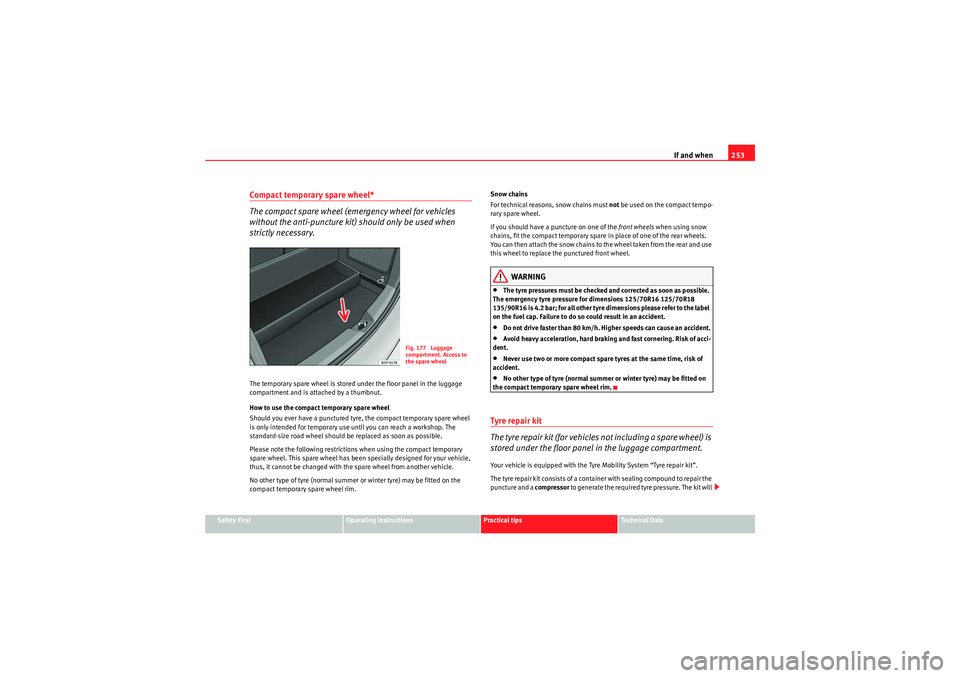
strictly necessary.The temporary spare wheel is stored under the floor panel in the luggage
compartment and is attached by a thumbnut.
How to use the compact temporary spare wheel
Should you ever have a punctured tyre, the compact temporary spare wheel
is only intended for temporary use until you can reach a workshop. The
standard-size road wheel should be replaced as soon as possible.
Please note the following restrictions when using the compact temporary
spare wheel. This spare wheel has been specially designed for your vehicle,
thus, it cannot be changed with the spare wheel from another vehicle.
No other type of tyre (normal summer or winter tyre) may be fitted on the
compact temporary spare wheel rim. Snow chains
For technical reasons, snow chains must
not be used on the compact tempo-
rary spare wheel.
If you should have a puncture on one of the front wheels when using snow
chains, fit the compact temporary spare in place of one of the rear wheels.
You can then attach the snow chains to the wheel taken from the rear and use
this wheel to replace the punctured front wheel.
WARNING
•The tyre pressures must be checked and corrected as soon as possible.
The emergency tyre pressure for dimensions 125/70R16 125/70R18
135/90R16 is 4.2 bar; for all other tyre dimensions please refer to the label
on the fuel cap. Failure to do so could result in an accident.•Do not drive faster than 80 km/h. Higher speeds can cause an accident.•Avoid heavy acceleration, hard braking and fast cornering. Risk of acci-
dent.•Never use two or more compact spare tyres at the same time, risk of
accident.•No other type of tyre (normal summer or winter tyre) may be fitted on
the compact temporary spare wheel rim.
Tyre repair kit
The tyre repair kit (for vehicles not including a spare wheel) is
stored under the floor panel in the luggage compartment.Your vehicle is equipped with the Tyre Mobility System “Tyre repair kit”.
The tyre repair kit consists of a container with sealing compound to repair the
puncture and a compressor to generate the required tyre pressure. The kit will
Fig. 177 Luggage
compartment. Access to
the spare wheel
AlteaXL_EN.book Seite 253 Dienstag, 1. September 2009 10:37 10