technical specifications Seat Altea XL 2012 Owner's Manual
[x] Cancel search | Manufacturer: SEAT, Model Year: 2012, Model line: Altea XL, Model: Seat Altea XL 2012Pages: 315, PDF Size: 4.51 MB
Page 285 of 315
283
If and when
Do not pull too hard with the towing vehicle and take care to avoid jerking
the tow-rope. When towing on an unpaved road, there is always a risk of
overloading and damaging the anchorage points.
The ignition of the vehicle being towed must be switched on to prevent the
steering wheel from locking and also to allow the use of the turn signals,
horn, windscreen wipers and washers.
As the brake servo does not work if the engine is not running, you must ap-
ply considerably more pressure to the brake pedal than you normally would.
As the power assisted steering does not work if the engine is not running,
you will need more strength to steer than you normally would.
● The vehicle must not be towed faster than 50 km/h.
● The vehicle must not be towed faster than 50 km/h.
Towing vehicles with an automatic gearbox
● Put the selector lever into position “N”.
● Do not drive faster than 50 km/h.
● Do not tow further than 50 km.
● If a breakdown vehicle is used, the vehicle must be towed with the front
wheels raised.
Note
● Observe legal requirements when towing or tow-starting.
● Switch on the hazard warning lights of both vehicles. However, observe
any regulations to the contrary.
● For technical reasons, vehicles with an automatic gearbox must not be
tow-started.
● If damage to your vehicle means that there is no lubricant in the gear-
box, you must raise the drive wheels while the vehicle is being towed.
● If the vehicle has to be towed more than 50 km, the front wheels should
be raised during towing, and towing should be carried out by a qualified
person. ●
The steering wheel is locked when the vehicle has no electrical power.
The vehicle must then be towed with the front wheels raised. Towing should
be carried out by a qualified person.
● The towing eye should always be kept in the vehicle.
Safety FirstOperating InstructionsPractical TipsTechnical Specifications
Page 287 of 315
285
Description of specifications
Technical Specifications
Description of specifications Important information
Important
The information in the vehicle documentation always has
precedence. All technical specifications provided in this manual are valid for the stand-
ard model in Spain. The vehicle data card included in the Inspection and
Maintenance Plan in the vehicle documents shows which engine is installed
in the vehicle.
The figures may be different depending on if additional equipment is fitted,
for different models, for special vehicles and for other countries.
Abbreviations used in the Technical Specifications section
Abbrevia- tionMeaning
kWKilowatt, engine power measurement.
PSPferdestärke (horsepower), formerly used to denote engine
power.
rpmRevolutions per minute - engine speed.NmNewton metres, unit of engine torque.l/100 kmFuel consumption in litres per 100 km.g/kmCarbon dioxide emissions in grams per km travelled.CO2Carbon dioxide
Abbrevia-
tionMeaning
CNCetane number, indication of the diesel combustion power.
RONResearch octane number, indication of the knock resistance
of petrol.
Safety FirstOperating InstructionsPractical TipsTechnical Specifications
Page 289 of 315

287
Description of specifications
Information on fuel consumption
Fuel consumption
The consumption and emission details shown on the vehicle
data sticker differ from one vehicle to another. The vehicle's fuel consumption and CO 2 emissions can be consulted on the
vehicle data sticker in the spare wheel well, inside the luggage compart-
ment and on the rear cover of the Maintenance Programme.
The fuel consumption and CO 2 emission values refer to the weight category
assigned to your vehicle according to the engine and gearbox combination,
as well as the specific equipment fitted, and is only used to compare be-
tween the different models.
The fuel consumption and CO 2 emissions do not depend only on the per-
formance of the vehicle, they can also differ from the established values de-
pending on other factors such as driving style, road conditions, traffic con-
ditions, environmental conditions, load and number of passengers.
Calculation of fuel consumption
The consumption values have been calculated based on measurements per-
formed or supervised by certified CE laboratories according to the latest ver-
sion of directives 715/2007/EC and 80/1268/CEE (for more information
consult the European Union Publications Office at EUR-Lex: © European Un-
ion, http://eur-lex.europa.eu/en/index.htm) and are valid for the kerb
weight indicated for the vehicle.
Note
In practice, and considering all the factors mentioned here, consumption
values can differ from those calculated in the current European regulations. Weights
Kerb weight refers to the basic model with a fuel tank filled to 90% capacity
and without optional extras. The figure quoted includes 75 kg to allow for
the weight of the driver.
For special versions and optional equipment fittings or for the addition of
accessories, the weight of the vehicle will increase
⇒
.
WARNING
● Please note that the centre of gravity may shift when transporting
heavy objects; this may affect the vehicle's handling and lead to an acci-
dent. Always adjust your speed and driving style to suit road conditions
and requirements.
● Never exceed the gross axle weight rating or the gross vehicle weight
rating. If the allowed axle load or the allowed total weight is exceeded,
the driving characteristics of the vehicle may change, leading to acci-
dents, injuries and damage to the vehicle.
Towing a trailer Trailer weights
Trailer weight
The trailer weights and drawbar loads approved are selected in intensive tri-
als according to precisely defined criteria. The approved trailer weights are
valid for vehicles in the EU for maximum speeds of 80 km/h (in certain cir-
cumstances up to 100 km/h). The figures may be different in other coun-
tries. All data in the official vehicle documents take precedence over these
data ⇒
.
Safety FirstOperating InstructionsPractical TipsTechnical Specifications
Page 291 of 315
289
Technical specifications
Technical specifications
Checking fluid levels
From time to time, the levels of the different fluids in the ve-
hicle must be checked. Never fill with incorrect fluids, other-
wise serious damage to the engine may be caused.
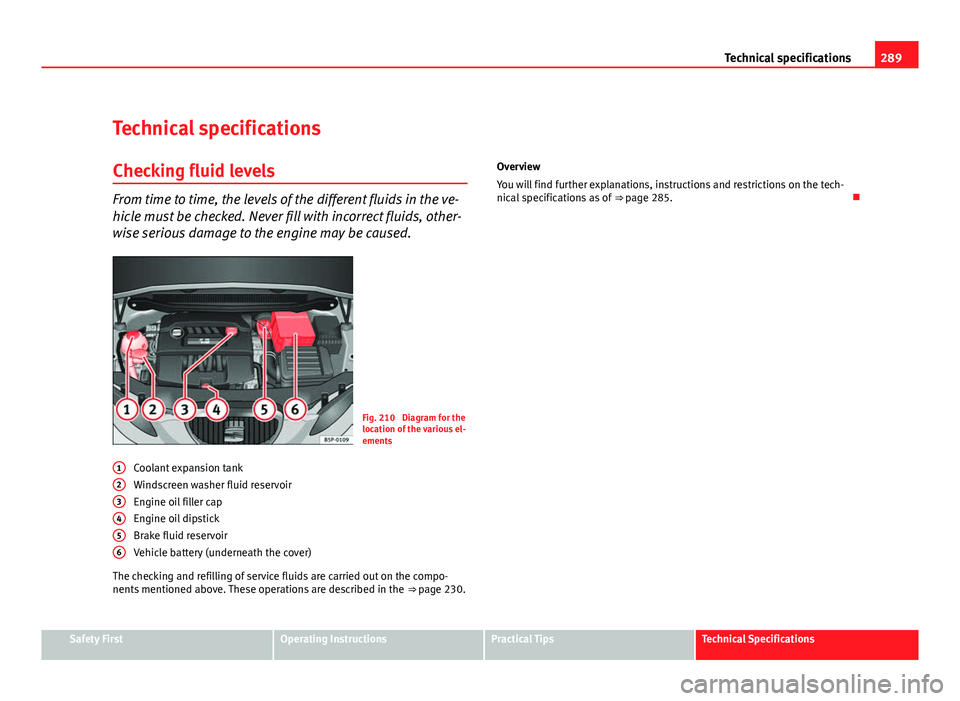
Fig. 210 Diagram for the
location of the various el-
ements
Coolant expansion tank
Windscreen washer fluid reservoir
Engine oil filler cap
Engine oil dipstick
Brake fluid reservoir
Vehicle battery (underneath the cover)
The checking and refilling of service fluids are carried out on the compo-
nents mentioned above. These operations are described in the ⇒ page 230.
1
23456
Overview
You will find further explanations, instructions and restrictions on the tech-
nical specifications as of
⇒ page 285.
Safety FirstOperating InstructionsPractical TipsTechnical Specifications
Page 292 of 315
290Technical specifications
Petrol engine 1.4 63 kW (85 PS)
Engine specifications
Power output in kW (PS) rpm 63 (85)/ 5000
Maximum torque in Nm at rpm 132/ 3800
No. of cylinders/capacity in cm3
4/ 1390
Fuel Super 95 RON a)
/Normal 91 RON b)
a)
Research Octane Number = Anti-detonation rating of the petrol.
b) With a slight power loss
Performance Maximum speed in km/h 169
Acceleration from 0-80 km/h in sec. 10.1
Acceleration from 0-100 km/h in sec. 15.4
Weights
Gross vehicle weight in kg 1919
Weight in running order (with driver) in kg 1375
Gross front axle weight in kg 934
Gross rear axle weight in kg 1033
Permitted roof load in kg 75
Trailer weight
Trailer without brakes in kg 680
Trailer with brakes, gradients up to 8% in kg 1200
Trailer with brakes, gradients up to 12% in kg 800
Engine oil capacity
Approximate engine oil capacity with oil filter change 2.8 litres
Page 293 of 315
291
Technical specifications
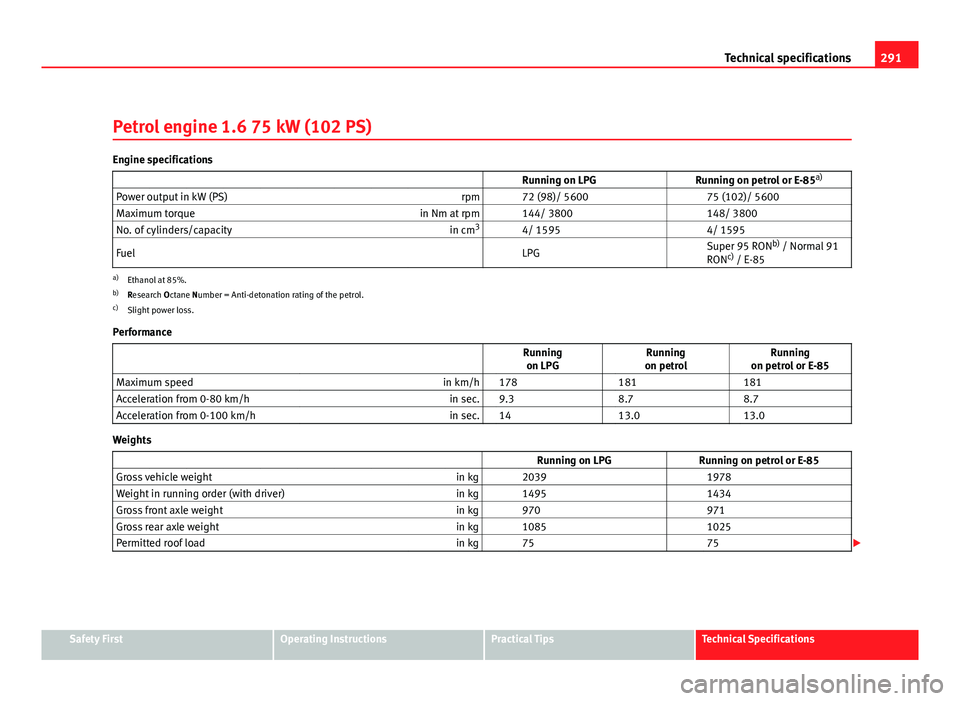
Petrol engine 1.6 75 kW (102 PS)
Engine specifications Running on LPG Running on petrol or E-85a)
Power output in kW (PS) rpm 72 (98)/ 5600 75 (102)/ 5600
Maximum torque in Nm at rpm 144/ 3800 148/ 3800
No. of cylinders/capacity in cm3
4/ 1595 4/ 1595
Fuel LPG Super 95 RON
b)
/ Normal 91
RON c)
/ E-85
a) Ethanol at 85%.
b) Research Octane Number = Anti-detonation rating of the petrol.
c) Slight power loss.
Performance Running
on LPG Running
on petrol Running
on petrol or E-85
Maximum speed in km/h 178 181 181
Acceleration from 0-80 km/h in sec. 9.3 8.7 8.7
Acceleration from 0-100 km/h in sec. 14 13.0 13.0
Weights
Running on LPG Running on petrol or E-85
Gross vehicle weight in kg 2039 1978
Weight in running order (with driver) in kg 1495 1434
Gross front axle weight in kg 970 971
Gross rear axle weight in kg 1085 1025
Permitted roof load in kg 75 75
Safety FirstOperating InstructionsPractical TipsTechnical Specifications
Page 294 of 315
292Technical specifications
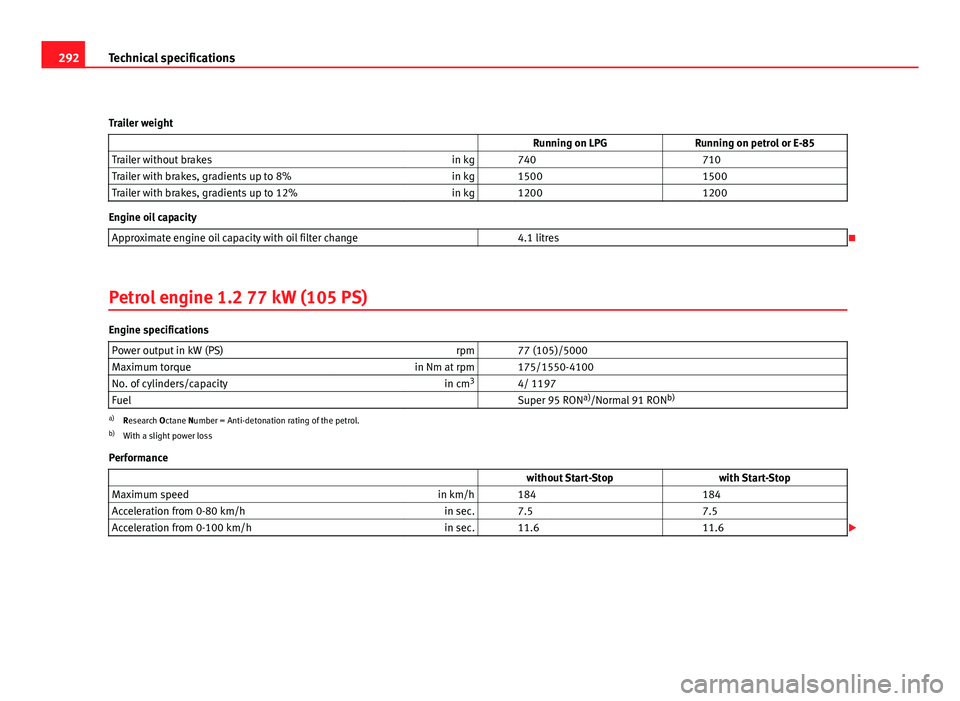
Trailer weight Running on LPGRunning on petrol or E-85
Trailer without brakes in kg 740 710
Trailer with brakes, gradients up to 8% in kg 1500 1500
Trailer with brakes, gradients up to 12% in kg 1200 1200
Engine oil capacity
Approximate engine oil capacity with oil filter change 4.1 litres
Petrol engine 1.2 77 kW (105 PS)
Engine specifications Power output in kW (PS) rpm 77 (105)/5000
Maximum torque in Nm at rpm 175/1550-4100
No. of cylinders/capacity in cm3
4/ 1197
Fuel Super 95 RON a)
/Normal 91 RON b)
a)
Research Octane Number = Anti-detonation rating of the petrol.
b) With a slight power loss
Performance without Start-Stopwith Start-Stop
Maximum speed in km/h 184 184
Acceleration from 0-80 km/h in sec. 7.5 7.5
Acceleration from 0-100 km/h in sec. 11.6 11.6
Page 295 of 315
293
Technical specifications
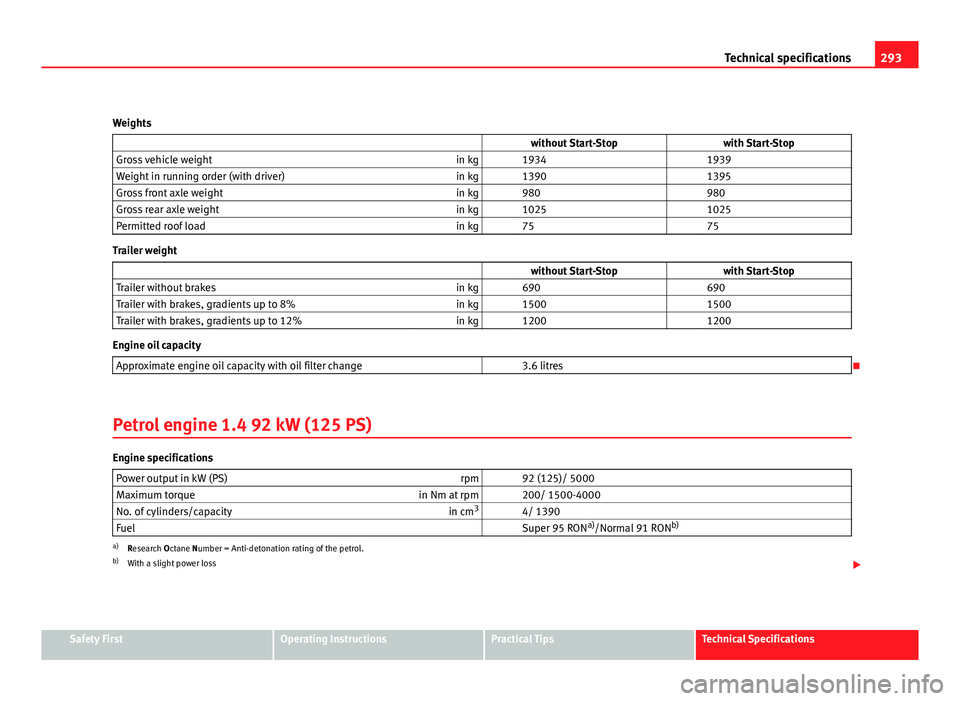
Weights without Start-Stop with Start-Stop
Gross vehicle weight in kg 1934 1939
Weight in running order (with driver) in kg 1390 1395
Gross front axle weight in kg 980 980
Gross rear axle weight in kg 1025 1025
Permitted roof load in kg 75 75
Trailer weight
without Start-Stopwith Start-Stop
Trailer without brakes in kg 690 690
Trailer with brakes, gradients up to 8% in kg 1500 1500
Trailer with brakes, gradients up to 12% in kg 1200 1200
Engine oil capacity
Approximate engine oil capacity with oil filter change 3.6 litres
Petrol engine 1.4 92 kW (125 PS)
Engine specifications Power output in kW (PS) rpm 92 (125)/ 5000
Maximum torque in Nm at rpm 200/ 1500-4000
No. of cylinders/capacity in cm3
4/ 1390
Fuel Super 95 RON a)
/Normal 91 RON b)
a)
Research Octane Number = Anti-detonation rating of the petrol.
b) With a slight power loss
Safety FirstOperating InstructionsPractical TipsTechnical Specifications
Page 296 of 315
294Technical specifications
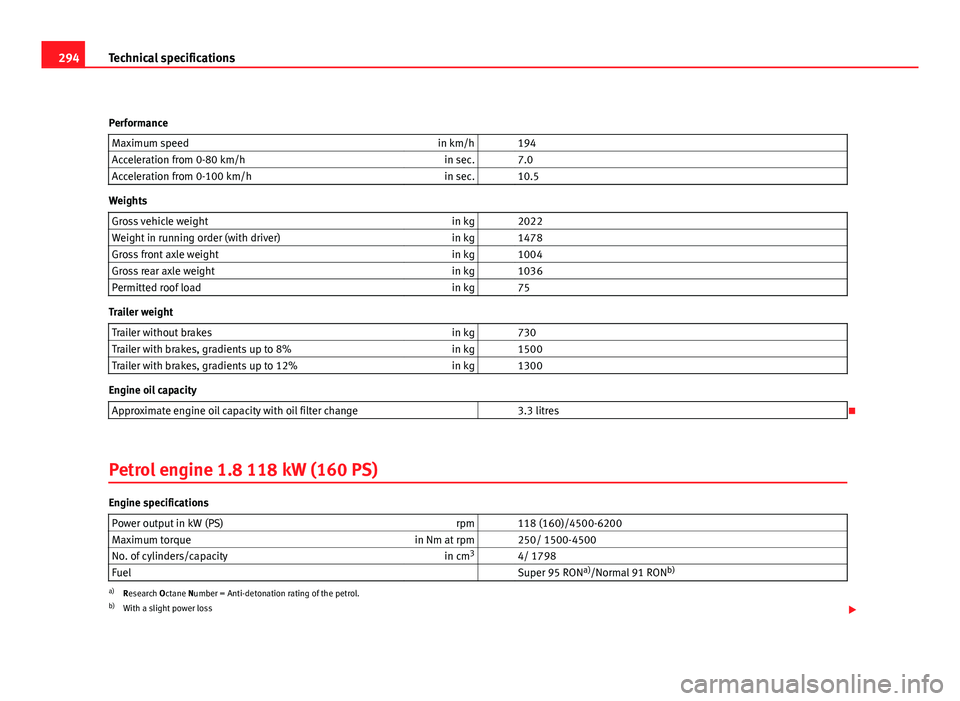
Performance Maximum speed in km/h 194
Acceleration from 0-80 km/h in sec. 7.0
Acceleration from 0-100 km/h in sec. 10.5
Weights
Gross vehicle weight in kg 2022
Weight in running order (with driver) in kg 1478
Gross front axle weight in kg 1004
Gross rear axle weight in kg 1036
Permitted roof load in kg 75
Trailer weight
Trailer without brakes in kg 730
Trailer with brakes, gradients up to 8% in kg 1500
Trailer with brakes, gradients up to 12% in kg 1300
Engine oil capacity
Approximate engine oil capacity with oil filter change 3.3 litres
Petrol engine 1.8 118 kW (160 PS)
Engine specifications Power output in kW (PS) rpm 118 (160)/4500-6200
Maximum torque in Nm at rpm 250/ 1500-4500
No. of cylinders/capacity in cm3
4/ 1798
Fuel Super 95 RON a)
/Normal 91 RON b)
a)
Research Octane Number = Anti-detonation rating of the petrol.
b) With a slight power loss
Page 297 of 315
295
Technical specifications
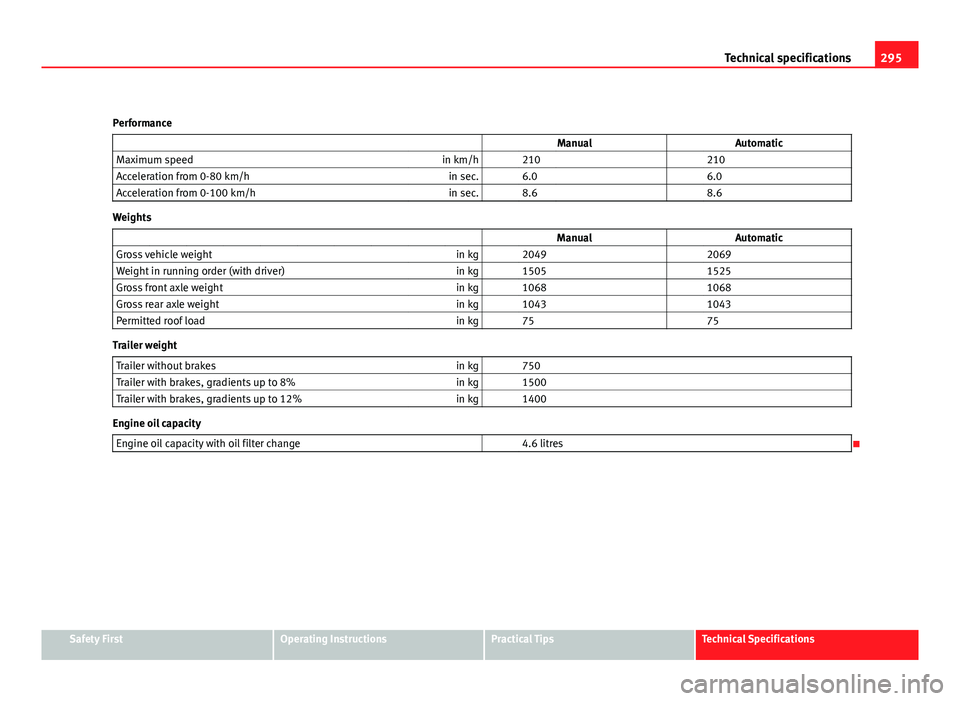
Performance ManualAutomatic
Maximum speed in km/h 210 210
Acceleration from 0-80 km/h in sec. 6.0 6.0
Acceleration from 0-100 km/h in sec. 8.6 8.6
Weights
Manual Automatic
Gross vehicle weight in kg 2049 2069
Weight in running order (with driver) in kg 1505 1525
Gross front axle weight in kg 1068 1068
Gross rear axle weight in kg 1043 1043
Permitted roof load in kg 75 75
Trailer weight
Trailer without brakes in kg 750
Trailer with brakes, gradients up to 8% in kg 1500
Trailer with brakes, gradients up to 12% in kg 1400
Engine oil capacity
Engine oil capacity with oil filter change 4.6 litres
Safety FirstOperating InstructionsPractical TipsTechnical Specifications