technical specifications Seat Altea XL 2012 Owner's Manual
[x] Cancel search | Manufacturer: SEAT, Model Year: 2012, Model line: Altea XL, Model: Seat Altea XL 2012Pages: 315, PDF Size: 4.51 MB
Page 265 of 315
263
If and when
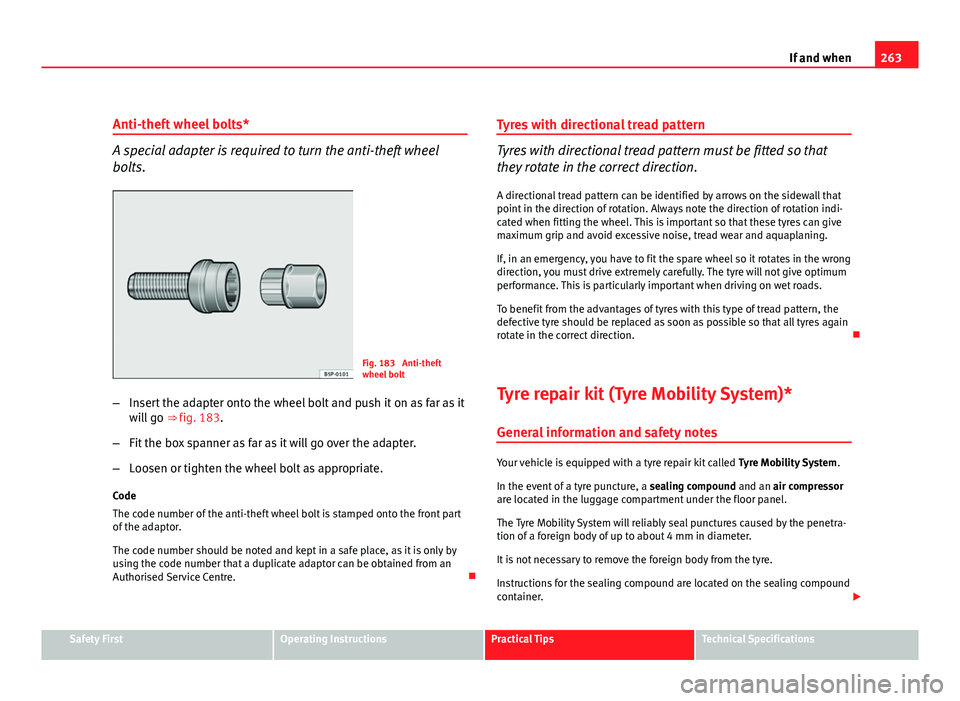
Anti-theft wheel bolts*
A special adapter is required to turn the anti-theft wheel
bolts.
Fig. 183 Anti-theft
wheel bolt
– Insert the adapter onto the wheel bolt and push it on as far as it
will go ⇒ fig. 183.
– Fit the box spanner as far as it will go over the adapter.
– Loosen or tighten the wheel bolt as appropriate.
Code
The code number of the anti-theft wheel bolt is stamped onto the front part
of the adaptor.
The code number should be noted and kept in a safe place, as it is only by
using the code number that a duplicate adaptor can be obtained from an
Authorised Service Centre. Tyres with directional tread pattern
Tyres with directional tread pattern must be fitted so that
they rotate in the correct direction.
A directional tread pattern can be identified by arrows on the sidewall that
point in the direction of rotation. Always note the direction of rotation indi-
cated when fitting the wheel. This is important so that these tyres can give
maximum grip and avoid excessive noise, tread wear and aquaplaning.
If, in an emergency, you have to fit the spare wheel so it rotates in the wrong
direction, you must drive extremely carefully. The tyre will not give optimum
performance. This is particularly important when driving on wet roads.
To benefit from the advantages of tyres with this type of tread pattern, the
defective tyre should be replaced as soon as possible so that all tyres again
rotate in the correct direction.
Tyre repair kit (Tyre Mobility System)* General information and safety notes
Your vehicle is equipped with a tyre repair kit called Tyre Mobility System.
In the event of a tyre puncture, a sealing compound and an air compressor
are located in the luggage compartment under the floor panel.
The Tyre Mobility System will reliably seal punctures caused by the penetra-
tion of a foreign body of up to about 4 mm in diameter.
It is not necessary to remove the foreign body from the tyre.
Instructions for the sealing compound are located on the sealing compound
container.
Safety FirstOperating InstructionsPractical TipsTechnical Specifications
Page 267 of 315
265
If and when
Tyre repair
The following sections describe the procedures for repairing
a tyre.
Using the sealing compound
– The instructions on the container give detailed information on
how to use the sealing compound.
Inflating the tyre.
– Remove the air compressor and hose from the container.
– Screw the retaining nut onto the valve.
– Plug the compressor cable into a 12 volt power point.
– Turn on compressor and monitor the pressure shown on the
pressure gauge.
Completing the repair
– Remove the compressor hose from the valve.
– Fit the valve cap.
– Unplug the compressor from the socket.
– Return all tools to their proper storing location.
Note
● If the vehicle is equipped with tyre pressure control, enter the new tyre
pressures using the SET button on the centre console.
● The compressor should never be allowed to run for longer than 6 mi-
nutes.
Safety FirstOperating InstructionsPractical TipsTechnical Specifications
Page 269 of 315
267
If and when
The electric windows are protected by circuit breakers. These reset automat-
ically after a few seconds when the overload (caused for example by frozen
windows) has been corrected.
Fuses colour code
ColourAmpslight brown5Red10Blue15Yellow20Natural (white)25Green30orange40Red50white80Blue100grey150violet200
WARNING
Never “repair” damaged fuses and never replace them with fuses with a
higher rating. Failure to comply could result in fire. This could also cause
damage to other parts of the electrical system.
Note
● If a newly replaced fuse blows again after a short time, the electrical sys-
tem must be checked by a specialised workshop as soon as possible.
● If you replace a fuse with higher-rating fuse, you could cause damage to
another location in the electrical system. ●
Always keep some spare fuses in the vehicle. These are available from
SEAT dealers.
● In addition to the fuses listed in the following tables, there are other
fuses which must be replaced by the Technical Service Workshop.
Safety FirstOperating InstructionsPractical TipsTechnical Specifications
Page 271 of 315
269
If and when
NumberConsumerAmps48Convenience controls2049Heating controls4050Heated seats3051Sunroof2052Headlight washer system2053Trailer hook pre-installation assistant2054Taxi (taximeter power supply)555Trailer hook pre-installation assistant2056Taxi (transmitter power supply)1557Telephone power supply with START STOP1058Central locking control unit30
Some of the electrical items listed in the table are only fitted on certain
models or are optional extras.
Please note that the above list, while correct at the time of printing, is sub-
ject to alterations. If discrepancies should occur, please refer to the sticker
on the inside of the fuse cover for the correct information for your model.
Fuses layout, engine compartment, left part
Fuses
NumberConsumerAmps1Windscreen wipers202DQ200 gearbox303Cable control unit54ABS205AQ gearbox156Instrument panel/Steering column5
NumberConsumerAmps7Ignition key408Radio159Telephone/TomTom Navigator5
10Engine management5Engine management1011Vacant 12Electronic control unit5
13Petrol injection module supply15Diesel injection module supply3014Coil20
15Engine management5Pump relay1016Right lighting3017Horn1518Vacant 19Clean30
20Water pump10Pressure sensor pump for 1.8 engine2021 a)Lambda probe1522Brake pedal, speed sensor5
23a)Engine management5Engine management10Engine management1524AKF, gearbox valve1025a)ABS pump4026Left lighting30
27a)Engine management40Engine management5028Vacant
Safety FirstOperating InstructionsPractical TipsTechnical Specifications
Page 273 of 315
271
If and when
Side turn signal - W5W
Number plate light - C5W
Note
● Depending on weather conditions (cold or wet), the front lights, the fog
lights, the tail lights and the turn signals may be temporarily misted. This
has no influence on the useful life of the lighting system. By switching on
the lights, the area through which the beam of light is projected will quickly
be demisted. However, the edges may continue to be misted.
● Please check at regular intervals that all lighting (especially the exterior
lighting) on your vehicle is functioning properly. This is not only in the inter-
est of your own safety, but also that of all other road users.
● Due to the difficulty in accessing some of the bulbs, any replacement
work should be done by a SEAT dealer. However, the following is a descrip-
tion of how to change the lamps except for the fog lights* and interior
lamps.
Side turn signal
Number plate light
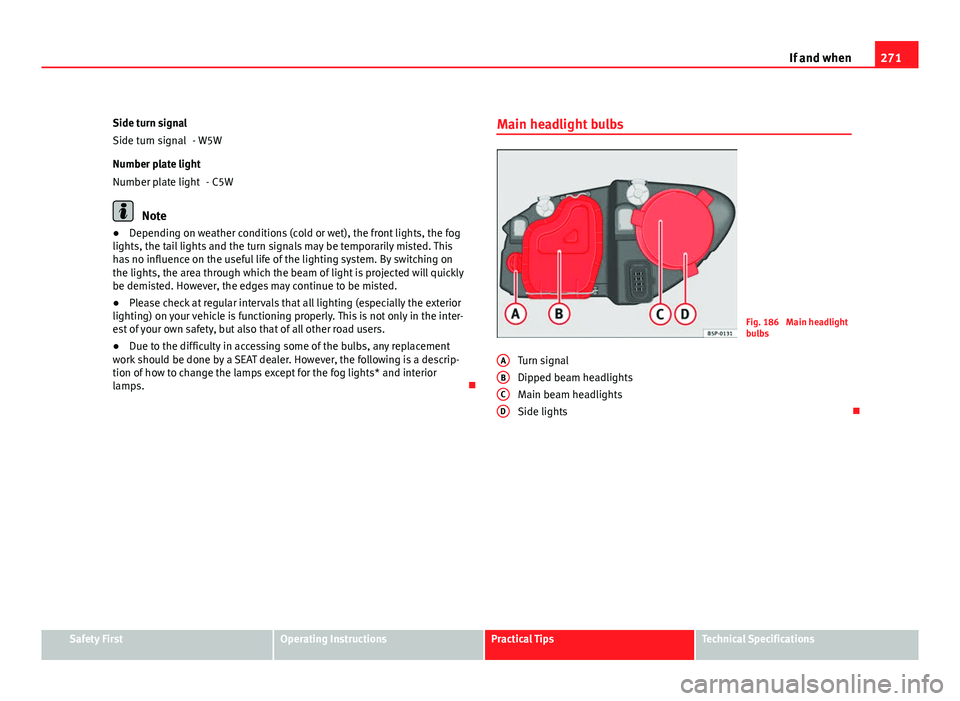
Main headlight bulbs
Fig. 186 Main headlight
bulbs
Turn signal
Dipped beam headlights
Main beam headlights
Side lights
A
BCD
Safety FirstOperating InstructionsPractical TipsTechnical Specifications
Page 275 of 315
273
If and when
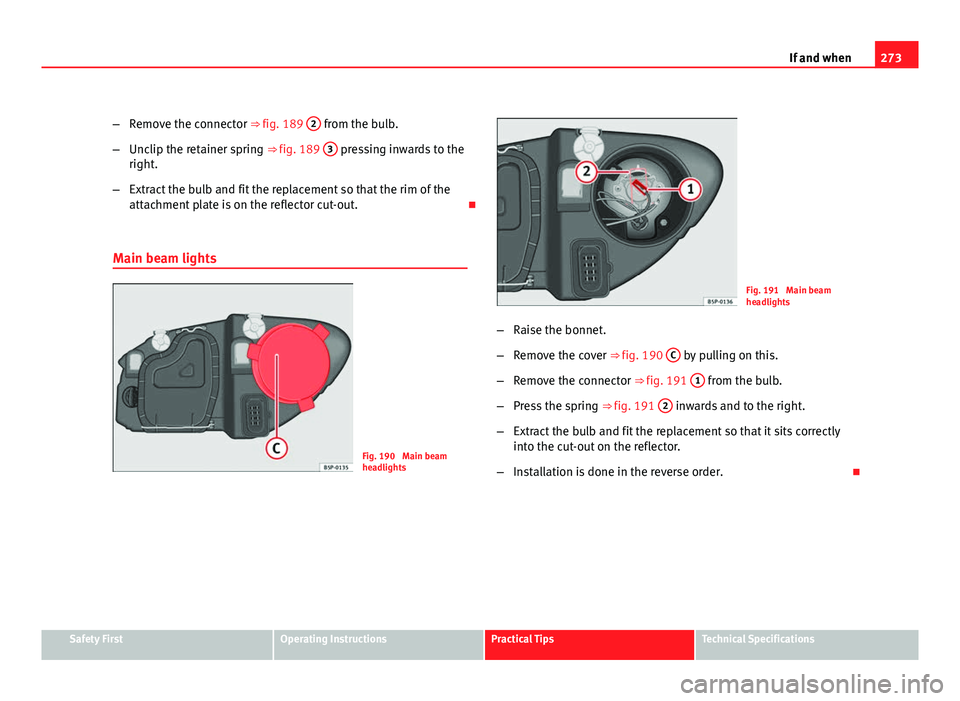
– Remove the connector ⇒ fig. 189 2
from the bulb.
– Unclip the retainer spring ⇒ fig. 189 3
pressing inwards to the
right.
– Extract the bulb and fit the replacement so that the rim of the
attachment plate is on the reflector cut-out.
Main beam lights
Fig. 190 Main beam
headlights
Fig. 191 Main beam
headlights
– Raise the bonnet.
– Remove the cover ⇒ fig. 190 C
by pulling on this.
– Remove the connector ⇒ fig. 191 1
from the bulb.
– Press the spring ⇒ fig. 191 2
inwards and to the right.
– Extract the bulb and fit the replacement so that it sits correctly
into the cut-out on the reflector.
– Installation is done in the reverse order.
Safety FirstOperating InstructionsPractical TipsTechnical Specifications
Page 277 of 315
275
If and when
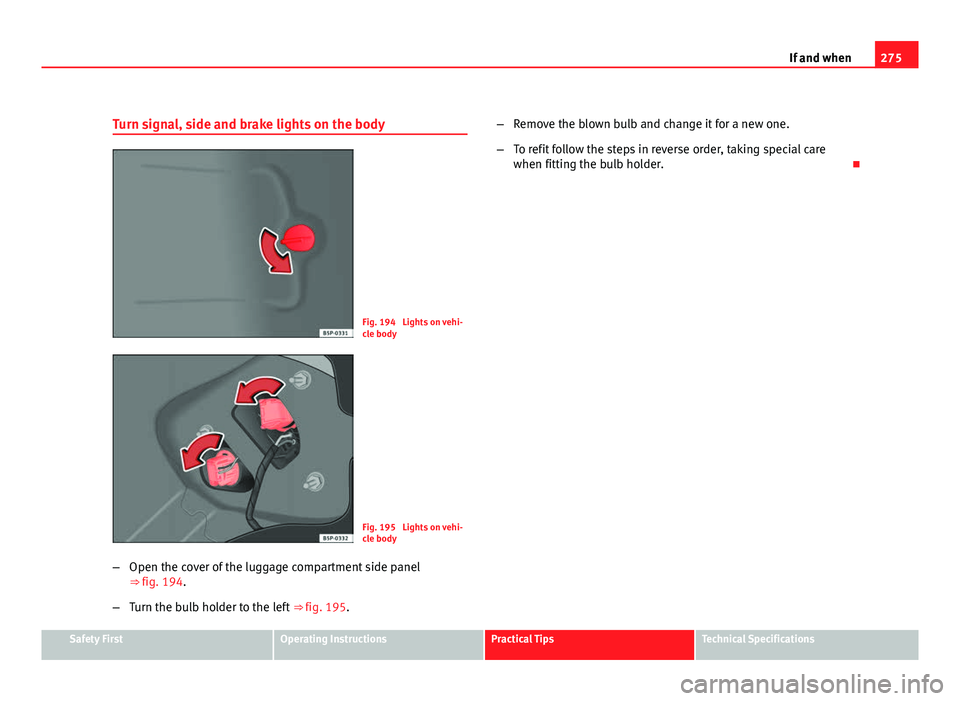
Turn signal, side and brake lights on the body
Fig. 194 Lights on vehi-
cle body
Fig. 195 Lights on vehi-
cle body
– Open the cover of the luggage compartment side panel
⇒ fig. 194.
– Turn the bulb holder to the left ⇒ fig. 195. –
Remove the blown bulb and change it for a new one.
– To refit follow the steps in reverse order, taking special care
when fitting the bulb holder.
Safety FirstOperating InstructionsPractical TipsTechnical Specifications
Page 279 of 315
277
If and when
Side turn signals
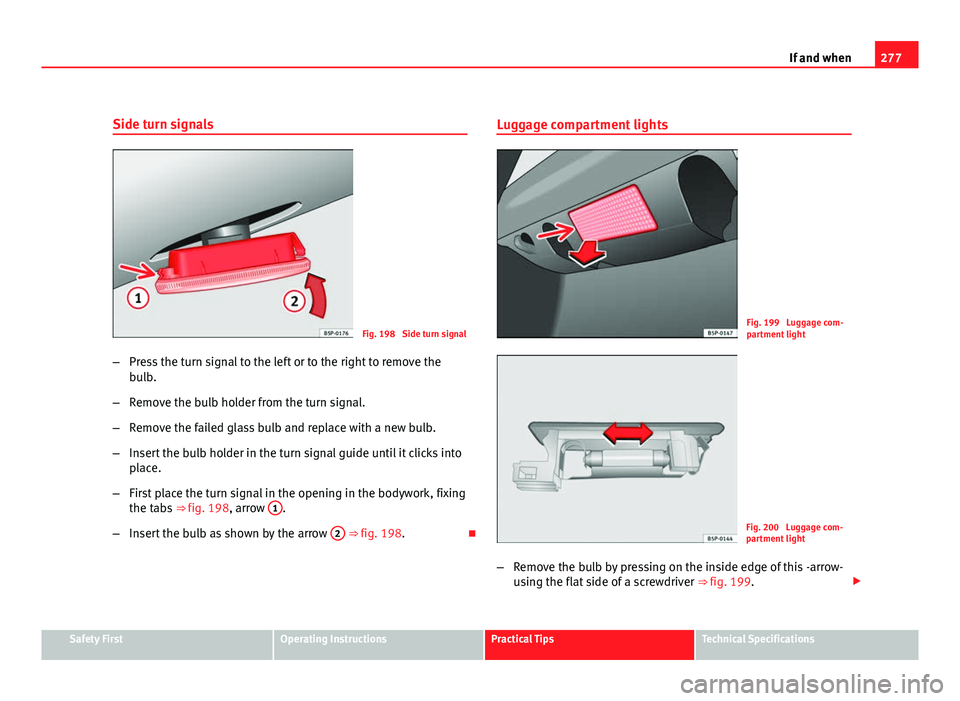
Fig. 198 Side turn signal
– Press the turn signal to the left or to the right to remove the
bulb.
– Remove the bulb holder from the turn signal.
– Remove the failed glass bulb and replace with a new bulb.
– Insert the bulb holder in the turn signal guide until it clicks into
place.
– First place the turn signal in the opening in the bodywork, fixing
the tabs ⇒ fig. 198, arrow 1
.
– Insert the bulb as shown by the arrow 2
⇒ fig. 198.Luggage compartment lights
Fig. 199 Luggage com-
partment light
Fig. 200 Luggage com-
partment light
– Remove the bulb by pressing on the inside edge of this -arrow-
using the flat side of a screwdriver ⇒ fig. 199.
Safety FirstOperating InstructionsPractical TipsTechnical Specifications
Page 281 of 315
279
If and when
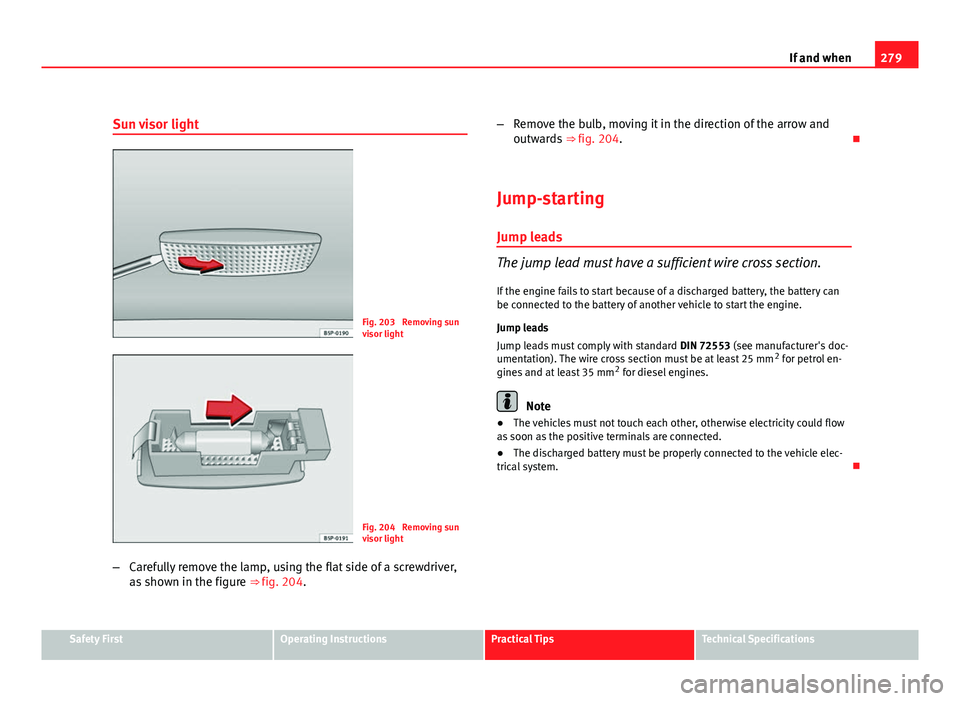
Sun visor light
Fig. 203 Removing sun
visor light
Fig. 204 Removing sun
visor light
– Carefully remove the lamp, using the flat side of a screwdriver,
as shown in the figure ⇒ fig. 204. –
Remove the bulb, moving it in the direction of the arrow and
outwards ⇒ fig. 204.
Jump-starting
Jump leads
The jump lead must have a sufficient wire cross section. If the engine fails to start because of a discharged battery, the battery can
be connected to the battery of another vehicle to start the engine.
Jump leads
Jump leads must comply with standard DIN 72553 (see manufacturer's doc-
umentation). The wire cross section must be at least 25 mm 2
for petrol en-
gines and at least 35 mm 2
for diesel engines.
Note
● The vehicles must not touch each other, otherwise electricity could flow
as soon as the positive terminals are connected.
● The discharged battery must be properly connected to the vehicle elec-
trical system.
Safety FirstOperating InstructionsPractical TipsTechnical Specifications
Page 283 of 315
281
If and when
11. Turn on the heater blower and heated rear window in the vehi- cle with the flat battery. This helps minimise voltage peaks
which are generated when the leads are disconnected.
12. When the engine is running, disconnect the leads in reverse order to the details given above.
Connect the battery clamps so they have good metal-to-metal contact with
the battery terminals.
If the engine fails to start, switch off the starter after about 10 seconds and
try again after about half a minute.
WARNING
● Please note the safety warnings referring to working in the engine
compartment ⇒ page 230, Working in the engine compartment.
● The battery providing assistance must have the same voltage as the
flat battery (12V) and approximately the same capacity (see imprint on
battery). Failure to comply could result in an explosion.
● Never use jump leads when one of the batteries is frozen. Danger of
explosion! Even after the battery has thawed, battery acid could leak and
cause chemical burns. If a battery freezes, it should be replaced.
● Keep sparks, flames and lighted cigarettes away from batteries, dan-
ger of explosion. Failure to comply could result in an explosion.
● Observe the instructions provided by the manufacturer of the jump
leads.
● Do not connect the negative cable from the other vehicle directly to
the negative terminal of the flat battery. The gas emitted from the battery
could be ignited by sparks. Danger of explosion.
● Do not attach the negative cable from the other vehicle to parts of the
fuel system or to the brake line.
WARNING (Continued)
● The non-insulated parts of the battery clamps must not be allowed to
touch. The jump lead attached to the positive battery terminal must not
touch metal parts of the vehicle, this can cause a short circuit.
● Position the leads in such a way that they cannot come into contact
with any moving parts in the engine compartment.
● Do not bend over the batteries. This could result in chemical burns.
Note
The vehicles must not touch each other, otherwise electricity could flow as
soon as the positive terminals are connected.
Safety FirstOperating InstructionsPractical TipsTechnical Specifications