height Seat Arona 2017 User Guide
[x] Cancel search | Manufacturer: SEAT, Model Year: 2017, Model line: Arona, Model: Seat Arona 2017Pages: 308, PDF Size: 6.66 MB
Page 148 of 308
Operation
Note
● If the el ectric
al adjustment ever fails to op-
erate, the mirrors can be adjusted by hand by
lightly pressing the edge of the mirror glass.
● In vehicles with electric exterior mirrors,
the fol
lowing points should be observed: if,
due to an external force (e.g. being knocked
while manoeuvring), the adjustment of the
mirror housing is altered, the mirror will have
to be fully folded electrically. Do not readjust
the rear vision mirror housing by hand, as
this will interfere with the mirror adjuster
function.
● The fold-in function on the exterior mirrors
wil
l not activate at speeds over 40 km/h
(25 mph). Seats and head restraints
Adju
s
tin
g the seat and head re-
straints
Adjusting the front seats Read the additional information carefully
›› ›
page 18 WARNING
The safe driving chapter contains important
inform ation, tip
s, suggestions and warnings
that you should read and observe for your
own safety and the safety of your passengers
››› page 71. WARNING
● Never a dju
st the driver or front passenger
seat while the vehicle is in motion. While ad-
justing your seat, you will assume an incor-
rect sitting position. Risk of accidents. Adjust
the driver or front passenger seat only when
the vehicle is stationary.
● To reduce the risk of injury to the driver and
front p
assenger in case of a sudden braking
or an accident, never drive with the backrest
tilted towards the rear. The maximum protec-
tion of the seat belt can be achieved only
when the backrests are in an upright position
and the driver and front passenger have prop-
erly adjusted their seat belts. The further the backrests are tilted to the rear, the greater
the risk
of
injury due to improper positioning
of the belt web!
● Exercise caution when securing the seat
height into f
orwards/backwards position. In-
juries can be caused if the seat height is ad-
justed without due care and attention.
● To move the seat forwards and backwards,
pul
l upwards and not sideways on the lever,
as the force exerted on it in that direction
could damage it. Adjusting the front head restraints
Read the additional information carefully
› ›
›
page 19
Adjust the head restraint ›››
page 19 so
that as far as possible the top of the head re-
straint is level with the top of your head.
When this is not possible, try to get as close
as possible to this position. WARNING
● Never driv e if
the head restraints have been
removed. Risk of injury.
● After refitting the head restraint, you must
alwa
ys adjust it properly for height to achieve
optimal protection.
● Please observe the safety warnings ›››
in
Corr ect
adjustment of front head restraints on
page 75. 146
Page 151 of 308
Seats and head restraints
Folding down the back seat Fig. 153
Folding up the rear seat cushion. Fig. 154
On the rear seat backrest: unlock
b utt
on 1 ; red mark
2 .
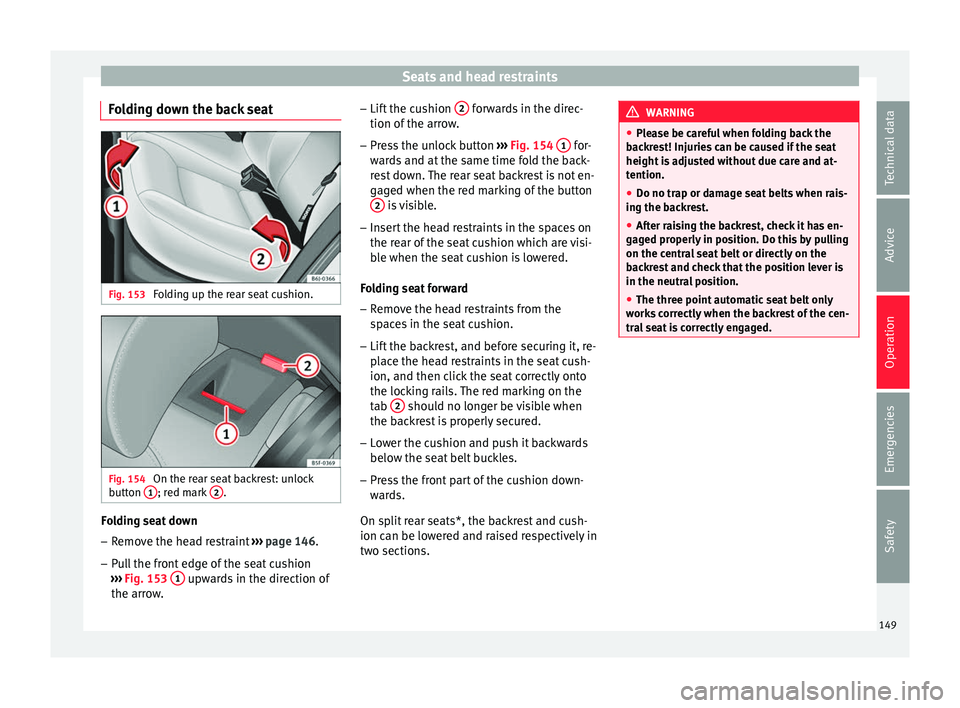
Folding seat down
– Remove the head restraint ››
› page 146.
– Pull the front edge of the seat cushion
›››
Fig. 153 1 upwards in the direction of
the arr o
w
. –
Lift the c
ushion 2 forwards in the direc-
tion of the arr
o
w.
– Press the unlock button ›››
Fig. 154 1 for-
w ar
d
s and at the same time fold the back-
rest down. The rear seat backrest is not en-
gaged when the red marking of the button 2 is visible.
– Insert the head restraints in the spaces on
the r e
ar of
the seat cushion which are visi-
ble when the seat cushion is lowered.
Folding seat forward
– Remove the head restraints from the
spac
es in the seat cushion.
– Lift the backrest, and before securing it, re-
plac
e the head restraints in the seat cush-
ion, and then click the seat correctly onto
the locking rails. The red marking on the
tab 2 should no longer be visible when
the b ac
k
rest is properly secured.
– Lower the cushion and push it backwards
below the seat
belt buckles.
– Press the front part of the cushion down-
ward
s.
On split rear seats*, the backrest and cush-
ion can be lowered and raised respectively in
two sections. WARNING
● Ple a
se be careful when folding back the
backrest! Injuries can be caused if the seat
height is adjusted without due care and at-
tention.
● Do no trap or damage seat belts when rais-
ing the bac
krest.
● After raising the backrest, check it has en-
gaged pr
operly in position. Do this by pulling
on the central seat belt or directly on the
backrest and check that the position lever is
in the neutral position.
● The three point automatic seat belt only
works
correctly when the backrest of the cen-
tral seat is correctly engaged. 149
Technical data
Advice
Operation
Emergencies
Safety
Page 157 of 308
Transport and practical equipment
Luggage compartment variable floor Fig. 166
Luggage compartment variable
floor: r ai
sed po
sition; lowered position. Fig. 167
Luggage compartment variable
floor: sloped po s
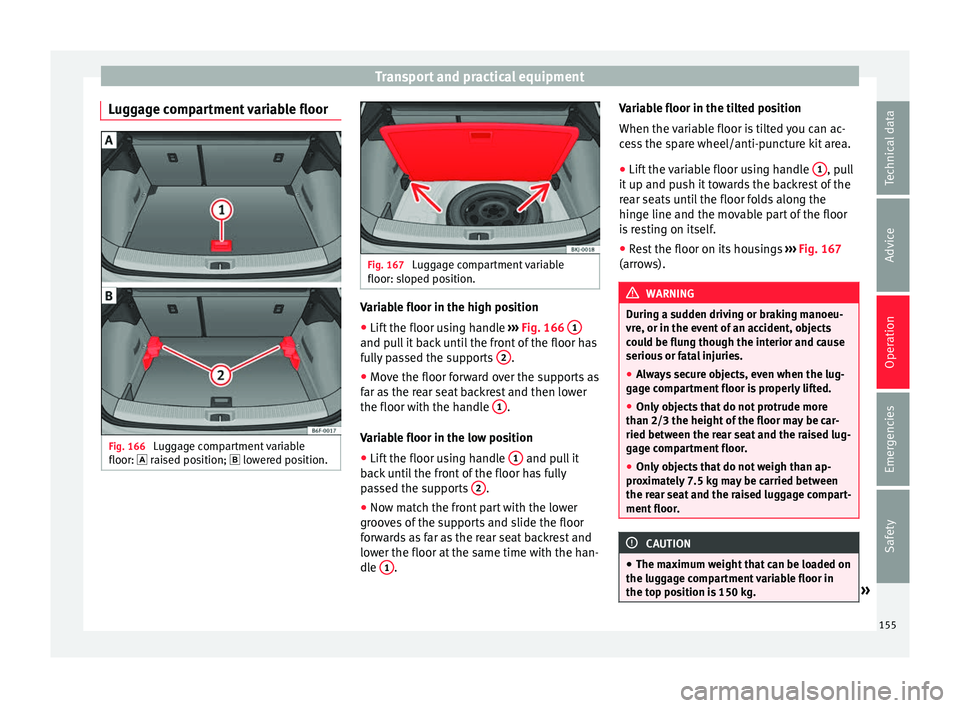
ition. Variable floor in the high position
●
Lift the floor using handle ››
›
Fig. 166 1 and pull it back until the front of the floor has
f
u
l
ly passed the supports 2 .
● Move the floor forward over the supports as
f ar a
s
the rear seat backrest and then lower
the floor with the handle 1 .
V ari
ab
le floor in the low position
● Lift the floor using handle 1 and pull it
b ac
k
until the front of the floor has fully
passed the supports 2 .
● Now match the front part with the lower
gr oo
v
es of the supports and slide the floor
forwards as far as the rear seat backrest and
lower the floor at the same time with the han-
dle 1 .Variable floor in the tilted position
When the
v
ari
able floor is tilted you can ac-
cess the spare wheel/anti-puncture kit area.
● Lift the variable floor using handle 1 , pull
it up and p
u
sh it towards the backrest of the
rear seats until the floor folds along the
hinge line and the movable part of the floor
is resting on itself.
● Rest the floor on its housings ›››
Fig. 167
(arrows). WARNING
During a sudden driving or braking manoeu-
vre, or in the ev ent
of an accident, objects
could be flung though the interior and cause
serious or fatal injuries.
● Always secure objects, even when the lug-
gage c
ompartment floor is properly lifted.
● Only objects that do not protrude more
than 2/3 the height of
the floor may be car-
ried between the rear seat and the raised lug-
gage compartment floor.
● Only objects that do not weigh than ap-
prox
imately 7.5 kg may be carried between
the rear seat and the raised luggage compart-
ment floor. CAUTION
● The max imum w
eight that can be loaded on
the luggage compartment variable floor in
the top position is 150 kg. » 155
Technical data
Advice
Operation
Emergencies
Safety
Page 158 of 308
Operation
●
Do not l et
the luggage compartment floor
fall when closing it. Always carefully guide it
downwards in a controlled manner. Other-
wise, the lining and the floor of the luggage
compartment could be damaged. Note
SEAT recommends the use of straps to secure
o b j
ects to retaining rings. Roof carrier*
Intr oduction The vehicle roof has been designed to opti-
mi
se aer
ody
namics. For this reason, cross
bars or conventional roof carrier systems can-
not be secured to the roof water drains.
As the roof water drains are integrated in the
roof to reduce air resistance, only SEAT-ap-
proved cross bars and roof carrier systems
can be used.
Cases in which cross bars and the roof carri-
er system should be disassembled.
● When they are not used.
● When the vehicle is washed in a car wash.
● When the vehicle height exceeds the maxi-
mum height, for e x
ample, in some garages. WARNING
When heavy or bulky loads are transported
on the roof c
arrier system, car driving per-
formance is affected, as the centre of gravity
shifts and there is greater wind resistance.
● Always secure the load properly using belts
or retainin
g straps that are suitable and in a
good condition.
● Bulky, heavy, long or flat loads have a neg-
ative effect
on aerodynamics, the centre of
gravity and driving performance.
● Avoid sudden braking and manoeuvres.
● Adapt your speed and driving style at all
times t
o suit visibility, weather, road and traf-
fic conditions. CAUTION
● Remo v
e the cross bars and the roof carrier
system before entering a car wash.
● Vehicle height is increased by the installa-
tion of cr
oss bars or a roof carrier system and
the load secured on them. For this purpose,
check that your vehicle's height does not sur-
pass the headspace limit, for example, for un-
derpasses or for entering garage doors.
● Any cross bars, roof carrier systems or
load
s secured to them must not interfere with
the roof aerial or block the path of the rear
lid.
● On opening the rear lid make sure that it
does not
knock into the roof load. For the sake of the environment
When cross bars and a roof carrier system are
ins t
alled, the increased air resistance means
that the vehicle uses more fuel. Attach the cross bars and the roof car-
rier sys
t
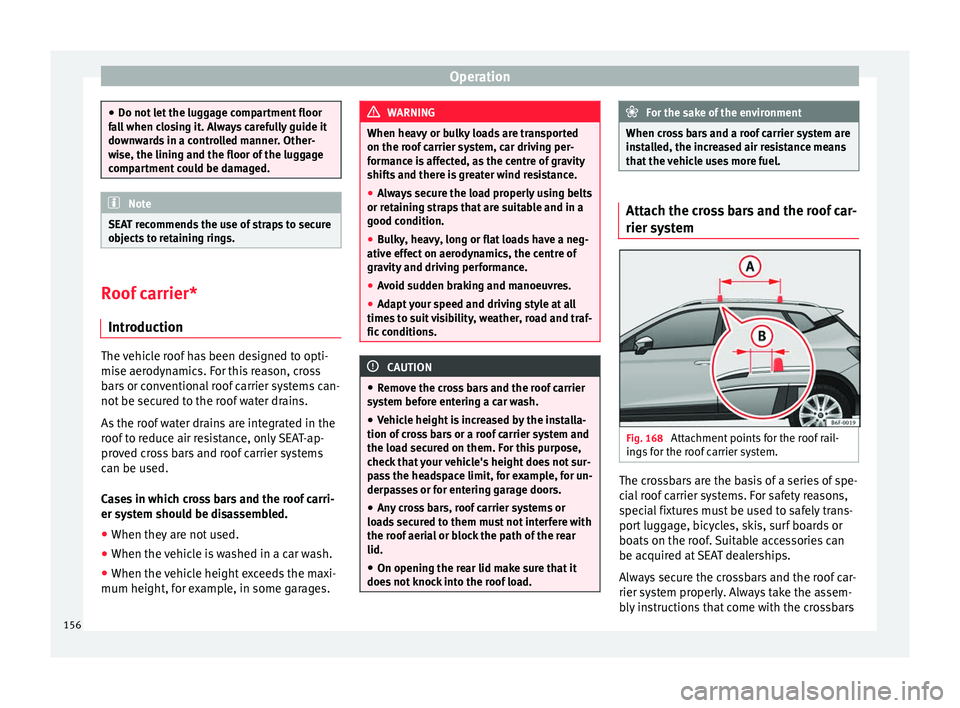
em Fig. 168
Attachment points for the roof rail-
in g
s
for the roof carrier system. The crossbars are the basis of a series of spe-
c
i
al
roof carrier systems. For safety reasons,
special fixtures must be used to safely trans-
port luggage, bicycles, skis, surf boards or
boats on the roof. Suitable accessories can
be acquired at SEAT dealerships.
Always secure the crossbars and the roof car-
rier system properly. Always take the assem-
bly instructions that come with the crossbars
156
Page 197 of 308
Driving
Engine pre-heating/fault system* The warning lamp lights up to show that the
glow p
lug
s are preheating the diesel engine.
The control lamp lights up
If the control lamp lights up when the en-
gine is started it means that the glow plugs
are preheating. The engine can be started
straight away when the lamp switches off.
Control lamp flashes
If a fault develops in the engine management
system while you are driving, the glow plug
system lamp will flash . Take the vehicle to
a specialised workshop as soon as possible
and have the engine checked.
Driving tips Drivin g abr
oadTo drive abroad, the following must be taken
int
o c
on
sideration:
● For vehicles fitted with a catalytic converter
ensur
e that unleaded petrol is available for
the journey. See the chapter “Refuelling”. Au-
tomobile organisations will have information
about service station networks selling unlea-
ded fuel. ●
In some countrie
s, it is possible that your
car model is not sold, and therefore some
spare parts are not available or the technical
services may only be able to carry out limited
repairs.
SEAT importers and distributors will gladly
provide information about the technical prep-
aration that your vehicle requires and also
about necessary maintenance and repair
possibilities.
Adhesive strips for headlights
In countries where vehicles drive on the other
side of the road to your home country, the
asymmetric dipped beam may dazzle drivers
of oncoming vehicles.
To prevent dazzling, you must apply stickers
to certain parts of the headlight lenses. Fur-
ther information is available at any Technical
Service.
Driving on flooded roads To prevent damage to the vehicle when driv-
in
g thr
ough w
ater, for example, along a floo-
ded road, please observe the following:
● The water should never come above the
lower edg
e of the bodywork.
● Drive at pedestrian speed. WARNING
After driving through water, mud, sludge,
etc ., the br
aking effect can be delayed slight-
ly due to moisture build-up on the discs and
brake pads. Applying the brakes carefully
several times will remove the moisture and
restore the full braking effect. CAUTION
● Drivin g thr
ough flooded areas may severely
damage vehicle components such as the en-
gine, transmission, running gear or electrical
system.
● Whenever driving through water, the Start-
Stop sys
tem* must be switched off
››› page 196. Note
● Check the depth of
the water before enter-
ing the flooded zone.
● Do not stop in the water, drive in reverse, or
stop the en
gine in any situation.
● Note that vehicles travelling in the opposite
direction ma
y splash water that could exceed
the maximum permitted water height for your
vehicle.
● Avoid driving through salt water (corro-
sion). 195
Technical data
Advice
Operation
Emergencies
Safety
Page 254 of 308
Operation
WARNING
The towing bracket ball coupling must be
st or
ed securely in the luggage compartment
to prevent them being flung through the vehi-
cle and causing injury. Note
● By l
aw, the ball coupling must be removed
if a trailer is not being towed if it obscures
the number plate. Driving with a trailer
Fig. 234
Turn the 13-pin connector. Before driving
●
Grip the 13-pin connector at area A and
r emo
v
e it in the direction of the arrow
››› Fig. 234.
● Remove the protective cover 5
› ››
Fig. 222
up w
ards.
After driving
● Grip the 13-pin connector at area A and
in ser
t
it in the opposite direction to the arrow
››› Fig. 234.
● Fit the protective cover 5
› ›
› Fig. 222
on
the ball coupling.
Safety lug
The safety lug B
› ›
› Fig. 234
is used to hook
up the trailer's retainer cable.
On hooking it up to the safety lug, the retain-
er cable should have slack in all the trailer
positions with respect to the vehicle (sharp
bends, reverse gear, etc.).
Headlights
The front part of the vehicle may be raised
when the trailer is connected and the light
may dazzle the rest of the traffic.
Adapt the height of the headlights using the
headlight range rotary adjuster 1)
. WARNING
● Never u se the s
afety lug to tow!
● Adjust your speed to suit the road and traf-
fic condition
s.
● All work on the electrical system must be
carried out on
ly by specialised workshops.
● Never connect the trailer's electric system
to the electric
al connections of the rear lights
or any other power sources.
● After hooking up the trailer and connecting
the socket, c
heck that all the trailer's rear
lights are working properly. Note
● If ther e i
s any fault in the trailer's lighting,
check the fuses in the instrument panel fuse
box ›››
page 58.
● The contact between the retainer cable and
the safety
lug may give rise to mechanical
wear in the lug's surface protection. This
wear will not prevent the safety lug from op-
erating properly or cause any fault and is ex-
cluded from the warranty.
● When connecting and disconnecting the
trail
er, the towing vehicle's handbrake
should be applied. 1)
This does not apply for vehicles with bi-xenon
hea dlights.
252
Page 271 of 308

Checking and refilling levels
●
Wait u
ntil no more steam, smoke or coolant
is emitted from the bonnet, then carefully
open the bonnet.
● When working in the engine compartment,
alwa
ys observe the safety warnings
››› page 267. Closing the bonnet
–
Slightly lift the bonnet. –
Rel
e
ase the bonnet stay and replace it in its
support.
– At a height of approximately 30 cm let it fall
so it lock
s.
If the bonnet does not close, do not press
downwards. Open it again and let it fall as
mentioned above. WARNING
If the bonnet is not closed properly, it could
open whil e
you are driving and completely
obscure your view of the road. Risk of acci-
dent.
● After closing the bonnet, always check that
it is
properly secured. The bonnet must be
flush with the surrounding body panels. ●
If y
ou notice that the bonnet latch is not se-
cured when the vehicle is moving, stop the
vehicle immediately and close the bonnet
properly. Risk of accident. 269
Technical data
Advice
Operation
Emergencies
Safety
Page 283 of 308
Wheels
For the sake of the environment
Under-inflated tyres will increase fuel con-
sumption. New tyres and wheels
New tyres and wheels have to be run in.
The tyr
e
s and wheel rims are an essential
part of the vehicle's design. Those approved
by SEAT are specially matched to the charac-
teristics of the vehicle and make a major con-
tribution to good road-holding and safe han-
dling ››› .
T y
r
es should be replaced at least in pairs and
not individually (i.e. both front tyres or both
rear tyres together). A knowledge of tyre des-
ignations makes it easier to choose the cor-
rect tyres. Radial tyres have the tyre designa-
tions marked on the sidewall, for example:
195/55 R16 91V
This contains the following information:
Tyre width in mm
Height/width ratio in %
Tyre construction: Radial
Rim diameter in inches
Load rating code
Speed rating
195
55
R
16
91
V The tyres could also have the following infor-
mation:
● A direction of
rotation symbol
● “Reinforced” denotes heavy-duty tyres.
The manufact
uring date is also indicated on
the tyre sidewall (possibly only on the inner
side of the wheel).
“DOT ... 1116 ...” means, for example, that
the tyre was produced in the 11th week of
2016.
We recommend that work on tyres and
wheels be carried out by a Technical Service.
They are familiar with the procedure and
have the necessary special tools and spare
parts as well as the proper facilities for dis-
posing of the old tyres.
Any technical service has full information on
the technical requirements when installing or
changing tyres, wheels or wheel trims. WARNING
● We r ec
ommend that you use only wheels
and tyres which have been approved by SEAT
for your model. Failure to do so could impair
vehicle handling. Risk of accident.
● Avoid running the vehicle on tyres that are
more than 6
years old. If you have no alterna-
tive, you should drive slowly and with extra
care at all times. ●
Never u se o
ld tyres or those with an un-
known “history of use”.
● If wheel trims are retrofitted, you must en-
sure th
at the flow of air to the brakes is not
restricted. This could cause the brake system
to overheat.
● All four wheels must be fitted with radial
tyre
s of the same type, size (rolling circumfer-
ence) and the same tread pattern. For the sake of the environment
Old tyres must be disposed of according to
the l aw
s in the country concerned. Note
● A S EA
T Service Centre should be consulted
to find out whether wheels or tyres of differ-
ent sizes to those originally fitted by SEAT
can be fitted, and to find out about the com-
binations allowed between the front axle
(axle 1) and the rear axle (axle 2).
● For technical reasons, it is not generally
poss
ible to use the wheels from other vehi-
cles. This can also apply to wheels of the
same model. The use of wheels or tyres
which have not been approved by SEAT for
use with your model may invalidate the vehi-
cle's type approval for use on public roads.
● If the spare tyre is not the same as the
tyre
s that are mounted on the vehicle (e.g.
winter tyres) you should only use the spare
tyre for a short period of time and drive with » 281
Technical data
Advice
Operation
Emergencies
Safety
Page 293 of 308

Technical specifications›››
Fig. 244 CROSSOVER
AFront projection (mm)803
BRear projection (mm)769
CWheelbase (mm)2,566
DLength (mm)4,138
EFront a)
track (mm)1,503
FBack a)
track (mm)1,486
GWidth (mm)1,780
HHeight at kerb weight (mm)1,552 b)
IGround clearance between the axles (mm)190
JFront projection angle limited by the bumpermaximum 20.1°
KRear projection angle limited by the bumpermaximum 29.5°
Turning radius (m)11.0
a)
This data will change depending on the type of wheel rim.
b) Dimension to the roof bars.
291
Technical data
Advice
Operation
Emergencies
Safety
Page 304 of 308
Index
Starting the engine . . . . . . . . . . . . . . . . . . 169, 170 aft
er the f
uel tank has been run dry . . . . . . . . 170
diesel . . . . . . . . . . . . . . . . . . . . . . . . . . . . . . . . . 170
petrol . . . . . . . . . . . . . . . . . . . . . . . . . . . . . . . . . 169
Starting the vehicle . . . . . . . . . . . . . . . . . . . . . . . . 30
Steel wheel rims cleaning . . . . . . . . . . . . . . . . . . . . . . . . . . . . . . 261
Steering . . . . . . . . . . . . . . . . . . . . . . . . . . . . 73, 168 control lamp . . . . . . . . . . . . . . . . . . . . . . . . . . . 167
electromechanical . . . . . . . . . . . . . . . . . . . . . . 168
power . . . . . . . . . . . . . . . . . . . . . . . . . . . . . . . . 168
power-assisted steering . . . . . . . . . . . . . . . . . . 168
steering column lock . . . . . . . . . . . . . . . . . . . . 168
Steering wheel adjustment . . . . . . . . . . . . . . . . . . . . . . . . . . . . . 20
gearshift paddles (automatic gearbox) . . . . . . 185
Steering wheel controls . . . . . . . . . . . . . . . . . . . . 119
Steering wheel height adjustment . . . . . . . . . . . . 73
Storage compartment . . . . . . . . . . . . . . . . . . . . . 150 of front door panel . . . . . . . . . . . . . . . . . . . . . . 150
on the front passenger side . . . . . . . . . . . . . . . 150
right front seat . . . . . . . . . . . . . . . . . . . . . . . . . 150
storage pocket in the seat . . . . . . . . . . . . . . . . 150
Sun visors . . . . . . . . . . . . . . . . . . . . . . . . . . . . . . . 143
Switch hazard warning lights . . . . . . . . . . . . . . . . . . . 141
Switching off the engine . . . . . . . . . . . . . . . . . . . 171
Switching off the lights . . . . . . . . . . . . . . . . . . . . 137
Switching on the lights . . . . . . . . . . . . . . . . . . . . 137
Switching the ignition on and off . . . . . . . . 30, 168
System Easy Connect . . . . . . . . . . . . . . . . . . . . . . 118
T Taking care of your vehicle . . . . . . . . . . . . . . . . . 256 interior . . . . . . . . . . . . . . . . . . . . . . . . . . . . . . . . 262
Technical data roof load . . . . . . . . . . . . . . . . . . . . . . . . . . . . . . 157 Technical specifications . . . . . . . . . . . . . . . . . . . . 285
Temperat
ure display
engine oil . . . . . . . . . . . . . . . . . . . . . . . . . . . . . . 40
outside temperature . . . . . . . . . . . . . . . . . . . . . . 39
Temporary spare wheel . . . . . . . . . . . . . . . . . . . . 283
Tightening the belt . . . . . . . . . . . . . . . . . . . . . . . . . 81
Tightening torque wheel bolts . . . . . . . . . . . . . . . . . . . . . . . . . . . . . 65
Tightening torque of wheel bolts . . . . . . . . . . . . 287
Tiptronic (automatic gearbox) . . . . . . . . . . 183, 185
Top speed . . . . . . . . . . . . . . . . . . . . . . . . . . . . . . . . 40
Top Tether . . . . . . . . . . . . . . . . . . . . . . . . . . . . . 26, 29
Top Tether system . . . . . . . . . . . . . . . . . . . . . . 26, 29
Tow-starting . . . . . . . . . . . . . . . . . . . . . . . . . . . 67, 96
Tow-starting the engine . . . . . . . . . . . . . . . . . . . . . 97
Towing blind spot detector (BSD) . . . . . . . . . . . . . . . . 225
special characteristics . . . . . . . . . . . . . . . . . . . 225
Towing a trailer . . . . . . . . . . . . . . . . . . . . . . . . . . . 250
Towing bracket retrofitting . . . . . . . . . . . . . . . . . . . . . . . . . . . . . 253
Towing bracket device . . . . . . . . . . . . . . . . . . . . . 245 ball coupling . . . . . . . . . . . . . . . . . . . . . . . . . . . 251
description . . . . . . . . . . . . . . . . . . . . . . . . . . . . 245
operation and care . . . . . . . . . . . . . . . . . . . . . . 249
Towing the vehicle . . . . . . . . . . . . . . . . . . . . . . 66, 96
Towline anchorage . . . . . . . . . . . . . . . . . . . . . . . . . 66 rear . . . . . . . . . . . . . . . . . . . . . . . . . . . . . . . . . . . 98
Tow rope . . . . . . . . . . . . . . . . . . . . . . . . . . . . . . . . 250
Traction control system . . . . . . . . . . . 177, 178, 179 control lamp . . . . . . . . . . . . . . . . . . . . . . . . . . . 178
Trailer . . . . . . . . . . . . . . . . . . . . . . . . . . . . . . . . . . 245 connecting . . . . . . . . . . . . . . . . . . . . . . . 251, 252
driving with a trailer . . . . . . . . . . . . . . . . . . . . . 252
electrical socket . . . . . . . . . . . . . . . . . . . . . . . . 251
hitching . . . . . . . . . . . . . . . . . . . . . . . . . . . . . . . 251
mode . . . . . . . . . . . . . . . . . . . . . . . . . . . . . . . . . 286 parking Aid . . . . . . . . . . . . . . . . . . . . . . . . . . . . 241
rear lights
. . . . . . . . . . . . . . . . . . . . . . . . . . . . . 250
safety lug . . . . . . . . . . . . . . . . . . . . . . . . . . . . . 252
tow rope . . . . . . . . . . . . . . . . . . . . . . . . . . . . . . 250
Trailer turn signals control lamp . . . . . . . . . . . . . . . . . . . . . . . . . . . 139
Trailer weights . . . . . . . . . . . . . . . . . . . . . . . . . . . 286
Transporting children . . . . . . . . . . . . . . . . . . . . . . . 88
Transporting items fastening rings . . . . . . . . . . . . . . . . . . . . . . . . . 154
roof carrier . . . . . . . . . . . . . . . . . . . . . . . . . . . . . 156
roof carrier system . . . . . . . . . . . . . . . . . . . . . . 156
Transporting objects roof carrier system . . . . . . . . . . . . . . . . . . . . . . 157
Trim parts: cleaning . . . . . . . . . . . . . . . . . . . . . . . 262
Turn signal lever . . . . . . . . . . . . . . . . . . . . . . . . . . 139
Turn signals control lamp . . . . . . . . . . . . . . . . . . . . . . . . . . . 139
Tyre Mobility System . . . . . . . . . . . . . . . . . . . . . . . 60 components . . . . . . . . . . . . . . . . . . . . . . . . . . . . 95
inflating a tyre . . . . . . . . . . . . . . . . . . . . . . . . . . . 95
sealing a tyre . . . . . . . . . . . . . . . . . . . . . . . . . . . 95
see also Anti-puncture kit . . . . . . . . . . . . . . . . . 94
Tyre pressure monitoring system . . . . . . . . . . . . 280
Tyre pressures . . . . . . . . . . . . . . . . . . . . . . . . . . . . 287
Tyre profile . . . . . . . . . . . . . . . . . . . . . . . . . . . . . . 280
Tyre repair . . . . . . . . . . . . . . . . . . . . . . . . . . . . . . . . 94
Tyre repair kit see Anti-puncture kit . . . . . . . . . . . . . . . . . . . . . 94
Tyres . . . . . . . . . . . . . . . . . . . . . . . . . . . . . . . . . . . 278 changing . . . . . . . . . . . . . . . . . . . . . . . . . . . . . . . 61
new tyres . . . . . . . . . . . . . . . . . . . . . . . . . . . . . . 281
pressure . . . . . . . . . . . . . . . . . . . . . 279, 280, 282
run-in . . . . . . . . . . . . . . . . . . . . . . . . . . . . . . . . . 278
useful life . . . . . . . . . . . . . . . . . . . . . . . . . . . . . 280
wear indicators . . . . . . . . . . . . . . . . . . . . . . . . . 280
with directional tread pattern . . . . . . . . . 65, 279
302