belt Seat Arona 2017 Owner's Manual
[x] Cancel search | Manufacturer: SEAT, Model Year: 2017, Model line: Arona, Model: Seat Arona 2017Pages: 308, PDF Size: 6.66 MB
Page 7 of 308
Table of Contents
Table of Contents
The e s
senti
als . . . . . . . . . . . . . . . . . . . . . . . . 7
Exterior view . . . . . . . . . . . . . . . . . . . . . . . . . . . . 7
Exterior view . . . . . . . . . . . . . . . . . . . . . . . . . . . . 8
Driver-side general instrument panel (left-
hand drive) . . . . . . . . . . . . . . . . . . . . . . . . . . . . .
9
Driver-side general instrument panel (right-
hand drive) . . . . . . . . . . . . . . . . . . . . . . . . . . . . .
10
Centre console . . . . . . . . . . . . . . . . . . . . . . . . . . 11
Passenger-side general instrument panel (left-
hand drive) . . . . . . . . . . . . . . . . . . . . . . . . . . . . .
12
Passenger-side general instrument panel
(right-hand driv
e) . . . . . . . . . . . . . . . . . . . . . . . . 13
Interior view . . . . . . . . . . . . . . . . . . . . . . . . . . . . 14
How it works . . . . . . . . . . . . . . . . . . . . . . . . . . . . 15
Opening and closing . . . . . . . . . . . . . . . . . . . . . 15
Before driving . . . . . . . . . . . . . . . . . . . . . . . . . . . 18
Airbags . . . . . . . . . . . . . . . . . . . . . . . . . . . . . . . . 20
Child seats . . . . . . . . . . . . . . . . . . . . . . . . . . . . . 23
Starting the vehicle . . . . . . . . . . . . . . . . . . . . . . 30
Lights and visibility . . . . . . . . . . . . . . . . . . . . . . 30
Easy Connect . . . . . . . . . . . . . . . . . . . . . . . . . . . 33
Driver information system . . . . . . . . . . . . . . . . . 35
Status display . . . . . . . . . . . . . . . . . . . . . . . . . . . 38
Cruise control . . . . . . . . . . . . . . . . . . . . . . . . . . . 42
Warning lamps . . . . . . . . . . . . . . . . . . . . . . . . . . 44
Gearbox lever . . . . . . . . . . . . . . . . . . . . . . . . . . . 47
Air conditioning . . . . . . . . . . . . . . . . . . . . . . . . . 48
Fluid Level control . . . . . . . . . . . . . . . . . . . . . . . 54
Emergencies . . . . . . . . . . . . . . . . . . . . . . . . . . . . 58
Fuses . . . . . . . . . . . . . . . . . . . . . . . . . . . . . . . . . . 58
Bulbs . . . . . . . . . . . . . . . . . . . . . . . . . . . . . . . . . . 59
Action in the event of a puncture . . . . . . . . . . . 60
Changing a wheel . . . . . . . . . . . . . . . . . . . . . . . 61
Snow chains . . . . . . . . . . . . . . . . . . . . . . . . . . . . 66
Emergency towing of the vehicle . . . . . . . . . . . 66 How to jump start . . . . . . . . . . . . . . . . . . . . . . . . 67
Changing the windscreen wiper blades . . . . . . 69
Safety . . . . . . . . . . . . . . . . . . . . . . . . . . . . . . . . 71
Safe driving . . . . . . . . . . . . . . . . . . . . . . . . . . . . 71
Safety first! . . . . . . . . . . . . . . . . . . . . . . . . . . . . . 71
Advice about driving . . . . . . . . . . . . . . . . . . . . . 71
Correct position for passengers . . . . . . . . . . . . 72
Pedal area . . . . . . . . . . . . . . . . . . . . . . . . . . . . . . 76
Seat belts . . . . . . . . . . . . . . . . . . . . . . . . . . . . . . 77
Why wear a seat belt? . . . . . . . . . . . . . . . . . . . . 77
How to properly adjust your seatbelt . . . . . . . . 80
Belt pretensioners* . . . . . . . . . . . . . . . . . . . . . . 81
Airbag system . . . . . . . . . . . . . . . . . . . . . . . . . . 82
Brief introduction . . . . . . . . . . . . . . . . . . . . . . . . 82
Airbag safety instructions . . . . . . . . . . . . . . . . . 84
Deactivating airbags . . . . . . . . . . . . . . . . . . . . . 86
Transporting children safely . . . . . . . . . . . . . . . 88
Safety for children . . . . . . . . . . . . . . . . . . . . . . . 88
Child seats . . . . . . . . . . . . . . . . . . . . . . . . . . . . . 89
Event Data Recorder . . . . . . . . . . . . . . . . . . . . . . 92
Description and operation . . . . . . . . . . . . . . . . . 92
Emergencies . . . . . . . . . . . . . . . . . . . . . . . . . . 93
Self-help . . . . . . . . . . . . . . . . . . . . . . . . . . . . . . . 93
Emergency equipment . . . . . . . . . . . . . . . . . . . . 93
Tyre repair . . . . . . . . . . . . . . . . . . . . . . . . . . . . . . 94
Changing the windscreen wiper blades . . . . . . 96
Towing or tow-starting . . . . . . . . . . . . . . . . . . . . 96
Fuses and bulbs . . . . . . . . . . . . . . . . . . . . . . . . . 100
Fuses . . . . . . . . . . . . . . . . . . . . . . . . . . . . . . . . . . 100
Changing bulbs . . . . . . . . . . . . . . . . . . . . . . . . . 102
Change the front bulbs . . . . . . . . . . . . . . . . . . . 103
Change the rear bulbs . . . . . . . . . . . . . . . . . . . . 105
Changing the interior bulbs . . . . . . . . . . . . . . . . 107
Operation . . . . . . . . . . . . . . . . . . . . . . . . . . . . . 111
Controls and displays . . . . . . . . . . . . . . . . . . . . 111
General instrument panel . . . . . . . . . . . . . . . . . 110 Instruments and warning/control lamps
. . . . . 113
Instruments . . . . . . . . . . . . . . . . . . . . . . . . . . . . 113
Warning and control lamps . . . . . . . . . . . . . . . . 117
Introduction to the Easy Connect system* . . . . 118
System settings (CAR)* . . . . . . . . . . . . . . . . . . . 118
Communications and multimedia . . . . . . . . . . . 119
Steering wheel controls* . . . . . . . . . . . . . . . . . . 119
Multimedia . . . . . . . . . . . . . . . . . . . . . . . . . . . . . 123
Opening and closing . . . . . . . . . . . . . . . . . . . . . 124
Keys . . . . . . . . . . . . . . . . . . . . . . . . . . . . . . . . . . . 124
Central locking system . . . . . . . . . . . . . . . . . . . . 126
Anti-theft alarm* . . . . . . . . . . . . . . . . . . . . . . . . 132
Boot hatch . . . . . . . . . . . . . . . . . . . . . . . . . . . . . 135
Electric windows . . . . . . . . . . . . . . . . . . . . . . . . . 135
Lights and visibility . . . . . . . . . . . . . . . . . . . . . . 137
Lights . . . . . . . . . . . . . . . . . . . . . . . . . . . . . . . . . 137
Interior lights . . . . . . . . . . . . . . . . . . . . . . . . . . . 142
Visibility . . . . . . . . . . . . . . . . . . . . . . . . . . . . . . . 143
Windscreen wiper and rear window wiper sys-
tems . . . . . . . . . . . . . . . . . . . . . . . . . . . . . . . . . . 143 R
ear view mirrors . . . . . . . . . . . . . . . . . . . . . . . . 144
Seats and head restraints . . . . . . . . . . . . . . . . . 146
Adjusting the seat and head restraints . . . . . . 146
Seat functions . . . . . . . . . . . . . . . . . . . . . . . . . . 147
Transport and practical equipment . . . . . . . . . 150
Practical equipment . . . . . . . . . . . . . . . . . . . . . . 150
Luggage compartment . . . . . . . . . . . . . . . . . . . . 152
Roof carrier* . . . . . . . . . . . . . . . . . . . . . . . . . . . . 156
Air conditioning . . . . . . . . . . . . . . . . . . . . . . . . . 158
Heating, ventilation and cooling . . . . . . . . . . . . 158
Heating and fresh air . . . . . . . . . . . . . . . . . . . . . 161
Manual air conditioning* . . . . . . . . . . . . . . . . . . 163
Climatronic* . . . . . . . . . . . . . . . . . . . . . . . . . . . . 165
Driving . . . . . . . . . . . . . . . . . . . . . . . . . . . . . . . . 167
Address . . . . . . . . . . . . . . . . . . . . . . . . . . . . . . . . 167
Starting and stopping the engine . . . . . . . . . . . 168
Braking and parking . . . . . . . . . . . . . . . . . . . . . 174
Braking and stability systems . . . . . . . . . . . . . . 177 5
Page 21 of 308
The essentials
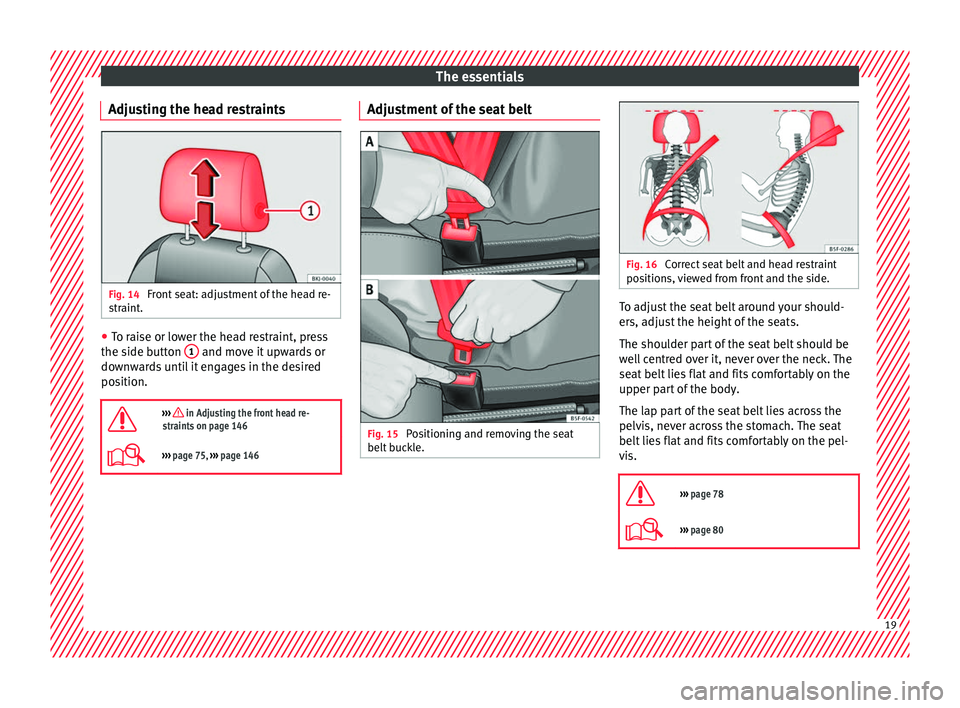
Adjusting the head restraints Fig. 14
Front seat: adjustment of the head re-
s tr
aint
. ●
To raise or lower the head restraint, press
the s ide b
utt
on 1 and move it upwards or
do wn
w
ards until it engages in the desired
position.
››› in Adjusting the front head re-
straints on page 146
››› page 75, ››› page 146 Adjustment of the seat belt
Fig. 15
Positioning and removing the seat
belt b
uc
kle. Fig. 16
Correct seat belt and head restraint
pos ition
s, viewed from front and the side. To adjust the seat belt around your should-
er
s, a
dju
st the height of the seats.
The shoulder part of the seat belt should be
well centred over it, never over the neck. The
seat belt lies flat and fits comfortably on the
upper part of the body.
The lap part of the seat belt lies across the
pelvis, never across the stomach. The seat
belt lies flat and fits comfortably on the pel-
vis.
››› page 78
››› page 80 19
Page 22 of 308
The essentials
Seat belt tensioners During a collision, the seat belts on the front
seats
ar
e retracted automatically.
The tensioner can be triggered only once.
››› in Service and disposal of belt ten-
sioners on page 82
››› page 81 Adjusting the exterior mirrors
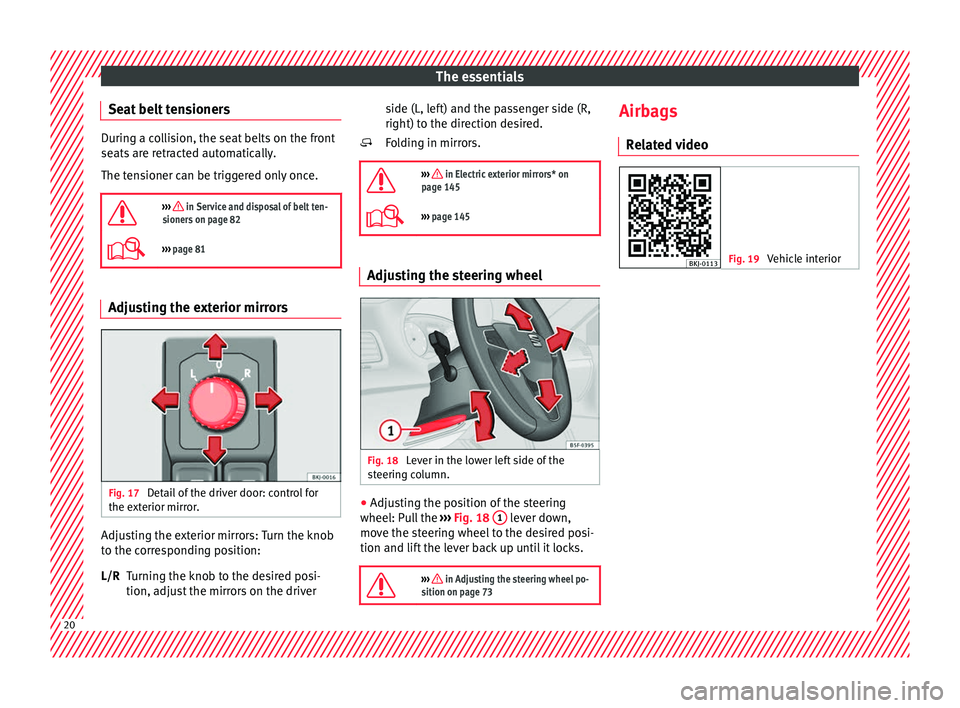
Fig. 17
Detail of the driver door: control for
the e xt
erior mirr
or. Adjusting the exterior mirrors: Turn the knob
t
o the c
orr
esponding position:
Turning the knob to the desired posi-
tion, adjust the mirrors on the driver
L/R side (L, left) and the passenger side (R,
right) to the direction de
sired.
Folding in mirrors.
››› in Electric exterior mirrors* on
page 145
››› page 145 Adjusting the steering wheel
Fig. 18
Lever in the lower left side of the
s t
eerin
g column. ●
Adjusting the position of the steering
wheel: P ul
l the ››› Fig. 18 1 lever down,
mo v
e the s
teering wheel to the desired posi-
tion and lift the lever back up until it locks.
››› in Adjusting the steering wheel po-
sition on page 73
Airbags
R el
at
ed video Fig. 19
Vehicle interior20
Page 23 of 308
The essentials
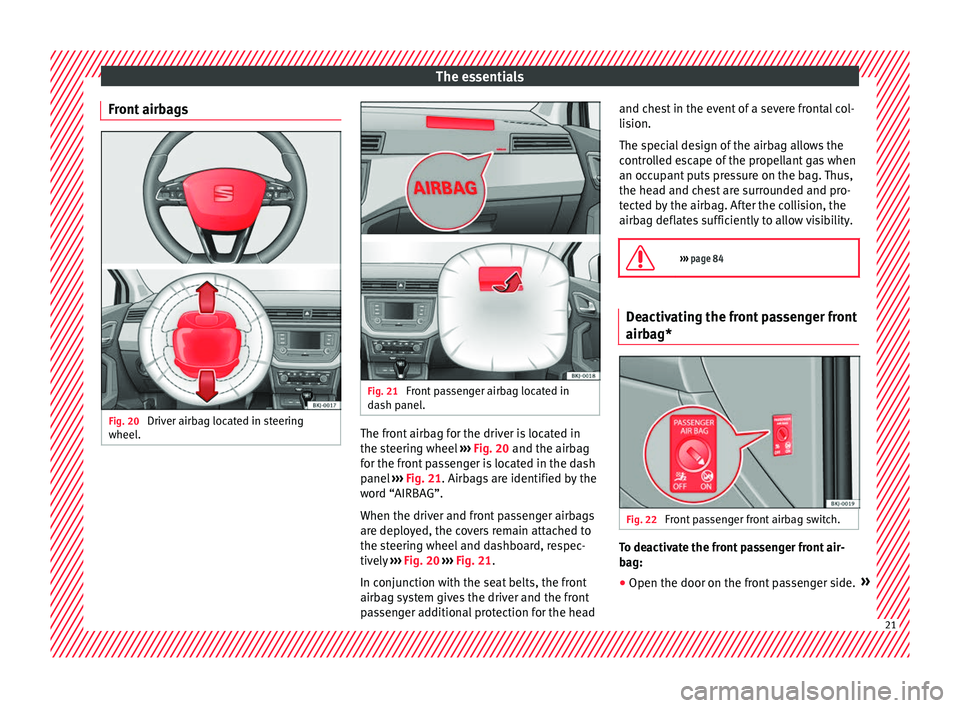
Front airbags Fig. 20
Driver airbag located in steering
wheel . Fig. 21
Front passenger airbag located in
d ash p
anel. The front airbag for the driver is located in
the s
t
eerin
g wheel ››› Fig. 20 and the airbag
for the front passenger is located in the dash
panel ››› Fig. 21. Airbags are identified by the
word “AIRBAG”.
When the driver and front passenger airbags
are deployed, the covers remain attached to
the steering wheel and dashboard, respec-
tively ››› Fig. 20 ››› Fig. 21.
In conjunction with the seat belts, the front
airbag system gives the driver and the front
passenger additional protection for the head and chest in the event of a severe frontal col-
lision.
The s
pecial design of the airbag allows the
controlled escape of the propellant gas when
an occupant puts pressure on the bag. Thus,
the head and chest are surrounded and pro-
tected by the airbag. After the collision, the
airbag deflates sufficiently to allow visibility.
››› page 84 Deactivating the front passenger front
airb
ag* Fig. 22
Front passenger front airbag switch. To deactivate the front passenger front air-
b
ag:
● Open the door on the fr ont
passenger side.» 21
Page 24 of 308
The essentials
● Inser
t
the key blade into the slot provided
in the deactivation switch.
● Approximately ¾ of the length of the key
bla
de remains inserted (the maximum).
● Turn the key blade, changing its position to
. Do not for
ce it. If you have difficulty, en-
sure that you have inserted the key as far as
it will go.
● Finally, check the control lamp on the in-
strument p
anel where it shows
the following should appear .
››› in Deactivation of front passenger
front airbag* on page 87
››› page 86 Side airbags*
Fig. 23
Side airbag in driver's seat. Fig. 24
Illustration of completely inflated side
airbag on l ef
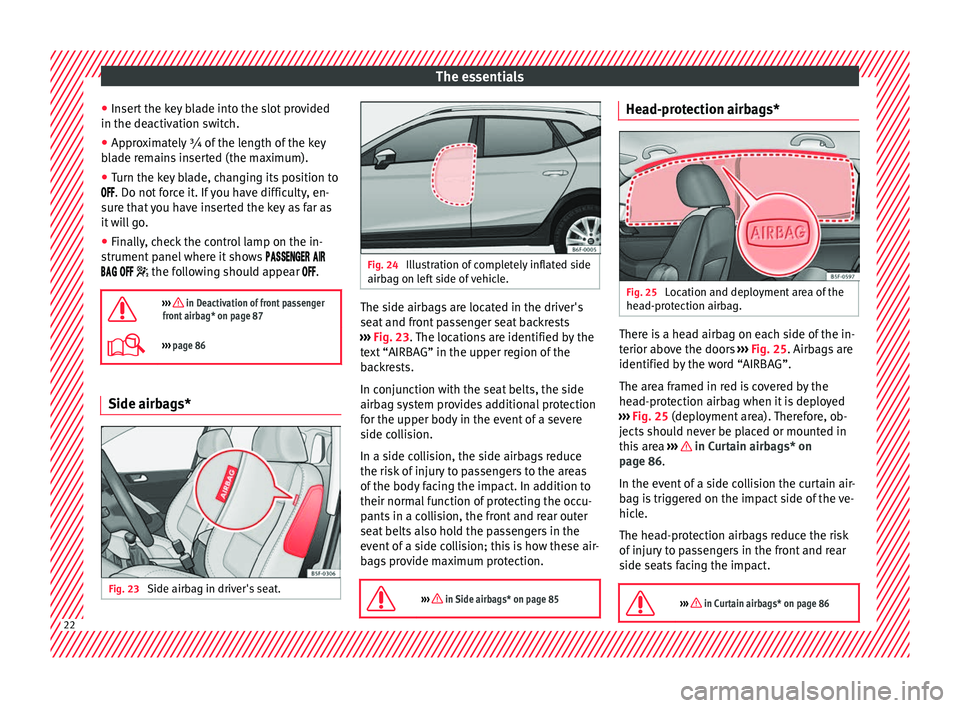
t side of vehicle. The side airbags are located in the driver's
se
at
and fr
ont passenger seat backrests
››› Fig. 23. The locations are identified by the
text “AIRBAG” in the upper region of the
backrests.
In conjunction with the seat belts, the side
airbag system provides additional protection
for the upper body in the event of a severe
side collision.
In a side collision, the side airbags reduce
the risk of injury to passengers to the areas
of the body facing the impact. In addition to
their normal function of protecting the occu-
pants in a collision, the front and rear outer
seat belts also hold the passengers in the
event of a side collision; this is how these air-
bags provide maximum protection.
››› in Side airbags* on page 85 Head-protection airbags*
Fig. 25
Location and deployment area of the
he a
d-pr
otection airbag. There is a head airbag on each side of the in-
t
erior abo
v
e the doors ››› Fig. 25. Airbags are
identified by the word “AIRBAG”.
The area framed in red is covered by the
head-protection airbag when it is deployed
››› Fig. 25 (deployment area). Therefore, ob-
jects should never be placed or mounted in
this area ››› in Curtain airbags* on
p ag
e 86
.
In the event of a side collision the curtain air-
bag is triggered on the impact side of the ve-
hicle.
The head-protection airbags reduce the risk
of injury to passengers in the front and rear
side seats facing the impact.
››› in Curtain airbags* on page 86 22
Page 26 of 308
The essentials
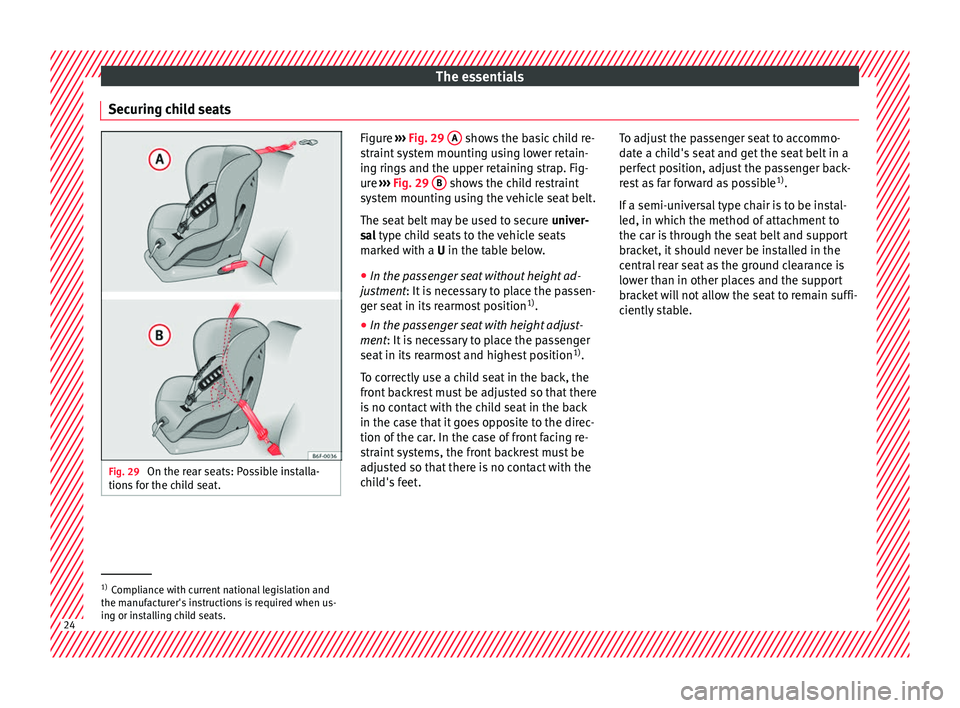
Securing child seats Fig. 29
On the rear seats: Possible installa-
tions f
or the child seat. Figure
››› Fig. 29 A shows the basic child re-
str aint
system mounting using lower retain-
ing rings and the upper retaining strap. Fig-
ure ››› Fig. 29 B shows the child restraint
sys t
em mounting using the vehicle seat belt.
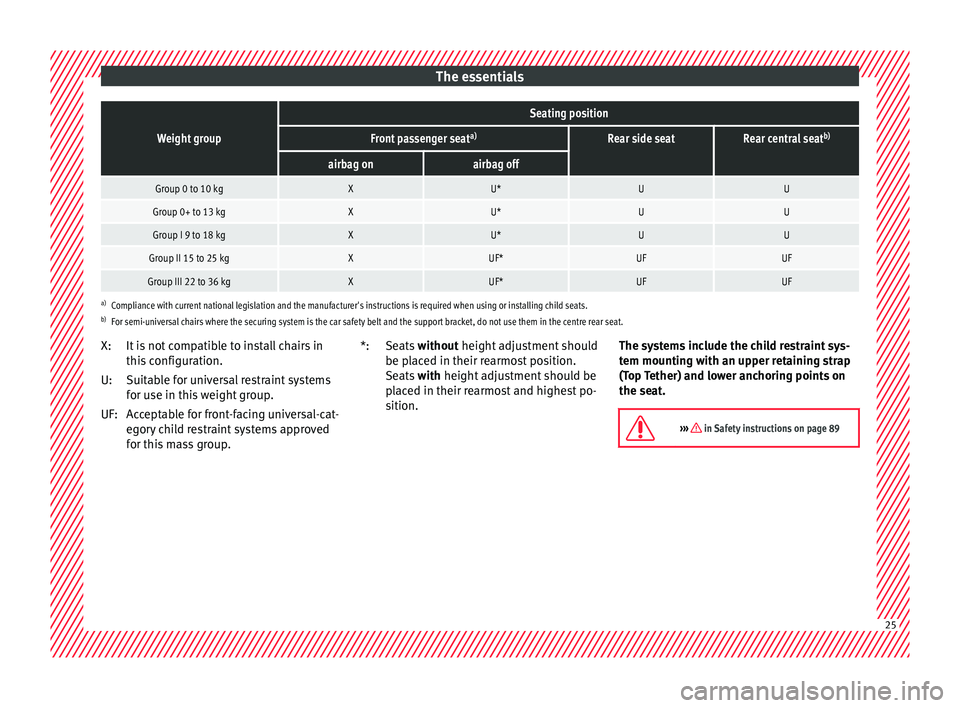
The seat belt may be used to secure univer-
sal type child seats to the vehicle seats
marked with a U in the table below.
● In the passenger seat without height ad-
justment
: It is necessary to place the passen-
ger seat in its rearmost position 1)
.
● In the passenger seat with height adjust-
ment: It
is necessary to place the passenger
seat in its rearmost and highest position 1)
.
To correctly use a child seat in the back, the
front backrest must be adjusted so that there
is no contact with the child seat in the back
in the case that it goes opposite to the direc-
tion of the car. In the case of front facing re-
straint systems, the front backrest must be
adjusted so that there is no contact with the
child's feet. To adjust the passenger seat to accommo-
date a c
hild's seat and get the seat belt in a
perfect position, adjust the passenger back-
rest as far forward as possible 1)
.
If a semi-universal type chair is to be instal-
led, in which the method of attachment to
the car is through the seat belt and support
bracket, it should never be installed in the
central rear seat as the ground clearance is
lower than in other places and the support
bracket will not allow the seat to remain suffi-
ciently stable. 1)
Compliance with current national legislation and
the manuf act
urer's instructions is required when us-
ing or installing child seats. 24
Page 27 of 308
The essentialsWeight group
Seating position
Front passenger seat
a)Rear side seatRear central seatb)
airbag onairbag off
Group 0 to 10 kgXU*UU
Group 0+ to 13 kgXU*UU
Group I 9 to 18 kgXU*UU
Group II 15 to 25 kgXUF*UFUF
Group III 22 to 36 kgXUF*UFUF
a)
Compliance with current national legislation and the manufacturer's instructions is required when using or installing child seats.
b) For semi-universal chairs where the securing system is the car safety belt and the support bracket, do not use them in the centre rear seat.
It is not compatible to install chairs in
this configuration.
Suitable for universal restraint systems
for use in this weight group.
Acceptable for front-facing universal-cat-
egory child restraint systems approved
for this mass group.
X:
U:
UF:
Seats
without height adjustment should
be pl aced in their rearmost position.
Seats with height adjustment should be
placed in their rearmost and highest po-
sition.
*:
The systems include the child restraint sys-
tem mountin
g with an upper retaining strap
(Top Tether) and lower anchoring points on
the seat.
››› in Safety instructions on page 89 25
Page 31 of 308
The essentials
Securing child seats with the Top
T ether* r
et
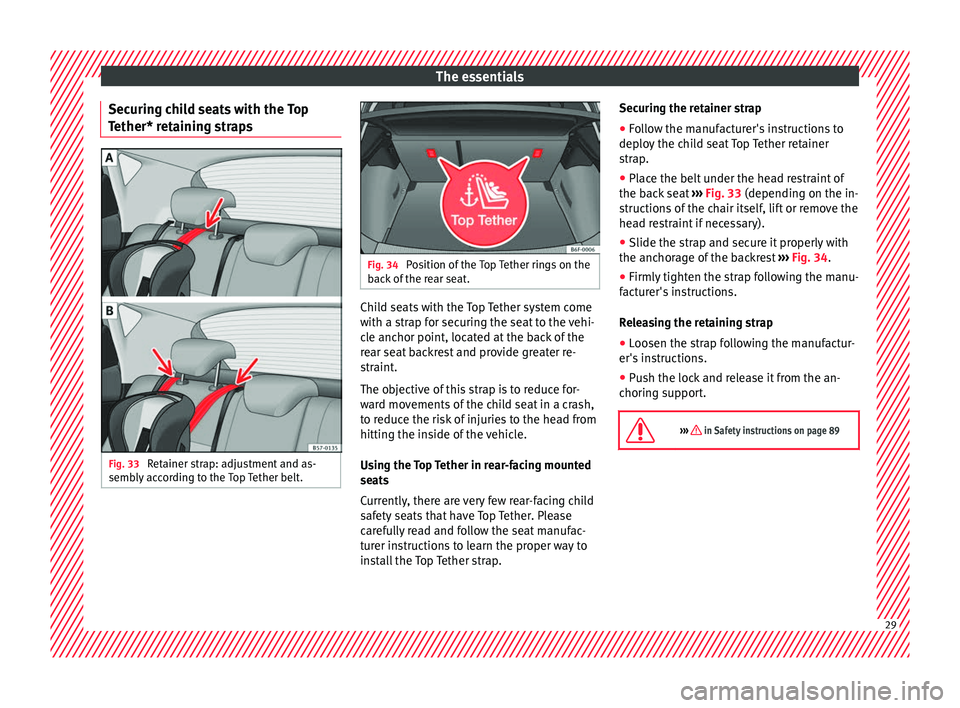
aining strapsFig. 33
Retainer strap: adjustment and as-
semb ly
ac
cording to the Top Tether belt. Fig. 34
Position of the Top Tether rings on the
bac k
of the rear seat. Child seats with the Top Tether system come
w
ith a s
tr
ap for securing the seat to the vehi-
cle anchor point, located at the back of the
rear seat backrest and provide greater re-
straint.
The objective of this strap is to reduce for-
ward movements of the child seat in a crash,
to reduce the risk of injuries to the head from
hitting the inside of the vehicle.
Using the Top Tether in rear-facing mounted
seats
Currently, there are very few rear-facing child
safety seats that have Top Tether. Please
carefully read and follow the seat manufac-
turer instructions to learn the proper way to
install the Top Tether strap. Securing the retainer strap
● Follow the manufacturer's instructions to
deploy
the child seat Top Tether retainer
strap.
● Place the belt under the head restraint of
the back
seat ››› Fig. 33 (depending on the in-
structions of the chair itself, lift or remove the
head restraint if necessary).
● Slide the strap and secure it properly with
the anchorag
e of the backrest ››› Fig. 34.
● Firmly tighten the strap following the manu-
factur
er's instructions.
Releasing the retaining strap
● Loosen the strap following the manufactur-
er's ins
tructions.
● Push the lock and release it from the an-
choring s
upport.
››› in Safety instructions on page 89 29
Page 47 of 308
The essentials
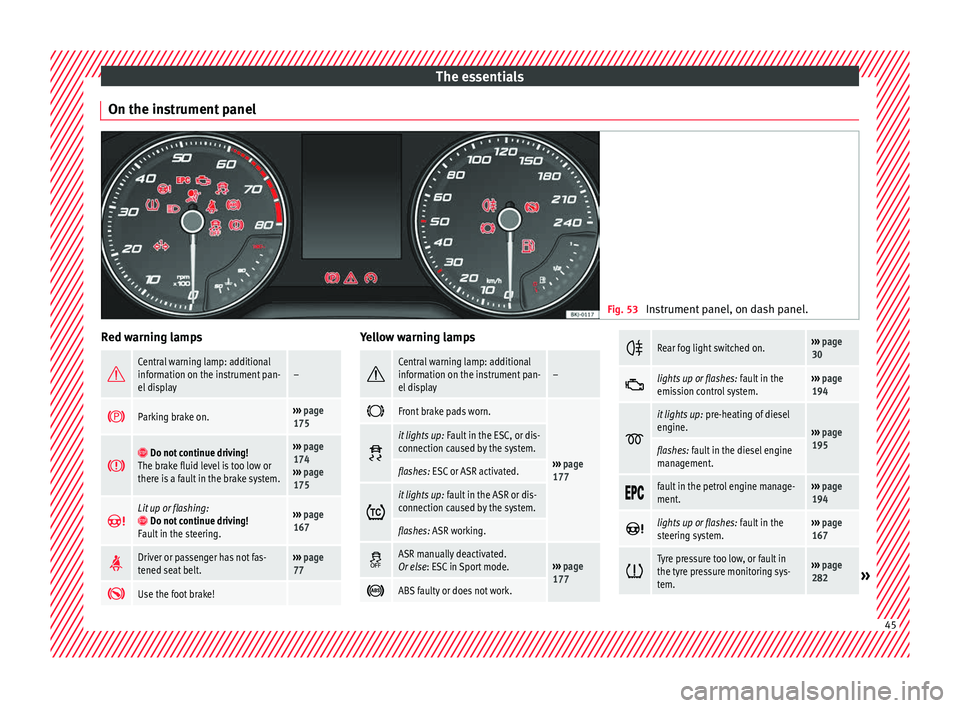
On the instrument panel Fig. 53
Instrument panel, on dash panel. Red warning lamps
Central warning lamp: additional
information on the instrument pan-
el display–
Parking brake on.›››
page
175
Do not continue driving!
The brake fluid level is too low or
there is a fault in the brake system.››› page
174
››› page
175
Lit up or flashing: Do not continue driving!
Fault in the steering.››› page
167
Driver or passenger has not fas-
tened seat belt.›››
page
77
Use the foot brake! Yellow warning lamps
Central warning lamp: additional
information on the instrument pan-
el display–
Front brake pads worn.
›››
page
177
it lights up:
Fault in the ESC, or dis-
connection caused by the system.
flashes: ESC or ASR activated.
it lights up:
fault in the ASR or dis-
connection caused by the system.
flashes: ASR working.
ASR manually deactivated.
Or else
: ESC in Sport mode.››› page
177
ABS faulty or does not work.
Rear fog light switched on.›››
page
30
lights up or flashes:
fault in the
emission control system.››› page
194
it lights up:
pre-heating of diesel
engine.
››› page
195
flashes: fault in the diesel engine
management.
fault in the petrol engine manage-
ment.›››
page
194
lights up or flashes:
fault in the
steering system.››› page
167
Tyre pressure too low, or fault in
the tyre pressure monitoring sys-
tem.›››
page
282» 45
Page 48 of 308
The essentials
Fuel tank almost empty.›››
page
117
Fault in airbag system and seat
belt tensioners.›››
page
82 Other warning lamps
Left or right turn signal.›››
page
31
Hazard warning lights on.››› page
141
Trailer turn signals›››
page
245
it lights up green:
Press the brake
pedal!
It blinks in green: the selector lever
locking button has not engaged.››› page
183
it lights up green:
cruise control ac-
tivated or speed limiter switched
on and active.
››› page
42
››› page
200
it blinks in green: the speed set by
the speed limiter has been excee-
ded.
Main beam on or flasher on.›››
page
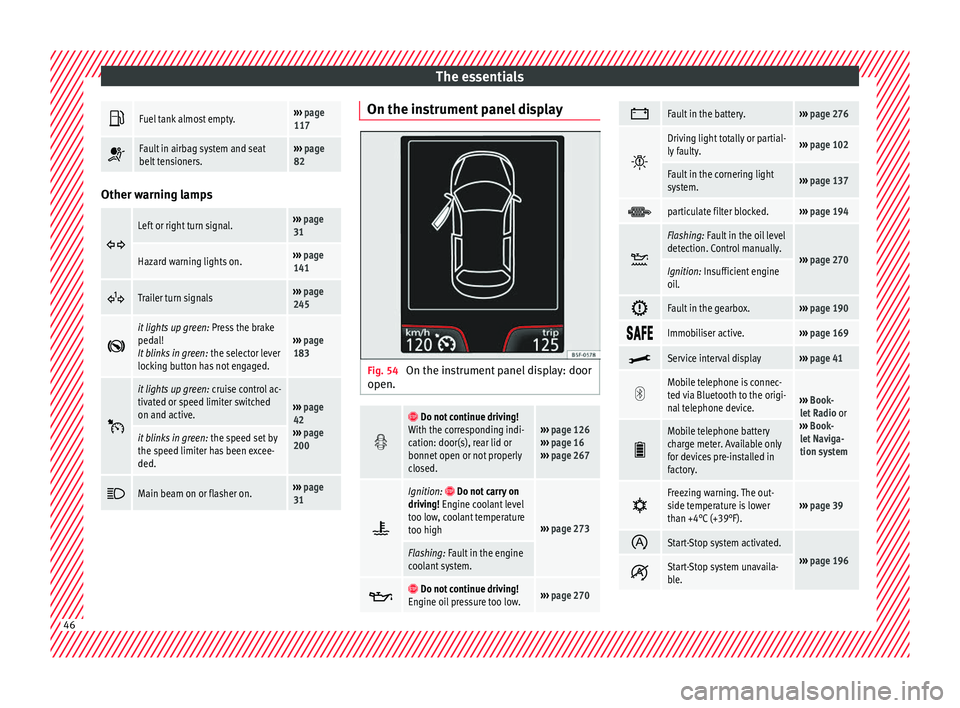
31 On the instrument panel display
Fig. 54
On the instrument panel display: door
open.
Do not continue driving!
With the corresponding indi-
cation: door(s), rear lid or
bonnet open or not properly
closed.››› page 126
››› page 16
››› page 267
Ignition: Do not carry on
driving! Engine coolant level
too low, coolant temperature
too high
››› page 273
Flashing: Fault in the engine
coolant system.
Do not continue driving!
Engine oil pressure too low.››› page 270
Fault in the battery.›››
page 276
Driving light totally or partial-
ly faulty.›››
page 102
Fault in the cornering light
system.››› page 137
particulate filter blocked.›››
page 194
Flashing: Fault in the oil level
detection. Control manually.
›››
page 270Ignition: Insufficient engine
oil.
Fault in the gearbox.›››
page 190
Immobiliser active.›››
page 169
Service interval display›››
page 41
Mobile telephone is connec-
ted via Bluetooth to the origi-
nal telephone device.
›››
Book-
let Radio or
››› Book-
let Naviga-
tion system
Mobile telephone battery
charge meter. Available only
for devices pre-installed in
factory.
Freezing warning. The out-
side temperature is lower
than +4°C (+39°F).›››
page 39
Start-Stop system activated.
›››
page 196 Start-Stop system unavaila-
ble.
46