wheel Seat Arona 2018 Manual Online
[x] Cancel search | Manufacturer: SEAT, Model Year: 2018, Model line: Arona, Model: Seat Arona 2018Pages: 316, PDF Size: 6.77 MB
Page 287 of 316
Wheels
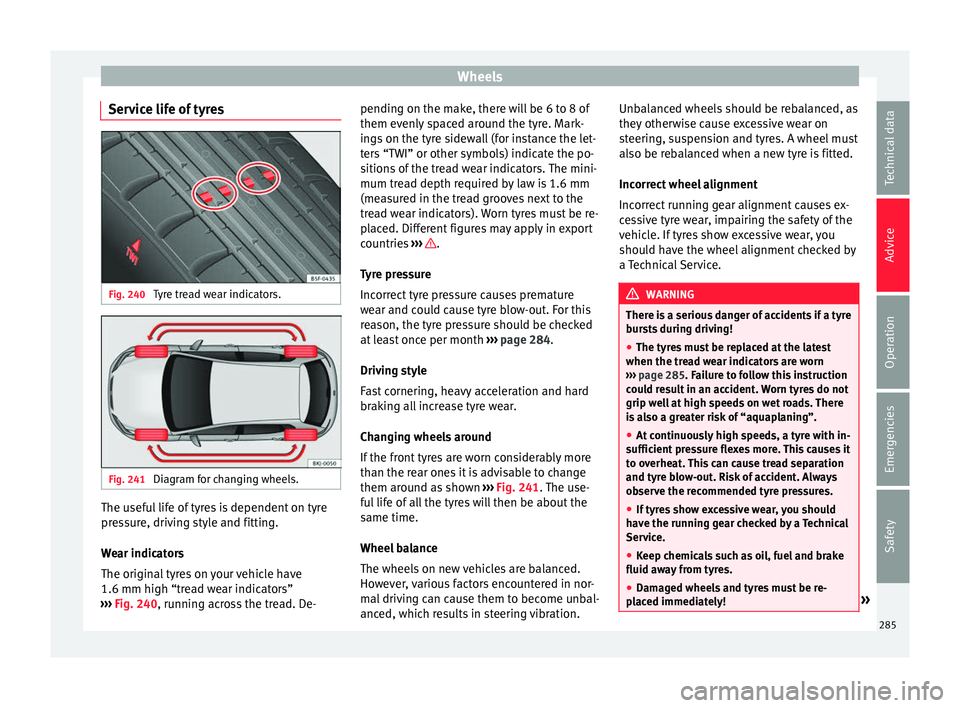
Service life of tyres Fig. 240
Tyre tread wear indicators. Fig. 241
Diagram for changing wheels. The useful life of tyres is dependent on tyre
pr
e
s
sure, driving style and fitting.
Wear indicators
The original tyres on your vehicle have
1.6 mm high “tread wear indicators”
››› Fig. 240, running across the tread. De- pending on the make, there will be 6 to 8 of
them evenly
spaced around the tyre. Mark-
ings on the tyre sidewall (for instance the let-
ters “TWI” or other symbols) indicate the po-
sitions of the tread wear indicators. The mini-
mum tread depth required by law is 1.6 mm
(measured in the tread grooves next to the
tread wear indicators). Worn tyres must be re-
placed. Different figures may apply in export
countries ››› .
T y
r
e pressure
Incorrect tyre pressure causes premature
wear and could cause tyre blow-out. For this
reason, the tyre pressure should be checked
at least once per month ››› page 284.
Driving style
Fast cornering, heavy acceleration and hard
braking all increase tyre wear.
Changing wheels around
If the front tyres are worn considerably more
than the rear ones it is advisable to change
them around as shown ››› Fig. 241. The use-
ful life of all the tyres will then be about the
same time.
Wheel balance
The wheels on new vehicles are balanced.
However, various factors encountered in nor-
mal driving can cause them to become unbal-
anced, which results in steering vibration. Unbalanced wheels should be rebalanced, as
they otherw
ise cause excessive wear on
steering, suspension and tyres. A wheel must
also be rebalanced when a new tyre is fitted.
Incorrect wheel alignment
Incorrect running gear alignment causes ex-
cessive tyre wear, impairing the safety of the
vehicle. If tyres show excessive wear, you
should have the wheel alignment checked by
a Technical Service. WARNING
There is a serious danger of accidents if a tyre
bur s
ts during driving!
● The tyres must be replaced at the latest
when the trea
d wear indicators are worn
››› page 285. Failure to follow this instruction
could result in an accident. Worn tyres do not
grip well at high speeds on wet roads. There
is also a greater risk of “aquaplaning”.
● At continuously high speeds, a tyre with in-
sufficient
pressure flexes more. This causes it
to overheat. This can cause tread separation
and tyre blow-out. Risk of accident. Always
observe the recommended tyre pressures.
● If tyres show excessive wear, you should
have the ru
nning gear checked by a Technical
Service.
● Keep chemicals such as oil, fuel and brake
fluid awa
y from tyres.
● Damaged wheels and tyres must be re-
plac
ed immediately! » 285
Technical data
Advice
Operation
Emergencies
Safety
Page 288 of 316
Advice
For the sake of the environment
Under-inflated tyres will increase fuel con-
sumption. New tyres and wheels
New tyres and wheels have to be run in.
The tyr
e
s and wheel rims are an essential
part of the vehicle's design. Those approved
by SEAT are specially matched to the charac-
teristics of the vehicle and make a major con-
tribution to good road-holding and safe han-
dling ››› .
T y
r
es should be replaced at least in pairs and
not individually (i.e. both front tyres or both
rear tyres together). A knowledge of tyre des-
ignations makes it easier to choose the cor-
rect tyres. Radial tyres have the tyre designa-
tions marked on the sidewall, for example:
195/55 R16 91V
This contains the following information:
Tyre width in mm
Height/width ratio in %
Tyre construction: Radial
Rim diameter in inches
Load rating code
Speed rating
195
55
R
16
91
V The tyres could also have the following infor-
mation:
● A direction of
rotation symbol
● “Reinforced” denotes heavy-duty tyres.
The manufact
uring date is also indicated on
the tyre sidewall (possibly only on the outer
side of the wheel).
“DOT... 1116...” means, for example, that the
tyre was produced in the 11th week of 2016.
We recommend that work on tyres and
wheels be carried out by a Technical Service.
They are familiar with the procedure and
have the necessary special tools and spare
parts as well as the proper facilities for dis-
posing of the old tyres.
Any technical service has full information on
the technical requirements when installing or
changing tyres, wheels or wheel trims. WARNING
● We r ec
ommend that you use only wheels
and tyres which have been approved by SEAT
for your model. Failure to do so could impair
vehicle handling. Risk of accident.
● Avoid running the vehicle on tyres that are
more than 6
years old. If you have no alterna-
tive, you should drive slowly and with extra
care at all times.
● Never use old tyres or those with an un-
known “his
tory of use”. ●
If wheel trims
are retrofitted, you must en-
sure that the flow of air to the brakes is not
restricted. This could cause the brake system
to overheat.
● All four wheels must be fitted with radial
tyre
s of the same type, size (rolling circumfer-
ence) and the same tread pattern. For the sake of the environment
Old tyres must be disposed of according to
the l aw
s in the country concerned. Note
● A S EA
T Service Centre should be consulted
to find out whether wheels or tyres of differ-
ent sizes to those originally fitted by SEAT
can be fitted, and to find out about the com-
binations allowed between the front axle
(axle 1) and the rear axle (axle 2).
● For technical reasons, it is not generally
poss
ible to use the wheels from other vehi-
cles. This can also apply to wheels of the
same model. The use of wheels or tyres
which have not been approved by SEAT for
use with your model may invalidate the vehi-
cle's type approval for use on public roads.
● If the spare tyre is not the same as the
tyre
s that are mounted on the vehicle (e.g.
winter tyres) you should only use the spare
tyre for a short period of time and drive with
extra care. Refit the normal road wheel as
soon as possible. 286
Page 289 of 316
Wheels
Wheel bolts The design of wheel bolts is matched to the
rims. If diff
er
ent wheel rims are fitted, the
correct wheel bolts with the right length and
correctly shaped bolt heads must be used.
This ensures that wheels are fitted securely
and that the brake system functions correctly.
In certain circumstances, you should not use
wheel bolts from a different vehicle, even if it
is the same model ››› page 259. WARNING
If the wheel bolts are not tightened correctly,
the wheel c ou
ld become loose while driving.
Risk of accident.
● The wheel bolts must be clean and turn
eas
ily. Never apply grease or oil to them.
● Use only wheel bolts which belong to the
wheel.
● If the pr
escribed torque of the wheel bolts
is t
oo low, they could loosen whilst the vehi-
cle is in motion. Risk of accident! If the tight-
ening torque is too high, the wheel bolts and
threads can be damaged. CAUTION
The prescribed tightening torque for wheel
bolt s
for steel and alloy wheels is 120 Nm. Tyre monitoring indicator*
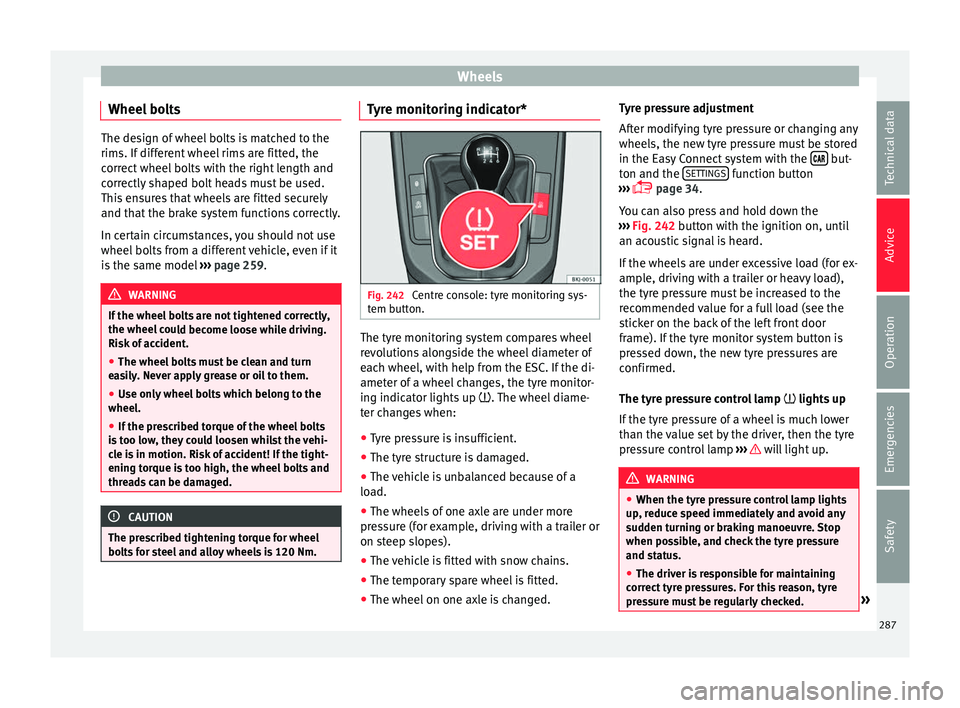
Fig. 242
Centre console: tyre monitoring sys-
t em b
utt
on. The tyre monitoring system compares wheel
r
ev
o
lutions alongside the wheel diameter of
each wheel, with help from the ESC. If the di-
ameter of a wheel changes, the tyre monitor-
ing indicator lights up . The wheel diame-
ter changes when:
● Tyre pressure is insufficient.
● The tyre structure is damaged.
● The vehicle is unbalanced because of a
load.
● The wheel
s of one axle are under more
pres
sure (for example, driving with a trailer or
on steep slopes).
● The vehicle is fitted with snow chains.
● The temporary spare wheel is fitted.
● The wheel on one axle is changed. Tyre pressure adjustment
After modif
ying tyre pressure or changing any
wheels, the new tyre pressure must be stored
in the Easy Connect system with the but-
t on and the S
ET
TINGS function button
› ›
›
page 34.
You can also press and hold down the
››› Fig. 242 button with the ignition on, until
an acoustic signal is heard.
If the wheels are under excessive load (for ex-
ample, driving with a trailer or heavy load),
the tyre pressure must be increased to the
recommended value for a full load (see the
sticker on the back of the left front door
frame). If the tyre monitor system button is
pressed down, the new tyre pressures are
confirmed.
The tyre pressure control lamp lights up
If the tyre pressure of a wheel is much lower
than the value set by the driver, then the tyre
pressure control lamp ››› will light up.
WARNING
● When the tyr e pr
essure control lamp lights
up, reduce speed immediately and avoid any
sudden turning or braking manoeuvre. Stop
when possible, and check the tyre pressure
and status.
● The driver is responsible for maintaining
correct
tyre pressures. For this reason, tyre
pressure must be regularly checked. » 287
Technical data
Advice
Operation
Emergencies
Safety
Page 290 of 316
Advice
●
Under cer t
ain circumstances (e.g. when
driving in a sporty manner, in winter condi-
tions or on a dirt track) the tyre control lamp
may light up belatedly or may function incor-
rectly. Note
If the battery is disconnected, the yellow
w arnin g l
amp lights up after turning the
ignition on. This should turn off after a brief
journey. Spare wheel (temporary spare
wheel)*
Loc
ation and u
se of the temporary
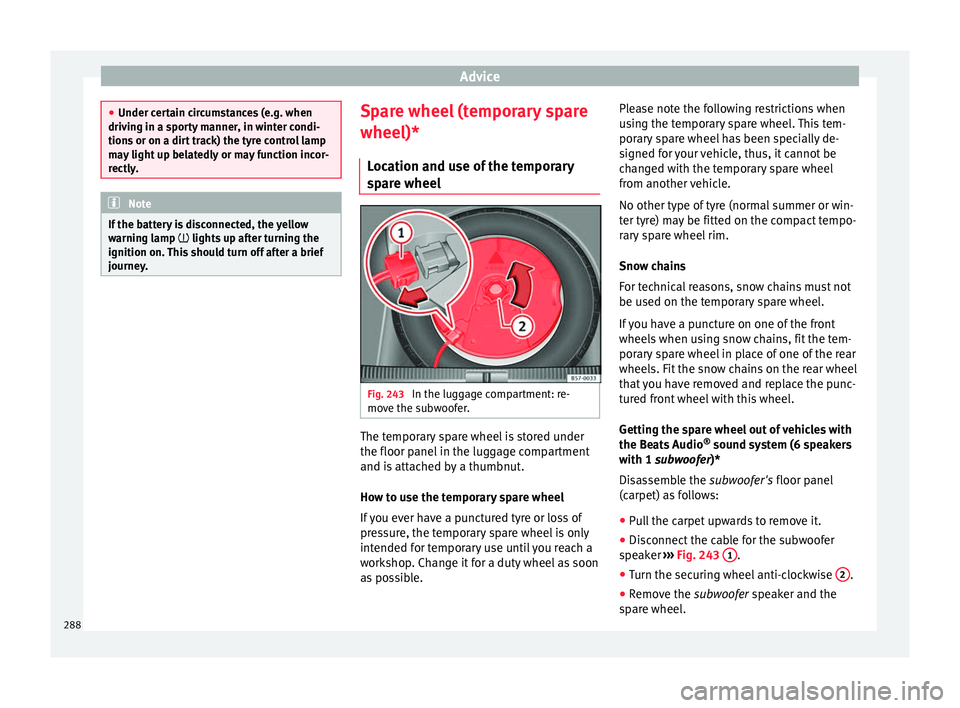
spare wheel Fig. 243
In the luggage compartment: re-
mo v
e the s
ubwoofer. The temporary spare wheel is stored under
the floor p
anel
in the lug
gage compartment
and is attached by a thumbnut.
How to use the temporary spare wheel
If you ever have a punctured tyre or loss of
pressure, the temporary spare wheel is only
intended for temporary use until you reach a
workshop. Change it for a duty wheel as soon
as possible. Please note the following restrictions when
usin
g the temporary spare wheel. This tem-
porary spare wheel has been specially de-
signed for your vehicle, thus, it cannot be
changed with the temporary spare wheel
from another vehicle.
No other type of tyre (normal summer or win-
ter tyre) may be fitted on the compact tempo-
rary spare wheel rim.
Snow chains
For technical reasons, snow chains must not
be used on the temporary spare wheel.
If you have a puncture on one of the front
wheels when using snow chains, fit the tem-
porary spare wheel in place of one of the rear
wheels. Fit the snow chains on the rear wheel
that you have removed and replace the punc-
tured front wheel with this wheel.
Getting the spare wheel out of vehicles with
the Beats Audio ®
sound system (6 speakers
with 1 subwoofer)*
Disassemble the subwoofer's floor panel
(carpet) as follows:
● Pull the carpet upwards to remove it.
● Disconnect the cable for the subwoofer
speak
er ›››
Fig. 243 1 .
● Turn the securing wheel anti-clockwise 2 .
● Remove the s ub
woofer
speaker and the
spare wheel.
288
Page 291 of 316
Wheels
● When r ep
l
acing the spare wheel, place the
subwoofer speaker in the direction indicated
by the arrow and with the word “FRONT” fac-
ing forward.
● Reconnect the speaker cable and firmly ro-
tate the sec
uring wheel clockwise so that the
subwoofer system and wheel are firmly in
place.
Removing the 16” temporary spare wheel
(without subwoofer)
● Remove the luggage compartment variable
floor to acc
ess the wheel and the tools
››› page 161.
● Loosen the strap that secures the box by
pres
sing on the buckle.
● Remove the toolbox.
● Turn the securing wheel anti-clockwise and
remov
e it.
● Press the thread and turn it 90° clockwise
or anti-clock
wise and remove it.
● Pull on the front part of the spare wheel to
remov
e it. WARNING
● Aft er fittin
g the temporary spare wheel,
check the tyre pressures as soon as possible.
Failure to do so may cause an accident. The
tyre pressure is listed on the back of the left
front door frame. ●
Do not driv e at
over 80 km/h (50 mph)
when the temporary spare wheel is fitted on
the vehicle: risk of accident!
● Avoid heavy acceleration, hard braking and
fas
t cornering: risk of accident!
● Never use more than one temporary spare
wheel at the s
ame time, risk of accident.
● No other type of tyre (normal summer or
winter ty
re) may be fitted on the compact
temporary spare wheel rim. Winter service
W int
er ty
res In winter conditions winter tyres will consid-
er
ab
ly
improve the vehicle's handling. The
design of summer tyres (width, rubber com-
pound, tread pattern) gives less grip on ice
and snow.
Winter tyres must be inflated to a pressure of
0.2 bar (2.9 psi/20 kPa) higher than the pres-
sures specified for summer tyres (see the
sticker on the back of the left front door
frame).
Winter tyres must be fitted on all four wheels.
Information on permitted winter tyre sizes
can be found in the vehicle's registration
documentation. Use only radial winter tyres. All tyre sizes listed in the vehicle documenta-
tion also app
ly to winter tyres.
Winter tyres lose their effectiveness when the
tread is worn down to a depth of 4 mm.
The speed rating code ››› page 286, New
tyres and wheels determines the following
speed limits for winter tyres: ››› max. 160 km/h (99 mph)
m
ax. 180 km/h (112 mph)
m ax. 190 km/h (118 mph)
m
ax. 210 km/h (130 mph)
In some countries, vehicles which can exceed
the speed rating of the fitted tyre must have
an appropriate sticker in the driver's field of
view. These stickers are available from your
technical service. The legal requirements of
each country must be followed.
Do not have winter tyres fitted for unnecessa-
rily long periods. Vehicles with summer tyres
handle better when the roads are free of
snow and ice.
If you have a flat tyre, please refer to the
notes on the spare wheel ››› page 286, New
tyres and wheels . WARNING
The maximum speed for the winter tyres must
not be e x
ceeded. Otherwise, this could lead
to damage and risk of accident. » Q
S
T
H
289
Technical data
Advice
Operation
Emergencies
Safety
Page 294 of 316
Technical data
Vehicle data label
The d at
a s
ticker is placed on the inside of the
spare wheel well, in the boot and on the rear
cover of the Maintenance Programme.
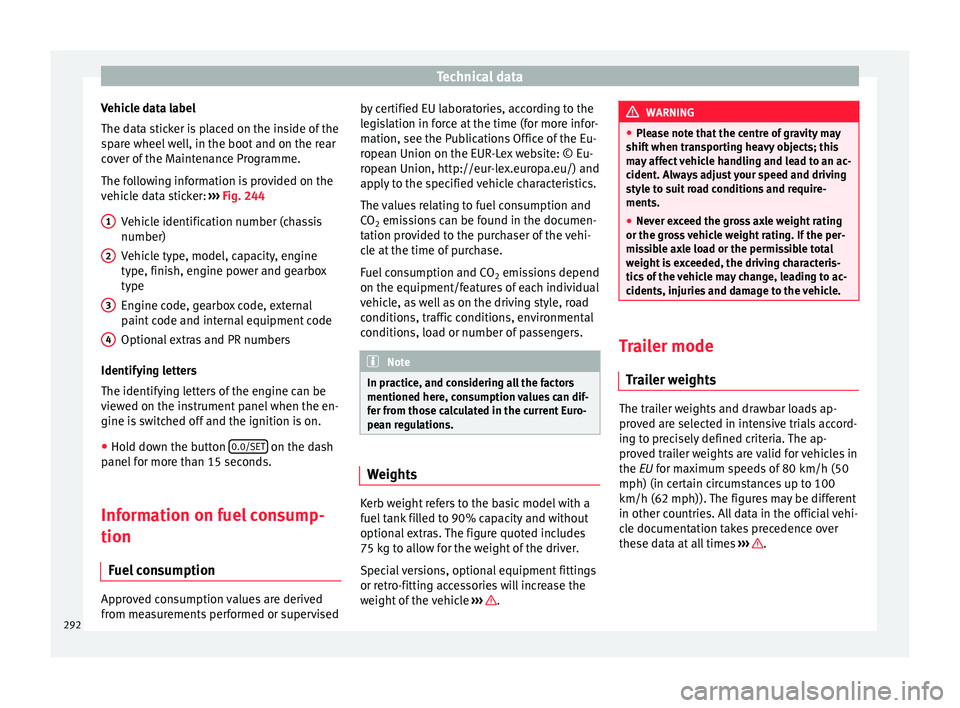
The following information is provided on the
vehicle data sticker: ››› Fig. 244
Vehicle identification number (chassis
number)
Vehicle type, model, capacity, engine
type, finish, engine power and gearbox
type
Engine code, gearbox code, external
paint code and internal equipment code
Optional extras and PR numbers
Identifying letters
The identifying letters of the engine can be
viewed on the instrument panel when the en-
gine is switched off and the ignition is on.
● Hold down the button 0.0/SET on the dash
p anel
f
or more than 15 seconds.
Information on fuel consump-
tion Fuel c
onsumption Approved consumption values are derived
fr
om me
a
surements performed or supervised
1 2
3
4 by certified EU laboratories, according to the
l
e
gi
slation in force at the time (for more infor-
mation, see the Publications Office of the Eu-
ropean Union on the EUR-Lex website: © Eu-
ropean Union, http://eur-lex.europa.eu/) and
apply to the specified vehicle characteristics.
The values relating to fuel consumption and
CO 2 emissions can be found in the documen-
tation provided to the purchaser of the vehi-
cle at the time of purchase.
Fuel consumption and CO 2 emissions depend
on the equipment/features of each individual
vehicle, as well as on the driving style, road
conditions, traffic conditions, environmental
conditions, load or number of passengers. Note
In practice, and considering all the factors
mentioned here, c on
sumption values can dif-
fer from those calculated in the current Euro-
pean regulations. Weights
Kerb weight refers to the basic model with a
f
uel
t
ank filled to 90% capacity and without
optional extras. The figure quoted includes
75 kg to allow for the weight of the driver.
Special versions, optional equipment fittings
or retro-fitting accessories will increase the
weight of the vehicle ››› . WARNING
● Ple a
se note that the centre of gravity may
shift when transporting heavy objects; this
may affect vehicle handling and lead to an ac-
cident. Always adjust your speed and driving
style to suit road conditions and require-
ments.
● Never exceed the gross axle weight rating
or the gros
s vehicle weight rating. If the per-
missible axle load or the permissible total
weight is exceeded, the driving characteris-
tics of the vehicle may change, leading to ac-
cidents, injuries and damage to the vehicle. Trailer mode
Tr
ai
ler weights The trailer weights and drawbar loads ap-
pr
o
v
ed are selected in intensive trials accord-
ing to precisely defined criteria. The ap-
proved trailer weights are valid for vehicles in
the EU for maximum speeds of 80 km/h (50
mph) (in certain circumstances up to 100
km/h (62 mph)). The figures may be different
in other countries. All data in the official vehi-
cle documentation takes precedence over
these data at all times ››› .
292
Page 295 of 316
Technical specifications
Drawbar loads
The maximum permitt ed dr
a
wbar load on the
ball coupling of the towing bracket must not
exceed 55 kg.
In the interest of road safety, we recommend
that you always tow approaching the maxi-
mum drawbar load. The response of the trail-
er on the road will be poor, if the drawbar
load is too small.
If the maximum permissible drawbar load
cannot be met (e.g. with small, empty and
light-weight single axle trailers or tandem
axle trailers with a wheelbase of less than 1
metre), a minimum of 4% of the actual trailer
weight is legally required for the drawbar
load. WARNING
● For s af
ety reasons, you should not drive at
speeds above 80 km/h (50 mph) when towing
a trailer. This also applies in countries where
higher speeds are permitted.
● Never exceed the maximum trailer weights
or the drawb
ar load. If the permissible axle
load or the permissible total weight is excee-
ded, the driving characteristics of the vehicle
may change, leading to accidents, injuries
and damage to the vehicle. Wheels
Ty
r
e pressure and wheel bolts Tyre pressure
The stic
k
er with the tyre pressure values can
be found on the back of the left front door
frame. The tyre pressure values given there
are for cold tyres. Do not reduce the slightly
raised pressures of warm tyres ››› .
The pre s
sure for winter tyres is 0.2 bar higher
than that of summer tyres (2.9 psi / 20 kPa).
Wheel bolts
After the wheels have been changed, the
tightening torque of the wheel bolts should
be checked as soon as possible with a torque
wrench ››› . The tightening torque for steel
and al lo
y
wheels is 120 Nm. WARNING
● Check the ty
re pressure at least once per
month. Checking the tyre pressure is very im-
portant. If the tyre pressure is too high or too
low, there is an increased danger of accidents
- particularly at high speeds.
● If the tightening torque of the wheel bolts
is t
oo low, they could loosen while the vehi-
cle is in motion. Risk of accident! If the tight-
ening torque is too high, the wheel bolts and
threads can be damaged. Note
We recommend that you ask your Technical
Serv ic
e for information about appropriate
wheel, tyre and snow chain size. 293
Technical data
Advice
Operation
Emergencies
Safety
Page 302 of 316
Technical data›››
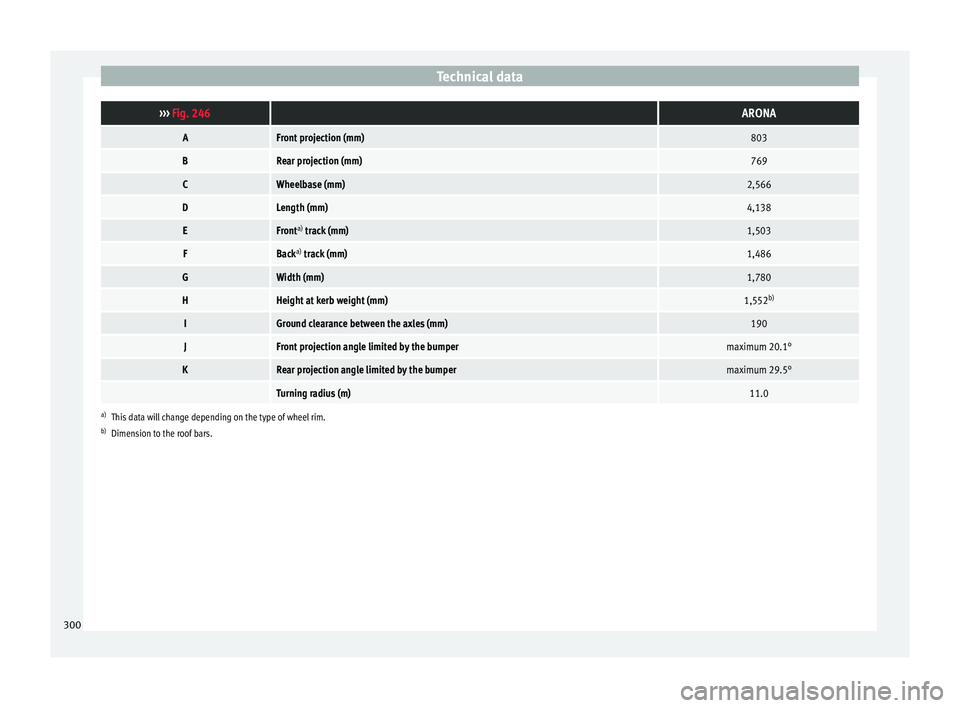
Fig. 246 ARONA
AFront projection (mm)803
BRear projection (mm)769
CWheelbase (mm)2,566
DLength (mm)4,138
EFront a)
track (mm)1,503
FBack a)
track (mm)1,486
GWidth (mm)1,780
HHeight at kerb weight (mm)1,552 b)
IGround clearance between the axles (mm)190
JFront projection angle limited by the bumpermaximum 20.1°
KRear projection angle limited by the bumpermaximum 29.5°
Turning radius (m)11.0
a)
This data will change depending on the type of wheel rim.
b) Dimension to the roof bars.
300
Page 303 of 316
Index
Index
A
ABS . . . . . . . . . . . . . . . . . . . . . . . . . . . . . . . . . . . .
185
c ontr
ol lamp . . . . . . . . . . . . . . . . . . . . . . . . . . . 185
ACC . . . . . . . . . . . . . . . . . . . . . . . . . . . . . . . . . . . . 214 radar sensor . . . . . . . . . . . . . . . . . . . . . . . . . . . 217
Accessories . . . . . . . . . . . . . . . . . . . . . . . . . . . . . . 259
Adaptive cruise control . . . . . . . . . . . . . . . 205, 214 function for preventing overtaking in an insidelane . . . . . . . . . . . . . . . . . . . . . . . . . . . . . . . . 220
indications on the display . . . . . . . . . . . . . . . . 216
malfunction . . . . . . . . . . . . . . . . . . . . . . . . . . . . 215
radar sensor . . . . . . . . . . . . . . . . . . . . . . . . . . . 217
special driving situations . . . . . . . . . . . . . . . . . 221
warning and control lamp . . . . . . . . . . . . . . . . 216
Adaptive Cruise Control deactivating temporarily . . . . . . . . . . . . . . . . . 221
operating . . . . . . . . . . . . . . . . . . . . . . . . . . . . . . 217
AdBlue information . . . . . . . . . . . . . . . . . . . . . . . . . . . . 271
maximum filling capacity . . . . . . . . . . . . . . . . . 271
refilling . . . . . . . . . . . . . . . . . . . . . . . . . . . . . . . 271
specification . . . . . . . . . . . . . . . . . . . . . . . . . . . 271
tank capacity . . . . . . . . . . . . . . . . . . . . . . . . . . . 271
Additional consumers (efficiency program) . . . . . 42
Adjusting front head restraints . . . . . . . . . . . . . . . . . . . . . . 79
lights . . . . . . . . . . . . . . . . . . . . . . . . . . . . . . . . . 147
rear head restraints . . . . . . . . . . . . . . . . . 79, 153
seats . . . . . . . . . . . . . . . . . . . . . . . . . . . . . . . . . . 76
Adjusting the front seats adjusting the lumbar support . . . . . . . . . . . . . 152
Adjusting the head restraints front head restraints . . . . . . . . . . . . . . . . . . . . . 152
rear head restraints . . . . . . . . . . . . . . . . . . . . . . 79 Adjusting the seat . . . . . . . . . . . . . . . . . . . . . . . . 152
Adjustment
CAR menu
. . . . . . . . . . . . . . . . . . . . . . . . . . . . . 122
front head restraints . . . . . . . . . . . . . . . . . . . . . 152
Airbag covers . . . . . . . . . . . . . . . . . . . . . . . . . . . . . 21
Airbags . . . . . . . . . . . . . . . . . . . . . . . . . . . . . . . . . . 86 description . . . . . . . . . . . . . . . . . . . . . . . . . . . . . 87
Airbag system . . . . . . . . . . . . . . . . . . . . . . . . . . 20, 86 activation . . . . . . . . . . . . . . . . . . . . . . . . . . . . . . 87
control lamp . . . . . . . . . . . . . . . . . . . . . . . . . . . . 91
deactivation of front airbag . . . . . . . . . . . . . . . . 90
description . . . . . . . . . . . . . . . . . . . . . . . . . . . . . 87
front airbags . . . . . . . . . . . . . . . . . . . . . . . . . 21, 88
functioning . . . . . . . . . . . . . . . . . . . . . . . . . . . . . 87
head-protection airbags . . . . . . . . . . . . . . . 23, 89
side airbags . . . . . . . . . . . . . . . . . . . . . . . . . 22, 88
Air conditioning . . . . . . . . . . . . . . . . . . . . . . . . . . . 51 Climatronic . . . . . . . . . . . . . . . . . . . . . . . . . . . . 171
controls . . . . . . . . . . . . . . . . . . . . . . . . . . . . . . . 169
general notes . . . . . . . . . . . . . . . . . . . . . . . . . . 164
manual air conditioning . . . . . . . . . . . . . . . . . . . 53
Air outlets . . . . . . . . . . . . . . . . . . . . . . . . . . . . . . . 165
Air recirculation air conditioning . . . . . . . . . . . . . . . . . . . . . . . . 166
Alarm system . . . . . . . . . . . . . . . . . . . . . . . . . . . . 138 switching off . . . . . . . . . . . . . . . . . . . . . . . . . . . 139
Alcantara: cleaning . . . . . . . . . . . . . . . . . . . . . . . 268
Alloy wheel rims . . . . . . . . . . . . . . . . . . . . . . . . . . 265
Alternator warning lamp . . . . . . . . . . . . . . . . . . . . . . . . . . 282
Ambient lighting . . . . . . . . . . . . . . . . . . . . . . . . . 148
Anchoring the front tow line. . . . . . . . . . . . . . . . . . . . . . . . 102
Anti-freeze . . . . . . . . . . . . . . . . . . . . . . . . . . . . . . . 59
Anti-lock brake system . . . . . . . . . . . . 181, 183, 185 control lamp . . . . . . . . . . . . . . . . . . . . . . . . . . . 185
Anti-puncture . . . . . . . . . . . . . . . . . . . . . . . . . . 64, 98 Anti-puncture kit . . . . . . . . . . . . . . . . . . . . . . . . 64, 98
check after 10 minutes . . . . . . . . . . . . . . . . . . . . 99
Anti-puncture set . . . . . . . . . . . . . . . . . . . . . . . . . . 98
Anti-theft alarm . . . . . . . . . . . . . . . . . . . . . . . . . . 138 trailer . . . . . . . . . . . . . . . . . . . . . . . . . . . . . . . . . 257
vehicle interior monitoring and anti-tow pro-tection . . . . . . . . . . . . . . . . . . . . . . . . . . . . . . 140
Anti-theft alarm system . . . . . . . . . . . . . . . . . . . . 138 switching off . . . . . . . . . . . . . . . . . . . . . . . . . . . 139
Anti-theft security system . . . . . . . . . . . . . . . . . . . 15
Anti-tow protection . . . . . . . . . . . . . . . . . . . . . . . 140
Aquaplaning . . . . . . . . . . . . . . . . . . . . . . . . . . . . . 285
Ashtray . . . . . . . . . . . . . . . . . . . . . . . . . . . . . . . . . 157
Aspects to note before setting off . . . . . . . . . . . . . 75
ASR . . . . . . . . . . . . . . . . . . . . . . . . . . . . . . . . . . . . 182 control lamp . . . . . . . . . . . . . . . . . . . . . . . . . . . 182
Assistance systems ACC . . . . . . . . . . . . . . . . . . . . . . . . . . . . . . . . . . 214
adaptive cruise control . . . . . . . . . . . . . . . . . . . 214
blind spot detector (BSD) with parking assis-tance (RCTA) . . . . . . . . . . . . . . . . . . . . . . . . . 224
Cruise control system . . . . . . . . . . . . . . . . . . . . 205
emergency brake assist (Front Assist) . . . . . . . 210
fatigue detection . . . . . . . . . . . . . . . . . . . . . . . 231
Park Assist . . . . . . . . . . . . . . . . . . . . . . . . . . . . 232
parking aid . . . . . . . . . . . . . . . . . . . . . . . 240, 241
parking assistance (RCTA) . . . . . . . . . . . . . . . . 224
speed limiter . . . . . . . . . . . . . . . . . . . . . . . . . . . 207
Assisted starting . . . . . . . . . . . . . . . . . . . . . . . . . . 71
Audible warning signal unfastened safety belt . . . . . . . . . . . . . . . . . . . . 81
warning and control lamps . . . . . . . . . . . . . . . 121
Automatic car wash tunnel . . . . . . . . . . . . . . . . . 261
Automatic gearbox . . . . . . . . . . . . . . . . . . . . . . . . 188 downhill speed control . . . . . . . . . . . . . . . . . . 193
driving tips . . . . . . . . . . . . . . . . . . . . . . . . . . . . 191
emergency program . . . . . . . . . . . . . . . . . . . . . 194
kick-down feature . . . . . . . . . . . . . . . . . . . . . . . 192 301
Page 304 of 316
Index
launch control program . . . . . . . . . . . . . . . . . . 192
m anual
r
elease of the selector lever . . . . . . . . . 50
selector lever lock . . . . . . . . . . . . . . . . . . . . . . . 189
selector lever positions . . . . . . . . . . . . . . . . . . 188
steering wheel with gear shift paddles . . . . . . 190
tiptronic . . . . . . . . . . . . . . . . . . . . . . . . . . 188, 190
Automatic lighting . . . . . . . . . . . . . . . . . . . . . . . . 144
AUX-IN . . . . . . . . . . . . . . . . . . . . . . . . . . . . . . . . . . 129
B Back seat folding down and raising the back seat back-rest . . . . . . . . . . . . . . . . . . . . . . . . . . . . . . . . . 155
Battery . . . . . . . . . . . . . . . . . . . . . . . . . . . . . . . . . . 131
Before setting off . . . . . . . . . . . . . . . . . . . . . . . . . . 75
Belt tensioners control lamp . . . . . . . . . . . . . . . . . . . . . . . . . . . . 91
Belt tightening . . . . . . . . . . . . . . . . . . . . . . . . . . . . 85
Biodiesel . . . . . . . . . . . . . . . . . . . . . . . . . . . . . . . . 270
Blind spot detector (BSD) . . . . . . . . . . . . . . . . . . 224 control lamps . . . . . . . . . . . . . . . . . . . . . . . . . . 224
driving situations . . . . . . . . . . . . . . . . . . . . . . . 227
indication in the external rear view mirror . . . 225
malfunction . . . . . . . . . . . . . . . . . . . . . . . . . . . . 224
operating . . . . . . . . . . . . . . . . . . . . . . . . . . . . . . 225
towing . . . . . . . . . . . . . . . . . . . . . . . . . . . . . . . . 229
Bonnet . . . . . . . . . . . . . . . . . . . . . . . . . 17, 273, 275 closing . . . . . . . . . . . . . . . . . . . . . . . . . . . . . . . . 274
opening . . . . . . . . . . . . . . . . . . . . . . . . . . . . . . . 274
Brake assist . . . . . . . . . . . . . . . . . . . . . . . . . . . . . 181
Brake fluid . . . . . . . . . . . . . . . . . . . . . . . . . . 60, 280 changing . . . . . . . . . . . . . . . . . . . . . . . . . . . . . . 280
Brake pads . . . . . . . . . . . . . . . . . . . . . . . . . 179, 197
Brakes brake fluid . . . . . . . . . . . . . . . . . . . . . . . . . . . . . 280
new Brake pads . . . . . . . . . . . . . . . . . . . . . . . . 179
Brake servo . . . . . . . . . . . . . . . . . . . . . . . . . 179, 186 Brake system . . . . . . . . . . . . . . . . . . . . . . . . . . . . 280
Brakin
g
brake assist . . . . . . . . . . . . . . . . . . . . . . . . . . . . 181
Braking distance . . . . . . . . . . . . . . . . . . . . . . . . . 179
Braking system warning lamp . . . . . . . . . . . . . . . . . . . . . . . . . . 179
BSD see Blind spot detector (BSD) . . . . . . . . . . . . . 224
Bulbs changing the bulbs . . . . . . . . . . . . . . . . . . . . . 106
Buzzer . . . . . . . . . . . . . . . . . . . . . . . . . . . . . . . . . . 145
C
Capacities . . . . . . . . . . . . . . . . . . . . . . . . . . . . . . . . 57 AdBlue tank . . . . . . . . . . . . . . . . . . . . . . . . . . . 271
fuel tank . . . . . . . . . . . . . . . . . . . . . . . . . . . . . . 121
Car care exterior . . . . . . . . . . . . . . . . . . . . . . . . . . . . . . . 261
Care and cleaning . . . . . . . . . . . . . . . . . . . . . . . . 260
Catalytic converter . . . . . . . . . . . . . . . . . . . . . . . . 200 malfunction . . . . . . . . . . . . . . . . . . . . . . . . . . . . 200
CCS . . . . . . . . . . . . . . . . . . . . . . . . . . . . . . . . . . . . . 45
Central locking anti-theft alarm . . . . . . . . . . . . . . . . . . . . . . . . . 138
automatic speed-dependent locking . . . . . . . 134
central locking button . . . . . . . . . . . . . . . . . . . 134
electric windows . . . . . . . . . . . . . . . . . . . . . . . . 142
emergency locking . . . . . . . . . . . . . . . . . . . . . . . 16
key by remote control . . . . . . . . . . . . . . . . . . . . 130
Keyless Access . . . . . . . . . . . . . . . . . . . . . . . . . 135
selective unlocking system . . . . . . . . . . . . . . . 133
self-locking system to prevent involuntary un-locking . . . . . . . . . . . . . . . . . . . . . . . . . . . . . . 134
unlocking system . . . . . . . . . . . . . . . . . . . . . . . 134
Central locking system . . . . . . . . . . . . . . . . . . . . . 132 safe security system . . . . . . . . . . . . . . . . . . . . . 132
Central wheel trim . . . . . . . . . . . . . . . . . . . . . . 65, 66 Centre console . . . . . . . . . . . . . . . . . . . . . . . . . . . . 11
Cetane number (die
sel fuel) . . . . . . . . . . . . . . . . 270
Changing a bulb additional brake light . . . . . . . . . . . . . . . . . . . . 111
dipped beam . . . . . . . . . . . . . . . . . . . . . . . . . . 108
DRL (daytime running light) . . . . . . . . . . . . . . . 108
fog light . . . . . . . . . . . . . . . . . . . . . . . . . . . . . . . 109
general notes . . . . . . . . . . . . . . . . . . . . . . . . . . 106
interior light and reading light . . . . . . . . . . . . 111
luggage compartment light . . . . . . . . . . . . . . . 112
main beam headlight . . . . . . . . . . . . . . . . . . . . 107
number plate light . . . . . . . . . . . . . . . . . . . . . . 110
rear bulb in the side panel . . . . . . . . . . . . . . . . 109
rear light in the rear lid . . . . . . . . . . . . . . . . . . . 110
turn signal light . . . . . . . . . . . . . . . . . . . . . . . . 108
Changing a wheel . . . . . . . . . . . . . . . . . . . . . . . . . 65 subsequent work . . . . . . . . . . . . . . . . . . . . . . . . 69
wheel bolts . . . . . . . . . . . . . . . . . . . . . . . . . . . . . 67
Changing settings CAR menu . . . . . . . . . . . . . . . . . . . . . . . . . . . . . . 34
Changing the blades . . . . . . . . . . . . . . . . . . . . . . 100
Charging the battery . . . . . . . . . . . . . . . . . . . . . . . 71
Checking levels engine compartment . . . . . . . . . . . . . . . . . . . . 275
Childproof locks electric windows . . . . . . . . . . . . . . . . . . . . . . . . 141
Child seats . . . . . . . . . . . . . . . . . . . . . . . . . . . . 23, 93 categorisation into groups . . . . . . . . . . . . . . . . . 94
ISOFIX system . . . . . . . . . . . . . . . . . . . . . . . . . . . 27
safety instructions . . . . . . . . . . . . . . . . . . . . 23, 92
securing with seat belt . . . . . . . . . . . . . . . . . . . . 25
Top Tether system . . . . . . . . . . . . . . . . . . . . . 27, 30
Chrome parts cleaning . . . . . . . . . . . . . . . . . . . . . . . . . . . . . . 264
Cigarette lighter . . . . . . . . . . . . . . . . . . . . . . . . . . 158
302