isofix Seat Arona 2018 Owner's Manual
[x] Cancel search | Manufacturer: SEAT, Model Year: 2018, Model line: Arona, Model: Seat Arona 2018Pages: 316, PDF Size: 6.77 MB
Page 29 of 316
The essentials
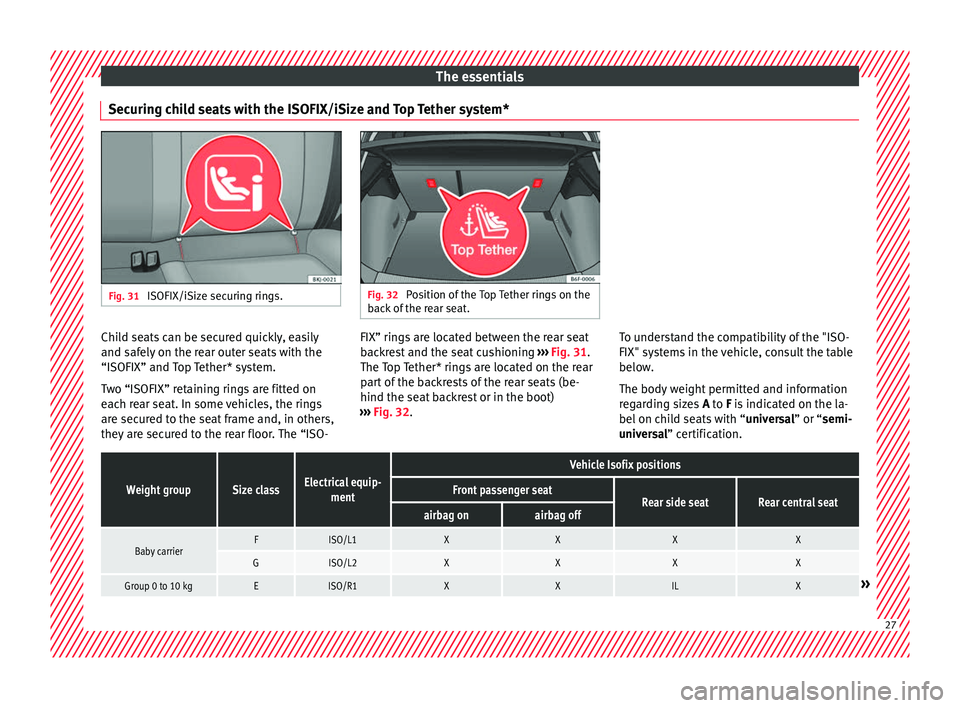
Securing child seats with the ISOFIX/iSize and Top Tether system* Fig. 31
ISOFIX/iSize securing rings. Fig. 32
Position of the Top Tether rings on the
bac k
of the rear seat. Child seats can be secured quickly, easily
and s
af
ely
on the rear outer seats with the
“ISOFIX” and Top Tether* system.
Two “ISOFIX” retaining rings are fitted on
each rear seat. In some vehicles, the rings are secured to the seat frame and, in others,
they are secured to the rear floor. The “ISO- FIX” rings are located between the rear seat
back
rest and the seat cushioning ››› Fig. 31.
The Top Tether* rings are located on the rear
part of the backrests of the rear seats (be-
hind the seat backrest or in the boot)
››› Fig. 32. To understand the compatibility of the "ISO-
FIX" syst
ems in the vehicle, consult the table
below.
The body weight permitted and information
regarding sizes A to F is indicated on the la-
bel on child seats with “ universal” or “semi-
universal” certification.
Weight groupSize classElectrical equip- ment
Vehicle Isofix positions
Front passenger seatRear side seatRear central seatairbag onairbag off
Baby carrierFISO/L1XXXX
GISO/L2XXXX
Group 0 to 10 kgEISO/R1XXILX» 27
Page 30 of 316
The essentialsWeight groupSize classElectrical equip-
ment
Vehicle Isofix positions
Front passenger seatRear side seatRear central seatairbag onairbag off
Group 0+ to 13 kg
EISO/R1XXILX
DISO/R2XXILX
CISO/R3XXILX
Group I 9 to 18 kg
DISO/R2XXILX
CISO/R3XXILX
BISO/F2XXIUF/ILX
B1ISO/F2XXXIUF/ILX
AISO/F3XXIUF/ILX
Group II 15 to 25 kg------ ------
Group III 22 to 36 kg------ ------
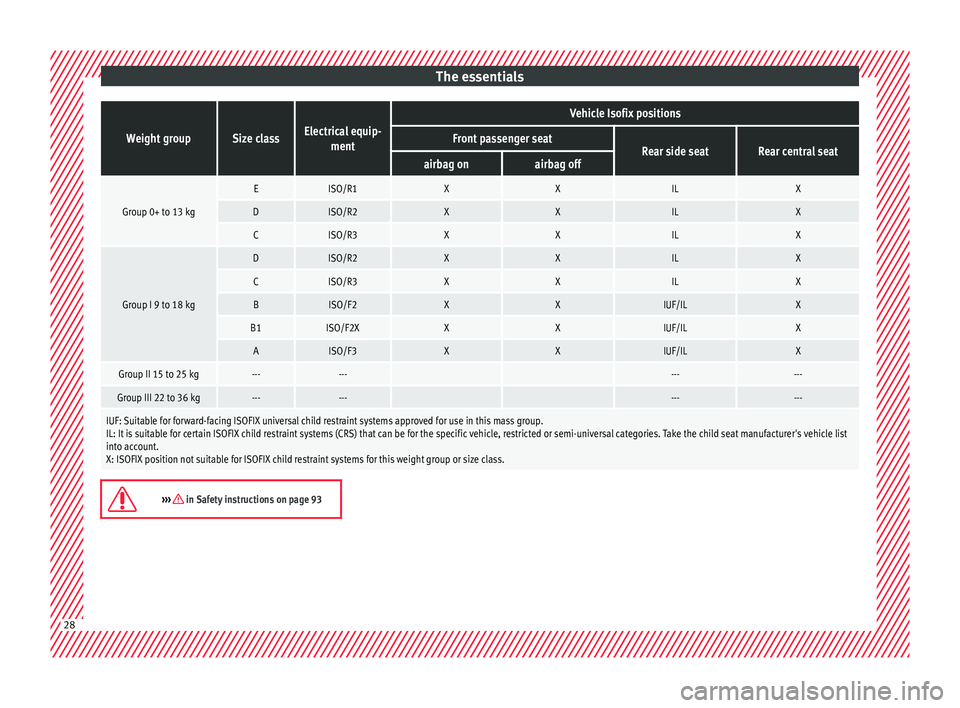
IUF: Suitable for forward-facing ISOFIX universal child restraint systems approved for use in this mass group.
IL: It is suitable for certain ISOFIX child restraint systems (CRS) that can be for the specific vehicle, restricted or semi-universal categories. Take the child seat manufacturer's vehicle list
into account.
X: ISOFIX position not suitable for ISOFIX child restraint systems for this weight group or size class.
››› in Safety instructions on page 93
28
Page 31 of 316
The essentials
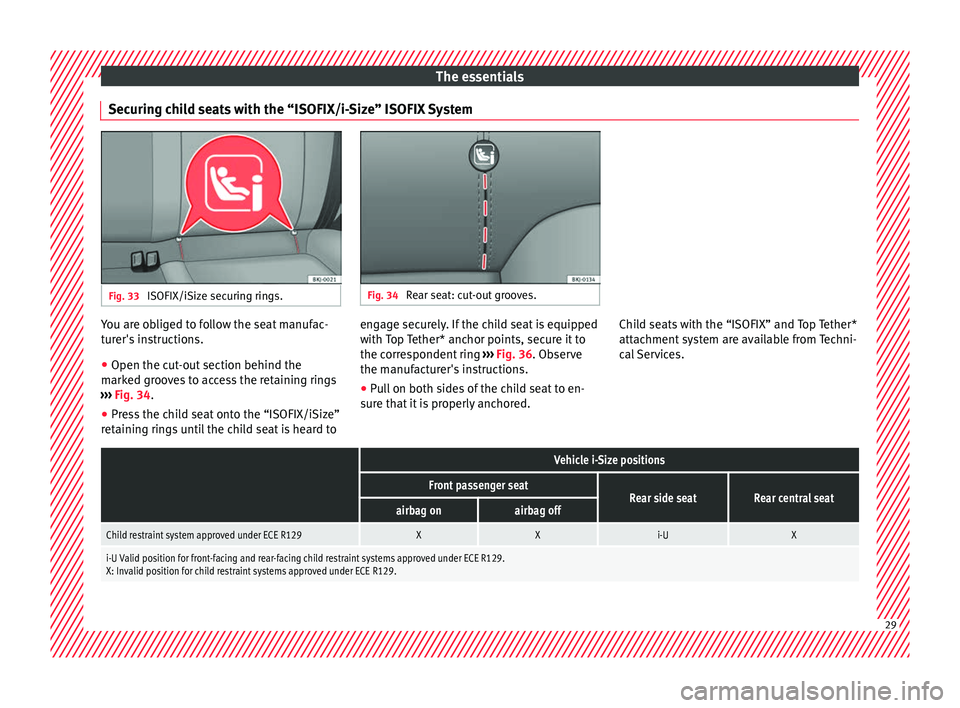
Securing child seats with the “ISOFIX/i-Size” ISOFIX System Fig. 33
ISOFIX/iSize securing rings. Fig. 34
Rear seat: cut-out grooves. You are obliged to follow the seat manufac-
t
ur
er's
instructions.
● Open the cut-out section behind the
marked gr
ooves to access the retaining rings
››› Fig. 34.
● Press the child seat onto the “ISOFIX/iSize”
retainin
g rings until the child seat is heard to engage securely. If the child seat is equipped
with Top
Tether* anchor points, secure it to
the correspondent ring ››› Fig. 36. Observe
the manufacturer's instructions.
● Pull on both sides of the child seat to en-
sure th
at it is properly anchored. Child seats with the “ISOFIX” and Top Tether*
attachment
system are available from Techni-
cal Services.
Vehicle i-Size positions
Front passenger seatRear side seatRear central seatairbag onairbag off
Child restraint system approved under ECE R129XXi-UX
i-U Valid position for front-facing and rear-facing child restraint systems approved under ECE R129.
X: Invalid position for child restraint systems approved under ECE R129. 29
Page 78 of 316
Safety
risk of injury. The following points cover part
of the s
af
ety equipment in your SEAT 1)
:
● three-point seat belts,
● Belt tension limiter for the front and rear
side seats
● belt
tensioners for the front and rear seats,
● front airbags,
● side airbags in the front seat backrests,
● “ISOFIX” anchor points for “ISOFIX” rear
chil
d seat system
● height-adjustable front head restraints,
● Rear-centre head restraints with in-use po-
sition and non-use po
sition
● adjustable steering column.
The safety
equipment mentioned above
works together to provide you and your pas-
sengers with the best possible protection in
the event of an accident. However, these
safety systems can only be effective if you
and your passengers are sitting in a correct
position and use this equipment properly.
Safety is everyone's business! Correct position of the vehicle
occup
ants
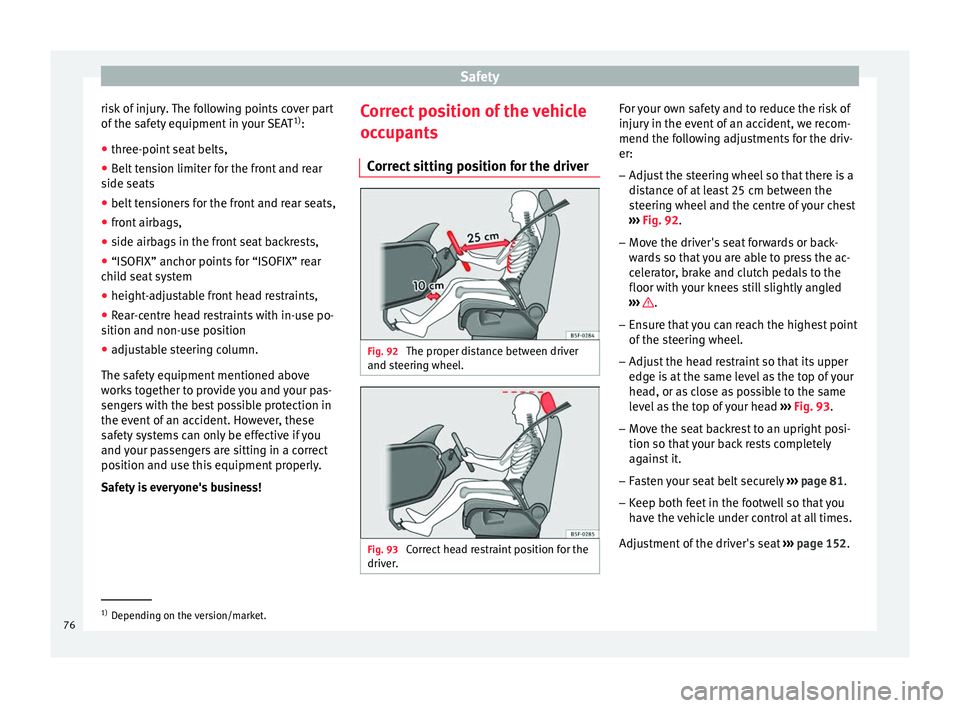
Correct sitting position for the driver Fig. 92
The proper distance between driver
and s t
eerin
g wheel. Fig. 93
Correct head restraint position for the
driv er
. For your own safety and to reduce the risk of
injur
y
in the ev
ent of an accident, we recom-
mend the following adjustments for the driv-
er:
– Adjust the steering wheel so that there is a
dist
ance of at least 25 cm between the
steering wheel and the centre of your chest
››› Fig. 92.
– Move the driver's seat forwards or back-
ward
s so that you are able to press the ac-
celerator, brake and clutch pedals to the
floor with your knees still slightly angled
››› .
– Ensure that you can reach the highest point
of the s
t
eering wheel.
– Adjust the head restraint so that its upper
edge is
at the same level as the top of your
head, or as close as possible to the same
level as the top of your head ››› Fig. 93.
– Move the seat backrest to an upright posi-
tion so that
your back rests completely
against it.
– Fasten your seat belt securely ›››
page 81.
– Keep both feet in the footwell so that you
have the
vehicle under control at all times.
Adjustment of the driver's seat ››› page 152. 1)
Depending on the version/market.
76
Page 94 of 316
Safety
Transporting children safely Saf ety
f
or children
Introduction For safety reasons, as we have learned from
acc
ident
statistics, we recommend that chil-
dren under 12 years of age travel in the rear
seats. Depending on their age, height and
weight, children travelling in rear seats must
use a child seat or a seat belt. For safety rea-
sons, the child seat should be installed in the
rear seat, behind the front passenger seat or
in the centre back seat.
The physical laws involved and the forces
acting in a collision apply also to children
››› page 83. But unlike adults, children do not
have fully developed muscle and bone struc-
tures. This means that children are subject to
a greater risk of injury.
To reduce the risk of injuries, children must
always use special child restraint systems
when travelling in the vehicle.
We recommend the use of child safety prod-
ucts from the SEAT Original Accessories Pro-
gramme, which includes systems for all ages
made by “Peke” (not for all countries) (see
www.seat.com). These systems have been especially de-
signed and ap
pr
oved, complying with the
ECE-R44. regulation.
SEAT recommends securing the child seats
shown on the website as described below:
● Child seats in the opposite direction of
travel
(group 0+): ISOFIX and support bracket
(Peke G0 Plus + ISOFIX Base (RWF)).
● Child seats in the direction of travel (group
1): ISOFIX and T
op Tether (Peke G1 ISOFIX
DUO Plus).
● Child seats in the direction of travel (group
2): seat belt
and ISOFIX (RÖMER KIDFIX XP ©
).
● Child seats in the direction of travel (group
3): with seat
belt (TAKATA MAXI PLUS ©
).
Follow the manufacturer's instructions and
observe any statutory requirements when in-
stalling and using child seats. Always read
and note ››› page 92.
We recommend you always carry the manu-
facturer's Child Seat Instruction Manual to-
gether with the on-board documentation.
Important information regarding the
front p
assenger's airbag Read the additional information carefully
› ›
›
page 23. Read and always observe the safety informa-
tion included in the fo
llowing chapters:
● Safety distance with respect to the passen-
ger airbag ›
›› page 86.
● Objects between the passenger and the
pas
senger side airbag ››› in Front airbags
on p ag
e 88
.
The passenger side front airbag, when ena-
bled, is a serious risk for a child that is facing
backward since the airbag can strike the seat
with such force that it can cause serious or
fatal injuries. Children up to 12 years old
should always travel on the rear seat.
Therefore we strongly recommend you to
transport children on the rear seats. This is
the safest location in the vehicle. Alternative-
ly, the front passenger airbag can be disa-
bled with a key-operated switch ››› page 90.
When transporting children, use a child seat
suitable for the age and size of each child
››› page 94. WARNING
● If a c hi
ld seat is secured to the front pas-
senger seat, the risk to the child of sustain-
ing critical or fatal injuries in the event of an
accident increases.
● An inflating front passenger airbag can
strike the r
ear-facing child seat and project it
with great force against the door, the roof or
the backrest. 92
Page 95 of 316
Transporting children safely
●
Never in s
tall a child seat facing backwards
on the front passenger seat unless the front
passenger front airbag has been disabled.
Risk of potentially fatal injuries to the child!
However, if it is necessary, in exceptional ca-
ses, to transport a child in the front passen-
ger seat, the front passenger front airbag
must always be disabled ››› page 90, Activa-
tion and deactivation of front passenger air-
bag*. If the passenger seat has a height ad-
justment option, move it to the highest, most
upright position. If it is a fixed seat, it should
be moved to the rearmost position possible.
● For those vehicles that do not include a key
lock sw
itch to deactivate the airbag, the vehi-
cle must be taken to a technical service. Do
not forget to reconnect the airbag when an
adult wants to sit in the front passenger seat.
● All vehicle occupants, especially children,
must
assume the proper sitting position and
be properly belted in while travelling.
● Never hold children or babies on your lap,
this c
an result in potentially fatal injuries to
the child!
● Never allow a child to be transported in a
vehicl
e without being properly secured, or to
stand up or kneel on a seat while travelling.
In an accident, the child could be flung
through the vehicle, causing possibly fatal in-
juries to themselves and to the other vehicle
occupants.
● If children assume an improper sitting posi-
tion when the vehic
le is moving, they expose
themselves to greater risk of injury in the
event of a sudden braking manoeuvre or in an accident. This is particularly important if the
chi
l
d is travelling on the front passenger seat
and the airbag system is triggered in an acci-
dent; as this could cause serious injury or
even death.
● A suitable child seat can protect your child!
● Never leave a child alone in the child seat
or inside the
vehicle because depending on
the season, very high temperatures may be
reached inside a parked vehicle, which could
be fatal.
● Children who are less than 1.5 metres tall
must
not wear a normal seat belt without a
child seat, as this could cause injuries to the
abdominal and neck areas during a sudden
braking manoeuvre or in an accident.
● Do not allow the seat belt to become twis-
ted and the seat
belt should be properly in
place ››› page 81.
● Only one child may occupy a child seat
›››
page 93, Child seats.
● When a child seat is mounted in the rear
seats, the door c
hild-proof lock should be ac-
tivated ››› page 138. Child seats
Saf ety
in
structions Read the additional information carefully
› ›
›
page 23. WARNING
When travelling, children must be secured in
the v ehic
le with a restraint system suitable
for age, weight and size.
● Read and always observe information and
warning
s concerning the use of child seats
››› page 92. WARNING
The retaining rings are designed only for use
with “ISOFIX” and T op
Tether* system child
seats.
● Never secure other child seats that do not
have the “ISOFIX” or T
op Tether* system, or
retaining belts or objects to the fastening
rings - this can result in potentially fatal inju-
ries to the child.
● Ensure that the child seat is secured cor-
rectly u
sing the “ISOFIX” and Top Tether* se-
curing rings. WARNING
An undue installation of the safety seat will
incr e
ase the risk of injury in the event of a
crash.
● Never tie the retainer strap to a hook in the
luggag
e compartment.
● Never secure or tie luggage or other items
to the low
er anchorages (ISOFIX) or the upper
ones (Top Tether). 93
Technical data
Advice
Operation
Emergencies
Safety
Page 96 of 316
Safety
Categorisation of child seats into
gr oup
s Use only child seats that are officially ap-
pro
v
ed and suitable for the child.
These seats are subject to the ECE-R 44 or
ECE-R 129 standard. ECE-R stands for: Eco-
nomic Commission for Europe Regulation.
The child seats are grouped into 5 catego-
ries:
Group 0: Up to 10 kg (up to around 9
months)
Group 0+: Up to 13 kg (up to around 18
months)
Group 1: from 9 to 18 kg (up to approx. 4
years old)
Group 2: from 15 to 25 kg (up to approx. 7
years old)
Group 3: From 22 to 36 kg (over around 7
years old)
Child seats that have been tested and ap-
proved under the ECE-R 44 or ECE-R 129
standard bear the test mark ECE-R 44 or ECE-
R 129 on the seat (the letter E in a circle with
the test number below it).
Follow the manufacturer's instructions and
observe any statutory requirements when in-
stalling and using child seats. We recommend you to always include the
manuf
act
urer's Child Seat Instruction Manual
together with the on-board documentation.
SEAT recommends you use child seats from
the Original Accessories Catalogue . These
child seats have been designed and tested
for use in SEAT vehicles. You can find the
right child seat for your model and age group
at SEAT dealers.
Child seats by approval category
Child seats may have the approval category
of universal, semi-universal, vehicle specific
(all according to the ECE-R 44 standard) or i-
Size (according to the ECE-R 129 standard).
● Universal: Child se
ats with universal appro-
val can be installed in all vehicles. There is
no need to consult any list of models. In the
case of universal approval for ISOFIX, the
child seat is additionally provided with a Top
Tether belt.
● Semi-universal: semi-univer
sal approval, in
addition to the standard requirements of uni-
versal approval, requires safety devices to
lock the child seat, which require additional
testing. Child seats with semi-universal ap-
proval include a list of vehicle models for
which they can be installed.
● Vehicle-specific: vehic
le-specific approval
requires a dynamic test of the child seat for
each vehicle model separately. Child seats
with vehicle-specific approval also include a list of vehicle models for which they can be
inst
alled.
● i-Size: Child seats with i-Size approval must
meet the r
equirements prescribed in the ECE-
R 129 standard in relation to installation and
safety. Child seat manufacturers can tell you
which seats have i-Size approval for this vehi-
cle.
Attachment systems Depending on the country, different attach-
ment
sy
s
tems are used for safely installing
child seats.
Attachment systems overview
● ISOFIX: ISOFIX is
a standardised attach-
ment system allowing quick and safe attach-
ment of child seats in the vehicle. ISOFIX at-
tachment establishes a rigid connection be-
tween the child seat and the car body.
The child seat has two rigid attachment clips,
called connectors. These connectors are fit-
ted into the ISOFIX attachment rings found
between the seat cushion and the backrest of
the vehicle's back seat (on the sides). ISOFIX
attachment systems are used mainly in Eu-
rope ›››
page 27. If necessary, ISOFIX at-
tachment may have to be supplemented with
a Top Tether belt or a support bracket.
94
Page 97 of 316
Transporting children safely
● Aut om
atic
three-point seat belt . Whenever
possible, it is preferable to attach the child
seats with the ISOFIX system rather than at-
taching them with an automatic three-point
seat belt ›››
page 25.
Additional attachment:
● Top Tether : The Top Tether belt is guided
ov
er the back of the rear seat and attached to
an anchor point with a hook. Anchor points
are located at the back of the rear seat back-
rest on the boot side ›››
page 30
. The
rings for retaining the Top Tether belt are
marked with an anchor symbol.
● Support bracket : Some chi
ld seats rest on
the floor of the vehicle with a support brack-
et. The support bracket prevents the child
seat from tipping forward in the event of im-
pact. Child seats fitted with a support bracket
should only be used in the passenger seat
and side rear seats ››› . For the assembly of
thi s
type of
seat you should also consult the
list of approved vehicles for this assembly,
available in the instructions for child restraint
systems.
Recommended systems for attaching child
seats
SEAT recommends attaching child seats as
follows: ●
Baby
carriers or child seats in the opposite
direction of travel: ISOFIX and support brack-
et or iSize.
● Child seats in the direction of travel: ISO-
FIX and T
op Tether. WARNING
Incorrect use of the support bracket can
cau se seriou
s or fatal injury.
● Make sure the support bracket is correctly
and safely
installed. 95
Technical data
Advice
Operation
Emergencies
Safety
Page 304 of 316
Index
launch control program . . . . . . . . . . . . . . . . . . 192
m anual
r
elease of the selector lever . . . . . . . . . 50
selector lever lock . . . . . . . . . . . . . . . . . . . . . . . 189
selector lever positions . . . . . . . . . . . . . . . . . . 188
steering wheel with gear shift paddles . . . . . . 190
tiptronic . . . . . . . . . . . . . . . . . . . . . . . . . . 188, 190
Automatic lighting . . . . . . . . . . . . . . . . . . . . . . . . 144
AUX-IN . . . . . . . . . . . . . . . . . . . . . . . . . . . . . . . . . . 129
B Back seat folding down and raising the back seat back-rest . . . . . . . . . . . . . . . . . . . . . . . . . . . . . . . . . 155
Battery . . . . . . . . . . . . . . . . . . . . . . . . . . . . . . . . . . 131
Before setting off . . . . . . . . . . . . . . . . . . . . . . . . . . 75
Belt tensioners control lamp . . . . . . . . . . . . . . . . . . . . . . . . . . . . 91
Belt tightening . . . . . . . . . . . . . . . . . . . . . . . . . . . . 85
Biodiesel . . . . . . . . . . . . . . . . . . . . . . . . . . . . . . . . 270
Blind spot detector (BSD) . . . . . . . . . . . . . . . . . . 224 control lamps . . . . . . . . . . . . . . . . . . . . . . . . . . 224
driving situations . . . . . . . . . . . . . . . . . . . . . . . 227
indication in the external rear view mirror . . . 225
malfunction . . . . . . . . . . . . . . . . . . . . . . . . . . . . 224
operating . . . . . . . . . . . . . . . . . . . . . . . . . . . . . . 225
towing . . . . . . . . . . . . . . . . . . . . . . . . . . . . . . . . 229
Bonnet . . . . . . . . . . . . . . . . . . . . . . . . . 17, 273, 275 closing . . . . . . . . . . . . . . . . . . . . . . . . . . . . . . . . 274
opening . . . . . . . . . . . . . . . . . . . . . . . . . . . . . . . 274
Brake assist . . . . . . . . . . . . . . . . . . . . . . . . . . . . . 181
Brake fluid . . . . . . . . . . . . . . . . . . . . . . . . . . 60, 280 changing . . . . . . . . . . . . . . . . . . . . . . . . . . . . . . 280
Brake pads . . . . . . . . . . . . . . . . . . . . . . . . . 179, 197
Brakes brake fluid . . . . . . . . . . . . . . . . . . . . . . . . . . . . . 280
new Brake pads . . . . . . . . . . . . . . . . . . . . . . . . 179
Brake servo . . . . . . . . . . . . . . . . . . . . . . . . . 179, 186 Brake system . . . . . . . . . . . . . . . . . . . . . . . . . . . . 280
Brakin
g
brake assist . . . . . . . . . . . . . . . . . . . . . . . . . . . . 181
Braking distance . . . . . . . . . . . . . . . . . . . . . . . . . 179
Braking system warning lamp . . . . . . . . . . . . . . . . . . . . . . . . . . 179
BSD see Blind spot detector (BSD) . . . . . . . . . . . . . 224
Bulbs changing the bulbs . . . . . . . . . . . . . . . . . . . . . 106
Buzzer . . . . . . . . . . . . . . . . . . . . . . . . . . . . . . . . . . 145
C
Capacities . . . . . . . . . . . . . . . . . . . . . . . . . . . . . . . . 57 AdBlue tank . . . . . . . . . . . . . . . . . . . . . . . . . . . 271
fuel tank . . . . . . . . . . . . . . . . . . . . . . . . . . . . . . 121
Car care exterior . . . . . . . . . . . . . . . . . . . . . . . . . . . . . . . 261
Care and cleaning . . . . . . . . . . . . . . . . . . . . . . . . 260
Catalytic converter . . . . . . . . . . . . . . . . . . . . . . . . 200 malfunction . . . . . . . . . . . . . . . . . . . . . . . . . . . . 200
CCS . . . . . . . . . . . . . . . . . . . . . . . . . . . . . . . . . . . . . 45
Central locking anti-theft alarm . . . . . . . . . . . . . . . . . . . . . . . . . 138
automatic speed-dependent locking . . . . . . . 134
central locking button . . . . . . . . . . . . . . . . . . . 134
electric windows . . . . . . . . . . . . . . . . . . . . . . . . 142
emergency locking . . . . . . . . . . . . . . . . . . . . . . . 16
key by remote control . . . . . . . . . . . . . . . . . . . . 130
Keyless Access . . . . . . . . . . . . . . . . . . . . . . . . . 135
selective unlocking system . . . . . . . . . . . . . . . 133
self-locking system to prevent involuntary un-locking . . . . . . . . . . . . . . . . . . . . . . . . . . . . . . 134
unlocking system . . . . . . . . . . . . . . . . . . . . . . . 134
Central locking system . . . . . . . . . . . . . . . . . . . . . 132 safe security system . . . . . . . . . . . . . . . . . . . . . 132
Central wheel trim . . . . . . . . . . . . . . . . . . . . . . 65, 66 Centre console . . . . . . . . . . . . . . . . . . . . . . . . . . . . 11
Cetane number (die
sel fuel) . . . . . . . . . . . . . . . . 270
Changing a bulb additional brake light . . . . . . . . . . . . . . . . . . . . 111
dipped beam . . . . . . . . . . . . . . . . . . . . . . . . . . 108
DRL (daytime running light) . . . . . . . . . . . . . . . 108
fog light . . . . . . . . . . . . . . . . . . . . . . . . . . . . . . . 109
general notes . . . . . . . . . . . . . . . . . . . . . . . . . . 106
interior light and reading light . . . . . . . . . . . . 111
luggage compartment light . . . . . . . . . . . . . . . 112
main beam headlight . . . . . . . . . . . . . . . . . . . . 107
number plate light . . . . . . . . . . . . . . . . . . . . . . 110
rear bulb in the side panel . . . . . . . . . . . . . . . . 109
rear light in the rear lid . . . . . . . . . . . . . . . . . . . 110
turn signal light . . . . . . . . . . . . . . . . . . . . . . . . 108
Changing a wheel . . . . . . . . . . . . . . . . . . . . . . . . . 65 subsequent work . . . . . . . . . . . . . . . . . . . . . . . . 69
wheel bolts . . . . . . . . . . . . . . . . . . . . . . . . . . . . . 67
Changing settings CAR menu . . . . . . . . . . . . . . . . . . . . . . . . . . . . . . 34
Changing the blades . . . . . . . . . . . . . . . . . . . . . . 100
Charging the battery . . . . . . . . . . . . . . . . . . . . . . . 71
Checking levels engine compartment . . . . . . . . . . . . . . . . . . . . 275
Childproof locks electric windows . . . . . . . . . . . . . . . . . . . . . . . . 141
Child seats . . . . . . . . . . . . . . . . . . . . . . . . . . . . 23, 93 categorisation into groups . . . . . . . . . . . . . . . . . 94
ISOFIX system . . . . . . . . . . . . . . . . . . . . . . . . . . . 27
safety instructions . . . . . . . . . . . . . . . . . . . . 23, 92
securing with seat belt . . . . . . . . . . . . . . . . . . . . 25
Top Tether system . . . . . . . . . . . . . . . . . . . . . 27, 30
Chrome parts cleaning . . . . . . . . . . . . . . . . . . . . . . . . . . . . . . 264
Cigarette lighter . . . . . . . . . . . . . . . . . . . . . . . . . . 158
302
Page 309 of 316
Index
Instrument panel . . . . . . . . . . . . . . . . . . . . . . . . . 117 dis
p
lay . . . . . . . . . . . . . . . . . . . . . . . . . . . 117, 118
instruments . . . . . . . . . . . . . . . . . . . . . . . . . . . . 117
odometer . . . . . . . . . . . . . . . . . . . . . . . . . . . . . . 120
service interval indication . . . . . . . . . . . . . . . . . 43
warning and control lamps . . . . . . . . . . . . . . . 121
Instrument panel lighting . . . . . . . . . . . . . . . . . . 148
Instruments . . . . . . . . . . . . . . . . . . . . . . . . . . . . . 117
Interior bulbs . . . . . . . . . . . . . . . . . . . . . . . . . . . . 111
Interior lights . . . . . . . . . . . . . . . . . . . . . . . . . . . . . 33
Interior mirror . . . . . . . . . . . . . . . . . . . . . . . . . . . . 150 anti-dazzle . . . . . . . . . . . . . . . . . . . . . . . . . . . . 150
Interior view . . . . . . . . . . . . . . . . . . . . . . . . . . . . . . 14
ISOFIX . . . . . . . . . . . . . . . . . . . . . . . . . . . . . . . . 27, 29
ISOFIX system . . . . . . . . . . . . . . . . . . . . . . . . . . . . . 27
J Jack . . . . . . . . . . . . . . . . . . . . . . . . . . . . . . . . . . . . . 65 mounting points . . . . . . . . . . . . . . . . . . . . . . . . . 68
Journey data . . . . . . . . . . . . . . . . . . . . . . . . . . . . . . 37 memory . . . . . . . . . . . . . . . . . . . . . . . . . . . . . . . . 38
Jump leads . . . . . . . . . . . . . . . . . . . . . . . . . . . . . . . 71
K
Key-operated switch . . . . . . . . . . . . . . . . . . . . . . . . 90
Key by remote control unlocking and locking . . . . . . . . . . . . . . . . . . . 130
Keyless-Entry see Keyless Access . . . . . . . . . . . . . . . . . . . . . . 135
Keyless-Exit see Keyless Access . . . . . . . . . . . . . . . . . . . . . . 135
Keyless Access Keyless-Entry . . . . . . . . . . . . . . . . . . . . . . . . . . 135
Keyless-Exit . . . . . . . . . . . . . . . . . . . . . . . . . . . . 135
Press & Drive . . . . . . . . . . . . . . . . . . . . . . . . . . . 176
special characteristics . . . . . . . . . . . . . . . . . . . 137 starting the engine . . . . . . . . . . . . . . . . . . . . . . 177
unloc
king and locking the vehicle . . . . . . . . . . 135
Keyless Access locking and ignition system see Keyless Access . . . . . . . . . . . . . . . . . . . . . . 135
Keys replacing the battery . . . . . . . . . . . . . . . . . . . . 131
spare key . . . . . . . . . . . . . . . . . . . . . . . . . . . . . . 130
synchronise . . . . . . . . . . . . . . . . . . . . . . . . . . . . 132
unlocking and locking . . . . . . . . . . . . . . . 15, 130
vehicle key . . . . . . . . . . . . . . . . . . . . . . . . . . . . 130
Kick-down automatic gearbox . . . . . . . . . . . . . . . . . . . . . . 192
manual gearbox . . . . . . . . . . . . . . . . . . . . . . . . 231
L
Launch control (automatic gearbox) . . . . . . . . . . 192
Leaving Home . . . . . . . . . . . . . . . . . . . . . . . . . . . . 146
Leaving Home Function . . . . . . . . . . . . . . . . . . . . 146
Lifting the vehicle . . . . . . . . . . . . . . . . . . . . . . . . . . 68
Lights . . . . . . . . . . . . . . . . . . . . . . . . . . . . . . 31, 143 additional brake light . . . . . . . . . . . . . . . . . . . . 111
automatic lighting . . . . . . . . . . . . . . . . . . . . . . 144
changing the bulbs . . . . . . . . . . . . . . . . . . . . . 106
coming home . . . . . . . . . . . . . . . . . . . . . . . . . . 146
control and warning lamps . . . . . . . . . . . . . . . 143
daytime running lights . . . . . . . . . . . . . . . . . . . 144
fog lights . . . . . . . . . . . . . . . . . . . . . . . . . . . . . . 145
fog lights with cornering function . . . . . . . . . . 146
instrument lighting . . . . . . . . . . . . . . . . . . . . . . 148
interior light and front reading lights . . . . . . . 111
interior lights . . . . . . . . . . . . . . . . . . . . . . . . . . 148
leaving home . . . . . . . . . . . . . . . . . . . . . . . . . . 146
lights range control . . . . . . . . . . . . . . . . . . . . . 147
light switch . . . . . . . . . . . . . . . . . . . . . . . 143, 144
luggage compartment light . . . . . . . . . . . . . . . 112
main beam lever . . . . . . . . . . . . . . . . . . . . . . . . 145
main beams . . . . . . . . . . . . . . . . . . . . . . . . . . . . 32 motorway light . . . . . . . . . . . . . . . . . . . . . . . . . 147
number plat
e light . . . . . . . . . . . . . . . . . . . . . . 110
parking lights . . . . . . . . . . . . . . . . . . . . . . . . . . 145
reading lights . . . . . . . . . . . . . . . . . . . . . . . . . . 148
turn signal lever . . . . . . . . . . . . . . . . . . . . . . . . 145
Lights range control . . . . . . . . . . . . . . . . . . . . . . . 147
Light switch . . . . . . . . . . . . . . . . . . . . . . . . . . . . . . 31
Load compartment in the luggage compartment see Loading the luggage compartment . . . . . 158
Loading the luggage compartment . . . . . . . . . . . 158
Loading the vehicle fastening rings . . . . . . . . . . . . . . . . . . . . . . . . . 160
luggage compartment . . . . . . . . . . . . . . . . . . . . 16
roof carrier system . . . . . . . . . . . . . . . . . . . . . . 163
Locking and unlocking in the door cylinder . . . . . . . . . . . . . . . . . . . . . . 15
with Keyless Access . . . . . . . . . . . . . . . . . . . . . 135
with the central lock button . . . . . . . . . . . . . . . 134
Locking the front passenger door manually . . . . . 16
Luggage . . . . . . . . . . . . . . . . . . . . . . . . . . . . . . . . 158
Luggage compartment . . . . . . . . . . . . . . . . . 16, 158 luggage compartment light . . . . . . . . . . . . . . . 148
luggage compartment variable floor . . . . . . . . 161
manual release mechanism . . . . . . . . . . . . . . . . 17
store the rear shelf . . . . . . . . . . . . . . . . . . . . . . 159
see also Loading the luggage compartment . 158
Luggage compartment floor . . . . . . . . . . . . . . . . 161
Luggage compartment variable floor . . . . . . . . . 161
M Main beam lever . . . . . . . . . . . . . . . . . . . . . . . . . . 145
Maintenance intervals . . . . . . . . . . . . . . . . . . . . . 275
Malfunction adaptive cruise control . . . . . . . . . . . . . . . . . . . 215
catalytic converter . . . . . . . . . . . . . . . . . . . . . . 200
clutch . . . . . . . . . . . . . . . . . . . . . . . . . . . . . . . . . 194
diesel particulate filter . . . . . . . . . . . . . . . . . . . 200
307