ignition Seat Ateca 2017 Owner's Manual
[x] Cancel search | Manufacturer: SEAT, Model Year: 2017, Model line: Ateca, Model: Seat Ateca 2017Pages: 328, PDF Size: 6.36 MB
Page 288 of 328
Advice
WARNING
Oil is highly inflammable! Ensure that no oil
c ome
s into contact with hot engine compo-
nents when topping up. CAUTION
If the oil level is above the area A do not
s t
art the engine. This could result in damage
to the engine and catalytic converter. Contact
a specialised workshop. For the sake of the environment
The oil level must never be above area A .
Other w
ise oil can be drawn in through the
crankcase breather and escape into the at-
mosphere via the exhaust system. Note
Before a long trip, we recommend finding an
en gine oi
l that conforms to the correspond-
ing VW specifications and recommend keep-
ing it in the vehicle. This way, the correct en-
gine oil will always be available for a top-up if
needed. Changing engine oil
Read the additional information carefully
› ›
› page 48.
The engine oil must be changed at the inter-
vals given in the service schedule. We recommend that you have the engine oil
ch
anged by a Technical Service.
The oil change intervals are shown in the
Maintenance Programme. WARNING
Only change the engine oil yourself if you
h av
e the specialist knowledge required!
● Before opening the bonnet, read and ob-
serv
e the warnings ››› page 282.
● Wait for the engine to cool down. Hot oil
ma
y cause burn injuries.
● Wear eye protection to avoid injuries, such
as
acid burns, caused by splashes of oil.
● When removing the oil drain plug with your
fing
ers, keep your arm horizontal to help pre-
vent oil from running down your arm.
● Wash your skin thoroughly if it comes into
cont
act with engine oil.
● Engine oil is poisonous! Used oil must be
st
ored in a safe place out of the reach of chil-
dren. CAUTION
No additives should be used with engine oil.
Thi s
could result in engine damage. Any dam-
age caused by the use of such additives
would not be covered by the factory warranty. For the sake of the environment
● Bec
ause of disposal problems and the spe-
cial tools and specialist knowledge required,
we recommend that you have the engine oil
and filter changed by a Technical Service.
● Never pour oil down drains or into the
grou
nd.
● Use a suitable container when draining the
used oi
l. It must be large enough to hold all
the engine oil. Cooling system
Top
ping up coolant Read the additional information carefully
› ›
› page 49
Top up coolant when the level is below the
MIN (minimum) mark.
Checking coolant level
– Park the vehicle in a horizontal position.
– Switch the ignition off.
– Read off the coolant level on coolant ex-
pan
sion tank. When the engine is cold, the
coolant level should be between the marks.
When the engine is hot, it may be slightly
above the upper mark.
286
Page 289 of 328
Checking and refilling levels
Topping up coolant
– Wait for the engine to cool down.
– Cover the coolant expansion tank cap with
a c loth and c
arefully unscrew it to the left
››› .
– Top up the coolant only if there is still cool-
ant in the e
xpansion tank, otherwise you
could damage the engine. If there is no
coolant in the expansion tank, do not con-
tinue driving. You should obtain professio- nal assistance ››› .
– If there is still some coolant in the expan-
sion t
ank, top up to the upper mark.
– Top up with coolant until the level becomes
st
able.
– Screw the cap back on correctly.
Any
loss of coolant fluid normally indicates a
leak in the cooling system. Take the vehicle
straight to a specialised workshop to have
the cooling system examined. If there are no
leaks in the engine cooling system, a loss of
coolant can only occur if the coolant boils
and is forced out of the system as a result of
overheating. WARNING
● The c oo
ling system is under pressure. Do
not unscrew the cap on the coolant expan-
sion tank when the engine is hot: risk of
burns! ●
The antifr eez
e and coolant fluid can be a
health hazard. Therefore, the antifreeze
should be stored in the original container in a
safe place out of reach of children. Failure to
comply could result in poisoning.
● If working inside the engine compartment,
remember th
at, even when the ignition is
switched off, the radiator fan may start up au-
tomatically, and therefore there is a risk of in-
jury. WARNING
If there is not enough anti-freeze in the cool-
ant sy
stem, the engine may fail leading to se-
rious damage.
● Please make sure that the percentage of
ad
ditive is correct with respect to the lowest
expected ambient temperature in the zone in
which the vehicle is to be used.
● When the outside temperature is very low,
the coo
lant could freeze and the vehicle
would be immobilised. In this case, the heat-
ing would not work either and inadequately
dressed passengers could die of cold. CAUTION
Do not top up the expansion tank with cool-
ant fluid if
it is empty! Air could enter the
cooling system. In this case, stop driving.
Seek specialist assistance. Otherwise, there
is a risk of engine damage. CAUTION
The original additives should never be mixed
w ith c
oolants which are not approved by
SEAT. Otherwise, you run the risk of causing
severe damage to the engine and the engine
cooling system.
● If the fluid in the expansion tank is not pur-
pl
e but is, for example, brown, this indicates
that the G13 additive has been mixed with an
inadequate coolant. The coolant must be
changed as soon as possible if this is the
case! This could result in serious faults and
engine damage. For the sake of the environment
Coolants and additives can contaminate the
en v
ironment. If any fluids are spilled, they
should be collected and correctly disposed
of, with respect to the environment. Brake fluid
Top
ping up brake fluid Read the additional information carefully
› ›
› page 50
Checking the brake fluid level
The brake fluid level must be between the
MIN and MAX markings. »
287
Technical data
Advice
Operation
Emergencies
Safety
Page 291 of 328
Checking and refilling levels
CAUTION
● Do not mi
x cleaning products recommen-
ded by SEAT with other products. This could
lead to flocculation and may block the wind-
screen washer jets.
● When topping up service fluids, make abso-
lutely
certain that you fill the fluids into the
correct reservoirs. Using the wrong fluids
could cause serious malfunctions and engine
damage!
● Not having windscreen wiper fluid reduces
vi
sibility through the windscreen, and leads
to loss of visibility in headlights in models
with headlight washer. Battery
Gener a
l information Read the additional information carefully
› ›
› page 50.
The battery is located in the engine compart-
ment and is almost maintenance-free. It is
checked as part of the Inspection Service.
Nevertheless, check the terminals are clean
and have the correct tightening torque, espe-
cially in summer and winter.
Disconnecting the battery
The battery should only be disconnected in
exceptional cases. When the battery is dis- connected, some of the vehicle's functions
are “lo
st” (››› table on page 289). These
functions will require resetting after the bat-
tery is reconnected.
Deactivate the anti-theft alarm* before you
disconnect the battery Otherwise the alarm
will be triggered.
FunctionReprogramming
One-touch function of
the electric windows››› page 128, One-touch
opening and closing.
Remote control key
If the vehicle does not re-
spond to the key, they
should be synchronised
››› page 120.
Digital clock››› page 104.
ESC warning lampAfter driving for a few me-
tres, the warning lamp goes
out again. If the vehicle is not used for long periods
The
v
ehicle has a system for monitoring the
current consumption when the engine is left
unused for long periods of time ››› page 274.
Some functions, such as the interior lights, or
the remote door opening, may be temporarily
disabled to prevent the battery from running
flat. These functions will come back on as
soon as the ignition is switched on and the
engine started. Winter conditions
Durin
g the winter, the starting power may be
reduced, and if necessary, the battery should
be charged ››› in Important safety warn-
in g
s for handling a vehicle battery on
page 290
Important safety warnings for han-
dling a
vehicle battery All work on batteries requires specialist
kno
wl
edge. Please refer to a SEAT Official
Service or a workshop specialising in batter-
ies: risk of burns or exploding battery!
The battery must not be opened. Never try to
change the fluid level of the battery. Other-
wise explosive gas is released from the bat-
tery that could cause an explosion.
Wear eye protection.
Battery acid is very corrosive and caustic. Wear
protective gloves and eye protection. In the event
of electrolyte splashes, rinse off with plenty of
water.
Fires, sparks, open flames and smoking are pro-
hibited.
The battery should only be charged in a well-ven-
tilated zone. Risk of explosion!
Keep children away from acid and batteries!»
289
Technical data
Advice
Operation
Emergencies
Safety
Page 292 of 328
Advice
WARNING
● When r ep
airing or working on the electrical
system, proceed as follows:
–1. Remove the key from the ignition. The
negative cable on the battery must be
disconnected.
– 2. When the repair is finished, reconnect
the negative pole of the battery.
● Switch off all electrical devices before re-
connectin
g the battery. Reconnect first the
positive cable and then the negative cable.
Never reverse the polarity of the connections.
This could cause an electrical fire.
● Ensure that the vent hose is always connec-
ted t
o the battery.
● Never use damaged batteries. This could
cau
se an explosion! Replace a damaged bat-
tery immediately. CAUTION
● Nev er di
sconnect the battery if the ignition
is switched on or if the engine is running.
This could damage the electrical system or
electronic components. Charging the battery
Terminals for charging the battery are fitted
in the en
gine c
ompartment. –
Note the w
arnings ››› in Important safety
w arnin
gs for handling a vehicle battery on
page 290 and ››› .
– Switch off all electrical devices. Remove the
ignition k ey
.
– Raise the bonnet ››
› page 283.
– Open the battery cover.
– Connect the charger clamps as described
to the
positive pole of the battery (+) and
exclusively to an earth on the bodywork
(–).
– Only use a charger which is compatible for
use w
ith 12 V nominal voltage batteries.
The charge must not exceed a voltage of 15
V.
– Now connect the battery charger to the
pow
er socket and switch on.
– After charging the battery: switch off the
batt
ery charger and disconnect the power
socket cable.
– Finally disconnect the charger cables from
the batt
ery.
– Replace the battery cover correctly.
– Close the bonnet ››
› page 283.
Important: Before you charge the battery
make sure you read the manufacturer's in-
structions for using the battery charger. WARNING
Never charge a battery that has frozen: re-
p l
ace battery! Failure to do so may lead to an
explosion. Note
Use only the terminals in the engine compart-
ment t
o charge the battery. Replacing the battery
The new battery should have the same speci-
fic
ation
s (amperage, load and voltage) as the
used battery.
Your vehicle is equipped with an intelligent
power management system to control the
distribution of electrical energy ›››
page 274.
The power management function ensures
that the battery is charged much more effi-
ciently than on vehicles without a power
management system. To maintain this func-
tion after replacing the battery, we recom-
mend that the replacement battery used is of
the same make and type as the original fitted
battery. To make proper use of the power
management function after the battery has
been changed, have the battery coded to the
power management mode at a specialised
workshop.
290
Page 298 of 328
Advice
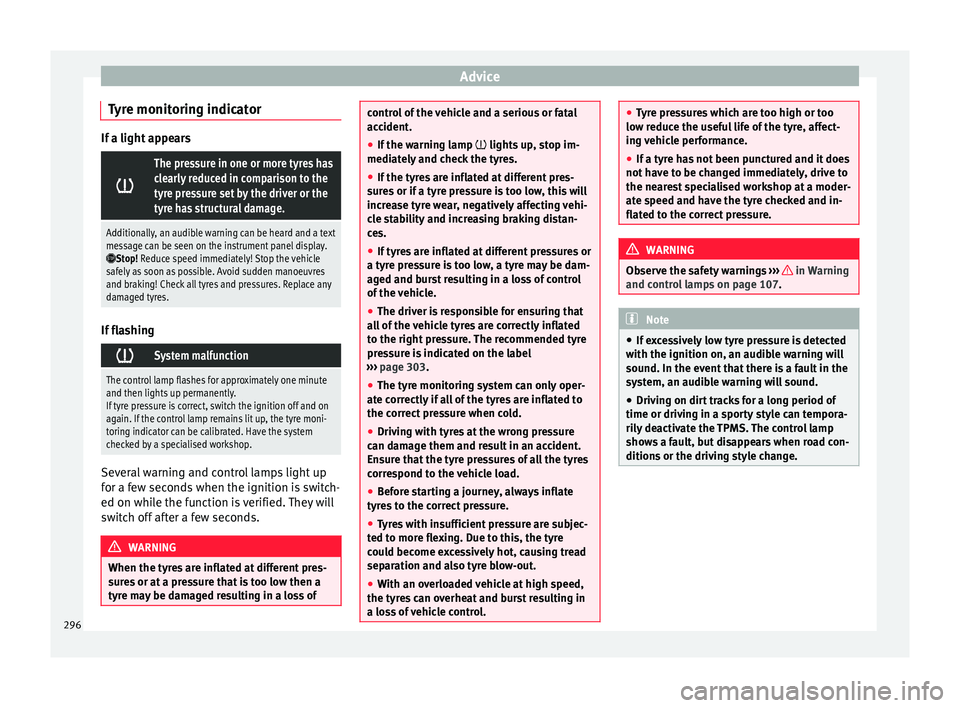
Tyre monitoring indicator If a light appears
The pressure in one or more tyres has
clearly reduced in comparison to the
tyre pressure set by the driver or the
tyre has structural damage.
Additionally, an audible warning can be heard and a text
message can be seen on the instrument panel display.
Stop! Reduce speed immediately! Stop the vehicle
safely as soon as possible. Avoid sudden manoeuvres
and braking! Check all tyres and pressures. Replace any
damaged tyres. If flashing
System malfunction
The control lamp flashes for approximately one minute
and then lights up permanently.
If tyre pressure is correct, switch the ignition off and on
again. If the control lamp remains lit up, the tyre moni-
toring indicator can be calibrated. Have the system
checked by a specialised workshop.
Several warning and control lamps light up
f
or a f
ew seconds when the ignition is switch-
ed on while the function is verified. They will
switch off after a few seconds. WARNING
When the tyres are inflated at different pres-
s ur
es or at a pressure that is too low then a
tyre may be damaged resulting in a loss of control of the vehicle and a serious or fatal
ac
c
ident.
● If the warning lamp lights
up, stop im-
mediately and check the tyres.
● If the tyres are inflated at different pres-
sur
es or if a tyre pressure is too low, this will
increase tyre wear, negatively affecting vehi-
cle stability and increasing braking distan-
ces.
● If tyres are inflated at different pressures or
a tyr
e pressure is too low, a tyre may be dam-
aged and burst resulting in a loss of control
of the vehicle.
● The driver is responsible for ensuring that
al
l of the vehicle tyres are correctly inflated
to the right pressure. The recommended tyre
pressure is indicated on the label
››› page 303.
● The tyre monitoring system can only oper-
ate c
orrectly if all of the tyres are inflated to
the correct pressure when cold.
● Driving with tyres at the wrong pressure
can d
amage them and result in an accident.
Ensure that the tyre pressures of all the tyres
correspond to the vehicle load.
● Before starting a journey, always inflate
tyr
es to the correct pressure.
● Tyres with insufficient pressure are subjec-
ted t
o more flexing. Due to this, the tyre
could become excessively hot, causing tread
separation and also tyre blow-out.
● With an overloaded vehicle at high speed,
the tyr
es can overheat and burst resulting in
a loss of vehicle control. ●
Ty
re pressures which are too high or too
low reduce the useful life of the tyre, affect-
ing vehicle performance.
● If a tyre has not been punctured and it does
not h
ave to be changed immediately, drive to
the nearest specialised workshop at a moder-
ate speed and have the tyre checked and in-
flated to the correct pressure. WARNING
Observe the safety warnings ›
›
› in Warning
and c ontr
ol lamps on page 107. Note
● If e
xcessively low tyre pressure is detected
with the ignition on, an audible warning will
sound. In the event that there is a fault in the
system, an audible warning will sound.
● Driving on dirt tracks for a long period of
time or drivin
g in a sporty style can tempora-
rily deactivate the TPMS. The control lamp
shows a fault, but disappears when road con-
ditions or the driving style change. 296
Page 299 of 328
Wheels
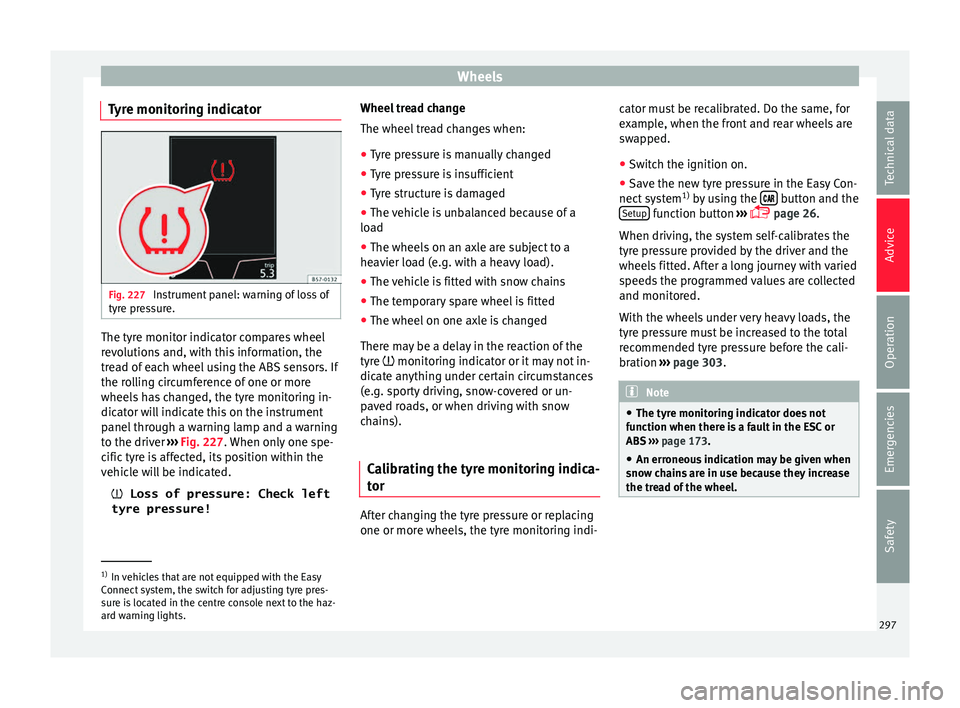
Tyre monitoring indicator Fig. 227
Instrument panel: warning of loss of
ty r
e pressure. The tyre monitor indicator compares wheel
r
ev
olutions and, with this information, the
tread of each wheel using the ABS sensors. If
the rolling circumference of one or more
wheels has changed, the tyre monitoring in-
dicator will indicate this on the instrument
panel through a warning lamp and a warning
to the driver ››› Fig. 227. When only one spe-
cific tyre is affected, its position within the
vehicle will be indicated.
Loss of pressure: Check left
tyre pressure! Wheel tread change
The wheel tr
ead changes when:
● Tyre pressure is manually changed
● Tyre pressure is insufficient
● Tyre structure is damaged
● The vehicle is unbalanced because of a
loa
d
● The wheels on an axle are subject to a
heav
ier load (e.g. with a heavy load).
● The vehicle is fitted with snow chains
● The temporary spare wheel is fitted
● The wheel on one axle is changed
There m
ay be a delay in the reaction of the
tyre monitoring indicator or it may not in-
dicate anything under certain circumstances
(e.g. sporty driving, snow-covered or un-
paved roads, or when driving with snow
chains).
Calibrating the tyre monitoring indica-
tor After changing the tyre pressure or replacing
one or mor
e wheel
s, the tyre monitoring indi- cator must be recalibrated. Do the same, for
ex
ample, when the front and rear wheels are
swapped.
● Switch the ignition on.
● Save the new tyre pressure in the Easy Con-
nect sy
stem1)
by using the button and the
Set up function button
››
›
page 26.
When driving, the system self-calibrates the
tyre pressure provided by the driver and the
wheels fitted. After a long journey with varied
speeds the programmed values are collected
and monitored.
With the wheels under very heavy loads, the
tyre pressure must be increased to the total
recommended tyre pressure before the cali-
bration ››› page 303. Note
● The ty r
e monitoring indicator does not
function when there is a fault in the ESC or
ABS ››› page 173.
● An erroneous indication may be given when
sno
w chains are in use because they increase
the tread of the wheel. 1)
In vehicles that are not equipped with the Easy
C onnect
system, the switch for adjusting tyre pres-
sure is located in the centre console next to the haz-
ard warning lights. 297
Technical data
Advice
Operation
Emergencies
Safety
Page 304 of 328
Technical data
Vehicle data sticker
The v
ehicle data sticker is under the carpet
trim in the luggage compartment, in the
spare wheel well. A sticker with the vehicle
data is attached to the inside cover of the
Maintenance Programme.
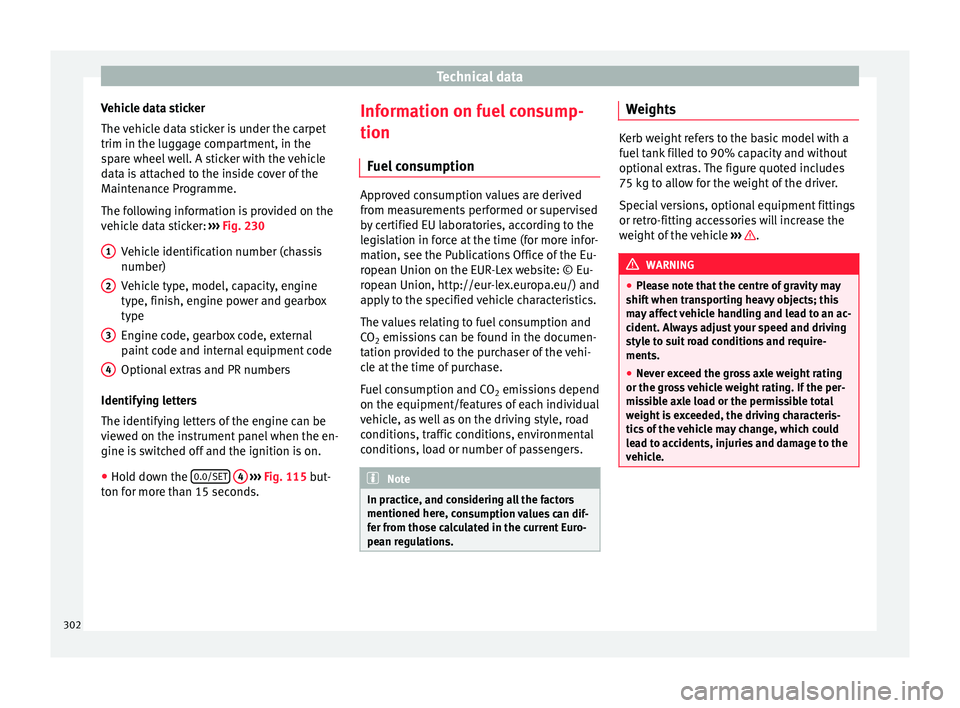
The following information is provided on the
vehicle data sticker: ››› Fig. 230
Vehicle identification number (chassis
number)
Vehicle type, model, capacity, engine
type, finish, engine power and gearbox
type
Engine code, gearbox code, external
paint code and internal equipment code
Optional extras and PR numbers
Identifying letters
The identifying letters of the engine can be
viewed on the instrument panel when the en-
gine is switched off and the ignition is on.
● Hold down the 0.0/SET
4
› ›
›
Fig. 115 but-
ton for more than 15 seconds. 1 2
3
4 Information on fuel consump-
tion
Fuel
consumption Approved consumption values are derived
fr
om me
asurements performed or supervised
by certified EU laboratories, according to the
legislation in force at the time (for more infor-
mation, see the Publications Office of the Eu-
ropean Union on the EUR-Lex website: © Eu-
ropean Union, http://eur-lex.europa.eu/) and
apply to the specified vehicle characteristics.
The values relating to fuel consumption and
CO 2 emissions can be found in the documen-
tation provided to the purchaser of the vehi-
cle at the time of purchase.
Fuel consumption and CO 2 emissions depend
on the equipment/features of each individual
vehicle, as well as on the driving style, road
conditions, traffic conditions, environmental
conditions, load or number of passengers. Note
In practice, and considering all the factors
mentioned her e, c
onsumption values can dif-
fer from those calculated in the current Euro-
pean regulations. Weights
Kerb weight refers to the basic model with a
f
uel
tank filled to 90% capacity and without
optional extras. The figure quoted includes
75 kg to allow for the weight of the driver.
Special versions, optional equipment fittings
or retro-fitting accessories will increase the
weight of the vehicle ››› .
WARNING
● Ple
ase note that the centre of gravity may
shift when transporting heavy objects; this
may affect vehicle handling and lead to an ac-
cident. Always adjust your speed and driving
style to suit road conditions and require-
ments.
● Never exceed the gross axle weight rating
or the gro
ss vehicle weight rating. If the per-
missible axle load or the permissible total
weight is exceeded, the driving characteris-
tics of the vehicle may change, which could
lead to accidents, injuries and damage to the
vehicle. 302
Page 312 of 328
Index
Assist systems Park
Assist . . . . . . . . . . . . . . . . . . . . . . . . . . . . 232
parking system Plus . . . . . . . . . . . . . . . . . . . . . 239
speed limiter . . . . . . . . . . . . . . . . . . . . . . . . . . . 194
Audible signal lights . . . . . . . . . . . . . . . . . . . . . . . . . . . . . . . . . 131
Audible warning signal seat belt not fastened . . . . . . . . . . . . . . . . . . . . 68
warning and control lamps . . . . . . . . . . . . . . . 106
Auto Hold . . . . . . . . . . . . . . . . . . . . . . . . . . . . . . . 191
Auto Hold function . . . . . . . . . . . . . . . . . . . . . . . . 191
Auto Lock (central locking) . . . . . . . . . . . . . . . . . 112
Automatic car washes switching the Auto Hold function off . . . . . . . . 192
Automatic dipped beam control . . . . . . . . . . . . . 132
Automatic gear safety interlock for ignition key . . . . . . . . . . . . 165
Automatic gearbox . . . . . . . . . . . . . . . . . . . . . . . . 177 backup programme . . . . . . . . . . . . . . . . . . . . . 183
downhill speed control . . . . . . . . . . . . . . . . . . 182
driving tips . . . . . . . . . . . . . . . . . . . . . . . . . . . . 180
kick-down feature . . . . . . . . . . . . . . . . . . . . . . . 181
launch control programme . . . . . . . . . . . . . . . . 181
manual release of selector lever . . . . . . . . . . . . 41
selector lever lock . . . . . . . . . . . . . . . . . . . . . . . 178
selector lever positions . . . . . . . . . . . . . . . . . . 177
Steering wheel with gearshift paddles . . . . . . 179
tiptronic . . . . . . . . . . . . . . . . . . . . . . . . . . 177, 179
towing . . . . . . . . . . . . . . . . . . . . . . . . . . . . . . . . . 87
AUX-IN . . . . . . . . . . . . . . . . . . . . . . . . . . . . . . . . . . 111
Auxiliary heater . . . . . . . . . . . . . . . . . . . . . . . . . . 161 activating . . . . . . . . . . . . . . . . . . . . . . . . . . . . . 163
electric consumers . . . . . . . . . . . . . . . . . . . . . . 164
operating instructions . . . . . . . . . . . . . . . . . . . 164
programming . . . . . . . . . . . . . . . . . . . . . . . . . . 163
remote control . . . . . . . . . . . . . . . . . . . . . . . . . 162
remote control range . . . . . . . . . . . . . . . . . . . . 163 special features . . . . . . . . . . . . . . . . . . . . . . . . 162
swit
ching off . . . . . . . . . . . . . . . . . . . . . . . . . . . 161
switching on . . . . . . . . . . . . . . . . . . . . . . . . . . . 161
things to note . . . . . . . . . . . . . . . . . . . . . . . . . . 164
B Battery . . . . . . . . . . . . . . . . . . . . . . . . . . . . . . . . . . 120 replacement in the remote control (auxiliaryheater) . . . . . . . . . . . . . . . . . . . . . . . . . . . . . . 162
Before starting the vehicle . . . . . . . . . . . . . . . . . . 62
Belt tightening . . . . . . . . . . . . . . . . . . . . . . . . . . . . 72
Bench seat . . . . . . . . . . . . . . . . . . . . . . . . . . . . . . 146
Bicycle rack Fitting on the retractable tow hitch . . . . . . . . . 258
maximum load . . . . . . . . . . . . . . . . . . . . . . . . . 258
Biodiesel . . . . . . . . . . . . . . . . . . . . . . . . . . . . . . . . 278
Blind spot detector (BSD) . . . . . . . . . . . . . . . . . . 220 control lamps . . . . . . . . . . . . . . . . . . . . . . . . . . 220
driving situations . . . . . . . . . . . . . . . . . . . . . . . 223
indication in the external rear view mirror . . . 221
malfunction . . . . . . . . . . . . . . . . . . . . . . . . . . . . 220
operating . . . . . . . . . . . . . . . . . . . . . . . . . . . . . . 221
towing . . . . . . . . . . . . . . . . . . . . . . . . . . . . . . . . 225
Bonnet . . . . . . . . . . . . . . . . . . . . . . . . . . . . . 11, 282 opening the bonnet . . . . . . . . . . . . . . . . . . . . . 283
Brake emergency braking function . . . . . . . . . . . . . . 170
brake fluid . . . . . . . . . . . . . . . . . . . . . . . . . . . . . . . . 50
Brakes . . . . . . . . . . . . . . . . . . . . . . . . . . . . . . . . . . 172 brake fluid . . . . . . . . . . . . . . . . . . . . . . . . . . . . . 287
brake servo . . . . . . . . . . . . . . . . . . . . . . . . . . . . 172
electronic parking brake . . . . . . . . . . . . . . . . . 170
new brake pads . . . . . . . . . . . . . . . . . . . . . . . . 172
Braking front assist . . . . . . . . . . . . . . . . . . . . . . . . . . . . 173
BSD see Blind spot detector (BSD) . . . . . . . . . . . . . 220 C
Camer
a
cleaning . . . . . . . . . . . . . . . . . . . . . . . . . . . . . . 268
cleanliness . . . . . . . . . . . . . . . . . . . . . . . . . . . . 228
Lane Assist . . . . . . . . . . . . . . . . . . . . . . . . . . . . 215
Capacities . . . . . . . . . . . . . . . . . . . . . . . . . . . . . . . . 48 AdBlue tank . . . . . . . . . . . . . . . . . . . . . . 279, 280
fuel tank . . . . . . . . . . . . . . . . . . . . . . . . . . . . . . 106
windscreen washer water . . . . . . . . . . . . . . . . 288
Car-care products . . . . . . . . . . . . . . . . . . . . . . . . . 266
Catalytic converter . . . . . . . . . . . . . . . . . . . . . . . . 186 malfunction . . . . . . . . . . . . . . . . . . . . . . . . . . . . 186
CCS . . . . . . . . . . . . . . . . . . . . . . . . . . . . . . . . . . . . . 36
CD-ROM player (navigation) . . . . . . . . . . . . . . . . 148
Central locking anti-theft alarm . . . . . . . . . . . . . . . . . . . . . . . . . 121
central locking switch . . . . . . . . . . . . . . . . . . . . 115
Electric windows . . . . . . . . . . . . . . . . . . . . . . . . 127
Keyless Access . . . . . . . . . . . . . . . . . . . . . . . . . 116
Manual locking . . . . . . . . . . . . . . . . . . . . . . . . . . 10
programming . . . . . . . . . . . . . . . . . . . . . . . . . . 115
remote control key . . . . . . . . . . . . . . . . . . . . . . 114
selective unlocking system . . . . . . . . . . . . . . . 114
sliding/tilting sunroof . . . . . . . . . . . . . . . . . . . 127
Central locking system . . . . . . . . . . . . . . . . . . . . . 112
Central wheel trim . . . . . . . . . . . . . . . . . . . . . . . . . 54
Cetane number (diesel fuel) . . . . . . . . . . . . . . . . 278
Changing parts . . . . . . . . . . . . . . . . . . . . . . . . . . . . . . . . . 265
changing a bulb dipped beam . . . . . . . . . . . . . . . . . . . . . . . . . . . 94
rear bulb in the side panel . . . . . . . . . . . . . . . . . 96
rear light in the rear lid . . . . . . . . . . . . . . . . . . . . 97
Changing a bulb . . . . . . . . . . . . . . . . . . . . . . . . . . . 93 fog light . . . . . . . . . . . . . . . . . . . . . . . . . . . . . . . . 95
main beam . . . . . . . . . . . . . . . . . . . . . . . . . . . . . 94
turn signal . . . . . . . . . . . . . . . . . . . . . . . . . . . . . . 94
310
Page 314 of 328
Index
Display of traffic signs on the instrument panel activ at
e . . . . . . . . . . . . . . . . . . . . . . . . . . . . . . . 229
deactivate . . . . . . . . . . . . . . . . . . . . . . . . . . . . . 229
Disposal Seat belt tensioners . . . . . . . . . . . . . . . . . . . . . . 72
Distance control see Adaptive cruise control . . . . . . . . . . . . . . . 197
Door cylinder . . . . . . . . . . . . . . . . . . . . . . . . . . . . . . 9
Door handle . . . . . . . . . . . . . . . . . . . . . . . . . . . . . . . 9
Door lock . . . . . . . . . . . . . . . . . . . . . . . . . . . . . . . . . . 9
Door release lever . . . . . . . . . . . . . . . . . . . . . . . . 101
Doors Childproof locks . . . . . . . . . . . . . . . . . . . . . . . . 120
opening and closing . . . . . . . . . . . . . . . . . . . . . . 9
Downhill speed control . . . . . . . . . . . . . . . . . . . . 182
Downhill speed control function . . . . . . . . . . . . . 182
Drawer . . . . . . . . . . . . . . . . . . . . . . . . . . . . . . . . . . 147
Drink holders . . . . . . . . . . . . . . . . . . . . . . . . . . . . 147
Driver see Correct sitting position . . . . . . . . . 63, 64, 65
Driver information system CD/radio indication . . . . . . . . . . . . . . . . . . . . . . 29
engine oil temperature display . . . . . . . . . . . . . 34
Operation with the windscreen wiper lever . . . 29
Driving Driving abroad . . . . . . . . . . . . . . . . . . . . . . . . . 136
driving through water . . . . . . . . . . . . . . . . . . . . 187
towing . . . . . . . . . . . . . . . . . . . . . . . . . . . . . . . . . 90
Driving abroad headlights . . . . . . . . . . . . . . . . . . . . . . . . . . . . . 136
Driving data . . . . . . . . . . . . . . . . . . . . . . . . . . . . . . 29 data summary . . . . . . . . . . . . . . . . . . . . . . . . . . . 33
memory . . . . . . . . . . . . . . . . . . . . . . . . . . . . . . . . 33
Driving in winter trailer . . . . . . . . . . . . . . . . . . . . . . . . . . . . . . . . . 255
Driving mode . . . . . . . . . . . . . . . . . . . . . . . . . . . . 226
Driving on flooded roads . . . . . . . . . . . . . . . . . . . 187 Driving profile . . . . . . . . . . . . . . . . . . . . . . . . . . . . 226
Drivin
g safety . . . . . . . . . . . . . . . . . . . . . . . . . . . . . 62
DSG . . . . . . . . . . . . . . . . . . . . . . . . . . . . . . . . . . . . 177
Duplicate keys . . . . . . . . . . . . . . . . . . . . . . . . . . . 113
Dust and pollen filter . . . . . . . . . . . . . . . . . . . . . . 156
Dynamic headlight range control . . . . . . . . . . . . 137
E E10 see Ethanol (fuel) . . . . . . . . . . . . . . . . . . . . . . . 277
Easy Connect . . . . . . . . . . . . . . . . . . . . . . . . 26, 108
Easy Open . . . . . . . . . . . . . . . . . . . . . . . . . . . . . . . 116 special characteristics . . . . . . . . . . . . . . . . . . . 118
Economical driving . . . . . . . . . . . . . . . . . . . . . . . . . . . . . . . . 185
EDL see Electronic differential lock . . . . . . . . . . . . . 173
Efficiency programme additional electrical appliances . . . . . . . . . . . . 34
saving tips . . . . . . . . . . . . . . . . . . . . . . . . . . . . . . 34
Electric windows . . . . . . . . . . . . . . . . . . . . . . 12, 126 convenience opening and closing . . . . . . . . . 127
Electromechanical steering . . . . . . . . . . . . . . . . . 273 lamp . . . . . . . . . . . . . . . . . . . . . . . . . . . . . . . . . 273
Electronic differential lock . . . . . . . . . . . . . . . . . . 173
Electronic immobiliser . . . . . . . . . . . . . . . . . . . . . . . 9
Electronic self-locking . . . . . . . . . . . . . . . . . . . . . 173
Electronic stability control (ESC) . . . . . . . . . . . . . 173
Electronic torque management (XDS) . . . . . . . . . 173
Emergencies . . . . . . . . . . . . . . . . . . . . . . . . . . . . . . 83 Anti-puncture kit . . . . . . . . . . . . . . . . . . . . . . . . . 83
automatic gearbox backup programme . . . . . 183
bulbs . . . . . . . . . . . . . . . . . . . . . . . . . . . . . . . . . . 52
changing a wheel . . . . . . . . . . . . . . . . . . . . . . . . 54
emergency towing of the vehicle . . . . . . . . . . . . 57
fuses . . . . . . . . . . . . . . . . . . . . . . . . . . . . . . . . . . 51
hazard warning lights . . . . . . . . . . . . . . . . . . . 135 jump leads . . . . . . . . . . . . . . . . . . . . . . . . . . . . . 58
Manual
unlocking and locking . . . . . . . . . . . . . 85
puncture . . . . . . . . . . . . . . . . . . . . . . . . . . . . . . . 52
replacing a blown fuse . . . . . . . . . . . . . . . . . . . . 51
replacing the battery . . . . . . . . . . . . . . . . . . . . 290
vehicle tool kit . . . . . . . . . . . . . . . . . . . . . . . . . . 83
Emergency Assist . . . . . . . . . . . . . . . . . . . . . . . . . 218 see Emergency Assist . . . . . . . . . . . . . . . . . . . . 218
switching off . . . . . . . . . . . . . . . . . . . . . . . . . . . 218
switching on . . . . . . . . . . . . . . . . . . . . . . . . . . . 218
Emergency braking function . . . . . . . . . . . . . . . . 170
Emergency braking warning . . . . . . . . . . . . . . . . 136
Emergency operation passenger door . . . . . . . . . . . . . . . . . . . . . . . . . . 10
Selector lever . . . . . . . . . . . . . . . . . . . . . . . . . . . 41
Emission control system control lamp . . . . . . . . . . . . . . . . . . . . . . . . . . . 187
Emissions data . . . . . . . . . . . . . . . . . . . . . . . . . . . 301
Engine assisted starting . . . . . . . . . . . . . . . . . . . . . . . . . 58
noises . . . . . . . . . . . . . . . . . . . . . . . . . . . . . . . . 169
preheating . . . . . . . . . . . . . . . . . . . . . . . . . . . . 165
running in . . . . . . . . . . . . . . . . . . . . . . . . . . . . . 184
Start-Stop system . . . . . . . . . . . . . . . . . . . . . . . 188
starting . . . . . . . . . . . . . . . . . . . . . . . . . . . . . . . 165
starting up (driver messages with the mechan- ical contact) . . . . . . . . . . . . . . . . . . . . . . . . . . 165
switching off (key) . . . . . . . . . . . . . . . . . . . . . . 166
Engine and ignition automatic ignition switch-off . . . . . . . . . . . . . . 167
My Beat . . . . . . . . . . . . . . . . . . . . . . . . . . . . . . . 169
preheating the engine . . . . . . . . . . . . . . . . . . . 168
starting the engine . . . . . . . . . . . . . . . . . . . . . . 168
starting the engine with Press & Drive . . . . . . 168
stopping the engine . . . . . . . . . . . . . . . . . . . . . 169
Engine compartment . . . . . . . . . . . . . . . . . . 11, 282 battery . . . . . . . . . . . . . . . . . . . . . . . . . . . . 50, 289
brake fluid . . . . . . . . . . . . . . . . . . . . . . . . . 50, 287
312
Page 316 of 328
Index
Fuel tank flap openin g and c
losing . . . . . . . . . . . . . . . . . . . . . 48
Full-LED Headlights . . . . . . . . . . . . . . . . . . . . . . . . 93
Function Coming Home . . . . . . . . . . . . . . . . . . . . 134
Function Leaving Home . . . . . . . . . . . . . . . . . . . . 135
Fuses . . . . . . . . . . . . . . . . . . . . . . . . . . . . . . . . . 51, 90 fuse box . . . . . . . . . . . . . . . . . . . . . . . . . . . . . . . . 91
identifying blown fuses . . . . . . . . . . . . . . . . . . . 51
Identifying by colours . . . . . . . . . . . . . . . . . . . . . 51
Preparation before replacing . . . . . . . . . . . . . . . 51
replacing . . . . . . . . . . . . . . . . . . . . . . . . . . . . . . . 51
G Gear-change indicator . . . . . . . . . . . . . . . . . . . . . . 31
Gearbox DSG see Automatic gearbox . . . . . . . . . . . . . . . . . . . 177
Gearbox lever . . . . . . . . . . . . . . . . . . . . . . . . . . . . . 40
Gear change . . . . . . . . . . . . . . . . . . . . . . . . . . . . . . 40 automatic . . . . . . . . . . . . . . . . . . . . . . . . . . . . . . 41
Kick-down . . . . . . . . . . . . . . . . . . . . . . . . . . . . . 227
manual gearbox . . . . . . . . . . . . . . . . . . . . . . . . 176
Manual gear change . . . . . . . . . . . . . . . . . . . . . . 40
Gear engaged . . . . . . . . . . . . . . . . . . . . . . . . . . . . . 40
Gear recommendation . . . . . . . . . . . . . . . . . . . . . . 31
Gearshift paddles (automatic gearbox) . . . . . . . 179
General instrument panel Control lamps . . . . . . . . . . . . . . . . . . . . . . . . . . . 38
controls and displays . . . . . . . . . . . . . . . . . . . . 101
Engine compartment . . . . . . . . . . . . . . . . . . . . 282
Warning lamps . . . . . . . . . . . . . . . . . . . . . . . . . . 38
Glove compartment . . . . . . . . . . . . . . . . . . . . . . . 148
H
Hand brake See Parking brake . . . . . . . . . . . . . . . . . . . . . . 170
Hazard warning lights . . . . . . . . . . . . . . . . . 24, 135 HDC
se e Hill Descent Control . . . . . . . . . . . . . . . . . . 190
Head-on collisions and the laws of physics . . . . . 70
Head-protection airbags description . . . . . . . . . . . . . . . . . . . . . . . . . . . . . 17
safety instructions . . . . . . . . . . . . . . . . . . . . . . . 76
Headlight range control . . . . . . . . . . . . . . . . . . . . 137
Headlights driving abroad . . . . . . . . . . . . . . . . . . . . . . . . . 136
Headlight washers . . . . . . . . . . . . . . . . . . . . . . 139
Head restraints . . . . . . . . . . . . . . . . . . . . . . . . . . . . 13 adjustment . . . . . . . . . . . . . . . . . . . . . . . . . . . . 143
front head restraints . . . . . . . . . . . . . . . . . . . . . . 66
rear head restraints . . . . . . . . . . . . . . . . . . . . . . 66
Headrests . . . . . . . . . . . . . . . . . . . . . . . . . . . . . . . . 13 adjustment . . . . . . . . . . . . . . . . . . . . . . . . . . . . 143
front . . . . . . . . . . . . . . . . . . . . . . . . . . . . . . . . . . . 66
Heated rear window . . . . . . . . . . . . . . . . . . . . . 43, 45
Heating and fresh air . . . . . . . . . . . . . . . . . . . . . . . 46
Hill Descent Control control lamp . . . . . . . . . . . . . . . . . . . . . . . . . . . 190
Horn . . . . . . . . . . . . . . . . . . . . . . . . . . . . . . . . . . . 101
How to jump start . . . . . . . . . . . . . . . . . . . . . . . . . . 58 description . . . . . . . . . . . . . . . . . . . . . . . . . . . . . 59
I
Identifying letters on engine . . . . . . . . . . . . . . . . 301
Ignition . . . . . . . . . . . . . . . . . . . . . . . . . . . . . 23, 165
Ignition lock . . . . . . . . . . . . . . . . . . . . . . . . . 23, 165 see Starter button . . . . . . . . . . . . . . . . . . . . . . . 167
Incorrect sitting position . . . . . . . . . . . . . . . . . . . . 65
Indications on display traffic signs . . . . . . . . . . . . . . . . . . . . . . . . . . . . 229
Indications on the ACT . . . . . . . . . . . . . . . . . . . . . . . . . . . . . . . . . . 185 Indications on the display . . . . . . . . . . . . . . . . . . 103
ad aptive cruise control . . . . . . . . . . . . . . . . . . . 199
assist systems submenu . . . . . . . . . . . . . . . . . . 32
compass . . . . . . . . . . . . . . . . . . . . . . . . . . . . . . 104
distance travelled . . . . . . . . . . . . . . . . . . . . . . . 104
doors, bonnet and rear lid open . . . . . . . . . . . . 32
Driver information system . . . . . . . . . . . . . . . . . 29
driving data . . . . . . . . . . . . . . . . . . . . . . . . . . . . . 33
ECO . . . . . . . . . . . . . . . . . . . . . . . . . . . . . . . . . . 104
engine oil . . . . . . . . . . . . . . . . . . . . . . . . . . . . . . 34
MKB . . . . . . . . . . . . . . . . . . . . . . . . . . . . . . . . . . 105
outside temperature . . . . . . . . . . . . . . . . . . . . . . 31
recommended gear . . . . . . . . . . . . . . . . . . . . . 104
second speed display . . . . . . . . . . . . . . . . . . . 104
selector lever positions . . . . . . . . . . . . . 104, 177
service intervals . . . . . . . . . . . . . . . . . . . . . . . . . 35
speed warning . . . . . . . . . . . . . . . . . . . . . . . . . 104
Start-Stop . . . . . . . . . . . . . . . . . . . . . . . . . . . . . 104
time . . . . . . . . . . . . . . . . . . . . . . . . . . . . . . . . . . 104
tyre monitoring . . . . . . . . . . . . . . . . . . . . . . . . . 297
warning and control lamps . . . . . . . . . . . . . . . 199
warning and information messages . . . . . . . . . 32
Indications on the screen SEAT Drive Profile . . . . . . . . . . . . . . . . . . . . . . . 225
Inertia mode . . . . . . . . . . . . . . . . . . . . . . . . . . . . . 182
Infotainment system . . . . . . . . . . . . . . . . . . . . . . . 26
Inspection . . . . . . . . . . . . . . . . . . . . . . . . . . . . . . . 284
Inspection service . . . . . . . . . . . . . . . . . . . . . . . . 284
Instrument cluster . . . . . . . . . . . . . . . . . . . . . . . . 102
Instrument panel . . . . . . . . . . . . . . . . . . . . . . . . . 102 display . . . . . . . . . . . . . . . . . . . . . . . . . . . 102, 103
instruments . . . . . . . . . . . . . . . . . . . . . . . . . . . . 102
menus . . . . . . . . . . . . . . . . . . . . . . . . . . . . . . . . . 29
odometer . . . . . . . . . . . . . . . . . . . . . . . . . . . . . . 105
service interval indication . . . . . . . . . . . . . . . . . 35
warning and control lamps . . . . . . . . . . . . . . . 106
Interior lights . . . . . . . . . . . . . . . . . . . . . . . . . . . . . 24
314