ignition Seat Ateca 2017 Owners Manual
[x] Cancel search | Manufacturer: SEAT, Model Year: 2017, Model line: Ateca, Model: Seat Ateca 2017Pages: 328, PDF Size: 6.36 MB
Page 258 of 328
Operation
into account the speed limit for vehicles with
tr
ai
lers in the corresponding country, as it
could be less than the speed limit for vehi-
cles without a trailer.
● Never attempt to “straighten” the towing
vehic
le and trailer while accelerating. WARNING
If the towing bracket has been retrofitted by a
non- S
EAT workshop, the Start-Stop system
must be disconnected manually whenever
driving with a trailer. Otherwise the brake
system could be damaged and could conse-
quently cause a serious accident or injury.
● Always disconnect the Start-Stop system
manua
lly when using a towing bracket that
has not been fitted by a SEAT workshop. Note
● Bef
ore hitching or unhitching a trailer, al-
ways deactivate the anti-theft alarm
››› page 112. Otherwise, the tilt sensor could
cause the alarm to go off.
● Do not drive with a trailer for the engine's
firs
t 1000 km ››› page 184.
● SEAT recommends that, if possible, the tow
hitc
h be disassembled or covered when it is
not going to be used. In the event of a rear-
end collision, the damage to the vehicle
could be greater if the bracket is fitted.
● Some retrofitted towing brackets cover the
re
ar towing eye. In these cases, the towing eye should not be used for tow-starting or for
t
o
wing other vehicles. For this reason, if the
vehicle has been retrofitted with a towing
bracket, always keep the tow hitch in the ve-
hicle when you disassemble it. Control lamp
The tow hitch is not securely locked in
position.
Check that the towing bracket is locked
››› page 257. Some warning and control lamps will light up
briefly
when the ignition i
s switched on to
check certain functions. They will switch off
after a few seconds. WARNING
If the warning lamps and the corresponding
me s
sages are ignored when they light up, the
vehicle may stall in traffic and cause acci-
dents and severe injuries.
● Never ignore the warning lamps or messag-
es.
● St
op the vehicle at the next opportunity
and in a saf
e place. CAUTION
Failure to heed the control lamps and corre-
s pondin
g text messages when they light up
may result in damage to the vehicle. Technical requirements
Vehicles that are
fact
ory-equipped with a
towing bracket fulfil all the technical and le-
gal requirements for driving with a trailer.
If the vehicle is retrofitted with a towing
bracket, only a bracket that is authorised for
the maximum authorised load of the trailer
that is to be towed may be fitted. The towing
bracket must be suitable for the vehicle and
the trailer and must be properly secured to
the vehicle's chassis. Only use a towing
bracket that has been authorised by SEAT for
this vehicle. Always check and take into ac-
count the towing bracket manufacturer's in-
structions. Never fit a towing bracket “with
weight distribution” or “load compensation”.
Towing bracket fitted on the bumper
Never fit a towing bracket to the bumper or to
the area where the bumper is mounted. The
towing bracket should not impair the bum-
per's function. Do not make modifications or
repairs to the exhaust system or the brake
system. Make regular checks to ensure that
the towing bracket is secure.
Engine cooling system
Driving with a trailer increases the load on
the engine and cooling system. The cooling
system should have sufficient coolant and be
prepared for the additional effort involved in
driving with a trailer.
256
Page 262 of 328
Operation
Tow rope
The t o
w rope must always be securely fixed
to the towing vehicle and loose enough so
that the vehicle can handle turns smoothly.
However, make sure that the cable does not
rub on the ground while driving.
Trailer rear lights
Always check the trailer's rear lights to en-
sure they are working correctly and that they
comply with the relevant safety regulations.
Make sure that the maximum permissible
power that can be absorbed by the trailer is
not exceeded ››› page 257.
Connection to the anti-theft system
The trailer is included in the anti-theft system
if the following conditions are met: ● If the vehicle is factory-equipped with an
anti-theft
alarm and towing bracket.
● If the trailer is electrically connected to the
to
wing vehicle through the trailer power
socket.
● If the electrical systems of the vehicle and
trai
ler are in perfect condition and have no
faults or damage.
● If the vehicle is locked with the key and the
anti-theft
alarm is activated.
When the vehicle is locked, the alarm is trig-
gered if the electrical connection with the
trailer is cut off. Before hitching or unhitching a trailer, always
turn off
the anti-theft alarm. Otherwise, the
tilt sensor could cause the alarm to go off.
Trailers with LED rear lights
For technical reasons, trailers fitted with LED
rear lights cannot be connected to the anti-
theft alarm system.
When the vehicle is locked, the alarm does
not go off when the electrical connection with
the trailer is cut if it has rear lights with light-
emitting diodes.
If the Eco driving profile was selected when
hitching the trailer, this will automatically
switch to the Normal profile. If the system
cannot detect the attached trailer or if the
towing bracket has been retrofitted by an au-
to repair shop other than SEAT, you must
manually select the Normal profile before you
start driving with a trailer attached. To recon-
nect the Eco profile once the trailer has been
unhitched, switch the ignition off and back
on once. WARNING
If the cables are improperly or incorrectly
c onnect
ed, it may lead to an excessive
amount of current supplied to the trailer,
which can cause abnormalities in the entire
vehicle electronic system, as well as acci-
dents and serious injuries. ●
En s
ure that any repairs that need to be car-
ried out on the electrical system are carried
out by a specialised workshop.
● Never connect the trailer's electric system
directly
to the electrical connections of the
tail lights or any other power sources. WARNING
Contact between the pins of the trailer power
soc k
et can cause short circuits, overloading
of the electrical system or failure of the light-
ing system, and consequently can cause acci-
dents and serious injuries.
● Never connect the pins of the trailer power
sock
et to each other.
● Make sure any work on bent pins is carried
out b
y a specialised workshop. CAUTION
Do not leave the trailer connected to the vehi-
c l
e when parked; place it on its support
wheel or its supports. If the vehicle rises or
falls due, for example, to a variation of the
load or a burst tyre, increased pressure will
be placed on the towing bracket and the trail-
er, and both the vehicle and the trailer can be
damaged. Note
● In c a
se of malfunctioning of the electrical
systems of the vehicle or trailer, as well as of 260
Page 269 of 328
Care and maintenance
Automatic car washes
B ef
ore going through a car wash, be sure to
take the usual precautions such as closing
the windows and roof. If the vehicle has spe-
cial accessories such as spoilers or a roof
rack or two-way radio aerial, etc., it is advisa-
ble to consult the car wash tunnel operator.
It is best to use a car wash without revolving
bristles if possible.
Washing the vehicle with a high pressure
cleaner
When washing the vehicle with a high-pres-
sure cleaner, always follow the operating in-
structions for the equipment. This applies
particularly to the operating pressure and the
spraying distance. Do not hold the nozzle too
close to soft materials such as rubber hoses
or seals. The same applies to the parking aid
sensors*, which are located in the rear bump-
er.
Do not use a nozzle that sprays the water out
in a direct stream or one that has a rotating
jet for forcing off dirt.
Washing the car by hand
When washing the car by hand, use plenty of
water to soften the dirt first, and rinse off as
well as possible.
Then clean the vehicle with a soft sponge,
glove or brush using only slight pressure.
You should start on the roof and work down. Special car
soap should only be used for very
persistent dirt.
Rinse the sponge or glove thoroughly and of-
ten.
Wheels, sills and similar should be cleaned
last. Use a second sponge for this. WARNING
● The v
ehicle should only be washed with the
ignition switched off. Failure to follow this in-
struction could result in an accident.
● Do not clean the underside of chassis, the
ins
ide of wheel arches or wheel trims without
protecting your hands and arms. You may cut
yourself on sharp-edged metal parts. Other-
wise, there is a risk of sustaining cuts.
● When washing the car during the winter
sea
son: water and ice in the brake system
can reduce braking effectiveness: risk of acci-
dent! CAUTION
● Do not w
ash the vehicle in direct sunlight –
otherwise the paint can be damaged.
● Do not use sponges, abrasive household
spon
ges or similar to clean insect remains.
This could damage the surface.
● Clean off stubborn dirt (insects, etc.) from
the hea
dlights at regular intervals, for in-
stance when filling the fuel tank. The head-
lights should only be washed with water, do not wipe them with a dry cloth or sponge. It
i
s
best to use soapy water.
● Never wash tyres with a jet that sprays the
wat
er out in a direct stream. This could dam-
age the tyres even if the spray is kept at a
distance and only used for a very short time.
● Before washing the vehicle in an automatic
car w
ash, please make sure to retract the ex-
terior mirrors to prevent them from being
damaged. Electrically retractable exterior
mirrors must not be folded in or out by hand,
always use the electrical power control. CAUTION
● Bef
ore washing the vehicle in an automatic
car wash, please proceed as follows to lock
the wiper arms so that they are not moved to-
wards the top of the windscreen:
–the bonnet must be closed.
– switch the ignition on and off.
– press the windscreen wiper lever forward
briefly (windscreen washer function).
This will lock the wiper arms. For the sake of the environment
The car should only be washed in special
w a
sh bays. These areas are prepared to pre-
vent oily water from getting into the public
drains. In some places, washing vehicles out-
side the areas intended for this purpose is
prohibited. 267
Technical data
Advice
Operation
Emergencies
Safety
Page 276 of 328
Advice
The four-wheel drive is specially designed to
c omp
lement the superior engine power. This
combination gives the vehicle exceptional
handling and performance capabilities, both
on normal roads and in more difficult condi-
tions, such as snow and ice. Even so (or per-
haps especially for this reason), it is impor-
tant to observe certain safety points ››› .
W int
er tyres
Thanks to four-wheel drive, your vehicle will
have plenty of traction in winter conditions,
even with the standard tyres. Nevertheless,
we still recommend that winter tyres or all-
season tyres be fitted on all four wheels to
give even better braking response.
Snow chains
On roads where snow chains are mandatory,
this also applies to cars with four-wheel drive
››› page 56.
Changing tyres
On vehicles with four-wheel drive, all four
tyres must have the same rolling circumfer-
ence. Also avoid using tyres with varying
tread depths ››› page 293.
Off-roader?
Your SEAT is not an off-road vehicle: it does
not have enough ground clearance to be
used as such. It is therefore best to avoid rough tracks and uneven terrain as much as
pos
sible. WARNING
● Ev
en with four-wheel drive, you should al-
ways adjust your speed to suit the condi-
tions. Do not let the extra safety features
tempt you into taking any risks when driving.
Risk of accident!
● The braking capability of your vehicle is
limited b
y the tyres' grip. It is therefore no
different from a car without four-wheel drive.
So do not be tempted to drive too fast on firm
or slippery roads just because the vehicle
still has good acceleration in these condi-
tions. Risk of accident!
● On wet roads bear in mind that the front
wheels
may start to “aquaplane” and lose
contact with the road if the car is driven too
fast. If this should happen, there will be no
sudden increase in engine speed to warn the
driver, as occurs with a front-wheel drive car.
For this reason you should always choose a
driving speed suitable for the road condi-
tions. Risk of accident! Power Management
Thi s
system helps to ensure reliable
starting The power management controls the distribu-
tion of
el
ectrical energy and thus helps to en- sure that there is always enough power avail-
abl
e to start the engine.
If a vehicle with a conventional electrical sys-
tem is left parked for a long time, the battery
will gradually lose its charge because certain
electrical devices, such as the electronic
gearbox lock continues to draw current even
when the ignition is off. In some cases there
may not be enough power available to start
the engine.
Your vehicle is equipped with an intelligent
power management system to control the
distribution of electrical energy. This signifi-
cantly improves reliability when starting the
engine, and also prolongs the useful life of
the battery.
The main functions incorporated in the power
management system are battery diagnosis,
residual current management and dynamic
power management.
Battery diagnosis
The battery diagnosis function constantly
registers the condition of the battery. Sen-
sors detect the battery voltage, battery cur-
rent and battery temperature. This enables
the system to calculate the current power lev-
el and charge condition of the battery.
Residual current management
The residual current management reduces
power consumption while the vehicle is
274
Page 277 of 328
Intelligent technology
parked. It controls the supply of power to the
v ariou
s electrical devices while the ignition is
switched off. The system takes the battery di-
agnosis data into consideration.
Depending on the power level of the battery,
switch off the individual electrical devices
one after the other to prevent the battery
from losing too much charge and to ensure
that the engine can be started reliably.
Dynamic power management
While the vehicle is moving, this function dis-
tributes the available power to the various
electrical devices and systems according to
their requirements. The power management
ensures that on-board systems do not con-
sume more electrical power than the alterna-
tor can supply, and thus maintains the maxi-
mum possible battery power level. Note
● Neither i s
the power management system
able to overcome the given physical limits.
Please remember that the power and useful
life of the battery are limited.
● When there is a risk that the vehicle will
not s
tart, the alternator power failure or low
battery charge level warning lamp will be
shown ››› page 106. Flat battery
Starting ability has first priority.
Shor
t
trips, city traffic and low temperatures
all place a heavy load on the battery. In these
conditions a large amount of power is con-
sumed, but only a small amount is supplied.
The situation is also critical if electrical devi-
ces are in use when the engine is not run-
ning. In this case power is consumed when
none is being generated.
In these situations you will be aware that the
power management system is intervening to
control the distribution of electrical power.
When the vehicle is parked for long periods
If you do not drive your vehicle for a period of
several days or weeks, the power manage-
ment will gradually shut off the electrical de-
vices one by one or reduce the amount of cur-
rent they are using. This limits the amount of
power consumed and helps to ensure relia-
ble starting even after a long period. Some
convenience functions, such as remote vehi-
cle opening, may not be available under cer-
tain circumstances. These functions will be
restored when you switch on the ignition and
start the engine. With the engine switched off
F
or e
xample, if you listen to the sound sys-
tem with the engine switched off the battery
will run down.
If the energy consumption means there is a
risk that the engine will not start, a text will
appear in vehicles with a driver information
system*.
This driver indicator tells you that you must
start the engine so that the battery can re-
charge.
When the engine is running
Although the alternator generates electrical
power, the battery can still become dis-
charged while the vehicle is being driven.
This can occur when a lot of power is being
consumed but only a small amount supplied,
especially if the battery is not fully charged
initially.
To restore the necessary energy balance, the
system will then temporarily shut off the elec-
trical devices that are using a lot of power, or
reduce the current they are consuming. Heat-
ing systems in particular use a large amount
of electrical power. If you notice, for instance,
that the seat heating* or the rear window
heater is not working, they may have been
temporarily switched off or regulated to a
lower heat output. These systems will be
available again as soon as sufficient electri-
cal power is available. »
275
Technical data
Advice
Operation
Emergencies
Safety
Page 278 of 328
Advice
You may also notice that the engine runs at a
s lightly
faster idling speed when necessary.
This is quite normal, and no cause for con-
cern. The increased idling speed allows the
alternator to meet the greater power require-
ment and charge the battery at the same
time. Checking and refilling levels
Fi l
ling the tank
Filling up Read the additional information carefully
› ›
› page 48
If the automatic filler nozzle is operated cor-
rectly, it will switch itself off as soon as the
fuel tank is “full”. Do not try to put in more
fuel after the nozzle cuts out, as this will fill
the expansion chamber in the fuel tank.
The correct fuel grade for your vehicle is giv-
en on a sticker on the inside of the fuel tank
flap. Further notes on fuel can be found at
››› page 277.
The capacity of your vehicle's fuel tank is giv-
en in ›››
page 48. WARNING
Fuel is highly flammable and can cause seri-
ou s
burns and other injuries.
● When refuelling, turn off the engine, the
auxi
liary heater ››› page 161 and turn off the
ignition for safety reasons.
● Do not smoke when filling the fuel tank or a
cani
ster. Naked flames are forbidden in the
vicinity due to the risk of explosion. ●
Ob
serve legislation governing the use,
storage and carrying of a spare fuel canister
in the vehicle.
● For safety reasons we do not recommend
carr
ying a spare fuel canister in the vehicle.
In an accident the canister could be damaged
and could leak.
● If, in exceptional circumstances, you have
to c
arry a spare fuel canister, please observe
the following points:
– Never fill fuel into the spare fuel canister
if it is inside or on top of the vehicle. An
electrostatic charge could build up during
filling, causing the fuel vapour to ignite.
Danger of explosion. Always place the
canister on the ground to fill it.
– Insert the filling nozzle as far as possible
into the spare fuel canister.
– If the spare fuel canister is made of met-
al, the filling nozzle must be in contact
with the canister during filling. This
helps prevent an electrostatic charge
building up.
– Never spill fuel in the vehicle or in the
luggage compartment. Fuel vapour is ex-
plosive. Risk of fatal accident! CAUTION
● If an
y fuel is spilt onto the vehicle, it
should be removed immediately. It could oth-
erwise damage the paintwork.
● Never run the tank completely dry. An irreg-
ul
ar fuel supply could cause misfiring. As a 276
Page 279 of 328
Checking and refilling levels
result, unburnt fuel could enter the exhaust
sy
s
tem and damage the catalytic converter.
● When filling the fuel tank after having run it
comp
letely dry on a vehicle with a diesel en-
gine, the ignition must be switched on for at
least 30 seconds before starting the engine.
When you then start the engine it may take
longer than normal (up to one minute) to
start firing. This is because air needs to be
bled from the fuel system while starting. For the sake of the environment
Do not overfill the fuel tank, it may cause the
f uel
to overflow if it becomes warm. Note
There is no emergency mechanism for the
m anua
l release of the fuel tank flap. If neces-
sary, request assistance from specialised per-
sonnel. Note
Diesel vehicles are fitted with a protective de-
v ic
e that prevents the insertion of the wrong
fuel hose 1)
. It is only possible to refuel with
Diesel nozzles.
● If the pump nozzle is worn, damaged, or if
it i
s very small, it is possible that it will not
be able to open the protective device. Before
trying to insert the pump nozzle by turning it, try a different pump or request specialist
help
.
● If
you fill the tank from a reserve fuel canis-
ter
, the protective device will not open. One
way to resolve this is to pour the fuel in very
slowly. Fuel
Ty
pes of petrol The correct grade of petrol is listed inside the
f
uel
tank flap.
The vehicle is equipped with a catalytic con-
verter and must only be run on unleaded pet-
rol. The petrol must comply with European
Standard EN 228 or German standard DIN
51626-1 and must be unleaded. You can re-
fuel with a maximum ethanol proportion of
10 % (E10). The types of petrol are differenti-
ated by their octane rating (RON).
The following titles appear on the corre-
sponding adhesive on the fuel tank flap: Super unleaded 95 octane or normal 91 oc-
tane u
nleaded petrol
We recommend you use super 95 octane pet-
rol. If this is not available: normal 91 octane
petrol, with a slight decrease in power.
Super unleaded petrol with a minimum of 95
octanes
You should use super petrol with a minimum
of 95 octanes.
If super is not available, in an emergency you
may refuel with normal 91 octane petrol. In
this case only use moderate engine speeds
and a light throttle. Refuel with super as soon
as possible.
Super unleaded 98 octane or super 95 oc-
tane unleaded petrol
We recommend you use super plus 98 octane
petrol. If this is not available: super 95 oc-
tane petrol, with a slight decrease in power.
If super is not available, in an emergency you
may refuel with normal 91 octane petrol. In
this case only use moderate engine speeds
and a light throttle. Refuel with super as soon
as possible. »1)
Depending on country
277
Technical data
Advice
Operation
Emergencies
Safety
Page 282 of 328
Advice
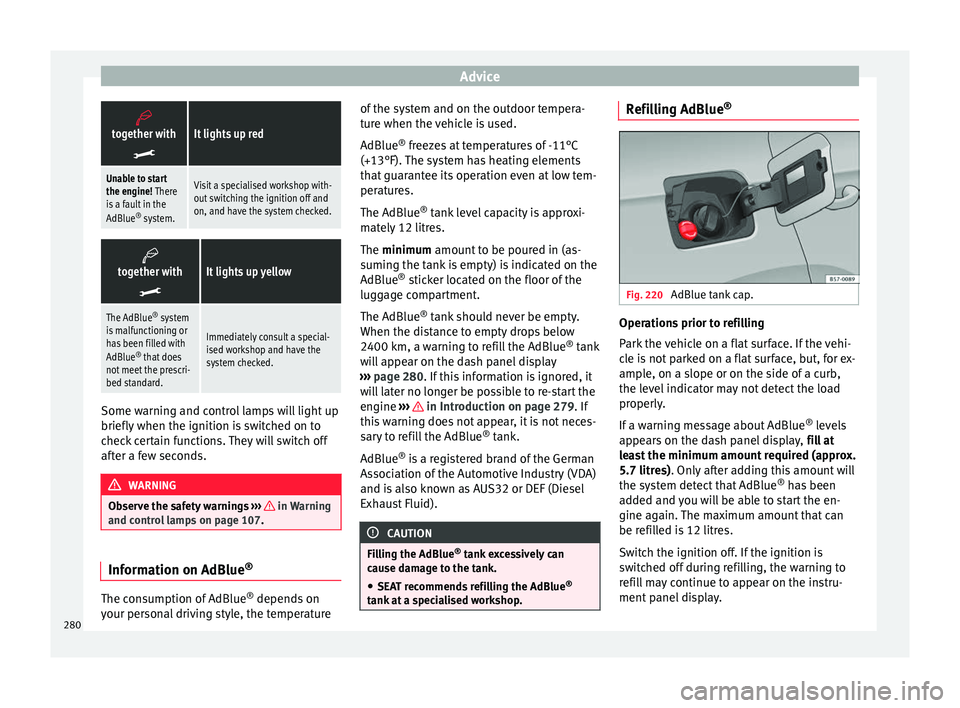
together with
It lights up red
Unable to start
the engine! There
is a fault in the
AdBlue ®
system.Visit a specialised workshop with-
out switching the ignition off and
on, and have the system checked.
together with
It lights up yellow
The AdBlue
®
system
is malfunctioning or
has been filled with
AdBlue ®
that does
not meet the prescri-
bed standard.
Immediately consult a special-
ised workshop and have the
system checked. Some warning and control lamps will light up
briefly
when the ignition i
s switched on to
check certain functions. They will switch off
after a few seconds. WARNING
Observe the safety warnings ››
› in Warning
and c ontr
ol lamps on page 107. Information on AdBlue
®The consumption of AdBlue
®
depend s
on
your personal driving style, the temperature of the system and on the outdoor tempera-
tur
e when the vehicle is used.
AdBlue ®
freezes at temperatures of -11°C
(+13°F). The system has heating elements
that guarantee its operation even at low tem-
peratures.
The AdBlue ®
tank level capacity is approxi-
mately 12 litres.
The minimum amount to be poured in (as-
suming the tank is empty) is indicated on the
AdBlue ®
sticker located on the floor of the
luggage compartment.
The AdBlue ®
tank should never be empty.
When the distance to empty drops below
2400 km, a warning to refill the AdBlue ®
tank
will appear on the dash panel display
››› page 280. If this information is ignored, it
will later no longer be possible to re-start the
engine ››› in Introduction on page 279. If
thi s
warning does not appear, it is not neces-
sary to refill the AdBlue ®
tank.
AdBlue ®
is a registered brand of the German
Association of the Automotive Industry (VDA)
and is also known as AUS32 or DEF (Diesel
Exhaust Fluid). CAUTION
Filling the AdBlue ®
tank
excessively can
cause damage to the tank.
● SEAT recommends refilling the AdBlue ®
tank
at a specialised workshop. Refilling AdBlue
® Fig. 220
AdBlue tank cap. Operations prior to refilling
P
ark
the vehicle on a flat surface. If the vehi-
cle is not parked on a flat surface, but, for ex-
ample, on a slope or on the side of a curb,
the level indicator may not detect the load
properly.
If a warning message about AdBlue ®
levels
appears on the dash panel display, fill at
least the minimum amount required (approx.
5.7 litres). Only after adding this amount will
the system detect that AdBlue ®
has been
added and you will be able to start the en-
gine again. The maximum amount that can
be refilled is 12 litres.
Switch the ignition off. If the ignition is
switched off during refilling, the warning to
refill may continue to appear on the instru-
ment panel display.
280
Page 283 of 328
Checking and refilling levels
Opening the tank filling neck
● Open the fuel tank flap.
● Unscrew the tank cap by turning it in an an-
ti-c loc
kwise direction.
Fill with a refill bottle
Only use AdBlue ®
that complies with ISO
22241-1. Only use original containers.
● Please observe the manufacturer's instruc-
tions, indic
ated on the refill bottle.
● Check the expiry date.
● Remove the cap of the refill bottle.
● Insert the neck of the bottle in the tank fill-
er neck
vertically and screw the bottle on by
hand, by turning it in a clockwise direction.
● Press the refill bottle in the direction of the
fil
ler neck and hold it in this position.
● Wait until the contents of the refill bottle
hav
e been poured into the AdBlue ®
tank. Do
not compress or break the bottle!
● Turn the bottle in a counter-clockwise direc-
tion and gently
pull it upwards ››› .
● The AdBlue ®
tank
is full when no more liq-
uid comes out of the bottle.
Closing the tank filling neck
● Screw on the tank cap in a clockwise direc-
tion unti
l it is tightly closed.
● Close the fuel tank flap. Operations before driving
●
After refilling the tank, only
switch on the
ignition.
● Leave the ignition on for at least 30 sec-
onds
for the system to detect the fluid load.
● Make sure you wait for at least 30 seconds
befor
e starting the engine! WARNING
AdBlue ®
shou l
d only be stored in the original
container, which should be tightly closed and
kept in a safe place.
● Never keep AdBlue ®
in empty f
ood contain-
ers, bottles or other similar containers. Other
people may confuse it for other products.
● Keep AdBlue ®
out of
the reach of children. CAUTION
● On ly
use AdBlue ®
that complies with ISO
22241-1. Only use original containers.
● Never mix AdBlue ®
with w
ater, fuel or addi-
tives. Any type of damage caused by such a
mixture will not be covered by the warranty.
● Never pour AdBlue ®
into the f
uel tank. This
could result in engine damage.
● Do not carry the refill bottle inside the vehi-
cl
e. If there is a leak (due to temperature
changes or damage to the bottle), the
AdBlue ®
may damage the vehicle. For the sake of the environment
Dispose of the refill bottle in an environment-
friendly m
anner. Note
You can buy refill bottles that are adequate
f or AdBlue ®
u
se at SEAT dealerships. 281
Technical data
Advice
Operation
Emergencies
Safety
Page 285 of 328
Checking and refilling levels
WARNING
● Sw it
ch the engine off, remove the key from
the ignition and apply the hand brake. If the
vehicle has a manual gearbox, place the lever
in neutral; if it has an automatic gearbox,
place the selector lever in position P. Wait for
the engine to cool down.
● Keep children away from the engine com-
par
tment.
● Never spill liquids used for vehicle opera-
tion on the engine c
ompartment, as these
may catch fire (e.g. the antifreeze in coolant).
● Take care not to cause short circuits in the
electric
al system, especially when working
on the battery.
● If working inside the engine compartment,
remember th
at, even when the ignition is
switched off, the radiator fan may start up au-
tomatically, and therefore there is a risk of in-
jury.
● Never cover the engine with additional in-
su
lating materials such as a blanket. Risk of
fire!
● Do not unscrew the cap on the coolant ex-
pan
sion tank when the engine is hot. The
cooling system is under pressure.
● Protect face, hands and arms by covering
the cap w
ith a large, thick rag to protect
against escaping coolant and steam.
● If it is necessary to work in the engine com-
par
tment while the engine is running, the ro-
tating components (for example, poly-V belt, alternator, radiator fan) and the high voltage
ignition sy
s
tem are an additional hazard.
● Observe the following additional warnings
if w
ork on the fuel system or the electrical
system is necessary:
– Always disconnect the battery from the
on-board network.
– Do not smoke.
– Never work near naked flames.
– Always keep an approved fire extinguish-
er immediately available. CAUTION
When topping up fluids make sure the correct
fluid i s
put into the correct filler opening, oth-
erwise this can cause serious malfunctions or
engine damage. For the sake of the environment
Inspect the ground underneath your vehicle
r e
gularly so that any leaks are detected at an
early stage. If you find spots of oil or other
fluids in the area where it was parked, have
your vehicle inspected at the workshop. Note
In right-hand drive vehicles* some brake flu-
id r e
servoirs are on the other side of the en-
gine compartment ››› Fig. 221. Opening the bonnet
Read the additional information carefully
› ›
› page 11
The bonnet is released from inside the vehi-
cle.
Check that the windscreen wiper arms are
not unfolded. Otherwise the paint may be
damaged.
The bonnet can only be unlocked when the
driver door is open. WARNING
Never open the bonnet if you see steam or
drip s
of coolant being released from the en-
gine compartment. Failure to comply could
result in burns. Wait until no steam or coolant
can be seen before opening the bonnet. Closing the bonnet
–
Slightly lift the bonnet.
– Release the bonnet stay before pressing it
bac
k into its support.
– Carefully close the bonnet.
– Press the bonnet down until it locks into
pl
ace.
– Make sure that the bonnet catches onto its
cl
asp. Do not press down too hard ››› .
»
283
Technical data
Advice
Operation
Emergencies
Safety