brake sensor Seat Ateca 2017 User Guide
[x] Cancel search | Manufacturer: SEAT, Model Year: 2017, Model line: Ateca, Model: Seat Ateca 2017Pages: 328, PDF Size: 6.36 MB
Page 214 of 328
Operation
●
Ad apt
your speed and safe distance to the
vehicle in front of you at all times to suit visi-
bility, weather, road and traffic conditions.
● The City Emergency braking function alone
cannot
prevent accidents or serious injury.
● In complex driving situations, the City
Emerg
ency braking function may issue unnec-
essary warnings and intervene inopportunely
in braking, such as in work areas or if there
are metal rails.
● If the operation of the City Emergency brak-
ing f
unction is impaired, for example, by dirt
or because the radar sensor has lost its set-
tings, the system may issue unnecessary
warnings and intervene inopportunely in the
braking.
● The City emergency braking function only
re
acts to people if the vehicle has a pedes-
trian-monitoring system. The system does
not react to animals or vehicles crossing your
path or approaching head-on in the same
lane. Note
● When the C ity
Emergency braking function
causes a braking, the brake pedal is “hard-
er”.
● Automatic interventions on the brakes by
the City
Emergency braking function may be interrupted by pressing the clutch, accelera-
t
or or mo
ving the wheel.
● The City Emergency braking function can
brak
e the vehicle until it stops completely.
However, the brake system does not halt the
vehicle permanently. Use the foot brake!
● If several inopportune intervenes occur,
swit
ch off the Front Assist and with it the City
Emergency braking function. Take it to a spe-
cialised workshop, SEAT recommends visiting
a SEAT dealership.
● If numerous unnecessary interventions oc-
cur
, the City Emergency braking function may
switch off automatically. Pedestrian Monitoring*
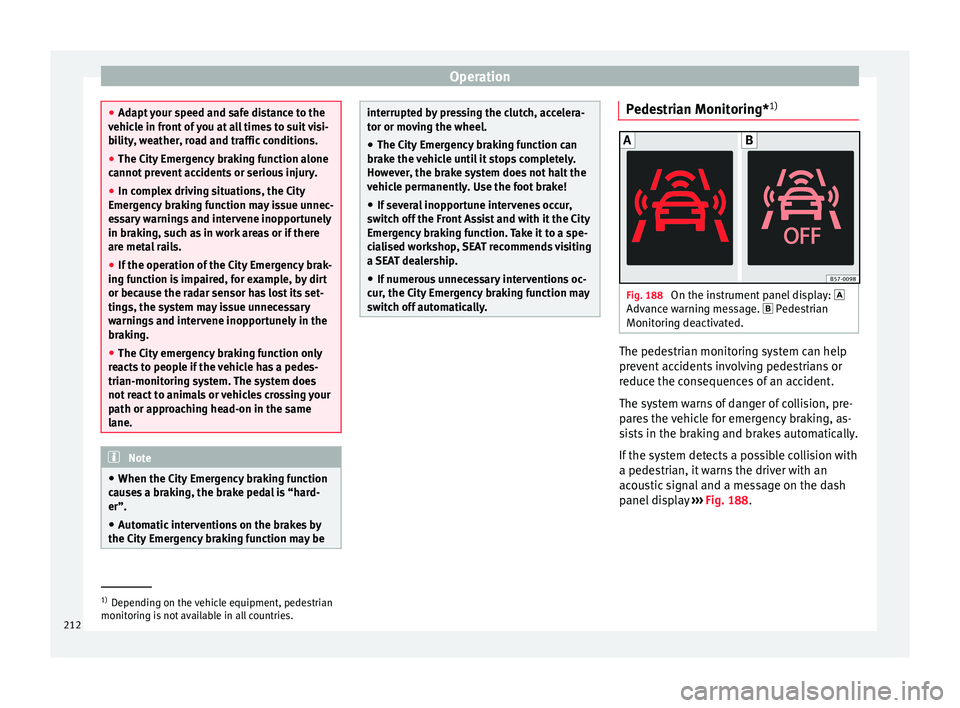
1) Fig. 188
On the instrument panel display:
Adv anc
e warning message. Pedestrian
Monitoring deactivated. The pedestrian monitoring system can help
pr
ev
ent accidents involving pedestrians or
reduce the consequences of an accident.
The system warns of danger of collision, pre-
pares the vehicle for emergency braking, as-
sists in the braking and brakes automatically.
If the system detects a possible collision with
a pedestrian, it warns the driver with an
acoustic signal and a message on the dash
panel display ››› Fig. 188. 1)
Depending on the vehicle equipment, pedestrian
monit orin
g is not available in all countries.
212
Page 215 of 328
Driver assistance systems
The pedestrian monitoring system, including
the a dv
ance warning, is automatically con-
nected when the ignition is switched on
››› page 165.
SEAT recommends always having the pedes-
trian monitoring system connected. The ex-
ceptions set out for the Front Assist system
are equally valid for the pedestrian monitor-
ing system ››› page 210.
Switching the pedestrian monitoring system
on and off
With the ignition on, the pedestrian monitor-
ing system can be switched on and off as fol-
lows:
● Switch the system on and off in the info-
tainment
system using the button and
the Set
up and
Driv
er a
ssistance function but-
t on
s ›››
page 26.
When the pedestrian protection system is
switched off, the dash panel display shows a
message indicating this ››› Fig. 188 . The
pedestrian monitoring system is switched off
with the Front Assist function. WARNING
The technology in the pedestrian monitoring
sy s
tem cannot defy the laws of physics and
only works within the system's limits. The
driver is always responsible for braking in
time. If the pedestrian monitoring system is- sues a warning, brake the vehicle immediate-
ly
w
ith the brake pedal or swerve to avoid the
pedestrian, depending on traffic conditions.
● The pedestrian monitoring system alone
cannot
avoid accidents or serious injury.
● In complex driving situations, the pedes-
trian monit
oring system may issue unneces-
sary warnings and intervene unnecessarily in
braking, such as in main roads with turnings.
● If the operation of the system is impaired,
for e
xample, because the radar sensor and
camera are covered or have lost their set-
tings, the system may issue unnecessary
warnings and intervene inopportunely in the
braking.
● The driver must always be ready to take
ov
er the control of the vehicle. Note
● When the v
ehicle is braked via the pedes-
trian monitoring system, the brake pedal be-
comes stiffer.
● Automatic interventions by the pedestrian
monitorin
g system on the brakes may be in-
terrupted by pressing the accelerator or mov-
ing the wheel.
● If the pedestrian monitoring system does
not w
ork as described in this chapter (e.g. if
it intervening unnecessarily several times),
switch if off, contact a specialist workshop
immediately and request to have the system
checked. SEAT recommends visiting a SEAT
dealership for this. Lane Assist system*
Intr oduction WARNING
The intelligent technology in the Lane Assist
sy s
tem cannot change the limits imposed by
the laws of physics and by the very nature of
the system. Careless or uncontrolled use of
the Lane Assist system may cause accidents
and injury. The system is not a replacement
for driver awareness.
● Always adapt your speed and the distance
to the
vehicles ahead in line with visibility,
weather conditions, the condition of the road
and the traffic situation.
● Always keep your hands on the steering
wheel so it
can be turned at any time.
● The Lane Assist system does not detect all
ro
ad markings. The road surfaces, road struc-
tures or objects in poor condition can be in-
correctly detected as road markings under
certain circumstances by the Lane Assist sys-
tem. In such situations, switch the Lane As-
sist system off immediately.
● Please observe the indications on the in-
strument
panel and act as is necessary.
● Always pay attention to the vehicle's sur-
rou
ndings.
● When the area of vision of the camera be-
come
s dirty, covered or is damaged, the Lane
Assist system function can be affected. » 213
Technical data
Advice
Operation
Emergencies
Safety
Page 221 of 328
Driver assistance systems
visibility, weather, road and traffic
c
ondition
s.
● Keep your hands on the wheel at all times
to be r
eady to intervene in the steering at any
time.
● The Emergency Assist alone cannot always
avoid ac
cidents or serious injuries.
● If the operation of the Emergency Assist is
impair
ed, for example if the radar sensor of
the adaptive cruise control (ACC) or the Lane
Assist camera are covered or have lost their
settings, the system may intervene inoppor-
tunely in braking or in steering.
● The Emergency Assist does not react to
peopl
e or animal or vehicles crossing your
path or which approach you head-on in the
same lane. WARNING
If the Emergency Assist Intervenes inoppor-
t u
nely, serious accidents and injuries may oc-
cur.
● If the Emergency Assist does not operate
properly
, switch off the Lane Assist
››› page 213. Doing so will also switch off the
Emergency Assist.
● Have the system checked by a specialised
work
shop. SEAT recommends visiting a SEAT
dealership for this. Note
● Aut om
atic interventions by the Emergency
Assist on the brakes may be interrupted by
pressing the accelerator or brake or by mov-
ing the wheel.
● Hazard warning lights that come on auto-
matic
ally can be switched off by pressing the
accelerator or the break, moving the steering
wheel or pressing the hazard warning light
switch.
● If this occurs, the Emergency Assist may
decel
erate the vehicle until it comes to a com-
plete stop.
● When the Emergency Assist is activated, it
is
only available again after the ignition has
been switched off and back on again. 219
Technical data
Advice
Operation
Emergencies
Safety
Page 226 of 328
Operation
● in the c a
se of special constructions to the
side of the vehicle, e.g., high or irregular di-
viders.
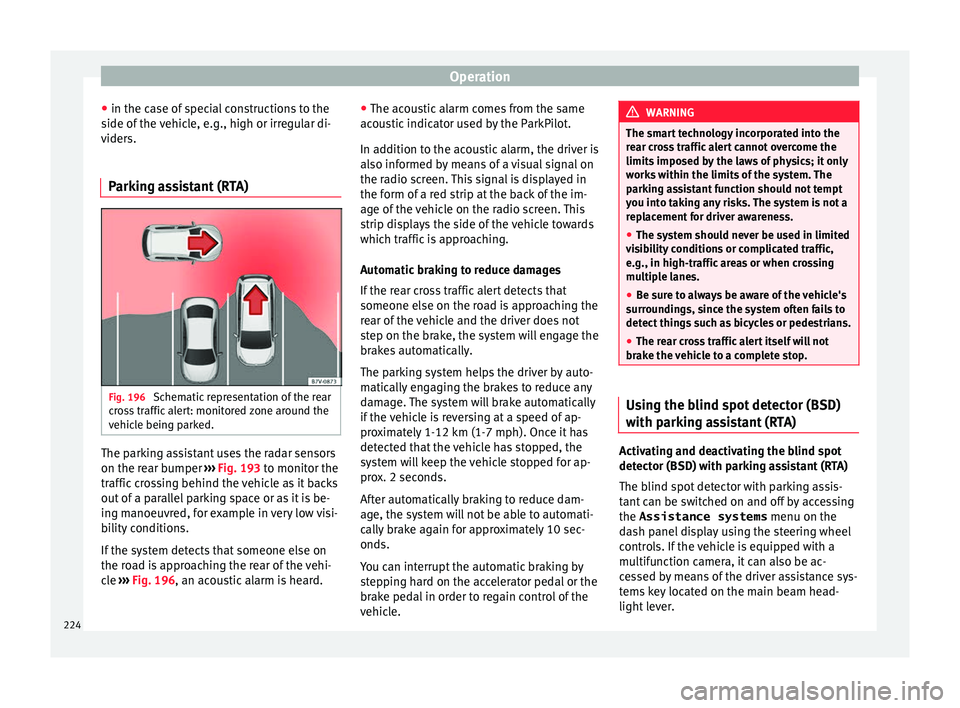
Parking assistant (RTA) Fig. 196
Schematic representation of the rear
c r
oss traffic alert: monitored zone around the
vehicle being parked. The parking assistant uses the radar sensors
on the r
e
ar bumper ››› Fig. 193 to monitor the
traffic crossing behind the vehicle as it backs
out of a parallel parking space or as it is be-
ing manoeuvred, for example in very low visi-
bility conditions.
If the system detects that someone else on
the road is approaching the rear of the vehi-
cle ››› Fig. 196, an acoustic alarm is heard. ●
The acou
stic alarm comes from the same
acoustic indicator used by the ParkPilot.
In addition to the acoustic alarm, the driver is
also informed by means of a visual signal on
the radio screen. This signal is displayed in
the form of a red strip at the back of the im-
age of the vehicle on the radio screen. This
strip displays the side of the vehicle towards
which traffic is approaching.
Automatic braking to reduce damages
If the rear cross traffic alert detects that
someone else on the road is approaching the
rear of the vehicle and the driver does not
step on the brake, the system will engage the
brakes automatically.
The parking system helps the driver by auto-
matically engaging the brakes to reduce any
damage. The system will brake automatically
if the vehicle is reversing at a speed of ap-
proximately 1-12 km (1-7 mph). Once it has
detected that the vehicle has stopped, the
system will keep the vehicle stopped for ap-
prox. 2 seconds.
After automatically braking to reduce dam-
age, the system will not be able to automati-
cally brake again for approximately 10 sec-
onds.
You can interrupt the automatic braking by
stepping hard on the accelerator pedal or the
brake pedal in order to regain control of the
vehicle. WARNING
The smart technology incorporated into the
r e
ar cross traffic alert cannot overcome the
limits imposed by the laws of physics; it only
works within the limits of the system. The
parking assistant function should not tempt
you into taking any risks. The system is not a
replacement for driver awareness.
● The system should never be used in limited
vi
sibility conditions or complicated traffic,
e.g., in high-traffic areas or when crossing
multiple lanes.
● Be sure to always be aware of the vehicle's
surr
oundings, since the system often fails to
detect things such as bicycles or pedestrians.
● The rear cross traffic alert itself will not
brak
e the vehicle to a complete stop. Using the blind spot detector (BSD)
w
ith p
arking assistant (RTA) Activating and deactivating the blind spot
det
ect
or (BSD) with parking assistant (RTA)
The blind spot detector with parking assis-
tant can be switched on and off by accessing
the Assistance systems menu on the
dash panel display using the steering wheel
controls. If the vehicle is equipped with a
multifunction camera, it can also be ac-
cessed by means of the driver assistance sys-
tems key located on the main beam head-
light lever.
224
Page 241 of 328
Driver assistance systems
Automatic braking intervention by
P ark
Assist Park Assist helps the driver by automatically
br
ak
ing in certain situations.
The driver is always responsible for braking
in time ››› .
Aut om
atic braking intervention to avoid ex-
ceeding the speed limit
To avoid exceeding the speed limit of approx-
imately 7 km/h (4 mph) when entering or
leaving a parking space, the brakes may acti-
vate automatically. After automatically acti-
vating the brakes, the manoeuvres to enter or
exit a parking space may continue.
The brakes are only automatically activated
once for each attempt to enter or exit a park-
ing space. If the speed of approximately
7 km/h (4 mph) is exceeded again, the corre-
sponding operation is halted.
Automatic braking to reduce damages
Depending on certain conditions, the Park
Assist system can automatically brake the ve-
hicle when faced with an obstacle, briefly ac-
tioning and holding down the brake ped-
al ››› . Following this the driver must press
the br ak
e pedal.
Automatic braking intervention to reduce
damage leads to the parking manoeuvre fin-
ishing. WARNING
The automatic braking intervention by Park
As s
ist should never tempt you to take any
risk that may compromise safety. The system
is not a replacement for driver awareness.
● The Park Assist system is subject to certain
limitation
s inherent to the system. In certain
situations, the automatic braking interven-
tion may only work in a limited way or not
work at all.
● Always be ready to use the brakes yourself!
● The automatic braking intervention will end
aft
er approximately 1.5 seconds. Following
this, brake the vehicle yourself. Parking System Plus (ParkPi-
lot)*
D e
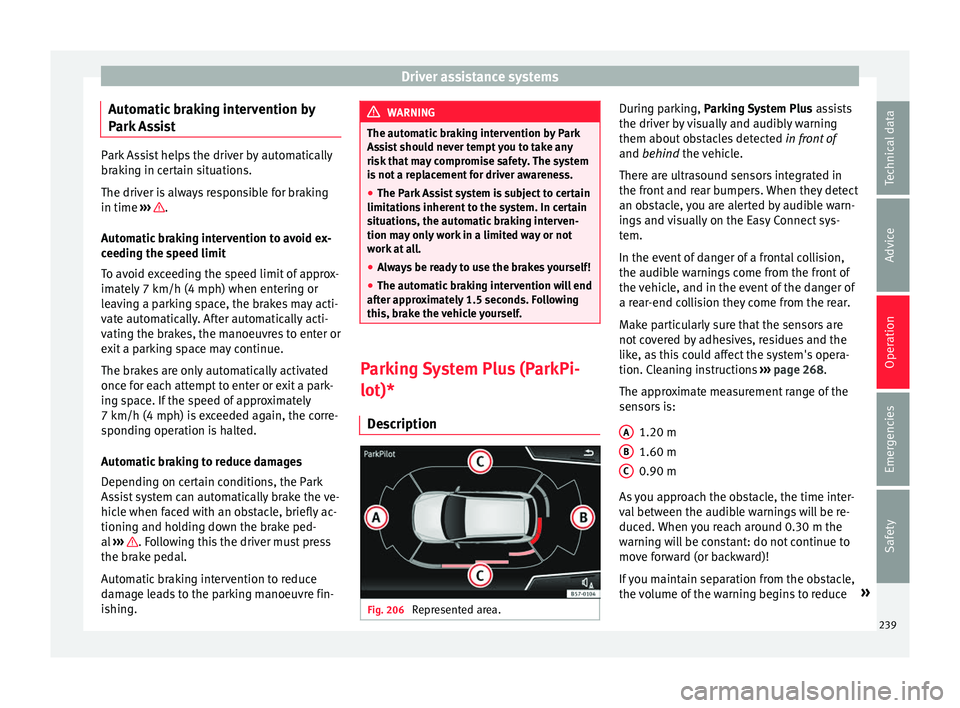
scription Fig. 206
Represented area. During parking, P
ark
ing System Plus assists
the driver by visually and audibly warning
them about obstacles detected in front of
and behind the vehicle.
There are ultrasound sensors integrated in
the front and rear bumpers. When they detect
an obstacle, you are alerted by audible warn-
ings and visually on the Easy Connect sys-
tem.
In the event of danger of a frontal collision,
the audible warnings come from the front of
the vehicle, and in the event of the danger of
a rear-end collision they come from the rear.
Make particularly sure that the sensors are
not covered by adhesives, residues and the
like, as this could affect the system's opera-
tion. Cleaning instructions ››› page 268.
The approximate measurement range of the
sensors is:
1.20 m
1.60 m
0.90 m
As you approach the obstacle, the time inter-
val between the audible warnings will be re-
duced. When you reach around 0.30 m the
warning will be constant: do not continue to
move forward (or backward)!
If you maintain separation from the obstacle,
the volume of the warning begins to reduce »
A B
C
239
Technical data
Advice
Operation
Emergencies
Safety
Page 258 of 328
Operation
into account the speed limit for vehicles with
tr
ai
lers in the corresponding country, as it
could be less than the speed limit for vehi-
cles without a trailer.
● Never attempt to “straighten” the towing
vehic
le and trailer while accelerating. WARNING
If the towing bracket has been retrofitted by a
non- S
EAT workshop, the Start-Stop system
must be disconnected manually whenever
driving with a trailer. Otherwise the brake
system could be damaged and could conse-
quently cause a serious accident or injury.
● Always disconnect the Start-Stop system
manua
lly when using a towing bracket that
has not been fitted by a SEAT workshop. Note
● Bef
ore hitching or unhitching a trailer, al-
ways deactivate the anti-theft alarm
››› page 112. Otherwise, the tilt sensor could
cause the alarm to go off.
● Do not drive with a trailer for the engine's
firs
t 1000 km ››› page 184.
● SEAT recommends that, if possible, the tow
hitc
h be disassembled or covered when it is
not going to be used. In the event of a rear-
end collision, the damage to the vehicle
could be greater if the bracket is fitted.
● Some retrofitted towing brackets cover the
re
ar towing eye. In these cases, the towing eye should not be used for tow-starting or for
t
o
wing other vehicles. For this reason, if the
vehicle has been retrofitted with a towing
bracket, always keep the tow hitch in the ve-
hicle when you disassemble it. Control lamp
The tow hitch is not securely locked in
position.
Check that the towing bracket is locked
››› page 257. Some warning and control lamps will light up
briefly
when the ignition i
s switched on to
check certain functions. They will switch off
after a few seconds. WARNING
If the warning lamps and the corresponding
me s
sages are ignored when they light up, the
vehicle may stall in traffic and cause acci-
dents and severe injuries.
● Never ignore the warning lamps or messag-
es.
● St
op the vehicle at the next opportunity
and in a saf
e place. CAUTION
Failure to heed the control lamps and corre-
s pondin
g text messages when they light up
may result in damage to the vehicle. Technical requirements
Vehicles that are
fact
ory-equipped with a
towing bracket fulfil all the technical and le-
gal requirements for driving with a trailer.
If the vehicle is retrofitted with a towing
bracket, only a bracket that is authorised for
the maximum authorised load of the trailer
that is to be towed may be fitted. The towing
bracket must be suitable for the vehicle and
the trailer and must be properly secured to
the vehicle's chassis. Only use a towing
bracket that has been authorised by SEAT for
this vehicle. Always check and take into ac-
count the towing bracket manufacturer's in-
structions. Never fit a towing bracket “with
weight distribution” or “load compensation”.
Towing bracket fitted on the bumper
Never fit a towing bracket to the bumper or to
the area where the bumper is mounted. The
towing bracket should not impair the bum-
per's function. Do not make modifications or
repairs to the exhaust system or the brake
system. Make regular checks to ensure that
the towing bracket is secure.
Engine cooling system
Driving with a trailer increases the load on
the engine and cooling system. The cooling
system should have sufficient coolant and be
prepared for the additional effort involved in
driving with a trailer.
256
Page 269 of 328
Care and maintenance
Automatic car washes
B ef
ore going through a car wash, be sure to
take the usual precautions such as closing
the windows and roof. If the vehicle has spe-
cial accessories such as spoilers or a roof
rack or two-way radio aerial, etc., it is advisa-
ble to consult the car wash tunnel operator.
It is best to use a car wash without revolving
bristles if possible.
Washing the vehicle with a high pressure
cleaner
When washing the vehicle with a high-pres-
sure cleaner, always follow the operating in-
structions for the equipment. This applies
particularly to the operating pressure and the
spraying distance. Do not hold the nozzle too
close to soft materials such as rubber hoses
or seals. The same applies to the parking aid
sensors*, which are located in the rear bump-
er.
Do not use a nozzle that sprays the water out
in a direct stream or one that has a rotating
jet for forcing off dirt.
Washing the car by hand
When washing the car by hand, use plenty of
water to soften the dirt first, and rinse off as
well as possible.
Then clean the vehicle with a soft sponge,
glove or brush using only slight pressure.
You should start on the roof and work down. Special car
soap should only be used for very
persistent dirt.
Rinse the sponge or glove thoroughly and of-
ten.
Wheels, sills and similar should be cleaned
last. Use a second sponge for this. WARNING
● The v
ehicle should only be washed with the
ignition switched off. Failure to follow this in-
struction could result in an accident.
● Do not clean the underside of chassis, the
ins
ide of wheel arches or wheel trims without
protecting your hands and arms. You may cut
yourself on sharp-edged metal parts. Other-
wise, there is a risk of sustaining cuts.
● When washing the car during the winter
sea
son: water and ice in the brake system
can reduce braking effectiveness: risk of acci-
dent! CAUTION
● Do not w
ash the vehicle in direct sunlight –
otherwise the paint can be damaged.
● Do not use sponges, abrasive household
spon
ges or similar to clean insect remains.
This could damage the surface.
● Clean off stubborn dirt (insects, etc.) from
the hea
dlights at regular intervals, for in-
stance when filling the fuel tank. The head-
lights should only be washed with water, do not wipe them with a dry cloth or sponge. It
i
s
best to use soapy water.
● Never wash tyres with a jet that sprays the
wat
er out in a direct stream. This could dam-
age the tyres even if the spray is kept at a
distance and only used for a very short time.
● Before washing the vehicle in an automatic
car w
ash, please make sure to retract the ex-
terior mirrors to prevent them from being
damaged. Electrically retractable exterior
mirrors must not be folded in or out by hand,
always use the electrical power control. CAUTION
● Bef
ore washing the vehicle in an automatic
car wash, please proceed as follows to lock
the wiper arms so that they are not moved to-
wards the top of the windscreen:
–the bonnet must be closed.
– switch the ignition on and off.
– press the windscreen wiper lever forward
briefly (windscreen washer function).
This will lock the wiper arms. For the sake of the environment
The car should only be washed in special
w a
sh bays. These areas are prepared to pre-
vent oily water from getting into the public
drains. In some places, washing vehicles out-
side the areas intended for this purpose is
prohibited. 267
Technical data
Advice
Operation
Emergencies
Safety
Page 311 of 328
Index
Index
A
ABS se
e Anti-lock brake system . . . . . . . . . . . . . . . 173
ACC . . . . . . . . . . . . . . . . . . . . . . . . . . . . . . . . . . . . 197 radar sensor . . . . . . . . . . . . . . . . . . . . . . . . . . . 200
Accessories . . . . . . . . . . . . . . . . . . . . . . . . . 148, 265
Adaptive cruise control . . . . . . . . . . . . . . . . . . . . 197 indications on the display . . . . . . . . . . . . . . . . 199
malfunction . . . . . . . . . . . . . . . . . . . . . . . . . . . . 198
radar sensor . . . . . . . . . . . . . . . . . . . . . . . . . . . 200
special driving situations . . . . . . . . . . . . . . . . . 205
warning and control lamp . . . . . . . . . . . . . . . . 199
Adaptive Cruise Control deactivating temporarily . . . . . . . . . . . . . . . . . 205
operating . . . . . . . . . . . . . . . . . . . . . . . . . . . . . . 201
AdBlue control lamp . . . . . . . . . . . . . . . . . . . . . . . . . . . 279
information . . . . . . . . . . . . . . . . . . . . . . . 279, 280
maximum filling capacity . . . . . . . . . . . . . . . . . 280
refilling . . . . . . . . . . . . . . . . . . . . . . . . . . . . . . . 280
specification . . . . . . . . . . . . . . . . . . . . . . . . . . . 280
tank capacity . . . . . . . . . . . . . . . . . . . . . . 279, 280
warning lamp . . . . . . . . . . . . . . . . . . . . . . . . . . 279
additional electrical appliances (efficiency pro- gramme) . . . . . . . . . . . . . . . . . . . . . . . . . . . . . . . 34
Adjusting front head restraints . . . . . . . . . . . . . . . . . . . . . . 66
front seats . . . . . . . . . . . . . . . . . . . . . . . . . . . . . 143
Adjusting the head restraints front head restraints . . . . . . . . . . . . . . . . . . . . . 143
Adjustment CAR menu . . . . . . . . . . . . . . . . . . . . . . . . . . . . . 108
front head restraints . . . . . . . . . . . . . . . . . . . . . 143 lights . . . . . . . . . . . . . . . . . . . . . . . . . . . . . . . . . 137
re
ar head restraints . . . . . . . . . . . . . . . . . 66, 143
seats . . . . . . . . . . . . . . . . . . . . . . . . . . . . . . . . . . 63
Airbag covers . . . . . . . . . . . . . . . . . . . . . . . . . . . . . 15
Airbags . . . . . . . . . . . . . . . . . . . . . . . . . . . . . . . . . . 73 description . . . . . . . . . . . . . . . . . . . . . . . . . . . . . 74
Airbag system . . . . . . . . . . . . . . . . . . . . . . . . . . 15, 73 activation . . . . . . . . . . . . . . . . . . . . . . . . . . . . . . 74
deactivation of front airbag . . . . . . . . . . . . . . . . 77
description . . . . . . . . . . . . . . . . . . . . . . . . . . . . . 74
front airbags . . . . . . . . . . . . . . . . . . . . . . . . . 15, 75
functioning . . . . . . . . . . . . . . . . . . . . . . . . . . . . . 74
head-protection airbags . . . . . . . . . . . . . . . . . . 17
Knee airbag . . . . . . . . . . . . . . . . . . . . . . . . . . . . . 16
side airbags . . . . . . . . . . . . . . . . . . . . . . . . . . . . 16
Air conditioning Climatronic . . . . . . . . . . . . . . . . . . . . . . . . 42, 156
heating and fresh air . . . . . . . . . . . . . . . . . . . . . 46
manual air conditioning . . . . . . . . . . . . . . . . . . . 44
User instructions . . . . . . . . . . . . . . . . . . . . . . . 158
Air conditioning system auxiliary heater . . . . . . . . . . . . . . . . . . . . . . . . . 161
Air outlets . . . . . . . . . . . . . . . . . . . . . . . . . . . . . . . 159
Air recirculation . . . . . . . . . . . . . . . . . . . . . . . . . . 160
Alcantara: cleaning . . . . . . . . . . . . . . . . . . . . . . . 272
Ambient lighting . . . . . . . . . . . . . . . . . . . . . . . . . 138
Anti-freeze . . . . . . . . . . . . . . . . . . . . . . . . . . . . . . . 49
Anti-lock brake system . . . . . . . . . . . . . . . . . . . . . 173
Anti-puncture . . . . . . . . . . . . . . . . . . . . . . . . . . 53, 83
Anti-puncture kit . . . . . . . . . . . . . . . . . . . . . . . . 53, 83 Check after 10 minutes . . . . . . . . . . . . . . . . . . . 85
Anti-puncture set . . . . . . . . . . . . . . . . . . . . . . . . . . 83
Anti-slip regulation . . . . . . . . . . . . . . . . . . . . . . . 173
Anti-theft alarm . . . . . . . . . . . . . . . . . . . . . 112, 121 trailer . . . . . . . . . . . . . . . . . . . . . . . . . . . . . . . . . 260
vehicle interior monitoring and anti-tow sys-tem . . . . . . . . . . . . . . . . . . . . . . . . . . . . . . . . . 123
Anti-theft security system . . . . . . . . . . . 9, 112, 119 Anti-theft system
trai ler . . . . . . . . . . . . . . . . . . . . . . . . . . . . . . . . . 260
Anti-tow protection . . . . . . . . . . . . . . . . . . . . . . . 123
Anti-trap function sun blind (sunroof) . . . . . . . . . . . . . . . . . . . . . . 130
sunroof . . . . . . . . . . . . . . . . . . . . . . . . . . . . . . . 130
Area View . . . . . . . . . . . . . . . . . . . . . . . . . . . . . . . 247 see area View . . . . . . . . . . . . . . . . . . . . . . . . . . 247
Area View system instructions for use . . . . . . . . . . . . . . . . . . . . . 249
menus . . . . . . . . . . . . . . . . . . . . . . . . . . . . . . . . 250
modes . . . . . . . . . . . . . . . . . . . . . . . . . . . . . . . . 250
screen . . . . . . . . . . . . . . . . . . . . . . . . . . . . . . . . 249
Special characteristics . . . . . . . . . . . . . . . . . . . 249
Aspects to take into account before starting the vehicle . . . . . . . . . . . . . . . . . . . . . . . . . . . . . . . . . 62
Assistance systems ACC . . . . . . . . . . . . . . . . . . . . . . . . . . . . . . . . . . 197
adaptive cruise control . . . . . . . . . . . . . . . . . . . 197
Area View . . . . . . . . . . . . . . . . . . . . . . . . . . . . . 247
Auto Hold function . . . . . . . . . . . . . . . . . . . . . . 191
blind spot detector (BSD) with parking assis-tance (RCTA) . . . . . . . . . . . . . . . . . . . . . . . . . 220
Cruise control system . . . . . . . . . . . . . . . . . . . . 193
Emergency Assist . . . . . . . . . . . . . . . . . . . . . . . 218
Front Assist . . . . . . . . . . . . . . . . . . . . . . . . . . . . 207
Hill Descent Control . . . . . . . . . . . . . . . . . . . . . 190
parking assistance (RCTA) . . . . . . . . . . . . . . . . 220
Pedestrian Monitoring system . . . . . . . . . . . . . 212
rear parking aid . . . . . . . . . . . . . . . . . . . . . . . . 244
Traffic Jam Assist . . . . . . . . . . . . . . . . . . . . . . . . 216
traffic sign detection system . . . . . . . . . . . . . . 228
tyre monitoring . . . . . . . . . . . . . . . . . . . . . . . . . 296
tyre monitoring indicator . . . . . . . . . . . . . . . . . 297
Assistance Systems fatigue detection . . . . . . . . . . . . . . . . . . . . . . . 231
tyre monitoring systems . . . . . . . . . . . . . . . . . 295
Assisted starting . . . . . . . . . . . . . . . . . . . . . . . . . . 58 309
Page 315 of 328
Index
closing the bonnet . . . . . . . . . . . . . . . . . . . . . . 283
c oo
lant . . . . . . . . . . . . . . . . . . . . . . . . . . . 49, 286
engine oil . . . . . . . . . . . . . . . . . . . . . . . . . 48, 285
opening the bonnet . . . . . . . . . . . . . . . . . . . . . 283
safety notes . . . . . . . . . . . . . . . . . . . . . . . . . . . 282
windscreen washer reservoir . . . . . . . . . . . . . . 288
Windscreen washer reservoir . . . . . . . . . . . . . . . 50
Engine coolant . . . . . . . . . . . . . . . . . . . . . . . . . . . . 49 G 12 plus-plus . . . . . . . . . . . . . . . . . . . . . . . . . . 49
G 13 . . . . . . . . . . . . . . . . . . . . . . . . . . . . . . . . . . . 49
specifications . . . . . . . . . . . . . . . . . . . . . . . . . . . 49
Engine data . . . . . . . . . . . . . . . . . . . . . . . . . . . . . . 304
Engine fault control lamp . . . . . . . . . . . . . . . . . . . . . . . . . . . 187
Engine management . . . . . . . . . . . . . . . . . . . . . . 186 control lamp . . . . . . . . . . . . . . . . . . . . . . . . . . . 187
Engine oil . . . . . . . . . . . . . . . . . . . . . . . . . . . 48, 284 changing . . . . . . . . . . . . . . . . . . . . . . . . . 284, 286
Checking oil level . . . . . . . . . . . . . . . . . . . . . . . 285
consumption . . . . . . . . . . . . . . . . . . . . . . . . . . . 285
dipstick . . . . . . . . . . . . . . . . . . . . . . . . . . . . . . . 285
inspection service . . . . . . . . . . . . . . . . . . . . . . 284
maintenance intervals . . . . . . . . . . . . . . . . . . . 284
Oil properties . . . . . . . . . . . . . . . . . . . . . . . . . . . 49
Specifications . . . . . . . . . . . . . . . . . . . . . . . . . . 284
temperature display . . . . . . . . . . . . . . . . . . . . . . 34
topping up . . . . . . . . . . . . . . . . . . . . . . . . . . . . 285
Environment ecological driving . . . . . . . . . . . . . . . . . . . . . . . 185
Environmental compatibility . . . . . . . . . . . . . . 184
Environmental tips Filling the tank . . . . . . . . . . . . . . . . . . . . . . . . . 277
refuelling . . . . . . . . . . . . . . . . . . . . . . . . . . . . . . 276
Equipment . . . . . . . . . . . . . . . . . . . . . . . . . 148, 265 ESC
electr onic stability control (ESC) . . . . . . . . . . . 173
multi-collision brake . . . . . . . . . . . . . . . . . . . . . 174
Sport Mode . . . . . . . . . . . . . . . . . . . . . . . . . . . . 175
Ethanol (fuel) . . . . . . . . . . . . . . . . . . . . . . . . . . . . 277
Exhaust gas purification system catalytic converter . . . . . . . . . . . . . . . . . . . . . . 186
diesel particulate filter . . . . . . . . . . . . . . . . . . . 186
Exhaust pipe: Cleaning . . . . . . . . . . . . . . . . . . . . 269
Exhaust purification system (diesel) . . . . . . . . . . 279
Exiting a parking space with Park Assist . . . . . . 238
Exterior lighting changing a bulb . . . . . . . . . . . . . . . . . . . . . . . . . 93
Exterior mirrors adjusting . . . . . . . . . . . . . . . . . . . . . . . . . . . . . . . 14
driving with a trailer . . . . . . . . . . . . . . . . . . . . . 257
Exterior rear view mirrors exterior . . . . . . . . . . . . . . . . . . . . . . . . . . . . . . . 141
heated . . . . . . . . . . . . . . . . . . . . . . . . . . . . . . . . 141
Exterior view . . . . . . . . . . . . . . . . . . . . . . . . . . . . . 5, 6
External aerial . . . . . . . . . . . . . . . . . . . . . . . . . . . . 265
F Fastening rings . . . . . . . . . . . . . . . . . . . . . . . . . . . 151
Fatigue detection . . . . . . . . . . . . . . . . . . . . . . . . . 231
Filling the tank . . . . . . . . . . . . . . . . . . . . . . . . . . . 276 fuel gauge . . . . . . . . . . . . . . . . . . . . . . . . . . . . . 106
Floor mats . . . . . . . . . . . . . . . . . . . . . . . . . . . . . . . . 67
Fluid Level control . . . . . . . . . . . . . . . . . . . . . . . . . 48
Fog light bulb . . . . . . . . . . . . . . . . . . . . . . . . . . . . . 95
Four-wheel drive snow chains . . . . . . . . . . . . . . . . . . . . . . . . . . . 274
towing . . . . . . . . . . . . . . . . . . . . . . . . . . . . . . . . . 87
winter tyres . . . . . . . . . . . . . . . . . . . . . . . . . . . . 274
Four wheel drive . . . . . . . . . . . . . . . . . . . . . . . . . . 273
Front airbags . . . . . . . . . . . . . . . . . . . . . . . . . . 15, 75
Front armrest . . . . . . . . . . . . . . . . . . . . . . . . . . . . 145 Front assist . . . . . . . . . . . . . . . . . . . . . . . . . . . . . . 173
Front
Assist . . . . . . . . . . . . . . . . . . . . . . . . . . . . . . 207
City Emergency braking function . . . . . . . . . . . 211
malfunction . . . . . . . . . . . . . . . . . . . . . . . . . . . . 208
on-screen messages . . . . . . . . . . . . . . . . . . . . 208
operating . . . . . . . . . . . . . . . . . . . . . . . . . . . . . . 209
radar sensor . . . . . . . . . . . . . . . . . . . . . . . . . . . 209
system limitations . . . . . . . . . . . . . . . . . . . . . . 210
temporarily switching off . . . . . . . . . . . . . . . . . 210
see also Front Assist system . . . . . . . . . . . . . . 207
Front Assist monitoring system malfunction . . . . . . . . . . . . . . . . . . . . . . . . . . . . 208
on-screen messages . . . . . . . . . . . . . . . . . . . . 208
Front Assist Monitoring system City Emergency braking function . . . . . . . . . . . 211
radar sensor . . . . . . . . . . . . . . . . . . . . . . . . . . . 209
Front Assist Monitoring System system limitations . . . . . . . . . . . . . . . . . . . . . . 210
Front Assist system temporarily switching off . . . . . . . . . . . . . . . . . 210
Front passenger front airbag control lamp . . . . . . . . . . . . . . . . . . . . . . . . . . . . 78
deactivation . . . . . . . . . . . . . . . . . . . . . . . . . 15, 78
Front seat manual adjustment . . . . . . . . . . . . . . . . . . . . . . 12
Fuel . . . . . . . . . . . . . . . . . . . . . . . . . . . . . . . . 48, 277 consumption . . . . . . . . . . . . . . . . . . . . . . . . . . . 302
diesel . . . . . . . . . . . . . . . . . . . . . . . . . . . . . . . . . 278
ethanol . . . . . . . . . . . . . . . . . . . . . . . . . . . . . . . 277
fuel gauge . . . . . . . . . . . . . . . . . . . . . . . . . . . . . 106
refuelling . . . . . . . . . . . . . . . . . . . . . . . . . . . . . . 277
saving . . . . . . . . . . . . . . . . . . . . . . . . . . . . . . . . 185
Fuel consumption Switching off using inertia . . . . . . . . . . . . . . . . 185
why does fuel consumption increase? . . . . . . 186
Fuel tank cap opening and closing . . . . . . . . . . . . . . . . . . . . . 48
313
Page 319 of 328
Index
Parking Aid adju
sting the display and audible warn-
ings . . . . . . . . . . . . . . . . . . . . . . . . . . . 243, 246
automatic activation . . . . . . . . . . . . . . . . . . . . 242
fault . . . . . . . . . . . . . . . . . . . . . . . . . . . . . 243, 247
sensors and camera: cleaning . . . . . . . . . . . . . 268
towing bracket . . . . . . . . . . . . . . . . . . . . . . . . . 247
visual indication . . . . . . . . . . . . . . . . . . . 242, 246
Parking aid system see Parking aid . . . . . . . . . . . . . . . . . . . . 239, 244
Parking assistance parking system plus . . . . . . . . . . . . . . . . . . . . . 239
see Park Assist . . . . . . . . . . . . . . . . . . . . . . . . . 232
surroundings warning . . . . . . . . . . . . . . . . . . . 239
Parking assistance (RCTA) . . . . . . . . . . . . . . . . . . 220
Parking assistant . . . . . . . . . . . . . . . . . . . . . . . . . 224
Parking assistant (RTA) . . . . . . . . . . . . . . . . . . . . 224 control lamp . . . . . . . . . . . . . . . . . . . . . . . . . . . 220
Parking brake . . . . . . . . . . . . . . . . . . . . . . . . . . . . 170 activate . . . . . . . . . . . . . . . . . . . . . . . . . . . . . . . 170
automatic activation . . . . . . . . . . . . . . . . . . . . 170
automatic release . . . . . . . . . . . . . . . . . . . . . . . 170
emergency braking function . . . . . . . . . . . . . . 170
release . . . . . . . . . . . . . . . . . . . . . . . . . . . . . . . . 170
Parking distance warning system see Parking aid . . . . . . . . . . . . . . . . . . . . 239, 244
Parking (automatic gearbox) . . . . . . . . . . . . . . . . 180
ParkPilot see Parking aid . . . . . . . . . . . . . . . . . . . . 239, 244
Particulate filter (diesel) . . . . . . . . . . . . . . . . . . . 186
Parts . . . . . . . . . . . . . . . . . . . . . . . . . . . . . . . . . . . 265
Passenger see Correct sitting position . . . . . . . . . 63, 64, 65
Passenger door manual locking . . . . . . . . . . . . . . 10
Pedals . . . . . . . . . . . . . . . . . . . . . . . . . . . . . . . . . . . 67
Pedestrian Monitoring system . . . . . . . . . . . . . . 212
Pedestrian protection see Pedestrian Monitoring system . . . . . . . . . 212 Petrol
ad ditives . . . . . . . . . . . . . . . . . . . . . . . . . . . . . . 277
refuelling . . . . . . . . . . . . . . . . . . . . . . . . . . . . . . 277
Plastic parts: cleaning . . . . . . . . . . . . . . . . 268, 270
Polishing . . . . . . . . . . . . . . . . . . . . . . . . . . . . . . . . 268
Positioning seat belts during pregnancy . . . . . . . . . . . . . . . . . . . . . . . . 72
seat belts . . . . . . . . . . . . . . . . . . . . . . . . . . . . . . 72
Power . . . . . . . . . . . . . . . . . . . . . . . . . . . . . . . . . . 148
Power Management . . . . . . . . . . . . . . . . . . . . . . . 274
Power sockets trailer . . . . . . . . . . . . . . . . . . . . . . . . . . . . . . . . . 259
Power steering see Electromechanical steering . . . . . . . . . . . . 273
Pre-heating system control lamp . . . . . . . . . . . . . . . . . . . . . . . . . . . 187
Preheating . . . . . . . . . . . . . . . . . . . . . . . . . . . . . . 165
Preheating the engine . . . . . . . . . . . . . . . . . . . . . 168
Press & Drive starter button . . . . . . . . . . . . . . . . . . . . . . . . . . 167
starting the engine . . . . . . . . . . . . . . . . . . . . . . 168
Puncture action . . . . . . . . . . . . . . . . . . . . . . . . . . . . . . . . . 52
R Racks . . . . . . . . . . . . . . . . . . . . . . . . . . . . . . . . . . . 148
Radar sensor . . . . . . . . . . . . . . . . . . . . . . . . 200, 209
Radio-operated remote control see Keys . . . . . . . . . . . . . . . . . . . . . . . . . . . . . . 113
Radio display: cleaning . . . . . . . . . . . . . . . . . . . . 270
Radio transmitters . . . . . . . . . . . . . . . . . . . . . . . . 265
Rain sensor . . . . . . . . . . . . . . . . . . . . . . . . . . . . . . 140 control of the function . . . . . . . . . . . . . . . . . . . 140
Raising the vehicle . . . . . . . . . . . . . . . . . . . . . . . . . 55
RCTA see Parking assistance (RCTA) . . . . . . . . . . . . . 220 Rear
hea drests . . . . . . . . . . . . . . . . . . . . . . . . . . . . . . 66
Rear Assist . . . . . . . . . . . . . . . . . . . . . . . . . . . . . . 252 instructions for use . . . . . . . . . . . . . . . . . . . . . 253
parking . . . . . . . . . . . . . . . . . . . . . . . . . . . . . . . 254
screen . . . . . . . . . . . . . . . . . . . . . . . . . . . . . . . . 253
special characteristics . . . . . . . . . . . . . . . . . . . 253
Rear Assist system . . . . . . . . . . . . . . . . . . . . . . . . 252
Rear bulbs in the side panel disassemble the rear light . . . . . . . . . . . . . . . . . 96
Rear lid . . . . . . . . . . . . . . . . . . . . . . . . . . . . . . . 10, 11 see also Luggage compartment . . . . . . . . . . . 123
Rear lights in the rear lid disassemble de bulb holder . . . . . . . . . . . . . . . 97
Rear parking aid . . . . . . . . . . . . . . . . . . . . . . . . . . 244
Rear seat backrest folding down . . . . . . . . . . . . . . . . . . . . . . . . . . . 146
folding down and lifting the backrest . . . . . . . 146
lifting . . . . . . . . . . . . . . . . . . . . . . . . . . . . . . . . . 146
Rear seat passengers see Correct sitting position . . . . . . . . . 63, 64, 65
Rear shelf storing . . . . . . . . . . . . . . . . . . . . . . . . . . . . . . . . 150
Rear View Camera . . . . . . . . . . . . . . . . . . . . . . . . . 252
Rear view mirror anti-dazzle . . . . . . . . . . . . . . . . . . . . . . . . . . . . 141
Rear view mirrors adjusting the exterior rear view mirrors . . . . . 141
Refuelling opening fuel tank flap . . . . . . . . . . . . . . . . . . . 276
Remote control key unlocking and locking . . . . . . . . . . . . . . . . . . . 114
Remote control (auxiliary heater) . . . . . . . . . . . . 162 replacing the battery . . . . . . . . . . . . . . . . . . . . 162
Removing and installing head restraints . . . . . . 143
Repair work . . . . . . . . . . . . . . . . . . . . . . . . . . . . . . 265
Replacement parts . . . . . . . . . . . . . . . . . . . . . . . . 265
317