key battery Seat Ateca 2017 User Guide
[x] Cancel search | Manufacturer: SEAT, Model Year: 2017, Model line: Ateca, Model: Seat Ateca 2017Pages: 328, PDF Size: 6.36 MB
Page 163 of 328
Air conditioning
Auxiliary heater (additional
he at
er)
Introduction The auxiliary heater runs on fuel from the ve-
hic
l
e's tank and can be used while you are
driving and when the vehicle is stationary.
The auxiliary heater can be switched on using
the fast heating button of the air condition-
ing controls, with the remote control or by
previously programming a departure time in
the auxiliary heater menu of the infotainment
system.
In winter, with the auxiliary heater switched
on, you can defog the windscreen and leave
it free of ice and snow (if it is a thin layer) be-
fore you start driving.
If the outside temperature is very high, the
vehicle interior can be ventilated with the en-
gine off using the auxiliary heater. WARNING
Swallowing a battery with a 20 mm diameter
or an y
other button battery can cause serious
and even fatal injuries within a very short
time.
● Always keep the remote control, keyrings
with b
atteries, the spare batteries, button
batteries and all other batteries over 20 mm
out of reach of children. ●
If
you suspect that someone may have
swallowed a battery, seek immediate medical
attention. WARNING
The auxiliary heater exhaust fumes contain
c arbon mono
xide, an odourless and colour-
less toxic gas. Carbon monoxide can cause
people to lose consciousness. It can also
cause death.
● Never switch on the auxiliary heater or
le
ave it running in enclosed spaces or areas
with no ventilation.
● Never programme the auxiliary heater so
that
it switches itself on and is running in an
enclosed space or an area with no ventila-
tion. WARNING
The components of the auxiliary heater are
e xtr
emely hot and could cause a fire.
● Always park your vehicle so that no part of
the exh
aust system can come in contact with
easily flammable materials that might be be-
low the vehicle, such as dried grass. CAUTION
Never place food, medicines or other temper-
at ur
e-sensitive objects close to the air vents.
Food, medicines and other objects sensitive
to heat or cold may be damaged or made un- suitable for use by the air coming from the
v
ent
s. Note
After switching the engine on with a 12-volt
b att
ery that is heavily discharged or newly
changed or after a jump start some system
settings (such as the time, the date, the per-
sonalised comfort settings and the program-
ming) might be altered or deleted. Check and
correct these settings once the battery is suf-
ficiently charged. Switching on and off the auxiliary
he
at
er
Switching the auxiliary heater on:
Manually with the fast heating button of the air
conditioner controls. The control lamp of the
button will light up
››› page 156.
Manually with the remote control
››› page 162.
Automatically by programming and activating a
departure time ››› page 163.
Switching the auxiliary heater off:
Manually with the fast heating button of the air
conditioner controls. The control lamp of the
button goes off
››› page 156.
Manually with the remote control
››› page 162.» 161
Technical data
Advice
Operation
Emergencies
Safety
Page 168 of 328

Operation
WARNING
● Nev er ru
n the engine in confined spaces, as
the exhaust gases are poisonous. CAUTION
Avoid high engine speeds, full throttle and
e xtr
eme load conditions until the engine has
reached its normal operating temperature,
otherwise this can damage the engine. For the sake of the environment
Do not warm up the engine by idling it. You
shou l
d drive off as soon as you start the en-
gine. This will help avoid unnecessary ex-
haust emissions. Note
● If it
is difficult to turn the ignition key to
the position 1 , turn the steering wheel to
both s ide
s to release the steering lock.
● When starting from cold, the engine may be
a little noi
sy for the first few seconds until oil
pressure has built up in the hydraulic valve
lifters. This is quite normal, and no cause for
concern.
● If the vehicle battery is disconnected and
rec
onnected, the key must remain in the posi-
tion 1 for around 5 seconds before starting
up .
● V
ehicles with automatic gearbox: after
swit
ching off the ignition, you can only re-
move the ignition key if the selector lever is in position “P” (parking lock). Next, the se-
l
ect
or lever is locked. Switching off the engine with the key
Switching off the engine
– Stop the vehicle.
– Turn the ignition key to position 1 ›››
Fig. 163.
En g
aging the steering wheel lock
In vehicles with automatic gearbox, the igni-
tion key can only be removed when the selec-
tor lever is in position P.
– Remove the key from the ignition in posi-
tion 1
› ›
›
Fig. 163 ››› .
– Turn the steering wheel until you hear it en-
gag
e.
Possible vehicle theft is prevented with the
steering lock engaged. WARNING
● Nev er sw
itch the engine off until the vehi-
cle is stationary. The brake servo and power
steering functions will not be completely cov-
ered under warranty. More force may also be
needed to turn the steering wheel or to brake.
As you cannot steer and brake in the normal
manner, there is a greater risk of accidents
and serious injury. ●
Nev er r
emove the key from the ignition if
the vehicle is in motion. Otherwise, the steer-
ing could suddenly lock, making it impossible
to steer the vehicle: risk of accident!
● Always take the key with you when you
le
ave the vehicle. This is particularly impor-
tant if there are children in the vehicle, as
they might otherwise be able to start the en-
gine or use power-operated equipment (e.g.
the electric windows), which could cause in-
juries. CAUTION
If the engine has been running under high
lo a
d for a long time, there is a risk of heat
building up in the engine compartment after
it has been switched off; this could cause en-
gine damage. For this reason, you should idle
the engine for approximately 2 minutes be-
fore you switch it off. Note
● Af t
er the engine is switched off the radiator
fan may run on for up to 10 minutes, even if
the ignition is switched off. It is also possible
that the fan turns itself on once more if the
coolant temperature increases due to the
heat accumulated in the engine compartment
or due to its prolonged exposure to solar ra-
diation.
● If the vehicle is stopped and the Start-Stop
sys
tem* switches off the engine, the ignition 166
Page 169 of 328
Driving
remains switched on. Make sure that the igni-
tion i
s
switched off before leaving the
vehicle, otherwise the battery could dis-
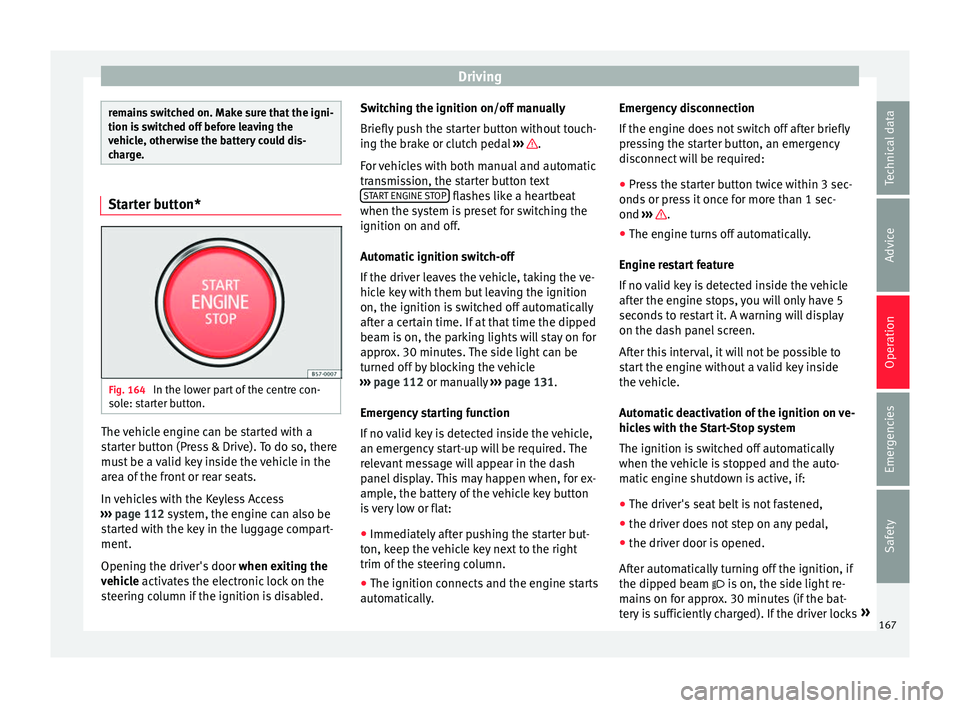
charge. Starter button*
Fig. 164
In the lower part of the centre con-
so l
e: starter button. The vehicle engine can be started with a
s
t
arter button (Press & Drive). To do so, there
must be a valid key inside the vehicle in the
area of the front or rear seats.
In vehicles with the Keyless Access
››› page 112 system, the engine can also be
started with the key in the luggage compart-
ment.
Opening the driver's door when exiting the
vehicle activates the electronic lock on the
steering column if the ignition is disabled. Switching the ignition on/off manually
Briefly p
ush the starter button without touch-
ing the brake or clutch pedal ››› .
F or
vehicles with both manual and automatic
transmission, the starter button text START ENGINE STOP flashes like a heartbeat
when the sy s
tem is preset for switching the
ignition on and off.
Automatic ignition switch-off
If the driver leaves the vehicle, taking the ve-
hicle key with them but leaving the ignition
on, the ignition is switched off automatically
after a certain time. If at that time the dipped
beam is on, the parking lights will stay on for
approx. 30 minutes. The side light can be
turned off by blocking the vehicle
››› page 112 or manually ››› page 131.
Emergency starting function
If no valid key is detected inside the vehicle,
an emergency start-up will be required. The
relevant message will appear in the dash
panel display. This may happen when, for ex-
ample, the battery of the vehicle key button
is very low or flat: ● Immediately after pushing the starter but-
ton, k
eep the vehicle key next to the right
trim of the steering column.
● The ignition connects and the engine starts
autom
atically. Emergency disconnection
If the en
gine does not switch off after briefly
pressing the starter button, an emergency
disconnect will be required:
● Press the starter button twice within 3 sec-
onds
or press it once for more than 1 sec-
ond ››› .
● The engine turns off automatically.
En gine r
estart feature
If no valid key is detected inside the vehicle
after the engine stops, you will only have 5
seconds to restart it. A warning will display
on the dash panel screen.
After this interval, it will not be possible to
start the engine without a valid key inside
the vehicle.
Automatic deactivation of the ignition on ve-
hicles with the Start-Stop system
The ignition is switched off automatically
when the vehicle is stopped and the auto-
matic engine shutdown is active, if:
● The driver's seat belt is not fastened,
● the driver does not step on any pedal,
● the driver door is opened.
Aft
er automatically turning off the ignition, if
the dipped beam is on, the side light re-
mains on for approx. 30 minutes (if the bat-
tery is sufficiently charged). If the driver locks »
167
Technical data
Advice
Operation
Emergencies
Safety
Page 170 of 328
Operation
the vehicle or manually turns off the light, the
s ide light
goes out. WARNING
Any accidental movement of the vehicle could
r e
sult in serious injury.
● When switching on the ignition, do not
pr
ess the brake or clutch pedal, otherwise
the engine could start immediately. WARNING
If vehicle keys are used negligently or with-
out due c
are, this may cause accidents and
serious injury.
● Never leave any key inside the vehicle
when ex
iting. Otherwise, a child or unauthor-
ised person could lock the vehicle, start the
engine or connect the ignition and, in this
way, operate electronic equipment (e.g. the
windows). Note
● Bef
ore leaving the vehicle, always discon-
nect the ignition manually and, if appropri-
ate, take into account the instructions on the
screen of the dash panel.
● If the vehicle is stationary for a long time
with the ignition on, the
vehicle battery
might be discharged and it might not be pos-
sible to start the engine.
● In diesel vehicles, there may be a delay in
the engine s
tarting if it requires preheating. ●
If durin
g the STOP phase you press the
START ENGINE STOP button, the ignition is
sw it
ched off and the button flashes.
● If the indication “Start-Stop system deacti-
vat
ed: Start the engine manually” is dis-
played on the dash panel display, the START ENGINE STOP button will blink.
Starting the engine
3
Valid for vehicles: with Keyless Access
StepStarting the engine with the starter but-
ton ››› page 167 (Press & Drive).
1.Press and hold the brake pedal until step 5 is
performed.
1a.In vehicles with a manual gearbox: press and
hold the clutch down until the engine starts.
2.Put the gearbox lever in neutral or the selector
lever in position P or N.
3.
Briefly press the starter button ››› Fig. 164 with-
out pressing the accelerator. For the engine to
start there must be a valid key in the vehicle.
After starting the engine, the light of the START ENGINE STOP
button changes to a fixed
light indicating that the engine has started.
4.If the engine does not start, stop and wait for
approx. 1 minute before trying again. If neces-
sary, perform an emergency start ››› page 167.
5.Disconnect the electronic parking brake when
you are about to start driving ››› page 170. WARNING
Never leave the vehicle with the engine run-
nin g, e
specially if a gear or gear range is en-
gaged. The vehicle could then suddenly move
or something strange could happen that
would cause damage, fire or serious injury. WARNING
Cold start sprays could explode or cause a
s ud
den increase in the engine speed.
● Never use sprays to cold start the engine. CAUTION
● The s t
arter motor or the engine may be
damaged if you try to start the engine while
driving or if you restart it immediately after
switching it off.
● If the engine is cold, avoid high engine
speed
s, pushing the engine too hard and rap-
id acceleration.
● Do not start the engine by pushing the ve-
hicl
e or towing it. Unburnt fuel could enter
the catalytic converter and damage it. Note
● Do not w
ait until the engine warms up with
the vehicle stationary; if you have good visi-
bility through the windows, start driving im-
mediately. This helps the engine reach oper-
ating temperature faster and reduces emis-
sions. 168
Page 173 of 328
Driving
● To s
top the braking process, release the
button or press the accelerator. WARNING
The improper use of the electronic parking
br ak
e can cause accidents and serious injury.
● Never use the electronic parking brake to
st
op the vehicle, unless it is an emergency.
Braking distances can be considerably lon-
ger, since, under certain circumstances, only
the rear wheels brake. Always use the foot
brake.
● Never accelerate from the engine when a
ge
ar range or a gear is engaged and the en-
gine is running. The vehicle could move, even
if the electronic parking brake is activated. CAUTION
To prevent the vehicle from unintentionally
mo v
ing when parking it, first apply the elec-
tronic parking brake and then remove your
foot from the brake pedal. Note
● In v
ehicles with a manual gearbox, releas-
ing the clutch and accelerating at the same
time automatically disconnects the electronic
parking brake.
● If the vehicle battery is flat, it will not be
pos
sible to disconnect the electronic parking
brake. Use the jump-start ›››
page 58. ●
When the el ectr
onic parking brake is ap-
plied or released, noises may be heard.
● The system performs automatic and audi-
bl
e tests sporadically in the parked vehicle if
some time elapses without the electronic
parking brake being used. Parking
The electronic parking brake should always
be ap
p
lied when the vehicle is parked.
Always note the following points when park-
ing the vehicle: – Use the brake pedal to stop the vehicle.
– Apply the electronic parking brake.
– Put it in 1st gear.
– Switch the engine off and remove the key
from the ignition.
Turn the steering wheel
slightly to engage the steering lock.
– Never leave a vehicle key in the vehicle.
Addition
al notes on parking the vehicle on
gradients:
Turn the steering wheel so that the vehicle
rolls against the kerb if it started to roll.
● If the vehicle is parked facing downhi
ll,
turn the front wheels so that they point to-
wards the kerb . ●
If the
vehicle is parked facing uphill, turn
the front wheels so that they point away from
the kerb.
● Secure the vehicle as usual by applying the
electr
onic parking brake firmly and putting it
in 1st gear. WARNING
● Tak
e measures to reduce the risk of injury
when you leave your vehicle unattended.
● Never park where the hot exhaust system
cou
ld ignite inflammable materials, such as
dry grass, low bushes, spilt fuel etc.
● Never allow vehicle occupants to remain in
the v
ehicle when it is locked. They would be
unable to open the vehicle from the inside,
and could become trapped in the vehicle in
an emergency. In the event of an emergency,
locked doors will delay assistance to vehicle
occupants.
● Never leave children alone in the vehicle.
They c
ould set the vehicle in motion, for ex-
ample, by releasing the electronic parking
brake or the gearshift lever, which would
cause the vehicle to move, but uncontrolla-
bly.
● Depending on weather conditions, it may
become e
xtremely hot or cold inside the vehi-
cle. This can be fatal. 171
Technical data
Advice
Operation
Emergencies
Safety
Page 285 of 328
Checking and refilling levels
WARNING
● Sw it
ch the engine off, remove the key from
the ignition and apply the hand brake. If the
vehicle has a manual gearbox, place the lever
in neutral; if it has an automatic gearbox,
place the selector lever in position P. Wait for
the engine to cool down.
● Keep children away from the engine com-
par
tment.
● Never spill liquids used for vehicle opera-
tion on the engine c
ompartment, as these
may catch fire (e.g. the antifreeze in coolant).
● Take care not to cause short circuits in the
electric
al system, especially when working
on the battery.
● If working inside the engine compartment,
remember th
at, even when the ignition is
switched off, the radiator fan may start up au-
tomatically, and therefore there is a risk of in-
jury.
● Never cover the engine with additional in-
su
lating materials such as a blanket. Risk of
fire!
● Do not unscrew the cap on the coolant ex-
pan
sion tank when the engine is hot. The
cooling system is under pressure.
● Protect face, hands and arms by covering
the cap w
ith a large, thick rag to protect
against escaping coolant and steam.
● If it is necessary to work in the engine com-
par
tment while the engine is running, the ro-
tating components (for example, poly-V belt, alternator, radiator fan) and the high voltage
ignition sy
s
tem are an additional hazard.
● Observe the following additional warnings
if w
ork on the fuel system or the electrical
system is necessary:
– Always disconnect the battery from the
on-board network.
– Do not smoke.
– Never work near naked flames.
– Always keep an approved fire extinguish-
er immediately available. CAUTION
When topping up fluids make sure the correct
fluid i s
put into the correct filler opening, oth-
erwise this can cause serious malfunctions or
engine damage. For the sake of the environment
Inspect the ground underneath your vehicle
r e
gularly so that any leaks are detected at an
early stage. If you find spots of oil or other
fluids in the area where it was parked, have
your vehicle inspected at the workshop. Note
In right-hand drive vehicles* some brake flu-
id r e
servoirs are on the other side of the en-
gine compartment ››› Fig. 221. Opening the bonnet
Read the additional information carefully
› ›
› page 11
The bonnet is released from inside the vehi-
cle.
Check that the windscreen wiper arms are
not unfolded. Otherwise the paint may be
damaged.
The bonnet can only be unlocked when the
driver door is open. WARNING
Never open the bonnet if you see steam or
drip s
of coolant being released from the en-
gine compartment. Failure to comply could
result in burns. Wait until no steam or coolant
can be seen before opening the bonnet. Closing the bonnet
–
Slightly lift the bonnet.
– Release the bonnet stay before pressing it
bac
k into its support.
– Carefully close the bonnet.
– Press the bonnet down until it locks into
pl
ace.
– Make sure that the bonnet catches onto its
cl
asp. Do not press down too hard ››› .
»
283
Technical data
Advice
Operation
Emergencies
Safety
Page 291 of 328
Checking and refilling levels
CAUTION
● Do not mi
x cleaning products recommen-
ded by SEAT with other products. This could
lead to flocculation and may block the wind-
screen washer jets.
● When topping up service fluids, make abso-
lutely
certain that you fill the fluids into the
correct reservoirs. Using the wrong fluids
could cause serious malfunctions and engine
damage!
● Not having windscreen wiper fluid reduces
vi
sibility through the windscreen, and leads
to loss of visibility in headlights in models
with headlight washer. Battery
Gener a
l information Read the additional information carefully
› ›
› page 50.
The battery is located in the engine compart-
ment and is almost maintenance-free. It is
checked as part of the Inspection Service.
Nevertheless, check the terminals are clean
and have the correct tightening torque, espe-
cially in summer and winter.
Disconnecting the battery
The battery should only be disconnected in
exceptional cases. When the battery is dis- connected, some of the vehicle's functions
are “lo
st” (››› table on page 289). These
functions will require resetting after the bat-
tery is reconnected.
Deactivate the anti-theft alarm* before you
disconnect the battery Otherwise the alarm
will be triggered.
FunctionReprogramming
One-touch function of
the electric windows››› page 128, One-touch
opening and closing.
Remote control key
If the vehicle does not re-
spond to the key, they
should be synchronised
››› page 120.
Digital clock››› page 104.
ESC warning lampAfter driving for a few me-
tres, the warning lamp goes
out again. If the vehicle is not used for long periods
The
v
ehicle has a system for monitoring the
current consumption when the engine is left
unused for long periods of time ››› page 274.
Some functions, such as the interior lights, or
the remote door opening, may be temporarily
disabled to prevent the battery from running
flat. These functions will come back on as
soon as the ignition is switched on and the
engine started. Winter conditions
Durin
g the winter, the starting power may be
reduced, and if necessary, the battery should
be charged ››› in Important safety warn-
in g
s for handling a vehicle battery on
page 290
Important safety warnings for han-
dling a
vehicle battery All work on batteries requires specialist
kno
wl
edge. Please refer to a SEAT Official
Service or a workshop specialising in batter-
ies: risk of burns or exploding battery!
The battery must not be opened. Never try to
change the fluid level of the battery. Other-
wise explosive gas is released from the bat-
tery that could cause an explosion.
Wear eye protection.
Battery acid is very corrosive and caustic. Wear
protective gloves and eye protection. In the event
of electrolyte splashes, rinse off with plenty of
water.
Fires, sparks, open flames and smoking are pro-
hibited.
The battery should only be charged in a well-ven-
tilated zone. Risk of explosion!
Keep children away from acid and batteries!»
289
Technical data
Advice
Operation
Emergencies
Safety
Page 292 of 328
Advice
WARNING
● When r ep
airing or working on the electrical
system, proceed as follows:
–1. Remove the key from the ignition. The
negative cable on the battery must be
disconnected.
– 2. When the repair is finished, reconnect
the negative pole of the battery.
● Switch off all electrical devices before re-
connectin
g the battery. Reconnect first the
positive cable and then the negative cable.
Never reverse the polarity of the connections.
This could cause an electrical fire.
● Ensure that the vent hose is always connec-
ted t
o the battery.
● Never use damaged batteries. This could
cau
se an explosion! Replace a damaged bat-
tery immediately. CAUTION
● Nev er di
sconnect the battery if the ignition
is switched on or if the engine is running.
This could damage the electrical system or
electronic components. Charging the battery
Terminals for charging the battery are fitted
in the en
gine c
ompartment. –
Note the w
arnings ››› in Important safety
w arnin
gs for handling a vehicle battery on
page 290 and ››› .
– Switch off all electrical devices. Remove the
ignition k ey
.
– Raise the bonnet ››
› page 283.
– Open the battery cover.
– Connect the charger clamps as described
to the
positive pole of the battery (+) and
exclusively to an earth on the bodywork
(–).
– Only use a charger which is compatible for
use w
ith 12 V nominal voltage batteries.
The charge must not exceed a voltage of 15
V.
– Now connect the battery charger to the
pow
er socket and switch on.
– After charging the battery: switch off the
batt
ery charger and disconnect the power
socket cable.
– Finally disconnect the charger cables from
the batt
ery.
– Replace the battery cover correctly.
– Close the bonnet ››
› page 283.
Important: Before you charge the battery
make sure you read the manufacturer's in-
structions for using the battery charger. WARNING
Never charge a battery that has frozen: re-
p l
ace battery! Failure to do so may lead to an
explosion. Note
Use only the terminals in the engine compart-
ment t
o charge the battery. Replacing the battery
The new battery should have the same speci-
fic
ation
s (amperage, load and voltage) as the
used battery.
Your vehicle is equipped with an intelligent
power management system to control the
distribution of electrical energy ›››
page 274.
The power management function ensures
that the battery is charged much more effi-
ciently than on vehicles without a power
management system. To maintain this func-
tion after replacing the battery, we recom-
mend that the replacement battery used is of
the same make and type as the original fitted
battery. To make proper use of the power
management function after the battery has
been changed, have the battery coded to the
power management mode at a specialised
workshop.
290
Page 312 of 328
Index
Assist systems Park
Assist . . . . . . . . . . . . . . . . . . . . . . . . . . . . 232
parking system Plus . . . . . . . . . . . . . . . . . . . . . 239
speed limiter . . . . . . . . . . . . . . . . . . . . . . . . . . . 194
Audible signal lights . . . . . . . . . . . . . . . . . . . . . . . . . . . . . . . . . 131
Audible warning signal seat belt not fastened . . . . . . . . . . . . . . . . . . . . 68
warning and control lamps . . . . . . . . . . . . . . . 106
Auto Hold . . . . . . . . . . . . . . . . . . . . . . . . . . . . . . . 191
Auto Hold function . . . . . . . . . . . . . . . . . . . . . . . . 191
Auto Lock (central locking) . . . . . . . . . . . . . . . . . 112
Automatic car washes switching the Auto Hold function off . . . . . . . . 192
Automatic dipped beam control . . . . . . . . . . . . . 132
Automatic gear safety interlock for ignition key . . . . . . . . . . . . 165
Automatic gearbox . . . . . . . . . . . . . . . . . . . . . . . . 177 backup programme . . . . . . . . . . . . . . . . . . . . . 183
downhill speed control . . . . . . . . . . . . . . . . . . 182
driving tips . . . . . . . . . . . . . . . . . . . . . . . . . . . . 180
kick-down feature . . . . . . . . . . . . . . . . . . . . . . . 181
launch control programme . . . . . . . . . . . . . . . . 181
manual release of selector lever . . . . . . . . . . . . 41
selector lever lock . . . . . . . . . . . . . . . . . . . . . . . 178
selector lever positions . . . . . . . . . . . . . . . . . . 177
Steering wheel with gearshift paddles . . . . . . 179
tiptronic . . . . . . . . . . . . . . . . . . . . . . . . . . 177, 179
towing . . . . . . . . . . . . . . . . . . . . . . . . . . . . . . . . . 87
AUX-IN . . . . . . . . . . . . . . . . . . . . . . . . . . . . . . . . . . 111
Auxiliary heater . . . . . . . . . . . . . . . . . . . . . . . . . . 161 activating . . . . . . . . . . . . . . . . . . . . . . . . . . . . . 163
electric consumers . . . . . . . . . . . . . . . . . . . . . . 164
operating instructions . . . . . . . . . . . . . . . . . . . 164
programming . . . . . . . . . . . . . . . . . . . . . . . . . . 163
remote control . . . . . . . . . . . . . . . . . . . . . . . . . 162
remote control range . . . . . . . . . . . . . . . . . . . . 163 special features . . . . . . . . . . . . . . . . . . . . . . . . 162
swit
ching off . . . . . . . . . . . . . . . . . . . . . . . . . . . 161
switching on . . . . . . . . . . . . . . . . . . . . . . . . . . . 161
things to note . . . . . . . . . . . . . . . . . . . . . . . . . . 164
B Battery . . . . . . . . . . . . . . . . . . . . . . . . . . . . . . . . . . 120 replacement in the remote control (auxiliaryheater) . . . . . . . . . . . . . . . . . . . . . . . . . . . . . . 162
Before starting the vehicle . . . . . . . . . . . . . . . . . . 62
Belt tightening . . . . . . . . . . . . . . . . . . . . . . . . . . . . 72
Bench seat . . . . . . . . . . . . . . . . . . . . . . . . . . . . . . 146
Bicycle rack Fitting on the retractable tow hitch . . . . . . . . . 258
maximum load . . . . . . . . . . . . . . . . . . . . . . . . . 258
Biodiesel . . . . . . . . . . . . . . . . . . . . . . . . . . . . . . . . 278
Blind spot detector (BSD) . . . . . . . . . . . . . . . . . . 220 control lamps . . . . . . . . . . . . . . . . . . . . . . . . . . 220
driving situations . . . . . . . . . . . . . . . . . . . . . . . 223
indication in the external rear view mirror . . . 221
malfunction . . . . . . . . . . . . . . . . . . . . . . . . . . . . 220
operating . . . . . . . . . . . . . . . . . . . . . . . . . . . . . . 221
towing . . . . . . . . . . . . . . . . . . . . . . . . . . . . . . . . 225
Bonnet . . . . . . . . . . . . . . . . . . . . . . . . . . . . . 11, 282 opening the bonnet . . . . . . . . . . . . . . . . . . . . . 283
Brake emergency braking function . . . . . . . . . . . . . . 170
brake fluid . . . . . . . . . . . . . . . . . . . . . . . . . . . . . . . . 50
Brakes . . . . . . . . . . . . . . . . . . . . . . . . . . . . . . . . . . 172 brake fluid . . . . . . . . . . . . . . . . . . . . . . . . . . . . . 287
brake servo . . . . . . . . . . . . . . . . . . . . . . . . . . . . 172
electronic parking brake . . . . . . . . . . . . . . . . . 170
new brake pads . . . . . . . . . . . . . . . . . . . . . . . . 172
Braking front assist . . . . . . . . . . . . . . . . . . . . . . . . . . . . 173
BSD see Blind spot detector (BSD) . . . . . . . . . . . . . 220 C
Camer
a
cleaning . . . . . . . . . . . . . . . . . . . . . . . . . . . . . . 268
cleanliness . . . . . . . . . . . . . . . . . . . . . . . . . . . . 228
Lane Assist . . . . . . . . . . . . . . . . . . . . . . . . . . . . 215
Capacities . . . . . . . . . . . . . . . . . . . . . . . . . . . . . . . . 48 AdBlue tank . . . . . . . . . . . . . . . . . . . . . . 279, 280
fuel tank . . . . . . . . . . . . . . . . . . . . . . . . . . . . . . 106
windscreen washer water . . . . . . . . . . . . . . . . 288
Car-care products . . . . . . . . . . . . . . . . . . . . . . . . . 266
Catalytic converter . . . . . . . . . . . . . . . . . . . . . . . . 186 malfunction . . . . . . . . . . . . . . . . . . . . . . . . . . . . 186
CCS . . . . . . . . . . . . . . . . . . . . . . . . . . . . . . . . . . . . . 36
CD-ROM player (navigation) . . . . . . . . . . . . . . . . 148
Central locking anti-theft alarm . . . . . . . . . . . . . . . . . . . . . . . . . 121
central locking switch . . . . . . . . . . . . . . . . . . . . 115
Electric windows . . . . . . . . . . . . . . . . . . . . . . . . 127
Keyless Access . . . . . . . . . . . . . . . . . . . . . . . . . 116
Manual locking . . . . . . . . . . . . . . . . . . . . . . . . . . 10
programming . . . . . . . . . . . . . . . . . . . . . . . . . . 115
remote control key . . . . . . . . . . . . . . . . . . . . . . 114
selective unlocking system . . . . . . . . . . . . . . . 114
sliding/tilting sunroof . . . . . . . . . . . . . . . . . . . 127
Central locking system . . . . . . . . . . . . . . . . . . . . . 112
Central wheel trim . . . . . . . . . . . . . . . . . . . . . . . . . 54
Cetane number (diesel fuel) . . . . . . . . . . . . . . . . 278
Changing parts . . . . . . . . . . . . . . . . . . . . . . . . . . . . . . . . . 265
changing a bulb dipped beam . . . . . . . . . . . . . . . . . . . . . . . . . . . 94
rear bulb in the side panel . . . . . . . . . . . . . . . . . 96
rear light in the rear lid . . . . . . . . . . . . . . . . . . . . 97
Changing a bulb . . . . . . . . . . . . . . . . . . . . . . . . . . . 93 fog light . . . . . . . . . . . . . . . . . . . . . . . . . . . . . . . . 95
main beam . . . . . . . . . . . . . . . . . . . . . . . . . . . . . 94
turn signal . . . . . . . . . . . . . . . . . . . . . . . . . . . . . . 94
310
Page 314 of 328
Index
Display of traffic signs on the instrument panel activ at
e . . . . . . . . . . . . . . . . . . . . . . . . . . . . . . . 229
deactivate . . . . . . . . . . . . . . . . . . . . . . . . . . . . . 229
Disposal Seat belt tensioners . . . . . . . . . . . . . . . . . . . . . . 72
Distance control see Adaptive cruise control . . . . . . . . . . . . . . . 197
Door cylinder . . . . . . . . . . . . . . . . . . . . . . . . . . . . . . 9
Door handle . . . . . . . . . . . . . . . . . . . . . . . . . . . . . . . 9
Door lock . . . . . . . . . . . . . . . . . . . . . . . . . . . . . . . . . . 9
Door release lever . . . . . . . . . . . . . . . . . . . . . . . . 101
Doors Childproof locks . . . . . . . . . . . . . . . . . . . . . . . . 120
opening and closing . . . . . . . . . . . . . . . . . . . . . . 9
Downhill speed control . . . . . . . . . . . . . . . . . . . . 182
Downhill speed control function . . . . . . . . . . . . . 182
Drawer . . . . . . . . . . . . . . . . . . . . . . . . . . . . . . . . . . 147
Drink holders . . . . . . . . . . . . . . . . . . . . . . . . . . . . 147
Driver see Correct sitting position . . . . . . . . . 63, 64, 65
Driver information system CD/radio indication . . . . . . . . . . . . . . . . . . . . . . 29
engine oil temperature display . . . . . . . . . . . . . 34
Operation with the windscreen wiper lever . . . 29
Driving Driving abroad . . . . . . . . . . . . . . . . . . . . . . . . . 136
driving through water . . . . . . . . . . . . . . . . . . . . 187
towing . . . . . . . . . . . . . . . . . . . . . . . . . . . . . . . . . 90
Driving abroad headlights . . . . . . . . . . . . . . . . . . . . . . . . . . . . . 136
Driving data . . . . . . . . . . . . . . . . . . . . . . . . . . . . . . 29 data summary . . . . . . . . . . . . . . . . . . . . . . . . . . . 33
memory . . . . . . . . . . . . . . . . . . . . . . . . . . . . . . . . 33
Driving in winter trailer . . . . . . . . . . . . . . . . . . . . . . . . . . . . . . . . . 255
Driving mode . . . . . . . . . . . . . . . . . . . . . . . . . . . . 226
Driving on flooded roads . . . . . . . . . . . . . . . . . . . 187 Driving profile . . . . . . . . . . . . . . . . . . . . . . . . . . . . 226
Drivin
g safety . . . . . . . . . . . . . . . . . . . . . . . . . . . . . 62
DSG . . . . . . . . . . . . . . . . . . . . . . . . . . . . . . . . . . . . 177
Duplicate keys . . . . . . . . . . . . . . . . . . . . . . . . . . . 113
Dust and pollen filter . . . . . . . . . . . . . . . . . . . . . . 156
Dynamic headlight range control . . . . . . . . . . . . 137
E E10 see Ethanol (fuel) . . . . . . . . . . . . . . . . . . . . . . . 277
Easy Connect . . . . . . . . . . . . . . . . . . . . . . . . 26, 108
Easy Open . . . . . . . . . . . . . . . . . . . . . . . . . . . . . . . 116 special characteristics . . . . . . . . . . . . . . . . . . . 118
Economical driving . . . . . . . . . . . . . . . . . . . . . . . . . . . . . . . . 185
EDL see Electronic differential lock . . . . . . . . . . . . . 173
Efficiency programme additional electrical appliances . . . . . . . . . . . . 34
saving tips . . . . . . . . . . . . . . . . . . . . . . . . . . . . . . 34
Electric windows . . . . . . . . . . . . . . . . . . . . . . 12, 126 convenience opening and closing . . . . . . . . . 127
Electromechanical steering . . . . . . . . . . . . . . . . . 273 lamp . . . . . . . . . . . . . . . . . . . . . . . . . . . . . . . . . 273
Electronic differential lock . . . . . . . . . . . . . . . . . . 173
Electronic immobiliser . . . . . . . . . . . . . . . . . . . . . . . 9
Electronic self-locking . . . . . . . . . . . . . . . . . . . . . 173
Electronic stability control (ESC) . . . . . . . . . . . . . 173
Electronic torque management (XDS) . . . . . . . . . 173
Emergencies . . . . . . . . . . . . . . . . . . . . . . . . . . . . . . 83 Anti-puncture kit . . . . . . . . . . . . . . . . . . . . . . . . . 83
automatic gearbox backup programme . . . . . 183
bulbs . . . . . . . . . . . . . . . . . . . . . . . . . . . . . . . . . . 52
changing a wheel . . . . . . . . . . . . . . . . . . . . . . . . 54
emergency towing of the vehicle . . . . . . . . . . . . 57
fuses . . . . . . . . . . . . . . . . . . . . . . . . . . . . . . . . . . 51
hazard warning lights . . . . . . . . . . . . . . . . . . . 135 jump leads . . . . . . . . . . . . . . . . . . . . . . . . . . . . . 58
Manual
unlocking and locking . . . . . . . . . . . . . 85
puncture . . . . . . . . . . . . . . . . . . . . . . . . . . . . . . . 52
replacing a blown fuse . . . . . . . . . . . . . . . . . . . . 51
replacing the battery . . . . . . . . . . . . . . . . . . . . 290
vehicle tool kit . . . . . . . . . . . . . . . . . . . . . . . . . . 83
Emergency Assist . . . . . . . . . . . . . . . . . . . . . . . . . 218 see Emergency Assist . . . . . . . . . . . . . . . . . . . . 218
switching off . . . . . . . . . . . . . . . . . . . . . . . . . . . 218
switching on . . . . . . . . . . . . . . . . . . . . . . . . . . . 218
Emergency braking function . . . . . . . . . . . . . . . . 170
Emergency braking warning . . . . . . . . . . . . . . . . 136
Emergency operation passenger door . . . . . . . . . . . . . . . . . . . . . . . . . . 10
Selector lever . . . . . . . . . . . . . . . . . . . . . . . . . . . 41
Emission control system control lamp . . . . . . . . . . . . . . . . . . . . . . . . . . . 187
Emissions data . . . . . . . . . . . . . . . . . . . . . . . . . . . 301
Engine assisted starting . . . . . . . . . . . . . . . . . . . . . . . . . 58
noises . . . . . . . . . . . . . . . . . . . . . . . . . . . . . . . . 169
preheating . . . . . . . . . . . . . . . . . . . . . . . . . . . . 165
running in . . . . . . . . . . . . . . . . . . . . . . . . . . . . . 184
Start-Stop system . . . . . . . . . . . . . . . . . . . . . . . 188
starting . . . . . . . . . . . . . . . . . . . . . . . . . . . . . . . 165
starting up (driver messages with the mechan- ical contact) . . . . . . . . . . . . . . . . . . . . . . . . . . 165
switching off (key) . . . . . . . . . . . . . . . . . . . . . . 166
Engine and ignition automatic ignition switch-off . . . . . . . . . . . . . . 167
My Beat . . . . . . . . . . . . . . . . . . . . . . . . . . . . . . . 169
preheating the engine . . . . . . . . . . . . . . . . . . . 168
starting the engine . . . . . . . . . . . . . . . . . . . . . . 168
starting the engine with Press & Drive . . . . . . 168
stopping the engine . . . . . . . . . . . . . . . . . . . . . 169
Engine compartment . . . . . . . . . . . . . . . . . . 11, 282 battery . . . . . . . . . . . . . . . . . . . . . . . . . . . . 50, 289
brake fluid . . . . . . . . . . . . . . . . . . . . . . . . . 50, 287
312