wipers Seat Ateca 2017 User Guide
[x] Cancel search | Manufacturer: SEAT, Model Year: 2017, Model line: Ateca, Model: Seat Ateca 2017Pages: 328, PDF Size: 6.36 MB
Page 134 of 328
Operation
Convenience turn signals
F or the c
onvenience turn signals, move the
lever as far as possible upwards or down-
wards and release the lever. The turn signal
will flash three times.
The convenience turn signals are activated
and deactivated in the Easy Connect system
via the key and the
Set
up function button
› ›
› page 108.
In vehicles that do not have the correspond-
ing menu, this function can be deactivated in
a specialised workshop. WARNING
Improper or lack of use of the turn signals, or
f or
getting to deactivate them can confuse
other road users. This could result in a seri-
ous accident.
● Always give warning when you are going to
ch
ange lane, overtake or when turning, acti-
vating the turn signal in good time.
● As soon as you have finished changing
lane, o
vertaking or turning, switch the turn
signal off. WARNING
Incorrect use of the headlights may cause ac-
c ident
s and serious injury, as the main beam
may distract or dazzle other drivers. Note
● If the c
onvenience turn signals are operat-
ing (three flashes) and the other convenience
turn signals are switched on, the active part
stops flashing and only flashes once in the
new part selected.
● The turn signal only works when the igni-
tion is
switched on. The hazard warning
lights also work when the ignition is switch-
ed off.
● If a trailer turn signal malfunctions, the
contr
ol lamp will stop flashing (trailer turn
signals) and the vehicle turn signal will flash
at double speed.
● The main beam he
adlights can only be
switched on if the dipped beam headlights
are already on.
● In cold or damp weather conditions, the
hea
dlights, tail lights and turn signals may
mist up inside temporarily. This is normal and
in no way effects the useful life of the vehicle
lighting system. Automatic dipped beam control
* The automatic dipped beam control is merely
int
ended a
s an aid and is not able to recog-
nise all driving situations.
When the light switch is in position , the
vehicle lights and the instrument panel and
switch lighting switch on and off automatical- ly in the following situations
››
› in Daytime
ru nnin
g lights on page 131:
Automatic switching
onAutomatic switching
off
The photo sensor detects
darkness, for example,
when driving through a
tunnel.When adequate lighting is
detected.
The rain sensor detects
rain and activates the
windscreen wipers.When the windscreen wip-
ers have been inactive for
a few minutes. WARNING
If the road is not well lit and other road users
c annot
see the vehicle well enough or at all,
accidents may occur.
● The automatic dipped beam control ( )
only
switches on the dipped beam when
there are no changes in brightness, and not,
for example when it is foggy. Main beam assist*
Main beam assist (Light Assist)
The m
ain be
am assist acts within the limits
of the system and depending on environmen-
tal and traffic conditions. Once switched on,
the system is activated as of a speed of
about 60 km/h (37 mph) and is deactivated
below about 30 km/h (18 mph) ››› .
132
Page 141 of 328
Lights and visibility
Note
The light above the sun visor automatically
sw it
ches off after a few minutes in certain
conditions. This prevents the battery from
discharging. Windscreen wiper and window
w
iper sy
stems
Window wiper lever Read the additional information carefully
› ›
› page 25 CAUTION
If the ignition is switched off with the wind-
s c
reen wipers active, they complete their
wipe before returning to the rest position.
When switching the ignition back on, the
windscreen wiper will continue to operate at
the same wiping level. Ice, snow and other
obstacles on the windscreen may damage the
wiper and the windscreen wiper motor.
● If necessary, remove snow and ice from the
wind
screen wipers before starting your jour-
ney.
● Carefully lift the frozen windscreen wipers
from the gl
ass. SEAT recommends a de-icer
spray for this operation.
● Do not switch on the windscreen wipers if
the wind
screen is dry. Cleaning with the windscreen wipers while dry can cause dam-
ag
e.
● In icy
conditions, always check that the
wiper b
lades are not frozen to the glass be-
fore using the wipers. In cold weather, it may
help to leave the vehicle parked with the wip-
ers in service position ›››
page 60. Note
● The w ind
screen and window wipers only
function when the ignition is switched on and
the bonnet or rear lid, respectively, are
closed.
● The interval wipe speed varies according to
the v
ehicle speed. The faster the vehicle is
moving, the more often the windscreen is
cleaned.
● The rear wiper is automatically switched on
when the wind
screen wiper is on and the car
is in reverse gear. Windscreen wiper functions
Windscreen wiper performance in different sit-
uations
If the vehicle is at a
standstillThe activated position provision-
ally changes to the previous posi-
tion.
Windscreen wiper performance in different sit-
uations
During automatic
wipe
The air conditioner comes on for
approximately 30 seconds in air
recirculation mode to prevent the
smell of the windscreen washer
fluid entering the inside the vehi-
cle.
For the interval wipe
Intervals between wipes depend
on the vehicle's speed. The high-
er the vehicle speed the shorter
the intervals. Heated windscreen washer jets
The he
atin
g only thaws the frozen jets, it
does not thaw the water in the washer hoses.
When the ignition is switched on the heated
windscreen washer jets automatically adjust
the heat depending on the ambient tempera-
ture.
Headlight wash/wipe system
The headlight washers/wipers clean the
headlight lenses.
After the ignition is switched on, the first and
every fifth time the windscreen washer is
switched on, the headlights are also washed.
Therefore, the windscreen wiper lever should
be pulled towards the steering wheel when
the dipped beam or main beam are on. Any
incrusted dirt (such as insects) should be
cleaned regularly (e.g. when refuelling). »
139
Technical data
Advice
Operation
Emergencies
Safety
Page 142 of 328
Operation
To ensure the headlight washers work cor-
r ectly
in winter, any snow which has got into
the bumper jet supports should be cleaned
away. If necessary, remove snow with an anti-
icing spray. Note
The wiper will try to wipe away any obstacles
th at
are on the windscreen. The wiper will
stop moving if the obstacle blocks its path.
Remove the obstacle and switch the wiper
back on again. Rain sensor*
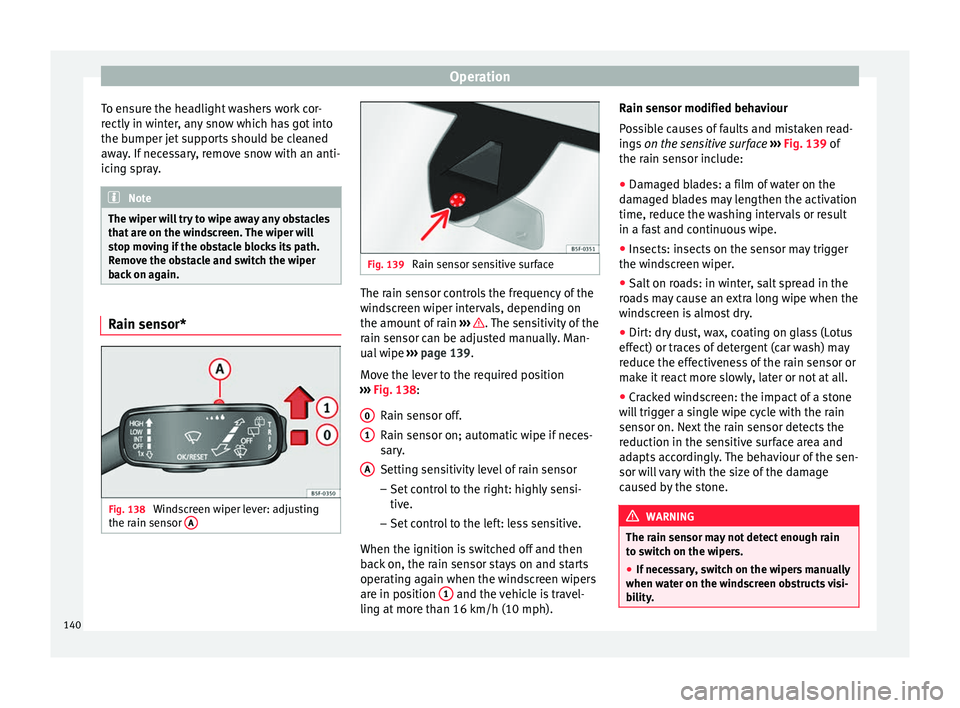
Fig. 138
Windscreen wiper lever: adjusting
the r ain sen
sor A Fig. 139
Rain sensor sensitive surface The rain sensor controls the frequency of the
w
ind
screen wiper intervals, depending on
the amount of rain ››› . The sensitivity of the
r ain sen
sor can be adjusted manually. Man-
ual wipe ››› page 139.
Move the lever to the required position
››› Fig. 138:
Rain sensor off.
Rain sensor on; automatic wipe if neces-
sary.
Setting sensitivity level of rain sensor
– Set control to the right: highly sensi-
tive.
– Set control to the left: less sensitive.
When the ignition is switched off and then
back on, the rain sensor stays on and starts
operating again when the windscreen wipers
are in position 1 and the vehicle is travel-
lin g at
more than 16 km/h (10 mph).
0 1
A Rain sensor modified behaviour
P
o
ssible causes of faults and mistaken read-
ings on the sensitive surface ››› Fig. 139 of
the rain sensor include:
● Damaged blades: a film of water on the
dam
aged blades may lengthen the activation
time, reduce the washing intervals or result
in a fast and continuous wipe.
● Insects: insects on the sensor may trigger
the wind
screen wiper.
● Salt on roads: in winter, salt spread in the
ro
ads may cause an extra long wipe when the
windscreen is almost dry.
● Dirt: dry dust, wax, coating on glass (Lotus
effect) or tr
aces of detergent (car wash) may
reduce the effectiveness of the rain sensor or
make it react more slowly, later or not at all.
● Cracked windscreen: the impact of a stone
wi
ll trigger a single wipe cycle with the rain
sensor on. Next the rain sensor detects the
reduction in the sensitive surface area and
adapts accordingly. The behaviour of the sen-
sor will vary with the size of the damage
caused by the stone. WARNING
The rain sensor may not detect enough rain
t o sw
itch on the wipers.
● If necessary, switch on the wipers manually
when wat
er on the windscreen obstructs visi-
bility. 140
Page 144 of 328
Operation
● If nec
essary the right exterior mirror adjust-
ment may need correcting. turn the control to
position R 1)
.
● In the Easy Connect system the exterior mir-
ror
s can be adjusted using the CAR button
and the f u
nction button SETUP .
Ti lt
function for front passenger exterior mir-
ror*
When parking backwards, and in order to be
able to see the kerb, the passenger side mir-
ror can be automatically tilted towards the
passenger to provide a better view of the
kerb. The control must be in the position R1)
for this feature to be operational.
The mirror returns to its original position as
soon as you drive forward at over 15 km/h
(9 mph) or switch off the ignition. It also re-
turns to its original position if the position of
the control is adjusted.
Storing the rear view mirror settings for the
tilt function
● Switch the ignition on.
● Access the Easy Connect system, Menu
CAR , function “Rear view mirrors and wind-
s c
reen wipers” and select “lower while re-
versing” ›››
page 108. ●
Select
the R1)
position on the control.
● Select reverse gear.
● Adjust the front passenger exterior mirror
so that
you can see, for example, the kerb
area well.
● Release the reverse gear.
● The adjusted position for the rear view mir-
ror i
s stored.
Fold in the exterior mirrors after parking
(convenience function)*
The Easy Connect system, Menu CAR , func-
tion “R e
ar view mirrors and windscreen wip-
ers” can be used to have the exterior mirrors
fold in when the vehicle is parked
››› page 108.
When the vehicle is locked with the remote
control, by pressing for more than approxi-
mately 1 second the exterior mirrors are fol-
ded in automatically. When the vehicle is
opened with the remote control, the exterior
mirrors are deployed automatically. WARNING
Convex or wide-angle* exterior mirrors give a
l ar
ger field of vision. However, they make ob-
jects look smaller and further away than they
really are. If you use these mirrors to esti- mate the distance to vehicles behind you
when c
h
anging lane, you could misjudge the
distance. Risk of accident! CAUTION
● If one of
the mirror housings is knocked out
of position (e.g. when parking), the mirrors
must first be fully retracted with the electric
control. Do not readjust the mirror housing by
hand, as this will interfere with the mirror ad-
juster function.
● Before washing the vehicle in an automatic
car w
ash, please make sure to retract the ex-
terior mirrors to prevent them from being
damaged. Electrically retractable exterior
mirrors must not be folded in or out by hand.
Always use the electrical power control. Note
If the electrical adjustment should fail to op-
er at
e, both of the mirrors can be adjusted by
hand by lightly pressing the edge of the mir-
ror glass. 1)
Regulation in right-hand drive vehicles is symmet-
ric al
.
142
Page 162 of 328
Operation
Air recirculation mode Basic pointsAir recirculation:
Manual recirculation
Air recirculation mode prevents the ambient
air fr
om ent
ering the interior.
When the outside temperature is very high,
selecting manual air recirculation mode for a
short period refreshes the vehicle interior
more quickly.
For safety reasons, air recirculation mode is
switched off when the button is press-
ed or the air distributor turned to .
Switching the manual air recirculation mode
on and off
To switch system on: press the button un-
til the warning lamp lights up.
To switch system off: press the button un-
til the warning lamp goes off.
Functioning mode of automatic air recircula-
tion (air conditioning menu)
With the automatic air recirculation mode ac-
tivated, the entry of fresh air into the cabin
interior is enabled. If the system detects a
high concentration of hazardous substances
in the ambient air, air recirculation mode is
switched on automatically. When the level of impurities drops to within a normal range, re-
c
ir
culation mode is switched off.
The system is unable to detect unpleasant
smells.
The air recirculation will not connect auto-
matically in versions without humidity sensor
and in the following external conditions:
● The outside temperature is lower than +3°C
(+38°F).
● The cooling system is switched off and the
outside t
emperature is below +10°C (+50°F).
● The cooling system is switched off, the out-
side t
emperature is below +15°C (+59°F) and
the windscreen wipers are switched on.
Activation/deactivation of automatic air recir-
culation is done in the air conditioner menu,
under Configuration. WARNING
Observe the safety warnings ››
› in Intro-
duction on p ag
e 157.
● If the cooling system is switched off and air
rec
irculation mode switched on, the windows
can mist over very quickly, considerably limit-
ing visibility.
● Switch air recirculation mode off when it is
not r
equired. CAUTION
Do not smoke when air recirculation is
sw it
ched on in vehicles with an air condition-
er. The smoke taken in could lie on the cool-
ing system vaporiser and on the activated
charcoal cartridge of the dust and pollen fil-
ter, leading to a permanently unpleasant
smell. Note
Climatronic: air recirculation mode is activa-
t ed t
o prevent exhaust gas or unpleasant
odours from entering the vehicle interior
when it is in reverse and while the automatic
windscreen wiper is working. 160
Page 271 of 328
Care and maintenance
Carbon parts The carbon parts on your vehicle have a pain-
t
ed s
urface. They do not need any special
care and are cleaned just like any other pain-
ted part ››› page 266.
Paint damage Minor damage to the paint, such as scratches
or s
t
one chips, should be touched up without
delay before the metal starts to corrode. Suit-
able touch-up brushes or sprays for your car
can be obtained from a SEAT Official Service.
The number of the original paint finish on the
vehicle is given on the data sticker
››› page 301.
If corrosion is already visible it must be thor-
oughly removed by a specialised workshop.
Windows Clear vision is an essential safety factor.
The w
ind
screen must not be cleaned with in-
sect remover or wax, otherwise the wind-
screen wipers will not function properly (jud-
dering).
Traces of rubber, oil, grease or silicone can
be removed with a window cleaning solution
or a silicone remover. Wax residue can only be removed with a special cleaner. Your SEAT
Offic
ial Service will be able to provide you
with more detailed information.
The windows should also be cleaned on the
inside at regular intervals.
Use a separate cloth or chamois to dry the
windows. Cloths used for waxing and polish-
ing contain residues that will cause smears
on the glass. WARNING
Do not use water-repellent coatings on the
w ind
screen. In bad visibility conditions (e.g.
in the rain, dark or with a low sun), these
coatings may cause dazzle: risk of accident!
Such coatings can also cause the windscreen
wiper blades to make noise. CAUTION
● Remo
ve snow and ice from windows and ex-
terior mirrors with a plastic scraper only. To
avoid scratches caused by dirt on the glass,
the scraper should only be pushed in one di-
rection and not moved to and fro.
● The heating element for the rear window is
locat
ed on the inner side of the window. To
avoid damaging them, do not apply stickers
to these heating elements.
● Never use warm or hot water to remove
sno
w and ice from windows and mirrors. This
could cause the glass to crack! Wheels
The wheels require regular attention to pre-
ser
v
e their appearance. It is important to re-
move road salt and brake dust by washing
the wheels at regular intervals, otherwise the
finish will be impaired.
After washing, the wheels should only be
cleaned with an "acid-free" cleaning agent
for alloy wheels. This is available from SEAT
Official Services and specialist retailers. Nev-
er leave the cleaning agent on the rims for
any longer than specified in the instructions
before rinsing it off. If the wheel cleaner fluid
contains acid it can attack the surfaces of the
wheel bolts.
Car polish or other abrasive agents should
not be used for maintaining the rims. If the
protective coating is damaged, e.g. by flying
stones, the damaged area should be re-
paired immediately. WARNING
Please note when cleaning the wheels that
w at
er, ice and road salt can impair the effec-
tiveness of the brakes; this can cause an acci-
dent. Exhaust tail pipe
It is important to remove road salt and brake
du
s
t by washing the wheels at regular »
269
Technical data
Advice
Operation
Emergencies
Safety
Page 290 of 328
Advice
However, if the brake fluid level goes down
notic e
ably in a short time, or drops below the
MIN mark, there may be a leak in the brake
system. Seek specialist assistance. A warn-
ing light on the instrument panel display
monitors the brake fluid level ››› page 106.
In right-hand drive vehicles the brake fluid
reservoir is on the other side of the engine
compartment.
Changing brake fluid
The regular intervals at which the brake fluid
should be replaced are listed in the Mainte-
nance Programme. We recommend you have
it replaced at a SEAT Official Service, during
an Inspection Service. WARNING
● Br ak
e fluid should be stored in the closed
original container in a safe place out of reach
of children. Risk of poisoning!
● If the brake fluid is left in the system for
too lon
g and the brakes are subjected to
heavy use, vapour bubbles may form in the
brake system. This would seriously affect the
efficiency of the brakes and the safety of the
vehicle. This may cause an accident. CAUTION
Brake fluid should not come into contact with
the v
ehicle paintwork, as it is abrasive. Windscreen washer reservoir
Chec k
ing and topping up the wind-
screen washer reservoir Read the additional information carefully
› ›
› page 50
Check the water level in the windscreen
washer reservoir regularly and top up as re-
quired.
The container for the windscreen washer con-
tains the cleaning fluid for the windscreen,
the rear window and the headlight washer
system*.
● Open the bonnet ›
›
›
page 282.
● The windscreen washer reservoir is marked
with the symbo
l on the cap.
● Check there is enough windscreen water in
the re
servoir.
Recommended windscreen wipers
● For the hottest seasons we recommend
summer G 052 184 A1 f
or clear glass. Propor-
tions of the mixture in the washer fluid tank:
1:100 (1 part concentrate per 100 parts wa-
ter).
● All year round, G 052 164 A2 for clear
gla
ss. Approximate proportion of the winter
mixture, up to -18°C (0°F): 1:2 (1 part con-
centrate per 2 parts water); otherwise, a 1:4 proportion of mixture in the washer fluid
tank.
C
apacity
The reservoir holds approximately 3 litres in
versions without headlight washer and 5 li-
tres in versions with headlight washer. WARNING
If the water from the windscreen washer does
not c
ontain enough anti-freeze, it may freeze
on the windscreen and rear window, reducing
forward and rear visibility.
● In winter, ensure the windscreen washer
cont
ains enough anti-freeze.
● In cold conditions, you should not use the
wind
screen wiper system unless you have
warmed the windscreen with the ventilation
system. The antifreeze could freeze on the
windscreen and reduce visibility. WARNING
Never mix an unsuitable antifreeze or other
s imi
lar additives with the windscreen washer
water. A greasy layer may be formed on the
windscreen which will impair visibility.
● Use clean water with a window cleaner rec-
ommended by
SEAT.
● If necessary, add a suitable antifreeze to
the wat
er in the reservoir.288
Page 323 of 328

Index
replacing . . . . . . . . . . . . . . . . . . . . . . . . . . . . . . 290
w int
er conditions . . . . . . . . . . . . . . . . . . . . . . . 289
Vehicle care natural leather . . . . . . . . . . . . . . . . . . . . . . . . . 271
windscreen wipers service position . . . . . . . . . 60
Vehicle interior monitoring and anti-tow system 123 activation . . . . . . . . . . . . . . . . . . . . . . . . . . . . . 122
Vehicle seats . . . . . . . . . . . . . . . . . . . . . . . . . . . . . 68
Vehicle tool kit . . . . . . . . . . . . . . . . . . . . . . . . . . . . 54
Vehicle tools . . . . . . . . . . . . . . . . . . . . . . . . . . . . . . 83
Ventilation slits . . . . . . . . . . . . . . . . . . . . . . . . . . 149
Vertical load on the coupling . . . . . . . . . . . . . . . . 255
Vertical load on the trailer coupling loading the trailer . . . . . . . . . . . . . . . . . . . . . . . 261
W Warning and control lamps . . . . . . . . . . . . . 38, 106 adaptive cruise control . . . . . . . . . . . . . . . . . . . 199
Airbag system . . . . . . . . . . . . . . . . . . . . . . . . . . . 77
applying the brake . . . . . . . . . . . . . . . . . 199, 208
ASR . . . . . . . . . . . . . . . . . . . . . . . . . . . . . . . . . . 174
audible warning signal . . . . . . . . . . . . . . . . . . 106
Cruise control system (CCS) . . . . . . . . . . . . . . . 193
electromechanical steering . . . . . . . . . . . . . . . 273
engine management . . . . . . . . . . . . . . . . . . . . 187
engine pre-heating/fault system . . . . . . . . . . . 187
ESC . . . . . . . . . . . . . . . . . . . . . . . . . . . . . . . . . . 174
for seat belts . . . . . . . . . . . . . . . . . . . . . . . . . . . . 68
gear change . . . . . . . . . . . . . . . . . . . . . . . . . . . 183
instrument panel . . . . . . . . . . . . . . . . . . . . . 38, 40
instrument panel display . . . . . . . . . . . . . . . . . . 39
Lane Assist . . . . . . . . . . . . . . . . . . . . . . . . . . . . 214
lights . . . . . . . . . . . . . . . . . . . . . . . . . . . . . . . . . 131
refuelling . . . . . . . . . . . . . . . . . . . . . . . . . . . . . . 276
Start-Stop . . . . . . . . . . . . . . . . . . . . . . . . . . . . . 188
tyre monitoring system . . . . . . . . . . . . . . . . . . 296 Warning lamps
AdBlue . . . . . . . . . . . . . . . . . . . . . . . . . . . . . . . . 279
s
peed limiter . . . . . . . . . . . . . . . . . . . . . . . . . . . 194
Warning symbols see Warning and control lamps . . . . . . . . . . . . 106
Warning triangle . . . . . . . . . . . . . . . . . . . . . . . . . . 135
Washing the vehicle . . . . . . . . . . . . . . . . . . . . . . . 266 sensors . . . . . . . . . . . . . . . . . . . . . . . . . . . . . . . 232
special characteristics . . . . . . . . . . . . . . . . . . . 118
Weights . . . . . . . . . . . . . . . . . . . . . . . . . . . . . . . . . 302
Wheel changing . . . . . . . . . . . . . . . . . . . . . . . . . . . . . . 293
Wheel balance . . . . . . . . . . . . . . . . . . . . . . . . . . . 292
Wheel bolts . . . . . . . . . . . . . . . . . . . . . . . . . . . . . . 303 anti-theft . . . . . . . . . . . . . . . . . . . . . . . . . . . . . . . 54
caps . . . . . . . . . . . . . . . . . . . . . . . . . . . . . . . . . . . 54
loosening . . . . . . . . . . . . . . . . . . . . . . . . . . . . . . 55
tightening torque . . . . . . . . . . . . . . . . . . . . . . . 295
Wheel cover removing . . . . . . . . . . . . . . . . . . . . . . . . . . . . . . . 54
Wheels . . . . . . . . . . . . . . . . . . . . . . . . . . . . 291, 303 central wheel trim . . . . . . . . . . . . . . . . . . . . . . . . 54
chains . . . . . . . . . . . . . . . . . . . . . . . . . . . . . . . . 303
changing . . . . . . . . . . . . . . . . . . . . . . . . . . . . 54, 56
cleaning . . . . . . . . . . . . . . . . . . . . . . . . . . . . . . 269
new wheels . . . . . . . . . . . . . . . . . . . . . . . . . . . . 293
snow chains . . . . . . . . . . . . . . . . . . . . . . . . . . . . 56
temporary spare wheel . . . . . . . . . . . . . . . . . . 298
Wheel spanner . . . . . . . . . . . . . . . . . . . . . . . . . . . . 83
Windows electric . . . . . . . . . . . . . . . . . . . . . . . . . . . . . . . . . 12
Electric . . . . . . . . . . . . . . . . . . . . . . . . . . . . . . . . 126
removing ice . . . . . . . . . . . . . . . . . . . . . . . . . . . 269
Window wiper . . . . . . . . . . . . . . . . . . . . . . . . . . . . 139
Window wiper blade . . . . . . . . . . . . . . . . . . . . . . . . 25 windscreen and rear window wiper blades
ch anging . . . . . . . . . . . . . . . . . . . . . . . . . . . . . . . 61
cleaning . . . . . . . . . . . . . . . . . . . . . . . . . . . . . . . 61
Windscreen and rear window wiper blades . . . . . 85
Windscreen washer . . . . . . . . . . . . . . . . . . . 50, 139
Windscreen washer water Capacity . . . . . . . . . . . . . . . . . . . . . . . . . . . . . . 288
checking . . . . . . . . . . . . . . . . . . . . . . . . . . . . . . 288
Topping up . . . . . . . . . . . . . . . . . . . . . . . . . . . . 288
Windscreen wiper . . . . . . . . . . . . . . . . . . . . . . . . . 139 Heated windscreen washer jets . . . . . . . . . . . . 139
window wiper lever . . . . . . . . . . . . . . . . . . . . . . 139
Windscreen wiper and rear window wiper sys- tems
service position . . . . . . . . . . . . . . . . . . . . . . . . . 60
Windscreen wipers . . . . . . . . . . . . . . . . . . . . . . . . . 25 functions . . . . . . . . . . . . . . . . . . . . . . . . . . . . . . 139
headlight washer system . . . . . . . . . . . . . . . . . 139
Lifting the wiper blade . . . . . . . . . . . . . . . . . . . . 60
rain sensor . . . . . . . . . . . . . . . . . . . . . . . . . . . . 140
replacing the wiper blades . . . . . . . . . . . . . . . . 60
service position . . . . . . . . . . . . . . . . . . . . . . . . . 60
special characteristics . . . . . . . . . . . . . . . . . . . 139
Winter conditions battery . . . . . . . . . . . . . . . . . . . . . . . . . . . . . . . . 289
defrosting the windows . . . . . . . . . . . . . . . . . . 269
diesel . . . . . . . . . . . . . . . . . . . . . . . . . . . . . . . . . 278
snow chains . . . . . . . . . . . . . . . . . . . . . . . . . . . . 56
Taking care of your vehicle . . . . . . . . . . . . . . . . 266
tyres . . . . . . . . . . . . . . . . . . . . . . . . . . . . . . . . . . 299
Winter driving sunroof . . . . . . . . . . . . . . . . . . . . . . . . . . . . . . . 128
Winter operation headlight washers . . . . . . . . . . . . . . . . . . . . . . 140
Heated windscreen washer jets . . . . . . . . . . . . 139
Salt on the roads . . . . . . . . . . . . . . . . . . . . . . . 140
Winter tyres . . . . . . . . . . . . . . . . . . . . . . . . . . . . . . 299 four-wheel drive . . . . . . . . . . . . . . . . . . . . . . . . 274 321