ad blue Seat Ateca 2017 Owner's Manual
[x] Cancel search | Manufacturer: SEAT, Model Year: 2017, Model line: Ateca, Model: Seat Ateca 2017Pages: 328, PDF Size: 6.36 MB
Page 6 of 328
Table of Contents
Adaptive Cruise Control ACC* . . . . . . . . . . . . . . 197
Front Assist system including City emergency
br ak
ing and pedestrian monitoring* . . . . . . . . 207
Lane Assist system* . . . . . . . . . . . . . . . . . . . . . . 213
Traffic Jam Assist . . . . . . . . . . . . . . . . . . . . . . . . 216
Emergency Assist . . . . . . . . . . . . . . . . . . . . . . . . 218
Blind spot detector (BSD) with parking assis-
tanc
e (RCTA)* . . . . . . . . . . . . . . . . . . . . . . . . . . . 220
SEAT Drive Profile* . . . . . . . . . . . . . . . . . . . . . . . 225
Traffic sign detection system* . . . . . . . . . . . . . . 228
Fatigue detection (break recommendation)* . . 231
Park Assist* . . . . . . . . . . . . . . . . . . . . . . . . . . . . 232
Parking System Plus (ParkPilot)* . . . . . . . . . . . 239
Parking aid (ParkPilot)* . . . . . . . . . . . . . . . . . . . 244
Area View* . . . . . . . . . . . . . . . . . . . . . . . . . . . . . 247
Rear Assist (Rear View Camera)* . . . . . . . . . . . . 252
Towing bracket device* . . . . . . . . . . . . . . . . . . . 255
Trailer mode . . . . . . . . . . . . . . . . . . . . . . . . . . . . 255
Advice . . . . . . . . . . . . . . . . . . . . . . . . . . . . . . . . 265
Care and maintenance . . . . . . . . . . . . . . . . . . . . 265
Accessories and modifications to the vehi-
cl
e . . . . . . . . . . . . . . . . . . . . . . . . . . . . . . . . . . . . 265
Care and cleaning . . . . . . . . . . . . . . . . . . . . . . . 266
Vehicle exterior care . . . . . . . . . . . . . . . . . . . . . . 266
Caring for the vehicle interior . . . . . . . . . . . . . . 270
Intelligent technology . . . . . . . . . . . . . . . . . . . . 273
Electromechanical steering . . . . . . . . . . . . . . . . 273
Four-wheel drive . . . . . . . . . . . . . . . . . . . . . . . . . 273
Power Management . . . . . . . . . . . . . . . . . . . . . . 274
Checking and refilling levels . . . . . . . . . . . . . . . 276
Filling the tank . . . . . . . . . . . . . . . . . . . . . . . . . . 276
Fuel . . . . . . . . . . . . . . . . . . . . . . . . . . . . . . . . . . . 277
Exhaust purification system for vehicles with
diesel
engines (AdBlue ®
) . . . . . . . . . . . . . . . . . 279
Engine compartment . . . . . . . . . . . . . . . . . . . . . 282
Engine oil . . . . . . . . . . . . . . . . . . . . . . . . . . . . . . 284
Cooling system . . . . . . . . . . . . . . . . . . . . . . . . . . 286 Brake fluid . . . . . . . . . . . . . . . . . . . . . . . . . . . . . 287
Windscreen washer reservoir . . . . . . . . . . . . . . 288
Battery . . . . . . . . . . . . . . . . . . . . . . . . . . . . . . . . . 289
Wheels
. . . . . . . . . . . . . . . . . . . . . . . . . . . . . . . . 291
Wheels and tyres . . . . . . . . . . . . . . . . . . . . . . . . 291
Tyre monitoring systems . . . . . . . . . . . . . . . . . . 295
Temporary spare wheel . . . . . . . . . . . . . . . . . . . 298
Winter service . . . . . . . . . . . . . . . . . . . . . . . . . . . 299
Technical data . . . . . . . . . . . . . . . . . . . . . . . . 301
Technical specifications . . . . . . . . . . . . . . . . . . 301
Important . . . . . . . . . . . . . . . . . . . . . . . . . . . . . . 301
Vehicle identification data . . . . . . . . . . . . . . . . . 301
Information on fuel consumption . . . . . . . . . . . 302
Trailer mode . . . . . . . . . . . . . . . . . . . . . . . . . . . . 303
Wheels . . . . . . . . . . . . . . . . . . . . . . . . . . . . . . . . 303
Engine data . . . . . . . . . . . . . . . . . . . . . . . . . . . . . 304
Dimensions . . . . . . . . . . . . . . . . . . . . . . . . . . . . . 307
Index . . . . . . . . . . . . . . . . . . . . . . . . . . . . . . . . . 309
4
Page 42 of 328

The essentials
Do not continue driving!
Engine oil pressure too low. If
the warning lamp flashes, stop
driving, even if the oil level is
correct. Do not even run the en-
gine at idle speed!
››› page
284
Fault in the battery.›››
page
289
Driving light totally or partially
faulty.›››
page
93
Fault in the cornering light sys-
tem.››› page
131
Diesel particulate filter blocked›››
page
186
Level of windscreen washer fluid
too low.›››
page
139
Flashing: Fault in the oil level de-
tection. Control manually.›››
page
284
Ignition: Insufficient engine oil.
Fault in the gearbox.›››
page
183
Light Assist on.›››
page
132
Immobiliser active.
Service interval display›››
page
35
Mobile telephone is connected
via Bluetooth to the original tele-
phone device.›››
Book-
let Radio
or
››› Book-
let Navi-
gation
system
Mobile telephone battery charge
meter. Available only for devices
pre-installed in factory.
Freezing warning. The outside
temperature is lower than +4°C
(+39°F).›››
page
31
Start-Stop system activated.›››
page
188
Start-Stop system unavailable.
Low consumption driving status›››
page
30 On the instrument panel
Fig. 51
Warning lamp for disabling the front
p a
ssenger airbag.
Front passenger front airbag is
disabled (
).
››› page
73
The front passenger front airbag
is activated (
).
››› page
73
››› in Warning and control lamps on
page 107
››› page 106 Gearbox lever
M anua
l gearbox Fig. 52
Gear shift pattern of a 5 or 6-speed
m anual
gearbox The position of the gears is indicated on the
g
e
arbox lever ››› Fig. 52.40
Page 51 of 328

The essentials
● Zone B : You can add oil but keep the level
in th at
zone.
● Zone C : Add oil up to zone
B .
T op
ping up engine oil
● Unscrew cap from oil filler opening.
● Add oil slowly.
● At the same time, check the level to ensure
you do not
add too much.
● When the oil level reaches at least zone B ,
u n
screw the engine oil filler cap carefully.
Oil properties
Engine typeSpecification
Petrol without flexible service
intervalVW 502 00/VW 504
00
Petrol with flexible service in-
terval (LongLife)VW 504 00
Diesel. Engines without Particu-
late filter (DPF)VW 505 01/VW 506
01/VW 507 00
Diesel. Particulate Filter En-
gines (DPF).
With or without flexible service
interval (with and without Long-
Life) a)VW 507 00
a)
Only use recommended oils, otherwise you may damage the
engine.
Engine oil additives
No type of additive should be mixed with the
engine oil. The deterioration caused by these
additives is not covered by the warranty.
››› in Changing engine oil on page 286
››› page 284 Coolant
Fig. 61
Engine compartment: coolant expan-
s ion t
ank cap. The coolant tank is located in the engine
c
omp
artment ›››
page 282.
When the engine is cold, replace the coolant
when the level is below . Coolant specifications
The engine c
ooling system is supplied from
the factory with a specially treated mixture of
water and at least 40 % of the additive G13
(TL-VW 774 J), purple. This mixture gives the
necessary frost protection down to -25°C
(-13°F) and protects the light alloy parts of
the engine cooling system against corrosion.
It also prevents scaling and considerably rai-
ses the boiling point of the coolant.
To protect the cooling system, the percentage
of additive must always be at least 40 %,
even in warm climates where anti-freeze pro-
tection is not required.
If for weather reasons further protection is
necessary, the proportion of additive may be
increased, but only up to 60 %; otherwise an-
tifreeze protection will diminish and this will
worsen cooling.
When the coolant is topped up, use a mixture
of distilled water and at least 40 % of the
G13 or G12 plus-plus (TL-VW 774 G) additive
(both are purple) to obtain an optimum anti-
corrosion protection ››› in Topping up cool-
ant on p ag
e 287. The mixture of G13 with
G12 plus (TL-VW 774 F), G12 (red) or G11
(green-blue) engine coolants will significant-
ly reduce anti-corrosion protection and
should therefore be avoided ››› in Topping
up c oo
lant on page 287. » 49
Page 53 of 328
The essentials
Emergencies F u
ses
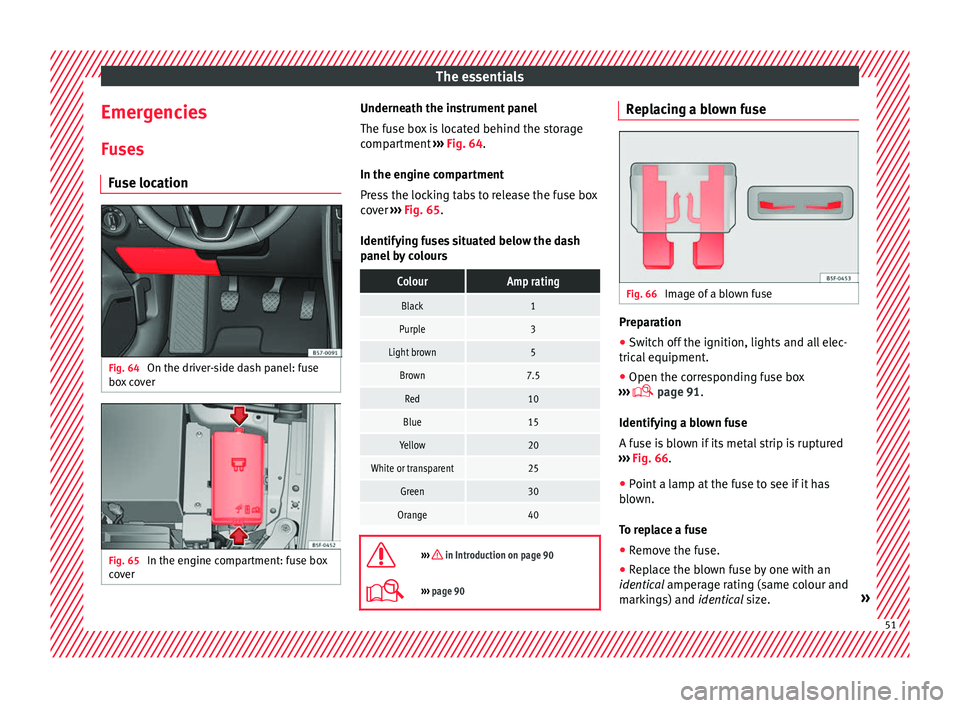
Fuse location Fig. 64
On the driver-side dash panel: fuse
bo x
cover Fig. 65
In the engine compartment: fuse box
c o
ver Underneath the instrument panel
The f
u
se box is located behind the storage
compartment ››› Fig. 64.
In the engine compartment
Press the locking tabs to release the fuse box
cover ››› Fig. 65.
Identifying fuses situated below the dash
panel by colours
ColourAmp rating
Black1
Purple3
Light brown5
Brown7.5
Red10
Blue15
Yellow20
White or transparent25
Green30
Orange40
››› in Introduction on page 90
›››
page 90 Replacing a blown fuse
Fig. 66
Image of a blown fuse Preparation
● Switch off the ignition, lights and all elec-
tric al
equipment.
● Open the corresponding fuse box
››
› page 91.
Identifying a blown fuse
A fuse is blown if its metal strip is ruptured
››› Fig. 66.
● Point a lamp at the fuse to see if it has
blo
wn.
To replace a fuse
● Remove the fuse.
● Replace the blown fuse by one with an
identic
al amperage rating (same colour and
markings) and identical size. » 51
Page 93 of 328
Fuses and bulbs
●
Nev er u
se a fuse with a higher value. Only
replace fuses with a fuse of the same amper-
age (same colour and markings) and size.
● Never repair a fuse.
● Never replace a fuse by a metal strip, staple
or simi
lar. CAUTION
● To pr
event damage to the vehicle's electric
system, before replacing a fuse always turn
off the ignition, the lights and all electrical
elements and remove the key from the igni-
tion.
● If you replace a fuse with higher-rating
fu
se, you could cause damage to another part
of the electrical system.
● Protect the fuse boxes when open to pre-
vent
the entry of dust or humidity as they can
damage the electrical system. Note
● One c omponent
may have more than one
fuse.
● Several components may run on a single
fu
se. Vehicle fuses
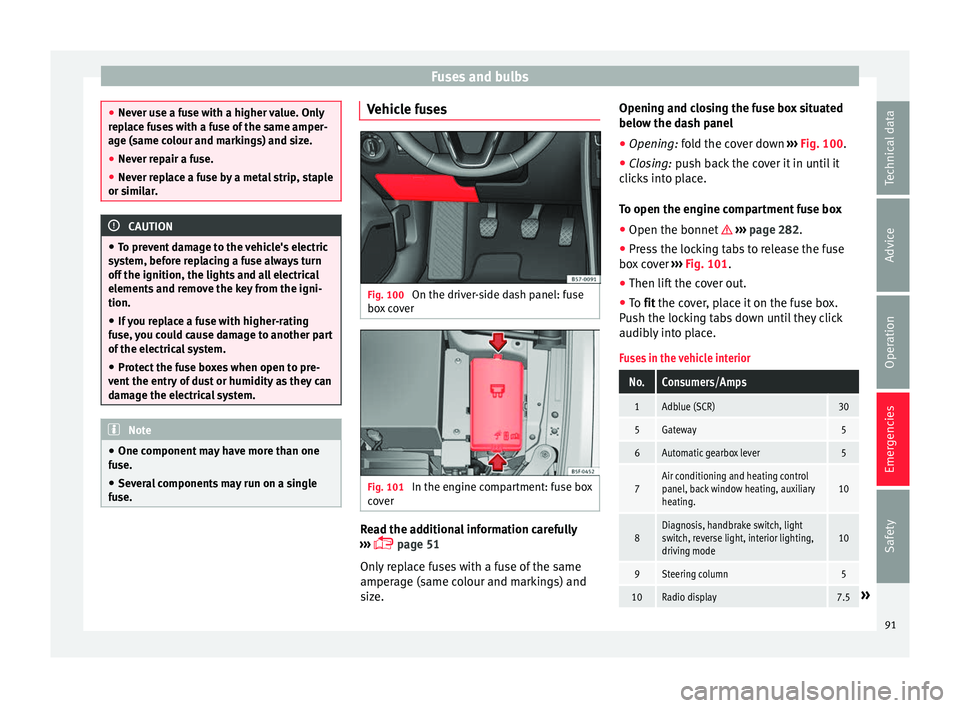
Fig. 100
On the driver-side dash panel: fuse
bo x
cover Fig. 101
In the engine compartment: fuse box
c o
ver Read the additional information carefully
› ›
› page 51
Only replace fuses with a fuse of the same
amperage (same colour and markings) and
size. Opening and closing the fuse box situated
below the d
ash panel
● Opening: fold the cover down ›
›› Fig. 100.
● Closing: push back the cover it in until it
c
licks into place.
To open the engine compartment fuse box
● Open the bonnet ››
› page 282.
● Press the locking tabs to release the fuse
box
cover ››› Fig. 101.
● Then lift the cover out.
● To fit the cover, place it on the fuse box.
P
ush the locking tabs down until they click
audibly into place.
Fuses in the vehicle interior
No.Consumers/Amps
1Adblue (SCR)30
5Gateway5
6Automatic gearbox lever5
7Air conditioning and heating control
panel, back window heating, auxiliary
heating.10
8Diagnosis, handbrake switch, light
switch, reverse light, interior lighting,
driving mode10
9Steering column5
10Radio display7.5» 91
Technical data
Advice
Operation
Emergencies
Safety
Page 111 of 328
Communications and multimedia
Communications and multimedia
St eerin
g wheel controls*
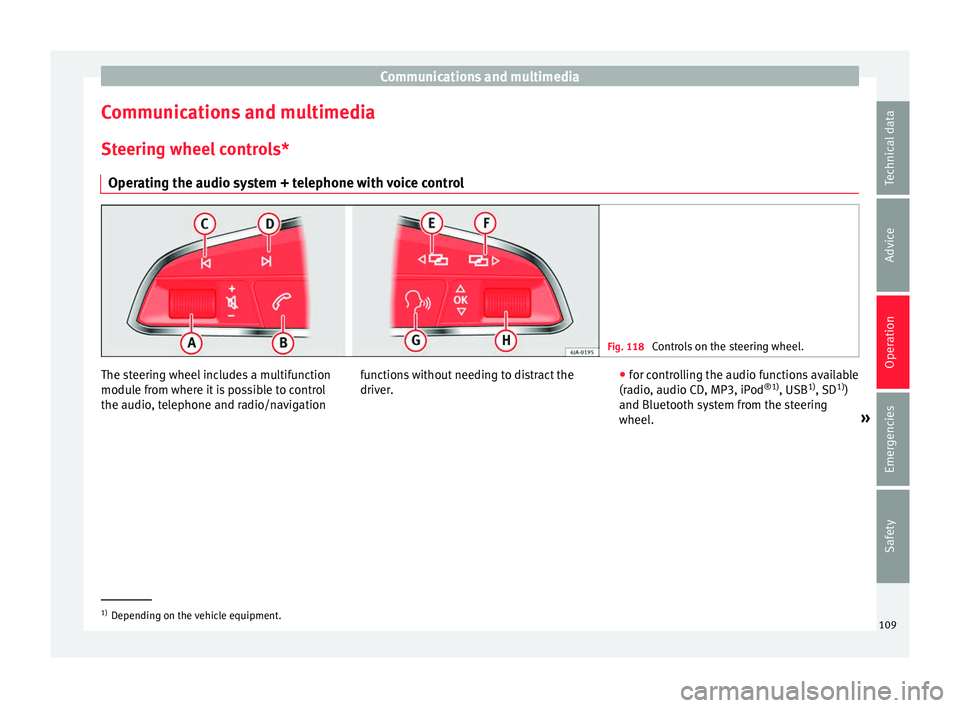
Operating the audio system + telephone with voice control Fig. 118
Controls on the steering wheel. The steering wheel includes a multifunction
modu
l
e from where it is possible to control
the audio, telephone and radio/navigation functions without needing to distract the
driver
. ●
for c ontrolling the audio functions available
(radio, audio CD, MP3, iPod ®1)
, USB 1)
, SD 1)
)
and Bluetooth system from the steering
wheel. »1)
Depending on the vehicle equipment.
109
Technical data
Advice
Operation
Emergencies
Safety
Page 160 of 328
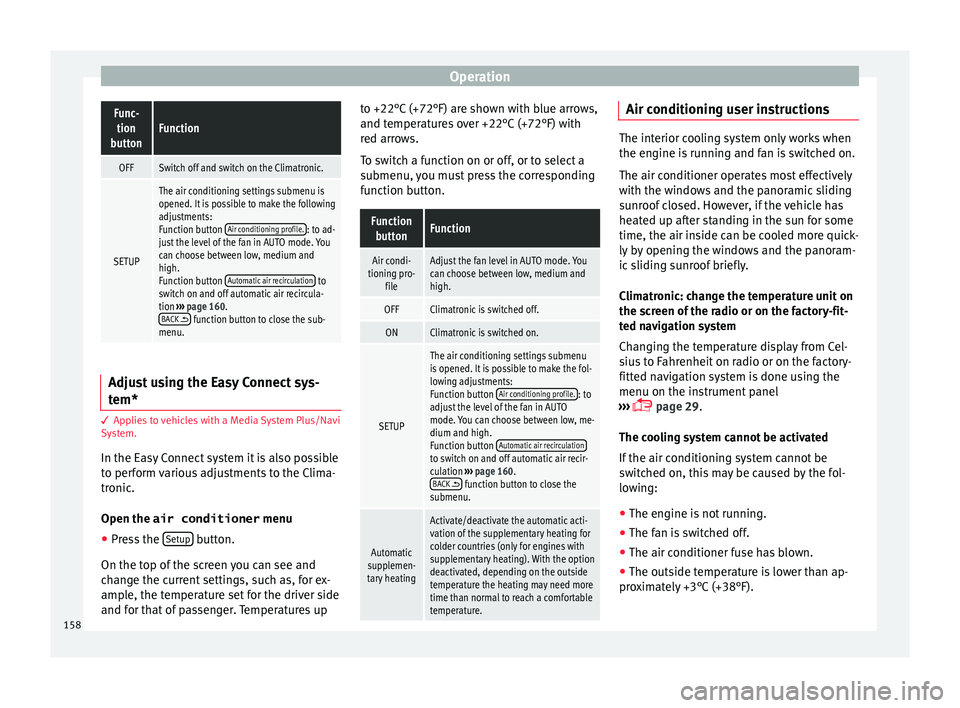
OperationFunc-
tion
buttonFunction
OFFSwitch off and switch on the Climatronic.
SETUP
The air conditioning settings submenu is
opened. It is possible to make the following
adjustments:
Function button Air conditioning profile.
: to ad-
just the level of the fan in AUTO mode. You
can choose between low, medium and
high.
Function button Automatic air recirculation
to
switch on and off automatic air recircula-
tion ››› page 160.
BACK
function button to close the sub-
menu. Adjust using the Easy Connect sys-
t
em* 3 Ap
p
lies to vehicles with a Media System Plus/Navi
System.
In the Easy Connect system it is also possible
to perform various adjustments to the Clima-
tronic.
Open the air conditioner menu
● Press the Set
up button.
On the t op of
the screen you can see and
change the current settings, such as, for ex-
ample, the temperature set for the driver side
and for that of passenger. Temperatures up to +22°C (+72°F) are shown with blue arrows,
and temper
atures over +22°C (+72°F) with
red arrows.
To switch a function on or off, or to select a
submenu, you must press the corresponding
function button.
Function buttonFunction
Air condi-
tioning pro- fileAdjust the fan level in AUTO mode. You
can choose between low, medium and
high.
OFFClimatronic is switched off.
ONClimatronic is switched on.
SETUP
The air conditioning settings submenu
is opened. It is possible to make the fol-
lowing adjustments:
Function button Air conditioning profile.
: to
adjust the level of the fan in AUTO
mode. You can choose between low, me-
dium and high.
Function button Automatic air recirculation
to switch on and off automatic air recir-
culation
››› page 160.
BACK
function button to close the
submenu.
Automatic
supplemen-
tary heating
Activate/deactivate the automatic acti-
vation of the supplementary heating for
colder countries (only for engines with
supplementary heating). With the option
deactivated, depending on the outside
temperature the heating may need more
time than normal to reach a comfortable
temperature. Air conditioning user instructions
The interior cooling system only works when
the en
gine i
s running and fan is switched on.
The air conditioner operates most effectively
with the windows and the panoramic sliding
sunroof closed. However, if the vehicle has
heated up after standing in the sun for some
time, the air inside can be cooled more quick-
ly by opening the windows and the panoram-
ic sliding sunroof briefly.
Climatronic: change the temperature unit on
the screen of the radio or on the factory-fit-
ted navigation system
Changing the temperature display from Cel-
sius to Fahrenheit on radio or on the factory-
fitted navigation system is done using the
menu on the instrument panel
››› page 29.
The cooling system cannot be activated
If the air conditioning system cannot be
switched on, this may be caused by the fol-
lowing: ● The engine is not running.
● The fan is switched off.
● The air conditioner fuse has blown.
● The outside temperature is lower than ap-
pr o
ximately +3°C (+38°F).
158
Page 281 of 328
Checking and refilling levels
CAUTION
● The v
ehicle is not designed for the use of
FAME fuel (biodiesel). The fuel system would
be damaged if you used biodiesel.
● Do not mix fuel additives, the so-called
“thinners”, petr
ol or similar additives with
diesel fuel.
● If poor-quality diesel fuel is used, it may be
nece
ssary to drain the fuel filter more fre-
quently than is specified in the Maintenance
Programme. We recommend having this done
by a specialised workshop. If water is allowed
to collect in the filter, this can cause engine
performance problems. Exhaust purification system for
v
ehic
les with diesel engines
(AdBlue ®
)
Introduction To reduce emissions, SCR (Selective Catalytic
R
eduction) c
an be used in vehicles with die-
sel engines. Through the special urea solu-
tion AdBlue ®
, SCR transforms nitrogen ox-
ides into nitrogen and water.
AdBlue ®
is stored in a separate tank in the
vehicle ›››
page 280. WARNING
If the level of AdBlue ®
is
too low and the igni-
tion is switched off, it will no longer be possi-
ble to re-start the engine. Not even by jump-
starting the car!
● Insert enough AdBlue ®
when the dis
tance
to empty is approx. 1000 km, at the latest.
● Never run the AdBlue ®
tank
completely dry. WARNING
AdBlue ®
is an irritant, corrosive liquid that
c
an cause injuries if it comes into contact
with the skin, eyes or respiratory organs.
● Before opening an AdBlue ®
rec
ipient, al-
ways take the manufacturer's instructions for
use into account. If the instructions are fol-
lowed correctly, it is not likely that the user
will come into contact with AdBlue ®
.
● If AdBlue ®
come
s into contact with your
eyes, rinse it immediately with plenty of wa-
ter for at least 15 minutes before seeking
medical attention.
● If AdBlue ®
come
s into contact with your
skin, rinse with water for at least 15 minutes
and, in case of skin irritation, seek medical
attention immediately.
● If you accidentally swallow AdBlue ®
, rinse
y
our mouth with plenty of water for at least
15 minutes. Do not induce vomiting unless
advised to by a doctor. Seek immediate medi-
cal attention. CAUTION
AdBlue ®
m ay damage the vehicle's painted
s
urfaces, plastic, upholstery and carpet,
among other things. In case of a spill, clean it
as soon as possible with a damp cloth and
plenty of cold water.
● Remove the AdBlue ®
that
has crystallised
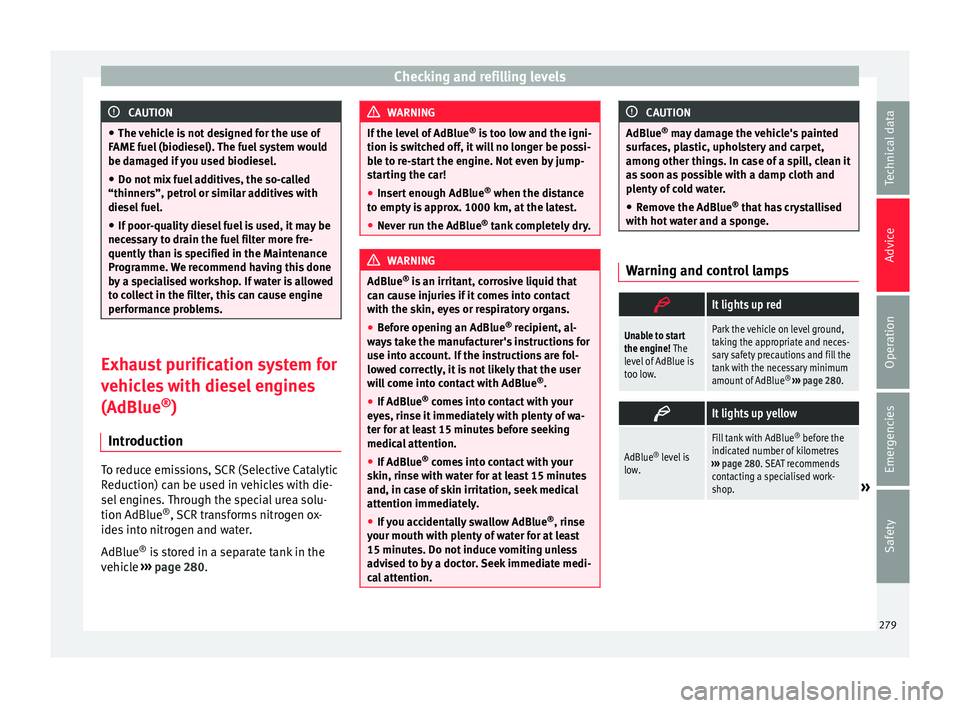
with hot water and a sponge. Warning and control lamps
It lights up red
Unable to start
the engine! The
level of AdBlue is
too low.Park the vehicle on level ground,
taking the appropriate and neces-
sary safety precautions and fill the
tank with the necessary minimum
amount of AdBlue ®
››› page 280.
It lights up yellow
AdBlue
®
level is
low.
Fill tank with AdBlue ®
before the
indicated number of kilometres
››› page 280. SEAT recommends
contacting a specialised work-
shop.
» 279
Technical data
Advice
Operation
Emergencies
Safety
Page 282 of 328
Advice
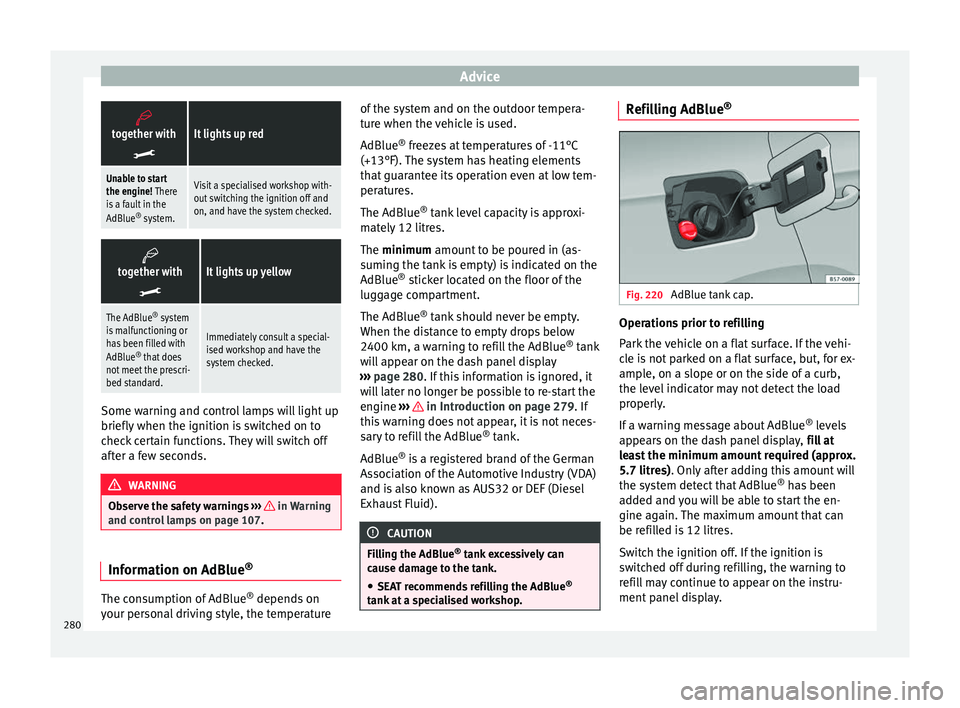
together with
It lights up red
Unable to start
the engine! There
is a fault in the
AdBlue ®
system.Visit a specialised workshop with-
out switching the ignition off and
on, and have the system checked.
together with
It lights up yellow
The AdBlue
®
system
is malfunctioning or
has been filled with
AdBlue ®
that does
not meet the prescri-
bed standard.
Immediately consult a special-
ised workshop and have the
system checked. Some warning and control lamps will light up
briefly
when the ignition i
s switched on to
check certain functions. They will switch off
after a few seconds. WARNING
Observe the safety warnings ››
› in Warning
and c ontr
ol lamps on page 107. Information on AdBlue
®The consumption of AdBlue
®
depend s
on
your personal driving style, the temperature of the system and on the outdoor tempera-
tur
e when the vehicle is used.
AdBlue ®
freezes at temperatures of -11°C
(+13°F). The system has heating elements
that guarantee its operation even at low tem-
peratures.
The AdBlue ®
tank level capacity is approxi-
mately 12 litres.
The minimum amount to be poured in (as-
suming the tank is empty) is indicated on the
AdBlue ®
sticker located on the floor of the
luggage compartment.
The AdBlue ®
tank should never be empty.
When the distance to empty drops below
2400 km, a warning to refill the AdBlue ®
tank
will appear on the dash panel display
››› page 280. If this information is ignored, it
will later no longer be possible to re-start the
engine ››› in Introduction on page 279. If
thi s
warning does not appear, it is not neces-
sary to refill the AdBlue ®
tank.
AdBlue ®
is a registered brand of the German
Association of the Automotive Industry (VDA)
and is also known as AUS32 or DEF (Diesel
Exhaust Fluid). CAUTION
Filling the AdBlue ®
tank
excessively can
cause damage to the tank.
● SEAT recommends refilling the AdBlue ®
tank
at a specialised workshop. Refilling AdBlue
® Fig. 220
AdBlue tank cap. Operations prior to refilling
P
ark
the vehicle on a flat surface. If the vehi-
cle is not parked on a flat surface, but, for ex-
ample, on a slope or on the side of a curb,
the level indicator may not detect the load
properly.
If a warning message about AdBlue ®
levels
appears on the dash panel display, fill at
least the minimum amount required (approx.
5.7 litres). Only after adding this amount will
the system detect that AdBlue ®
has been
added and you will be able to start the en-
gine again. The maximum amount that can
be refilled is 12 litres.
Switch the ignition off. If the ignition is
switched off during refilling, the warning to
refill may continue to appear on the instru-
ment panel display.
280
Page 283 of 328
Checking and refilling levels
Opening the tank filling neck
● Open the fuel tank flap.
● Unscrew the tank cap by turning it in an an-
ti-c loc
kwise direction.
Fill with a refill bottle
Only use AdBlue ®
that complies with ISO
22241-1. Only use original containers.
● Please observe the manufacturer's instruc-
tions, indic
ated on the refill bottle.
● Check the expiry date.
● Remove the cap of the refill bottle.
● Insert the neck of the bottle in the tank fill-
er neck
vertically and screw the bottle on by
hand, by turning it in a clockwise direction.
● Press the refill bottle in the direction of the
fil
ler neck and hold it in this position.
● Wait until the contents of the refill bottle
hav
e been poured into the AdBlue ®
tank. Do
not compress or break the bottle!
● Turn the bottle in a counter-clockwise direc-
tion and gently
pull it upwards ››› .
● The AdBlue ®
tank
is full when no more liq-
uid comes out of the bottle.
Closing the tank filling neck
● Screw on the tank cap in a clockwise direc-
tion unti
l it is tightly closed.
● Close the fuel tank flap. Operations before driving
●
After refilling the tank, only
switch on the
ignition.
● Leave the ignition on for at least 30 sec-
onds
for the system to detect the fluid load.
● Make sure you wait for at least 30 seconds
befor
e starting the engine! WARNING
AdBlue ®
shou l
d only be stored in the original
container, which should be tightly closed and
kept in a safe place.
● Never keep AdBlue ®
in empty f
ood contain-
ers, bottles or other similar containers. Other
people may confuse it for other products.
● Keep AdBlue ®
out of
the reach of children. CAUTION
● On ly
use AdBlue ®
that complies with ISO
22241-1. Only use original containers.
● Never mix AdBlue ®
with w
ater, fuel or addi-
tives. Any type of damage caused by such a
mixture will not be covered by the warranty.
● Never pour AdBlue ®
into the f
uel tank. This
could result in engine damage.
● Do not carry the refill bottle inside the vehi-
cl
e. If there is a leak (due to temperature
changes or damage to the bottle), the
AdBlue ®
may damage the vehicle. For the sake of the environment
Dispose of the refill bottle in an environment-
friendly m
anner. Note
You can buy refill bottles that are adequate
f or AdBlue ®
u
se at SEAT dealerships. 281
Technical data
Advice
Operation
Emergencies
Safety