maintenance Seat Ateca 2018 User Guide
[x] Cancel search | Manufacturer: SEAT, Model Year: 2018, Model line: Ateca, Model: Seat Ateca 2018Pages: 348, PDF Size: 7.32 MB
Page 289 of 348
Care and maintenance
–
the bonnet mu s
t be closed.
– switch the ignition on and off.
– press the windscreen wiper lever forward
briefly (windscreen washer function).
This will lock the wiper arms. For the sake of the environment
The car should only be washed in special
w ash b
ays. These areas are prepared to pre-
vent oily water from getting into the public
drains. In some places, washing vehicles out-
side the areas intended for this purpose is
prohibited. Camera sensors and lenses
●
Use a small brush to remove snow and a
de-ic er s
pr
ay to remove ice.
● Clean the sensors with a solvent-free prod-
uct and a soft, dr
y cloth.
● Moisten the camera lens using a standard
alcohol-b
ased glass cleaning agent and
clean the lens with a dry cloth. In the active
lane assist*, the area in front of the lens is
normally cleaned with the windscreen wash-
er. CAUTION
● When y ou c
lean the vehicle with a pressure
washer: –
Sta y
a suitable distance from the sensors
on the front and rear bumpers.
– Do not clean the camera lenses or sur-
rounding area with the pressure washer.
● Never use warm or hot water to remove
snow and ic
e from the reverse camera lens,
as it could crack the lens.
● Never use abrasive cleaning agents on the
lens. Waxing and polishing
Care
W
ax
in
g protects the paintwork. It is time to
apply a coat of good wax when water no lon-
ger forms droplets and rolls off the clean
paintwork.
Even if a wax solution is used regularly in the
vehicle washing tunnel, it is advisable to pro-
tect the paint with a hard wax coating at least
twice a year.
In the summer, you will find it is much easier
to remove dead insects (which accumulate
on the bumper and the front of the bonnet) if
the car has been treated with care products
recently.
Polishing
Polishing is only necessary if the paint has
lost its shine, and the gloss cannot be
brought back by putting on wax. If the polish does not contain wax, a wax
product shou
ld be applied after polishing. CAUTION
● Do not u se po
lishes and hard wax on pain-
ted parts with a matt finish or on plastic
parts.
● Do not apply paint polishes to the side trim
that ru
ns around the panoramic roof and ends
on the windscreen. However, it can be treated
with hard wax. Trims
In respect for the environment, the silver-
p
l
at
ed trims on the body are made of pure
aluminium (they do not contain chrome).
Dirt or marks on the trim mouldings should
be removed with a cleaning product with a
neutral PH (do not use a chrome cleaner).
Body polish is also unsuitable for use on trim
mouldings. The intensive cleaning fluids of-
ten used before the car goes into a car wash
may contain alkaline substances, which can
cause dull or milky patches when they dry
out.
SEAT Official Services carry stocks of cleaning
products which have been tested for use on
your vehicle and are not harmful to the envi-
ronment.
287
Technical data
Advice
Operation
Emergencies
Safety
Page 291 of 348
Care and maintenance
WARNING
Please note when cleaning the wheels that
wat er
, ice and road salt can impair the effec-
tiveness of the brakes; this can cause an acci-
dent. Exhaust pipe
It is important to remove road salt and brake
dus
t
by washing the wheels at regular inter-
vals, otherwise the exhaust tail pipe material
could be damaged. To remove impurities, do
not use rim, paint or chrome cleaners or oth-
er abrasive products. Clean the exhaust tail
pipes with cleaning products that are suita-
ble for stainless steel.
SEAT Official Services carry stocks of cleaning
products that have been tested and ap-
proved for use on your vehicle.
Caring for the vehicle interior Scr een f
or the radio/Easy Connect*
and control panel* The display can be cleaned with a soft cloth
and a pr
of
e
ssionally available “LCD cleaner”.
Moisten the cloth with a small amount of the
cleaning fluid. The Easy Connect control panel* should first
be cle
aned with a brush so that no dirt goes
into the device or between the keys and
housing. Next, we recommend cleaning the
Easy Connect control panel* using a cloth
dampened with water and washing-up liquid. CAUTION
● To av oid s
cratching the screen, do not wipe
the display with a dry cloth.
● To avoid damage, ensure that no liquid
goes
into the Easy Connect control panel*. Plastic and leatherette parts
Plastic parts and leatherette can be cleaned
w
ith a d
amp c
loth. If this is not sufficient,
plastic parts and leatherette should only be
treated with a special solvent-free plastic
cleaner.
Textile covers and trim parts Textile covers and trim parts (e.g. seats, door
trim) shou
l
d be c
leaned regularly with a vac-
uum cleaner. This will remove surface dirt
which could otherwise be rubbed into the
textile material during use. Do not use steam
cleaners, as the steam could carry the dirt
deeper into the textile material. Normal cleaning
We rec
ommend that you use a soft sponge or
a commercially available lint-free, micro-fibre
cloth for normal cleaning. Only use brushes
on floor coverings and mats, as other textile
surfaces could become damaged.
In the case of normal surface dirt you can use
a foam cleaner. Use a sponge to spread the
foam on the textile surface and to work it into
the material lightly. However, make sure that
the textile material does not become soaking
wet. Then dab off the foam with a dry and ab-
sorbent cloth (e.g. a micro-fibre cloth) and
vacuum off any residue once the surface is
completely dry.
Cleaning stains
Treat drink stains (such as coffee or fruit
juice, etc.) with a cleaning solution for deli-
cate fabrics. This solution should be applied
with a sponge. If the stains are difficult to re-
move, a washing paste can be applied direct-
ly onto the stain and worked into the fabric.
The surface will then have to be wiped with
clear water to remove any residue left by the
paste. To do so, use a damp cloth or sponge
and then dab the stain with an absorbent
cloth.
Remove chocolate or make-up stains with a
cleaning paste (for e.g., soft soap). Then re-
move the soap with water (wet sponge). »
289
Technical data
Advice
Operation
Emergencies
Safety
Page 293 of 348
Care and maintenance
Cleaning and care of leather uphols-
t er
y Natural leather requires an extra degree of at-
tention and c
ar
e.
Normal cleaning
– Moisten a cotton or woollen cloth with wa-
ter and wipe o
ver the leather surfaces.
More stubborn dirt
– More stubborn dirt can be removed using a
mil d so
ap solution (pure liquid soap: two
tablespoons dissolved in one litre of wa-
ter).
– Do not let the water soak through the leath-
er or penetrate int
o the seams.
– Then wipe off with a soft, dry cloth.
Remov
al of stains
– Remove fresh water
-based stains such as
coffee, tea, juices, blood etc. with an ab-
sorbent cloth or kitchen roll, or use the
cleaning agent from the care set for dried-
on stains.
– Remove fresh grea
se-based stains that
have not penetrated the surface such as
butter, mayonnaise, chocolate, etc. with an
absorbent cloth or kitchen roll or with the
cleaning agent from the care set. –
Tre
at fat-based, dried-in stains with grease-
dissolving spray.
– Treat less common stains on le
ather, such
as ball-pen and other inks, felt-tip pens,
nail polish, dispersion paint, shoe cream
etc. with a special leather stain remover.
Leather maintenance
– The leather should be treated regularly
(about twic
e a year) with a special leather-
care product.
– Apply these products very sparingly.
– Then wipe off with a soft cloth.
Should
you have questions regarding the
care and cleaning of the leather upholstery in
your vehicle, we recommend that you contact
your SEAT Official Service. Our representa-
tives will be happy to advise you and tell you
about the product range for leather conserva-
tion, for example:
● Cleaning and care set.
● Coloured leather-care cream.
● Stain remover for ball-pen inks, shoe cream
etc.
● Gr
ease dissolving spray.
● New products and further developments CAUTION
On no account use solvents (such as petrol,
turpentine), w ax
polish, shoe cream or simi-
lar materials. Cleaning Alcantara upholstery
Removing dust and dirt
– Moisten a cloth just a lit
tle and wipe down
the seat covers.
Removing stains – Moisten a cloth with lukewarm water or di-
luted whit
e spirits.
– Dab at the stain. Start at the outside and
work in
wards.
– Dry the clean area with a soft cloth.
Do not use l
eather cleaning products on Al-
cantara seat covers.
You may use a suitable soap on dust and dirt.
Dust and grit in the pores and seams can
scratch and damage the surface. If the car is
left standing in the sun for long periods, Al-
cantara leather should be protected against
direct sunlight to prevent it from fading. How-
ever, slight colour variations will arise in nor-
mal use. »
291
Technical data
Advice
Operation
Emergencies
Safety
Page 297 of 348
Checking and refilling levels
We recommend the use of diesel
f uel which
complies to European standard EN 590. If
diesel fuel which meets European standard
EN 590 is not available, the Cetane number
(CZ) must, at minimum, be 51. If the engine
is equipped with a particulate filter, the sul-
phur content of the fuel must be below 50
parts per million.
Winter-grade diesel
Summer fuel becomes thicker in winter and it
is more difficult to start the engine. For this
reason, petrol stations in some countries al-
so offer winter diesel with improved fluidity
when cold (winter-grade diesel).
Water in the fuel filter 1)
If your vehicle has a diesel engine and is
equipped with a fuel filter with a water sepa-
rator, the instrument panel may display the
following warning: Water in the
fuel filter. If this is the case, take the
vehicle to a specialised workshop so that
they can drain the fuel filter. CAUTION
● The v ehic
le is not designed for the use of
FAME fuel (biodiesel). The fuel system would
be damaged if you used biodiesel. ●
Do not mi x
fuel additives, the so-called
“thinners”, petrol or similar additives with
diesel fuel.
● If poor-quality diesel fuel is used, it may be
neces
sary to drain the fuel filter more fre-
quently than is specified in the Maintenance
Programme. We recommend having this done
by a specialised workshop. If water is allowed to collect in the filter, this can cause engine
performance problems. AdBlue
®
Inf orm
ation on AdBlue ® The consumption of AdBlue
®
depend s
on
y
our personal driving style, the temperature
of the system and on the outdoor tempera-
ture when the vehicle is used.
AdBlue ®
freezes at temperatures of -11°C
(+13°F). The system has heating elements
that guarantee its operation even at low tem-
peratures.
The AdBlue ®
tank level capacity is approxi-
mately 11 litres.
The AdBlue ®
tank should never be empty.
When the distance to empty drops below
2400 km, a warning to refill the AdBlue ®
tank will appear on the dash panel display
›››
page 295. If this information is ignored,
later on it will not be possible to re-start the
engine. If this warning does not appear, it is
not necessary to refill the AdBlue ®
tank.
AdBlue ®
is a registered brand of the German
Association of the Automotive Industry (VDA)
and is also known as AUS32 or DEF (Diesel
Exhaust Fluid). CAUTION
Filling the AdBlue ®
tank e
xcessively can
cause damage to the tank. Refilling AdBlue
® Fig. 238
AdBlue tank cap. »1)
Valid for the market: Algeria.
295
Technical data
Advice
Operation
Emergencies
Safety
Page 302 of 348
Advice
WARNING
● For s af
ety reasons the bonnet must always
be completely closed when the vehicle is
moving. Therefore, after closing the bonnet,
always check that the locking element is
properly engaged. This is the case if the bon-
net is flush with the adjacent body panels.
● Should you notice that the bonnet is not
safely
secured when the vehicle is moving,
stop the vehicle immediately and close the
bonnet. Failure to follow this instruction
could result in an accident. Engine oil
Gener a
l
notesThe engine comes with a special, multi-grade
oi
l
th
at can be used all year round.
Because the use of high-quality oil is essen-
tial for the correct operation of the engine
and its long useful life, when topping up or
changing oil, use only those oils that comply
with VW standards.
The specifications (VW standards) set out in
the following page should appear on the con-
tainer of the service oil; when the container
displays the specific standards for petrol and
diesel engines together, it means that the oil
can be used for both types of engines. We recommend that the oil change indicated
in the Mainten
ance Programme, be per-
formed by a technical service or specialised
workshop.
The correct oil specifications for your engine
are listed in the ›››
page 58, Engine oil
specifications.
Service intervals
Service intervals can be flexible (LongLife
service) or fixed (dependent on time/dis-
tance travelled).
If the PR code that appears on the back of the
Maintenance Programme booklet is PR QI6,
this means that your vehicle has the LongLife
service programmed. If it lists the codes QI1,
QI2, QI3, QI4 or QI7, the interval service is
dependent on time/distance travelled.
Flexible service intervals (LongLife service
intervals*)
Special oils and processes have been devel-
oped which, depending on the characteris-
tics and individual driving profiles, enable
the extension of the oil change service (Long-
Life service intervals).
Because this oil is essential for extending the
service intervals, it must only be used ob-
serving the following indications:
● Avoid mixing it with oil for fixed service in-
terv
als. ●
Only in e
xceptional circumstances, if the
engine oil level is too low ››› page 301,
Checking engine oil level and LongLife oil is
not available, it is permitted to top up (once)
with oil for fixed service intervals
››› page 58 (up to a maximum of 0.5 li-
tres).
Fixed service intervals*
If your vehicle does not have the “LongLife
service interval” or it has been disabled (by
request), you may use oils for fixed service
intervals, which also appear in
››› page 58, Engine oil specifications
. In
this case, your vehicle must be serviced after
a fixed interval of 1 year/15,000 km (10,000
miles)(whatever comes first) ››› Booklet
Maintenance Programme.
● In exceptional circumstances, if the engine
oil l
evel is too low ››› page 301, Checking en-
gine oil level and you cannot obtain the oil
specified for your vehicle, you can add a
small quantity of oil conforming to the speci-
fication ACEA A2 or ACEA A3 (petrol engines)
or ACEA B3 or ACEA B4 (diesel engines) (up
to 0.5 l).
Vehicles with diesel particulate filter*
The Maintenance Programme states whether
your vehicle is fitted with a diesel particulate
filter.
300
Page 304 of 348
Advice
WARNING
Oil is highly inflammable! Ensure that no oil
come s
into contact with hot engine compo-
nents when topping up. CAUTION
If the oil level is above area ›››
Fig. 240 A , do
not s t
art the engine. This could result in dam-
age to the engine and catalytic converter.
Contact a specialised workshop. For the sake of the environment
The oil level must never be above area
›› ›
Fig. 240 A . Otherwise oil can be drawn in
through the c r
ankcase breather and escape
into the atmosphere via the exhaust system. Note
Before a long trip, we recommend finding an
engine oi l
that conforms to the correspond-
ing VW specifications and recommend keep-
ing it in the vehicle. This way, the correct en-
gine oil will always be available for a top-up if
needed. Changing engine oil
Read the additional information carefully
› ›
›
page 57.
The engine oil must be changed at the inter-
vals given in the service schedule. We recommend that you have the engine oil
chan
ged by a Technical Service.
The oil change intervals are shown in the
Maintenance Programme. WARNING
Only change the engine oil yourself if you
hav e the s
pecialist knowledge required!
● Before opening the bonnet, read and ob-
serve the w
arnings ››› page 298.
● Wait for the engine to cool down. Hot oil
may
cause burn injuries.
● Wear eye protection to avoid injuries, such
as ac
id burns, caused by splashes of oil.
● When removing the oil drain plug with your
finger
s, keep your arm horizontal to help pre-
vent oil from running down your arm.
● Wash your skin thoroughly if it comes into
contact
with engine oil.
● Engine oil is poisonous! Used oil must be
stor
ed in a safe place out of the reach of chil-
dren. CAUTION
No additives should be used with engine oil.
This c
ould result in engine damage. Any dam-
age caused by the use of such additives
would not be covered by the factory warranty. For the sake of the environment
● Bec au
se of disposal problems and the spe-
cial tools and specialist knowledge required,
we recommend that you have the engine oil
and filter changed by a Technical Service.
● Never pour oil down drains or into the
ground.
● U
se a suitable container when draining the
used oil
. It must be large enough to hold all
the engine oil. Cooling system
Top
pin
g up coolant Read the additional information carefully
› ›
›
page 58
Top up coolant when the level is below the
MIN (minimum) mark.
Checking coolant level
– Park the vehicle in a horizontal position.
– Switch the ignition off.
– Read off the coolant level on coolant ex-
pans
ion tank. When the engine is cold, the
coolant level should be between the marks.
When the engine is hot, it may be slightly
above the upper mark.
302
Page 307 of 348
Checking and refilling levels
CAUTION
● Do not mi x
cleaning products recommen-
ded by SEAT with other products. This could
lead to flocculation and may block the wind-
screen washer jets.
● When topping up service fluids, make abso-
lutely c
ertain that you fill the fluids into the
correct reservoirs. Using the wrong fluids
could cause serious malfunctions and engine
damage!
● Not having windscreen wiper fluid reduces
vis
ibility through the windscreen, and leads
to loss of visibility in headlights in models
with headlight washer. Battery
Gener a
l
informationRead the additional information carefully
› ›
›
page 59.
The battery is located in the engine compart-
ment and is almost maintenance-free. It is
checked as part of the Inspection Service.
Nevertheless, check the terminals are clean
and have the correct tightening torque, espe-
cially in summer and winter.
Disconnecting the battery
The battery should only be disconnected in
exceptional cases. When the battery is dis- connected, some of the vehicle's functions
are “los
t” (››› table on page 305). These
functions will require resetting after the bat-
tery is reconnected.
Deactivate the anti-theft alarm* before you
disconnect the battery Otherwise the alarm
will be triggered.
FunctionReprogramming
One-touch function of
the electric windows››› page 141, One-touch
opening and closing.
Remote control key
If the vehicle does not re-
spond to the key, they
should be synchronised
››› page 134.
Digital clock››› page 116.
ESC warning lampAfter driving for a few me-
tres, the warning lamp goes
out again. If the vehicle is not used for long periods
The
v
ehic
le has a system for monitoring the
current consumption when the engine is left
unused for long periods of time ››› page 203.
Some functions, such as the interior lights, or
the remote door opening, may be temporarily
disabled to prevent the battery from running
flat. These functions will come back on as
soon as the ignition is switched on and the
engine started. Winter conditions
During the w
inter, the starting power may be
reduced, and if necessary, the battery should
be charged ››› in Important safety warn-
in g
s
for handling a vehicle battery on
page 306
Important safety warnings for han-
dling a v
ehicle battery All work on batteries requires specialist
kno
wl
edg
e. Please refer to a SEAT Official
Service or a workshop specialising in batter-
ies: risk of burns or exploding battery!
The battery must not be opened. Never try to
change the fluid level of the battery. Other-
wise explosive gas is released from the bat-
tery that could cause an explosion.
Wear eye protection.
Battery acid is very corrosive and caustic. Wear
protective gloves and eye protection. In the event
of electrolyte splashes, rinse off with plenty of
water.
Fires, sparks, open flames and smoking are pro-
hibited.
The battery should only be charged in a well-ven-
tilated zone. Risk of explosion!
Keep children away from acid and batteries!»
305
Technical data
Advice
Operation
Emergencies
Safety
Page 319 of 348
Technical specifications
Technical data
T ec
hnic
al specifications
Important The information in the vehicle documentation
alwa
y
s takes precedence over the informa-
tion in this Instruction Manual.
All technical specifications provided in this
documentation are valid for the standard
model in Spain. The vehicle data card inclu-
ded in the Maintenance Programme or the
vehicle registration documents shows which
engine is installed in the vehicle.
The figures may be different depending
whether additional equipment is fitted, for
different models, for special vehicles and for
other countries. Abbreviations used in the Technical Specifi-
cation
s
section
kWKilowatt, engine power measurement.
PSPferdestärke (horsepower), formerly used
to denote engine power.
rpmRevolutions per minute - engine speed.
NmNewton metres, unit of engine torque.
CZCetane number, indication of the diesel
combustion power.
RONResearch octane number, indication of
the knock resistance of petrol. Vehicle identification data
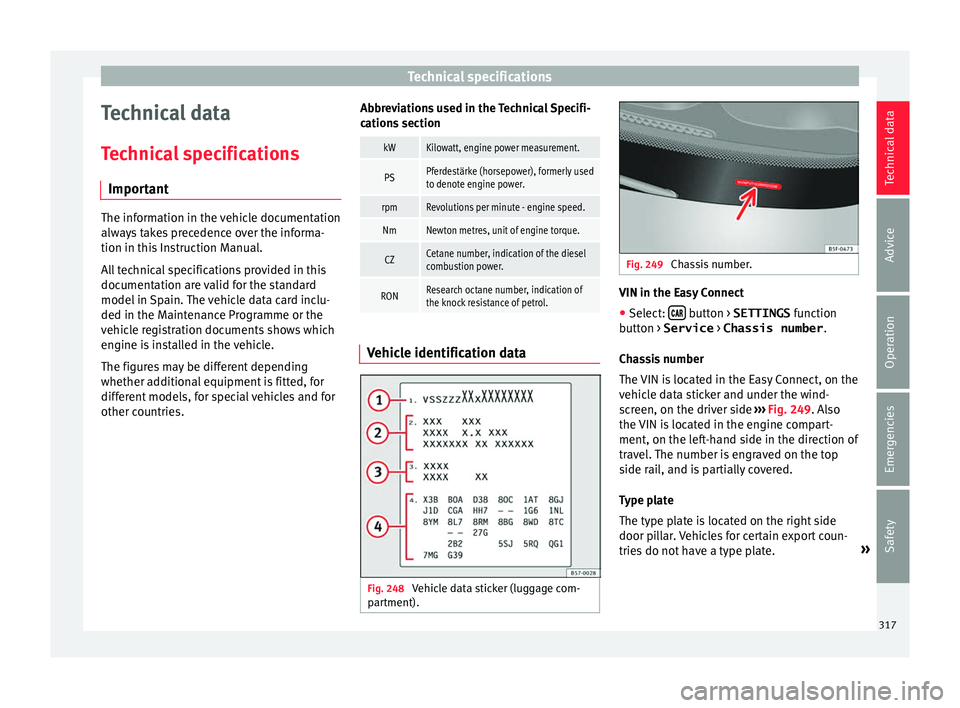
Fig. 248
Vehicle data sticker (luggage com-
p ar tment). Fig. 249
Chassis number. VIN in the Easy Connect
● Select:
button > SETTINGS
fu
nction
b
utton > Service > Chassis number .
Chassis number
The VIN is located in the Easy Connect, on the
vehicle data sticker and under the wind-
screen, on the driver side ››› Fig. 249. Also
the VIN is located in the engine compart-
ment, on the left-hand side in the direction of
travel. The number is engraved on the top
side rail, and is partially covered.
Type plate
The type plate is located on the right side
door pillar. Vehicles for certain export coun-
tries do not have a type plate. »
317
Technical data
Advice
Operation
Emergencies
Safety
Page 320 of 348
Technical data
Vehicle data sticker
The v
ehic
le data sticker is under the carpet
trim in the luggage compartment, in the
spare wheel well. A sticker with the vehicle
data is attached to the inside cover of the
Maintenance Programme.
The following information is provided on the
vehicle data sticker: ››› Fig. 248
Vehicle identification number (chassis
number)
Vehicle type, model, capacity, engine
type, finish, engine power and gearbox
type
Engine code, gearbox code, external
paint code and internal equipment code
Optional extras and PR numbers
Identifying letters
The identifying letters of the engine can be
viewed on the instrument panel when the en-
gine is switched off and the ignition is on.
● Hold down the button 0.0/SET on the dash
p anel
f
or more than 15 seconds.
1 2
3
4 Information on fuel consump-
tion
Fuel
c
onsumption Approved consumption values are derived
from me
a
surements performed or supervised
by certified EU laboratories, according to the
legislation in force at the time (for more infor-
mation, see the Publications Office of the Eu-
ropean Union on the EUR-Lex website: © Eu-
ropean Union, http://eur-lex.europa.eu/) and
apply to the specified vehicle characteristics.
The values relating to fuel consumption and
CO 2 emissions can be found in the documen-
tation provided to the purchaser of the vehi-
cle at the time of purchase.
Fuel consumption and CO 2 emissions depend
on the equipment/features of each individual
vehicle, as well as on the driving style, road
conditions, traffic conditions, environmental
conditions, load or number of passengers. Note
In practice, and considering all the factors
mentioned here, c on
sumption values can dif-
fer from those calculated in the current Euro-
pean regulations. Weights
Kerb weight refers to the basic model with a
fuel
t
ank filled to 90% capacity and without
optional extras. The figure quoted includes
75 kg to allow for the weight of the driver.
Special versions, optional equipment fittings
or retro-fitting accessories will increase the
weight of the vehicle ››› .
WARNING
● Ple a
se note that the centre of gravity may
shift when transporting heavy objects; this
may affect vehicle handling and lead to an ac-
cident. Always adjust your speed and driving
style to suit road conditions and require-
ments.
● Never exceed the gross axle weight rating
or the gros
s vehicle weight rating. If the per-
missible axle load or the permissible total
weight is exceeded, the driving characteris-
tics of the vehicle may change, which could
lead to accidents, injuries and damage to the
vehicle. 318
Page 335 of 348

Index
Emergency operation front
p
assenger door . . . . . . . . . . . . . . . . . . . . . 16
selector lever . . . . . . . . . . . . . . . . . . . . . . . . . . . 49
Emission control system control lamp . . . . . . . . . . . . . . . . . . . . . . . . . . . 205
Emissions data . . . . . . . . . . . . . . . . . . . . . . . . . . . 317
Engine assisted starting . . . . . . . . . . . . . . . . . . . . . . . . . 69
noises . . . . . . . . . . . . . . . . . . . . . . . . . . . . . . . . 185
preheating . . . . . . . . . . . . . . . . . . . . . . . . . . . . 181
running in . . . . . . . . . . . . . . . . . . . . . . . . . . . . . 201
Start-Stop system . . . . . . . . . . . . . . . . . . . . . . . 208
starting . . . . . . . . . . . . . . . . . . . . . . . . . . . . . . . 181
starting up (driver messages with the mechan-ical contact) . . . . . . . . . . . . . . . . . . . . . . . . . . 181
switching off (key) . . . . . . . . . . . . . . . . . . . . . . 182
Engine and ignition automatic ignition switch-off . . . . . . . . . . . . . . 183
My Beat . . . . . . . . . . . . . . . . . . . . . . . . . . . . . . . 185
preheating the engine . . . . . . . . . . . . . . . . . . . 184
starting the engine . . . . . . . . . . . . . . . . . . . . . . 184
starting the engine with Press & Drive . . . . . . 184
stopping the engine . . . . . . . . . . . . . . . . . . . . . 185
Engine compartment . . . . . . . . . . . . . . . . . . 17, 298 battery . . . . . . . . . . . . . . . . . . . . . . . . . . . . 59, 305
brake fluid . . . . . . . . . . . . . . . . . . . . . . . . . 59, 303
closing the bonnet . . . . . . . . . . . . . . . . . . . . . . 299
coolant . . . . . . . . . . . . . . . . . . . . . . . . . . . 58, 302
engine oil . . . . . . . . . . . . . . . . . . . . . . . . . 57, 301
opening the bonnet . . . . . . . . . . . . . . . . . . . . . 299
safety notes . . . . . . . . . . . . . . . . . . . . . . . . . . . 298
windscreen washer reservoir . . . . . . . . . . 59, 304
Engine coolant . . . . . . . . . . . . . . . . . . . . . . . . . . . . 58 G 12 plus-plus . . . . . . . . . . . . . . . . . . . . . . . . . . 58
G 13 . . . . . . . . . . . . . . . . . . . . . . . . . . . . . . . . . . . 58
specifications . . . . . . . . . . . . . . . . . . . . . . . . . . . 58
Engine data . . . . . . . . . . . . . . . . . . . . . . . . . . . . . . 320 Engine fault
contro l lamp . . . . . . . . . . . . . . . . . . . . . . . . . . . 205
Engine management . . . . . . . . . . . . . . . . . . . . . . 204 control lamp . . . . . . . . . . . . . . . . . . . . . . . . . . . 205
Engine oil . . . . . . . . . . . . . . . . . . . . . . . . . . . 57, 300 changing . . . . . . . . . . . . . . . . . . . . . . . . . 300, 302
checking oil level . . . . . . . . . . . . . . . . . . . . . . . 301
consumption . . . . . . . . . . . . . . . . . . . . . . . . . . . 301
dipstick . . . . . . . . . . . . . . . . . . . . . . . . . . . . . . . 301
inspection service . . . . . . . . . . . . . . . . . . . . . . 300
maintenance intervals . . . . . . . . . . . . . . . . . . . 300
oil properties . . . . . . . . . . . . . . . . . . . . . . . . . . . 58
specifications . . . . . . . . . . . . . . . . . . . . . . . . . . 300
temperature display . . . . . . . . . . . . . . . . . . . . . . 42
topping up . . . . . . . . . . . . . . . . . . . . . . . . . . . . 301
Environment ecological driving . . . . . . . . . . . . . . . . . . . . . . . 201
environmental compatibility . . . . . . . . . . . . . . 201
Environmental tips filling the tank . . . . . . . . . . . . . . . . . . . . . . . . . 293
refuelling . . . . . . . . . . . . . . . . . . . . . . . . . . . . . . 292
Equipment . . . . . . . . . . . . . . . . . . . . . . . . . 162, 284
ESC electronic stability control (ESC) . . . . . . . . . . . 189
Multi-collision brake . . . . . . . . . . . . . . . . . . . . . 190
Sport Mode . . . . . . . . . . . . . . . . . . . . . . . . . . . . 191
Ethanol (fuel) . . . . . . . . . . . . . . . . . . . . . . . . . . . . 293
Event Data Recorder . . . . . . . . . . . . . . . . . . . . . . . . 94
Exhaust gas purification system catalytic converter . . . . . . . . . . . . . . . . . . . . . . 204
diesel particulate filter . . . . . . . . . . . . . . . . . . . 204
Exhaust pipe: cleaning . . . . . . . . . . . . . . . . . . . . 289
Exhaust purification system for vehicles with diesel engines . . . . . . . . . . . . . . . . . . . . . . . . . 295
Exiting a parking space with Park Assist . . . . . . 256
Exterior lighting changing a bulb . . . . . . . . . . . . . . . . . . . . . . . . 106 Exterior mirrors
adjus ting . . . . . . . . . . . . . . . . . . . . . . . . . . . . . . . 20
driving with a trailer . . . . . . . . . . . . . . . . . . . . . 275
Exterior rear-view mirrors adjusting the exterior rear-view mirrors . . . . . 155
exterior . . . . . . . . . . . . . . . . . . . . . . . . . . . . . . . 155
heated . . . . . . . . . . . . . . . . . . . . . . . . . . . . . . . . 155
Exterior view . . . . . . . . . . . . . . . . . . . . . . . . . . . . . 7, 8
External aerial . . . . . . . . . . . . . . . . . . . . . . . . . . . . 284
F Fastening rings . . . . . . . . . . . . . . . . . . . . . . . . . . . 165
Fatigue detection . . . . . . . . . . . . . . . . . . . . . . . . . 248
Filling the tank . . . . . . . . . . . . . . . . . . . . . . . . . . . 292
Floor mats . . . . . . . . . . . . . . . . . . . . . . . . . . . . . . . . 78
Fluid Level control . . . . . . . . . . . . . . . . . . . . . . . . . 56
Fog light bulb . . . . . . . . . . . . . . . . . . . . . . . . . . . . 108
Four-wheel drive snow chains . . . . . . . . . . . . . . . . . . . . . . . . . . . 206
towing . . . . . . . . . . . . . . . . . . . . . . . . . . . . . . . . . 99
winter tyres . . . . . . . . . . . . . . . . . . . . . . . . . . . . 206
Four wheel drive . . . . . . . . . . . . . . . . . . . . . . . . . . 206
Front airbags . . . . . . . . . . . . . . . . . . . . . . . . . . 21, 86
Front armrest . . . . . . . . . . . . . . . . . . . . . . . . . . . . 159
Front Assist . . . . . . . . . . . . . . . . . . . . . . . . . . . . . . 189 indications on the display . . . . . . . . . . . . . . . . 217
Front passenger front airbag control lamp . . . . . . . . . . . . . . . . . . . . . . . . . . . . 89
deactivation . . . . . . . . . . . . . . . . . . . . . . . . . . . . 22
Front seat manual adjustment . . . . . . . . . . . . . . . . . . . . . . 18
Fuel . . . . . . . . . . . . . . . . . . . . . . . . . . . . . . . . 56, 293 consumption . . . . . . . . . . . . . . . . . . . . . . . . . . . 318
diesel . . . . . . . . . . . . . . . . . . . . . . . . . . . . . . . . . 294
ethanol . . . . . . . . . . . . . . . . . . . . . . . . . . . . . . . 293
fuel gauge . . . . . . . . . . . . . . . . . . . . . . . . . . . . . 118
333