belt Seat Ateca 2018 Service Manual
[x] Cancel search | Manufacturer: SEAT, Model Year: 2018, Model line: Ateca, Model: Seat Ateca 2018Pages: 348, PDF Size: 7.32 MB
Page 213 of 348
Driver assistance systems
disconnected manually in the Easy Connect
sy s
t
em by pressing the button and the
HDC function button
››
›
Fig. 42.
Control lamps
››› in Warning and control lamps on
p ag
e 119
.
It lights up white
Hill Descent Control is active.
It lights up grey
Hill Descent Control is not active. The system is switched
on, but is not adjusting.
Some warning and control lamps will light up
briefly
when the ignition i
s
switched on to
check certain functions. They will switch off
after a few seconds. WARNING
Observe the safety warnings ›››
in Warning
and contr o
l lamps on page 119. WARNING
Always be ready to brake. Otherwise, an acci-
dent c ou
ld occur and cause injury.
● Hill Descent Control is only an auxiliary
syst
em that in some situations may not suffi-
ciently brake the vehicle when going down a
slope. ●
The speed of the
vehicle may increase de-
spite the intervention of Hill Descent Control. Auto Hold Function
De s
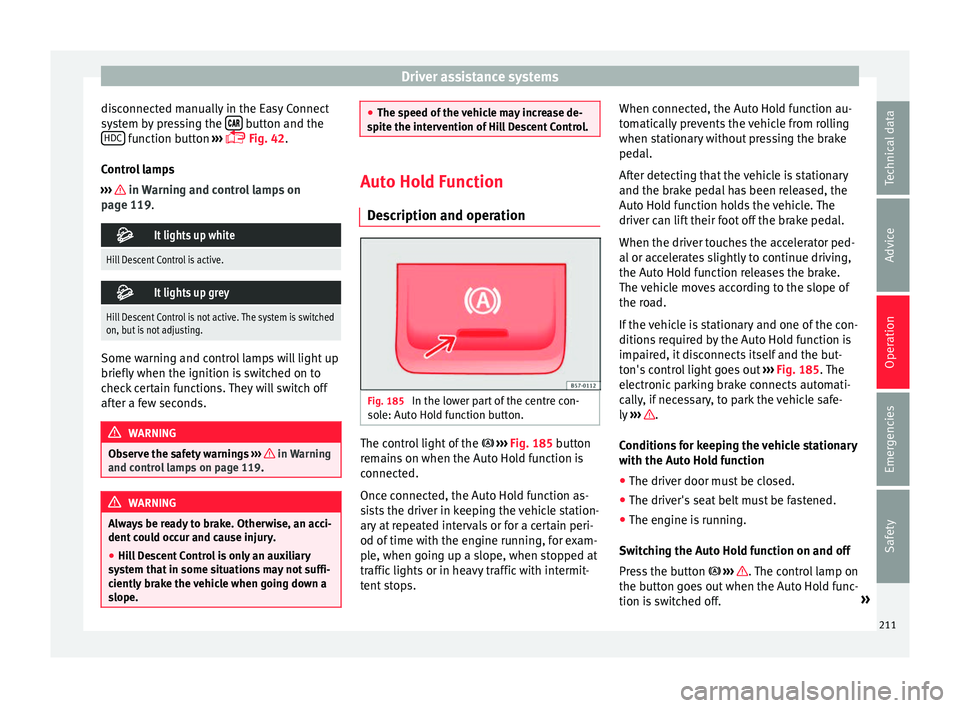
cription and operation Fig. 185
In the lower part of the centre con-
so l
e: Aut
o Hold function button. The control light of the
› ›
›
Fig. 185 button
remains on when the Auto Hold function is
connected.
Once connected, the Auto Hold function as-
sists the driver in keeping the vehicle station-
ary at repeated intervals or for a certain peri-
od of time with the engine running, for exam-
ple, when going up a slope, when stopped at
traffic lights or in heavy traffic with intermit-
tent stops. When connected, the Auto Hold function au-
tomatic
ally prevents the vehicle from rolling
when stationary without pressing the brake
pedal.
After detecting that the vehicle is stationary
and the brake pedal has been released, the
Auto Hold function holds the vehicle. The
driver can lift their foot off the brake pedal.
When the driver touches the accelerator ped-
al or accelerates slightly to continue driving,
the Auto Hold function releases the brake.
The vehicle moves according to the slope of
the road.
If the vehicle is stationary and one of the con-
ditions required by the Auto Hold function is
impaired, it disconnects itself and the but-
ton's control light goes out ››› Fig. 185. The
electronic parking brake connects automati-
cally, if necessary, to park the vehicle safe-
ly ››› .
C ondition
s
for keeping the vehicle stationary
with the Auto Hold function
● The driver door must be closed.
● The driver's seat belt must be fastened.
● The engine is running.
Switc
hing the Auto Hold function on and off
Press the button ››› . The control lamp on
the b utt
on g
oes out when the Auto Hold func-
tion is switched off. »
211
Technical data
Advice
Operation
Emergencies
Safety
Page 228 of 348
Operation
● If the driv
er i
s not wearing his/her seat
belt.
● If several brake lights of the vehicle or elec-
trically
connected trailer are damaged.
● If the vehicle is reversing.
● Driving faster than 210 km/h (150 mph).
Driver mes
sages
ACC not available
The system can no longer continue to guar-
antee safe vehicle detection and will be de-
activated. The sensor has lost its setting or is
damaged. Take the vehicle to a specialised
workshop and have the fault repaired. ACC and Front Assist: cur-
rently not available. No sensor
vision
This message will be displayed to the driver if
the radar sensor's vision is impaired due, for
example, to leaves, snow, heavy fog or dirt.
Clean the SEAT badge ››› Fig. 196.
ACC: currently not available.
Gradient too steep
The maximum road slope has been excee-
ded, hence safe ACC operation cannot be
guaranteed. The ACC cannot be switched on. ACC: only available in D, S
or M
Select the D/S or M position on the selector
lever.
ACC: parking brake applied
The AC
C is deactivated if the parking brake is
applied. The ACC is available once again after
the parking brake is released.
ACC: currently not available.
Intervention of stability con-
trol
The message for the driver is displayed when
the electronic stability control (ESC) inter-
venes. In this case, the ACC is automatically
switched off. ACC: Take action!
The message for the driver is displayed if,
when the vehicle starts up on a hill with a
mild slope, the vehicle rolls back even al-
though the ACC is activated. Apply the brake
to stop the vehicle from moving/colliding
with another vehicle. ACC: speed limit
The message for the driver is displayed if, in
vehicles with manual gearbox, the current
speed is too low for the ACC mode.
The speed to be stored must be at least
30 km/h (18 mph). The speed limiter
switches off if the speed falls below 20 km/h
(12 mph). ACC: available as of the 2nd
gear The ACC is operational as of the 2nd gear
(manual g
earbox).
ACC: engine speed
The message for the driver is displayed if,
when the ACC accelerates or brakes, the driv-
er does not shift up or down a gear in time,
which means exceeding or not reaching the
permissible engine speed. The ACC switches
itself off. A buzzer warning is heard. ACC: clutch pressed
Vehicles with a manual gearbox: pressing the
clutch pedal for longer abandons control
mode. Door open
Vehicles with automatic gearbox: the ACC
cannot be activated with the vehicle station-
ary and the door open. WARNING
There is a danger of rear collision when the
minimum dis t
ance to the vehicle in front is
exceeded and the speed difference between
both vehicles is so great that a speed reduc-
tion by the ACC will not suffice. In this case
the brake pedal should be applied immedi-
ately.
● The ACC may not be able to detect all situa-
tions pr
operly.
● “Stepping” on the accelerator may cause
the ACC
not to intervene in braking. Driver226
Page 251 of 348
Driver assistance systems
● When c ornerin
g
● On r
oads in poor condition
● In unfavourable weather conditions
● When a sporty driving style is employed
● In the event of a serious distraction to the
driver
Fatigue det
ection will be restored when the
vehicle is stopped for more than 15 minutes,
when the ignition is switched off or when the
driver has unbuckled their seat belt and
opened the door.
In the event of slow driving during a long pe-
riod of time (below 65 km/h, 40 mph) the
system automatically re-establishes the tired-
ness calculation. When driving at a faster
speed the driving behaviour will be recalcula-
ted.
Park Assist*
Relat
ed video Fig. 216
Smart solutions Introduction
The Park Assist system is an additional func-
tion of P
arkPi
lot ››› page 257 and helps the
driver to:
● find a suitable parking space,
● select a parking mode,
● park driving in reverse in suitable perpen-
dicul
ar and parallel spaces,
● park driving forwards in suitable perpen-
dicul
ar spaces,
● exit a parking space driving forwards from
a par al
lel space.
In vehicles with a Park Assist system and fac-
tory radio the front, rear and side areas are
represented, and the position of obstacles is
shown relative to the vehicle.
The Park Assist system is subject to certain
limitations inherent to the system and its use
requires special attention by the driver ››› .
WARNING
The technology used in the park assist sys-
tem in v
olves a series of limitations inherent
in the actual system and in the use of ultra-
sonic sensors. The use of Park Assist should
never tempt you to take any risk that may
compromise safety. The system is not a re-
placement for driver awareness.
● Any accidental movement of the vehicle
coul
d result in serious injury. ●
Adapt
your speed and driving style at all
times to suit visibility, weather, road and traf-
fic conditions.
● Certain surfaces of objects and garments
do not refl
ect the ultrasound sensors' sig-
nals. The system cannot detect, at least cor-
rectly, these objects or people wearing such
clothes.
● Ultrasound sensor signals may be affected
by e
xternal sound sources. In certain circum-
stances this may prevent them from detect-
ing people or objects.
● The ultrasound sensors have blind spots in
which ob
stacles and people are not regis-
tered.
● Monitor the area around the vehicle at all
times, sinc
e the ultrasound sensors do not
detect small children, animals or certain ob-
jects in all situations. WARNING
Quick turns of the steering wheel when park-
ing or e x
iting a parking space with Park As-
sist can cause serious injury.
● Do not hold the steering wheel during ma-
noeuvre
s to park or exit a parking space until
the system requests it. Doing so disables the
system during the manoeuvre, resulting in
the parking being cancelled. » 249
Technical data
Advice
Operation
Emergencies
Safety
Page 276 of 348
Operation
Vehicles with the Start-Stop system
If the
v
ehicle has a factory-fitted towing
bracket or one that is retrofitted by SEAT, the
Start-Stop system operates as normal. No
special characteristics need to be taken into
account.
If the system does not recognise the trailer or
the trailer bracket has not been retrofitted by
SEAT, the Start-Stop system must be discon-
nected by pressing the corresponding button
in the lower part of the centre console before
driving with the trailer, and it should remain
off for the rest of the journey ››› .
V ehic
l
es with driving profile selection
If you are going to be towing a trailer, the use
of the Eco driving profile is not recommen-
ded. You are advised to select another of the
available driving profiles before beginning to
drive with a trailer. WARNING
Never use the trailer to transport people,
sinc e it
would put their life in danger and is
also prohibited. WARNING
Undue use of the towing bracket may cause
injury and ac
cidents.
● Only use the towing bracket if it is in a per-
fect s
tate of repair and is properly secured. ●
Never modif y
or repair the towing bracket
in any way.
● In order to reduce the danger of injury in
the event of
rear-end collisions and to avoid
injury to pedestrians and cyclists when park-
ing the vehicle, cover or remove the tow hitch
when you are not using a trailer.
● Never fit a towing bracket “with weight dis-
tribution” or “loa
d compensation”. The vehi-
cle has not been designed for this type of
towing bracket. The towing bracket could fail
and the trailer could be released from the ve-
hicle. WARNING
Driving with a trailer and transporting heavy
or lar g
e objects can affect driving properties
and even cause an accident.
● Always secure the load properly using belts
or strap
s that are suitable and in good condi-
tion.
● Adapt your speed and driving style at all
times t
o suit visibility, weather, road and traf-
fic conditions.
● Trailers with a high centre of gravity are
more likely
to overturn than those with a low
one.
● Avoid sudden braking and manoeuvres.
● Take great care when overtaking.
● Reduce speed immediately if you notice
that the tr
ailer is swaying, however slightly. ●
Never driv e at
more than 80 km/h (50 mph)
when towing a trailer (or at more than
100 km/h (60 mph) in exceptional circum-
stances). This also applies in countries where
driving at higher speeds is permitted. Take
into account the speed limit for vehicles with
trailers in the corresponding country, as it
could be less than the speed limit for vehi-
cles without a trailer.
● Never attempt to “straighten” the towing
vehicl
e and trailer while accelerating. WARNING
If the towing bracket has been retrofitted by a
non-S EA
T workshop, the Start-Stop system
must be disconnected manually whenever
driving with a trailer. Otherwise the brake
system could be damaged and could conse-
quently cause a serious accident or injury.
● Always disconnect the Start-Stop system
manual
ly when using a towing bracket that
has not been fitted by a SEAT workshop. Note
● Bef or
e hitching or unhitching a trailer, al-
ways deactivate the anti-theft alarm
››› page 125. Otherwise, the tilt sensor could
cause the alarm to go off.
● Do not drive with a trailer for the engine's
first
1000 km ››› page 201.
● SEAT recommends that, if possible, the tow
hitch be di
sassembled or covered when it is274
Page 282 of 348
Operation
To promote safety while driving, SEAT recom-
mend s
m
aking the most of the maximum ver-
tical load technically permissible on the cou-
pling device ››› page 273. An insufficient ver-
tical load has a negative influence on the be-
haviour of both the vehicle and trailer.
The vertical load increases the weight on the
rear axle, reducing the vehicle's carrying ca-
pacity.
Gross combination weight of the towing ve-
hicle and trailer
The gross combination weight is the actual
weight of the loaded vehicle plus the actual
weight of the loaded trailer.
In some countries trailers are classified into
distinct categories. SEAT recommends ob-
taining information from a specialised work-
shop regarding which type of trailer is most
suitable for your vehicle.
Trailer loading
The weight of the towing vehicle and trailer
must be balanced. In order to do this, the
load must be as close as possible to the max-
imum vertical load technically permissible on
the coupling point, and it must be evenly dis-
tributed between the back and front of the
trailer:
● Distribute loads in the trailer so that heavy
obj
ects are as near to the axle as possible or
above it. ●
Secure the tr
ailer load properly.
Tyre pressure
Set the tyre pressure of the trailer tyres in ac-
cordance with the trailer manufacturer's rec-
ommendations.
When towing a trailer, inflate the tyres of the
towing vehicle with the maximum allowable
pressure ››› page 308. WARNING
If the maximum permissible axle weight, the
max imum lo
ad technically permissible on the
coupling point, the maximum authorised ve-
hicle weight or the gross combination weight
of the towing vehicle and trailer are excee-
ded, accidents and serious injuries may oc-
cur.
● Never exceed the values indicated!
● The actual weight on the front and rear
axle
s must never exceed the maximum per-
missible axle weight. The weight on the front
and rear axles must never exceed the maxi-
mum permissible weight. WARNING
A shift in weight could jeopardize the stabili-
ty and sec urity
of the towing vehicle and
trailer, which could lead to accidents and se-
rious injuries.
● Always load the trailer correctly. ●
Alw a
ys secure the load properly using belts
or straps that are suitable and in good condi-
tion. Driving with a trailer
Adjusting the headlights
When to
w
ing a trailer, the front part of the ve-
hicle could lift up, and if the dipped beams
are on, this could dazzle other drivers. Use
the headlight range control to lower the cone
of light. If you do not have headlight range
control, have the headlights adjusted by a
specialised workshop.
Special characteristics of driving with a trail-
er
● If your trailer has an overru
n brake, brake
gently at first and then rapidly. This will pre-
vent the jerking that can be caused by the
locking of trailer wheels.
● Due to the gross combination weight of the
tow
ing vehicle and trailer, the braking dis-
tance increases.
● When going down a slope, go into a lower
gear (if
using a manual gearbox or the tip-
tronic automatic gearbox mode) to take ad-
vantage of the braking power provided by the
engine. Otherwise, the braking system could
overheat and even fail.
280
Page 292 of 348
Advice
A spirit-based cleaner can be used to remove
gr e
a
se, oil, lipstick or ball point pen. Then
dab the dissolved grease or colour particles
off with an absorbent cloth or similar. You
may also have to treat the stain once more
using washing paste and water.
If the covers or textile trim panels are badly
soiled we recommend that you have them
cleaned by a professional cleaning company
with a shampoo and spray. Note
Open Velcro fasteners on clothes can damage
the seat upho
lstery. Make sure they are
closed. Natural leather
General information
Our r
an
g
e of leathers is large. The main type
used is particularly nappa in various forms,
that is, leather with a smooth surface in dif-
ferent colours.
The amount of dye used determines the ap-
pearance and properties of leather. If the
leather is left in a more natural state, it re-
tains its typical natural napped appearance
and confers excellent all-weather properties
to the seats. Fine veins, healed scars, insect
bites, wrinkles and a subtle variation in shad- ing remain visible; these are the characteris-
tic fe
atures of genuine natural leather.
Natural napped leather does not have a pro-
tective surface coating of dye. It is therefore
somewhat more prone to damage. This
should be borne in mind if children or pets
often travel in the car, or if there are other
factors that could lead to damage.
Types of leather with a coloured surface coat-
ing are likely to be more resistant to damage.
This has a great advantage for day-to-day
use. However, this means that the typical
natural characteristics of the surface are less
apparent, though this does not affect quality.
Cleaning and care
Due to the natural properties of the specially
selected hides employed, the finished leath-
er has a certain sensitivity to grease and dirt,
etc. so a degree of care is required in every-
day use and when looking after the leather.
Dark clothing (especially if damp or incorrect-
ly dyed) may stain leather upholstery on the
seats. Dust and grit in the pores and seams
can scratch and damage the surface. There-
fore leather should be cleaned at regular in-
tervals, depending on the actual amount of
use. When they have been in use for a certain
time, your car seats will acquire a typical and
unmistakable patina. This is characteristic for
leather as a natural product and is a sign of
genuine quality. To maintain the value of natural leather you
should not
e the following points: CAUTION
● Av oid e
xposing leather to direct sunlight
for long periods, otherwise it may tend to
lose some of its colour. If the car is left for a
prolonged period in the bright sun, it is best
to cover the leather.
● Sharp-edged objects on clothing, such as
belts, z
ip fasteners, rivets or similar, can also
leave permanent scratches and rough marks
on the surface of the leather. Note
● Use a s uit
able impregnating cream with ul-
tra-violet protection at regular intervals and
after cleaning. The cream nourishes and
moisturises the leather, keeps it supple and
able to breathe. A protective film will also
form.
● Clean the leather every 2 to 3 months and
remov
e fresh dirt as soon as possible.
● Remove stains from fresh ball-pen and oth-
er inks, lips
tick, shoe cream and similar
stains as soon as possible.
● Preserve the colour of the leather. A special
colour
ed cream will renew the colour of the
leather when required and will eliminate dif-
ferences in colour. 290
Page 294 of 348
Advice
CAUTION
● Do not u se so
lvents, wax polish, shoe
cream, stain removers, leather cleaning prod-
ucts or any similar products on Alcantara.
● To avoid damage, stubborn stains should
be remov
ed by a specialised workshop.
● On no account use brushes, hard sponges
or simil
ar utensils. Seat belts
–
Keep the seat belts clean.
– For cleaning, use a mild solution of soap
and w at
er
.
– Check the condition of the seat belts at reg-
ular int
ervals.
The retract function may not operate properly
in very dirty belts. Make sure that the inertia
reel seat belts are completely dry before al-
lowing them to retract. CAUTION
● Do not r emo
ve the seat belts from the vehi-
cle to clean them.
● Do not use chemical cleaning agents on the
seat belt
s, as this can damage the webbing.
Ensure that the seat belts do not come into
contact with corrosive fluids.
● If you find any damage to the belt webbing,
belt fitting
s, the belt retractor or the buckle, the belt in question must be replaced by a
spec
i
alised workshop. Checking and refilling levels
Fi l
lin
g the tank
Refuelling Read the additional information carefully
›› ›
page 56
If the automatic filler nozzle is operated cor-
rectly, it will switch itself off as soon as the
fuel tank is “full”. Do not try to put in more
fuel after the nozzle cuts out, as this will fill
the expansion chamber in the fuel tank.
The correct fuel grade for your vehicle is giv-
en on a sticker on the inside of the fuel tank
flap. Further notes on fuel can be found at
››› page 293.
The capacity of your vehicle's fuel tank is giv-
en in ›››
page 56. WARNING
Fuel is highly flammable and can cause seri-
ous b
urns and other injuries.
● When refuelling, turn off the engine, the
auxili
ary heater ››› page 177 and turn off the
ignition for safety reasons.
● Do not smoke when filling the fuel tank or a
canis
ter. Naked flames are forbidden in the
vicinity due to the risk of explosion. 292
Page 301 of 348
Checking and refilling levels
WARNING
● Swit c
h the engine off, remove the key from
the ignition and apply the hand brake. If the
vehicle has a manual gearbox, place the lever
in neutral; if it has an automatic gearbox,
place the selector lever in position P. Wait for
the engine to cool down.
● Keep children away from the engine com-
partment
.
● Never spill liquids used for vehicle opera-
tion on the engine comp
artment, as these
may catch fire (e.g. the antifreeze in coolant).
● Take care not to cause short circuits in the
electrica
l system, especially when working
on the battery.
● If working inside the engine compartment,
remember that, ev
en when the ignition is
switched off, the radiator fan may start up au-
tomatically, and therefore there is a risk of in-
jury.
● Never cover the engine with additional in-
sul
ating materials such as a blanket. Risk of
fire!
● Do not unscrew the cap on the coolant ex-
pans
ion tank when the engine is hot. The
cooling system is under pressure.
● Protect face, hands and arms by covering
the cap with a l
arge, thick rag to protect
against escaping coolant and steam.
● If it is necessary to work in the engine com-
partment
while the engine is running, the ro-
tating components (for example, poly-V belt, alternator, radiator fan) and the high voltage
ignition sys
t
em are an additional hazard.
● Observe the following additional warnings
if work
on the fuel system or the electrical
system is necessary:
– Always disconnect the battery from the
on-board network.
– Do not smoke.
– Never work near naked flames.
– Always keep an approved fire extinguish-
er immediately available. CAUTION
When topping up fluids make sure the correct
fluid is p
ut into the correct filler opening, oth-
erwise this can cause serious malfunctions or
engine damage. For the sake of the environment
Inspect the ground underneath your vehicle
re gu
larly so that any leaks are detected at an
early stage. If you find spots of oil or other
fluids in the area where it was parked, have
your vehicle inspected at the workshop. Note
In right-hand drive vehicles* some brake flu-
id re ser
voirs are on the other side of the en-
gine compartment ››› Fig. 239. Opening the bonnet
Read the additional information carefully
›› ›
page 17
The bonnet is released from inside the vehi-
cle.
Check that the windscreen wiper arms are
not unfolded. Otherwise the paint may be
damaged.
The bonnet can only be unlocked when the
driver door is open. WARNING
Never open the bonnet if you see steam or
drips of
coolant being released from the en-
gine compartment. Failure to comply could
result in burns. Wait until no steam or coolant
can be seen before opening the bonnet. Closing the bonnet
–
Slightly lift the bonnet.
– Release the bonnet stay before pressing it
bac
k
into its support.
– Carefully close the bonnet.
– Press the bonnet down until it locks into
plac
e.
– Make sure that the bonnet catches onto its
cla
sp. Do not press down too hard ››› .
»
299
Technical data
Advice
Operation
Emergencies
Safety
Page 332 of 348
Index
Audible warning signal lights . . . . . . . . . . . . . . . . . . . . . . . . . . . . . . . . .
144
se at
belt not fastened . . . . . . . . . . . . . . . . . . . . 79
warning and control lamps . . . . . . . . . . . . . . . 119
Auto Hold . . . . . . . . . . . . . . . . . . . . . . . . . . . . . . . 211
Auto Hold function . . . . . . . . . . . . . . . . . . . . . . . . 211
Auto Lock (central locking) . . . . . . . . . . . . . . . . . 125
Automatic car washes switching the Auto Hold function off . . . . . . . . 212
Automatic dipped beam control . . . . . . . . . . . . . 146
Automatic gearbox . . . . . . . . . . . . . . . . . . . . . . . . 193 downhill speed control . . . . . . . . . . . . . . . . . . 198
driving tips . . . . . . . . . . . . . . . . . . . . . . . . . . . . 196
emergency program . . . . . . . . . . . . . . . . . . . . . 199
kick-down feature . . . . . . . . . . . . . . . . . . . . . . . 197
launch control program . . . . . . . . . . . . . . . . . . 197
manual release of the selector lever . . . . . . . . . 49
safety interlock for ignition key . . . . . . . . . . . . 181
selector lever lock . . . . . . . . . . . . . . . . . . . . . . . 194
selector lever positions . . . . . . . . . . . . . . . . . . 193
steering wheel with gear shift paddles . . . . . . 195
tiptronic . . . . . . . . . . . . . . . . . . . . . . . . . . 193, 195
towing . . . . . . . . . . . . . . . . . . . . . . . . . . . . . . . . . 99
AUX-IN . . . . . . . . . . . . . . . . . . . . . . . . . . . . . . . . . . 123
Auxiliary heater . . . . . . . . . . . . . . . . . . . . . . . . . . 177 activating . . . . . . . . . . . . . . . . . . . . . . . . . . . . . 179
electric consumers . . . . . . . . . . . . . . . . . . . . . . 180
operating instructions . . . . . . . . . . . . . . . . . . . 180
programming . . . . . . . . . . . . . . . . . . . . . . . . . . 179
remote control . . . . . . . . . . . . . . . . . . . . . . . . . 178
remote control range . . . . . . . . . . . . . . . . . . . . 179
special features . . . . . . . . . . . . . . . . . . . . . . . . 178
switching off . . . . . . . . . . . . . . . . . . . . . . . . . . . 177
switching on . . . . . . . . . . . . . . . . . . . . . . . . . . . 177
things to note . . . . . . . . . . . . . . . . . . . . . . . . . . 180 B
Batter
y . . . . . . . . . . . . . . . . . . . . . . . . . . . . . . . . . . 133
replacement in the remote control (auxiliary heater) . . . . . . . . . . . . . . . . . . . . . . . . . . . . . . 178
Before setting off . . . . . . . . . . . . . . . . . . . . . . . . . . 73
Belt tensioners control lamp . . . . . . . . . . . . . . . . . . . . . . . . . . . . 89
Belt tightening . . . . . . . . . . . . . . . . . . . . . . . . . . . . 83
Bench seat . . . . . . . . . . . . . . . . . . . . . . . . . . . . . . 159
Bicycle rack fitting on the retractable tow hitch . . . . . . . . . 277
maximum load . . . . . . . . . . . . . . . . . . . . . . . . . 277
Biodiesel . . . . . . . . . . . . . . . . . . . . . . . . . . . . . . . . 294
Blind spot detector (BSD) . . . . . . . . . . . . . . . . . . 237 control lamps . . . . . . . . . . . . . . . . . . . . . . . . . . 237
driving situations . . . . . . . . . . . . . . . . . . . . . . . 240
indication in the external rear view mirror . . . 238
malfunction . . . . . . . . . . . . . . . . . . . . . . . . . . . . 237
operating . . . . . . . . . . . . . . . . . . . . . . . . . . . . . . 238
towing . . . . . . . . . . . . . . . . . . . . . . . . . . . . . . . . 242
Bonnet . . . . . . . . . . . . . . . . . . . . . . . . . . . . . 17, 298 opening the bonnet . . . . . . . . . . . . . . . . . . . . . 299
Brake fluid . . . . . . . . . . . . . . . . . . . . . . . . . . . . . . . 59
Brakes . . . . . . . . . . . . . . . . . . . . . . . . . . . . . . . . . . 188 brake fluid . . . . . . . . . . . . . . . . . . . . . . . . . . . . . 303
brake servo . . . . . . . . . . . . . . . . . . . . . . . . . . . . 188
electronic parking brake . . . . . . . . . . . . . . . . . 186
emergency braking function . . . . . . . . . . . . . . 187
new brake pads . . . . . . . . . . . . . . . . . . . . . . . . 188
Braking front assist . . . . . . . . . . . . . . . . . . . . . . . . . . . . 189
BSD see Blind spot detector (BSD) . . . . . . . . . . . . . 237
BSD Plus . . . . . . . . . . . . . . . . . . . . . . . . . . . . . . . . 232 C
Camera
c
leaning . . . . . . . . . . . . . . . . . . . . . . . . . . . . . . 287
cleanliness . . . . . . . . . . . . . . . . . . . . . . . . . . . . 245
Lane Assist . . . . . . . . . . . . . . . . . . . . . . . . . . . . 230
Capacities . . . . . . . . . . . . . . . . . . . . . . . . . . . . . . . . 56 AdBlue tank . . . . . . . . . . . . . . . . . . . . . . . . . . . 295
fuel tank . . . . . . . . . . . . . . . . . . . . . . . . . . . . . . 118
windscreen washer water . . . . . . . . . . . . . . . . 304
Car-care products . . . . . . . . . . . . . . . . . . . . . . . . . 285
Catalytic converter . . . . . . . . . . . . . . . . . . . . . . . . 204 malfunction . . . . . . . . . . . . . . . . . . . . . . . . . . . . 204
CCS . . . . . . . . . . . . . . . . . . . . . . . . . . . . . . . . . . . . . 44
CD-ROM player (navigation) . . . . . . . . . . . . . . . . 161
Central locking . . . . . . . . . . . . . . . . . . . . . . . . . . . 125 adjusting . . . . . . . . . . . . . . . . . . . . . . . . . . . . . . 128
anti-theft alarm . . . . . . . . . . . . . . . . . . . . . . . . . 134
central locking switch . . . . . . . . . . . . . . . . . . . . 128
electric windows . . . . . . . . . . . . . . . . . . . . . . . . 140
emergency locking . . . . . . . . . . . . . . . . . . . . . . . 16
Keyless Access . . . . . . . . . . . . . . . . . . . . . . . . . 129
Panoramic sliding/tilting sunroof . . . . . . . . . . 140
remote control key . . . . . . . . . . . . . . . . . . . . . . 127
selective unlocking system . . . . . . . . . . . . . . . 127
Central wheel trim . . . . . . . . . . . . . . . . . . . . . . . . . 64
Centre console . . . . . . . . . . . . . . . . . . . . . . . . . . . . 11
Cetane number (diesel fuel) . . . . . . . . . . . . . . . . 294
Changing a bulb . . . . . . . . . . . . . . . . . . . . . . . . . . 106 dipped beam . . . . . . . . . . . . . . . . . . . . . . . . . . 107
fog light . . . . . . . . . . . . . . . . . . . . . . . . . . . . . . . 108
main beam . . . . . . . . . . . . . . . . . . . . . . . . . . . . 107
number plate light . . . . . . . . . . . . . . . . . . . . . . 110
rear bulb in the side panel . . . . . . . . . . . . . . . . 109
rear light in the rear lid . . . . . . . . . . . . . . . . . . . 110
turn signal . . . . . . . . . . . . . . . . . . . . . . . . . . . . . 107
Changing a wheel . . . . . . . . . . . . . . . . . . . . . . . . . 64 subsequent work . . . . . . . . . . . . . . . . . . . . . . . . 67
330
Page 333 of 348
Index
Changing gear en g
agin
g gears (manual gearbox) . . . . . . . . . 192
Changing settings CAR menu . . . . . . . . . . . . . . . . . . . . . . . . . . . . . . 33
Changing the blades . . . . . . . . . . . . . . . . . . . . . . . 97
Changing the wiper blades . . . . . . . . . . . . . . . . . . 71
Charging the battery . . . . . . . . . . . . . . . . . . . . . . 306
Checking levels engine compartment . . . . . . . . . . . . . . . . . . . . 298
Childproof locks electric windows . . . . . . . . . . . . . . . . . . . . . . . . 139
Child seats . . . . . . . . . . . . . . . . . . . . . . . . . . . . 24, 91 categorisation into groups . . . . . . . . . . . . . . . . . 92
ISOFIX system . . . . . . . . . . . . . . . . . . . . . . . . . . . 26
safety instructions . . . . . . . . . . . . . . . . . . . . 24, 90
securing with seat belt . . . . . . . . . . . . . . . . . . . . 25
Top Tether system . . . . . . . . . . . . . . . . . . . . . 26, 29
Cleaning . . . . . . . . . . . . . . . . . . . . . . . . . . . . . . . . 285 alcantara . . . . . . . . . . . . . . . . . . . . . . . . . . . . . . 291
carbon parts . . . . . . . . . . . . . . . . . . . . . . . . . . . 288
Easy Connect control panel . . . . . . . . . . . . . . . 289
exhaust pipe . . . . . . . . . . . . . . . . . . . . . . . . . . . 289
fabrics . . . . . . . . . . . . . . . . . . . . . . . . . . . . . . . . 289
leather . . . . . . . . . . . . . . . . . . . . . . . . . . . . . . . . 290
natural leather . . . . . . . . . . . . . . . . . . . . . . . . . 291
plastic parts . . . . . . . . . . . . . . . . . . . . . . 288, 289
radio screen . . . . . . . . . . . . . . . . . . . . . . . . . . . 289
rims . . . . . . . . . . . . . . . . . . . . . . . . . . . . . . . . . . 288
seat belts . . . . . . . . . . . . . . . . . . . . . . . . . . . . . 292
trims . . . . . . . . . . . . . . . . . . . . . . . . . . . . . . . . . 287
washing the vehicle . . . . . . . . . . . . . . . . . . . . . 285
windows . . . . . . . . . . . . . . . . . . . . . . . . . . . . . . 288
Climatronic . . . . . . . . . . . . . . . . . . . . . . . . . . . . . . . 51
Close sunroof . . . . . . . . . . . . . . . . . . . . . . . . . . . . . . . 142
windows . . . . . . . . . . . . . . . . . . . . . . . . . . . . . . 139 Closing . . . . . . . . . . . . . . . . . . . . . . . . . . . . . . . . . 125
bonnet . . . . . . . . . . . . . . . . . . . . . . . . . . . . . . . . 299
re
ar lid . . . . . . . . . . . . . . . . . . . . . . . . . . . . . . . . 137
sun blind (sunroof) . . . . . . . . . . . . . . . . . . . . . . 143
sunroof . . . . . . . . . . . . . . . . . . . . . . . . . . . . . . . 142
windows . . . . . . . . . . . . . . . . . . . . . . . . . . . . . . 139
Clutch (warning lamp) . . . . . . . . . . . . . . . . . . . . . 199
Coming Home . . . . . . . . . . . . . . . . . . . . . . . . . . . . 148
Coming Home function . . . . . . . . . . . . . . . . . . . . 148
Connectivity Box . . . . . . . . . . . . . . . . . . . . . . . . . . 123
Control and warning lamps . . . . . . . . . . . . . 46, 119 adaptive cruise control . . . . . . . . . . . . . . . . . . . 222
airbags . . . . . . . . . . . . . . . . . . . . . . . . . . . . . . . . 88
airbag system . . . . . . . . . . . . . . . . . . . . . . . . . . . 89
applying the brake . . . . . . . . . . . . . . . . . . . . . . 222
ASR . . . . . . . . . . . . . . . . . . . . . . . . . . . . . . . . . . 191
audible warning signal . . . . . . . . . . . . . . . . . . 119
blind spot detector (BSD) . . . . . . . . . . . . . . . . 237
cruise control system (CCS) . . . . . . . . . . . . . . . 212
depress the brake . . . . . . . . . . . . . . . . . . . . . . . 217
diesel particulate filter . . . . . . . . . . . . . . . . . . . 204
electromechanical steering . . . . . . . . . . . . . . . 200
emission control . . . . . . . . . . . . . . . . . . . . . . . . 205
engine management . . . . . . . . . . . . . . . . . . . . 205
engine pre-heating/fault system . . . . . . . . . . . 205
ESC . . . . . . . . . . . . . . . . . . . . . . . . . . . . . . . . . . 191
gear change . . . . . . . . . . . . . . . . . . . . . . . . . . . 200
Hill Descent Control . . . . . . . . . . . . . . . . . . . . . 210
instrument panel . . . . . . . . . . . . . . . . . . . . . 46, 48
instrument panel display . . . . . . . . . . . . . . . . . . 47
Lane Assist . . . . . . . . . . . . . . . . . . . . . . . . . . . . 230
lights . . . . . . . . . . . . . . . . . . . . . . . . . . . . . . . . . 144
parking assistant (RCTA) . . . . . . . . . . . . . . . . . 237
refuelling . . . . . . . . . . . . . . . . . . . . . . . . . . . . . . 292
remote control (auxiliary heater) . . . . . . . . . . . 178
seat belt . . . . . . . . . . . . . . . . . . . . . . . . . . . . . . . 79
speed limiter . . . . . . . . . . . . . . . . . . . . . . . . . . . 214 Start-Stop . . . . . . . . . . . . . . . . . . . . . . . . . . . . . 208
tow hit
ch . . . . . . . . . . . . . . . . . . . . . . . . . . . . . . 277
towing bracket . . . . . . . . . . . . . . . . . . . . . . . . . 275
tyre monitoring system . . . . . . . . . . . . . . . . . . 312
Controls and displays general instrument panel . . . . . . . . . . . . . . . . . 113
Controls for the windows . . . . . . . . . . . . . . . 18, 139
Controls on the steering wheel operating the audio, telephone and naviga-tion system . . . . . . . . . . . . . . . . . . . . . . . . . . 121
Coolant checking level . . . . . . . . . . . . . . . . . . . . . . . . . . 302
Cooling coolant temperature gauge . . . . . . . . . . . . . . . 117
Cooling system checking coolant . . . . . . . . . . . . . . . . . . . . . . . 302
topping up coolant . . . . . . . . . . . . . . . . . . . . . . 302
Cornering lights . . . . . . . . . . . . . . . . . . . . . . . . . . . . . . . . . 148
Correct position . . . . . . . . . . . . . . . . . . . . . . . . . . . 74 driver . . . . . . . . . . . . . . . . . . . . . . . . . . . . . . . . . . 74
front passenger . . . . . . . . . . . . . . . . . . . . . . . . . 75
Correct sitting position rear seat passengers . . . . . . . . . . . . . . . . . . . . . 76
Cruise control . . . . . . . . . . . . . . . . . . . . . . . . 44, 212 operation . . . . . . . . . . . . . . . . . . . . . . . . . . . . . . 213
Cruise control system . . . . . . . . . . . . . . . . . . . . . . 212 warning and indication lamp . . . . . . . . . . . . . . 212
D Dangers in not using the seat belt . . . . . . . . . . . . 81
Dash panel . . . . . . . . . . . . . . . . . . . . . . . . . . . . . . . 46
Data sticker . . . . . . . . . . . . . . . . . . . . . . . . . . . . . . 317
Deactivating the front passenger front airbag . . . 22
Deactivation of front airbag . . . . . . . . . . . . . . . . . . 88
Defective bulbs changing a bulb . . . . . . . . . . . . . . . . . . . . . . . . 106
331