ESP Seat Ateca XL 2006 Workshop Manual
[x] Cancel search | Manufacturer: SEAT, Model Year: 2006, Model line: Ateca XL, Model: Seat Ateca XL 2006Pages: 288, PDF Size: 9.08 MB
Page 228 of 288

Checking and refilling levels
226
Driving with puncture-proof tyres (driving in emergency conditions)
– Leave the ESP/TCS on (electronic stabilisation programme), or, if necessary, switch on ⇒page 179.
– Drive carefully and at moderate speed (80km/h maximum).
– Avoid sharp turns and rapid manoeuvres.
– Avoid driving over obstacles (for example, kerbs) or potholes.
– Pay special attention to whether the ESP/TCS comes on frequently, whether there is smoke coming from the tyres or there
is smell of rubber, or whether the vehicle vibrates or rattles. In
the event of any of the above, stop the vehicle.Puncture-proof tyres are marked on th e tyre sidewall: “DSST”, “Eufonia”,
“RFT”, “ROF”, “RSC”, “SSR” or “ZP”.
This type of tyre sidewall is reinforced. When the tyres lose air, they are held
up by the sidewalls (driving in emergency conditions).
The loss in tyre pressure is displayed on the instrument panel. It is still
possible to drive for a minimum of 50 km or even more in favourable circum-
stances (for example, with low loads).
The damaged tyre should be replaced as soon as possible. The rim should be
checked for damage at a specialised workshop and replaced if necessary. We
recommend you contact your Service Centre. Where more than one tyre is
used in emergency conditions, the distance it is possible to travel decreases.
Starting to drive in emergency conditions
When the loss in tyre pressure is displayed on the instrument panel, this
implies that at least one tyre is being used in emergency conditions. ⇒
Stopping driving in emergency conditions
Do not drive on if:
•
smoke is coming from one of the tyres,
•
there is a smell of rubber,
•
the vehicle vibrates,
•
there is a rattling noise.
WARNING
When driving in emergency conditions, the driving quality of the vehicle is
considerably impaired.•
Drive carefully and at moderate speed (80km/h maximum).
•
Avoid sharp turns and rapid manoeuvres, and brake earlier than usual.
•
Avoid driving over obstacles (for example, kerbs) or potholes.
•
If one or more tyres are used in emergency conditions, the driving
quality of the vehicle is impaired and there is a risk of accident.Note
•
Puncture-proof tyres do not “deflate” on losing air pressure because they
are supported by the reinforced sidewalls. Therefore it is not possible to
detect damage to the tyre visually.
•
Snow chains should not be used on front wheels when driving in emer-
gency conditions.
New tyres and wheels
New tyres and wheels have to be run-in.The tyres and wheel rims are an essenti al part of the vehicle’s design. The
tyres and rims approved by SEAT are specially matched to the characteristics
of the vehicle and make a major contribution to good road holding and safe
handling ⇒.
AlteaXL_ingles_02_06 Seite 226 Dienstag, 1. August 2006 11:11 11
Page 234 of 288

If and when
232
Note•
Seek professional assistance if the repair of a tyre puncture is not
possible with the sealing compound.
Wheel changePreparation work
What you must do before changing a wheel.– If you have a flat tyre or puncture, park the vehicle as far away from the flow of traffic as possible. Choose a location that is as
level as possible.
– All passengers should leave the ve hicle. They should wait in a
safe area (for instance behind the roadside crash barrier).
– Switch off the engine. Switch on the hazard warning lights.
–Apply the handbrake firmly.
– Engage the first gear, or put the selector lever to position P for
those vehicles with an automatic gearbox.
– If you are towing a trailer, unhitch it from your vehicle.
– Take the vehicle tools and the spare wheel out of the luggage
compartment.
WARNING
Put the hazard warning lights on and place the warning triangle in position.
This is for your own safety and also warns other road users.
Caution
If you have to change the tyre on a gradient, block the wheel opposite the
wheel being changed by placing a stone or similar object under it to prevent
the vehicle from rolling away.
Note
Please observe legal requirements when doing so.Changing a wheelChange the wheel as described below
–Pull off the hub cap. Also refer to ⇒page 233.
– Slacken the wheel bolts.
– Raise the car with the jack in the corresponding zone.
– Ta k e o f f the wheel and then put on the spare wheel.
– Lower the vehicle.
– Tighten the wheel bolts firmly in diagonal sequence with the box
spanner
–Replace the hub cap.
AlteaXL_ingles_02_06 Seite 232 Dienstag, 1. August 2006 11:11 11
Page 244 of 288

If and when
242Fuses on left side of dash panelFuses
Number Electrical equipment Amperes
1V aca n t
2V aca n t
3V aca n t
4V aca n t
5V aca n t
6V aca n t
7V aca n t
8V aca n t
9 Airbag 5
10 Vacant
11 Vacant
11 Aftersales kit 5
12 Left xenon headlamp 10
13 Controls for heating / ESP switch, ASR/ Reverse gear/Telephone pre-installation 5
14 Control unit for ABS/ESP / Engine/ Headlamps/ Control unit for trailer/ light switch/ Instrument panel 10
15 Control unit for headlamp range co ntrol/ Heated windscreens / Instrument lighting/ Diagnosis control unit 10
16 Right xenon headlamp 10
17 D2L engine (2.0l 147 kW 4 speed TFSI) 10
18 Vacant
19 Vacant
20 Park Pilot (parking aid) / Gear lever/ ESP control unit 10
AlteaXL_ingles_02_06 Seite 242 Dienstag, 1. August 2006 11:11 11
Page 250 of 288

If and when
248Xenon headlamps
22)/self-adjusting
Dipped and main - D1S23)
Flasher and additional main - H1
Position W5W
Turn signals PY21W
Fog lights
Fog lights - H3
Fixed rear light
Stop/Position - P21W
24)
Turn signals - P21W
Rear tailgate light unit
Fog lamp (driver’s side) - P21W
Reversing light (passenger side) - P21W
Position - W5W
Indicator
Indicator - W5W
Registration plate light
Registration plate light - C5W
Note
•
Due to the difficulty in accessing the lamps, any replacement work should
be done by a SEAT dealer. However, the following is a description of how to
change the bulbs except for the fog lights and interior bulbs.
Main headlight lamps
Turn signals
Dipped headlights
Main beam headlights
Side lights
22)On this type of headlight, the bulb changes must be made by the SEAT dealer, given
that complex elements must be removed from the vehicle and a reset must be made
on the automatic control system incorporated.23)The Xenon bulbs discharge 2.5 times the light flux and have an average lifespan of 5
times more than that of halo gen bulbs, this means that, except due to unusual circum-
stances, there is no need to change the bulbs for the whole life of the vehicle.24)Electronically controlled single filament bulb for Stop/side bulbs. If the bulb blows it
will not work in either position or Stop position
Fig. 178 Main headlight
lamps
AAABACAD
AlteaXL_ingles_02_06 Seite 248 Dienstag, 1. August 2006 11:11 11
Page 261 of 288
If and when259
Safety First
Operating instructions
Tips and Maintenance
Te c h n i c a l D a t a
Towing and tow-startingTo w - s t a r t i n g
The use of jump leads is preferable to tow-starting.We recommend that you do not tow-start your vehicle. Jump-starting
is preferable ⇒page 256.
However, if your vehicle has to be tow-started:
–Engage the 2
nd or the 3
rd gear.
– Keep the clutch pressed down.
– Switch on the ignition.
– Once both vehicles are mo ving, release the clutch.
– As soon as the engine starts, press the clutch and move the gear lever into neutral. This helps to prevent driving into the towing
vehicle.
WARNING
The risk of accidents is high when tow-starting. The vehicle being towed
can easily collide with the towing vehicle.
Caution
When tow-starting, fuel could enter the catalytic converter and damage it.
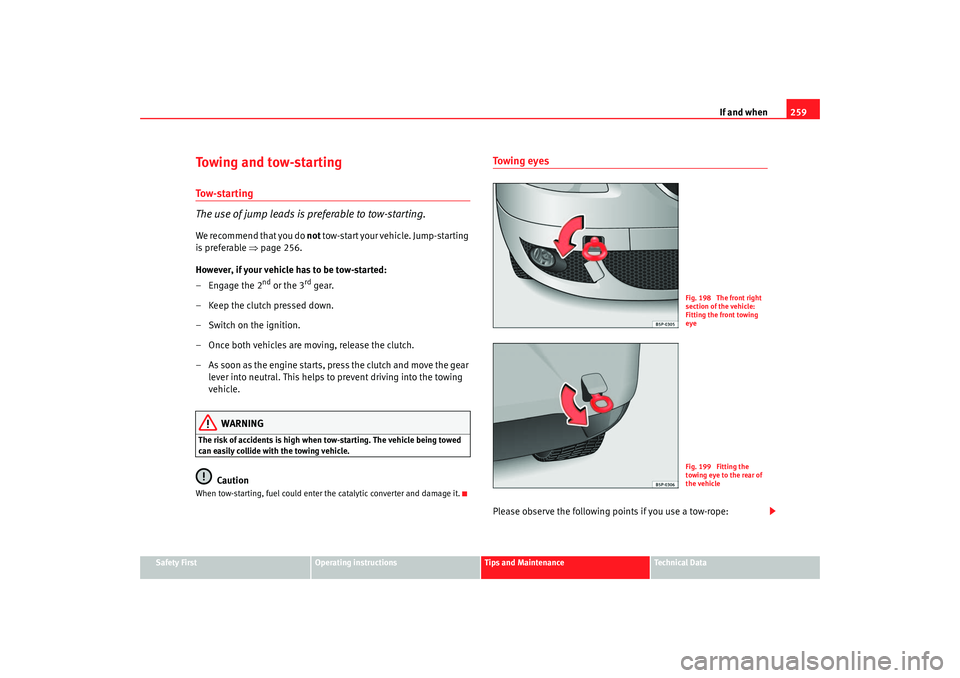
Towing eyesPlease observe the following points if you use a tow-rope:
Fig. 198 The front right
section of the vehicle:
Fitting the front towing
eyeFig. 199 Fitting the
towing eye to the rear of
the vehicle
AlteaXL_ingles_02_06 Seite 259 Dienstag, 1. August 2006 11:11 11
Page 262 of 288
If and when
260
Notes for the driver of the towing vehicle
– Drive slowly at first until the to w-rope is taut. Then accelerate
gradually.
– Begin and change gears cautiously. If you are driving an auto- matic vehicle, accelerate gently.
– Remember that the brake servo and power steering are not working in the vehicle you are towing. Brake earlier than you
would normally, but with a more gentle pressure on the brake.
Notes for the driver of the towed vehicle
– Ensure that the tow-rope remains taut at all times when towing.
Fitting the towing eye
– Take the towing ring from the onboard tools.
– Pull the lower front cover down and leave the cover hanging on the vehicle.
– Remove the cover of the screw hole, insert a screwdriver into the lower slot and lever gently.
– Screw the towing eye as shown by arrow anti-clockwise to the
limit position in the front ⇒page 259, fig. 198 or rear
⇒ page 259, fig. 199 threaded hole.Tow-rope or tow-bar
It is easier and safer to tow a vehicle with a tow-bar. You should only use a
tow-rope if you do not have a tow-bar.
A tow-rope should be slightly elastic to reduce the loading on both vehicles.
It is advisable to use a tow-rope made of synthetic fibre or similarly elastic
material. Attach the tow-rope or the tow-bar only to the towing eyes provided or a
towing bracket.
Driving style
Towing requires some experience, espec
ially when using a tow-rope. Both
drivers should be familiar with the te chnique required for towing. Inexperi-
enced drivers should not attempt to tow-start or tow away another vehicle.
Do not pull too hard with the towing vehicle and take care to avoid jerking the
tow-rope. When towing on an unpaved road, there is always a risk of over-
loading and damaging the anchorage points.
The ignition of the vehicle being towed must be switched on to prevent the
steering wheel from locking and also to allow the use of the turn signals,
horn, windscreen wipers and washers.
As the brake servo does not work if the engine is not running, you must apply
considerably more pressure to the brake pedal than you normally would.
As the power assisted steering does not work if the engine is not running, you
will need more strength to steer than you normally would.
Towing vehicles with an automatic gearbox
•
Put the selector lever into position “N”.
•
Do not drive faster than 50 km/h when towing a vehicle.
•
Do not tow further than 50 km.
•
If a breakdown vehicle is used, the vehicle must be towed with the front
wheels raised.Note
•
Observe legal requirements when towing or tow-starting.
•
Switch on the hazard warning lights of both vehicles. However, observe
any regulations to the contrary.
•
For technical reasons, vehicles with an automatic gearbox must not be
tow-started.
AlteaXL_ingles_02_06 Seite 260 Dienstag, 1. August 2006 11:11 11
Page 268 of 288

General notes on the technical data
266WeightsKerb weight refers to the basic model with a fuel tank filled to 90% capacity
and without optional extras. The figure quoted includes 75 kg to allow for the
weight of the driver.
For special versions and optional equipment fittings or for the addition of
accessories, the weight of the vehicle will increase ⇒.
WARNING
•
Please note that the centre of gravity may shift when transporting
heavy objects; this may affect the vehicle’s handling and lead to an acci-
dent. Always adjust your speed and dr iving style to suit road conditions
and requirements.
•
Never exceed the gross axle weight rating or the gross vehicle weight
rating. If the allowed axle load or the allowed total weight is exceeded, the
driving characteristics of the vehicle may change, leading to accidents,
injuries and damage to the vehicle.
To w i n g a t r a i l e rTrailer weightsTrailer weights
The trailer weights and drawbar loads approved are selected in intensive
trials according to precisely defined criteria. The approved trailer weights are
valid for vehicles in EU for maximum speeds of 80 km/h (in certain circum-
stances up to 100 km/h). The figures may be different in other countries. All
data in the official vehicle documents take precedence over these data ⇒. Drawbar load
The
maximum permitted weight exerted by the trailer drawbar on the ball joint
of the towing bracket must not exceed 75 kg.
In the interest of road safety, we recommend that you always tow
approaching the maximum drawbar load. The response of the trailer on the
road will be poor if th e drawbar load is too small.
If the maximum permissible drawbar load cannot be met (e.g. with small,
empty and light-weight single axle trailers or tandem axle trailers with an axle
base of less than 1 metre), at least 4% of the actual trailer weight is a legal
stipulation for a drawbar load.
WARNING
•
For safety reasons, you should not drive at speeds above 80 km/h when
towing a trailer. This also applies to countries where higher speeds are
permitted.
•
Never exceed the maximum trailer weights or the draw bar loading. If
the permissible axle load or the perm issible total weight is exceeded, the
driving characteristics of the vehicle may change, leading to accidents,
injuries and damage to the vehicle.
WheelsTyre pressure, snow chains, wheel boltsTyre pressures
The sticker with the tyre pressure values can be found on the inside of the
tank flap. The tyre pressure values given there are for cold tyres. The slightly
raised pressures of warm tyres must not be reduced ⇒.
AlteaXL_ingles_02_06 Seite 266 Dienstag, 1. August 2006 11:11 11
Page 281 of 288

Index279
Convenience closing
Sliding/tilting roof . . . . . . . . . . . . . . . . . . . . 109
Windows . . . . . . . . . . . . . . . . . . . . . . . . . . . . 108
Convenience opening Windows . . . . . . . . . . . . . . . . . . . . . . . . . . . . 108
Coolan . . . . . . . . . . . . . . . . . . . . . . . . . . . . . . . . 213
Coolant . . . . . . . . . . . . . . . . . . . . . . . . . . . 213, 214 Warning lamp . . . . . . . . . . . . . . . . . . . . . . . . . 64
Coolant Level . . . . . . . . . . . . . . . . . . . . . . . . . . . 214
Coolant level warning light . . . . . . . . . . . . . . . . . . . . . . . . . 75
Coolant Loss . . . . . . . . . . . . . . . . . . . . . . . . . . . 214
Coolant temperature Display . . . . . . . . . . . . . . . . . . . . . . . . . . . . . . 57
Safety instructions . . . . . . . . . . . . . . . . . . . . . 76
Cruise control system . . . . . . . . . . . . . . . . . . . . 173 Warning lamp . . . . . . . . . . . . . . . . . . . . . . . . . 77
Cruise control* Turning off the cruise control system . . . . . 176
Curtain airbags . . . . . . . . . . . . . . . . . . . . . . . . . . 41 Description . . . . . . . . . . . . . . . . . . . . . . . . . . . 41
Function . . . . . . . . . . . . . . . . . . . . . . . . . . . . . 42
Safety notes . . . . . . . . . . . . . . . . . . . . . . . . . . 42DDanger of fitting a child seat on the front passenger seat . . . . . . . . . . . . . . . . . . . . . . . . . . . . . . . 31
Diesel . . . . . . . . . . . . . . . . . . . . . . . . . . . . . . . . . 205
Diesel engine Winter driving . . . . . . . . . . . . . . . . . . . . . . . . 206 Diesel engine particulate filter* . . . . . . . . . . . . 183
Differential lock . . . . . . . . . . . . . . . . . . . . . . . . . 180
Differential lock fault (EDL)
warning lamp . . . . . . . . . . . . . . . . . . . . . . . . . 78
Digital clock . . . . . . . . . . . . . . . . . . . . . . . . . . . . . 58
Dipped headlights . . . . . . . . . . . . . . . . . . . . . . . 111
Disabling front passenger airbag Safety notes . . . . . . . . . . . . . . . . . . . . . . . . . . 45
Disabling the airbag Disabling front passenger airbag . . . . . . . . . 44
Display (without warning or information texts) . 59
Displays in the Mult i-function display
Memory displays . . . . . . . . . . . . . . . . . . . . . . 62
Door lock cylinders . . . . . . . . . . . . . . . . . . . . . . 194
Door release lever . . . . . . . . . . . . . . . . . . . . . . . . 55
Doors Childproof locks . . . . . . . . . . . . . . . . . . . . . . . 98
Warning lamp . . . . . . . . . . . . . . . . . . . . . . . . . 82
Drawer . . . . . . . . . . . . . . . . . . . . . . . . . . . . . . . . 134
Drinks holders at the front . . . . . . . . . . . . . . . . 138
Drive wheels traction control system . . . . . . . . 178
Driving Driving abroad . . . . . . . . . . . . . . . . . . . . . . . 183
With a trailer . . . . . . . . . . . . . . . . . . . . 186, 188
Driving abroad . . . . . . . . . . . . . . . . . . . . . . . . . . 183 Headlights . . . . . . . . . . . . . . . . . . . . . . . . . . 184
Driving economically . . . . . . . . . . . . . . . . . . . . . 188
Driving programs . . . . . . . . . . . . . . . . . . . . . . . . 167
Driving safety . . . . . . . . . . . . . . . . . . . . . . . . . . . . . 8 Driving with an automatic gearbox / DSG automatic
gearbox* . . . . . . . . . . . . . . . . . . . . . . . . . . 168
Driving with respect for the environment . . . . 188
Duplicate keys . . . . . . . . . . . . . . . . . . . . . . . . . . . 99
Dust filter . . . . . . . . . . . . . . . . . . . . . . . . . . . . . . 158
Dynamic headlight range control . . . . . . . . . . . 113
EEDL . . . . . . . . . . . . . . . . . . . . . . . . . . . . . . . . . . . 180
EDS Warning lamp . . . . . . . . . . . . . . . . . . . . . . . . 78
Electric steering system warning light . . . . . . . . . . . . . . . . . . . . . . . . . 82
Electrical sockets . . . . . . . . . . . . . . . . . . . . . . . . 143
Electronic differential lock . . . . . . . . . . . . . . . . 180 Warning lamp . . . . . . . . . . . . . . . . . . . . . . . . 78
Electronic immobiliser . . . . . . . . . . . . . . . . 83, 162 warning message . . . . . . . . . . . . . . . . . . . . . 64
Electronic stabilisation program . . . . . . . . . . . 179
Electronic stabilisation programme . . . . . . . . . . 81 Description . . . . . . . . . . . . . . . . . . . . . . . . . . 160
Warning lamp . . . . . . . . . . . . . . . . . . . . . . . 161
Electronic stabilisation programme (ESP) warning lamp . . . . . . . . . . . . . . . . . . . . . . . . . 81
emergency manual locking . . . . . . . . . . . . . . . . . 96
Emergency opening Doors . . . . . . . . . . . . . . . . . . . . . . . . . . . . . . 102
Emission control system warning lamp . . . . . . . . . . . . . . . . . . . . . . . . . 81
AlteaXL_ingles_02_06 Seite 279 Dienstag, 1. August 2006 11:11 11
Page 282 of 288

Index
280Engine
Running in . . . . . . . . . . . . . . . . . . . . . . . . . . 181
Engine compartment Working in the engine compartment . . . . . 206
Engine coolant . . . . . . . . . . . . . . . . . . . . . . . . . 213
Engine fault Warning lamp . . . . . . . . . . . . . . . . . . . . . . . . 81
Engine management Warning lamp . . . . . . . . . . . . . . . . . . . . . . . . 81
Engine oil . . . . . . . . . . . . . . . . . . . . . . . . . . . . . . 209 Changing . . . . . . . . . . . . . . . . . . . . . . . . . . . 213
Checking level . . . . . . . . . . . . . . . . . . . . . . . 211
Oil properties . . . . . . . . . . . . . . . . . . . . . . . . 210
Specifications . . . . . . . . . . . . . . . . . . . . . . . 209
Topping up . . . . . . . . . . . . . . . . . . . . . . . . . . 212
Engine oil dipstick . . . . . . . . . . . . . . . . . . . . . . . 211
Engine oil pressure Warning lamp . . . . . . . . . . . . . . . . . . . . . 64, 78
Environmental tip Avoiding pollution . . . . . . . . . . . . . . . . . . . . 204
ESP . . . . . . . . . . . . . . . . . . . . . . . . . . . . . . . . 81, 179
Example of menu use Open the configuration menu . . . . . . . . . . . 67
Program a speed limit warning . . . . . . . . . . 67
To activate and deactivate the speed limit warning . . . . . . . . . . . . . . . . . . . . . . . . . . . . 68
Examples of menu use Open the main menu . . . . . . . . . . . . . . . . . . 67
Open the winter tyres menu . . . . . . . . . . . . . 67
To close the winter tyres menu . . . . . . . . . . . 68
Exterior mirrors . . . . . . . . . . . . . . . . . . . . . . . . . 193 External aerial . . . . . . . . . . . . . . . . . . . . . . . . . . 200
FFastening rings . . . . . . . . . . . . . . . . . . . . . . . . . . 18
Fire extinguisher* . . . . . . . . . . . . . . . . . . . . . . . 145
Floor mats . . . . . . . . . . . . . . . . . . . . . . . . . . . . . . 16
Fog lights . . . . . . . . . . . . . . . . . . . . . . . . . . . . . . 111
Folding table* . . . . . . . . . . . . . . . . . . . . . . . . . . 135
Folding the seat backrests down . . . . . . . . . . . 132
Foot brake
Warning lamp . . . . . . . . . . . . . . . . . . . . . . . . 82
Front airbags . . . . . . . . . . . . . . . . . . . . . . . . . . . . 34 Description . . . . . . . . . . . . . . . . . . . . . . . . . . 34
Function . . . . . . . . . . . . . . . . . . . . . . . . . . . . . 35
Safety notes . . . . . . . . . . . . . . . . . . . . . . . . . . 37
Front interior light type 1 Switching light off . . . . . . . . . . . . . . . . . . . . 117
Switching light on . . . . . . . . . . . . . . . . . . . . 117
Front interior light type 2 Switching light off . . . . . . . . . . . . . . . . . . . . 117
Switching light on . . . . . . . . . . . . . . . . . . . . 117
Front passenger airbag deactivation . . . . . . . . . 44
Front reading lights . . . . . . . . . . . . . . . . . . . . . . 118
Front seat adjustment Lumbar support . . . . . . . . . . . . . . . . . . . . . . 130
Fuel Diesel . . . . . . . . . . . . . . . . . . . . . . . . . . . . . . 205
Petrol . . . . . . . . . . . . . . . . . . . . . . . . . . . . . . 204
Fuel level Indicator . . . . . . . . . . . . . . . . . . . . . . . . . . . . . 57 Fuel reserve . . . . . . . . . . . . . . . . . . . . . . . . . . . . . 75
Warning . . . . . . . . . . . . . . . . . . . . . . . . . . . . . 64
Fuel Tank Opening the fuel tank flap . . . . . . . . . . . . . 203
Fuel tank See Fuel reserve . . . . . . . . . . . . . . . . . . . . . . 75
Fuses . . . . . . . . . . . . . . . . . . . . . . . . . . . . . . . . . 240
GG 12 . . . . . . . . . . . . . . . . . . . . . . . . . . . . . . . . . . 213
Gear shift pattern . . . . . . . . . . . . . . . . . . . . . . . 165
General overview of the engine compartment 268
Glove compartment . . . . . . . . . . . . . . . . . . . . . 133
Glow plug system . . . . . . . . . . . . . . . . . . . . . . . 164 Warning lamp . . . . . . . . . . . . . . . . . . . . . . . . 81HHandbrake . . . . . . . . . . . . . . . . . . . . . . . . . . . . . 170Warning lamp . . . . . . . . . . . . . . . . . . . . 77, 171
Hazard warning lights . . . . . . . . . . . . . . . . . . . . 114
head restraints Adjusting . . . . . . . . . . . . . . . . . . . . . . . 128, 129
adjustment of the head restraint angle . . . 129
Removing . . . . . . . . . . . . . . . . . . . . . . . . . . . 129
head restraints, correct adjustment . . . . . . . . . 13 In-use and non-use positions . . . . . . . . . . . 14
Headlight flasher . . . . . . . . . . . . . . . . . . . . . . . 116
Headlight range contro . . . . . . . . . . . . . . . . . . . 113
AlteaXL_ingles_02_06 Seite 280 Dienstag, 1. August 2006 11:11 11